International Journal of Research (IJR)
e-ISSN: 2348-6848, p- ISSN: 2348-795X Volume 2, Issue 07, July 2015Available at http://internationaljournalofresearch.org
OFDM & PAPR on nonlinear commanding transform using
high power amplifier
Kannepogu Ashok Kumar
1; T.V.Suresh Kumar
2& D. Vijay Kumar
3 1M.Tech, Dept of ECE, Vijaya Engineering College, Telangana, India.Email: [email protected]
2Associate Professor, Dept of ECE, Vijaya Engineering college, Telangana,India,
Email: [email protected]
3Associate Professor, HOD, Dept of ECE, Vijaya Engineering college, Telangana,India,
Email: [email protected]
Abstract
The main limitation in employing orthogonal frequency division multiplexing (OFDM) system is high peak-to-average power ratio (PAPR) of the transmitted signal. A new nonlinear commanding algorithm that transforms the OFDM signals into the desirable statistics form defined by a linear piecewise function is proposed. The more adjustability in commanding form and an effective trade-off between the PAPR and bit error rate (BER) performances can be obtained by introducing an inflexion point and the variable slopes in the target probability density function. Theoretical analyses for this algorithm is presented and expressions regarding the achievable signal attenuation factor and transform gain are produced. The selection criteria of transform parameters focusing on its robustness and performance aspects are also examined. The conferred theoretical analyses are well verified via computer simulations.
Keywords: Orthogonal frequency division multiplexing (OFDM); peak-to-average power ratio (PAPR); nonlinear commanding transform (NCT); high power amplifier (HPA)
1.
Introduction
OFDM is a multicarrier modulation technique that divides the available spectrum among various low data rate subcarriers. Orthogonality is a must for OFDM otherwise it will lead to spectral overlapping. The subcarriers are so spaced as to satisfy the orthogonality condition [1]. A guard band is also provided in OFDM by using cyclic extension to avoid ICI. Frequency selective fading can also be decreased in OFDM by increasing the number of sub carriers. OFDM can provide an adaptive and scalable technology for wireless communication.
International Journal of Research (IJR)
e-ISSN: 2348-6848, p- ISSN: 2348-795X Volume 2, Issue 07, July 2015Available at http://internationaljournalofresearch.org
High rate data stream is split into many lower rate data streams which are transmitted at the same time over these equally spaced frequency bands. A subcarrier carrying a portion of the user information is transmitted in each band. The subcarriers are overlapping but they are recoverable since they are orthogonal [4].
Today OFDM used in many wireless standards such as terrestrial digital video broadcasting (DVB-T), digital audio broadcasting (DAB-T), and adopted in wireless local area networks (WLANs) (IEEE 802.11a, ETSI Hiperlan2) and wireless metropolitan area networks (IEEE 802.16d). The main drawback of OFDM is its high (PAPR) which causes serious degradation in performance when nonlinear power amplifier (PA) is used. This high PAPR forces the transmit PA to have a large input back off (IBO) in order to ensure linear amplification of the signal, which significantly reduces the efficiency of the amplifier, Furthermore, high
PAPR requires high resolution for the receiver analog-to-digital converter (A/D).
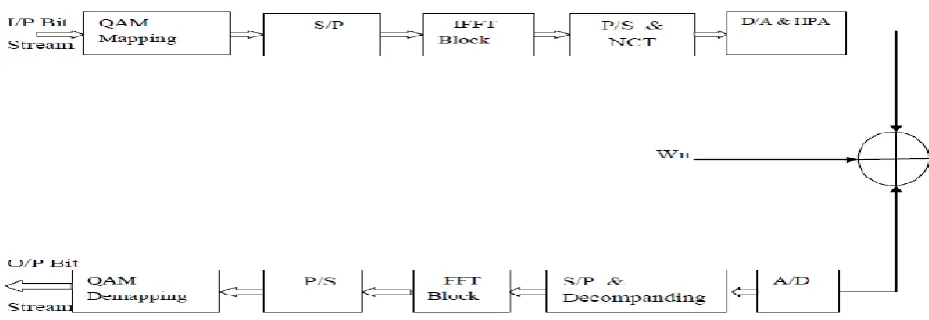
Since the dynamic range of the signal is much larger for high PAPR, a high-resolution quantize is required to reduce quantization error, which requires more bits and places a complexity and power burden on the receiver front end Many PAPR reduction schemes based on different techniques , such shaping , block coding , partial transmit sequence (PTS) technique and selective mapping (SLM) technique, phase optimization , tone reservation and injection and non linear companding transform schemes have been proposed in literature [4]. In this paper, we proposed and analyse non linear companding technique to reduce the PAPR of OFDM signal. Non linear companding has better system analysis including Peak to Average Power reduction and Bit Error Rate, the implementation complexity is less and no bandwidth expansion.
Fig 1: OFDM System Model.
2.
Related Work
The most attractive schemes are nonlinear transform due to the reason it’s a good system performance including PAPR reduction and BER. The implementation is complex and no expansion of bandwidth. In the stage of nonlinear companding transform is the 𝜇-law
International Journal of Research (IJR)
e-ISSN: 2348-6848, p- ISSN: 2348-795X Volume 2, Issue 07, July 2015Available at http://internationaljournalofresearch.org
saturation region of HPA make system performance worse. Main variation in between clipping and nonlinear Companding transform is described as: 1) Clipping is a method deliberately it clips high signals when the ampitude of the original OFDM signals are higher than of given threshold and then clipped signals cannot be recovered at the destination side. However nonlinear companding transform is compand to original OFDM signals use the strict monotone increase function. Finally the companded transform signals are at the transmitter it can be recovered effectively through the corresponding inversion of nonlinear function at the receiver side 2) Nonlinear companding transform extract small signals while coding a large signals to increase the signals immunity from noisy signals then after while the clipping method does not change small signals in that channel. Therefore clipping method suffers from mainly three problems: In-band distortion, then out-of-band radiation, and peak re-growth after DAC conversion. Based on these results the system performance is degraded due to the clipping it may not be optimistic. In this work to transform the amplitude of the original Orthogonal Frequency Division Multiplexing signals are described into the distribution with its PDF
FSC(s) = kS + b (k<0,b>0) .
Finally this nonlinear transform function is derived as.
This nonlinear companding transform belongs to the exponential companding scheme. Problem design criteria are two types of nonlinear companding transformation which is based on error function and exponential function, respectively, have been proposed. The
well-known original signls are highly sharp rectangular-like power spectrum. The well-known property will be affected on PAPR reduction technique, ex. slower spectrum roll-off, side-lobes are more, and higher adjacent channel interference. Lot of PAPR reduction schemes cause spectrum side-lobes getting, but the nonlinear companding transforms cause less side-lobes spectrum. Error and Exponential companding transform have very less impact on original power spectrum differencing to the 𝜇 -law commanding scheme. The major reason is Error, Exponential commanding methods are not only extracting the small amplitude signals but also coding the large amplitude which can maintain the average unchanged average power based on optimal parameters, and it can raise the immunity of small amplitude signals from various noise signals. Therefore 𝜇-law commanding transform can increases or maintain reliable power level and therefore it requires linear operation region in HPA.
3.
Implementation
In our work a novel approach is present to solve the Peak to Average Ratio(xn)by introducing the variable slopes parameters K1, K2 and inflexion point A (A>0) and cut-off point CA(0<C<1)(yn) in the probability density function in the Non Linear Companding Transform Technique then based on the inflexion point and variables parameter. The probability density function express as follows
International Journal of Research (IJR)
e-ISSN: 2348-6848, p- ISSN: 2348-795X Volume 2, Issue 07, July 2015Available at http://internationaljournalofresearch.org
ratio erupts in the orthogonal frequency division multiplexing while controlling the power generated by high power amplifier in the Non linear company ding trans form. Based on the
Probability density function definition
we have
After analysis of accurate Peak to average power ratio, from the above equation cumulative distribution function (CDF) is represents as follows
The following inverse function shows that cumulative distribution function is a increasing monotonic function is shows as follows
We can obtain the following relationship as h(x) is a monotonic function
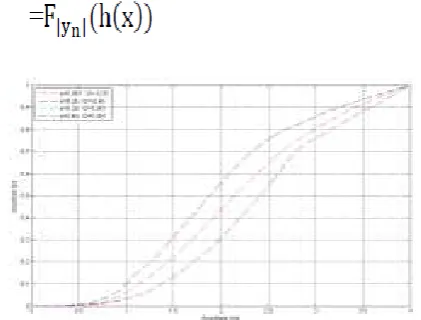
Fig 2: Transfer curves of the proposed work Non linear commanding transform.
After successfully attaining the transfer curves, now the Non linear commanding transform algorithm recovers the transform commanding function at the receiver section by performing the de commanding operation.
3.1 Reduction of PAPR:
The accurate Peak to average power ratio of the Non linear company ding transform is given as
International Journal of Research (IJR)
e-ISSN: 2348-6848, p- ISSN: 2348-795X Volume 2, Issue 07, July 2015Available at http://internationaljournalofresearch.org
compared to the non linear comp ending transform signal by gain G as follows
By changing the values of K2 and c according to the analysis, peak to average power ratio is reduced at high level. This reduction is done in the interval [4.6 db, 5.8db].CCDF of proposed work are as follows by substituting REDUCTION OF PAPR equations
Fig 3: The accurate peak to average power ratio of Non linear commanding transform signals.
Fig 4: Results of Peak to average power ratio and gain
4.
Experimental Results
For an OFDM system with N = 1024 subcarriers to assess general framework execution of the proposed transformation, computer simulations were executed. In the results it shows that to achieve better PAPR estimation, OFDM frames are modulated to acquire CCDFs, which have been calculated with an oversampling ratio J = 4.
A. Performance in PAPR suppression
Fig 5: illustrates the simulation results of CCDF of the PAPR which are very close to theoretical results. This predicts that theoretical and experimental results almost similar. Moreover, the new transformation algorithm with c = 0.25, k = -0.001 attains the maximum PAPR reduction and also observed with c = 0.25, k = -0.45 tends to far less degradation of BER performance at the receiver.
B. BER Performance
International Journal of Research (IJR)
e-ISSN: 2348-6848, p- ISSN: 2348-795X Volume 2, Issue 07, July 2015Available at http://internationaljournalofresearch.org
Fig 5: PAPR reduction performance for OFDM with N = 1024, QPSK modulation and oversampling ratio J = 4.
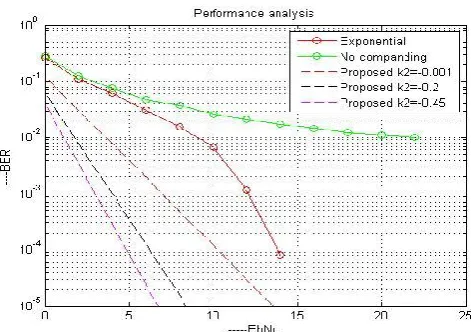
Fig 6: BER performance under an AWGN channel for the OFDM system with N = 1024 and 16QAM modulation
5.
Conclusion
In this article we have proposed a PAPR reduction scheme to improve the Bit Error Rate performance in OFDM system. PAPR reduction can be reduced by applying non-linear companding technique. This methodology gives 1-1.5db reduction in PAPR with the comapnding technique is achieved. The simulation results have shown that the proposed Nonlinear Companding Transform algorithm could offer better performance in terms of PAPR reduction without increasing the complexity of the system performance.
6. References
[1] T. Hwang, C. Yang, G. Wu, S. Li, and G. Y. Lee, “OFDM and its wireless application: A survey,” IEEE Trans. Veh. Technol., vol. 58, no. 4, pp. 1673–1694, May 2009.
[2] Tao Jiang, Wenbing Yao, Peng Guo, Yonghua Song, and Daiming Qu Two Novel Nonlinear Companding Schemes With Iterative Receiver to Reduce PAPR in Multi-Carrier
Modulation Systems IEEE TRANSACTIONS ON BROADCASTING, VOL. 52, NO. 2, JUNE 2006
[3] X.B Wang T.T Tjhung and C. S Ng, ―Reduction of peak to average power ratio of OFDM system using commanding technique, IEEE Trans broadcasting vol 45, no 3, pp 303-307, sept 1999. [4] T. Jiang, W. D. Xiang, P. C. Richardson, D. M. Qu, and G. X. Zhu, ―On the nonlinear companding transform for reduction in PAPR of MCM signals,‖ IEEE Trans. Wireless communications, vol. 6, no. 6, pp. 2017–2021, Jun. 2007.
[5] H. Nikookar and K. S. Lidsheim, ―Random phase updating algorithm for OFDM transmission with low PAPR,‖ IEEE Trans. Broadcasting, vol. 48, no. 2, pp. 123– 128, Jun. 2002.
[6] T. Jiang and G. X. Zhu, ―Nonlinear companding transform for reducing peak-to-average power ratio of OFDM signals,‖ IEEE Trans. Broadcasting, vol. 50, no. 3, pp. 342– 346, Sept. 2004.
[7] T. Jiang, Y. Yang, and Y. Song, ―Exponential companding transform for PAPR reduction in OFDM systems,‖ IEEE Trans. Broadcasting, vol. 51, no. 2, pp. 244– 248, Jun. 2005.
[8] T. Jiang, W. Yao, P. Guo, Y. Song, and D. Qu, ―Two novel nonlinear companding schemes with iterative receiver to reduce PAPR in multicarrier modulation systems,‖ IEEE Trans. Broadcasting, vol. 52, no. 2, pp. 268– 273, Mar. 2006
International Journal of Research (IJR)
e-ISSN: 2348-6848, p- ISSN: 2348-795X Volume 2, Issue 07, July 2015Available at http://internationaljournalofresearch.org
[10] X. B.Wang, T. T. Tjhung, and C. S. Ng, “Reduction of peak-to-average power ratio of OFDM system using A companding technique,” IEEE Trans. Broadcasting, vol. 45, no. 3, pp. 303–307, Sept. 1999.
[11] R. O’Neill and L. B. Lopes, “Envelope variations and spectral splatter in clipped multicarrier signals,” in Proc. IEEE PIMRC’95, Toronto, Canada, Sept. 1995, pp. 71–75
Authors Profiles
KANNEPOGU ASHOK KUMARpursuing his M.Tech, from Vijaya Engineering College, Telangana, India. Email:[email protected] om
T.V. SURESH KUMAR completed his M.Tech and working as a Associate Professor, from Vijaya Engineering college, Telangana,India, Email: [email protected], 8099787835
![Fig 6: depicts the BER versus under an AWGN channel using QAM being compared with exponential commanding (EC) [6] transform](https://thumb-us.123doks.com/thumbv2/123dok_us/7796869.1293586/5.595.63.277.595.705/depicts-versus-awgn-channel-compared-exponential-commanding-transform.webp)