Integer Matrices Homomorphic Encryption and
Its application
Yanan Bai
Jingwei Chen
Yong Feng
Wenyuan Wu
Chongqing Key Lab Automated Reasoning & Cognit,
Chongqing Institute of Green and intelligent Technology,
Chinese Academy Sciences,
University of Chinese Academy of Sciences.
e-mail:[email protected]
November 23, 2018
Abstract
We construct an integer matrices encryption scheme based on binary matrices encryption scheme proposed in Hiromasa et al.(PKC 2015). Our scheme supports homomorphic addition and multiplication operations, we prove the correctness and analyze the security. Besides, we implement four encryption schemes including public-key and symmetric-key binary matri-ces encryption schemes from Hiromasa et al.(PKC 2015), and public-key and symmetric-key integer matrices encryption schemes from this work. The experimental results show that the running time of homomorphic multiplycation just costs 3.03sec for integer matrix with 60×60 entry size. It provides a promising prospect for applications. Finally, we apply integer matrices encryption to homomorphiclly solve a problem that com-putes the number of length-k walks between any two vertices of a graph. The implement of the algorithm shows the effectiveness.
1
Introduction
Homomorphic encryption is a ciphertext computation technology, which allows us to evaluate functions over encryped texts, and can get the same results as evaluating over the corresponding plaintexts. With the development of cloud computing and global growth of data, private and sensitive information have re-ceived increasingly concern, ciphertext computing becomes an urgent demand. Homomorphic encryption can meet this requirement [17] [16], [12] [11].
encryption scheme [7] [6], which based on ideal lattice with low efficiency. In the year of 2012, Brakerski, Gentry and Vaikuntanathana made a newly lev-eled fully homomorphic encryption scheme [3], employing module switch and key switch technologies [4] [2]. In order to make homomorphic operations more natural, GSW, as the third generation homomorphic encryption system was proposed [8] by Gentry, Sahai and Waters in 2013. This scheme used eigenvec-tor to construct encryption scheme, and can encrypt binary bits and integers. At present, this scheme is one of the fastest and simplest fully homomorphic encryption scheme compared with previous ones. Later, Khedr et al. intro-duced SHIELD [10], which based on ring LWE setting. The impressed feature of this scheme is that it can conduct addition and multiplication homomorphic operations on encrypted polynomials. Hiromasa et al. [9] constructed the first fully homomorphic encryption scheme for binary matrices, and optimized the bootstrapping procedure of Alprin-Sheriff and Peikert [1]. As the homomorphic operations are limited to binary matrices, for most of applications we have to design complex circuit to achieve more homomorphic operations. Besides, for some application scenarios, efficiency is more significant than achieving full ho-morphism. Therefore, it is meaningful to design the integer matrices encryption scheme. In this paper, our constructions are the following.
• We propose a novel encryption and decryption algorithms for the integer matrices encryption scheme, which supports homomorphic addition and multiplication operations in the form of integer matrices, rather than the traditional binary form.
• We prove the correctness of the proposed scheme in theory, and analyze the security.
• With implementing the binary matrices and integer matrices encryption schemes, we evaluate the efficiency of proposed integer matrices encryption schemes.
• We apply the proposed scheme in the graph theory, which calculates the number of length-k walks between any two vertices in the encrypted net-work. The experimental result shows the effective of the proposed scheme.
2
Preliminaries
2.1
The Learning with Errors(LWE) Problem
The learnnig with errors (LWE) was introduced by Regev in [13], the definition is:
Definition 2.1. For security parameterλ, letn=n(λ) be an integer dimension, letχ =χ(λ) is a Gasussian distribution over Z, q =q(λ) be an integer. The
DLW En,χ,q problem is to distinguish the following two distributions:
2. One fristly drawss←−U Znq uniformly, and then sample (ai, bi) by sampling
ai U
←−Zn q,ei
R
←−χ, and settingbi =hai, si+ei.
TheDLW En,q,χassumption is that theDLW En,q,χ problem is infeasible.
Gadget matrix G: Let l=dlogqeand identifyZq as 0,1, ..., q−1. Then
eachm∈Zq can be represented as
m=
l−1
X
i=0
xi2i
where xi ∈ {0,1}. Let row vector gT = (1,2, ...,2l−1), and column vector
x= (x0, x1, ...xl−1)
T
∈Zl such thatgTx≡m modq. Define
G=gT⊗I(n+1)=
gT gT
. ..
gT
∈Z(n+1)×((n+1)l
Define operationG−1:
Znq+1−→Z(n+1)l describs below:
For anym∈Znq+1 →Z
(n+1)l and short vectorx∈
Z(n+1)l, such thatGx≡m
modqso we defineG−1(m) =x.
G−1 maps each vector m ∈ Znq+1 to a short vector x∈ Z(n+1)l and Gx ≡m
modqwill be satisfied.
2.2
GSW Fully Homomorphic Encryption scheme
The GSW fully homomorphic encryption scheme use approximate eigenector method to construct ciphertext C such that secrect key s is an approximate eigenvector ofC. The scheme was modified by Alperin-Sheriff [1]. We describe the scheme below.
GSW.Setup(1λ,1L): This step produce related parameters. Let l=dlog2qe,
andm>nl
GSW.keyGenSec(params): Choose ¯s ←−U Zn
q, and output sk = (1,−¯s) ∈
Zn+1
q
GSW.keyGenPub(params): Choose an×mrandom matrixA∈Znq×m, and
pickei R
←−χmat random. Compute
bT = ¯sTA+eT ∈Zmq .
Then the public key isB=
bT
A
∈Z(qn+1)×m, observe thatsB=eT modq.
GSW.Enc(params, pk, m): Letm∈Zq be an integer. To encrypt m, choose
a random short matrixR∈ {0,1}m×(n+1)l. Compute
whereGis the Gadget matrix andB is the public key. Ifm∈ {0,1}, take the same encryption method.
GSW.Dec(C, sk): This algorithm can recover plaintext m ∈ {0,1}. Let c
be the penultimate column of ciphertext matrix C. The decryption algorithm outputs plaintext m = bhs, cie2, where b·e2 denotes that Zq → {0,1}, if the
inner product is closer to 0, the result is 0, otherwise the inner product is closer to q/4, the result is 1. As sTc =msTG+sTBR =msTG+eTR modq, we
needeTRto be small, letnoise=eTR. Ifknoisek
∞< q/8, then we can recover m, wherekxk∞is the maximum norm of a vectorx.
GSW.MPDec(C, sk): This algorithm can recover plaintext m∈ Zq, we will
show the decryption process below. Taking the fristl−1 rows ofCs, let
Cs= γ0 γ1 .. .
γl−2
=m·
20 21 .. . 2l−2
+noise∈Zl−1
q .
We set plaintextm=Pl−2
i=0xi2i, where xi∈ {0,1}. Taking the last entity is
γl−2= (x0+ 2x1+...2l−2xl−2)·2l−2+el−2
so
x0=
γl−2−el−2
2l−2 −(2x1+ 2 2
x2+...2l−2xl−2)
≡ γl−2−el−2
2l−2 mod 2
Sinceel−2< q/8, and asq= 2l−1,
el−2
2l−2 <1/4, which implying
round γ
l−2−el−2
2l−2
=roundγl−2
2l−2
.
so we have
x0=round
γl−2
2l−2
mod 2
fori= 1,2, ...l−2,we can recover the rest of the bits in this way,
xi=round
γl−2−i−P i
j=12l−i+j−3xj−1
2l−2
!!
mod 2
Finally, we can get plaintextmbym=Pl−2
i=0xi2
i.
2.3
Binary matrices encryption scheme
satisfy decryption equation. For a secret matrixS ∈Zqr×(n+r), The ciphertext
C ∈ Z(qn+1)×(n+1)·l of matrix M ∈ {0,1}r×r satisfy that SC = M S+noise.
The scheme constructs the preimage ofM S+noisefor the functionfS(x) =Sx
modq, asS[BR+ M S0
G] =ER+M SG, so that the ciphertextCis a preimage ofBR+ M S0
Gfor the functionfG. But the pliantext space isM ∈ {0,1}r×r,
in this paper, we extend this scheme to encrypt integer matrices.
3
Integer Matrices Homomorphic Scheme
In this section, we firstly present a modifield scheme which can encrypt matrices with integer elements, based on the binary encryption scheme in [9]. We revise the encyption algorithm and redesign the decryption algorithm, so that the shceme can proceed homomorphic operation of addition and multiplication, then give the correctness and security analysis.
3.1
Midifield scheme
The integer matrices encryption scheme can be split into two shemes including symmetric and public-key encryption systems, the key generation algorithms and the encryption algorithms are slightly different, so we present the schemes respectively.
3.1.1 Public-key encryption scheme
-Setup:(1λ): Our scheme is parameterized by an integer lattice dimensionn.
Letλbe security parameter. Letqbe an integer modulus,χa distribution over
Z. The parameter above depends onλ. Letl :=dlog2qe. The message space
is Zr×r
q . Let m :=O((n+r) logq), N := (n+r)·l. The ciphertext space is
Z(qn+r)×N. LetgT = (1,2, ...2l−1) , andG=gT⊗In+r. This algorithm outputs
parameters above.
The key generation procedure is described as two steps: secret key generation and public key generation.
-KeyGenSec(params): The input is the parameters generated from the Setup procedure. Sample ¯S from Gassian distribution χr×n. Let Ir is the identity
matrix withrorder. We concatenateIrand ¯S, and output secret keyS:= [Irk
−S¯] and ¯S.
-KeyGenPub(params,S)¯ : This step gets the input including parameters and ¯
S. Let A be a random matrix sampled uniformlyA←−U Zqr×(n+r),Zq is defined
asZ∩[−q/2, q/2), the noise matrixE←−R χr×m. Let
B:=
SA¯ +E A
SetM(i,j)as ar×rmatrix with 1 in the (i, j) position and 0 in the others, and
R(i,j)as a random{0,1} matrix,R(i,j)
U
←− {0,1}m×N and compute
P(i,j):=BR(i,j)+
M
(i,j)S
0
G∈Z(n+r)×N
q .
Output public keypk:={(P(i,j), B)|16i, j6r}.
-PubIntEnc(params, pk, M): Plaintext matrixM ∈Zrq×r,M[i][j] denotes the
(i, j) element value ofM. SampleR(i,j)
U
←− {0,1}m×N, and output the ciphtext
matrix
C:=BR+ X
i,j∈[r]
M[i][j]·P(i,j)∈Z(qn+r)×N. (3.1)
-IntDec(params, C, S): The algorithm inputs parameters, ciphtext and secret key. Observe thatSC=M SG+noise. The fristr·l rows of (M SG)T is
m00 m10 ... .... mr0
2·m00 2·m10 ... ... 2·mr0
... ... ... ... ...
2(l−1)m
00 2(l−1)m10 ... ... 2(l−1)mr0
m01 m11 ... .... mr1
2·m01 2·m11 ... ... 2·mr1
... ... ... ... ...
2(l−1)m01 2(l−1)m11 ... ... 2(l−1)mr1
... ... ... ... ... ... ... ... ... ... m0r m1r ... .... mrr
2·m0r 2·m1r ... ... 2·mrr
... ... ... ... ...
2(l−1)m
0r 2(l−1)m1r ... ... 2(l−1)mrr
whose the frist column and the fristl rows is correspondent to the frist column and the fristlrows of (SC)T, if the noise is very small. This have the same form
asCs in algorithm GSW.MPDec, so that we can call GSW.MPDec to recover every bit ofm00. Besides, the followingl rows of (M SG)T is correspondent to
the respect (SC)T, so that we can call GSW.MPDec again to recover every bit
ofm01. In this way every element in matrixM will be got.
Homomorphic addition isC1LC2=C1+C2.
Homomorphic multiplication isC1JC2=C1·G−1(C2).
3.1.2 Asymmetric encryption scheme
-SecEnc(M, params, S,¯s): The input isM,parameters, secret keyS and ¯S. Sample a random matrix ¯A←−U Zn×N
q and E R
←−χr×N, and the output is:
C:=
S¯A¯+E A
+
M S
0
G∈Z(qn+r)×N
Homomorphic addition isC1LC2=C1+C2.
Homomorphic multiplication isC1JC2=C1·G−1(C2).
3.2
Correctness and security analysis
The correctness of decryption will be guaranteed by the following lemma.
Lemma 3.1. If a ciphertextC in the public-key encryption scheme encrypts a plaintext matrixM ∈ Zrq×r with
P
i,j∈[r]M[i][j] =µ, and the noise matrix E
satisfyingkEk∞·(µ+ 1)< q/8, thenIntDecsk(C) =M.
Proof. SubstitutingC by (3.1) and combiningSB=E, we have
SC=S(BR+ X
i,j∈[r]
M[i][j]·P(i,j))
=S(BR+ X
i,j∈[r]
M[i][j]·
BR(i,j)+
M(i,j)S
0
G)
=ER+ X
i,j∈[r]
M[i][j]·ER(i,j)+
X
i,j∈[r]
M[i][j]·(1,−S¯)
M
(i,j)S
0
G
=E(R+ X
i,j∈[r]
M[i][j]·R(i,j)) +
X
i,j∈[r]
M[i][j]·M(i,j)SG
=E(R+ X
i,j∈[r]
M[i][j]·R(i,j)) +M SG.
Letnoise=E(R+P
i,j∈[r]M[i][j]·R(i,j)). Sinceknoisek∞< q/8, i.e. kE(R+ P
i,j∈[r]M[i][j]·R(i,j))k∞ < q/8, so kEk∞·(µ+ 1) < q/8, according to the
GSW scheme [8], the decryption is correct.
The symmetric encryption scheme is similar with public key encryption scheme, so no more detailed description here.
The security of the two schemes holds fromDLW En,q,χproblem directly in
section 2.1, and circular security definition in [9] section 2.3 Definition 2. The security can be guaranteed by [9] [Lemma 4].
Lemma 3.2. [9] [Lemma 4]. LetB,M(i,j),R(i,j),R(i,j),P(i,j),(i, j= 1, ..., r)be
and DLW En,q,χ holds, then the joint distribution (B, BR(i,j), P(i,j), BR) is
computationally indistinguishable from uniform over Z(qn+r)×m×Z(qn+r)×N ×
Z(qn+r)×N×Z(qn+r)×N.
In the public-key scheme, the algorithm encrypts the bases of every element in plaintext matrix in the public key generation step. According to circular security definition in [9], lake nothing to adversary, so the security of the scheme can be hold.
4
Implementation
We have accomplished four homomorphic encryption schemes including binary matrices public-key and symmetry encryption schemes from literature [9], and integer matrices public-key and symmetry encryption schemes from section 3. We show the results of the implementation of these schemes and analyze the efficiency.
4.1
Experimental platform
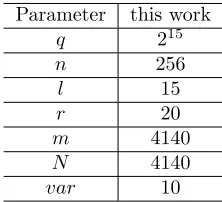
We implemented the schemes in python 2.7 using pycharm community 2018.1.3, and run the algorithms on on Ubuntu16.04 linux platform, with 256GB RAM and Intel Xeon(R) CPU E5-2680 v4. The parameters are chosen as follows:
Table 1: Parameters selection in encryption schemes Parameter this work
q 215
n 256
l 15
r 20
m 4140
N 4140
var 10
The four schemes contain four algorithms respectively. Each algorithm runs 20 times and takes the average as the result. For an integer matrix with 20×20 entry size, Table 2 shows the running time of binary matrices encrypion scheme, and Table 3 shows the running time of integer matrices encryption scheme.
Table 3: Runing time of integer matrices encryption scheme(sec) Scheme Type Setup KeyGen enc dec public-key encryption 0.00104 529.856 2.652 0.0238 symmetric encryption 0.00105 0.179 1.306 0.0250
In the symmetirc encryption schemes, binary matrices and integer matrices almost cost the same running time in setup and KeyGen, but in enc and dec algorithm, the latter is slower than the former.
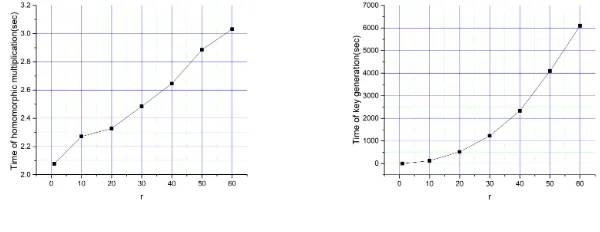
In the public-key encyption schemes, the key generation step consumes about 518sec in binary matrices and 530sec in integer matrices, it costs the most time in two types of schemes. Figure 1(b) shows in public-key integer matrices en-cryption scheme, how the time of key generation grows with the size of matrices increases. Besides, with the parameters selection in Table 1, we compute the space of the secret key, public key and ciphertext occupied in memory. Table 4 shows the details. We conclude that key generation takes a lot of time and space in public-key integer matrices scheme, which is a problem to research in future work.
Table 4: Key and ciphertext size (MB)
Type sksize pksize ctsize size 0.06317 5243.667 13.076
Table 5: Homomorphic operation running time in public-key integer matrices encryption scheme(sec)
Operation Setup KeyGen enc dec homomor eval Multiplication 0.00105 519.643 5.174 0.0236 2.362
Addition 0.00104 520.122 5.191 0.0235 1.091
Table 5 shows the homomorphic operations time consuming in public-key integer matrices encryption scheme. For a plaintext matrices 20×20, the mul-tiplication costs 2.4sec, and addition just costs 1.09sec. As the homomorphic operations are just natural matrices computations, the results confirm our the-oretical analysis above. Futhermore, Figure 1(a) shows that homomorphic mul-tiplication time grows over the size of matrices grows. We can see that for
(a) Running time of Homomorphic mul-tiplication.
(b)Time of Key Generation.
Figure 1: Running time in public-key integer matrices enryption scheme(sec)
5
Application
Matrices encryption schemes have a lot of applications, such as graph theory. One of the application scenarios is to homomorphiclly compute the number of legth-k walks between any two vertices, given an undirected graph. In graph theory, the plaintext operation to get the solution of this problem is described in [15] [5] through the powers of adjacent matrix. As an application, we present an algorithm using integer matrices public-key encryption in encrypted graph to homomorphiclly compute the number of walks of the length less thank(= 3) between any two vertices. The detail is in Algorithm 1.
We implement the Algorithm 1 on Ubuntu16.04 linux platform, with
320G-Algorithm 1Homomorphiclly compute the number of walks of the length less thank(= 3) between any two vertices
Input: an undirected graph G withrvertices
Output: The Matrix ¯A, denotes the number of walks of length less than 3 between any two vertices
1: Create the adjacency matrix Aof graph G;
2: Call algorithmn Setup, KeyGen in sequence; 3: Call algorithmn PubIntEnc to getEpk(A);
4: Call homomorphic multiplication algorithmn
Epk(A2) =mult(Epk(A), Epk(A)) andEpk(A3) =mult(Epk(A2), Epk(A));
5: Call homomorphic addition algorithmnEpk(A0) =add(Epk(A2), Epk(A3));
6: Call algorithmn IntDec to get ¯A=IntDec(params, Epk(A0), sk)
7: return ¯A
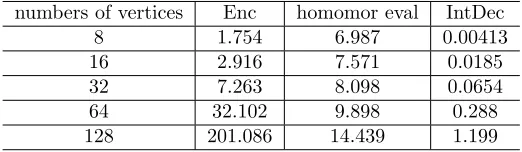
multi-plication and one addition, and to decrypt the final calculation. Table 6: Running time of Algorithm 1(sec)
numbers of vertices Enc homomor eval IntDec
8 1.754 6.987 0.00413
16 2.916 7.571 0.0185
32 7.263 8.098 0.0654
64 32.102 9.898 0.288
128 201.086 14.439 1.199
Furthermore, integer matrices encryption scheme can also be applied to so-cial networks, where any two people in the survey can be known through several people in the ciphertext domain.
6
Conclusion
In this paper, we extend binary matrices encryption schemes to integer ma-trices for improving the efficiency of encryption algorithm with homomorphic operations. We prove the correctness and analyze the security of the schemes, and implement four encryption schemes to show the efficiency of the schemes. Finally, as an application, we design an algorithm to solve a encryped graph theory problem.
The future work has three aspects: reducing the cost of space and time in key generation to improve the efficiency of the public-key encryption scheme; An-alyzing the growth of noise to make the scheme fully homomorphic; Designing specific application scenarios using the matrices encryption schemes to make homomorphic encryption more practical.
References
[1] J. Alperinsheriff and C. Peikert. Faster bootstrapping with polynomial error. International Cryptology Conference, 2014:297–314, 2014.
[2] Z. Brakerski. Fully Homomorphic Encryption without Modulus Switching from Classical GapSVP. In CRYPTO 2012, Univ Calif Santa Barbara, Santa Barbara, CA, pages 868–886, 2012.
[4] Z. Brakerski and V. Vaikuntanathan. Efficient Fully Homomorphic Encryp-tion from (Standard) LWE. InFOCS 2011, Palm Springs, CA, Foundations of Computer Science, pages 97–106, 2011.
[5] A. Duncan. Powers of the adjacency matrix and the walk matrix. The Collection, pages 9, 4–11, 2004.
[6] Gentry and Craig. Fully homomorphic encryption using ideal lattices.Stoc, 9(4):169–178, 2009.
[7] C. Gentry. A fully homomorphic encryption scheme. Stanford University, 2009.
[8] C. Gentry, A. Sahai, and B. Waters. Homomorphic Encryption from Learn-ing with Errors: Conceptually-Simpler, Asymptotically-Faster, Attribute-Based. In CRYPTO 2013, Univ Calif Santa Barbara, Santa Barbara, CA, pages 75–92, 2013.
[9] R. Hiromasa, M. Abe, and T. Okamoto. Packing Messages and Optimizing Bootstrapping in GSW-FHE. In PKC 2015, Gaithersburg, MD, Lecture Notes in Computer Science, pages 699–715, 2015.
[10] A. Khedr, G. Gulak, and V. Vaikuntanathan. SHIELD: Scalable Homo-morphic Implementation of Encrypted Data-Classifiers.IEEE
TRANSAC-TIONS ON COMPUTERS, 65(9):2848–2858, 2016.
[11] J. Liu, N. Asokan, and B. Pinkas. Secure Deduplication of Encrypted Data without Additional Independent Servers. InACM SIGSAC Conference on Computer and Communications Security (CCS), Denver,CO,, pages 874– 885, 2015.
[12] M. Naehrig, K. Lauter, and V. Vaikuntanathan. Can homomorphic en-cryption be practical? In CCSW 2011, ACM Cloud Computing Security Workshop, Chicago,USA, pages 113–124, 2011.
[13] O. Regev. On Lattices, Learning with Errors, Random Linear Codes, and Cryptography. JOURNAL OF THE ACM, 56(6):1–40, 2009.
[14] R. L. Rivest, L. Adleman, and M. L. Dertouzos. On data banks and priva-cy homomorphisms. Foundations of Secure Computation, pages 169–179, 1978.
[15] D. B. West. Introduction to graph theory, 2nd edition. Prentice-Hall Inc, 1996.