Scalable, transparent, and post-quantum secure computational
integrity
Eli Ben-Sasson* Iddo Bentov† Yinon Horesh* Michael Riabzev* March 6, 2018
Abstract
Human dignity demands that personal information, like medical and forensic data, be hidden from the public. But veils of secrecy designed to preserve privacy may also be abused to cover up lies and deceit by institutions entrusted with Data, unjustly harming citizens and eroding trust in central institutions.
Zero knowledge (ZK) proof systems are an ingenious cryptographic solution to this tension between the ideals of personal privacyand institutional integrity, enforcing the latter in a way that does not compromise the former. Public trust demandstransparencyfrom ZK systems, meaning they be set up with no reliance on any trusted party, and have no trapdoors that could be exploited by powerful parties to bear false witness. For ZK systems to be used with Big Data, it is imperative that the public verification process scale sublinearly in data size. Transparent ZK proofs that can be verifiedexponentiallyfaster than data size were first described in the 1990s but early constructions were impractical, and no ZK system realized thus far in code (including that used by crypto-currencies like Zcash™) has achieved bothtransparency and exponential verification speedup, simultaneously, for general computations.
Here we report the first realization of a transparent ZK system (ZK-STARK) in which verification scales exponentially faster than database size, and moreover, this exponential speedup in verification is observed concretely for meaningful and sequential computations, described next. Our system uses several recent advances on interactive oracle proofs (IOP), such as a “fast” (linear time) IOP system for error correcting codes.
Our proof-of-concept system allows the Police to prove to the public that the DNA profile of a Presidential Candidate does not appear in the forensic DNA profile database maintained by the Police. The proof, which is generated by the Police, relies on no external trusted party, and reveals no further information about the contents of the database, nor about the candidate’s profile. In particular, no DNA information is disclosed to any party outside the Police. The proof is shorter than the size of the DNA database, and verified faster than the time needed to examine that database na¨ıvely.
*Technion — Israel Institute of Technology, Haifa, Israel; supported by the Israel Science Foundation (grant # 1501/14), the
US–Israel Binational Science Foundation, and the European Union’s Horizon 2020 Research And Innovation Programme under grant agreement no. 693423.
†
Contents
1 Introduction 4
1.1 Main contribution . . . 6
1.2 Discussion — Applications to decentralized societal functions . . . 8
1.3 Comparison to other realized universal ZK systems . . . 9
1.3.1 Theoretical discussion . . . 9
1.3.2 Concrete performance . . . 11
2 Methods 14 2.1 Fast Reed-Solomon Interactive Oracle Proof of Proximity (FRI3rd) . . . 14
2.2 Arithmetization I — Algebraic Intermediate Representation (AIR) . . . 14
2.3 Arithmetization II — Algebraic Linking Interactive Oracle Proof (ALI) . . . 15
2.4 Low degree extension and composition degree . . . 17
2.5 Minimizing Authentication Path Complexity (APC) and Communication Complexity (CC) . 17 2.6 Organization of the remaining sections . . . 18
3 OnSTIKs andSTARKs — formal definitions and prior constructions 19 3.1 Scalable Transparent IOP of Knowledge (STIK) . . . 19
3.2 Main Theorems . . . 21
3.3 Scalable Transparent ARgument of Knowledge (STARK) as a realization ofSTIK. . . 22
3.4 PriorSTIKandSTARKconstructions . . . 23
A Measurements of the ZK-STARKfor the DNA profile match 31 A.0.1 Prover . . . 31
A.0.2 Verifier . . . 32
B FromAIRto ZK-STARK 33 B.1 Preliminaries and notation . . . 34
B.2 Algebraic Intermediate Representation (AIR) . . . 35
B.3 Algebraic placement and routing (APR) . . . 39
B.4 APRreduction . . . 40
B.5 Algebraic linking IOP (ALI) . . . 42
B.5.1 On the soundness error of theALIprotocol . . . 44
B.6 Fast Reed-Solomon (RS) IOP of Proximity (IOPP) (FRI) . . . 45
B.7 Proof of main theorems . . . 45
B.7.1 Proof of Main Theorem 3.4 . . . 46
B.7.2 Proof of Main Lemma B.6 . . . 46
B.7.3 Proof of Lemma B.7 . . . 48
B.7.4 Proof of ZK-STIKTheorem 3.5 . . . 50
B.8 Realization considerations . . . 51
C Algebraic placement and routing (APR) reduction 52 C.1 TheAPRreduction for space bounded computation . . . 52
C.1.1 Common definitions . . . 52
C.1.3 Witness reduction . . . 53
C.2 Proof of Theorem B.12 for space bounded computation . . . 53
C.2.1 Proof of completeness (Item 1) . . . 53
C.2.2 Proof of soundness (Item 2) . . . 54
C.2.3 Knowledge extraction (Item 3) . . . 55
C.2.4 Instance properties (Item 4h) . . . 55
C.3 TheAPRreduction for general computation . . . 56
C.3.1 Common definitions . . . 56
C.3.2 Instance reduction . . . 57
C.3.3 Witness reduction . . . 59
C.4 Proof of Theorem B.13 for general computation . . . 59
C.4.1 Proof of completeness (Item 1) . . . 59
C.4.2 Proof of soundness (Item 2) . . . 61
C.4.3 Knowledge extraction (Item 3) . . . 62
C.4.4 Instance properties (Item 4h) . . . 62
D Algebraic linking IOP (ALI) 63 D.1 The Algebraic Linking IOP (ALI) protocol . . . 63
D.2 Proof of theALIreduction Theorem B.15 . . . 64
D.2.1 Completeness — Part 2 . . . 64
D.2.2 Soundness — Part 3 . . . 64
D.2.3 Knowledge Extraction — Part 4 . . . 67
D.2.4 Perfect Zero-Knowledge — Part 5 . . . 68
D.2.5 Arithmetic complexity — Part 6 . . . 70
D.3 Conjectured soundness . . . 70
E An algebraic intermediate representation of the DNA profile match 71 E.1 Algebraic description of the Rijndael cipher . . . 72
E.2 Implementation technique of the Rijndael cipher . . . 72
E.3 State machine of the Rijndael cipher . . . 73
E.4 From encryption to hash function: Davies-Meyer . . . 74
E.5 DNA profile match (DPM) . . . 76
F TheAIRof the SHA2 hash function 80 G Affine rearrangeable networks 80 G.1 Combinatorial representation of back-to-back De Bruijn routing . . . 80
1
Introduction
Scalable verification of computational integrity over confidential datasets The problem addressed here is best illustrated by a hypothetical example: Suppose the Police (P), that is in charge of the national forensic DNA profile database (D), claims that the DNA profile (p) of a soon-to-be-appointed and alleged-to-be-corrupt Presidential Candidate, does not appear inD. Can cryptographic protocols convince the doubtful public to believe this claim, without compromising Dorp, without relying on any external trusted party (e.g., the Chief Justice), and with “reasonable” computational resources?
The DNA profile match (DPM) example is a special case of a more general problem. A party (P) executing a computation (C) on a dataset (D) may have incentive to misreport the correct output (C(D)), raising the problem ofcomputational integrity (CI)1 — ensuring thatPindeed reportsC(D)rather than an output more favorable toP. When the datasetDis public, any party (V) interested inverifyingCI can na¨ıvely re-executeCon Dand compare its output to that reported byP, as a customer might inspect a restaurant bill, or as a new Bitcoin node will verify its blockchain [86]. This na¨ıve solution does notscalebecause the time spent by the verifier (TV) is as large as the time required to execute the program (TC) andVmust read the full datasetD. Commitment schemes based on cryptographic hash functions [33] are commonly used to compute a short immutable “fingerprint”cmtfor the state at timetof a large datasetDt[33]. Typically cmtis negligible in length2compared toDt, and may be easily posted on a block-chain to serve as a public notice3. Thus, the CI solution we seek should havescalable verification, one in which verification time and communication complexity scale roughly likelogTCand|cmt|(the bit-length ofcmt), rather than likeTC and|Dt|; at the very least verification time/communication should be strictly less thanTCand|Dt|.
When the datasetDcontains confidential data, the na¨ıve solution can no longer be implemented and the partyPin charge ofDmay conceal violations of computational integrity under the veil of secrecy. Prevailing methods for enforcing CI over confidential data rely on a “trusted party”, like an auditor or accountant to na¨ıvely verify the computation on behalf of the public. This solution still offers no scaling, much like when the data is public. Worse still, it requires the public to trust a third party, which creates a potential single point of failure in the protocol, as this third party — to the extent it can be agreed upon — can be breached, bribed, or coerced by malicious parties.
Zero knowledge (ZK) proof and argument systems are automated protocols that replace human auditors as a means of guaranteeing computational integrity over confidential data for any efficient computation4, eliminating corruptibility and reducing costs [59]. A ZK system S for a computation C is a pair of ran-domized algorithms,S = (P,V); the proverP is the algorithm used to prove computational integrity and the verifierVchecks such proofs. The completeness and soundness ofSimply thatPcan efficiently prove all truisms but will fail to convince Vof any falsities (with all but negligible probability). The very first theoretical constructions of ZK systems with scalable verifiers for general computations5, discussed in the early 1990s, were based onProbabilistically Checkable Proofs(PCP). (See Section 1.3 for recent alterna-tive ZK constructions.) The celebrated PCP Theorem [7, 6, 3, 2] offered a surprising trade-off between the running time spent by the prover constructing the proof (TP), and the running time consumed by the verifier
1This problem is also known asdelegation of computation[58],certified computation[41] andverifiable computation[52]. 2
Commonly,cmtis the SHA2 hash ofDtwhich is 256 bits long for any dataset length.
3
A recent report by the World Economic Forum mentions several use cases, among them monitoring blood diamonds and curbing human trafficking [68].
4
In the interactive oracle proof model that we consider, as in the model of multi-prover interactive proofs, ZK proof systems exist for any language in nondeterministic exponential time (NEXP) [11, 15].
5
checking it (TV); this trade-off means proving time increasespolynomiallycompared to na¨ıve computation time (TP=TO(1)C ) whereas verification time decreasesexponentiallywith respect to it (TV = logO(1)TC).
A ZK system based on the PCP Theorem (ZK-PCP) [74, 85, 49, 75, 71] has three additional advantages that are essential for ongoing public trust in computational integrity. First, the assumptions on which the security of these constructions is founded — the existence of collision-resistant hash functions [74] for interactive solutions, and common access to a random function6(the “random oracle model” [50]) for non-interactive ones [85] — are not known to be susceptible to attacks by large-scale quantum computers; we call such solutionspost-quantum secure. The anticipated increase in scale of quantum computers [43] and the call for post-quantum cryptographic protocols, e.g., by the USA National Institute of Standards and Technology (NIST) [37], highlight the importance of a post-quantum secure ZK solution.
Second, ZK-PCPs areproof of knowledge(POK) systems, or, when realized as described above, argu-ment of knowledge(ARK) systems [33, 9]. Informally, in the context of the DPM example, a ZK-ARK is a proof that convinces the public that the Police has used “the true” datasetDtand Presidential Candidate DNA profilepwhose commitments were previously announced (see Definition 3.3).
Third, and most important, ZK-PCPs aretransparent(or “public randomness”7), which means that the randomness8 used by the verifier ispublic; in particular, setting up a ZK-PCP requires no external trusted setup phase, in contrast to newer ZK solutions, including the one used by the Zcash™ cryptocurrency (see Section 1.3). Transparency is essential for ongoing public trust because it severely limits the ability of even the most powerful of partiesPto abuse the system, and thus transparent systems are ones which the public may reliantly trust as long as there exists something unpredictable in the observable universe.
Summarizing, ZK-PCPs are an excellent method for ensuring public trust in CI over confidential data, and possess six core virtues: (i)transparency, (ii)universality— apply to any efficient computationC, even if it requires auxiliary (and possibly confidential) input likeDtabove, (iii) confidentiality (ZK)— do not compromise auxiliary inputs likeDt, (iv)post-quantum security, (v)proof/argument of knowledgeand (vi) scalable verification. Although ZK-PCPs have been known since the mid-1990’s, none have been realized in code thus far because, in the words of a recent survey [110],“the proofs arising from the PCP theorem (despite asymptotic improvements) were so long and complicated that it would have taken thousands of years to generate and check them, and would have needed more storage bits than there are atoms in the universe.” Consequently, recent realization efforts of ZK systems for general computations (surveyed in Section 1.3) focused on alternative techniques that do not achieve all of (i)–(vi), though some are extremely efficient in practice for concrete circuit sizes and for amortized computations.
Interactive Oracle Proofs (IOP) with scalable proofs To improve prover scalability without sacrificing properties (i)–(vi), a new model was recently suggested [22, 94], called aninteractive oracle proof (IOP)9, a common generalization of the IP, PCP, and interactive PCP (IPCP) models [72]. As in the PCP setting, the IOP verifier need not read prover messages in entirety but rather may query them at random locations; as in the IP setting, prover and verifier interact over several rounds. As was the case for ZK-PCPs, a ZK-IOP system can be converted into an interactive ARK assuming a family of collision-resistant hash functions, and can be turned into a non-interactive argument in the random oracle model [22], which is typically realized using a standard hash function. As a strict generalization of IP/PCP/IPCP, the IOP model offers several
6Even though the random oracle model, per se, is unattainable, it’s use is prevalent in cryptography and the theoretical
justifica-tion for it discussed, e.g., in [10] and following works.
7Transparent systems are also known asArthur-Merlinprotocols [4]. 8
Randomness is necessary for ZK proof systems for non-trivial computations [57, Section 3.2].
9
advantages. Most relevant to this work is the improvedprover scalability of IOPs, described below; this advantage holds both asymptotically — as input sizen→ ∞(cf. [15, 16]) — and for concrete input lengths that arise in practice. Based on this efficiency, a proof-of-concept implementation of an IOP, codenamed SCI, was recently reported10[13]; however,SCI does not have ZK and it’s concrete argument length and proving time are still quite large. IOPs with (perfect) ZK and scalable verifiers were recently described, first forNP[17], then forNEXP[15]. In both works, prover running time (TP) is bounded byTC·logO(1)TC; we refer to this asscalable proving time(also known asquasi-linearproving time).
Henceforth, we shall call a (universal) ZK system (vi’)fully scalable, or, simplyscalable, if both prover and verifier running times are scalable; this is justified because both running times are nearly-optimal, up to poly-logarithmic factors. A ZK-IOP system satisfying properties (i)–(v) and full scalability (vi’) will be called aScalable Transparent IOP of Knowledge(ZK-STIK); see Section 3 for formal definitions. Summarizing, theoretical constructions of ZK-STIK systems were recently presented, but their concrete efficiency and applicability to “practical” computations have not been demonstrated thus far.
1.1 Main contribution
We present a new construction of a (doubly) scalable and transparent ZK system in the IOP model (a ZK-STIK); see Theorems 3.4 and 3.5 for details. We realize this system as a ZK-STARKand apply it to a proof-of-concept “meaningful” computation that is highly sequential in nature — the DPM problem presented earlier. Our realization achieves (i) verification time that is strictly smaller than na¨ıve running time (TV <
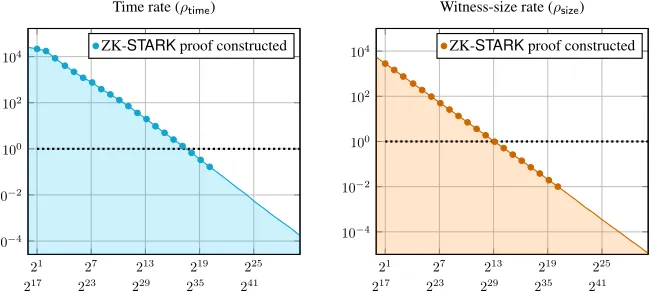
TC) and (ii) communication complexity that is strictly smaller than witness size. The core innovation and main source of improved performance in this system is the extended reliance on the IOP model, including theFast Reed-Solomon (RS) IOP of Proximity (IOPP)(FRI) protocol discussed in Section 2 (cf. [14]) and a new arithmetization procedure (see Section 2.3). We stress that the exponential speedup in verification time and witness-size described next (and displayed in Figure 1) apply to any computation that is defined for arbitrarily large witness size, though the particular point at which this speedup materializes depends on the complexity of the computation (as defined in Section 2.2)11.
DNA profile match computation As a proof-of-concept “meaningful” computation we construct a ZK-STARKfor theDNA profile match (DPM)problem, which we describe informally next (see Appendix E for details). This computation addresses the following hypothetical scenario: Suppose that the Police (acting as the proverP) is in charge of the national forensic DNA profile database (D), and at previous timethas posted (say, on a block-chain) a hiding commitment cmt to the state Dt of the database at that point in time. The Police now claims that the DNA profilepof the soon-to-be-appointed and alleged-to-be-corrupt Presidential Candidate, does not appear inDt and thus wishes to create, in a scalable manner, a proof that will convince the public that the DPM computation was carried out correctly, and the output reported by the Police is correct (with respect topandDt).
The prevailing standard for DNA profiles, used in over 50 countries, is theCombined DNA Index System (CODIS) format; according to this standard an individual is represented by the Short Tandem Repeat (STR) count of his/her DNA, measured for a set of 20 “core loci” [87] (the number of core loci increased from 13 to 20 starting January 2017). The commitment cmt to the state Dt of a CODIS database is assumed to be public information (say, published at timeton a blockchain), as is a commitmentcmp to the profile
10https://github.com/elibensasson/SCI-POC
11In particular, a computation with parameters similar to the last row of Figure 4 will behave similarly to the DPM computation
p of the Presidential Candidate; we assume p was extracted by an independent laboratory that handed it (confidentially) to the Police while publishingcmppublicly. Assume that the Police declares
“The valueαis the result of the match search for the profile with commitmentcmpin the database with commitmentcmt”
(*)
The answerαis one of three possibilities: “no match”, “partial match”,or“full match”. The public (open source) computation C is the one that would have been executed by a trusted third party verifying the claim above. This computation requires three public inputs —cmt,cmp andA— and two confidential inputs: (i) a DNA profile databaseD0and individual DNA profilep0. The computationCterminates success-fully if and only if the public inputs (cmt,cmp, A) and the confidential ones (D0, p0) satisfy three conditions: (i) the commitmentcm0of the confidential inputD0equals the public inputcmt; (ii) the commitmentcm0pof the confidential inputp0 equals the public inputcmp; and (iii) the output of the match search for the confi-dential inputp0in the confidential datasetD0leads to the publicly announced outcomeα; see Appendix E.5 for details.
Let|D(n)|denote the bit-length of a datasetD(n)that containsnprofiles (each profile is 40 bytes long); letCC(n)denote the communication complexity of the ZK-STARKforD(n), i.e., the total number of bits communicated between prover and verifier; similarly, letTC(n)denote the time needed to na¨ıvely verifyC by executing it onDwithnentries, and letTV(n)denote the time required byVto verify it, (both measured on a fixed physical computer.)
Realizing time and witness-size compression Consider a computationCwhich requires auxiliary confi-dential inputDthat varies in size, like the DPM example. Any ZK-systemS= (P,V)forCinduces a pair ofrate measuresfor time and witness-size, respectively:
ρtime(n) =
TV(n)
TC(n)
; ρsize(n) =
CC(n)
|D(n)| (1)
The rate measures (and thresholds defined next) depend onCand the systemS, so the notationρ(timeS;C)would be more precise, but we prefer notational simplicity and assumeCandSare known.
A rate value smaller than1indicatescompression, meaning verification inSis more efficient than na¨ıve verification. In fully scalable ZK systems verifier complexity is poly-logarithmic in prover complexity. Therefore eventually, for large enoughn, the system achieves compression. Our main claim here is that we exhibit, for the first time, time and witness-size compression for a ZK-STARKfor a large-scale sequential computation. Define thecompression thresholdto be the smallest valuen0such that for alln≥n0the rate is less than1,
θtime = min{n0 | ∀n≥n0 ρtime(n)<1}; θsize = min{n0 | ∀n≥n0 ρsize(n)<1} (2)
Figure 1 shows the rate measures for the DPM problem on a double logarithmic scale. The time com-pression threshold is atθtime = 2.8×10⁵ and the witness-size threshold isθsize = 9×10³. The largest database for which we could generate a proof during our tests isnmax = 220 ≈1.14×10⁶ DNA profiles; larger databases require more disk space and RAM than was available to us. Each profile occupies 40 bytes so|Dnmax| ≈ 43 megabytes. The time-rate fornmax is ρtime(nmax) = 1/6 and the witness-size rate is
21 27 213 219 225
10−4
10−2
100
102
104
Time rate (ρtime)
ZK-STARKproof constructed
217 223 229 235 241
21 27 213 219 225
10−4
10−2
100
102
104
Witness-size rate (ρsize)
ZK-STARKproof constructed
217 223 229 235 241
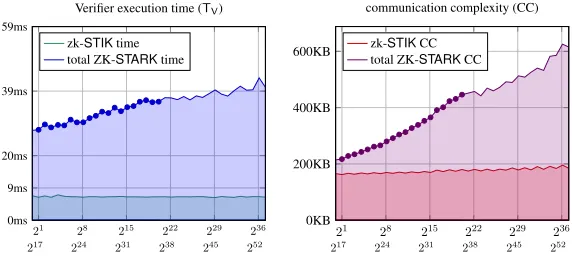
Figure 1: The time (left) and witness-size (right) rate functions of the DPM benchmark ZK-STARKas a function of (i) number of entries (n) in the database (upper horizontal axis) and (ii) number of multiplication gates (lower horizontal axis). Database size, in bytes, is40·nand processing a single profile corresponds to a circuit with≈216multiplication gates (bottom right entry of Figure 4, explained in Sections 1.3.2 and 2.2). Verifier complexity is independent of prover complexity, so it was measured (on a “standard” laptop; cf. Appendix A.0.2 for machine specifications) even for values ofnthat are larger than those for which a proof was generated; the values ofnfor which a proof was generated are marked by full circles.
1.2 Discussion — Applications to decentralized societal functions
Cryptocurrencies, led by Bitcoin, are disrupting established financial systems by suggesting a fully decen-tralized monetary system to replace fiat currency. Money is but one of the societal functionsthat could be decentralized, and legal contracts are already being replaced by automatedsmart contracts[103] in the Ethereum blockchain. We end this section by discussing the two expected impacts of ZK-STARKsystems on decentralized public ledgers.
Scalability A heated discussion is taking place in blockchains today, surrounding the proper way toscale the transaction throughput without over-taxing the time and space of nodes participating in the network. As first pointed out by one of the co-authors [12] and embraced recently by several crypto-currency initia-tives [66, 34, 76], fully scalable proof systems (even without zero-knowledge) could solve the scalability problem by exponentially decreasing verification time. In more detail, a single “prover node” can gener-ate in quasilinear time a proof that will convince all other nodes to accept the validity of the current stgener-ate of the ledger, without requiring those nodes to na¨ıvely re-execute the computation, nor to store the entire blockchain’s state, which would be required for such a na¨ıve verification.
several ZK-STARKproofs using incrementally verifiable computation [105] (cf. [29]).
1.3 Comparison to other realized universal ZK systems
Recent years have seen a dramatic effort to realize in code zero knowledge proof systems using various theoretical approaches that differ from that of our STARK. Many of these systems outperform our ZK-STARKfor sufficiently small-size computations, for low-depth parallel computations, and/or for batched and amortized computations; all of these cases are extremely useful in practice. But for large scale compu-tations, especiallysequential ones, the improved full scalability of our IOP-based approach is, eventually, noticeable.
Next, we briefly survey the different implementedapproaches that areuniversal, i.e., apply to general computations and languages inNP; the interested reader is referred to [110] and [13] for more information on computational integrity solutions, including ones that are non-universal and/or without zero-knowledge. We start by an “asymptotic” discussion in Section 1.3.1 and continue with a comparison of concrete param-eters for published and realized systems (Section 1.3).
1.3.1 Theoretical discussion
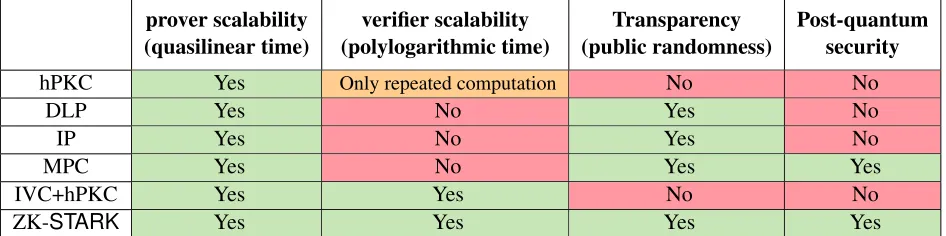
Within the vast (and growing) literature on realizations of ZK systems, we must limit the scope of our discussion and do so somewhat arbitrarily, by considering only systems that are ZK, Turing complete, and which have been realized in code. We compare these for the most general class of computational integrity statements (see Definition 3.1 for a formal definition) and consider four properties: asymptotic (i) prover scalability (quasilinear running time), (ii) asymptotic verifier scalability (poly-logarithmic verification), (iii) transparency, and (iv) post-quantum security. The first three terms are formally defined in Definition 3.3, and the last one is informal, but could be replaced with the property ofreliance only on collision resistant hash functions12. Figure 2 summarizes our discussion, and we provide details next.
• Homomorphic public-key cryptography (hPKC):This approach, initiated by Ishai et al. [69] (for the “designated verifier” case) and Groth [60] (for the “publicly verifiable” case), uses an efficient information-theoretic model called a “linear PCP” that is then “compiled” into a cryptographic sys-tem using hPKC. An extremely efficient instantiation, based on Quadratic Span Programs, was in-troduced by Gennaro et. al [53] (see [64, 52, 81, 30, 62, 63] for related work and further improve-ments). It serves, e.g., as the proof system behind Zerocash and Zcash™. The first implementation of a QSP based system is called Pinocchio [88], with subsequent implementations including lib-SNARK[21, 96] (discussed in the next section) which is used in the Zerocash and Zcash™ imple-mentations; additional implementations appear in [98, 101, 100, 99, 24, 108, 46].
The theoretical differences between hPKC and ZK-STARKare that of transparency and post-quantum security — hPKC lacks both. Verification time in hPKC is scalable (i.e., poly-logarithmic inTC) only for computations that are repeated many times, because the hPKC “setup phase” requires time≥TC.
• Discrete logarithm problem (DLP):An approach initiated by Groth [61] (cf. [97]) and implemented in [31], relies on the hardness of the DLP to construct a system that is transparent. Shor’s quantum fac-toring algorithm solves the DLP efficiently, rendering this approach quantum-susceptible. Addition-ally, verifier complexity in the DLP approach requires time≥TChence it is non-scalable (according
to our definition of the term), although communication complexity in the DLP approach is logarith-mic. We refer to the initial implementation of this system asBCCGP[31], and a recent improved version is calledBulletProofs[35].
• Interactive Proofs (IP) based: IP protocols can be performed with zero knowledge [11] but only recently have IP protocols been efficiently “scaled down” to small depth (non-sequential) computa-tions via so-called “proofs for muggles” of Goldwasser et al. [58, 94]. This led to a line of realiza-tions in code, early works lacked ZK [42, 41, 104, 107], but the state-of-the-art ones, like [112] and Hyrax[109], do have it.
Like ZK-STARK, these recent IP-based proofs are transparent and have a scalable prover, but are quantum-susceptible and their verifier is not scalable, as it scales linearly with computation time for “standard” (i.e., sequential) computations (like other approaches, it is quite efficient for batched and amortized computations and for small circuits).
• Secure multi-party computation (MPC):This approach, suggested by Ishai et al. [70] and imple-mented first in theZKBoo [55] system, and more recently, inLigero [1], “compiles” secure MPC protocols into ZK-PCP systems, by requiring the prover to commit to the transcript of a secure MPC protocol, and then reveal the view of one of the parties.
Like ZK-STARK, the MPC-based proofs are transparent, post-quantum secure and have scalable (quasilinear) proving time. However, MPC based systems have a non-scalable verifier, one that runs in time≥TCand communication complexity is non-scalable, it is
√
TCin the state of the art system [1]; for concrete circuits and amortized computations it is, nevertheless, extremely efficient.
• Incrementally Verifiable Computation (IVC):This approach, suggested by Valiant [105] (cf. [39, 29]) reduces prover space consumption by relying on knowledge extraction assumptions; this ap-proach can be applied on top of other proof systems with succinct (sub-linear) verifiers, including ZK-STARK, but thus far has been realized only for a single hPKC system [23].
Compared with ZK-STARK, systems built this way inherit most properties from the underlying proof system. In particular, the hPKC-based IVC is non-transparent and quantum-susceptible; however the verifier is scalable even for a computation executed only once, because the setup phase runs in poly-logarithmic time.
prover scalability (quasilinear time)
verifier scalability (polylogarithmic time)
Transparency (public randomness)
Post-quantum security
hPKC Yes Only repeated computation No No
DLP Yes No Yes No
IP Yes No Yes No
MPC Yes No Yes Yes
IVC+hPKC Yes Yes No No
ZK-STARK Yes Yes Yes Yes
1.3.2 Concrete performance
Different ZK proof systems are based on different cryptographic assumptions and are designed for different computational problems. Their realizations are written in different programming languages and tested on varied hardware. Therefore, exact “apples to apples” comparisons are difficult, if not impossible, to perform. Having said that, in this section weattemptto qualitatively compare the realized proof systems reported in the previous section in terms of verifier, prover, and communication complexity for computational problems that are similar in nature to the DPM.
Arithmetic circuit complexity as standard measuring yard All realized proof systems surveyed here (including our ZK-STARK) use arithmetization to reduce computational integrity (CI) statements to state-ments about systems of low-degree polynomials over finite fields (see Section 2). All other surveyed sys-tems use prime fieldsFp, though some (like MPC- and IP-based) could operate also over binary fields, like ZK-STARK; we stress that ZK-STARKcould also operate over prime fields13but we have not realized this in code. Most systems (ZK-STARKnot included) reduce CI statements toarithmetic circuits, i.e., ones that correspond to constraints that arequadraticpolynomials; ZK-STARKreduces to systems of higher-degree polynomials, e.g., for our DPM benchmark this degree is8.
Arithmetic circuit complexity is a a reasonable metric to use in order to compare various proof-systems. The main parameters that influence proof-system complexity (and are mentioned in prior works) arecircuit depth, circuit width (number of gates in each “level” of the circuit), nondeterministic witness size, and multiplication complexity, i.e., the number of multiplication gates. (Addition complexity is also relevant, but most proof systems are less affected by it.)
Our DPM computation corresponds to an arithmetic circuit with the following parameters, when applied to a database withnentries (see Figure 4):
• circuit depth isdepthn= 62·n;
• circuit width isw= 81;
• witness complexity iswitn= 40·nbytes;
• multiplication complexity ismultn= 1467·62·n= 90954·n≈216.4·n.
As discussed at length in Appendix A, we measured the full ZK-STARKsystem (prover+verifier) with60
bits of security forn= 2k, k= 1, . . . ,20, i.e., for arithmetic circuits with depth up todepthn ≈225.9, and with up to≈ 236.4 multiplication gates overF264; the (nonadaptive) verifier alone was measured even for
larger inputs, up ton= 236(see Appendix A).
To attempt an “apples to apples” comparison with other systems, we ran several of them on a single machine — one that is different than that used to measure the DPM code14— using the same benchmark computation based on the “exhaustive subset-sum” computation measured in prior work [13]; the results are summarized by Figure 3. The systems measured thus far this way are
• libSNARK(commit dc78fd, September 7, 2017) with80-bit security
• SCI(same measurements used in [13]) with80-bit security
13theFRIsystem requirespto contain a sufficiently large multiplicative subgroup of order2t+O(1); such prime fields abound, as
implied by Linnik’s Theorem [80].
14
• BCCGP with logarithmic communication complexity and 128-bit security, single threaded (same system used in [31])
• Ligerowith60bits of security (same system as reported in [1]);
• our ZK-STARK, with60-bit security ZK-STARK; we estimate prover prover time for80bits to be at most5%longer; cf. Appendix B.5.1.
We now briefly discuss the performance of these (and other prior reported works), focusing on the following complexity parameters: prover time, verifier time, and communication complexity.
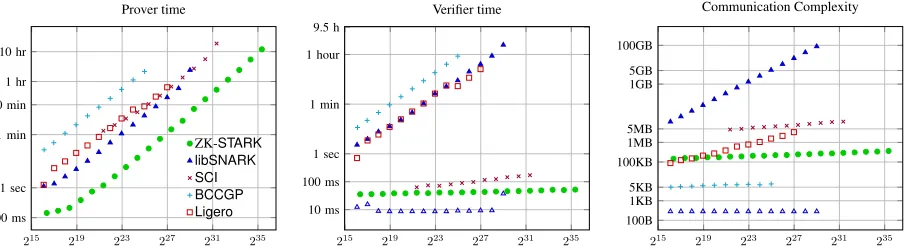
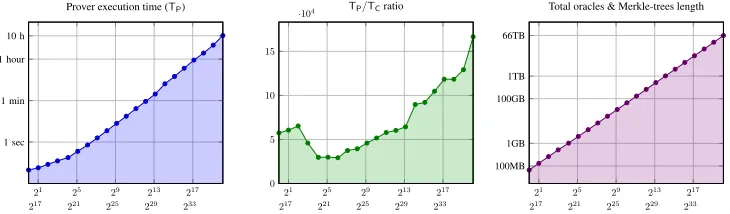
Prover complexity Nearly all systems surveyed earlier have prover complexity that scales either linearly or nearly-linearly in computation size. As shown in Figure 3, our ZK-STARKprover is at least10×faster than the other measured systems across the full range of compared computations (all systems were tested up to maximal proving time of12hours). We hope to perform similar “apples-to-apples” comparisons (i.e., same machine, circuit depth, width and size) with other systems like Hyrax andBulletProofs in future work.
215 219 223 227 231 235
100 ms 1 sec 1 min 10 min 1 hr 10 hr
Prover time
ZK-STARK libSNARK SCI BCCGP Ligero
215 219 223 227 231 235
10 ms 100 ms 1 sec 1 min 1 hour 9.5 h
Verifier time
215 219 223 227 231 235
100B 1KB 5KB 100KB 1MB 5MB 1GB 5GB 100GB
Communication Complexity
Figure 3: An “apples-to-apples” comparison of different realized proof systems as function of computation size, measured by number of multiplication gates. All systems were tested on the same server (specs below) and executed a computation of size and structure corresponding to the “exhaustive subset-sum” program from [13, Section 3]. The compared systems areSCI (pur-ple x-marks), which lacks ZK,libSNARK(blue triangles),BCCGP(cyan +-marks), executed in single-thread mode,Ligero(red squares) and ZK-STARK(green circles). From left to right, we measure prover time, verifier time and communication complexity. ForlibSNARK, the hollow marks in the middle and right plots measureonly post-processingverification time and CC, respectively; the full marks measuretotalverification time and CC, and this includes the (non-transparent) key-generation phase. Server speci-fication: 32 AMD cores at clock speed of 3.2GHz, with 512GB of DDR3 RAM. (Each pair of cores shares memory; this roughly corresponds to a machine with 16 cores and hyper-threading.)
Verifier complexity Different proof systems excel on different circuit topologies. For example, Ligero achieves best performance for circuits of sizesthat are iteratedstimes (i.e., whendepth≈w ≈ √mult), andHyraxworks best on small depth, massively parallel, circuits (depth =O(1)andw,mult depth). The concrete performance of IOP-based systems on such circuit topologies is an interesting question, left for future work.
expect the comparison with other works, likeHyraxandBulletProofs, to behave similarly; in particular, the Hyraxprover reaches≈10seconds for a circuit with≈228gates (but measured on a different machine than ours);BCCGPandBulletProofsrequire even greater running time [109, Figure 4.(i)]. For comparison, the ZK-STARKverifier for the DPM computation requires less than 50 ms (on a different machine), even for huge circuits15, withn = 236entries (profiles),witn ≈ 2.5-terabyte size witnesses and arithmetic circuits withmultn= 252multiplication gates and depth≈240(cf. Figure 7).
The hPKC systems likePinocchioandlibSNARK, and IVC+hPKC systems like that of [23], are differ-ent in this respect. They have a pre-processing phase that is performed only once per circuit. ForPinocchio andlibSNARKpre-processing time growslinearlywith circuit size. E.g., thelibSNARKsystem requires
≈16seconds for a computation with220gates. For the IVC+hPKC system, pre-processing time isconstant and does not depend on circuit size; however, this constant is quite large compared to our verifier time, it is
≈10seconds for a computation similar to our DPM.
Communication complexity (CC) The use of a pre-processing phase in the hPKC and IVC+hPKC sys-tems leads to extremely small post-processing CC; theBCCGPsystem also enjoys extremely short CC and, because its pre-processing is transparent, can be effectively replaced with a short seed to a pseudo-random generator. Concretely, for all computations measured in practice, post-processing CC ofPinocchio, lib-SNARK and the IVC+hPKC system are less than300 bytes, and that ofBCCGP is less than7KB [31] (see also Figure 3). However, pre-processing key length scales linearly with circuit size for hPKC; the IVC+hPKC system is different in this respect, it has succinct pre-processing length even for large compu-tation size, but once again, this length is concretely large — more than40 MB for a computation like our DPM.
For Ligero, communication complexity scales like70√multn field elements [1, Section 5.3], and for Hyraxit scales likewit1/k+10·depth·logwfield elements for arbitrary integerk[109, Section 1]; increasing
kdecreases CC but also increases verification time (which is at leastwit/(wit1/k)). Using the estimate for Hyrax, a quick calculation shows that for a circuit arising from our DPM computation with, sayn= 213
profiles, the CC ofHyraxwould reach several megabytes, compared with ZK-STARKCC that is less than
1megabyte even forn= 236profiles.
Summary Among all ZK systems tested in the “apples-to-apples” manner described above, our ZK-STARKhas the fastest prover for all circuit-sizes we were able to measure; in particular, it is≈10×faster than the second fastest measured system —libSNARK. Other systems perform better (shorter communica-tion, faster verification) on small circuits (ZKBoo,Ligero), small-depth circuits (Hyrax), and on compu-tations repeated many times with the same fixed circuit (BulletProofs,Pinocchio,libSNARK). However, for general large scale computations our ZK-STARKhas verification time and communication complexity outperform all othertransparentsystems published thus far for this range of parameters. In other words, our particular ZK-STARKrealization shows that the asymptotic benefits of full scalability and transparency are manifested already for concrete computations that are practically relevant, like the DPM, and suggest that our type of system is potentially useful for constructing scalability solutions, e.g., for decentralized crypto-currencies (as discussed in Section 1.2).
2
Methods
This section highlights the main innovative components that underlie the (double) scalability and concrete efficiency of our ZK-STARK; the exposition is short and informal. Later, in Section 3 we shall formally define the theoretical model which our ZK-STARKuses, and state the main theorems for this model (Theo-rems 3.4 and 3.5); then, in Appendix B we formally present the steps of the reduction (proved in subsequent sections).
Overview Many ZK systems (including ours) usearithmetization, a technique first16used to prove circuit lower bounds [93, 102], then adopted to interactive proof systems [5, 82]. Arithmetization is the reduction ofcomputationalproblems toalgebraicproblems, that involve “low degree” polynomials over a finite field F; in this context, “low degree” means degree is significantly smaller than field size.
The start point for arithmetization in all proof systems is a computational integrity statement which the prover wishes to prove, like
“αis the result of executingCforTsteps on (public) inputx” (**)
Notice the DPM statement (*) is a special case of (**). For our ZK-STARK, and for related prior sys-tems [27, 25, 13], the end point of arithmetization is a pair ofReed-Solomon (RS) proximity testing (RPT) problems17, and the scalability of our ZK-STARKrelies on a new solution to the RPT problem, discussed first; later we explain the arithmetization process in more detail.
2.1 Fast Reed-Solomon Interactive Oracle Proof of Proximity (FRI3rd)
For S ⊂ F and rate parameter ρ ∈ (0,1), the Reed-Solomon codeRS[F, S, ρ]is the family of functions
f :S → Fthat are evaluations of polynomials of degree< ρ|S|. The RPT problem assumes a verifier is given oracle access tof, and to auxiliary information like a probabilistically checkable proof of proximity (PCPP) [25, 48] or an interactive oracle proof of proximity (IOPP) [22, 94, 15]; the verifier’s task is to distinguish with high probability and with a small number of queries tofand the auxiliary PCPP/IOPP ora-cle(s), between the case thatf ∈RS[F, S, ρ]and the case thatf is0.1-far from (all members of)RS[F, S, ρ] in relative Hamming distance. Finding solutions to the RPT problem (a special case of the “low-degree testing” problem) is a major bottleneck for transparent systems.
Our ZK-STARK uses a new protocol to solve RPT, called the Fast RS IOPP (FRI). FRI is the first RPT solution to achieve prover arithmetic complexity that isstrictly linear—6· |S|arithmetic operations inF — and verifier arithmetic complexity that is strictly logarithmic: 21·log|S|arithmetic operations; additionally, the proof can be constructed inlog|S|cycles on a parallel machine, and is structured as to lead to short arguments (see Section 2.5). FRIimproves significantly, both asymptotically and concretely, on the previous RPT solutions which requiredquasilinearprover arithmetic complexity (θ(|S| ·logO(1)|S|)). See [14] for a detailed description.
2.2 Arithmetization I — Algebraic Intermediate Representation (AIR)
Having discussed its end point, we return to describe the innovative components of our ZK-STARKwithin the arithmetization process itself. The arithmetization is comprised of several phases that are similar to other
16
Earlier reductions, such as the one used in G¨odel’s Incompleteness Theorem, involvedinfinitealgebraic domains, in particular the natural numbers [56].
17
program and circuit compilation processes, so we borrow terminology used there and adapt it to our process. The first phase of arithmetization is that of constructing analgebraic intermediate representation (AIR) of the programC. Informally, theAIRis a set
P =
n
P1(X, ~~ Y), . . . , Ps(X, ~~ Y)
o
of low degree polynomials with coefficients inFover a pair of variable setsX~ = (X1, . . . , Xw)andY~ =
(Y1, . . . , Yw)that represent respectively the current and next state of the computation18(see Appendix C and Definition B.3 for more details). TheAIRdefines thetransition relationof the computationCin the sense that a pair(~x, ~y)∈Fw×
Fwcorresponds to a single valid transition (or “cycle”) ofCif and only if
P1(~x, ~y) =. . .=Ps(~x, ~y) = 0,
i.e., if and only if (~x, ~y) is a common solution of the AIR system P. The following parameters of P
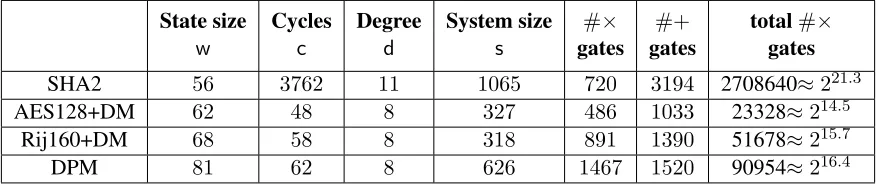
determine prover and verifier complexity, so minimizing them is a major goal of this phase. Thedegreeof theAIRisdeg(P) = maxsi=1deg(Pi); the(state) widthis the number of variables (w) needed to represent a state; the(AIR) sizeis the number of constraints (s), and thecycle countis the number of machine cycles needed to execute19C; when the program processes a large number (n) of data elements, as is the case for the DPM benchmark, we are interested in the number of cycles per element, denotedc; the total cycle count fornelements isc·n. If the computation is “expanded” to a circuit (as commonly done in the other solutions described in Section 1.3), the cycle count is a lower bound on circuit depth; for the sake of comparison with those other systems, we compute in the rightmost column of Figure 4 the total number of multiplication gates for this expanded circuit, as this measure along with circuit depth, are the complexity measures that dictate prover and verifier complexity.
A major contributor to prover complexity in our benchmarks is the cost of proving computational in-tegrity of repeated invocations of a cryptographic hash function; other computations are negligible compared to this cost. Thus, choice of the particular hash function (H) is of great importance, as is its definition in terms ofP. Our ZK-STARKuses the binary (characteristic2) fieldF264 because (i) it has efficient
arith-metic operations (e.g., addition is equivalent to exclusive-or) and (ii) its algebraic structure is needed for the FRI3rd protocol. Therefore, the cryptographic hash function we seek is one that is“binary field friendly”, meaning, informally, its AIR has small complexity parameters when defined over binary fields. Figure 4 summarizes the mainAIRcomplexity parameters for the DPM benchmark described in Section 1 and for three hash functions: the Secure Hash Algorithm 2 (SHA2) family [92] and the Davies–Meyer [111] hash based on the Rijndael block cipher [44] with 128 bits (AES128+DM) and with 160 bits (Rij160+DM). See Appendices E and F for details.
2.3 Arithmetization II — Algebraic Linking Interactive Oracle Proof (ALI)
The main bottleneck for prover time and space complexity is the cost of performingpolynomial interpola-tion and its inverse operation — multi-pointpolynomial evaluation; we discuss both in Section 2.4. The complexity measure that dominates this bottleneck is themaximal degreeof a polynomial which the prover must interpolate and/or evaluate; for a computation on a dataset of sizendenote this degree by dmax(n). Prior state-of-the-art [27, 20, 38, 13] gave
dmaxold (n) =n·c·w·d+n·c·s. (3) 18
This informal description omits, for simplicity, theboundary conditions, like public inputs and outputs of the computation.
19
State size w
Cycles c
Degree d
System size s
#×
gates
#+
gates
total#×
gates
SHA2 56 3762 11 1065 720 3194 2708640≈221.3
AES128+DM 62 48 8 327 486 1033 23328≈214.5
Rij160+DM 68 58 8 318 891 1390 51678≈215.7
DPM 81 62 8 626 1467 1520 90954≈216.4
Figure 4: Main complexity parameters of basic cryptographic primitives and the benchmark DNA profile match search program. The first four measures are explained in Section 2.2. The 5th and 6th columns measure total number of multiplication and addition gates in theAIR; the last column measures total number of multiplication gates (product of second and 5th columns) for the sake of comparison with other ZK systems that use this measure (cf. Section 1.3.2).
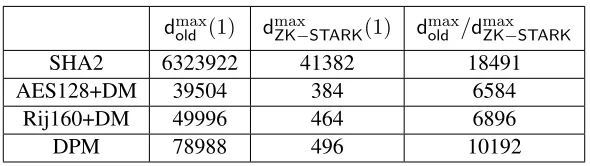
which leads to concretely large values (see first column of Figure 5). Our ZK-STARKreducesdmaxto
dmaxZK−STARK(n) =n·c·d (4)
which results in a multiplicative savings factor of6.5×104–1.8×10⁵ over prior works (see the last two columns of Figure 5). The improved efficiency of our ZK-STARKis due to two reasons, explained next. The first one completely removes the second summand of (3) and the second one removesw from its first summand.
Algebraic linking IOP (ALI) The second summand of (3) arises because our prover needs to apply a “local map” induced by theAIRsystemP (see [17] for a discussion of “local maps”). Prior state-of-the-art systems, like [13], used a local map that checks each constraint of theAIRseparately, leading to this second summand. Instead, our ZK-STARKuses a single round of interaction to reduce allsconstraints to asingle constraintthat is arandom linear combinationofP1, . . . , Ps. This round of interaction completely removes the second summand of (3).
Register-based encoding The na¨ıve computation performed by the prover can be recorded by anexecution trace, a two-dimensional array with c·nrows and wcolumns, in which each row represents the state of the computation at a single point in time19 and each column corresponds to analgebraic register tracked over allc·ncycles. Prior systems, like [13], encoded thefullexecution trace by asingleReed-Solomon codeword, leading to degreen·c·w; this degree is then multiplied byd to account for application of the afore-mentioned “local map” to the codeword, resulting in the first summand of (3). Our ZK-STARKuses a separateReed-Solomon codeword for each register20, leading towmany codewords, each of lower degree
n·c. At first glance this tradeoff may seem wasteful, because we now have to solve an RPT problem for each of thesewcodewords. However, the interaction and use of randomness allowed by the IOP model once again come to our aid: it suffices to solve a singleRPT problem, applied to arandomlinear combination of allw codewords. The use of a single codeword per register also helps with reducing communication complexity, as explained in Section 2.5 below.
Figure 5 compares the dmax value of our ZK-STARKto that of the prior state of the art [27, 20, 38, 13] and shows a multiplicative reduction factor of6.5×104–1.8×10⁵ for the computations discussed in Section 2.2 and Figure 4.
20
dmax
old (1) dmaxZK−STARK(1) dmaxold /dmaxZK−STARK
SHA2 6323922 41382 18491
AES128+DM 39504 384 6584
Rij160+DM 49996 464 6896
DPM 78988 496 10192
Figure 5: The maximal degree (dmax
) as given by formulas (3) and (4), respectively, for the computations discussed in Section 2.2. The last column gives the multiplicative improvement factor ofdmaxZK−STARKover the prior state of the art.
2.4 Low degree extension and composition degree
Decreasingdmaxaffords our ZK-STARKgreater scalability. But, eventually, as the input sizengrows, so doesdmax. The main bottleneck for prover time and space is the computation of thelow degree extension (LDE)of the execution trace, defined next.
Definition 2.1(Low degree extension (LDE)). Given finite subsetsS, S0 of a fieldFsatisfying|S0|> |S|
and a functionf :S → F, thelow degree extension (LDE)off toS0is the functionf0 :S0 → Fthat has the same interpolating polynomial as that off.
The LDE is typically computed by polynomial interpolation, followed by a polynomial multi-point evaluation step. State of the art algorithms for interpolating and evaluating polynomials over binary fields are known asadditive FFTalgorithms because they resemble the fast Fourier transform (FFT) [40]. To improve prover scalability, our ZK-STARK uses the recent and novel additive FFT of Lin et al. [79], inspection of this algorithm shows it leads to arithmetic complexity of3· |S0|log|S0|for the setsS0 that our system requires (see Theorem B.2). Prior additive FFTs [36, 106, 51] requiredθ(NlogNlog logN)operations); moreover, the memory-access pattern of this encoding algorithm leads to favorable running times compared with prior implementations [13].
Using this additive FFT, which hasstrictlyquasi-linear arithmetic complexity21, we also obtain the first ZK-STIKin which prover complexity isstrictlyquasi-linear,andverifier complexity isstrictlylogarithmic, in the size of the execution tracec·n·w; see Lemma B.6.
2.5 Minimizing Authentication Path Complexity (APC) and Communication Complexity
(CC)
The largest contributor to communication complexity, and to verifier time and space complexity in ZK-STARK(and prior related works [27, 20, 38, 13]) is the cost ofrealizingthe IOP model via Merkle trees. We now discuss the way our ZK-STARKreduces this cost.
The commit–reveal scheme of Kilian [74] (which uses the “cut-and-choose” method of Brassard et al. [33]) has the prover commit to each oracle by sending the root of a Merkle tree whose leaves are la-beled by oracle entries. Recall an IOP involvesseveraloracles, hence also several Merkle trees and several roots/commitments. After the prover has committed to all oracles, the verifier queries these oracles at ran-domly chosen positions. When the proverrevealsthe oracle answers to these queries, each answer must be appended with anauthentication pathproving the query answers are consistent with previously committed Merkle tree roots. Letλdenote the number of output bits of the cryptographic hash function used to con-struct a Merkle tree in our system; letAPtotal denote the total number of authentication path nodes in all
21A functiong(n)is called
subtrees of Merkle trees whose leaves are query answers, and letqtotal denote the total number of queries, made to all proof oracles. The total communication complexity (CC) of the proof system is
CC=qtotal·log|F|+APtotal·λ (5)
In addition to reducing the first summand above by improved soundness analysis, our ZK-STARKalso reduces the second summand in two separate ways:
1. The ZK-STARKverifier queries rows of the (LDE of the) execution trace, each row comprised of w field elements that represent the state at some point in the computation (or its LDE). To reduce communication complexity, the ZK-STARKprover places each such row in asinglesub-tree of the Merkle tree, and therefore onlyoneauthentication path is required per row (as opposed tow many paths in prior solutions).
2. The QUERYphase of theFRI protocol queries affine cosets of a fixed subspace. Accordingly, the ZK-STARKprover places each such coset in asingle sub-tree of the Merkle tree, thereby reducing the number of authentication paths to one-per-coset (as opposed to one per field element).
Finally, to improve running time and further reduce communication complexity, we use the Davies– Meyer hash composed with AES as the hash function for our ZK-STARKcommit-reveal scheme (recall AES is part of the instruction set of many modern processors).
2.6 Organization of the remaining sections
3
On
STIK
s and
STARK
s — formal definitions and prior constructions
In this section we state the main theorems that our ZK-STARKrealizes (Section 3.2). Along the way we explain what constitutes a ZK-STARK(Section 3.3) and point to earlier relevant works that are variants of it (Section 3.4). We assume familiarity with standard definitions of zero knowledge (ZK) interactive proof (IP) and argument systems [59, 33], probabilistically checkable proofs (PCP) [2] and PCPs of proximity (PCPP) [26, 48], as well as interactive oracle proofs (IOP) [22, 94] and interactive oracle proofs of proximity (IOPP) [16].
A nondeterministic machineM that decides a languageL ∈ NTIME(T(n))in time T(n)(ndenotes instance size)inducesa binary relationRM consisting of all pairs(x,w)wherex∈Landwis a sequence of nondeterministic choices ofM(x)that lead to an accepting state. In this case we sayR=RM isinduced byLand implicitly assumeM is fixed and known. The language that we shall be most interested in, is the NEXP-completecomputational integritylanguage22.
Definition 3.1(Computational Integrity). The binary relationRCIis the set of pairs(x,w)where
• x = (M, x, y, T, S) withM a nondeterministic Turing Machine,x andydenote input and output, andT ≥Sare integers in binary notation, indicating time and space bounds, respectively
• wis a description of the nondeterministic choices ofM on inputx that cause it to reach outputy
within≤T steps, using a memory tape of size at mostS (not including the read-only input tape on whichxis written).
The computational integrity (CI) language LCI is the projection of the binary relation RCI onto its first
coordinate; alternatively,LCI
4
={x= (M, x, y, T, S)| ∃w(x,w)∈RCI}.
The space boundS in the definition above is unneeded, becauseS ≤ T. However, IOP systems for space bounded computations (S = o(T)) are simpler and, often, concretely more efficient (this holds for our DPM computation). Thus, we treat space-bounded computations separately and dedicate and theorem to it (Theorem 3.4) before treating the more general (and complicated) case of general computational integrity (Theorem 3.5).
3.1 Scalable Transparent IOP of Knowledge (STIK)
ASTARK, defined later, is a realization of ascalable and transparent IOP of knowledge(STIK), discussed next. We start by recalling the IOP model as defined in [22].
Definition 3.2(Interactive Oracle Proof (IOP)). LetRbe a binary relation induced by a nondeterministic languageLand let∈[0,1]denotesoundness error. AnInteractive Oracle Proof (IOP)systemSforRwith soundnessis a pair of interactive randomized algorithmsS= (P,V)that satisfy the properties below;P is theproverandVis theverifier.
• operation:The input of the verifier isx, and the input of the prover is(x,w)for some stringw. The number of interactive rounds, denotedr(x), is called theround complexityof the system. During a single round the prover sends a message (which may depend onwand prior messages) to which the verifier is given oracle access, and the verifier responds with a message to the prover. We denote by
hP(x,w)↔V(x)ithe output ofVafter interacting withP; this output is eitheracceptorreject.
22
• completenessIf(x,w)∈RthenPr [hP(x,w)↔V(x)i=accept] = 1
• soundnessIfx6∈Lthen for anyP∗,Pr [hP∗↔V(x)i=accept]≤
Theproof length, denoted`(x), is the sum of lengths of all messages sent by the prover. Thequery complexity of the protocol, denotedq(x), is the number of entries read byVfrom the various prover messages. Given witnesswsuch that(x,w)∈R,prover complexity, denotedtp(x,w), is the complexity required to generate all prover messages, andverifier complexity, similarly defined, is denotedtv(x).
Next, we formally define a ZK-STIK. Most of the work described in later sections is related to con-structing a new, and more efficient, ZK-STIK; similarly, Sections 2.1–2.4 describe a ZK-STIKand only Sec-tion 2.5 discusses a ZK-STARK. A (ZK-)STIKcan beprovento be unconditionally sound, even against com-putationally unbounded provers; ZK-STARKsystems have only computational soundness, against bounded provers, thus require additional cryptographic assumptions, discussed later.
Definition 3.3 (Scalable Transparent IOP of Knowledge (STIK)). LetR be a binary relation induced by a nondeterministic languageL ∈ NTIME(T(n))forT(n) ≥ nand letS = (P,V)be an IOP for Lwith soundness error(n)<1. We saySis
• transparentif all verifier messages and queries are public random coins.
• (fully, or doubly) scalableif for every instancexof lengthn, both of the following hold:
1. scalable verifier:tv(n) =poly(n,logT(n),log 1/(n))
2. scalable prover:tp(n) =T(n)·poly(n,logT(n),log 1/(n))
• proof of knowledgeif there exists aknowledge error function0(n)∈[0,1]and a randomized extrac-torEthat, given oracle access to any proverP∗ that causes the verifier to acceptxwith probability
p(n)> 0(n), outputs in expected timepolyp(n)T−(n)0(n)
a witnesswsuch that(x,w)∈R.
• privacy preservationif there exists a randomized simulator Simthat samples (perfectly) the distri-bution on transcripts of interactions betweenVandP, and runs in timepoly(T(n)).
A (fully) scalable and transparent IOP of knowledge will be denoted by STIK. For T(n) = poly(n), a privacy-preservingSTIKhasperfect23zero knowledge(ZK-STIK) but forT(n) =nω(1)it implies only the weaker notion of awitness indistinguishableproof system (wi-STIK).
A few remarks regarding the definition above:
• transparency: Interactive proofs in which the verifier sends only public random coins are known as Arthur Merlin typeprotocols. The termtransparent proof was introduced in [6] and is synonymous to PCP. We choose this term because it adequately reflects the beneficial effect of public randomness on the transparency of the proof system and. Our terminology does not contradict the earlier definition of the term because transparent proofs (and PCPs) are also transparent according to the definition above.
• scalability:Scalable provers are called “quasi-linear” in a number of prior works and scalable verifiers are often called “succinct”. We identify both terms into a single one that reflects the beneficial effect of quasi-linear and succinct proof systems.
3.2 Main Theorems
We now state the two main theorems regarding IOP systems, that our ZK-STARK system realizes; the proof of both theorems appears in Appendix B.7. Since our IOP constructions use finite fields, prover and verifier complexity are most naturally stated using arithmetic complexity over the ambient field, the size of which is derived from the size of the instancex(see Remark B.1); we usetpFandtpF to denote arithmetic
complexity, assuming the fieldFis understood from context.
Our first theorem is quite efficient when applied to space bounded computations, like our DPM, and indeed our implementation realizes the IOP described in the theorem (cf. Appendix B.8). Although we use asymptotic notation below, the algebraic version of this theorem (Lemma B.6), involves only explicit constants, which may be useful in the future for estimating explicit proof parameters and for asymptotic comparisons with other works.
Recall thatNTimeSpace(T(n), S(n))is the class of nondeterministic languages that are decidable in simultaneous timeT(n)and spaceS(n).
Theorem 3.4(ZK-STIKfor space bounded computations). LetLbe a language inNTimeSpace(T(n), S(n)), T(n)≥
nand letRbe induced byL. ThenRhas a transparent witness indistinguishable IOP of knowledge with the following parameters, stated for soundness error functionerr(n) = 2−λ(n)
• perfect completeness and soundness error at mosterr(n)for instances of sizen
• knowledge error bounderr0(n) =O(err(n))
• round complexityr(n) = logT2(n) +O(1)
• query complexityq(n) = 36(λ+ 2)·(logT(n) +S(n) +O(1)), each query is an element of a binary fieldF,|F|= 2nforn=λ+ logT(n) +O(1)
• verifier arithmetic complexitytvF(n) = 2n2+O(λ·(S(n) + logT(n))
• prover arithmetic complexitytpF(n) =O(S(n)·T(n)·logT(n))
• proof lengthO(T(n)·S(n)), measured in field elements.
In particular, forS(n) =polylogT(n), this IOP is fully scalable, i.e., the system is a wi-STIK; if, addition-ally,T(n) =poly(n), then the system has perfect ZK, i.e., it is a ZK-STIK.
For computations with super-poly-logarithmic space the theorem above is not scalable, neither for prover nor for verifier. The following theorem is fully scalable for any nondeterministic language, i.e., it can be said to be auniversal wi-STIK.
Theorem 3.5(wi-STIKforNEXP). LetL∈NTIME(T(n)), T(n)≥nandRbe induced byL. ThenRhas a witness-indistinguishable, fully scalable, and transparent IOP of knowledge (wi-STIK) with the following parameters, stated for soundness error functionerr(n) = 2λ(n)
• perfect completeness and soundness errorerr(n)≤2−λ(n)for instances of sizen
• knowledge extraction bounderr0(n) =O(err(n))
• query complexity O(λ(n) ·logT(n)), each query is an element of a binary field F,|F| = 2n for n=λ(n) + logT(n) + log logT(n) +O(1).
• verifier arithmetic complexitytvF(n) =O(λ(n)·logT(n)),
• prover arithmetic complexitytpF(n) =O(T(n) log2T(n)),
• proof lengthO(T(n) logT(n)), measured in field elements.
ForT(n) =poly(n)the system has perfect ZK, i.e., it is a ZK-STIK.
3.3 Scalable Transparent ARgument of Knowledge (STARK) as a realization ofSTIK
Definition 3.3 refers to the IOP model, in which results can be proved with no cryptographic assumptions. Indeed, most of our contributions, described in following sections (like the FRIprotocol), are stated and studied in this “clean” IOP model; and a majority of our engineering work was dedicated to implementing IOP-based algorithms of aSTIK system. However, we are not aware of any unconditionally secure IOP realization that is scalable, and theoretical works show that such constructions are unlikely to emerge [54]. A number of fundamental transformations have been suggested in the past to realize PCP systems using various cryptographic assumptions, and these transformations were adapted to the IOP model [22]. In all such realizations the prover must be computationally bounded, and such systems are commonly called argument systems, and, consequently, the realization of aSTIKresults in aScalable Transparent ARgument of Knowledge(STARK).
The two main transformations of proof systems into realizable argument systems are:
• InteractiveSTARK(iSTARK) As shown by Kilian [74] for the PCP model, a family of collision-resistant hash functions can be used to convert a STIK into an interactive argument of knowledge system; if theSTIKhas perfect ZK, then the argument system has computational ZK. Any realization of aSTIK using this technique will be called aninteractiveSTARK(iSTARK); when one wants to emphasize that theSTIKis zero knowledge, the term ZK-iSTARKwill be used.
• Non-interactiveSTARK(nSTARK)As shown by Micali [85] and Valiant [105] for the PCP model, and by Ben-Sasson et al. [22] for the IOP model, anySTIK can be compiled into a non-interactive argument of knowledge in the random oracle model (called a non-interactive random-oracle proof (NIROP) there); if the STIK had perfect zero knowledge then the resulting construction has com-putational zero knowledge. Any realization of a STIK using this technique will be called an non-interactiveSTARK(nSTARK); when one wants to emphasize that theSTIKis zero knowledge, the term ZK-nSTARKwill be used.
3.4 PriorSTIKandSTARKconstructions
The acronymsSTIKand (ZK-)STARKmay be new to this work, but IOP systems obtaining the properties that define them have been described in the past, as discussed next.
STIK PCP systems are, by definition, transparent (1-round) IOP systems. The first such system with a scalable verifier was given in the works24of Babai et al. [7, 6] and the first fully scalable PCP, i.e., the first STIKconstruction, appears in the works25of Ben-Sasson et al. [25, 20]. The first ZK-STIKforNPappears in the work of Ben-Sasson et al. [17], later extended to a ZK-STIKforNEXP[15].
STARK The first realization of aSTIKsystem, i.e., the firstSTARK, appears in the recent work of Ben-Sasson et al. [13]; our current publication describes thefirst realization of a ZK-STIKand is therefore the first ZK-STARKconstruction. (See Section 1.3 for other ZK solutions).
Acknowledgements
We thank Eli Eliezer and Tal Shoenwald for providing access to the server used to measure prover per-formance described in Appendix A.0.1. We thank Arie Tal, Yechiel Kimchi and Gala Yadgar for help optimizing code performance. We thank the Andrea Cerulli, Venkitasubramaniam, Muthuramakrishnan, Madars Virza, and the other authors of [31, 1] for assistance in obtaining the data reported in Figure 3. We thank Shmuel (Muli) Ben-Sasson, Yuval Ishai and Uri Kolodny for commenting on an earlier draft.
24
The first work [7] shows this forNEXPand the second [6] scales it down toNP.
25
References
[1] Scott Ames, Carmit Hazay, Yuval Ishai, and Muthuramakrishnan Venkitasubramaniam. Ligero: Lightweight sublinear arguments without a trusted setup. InProceedings of the 24th ACM Conference on Computer and Communications Security, October 2017.
[2] Sanjeev Arora, Carsten Lund, Rajeev Motwani, Madhu Sudan, and Mario Szegedy. Proof verification and the hardness of approximation problems. Journal of the ACM, 45(3):501–555, 1998. Preliminary version in FOCS ’92.
[3] Sanjeev Arora and Shmuel Safra. Probabilistic checking of proofs: a new characterization of NP. Journal of the ACM, 45(1):70–122, 1998. Preliminary version in FOCS ’92.
[4] L´aszl´o Babai. Trading group theory for randomness. InProceedings of the 17th Annual ACM Symposium on Theory of Computing, STOC ’85, pages 421–429, 1985.
[5] L´aszl´o Babai and Lance Fortnow. Arithmetization: A new method in structural complexity theory. computa-tional complexity, 1(1):41–66, 1991.
[6] L´aszl´o Babai, Lance Fortnow, Leonid A. Levin, and Mario Szegedy. Checking computations in polylogarithmic time. InProceedings of the 23rd Annual ACM Symposium on Theory of Computing, STOC ’91, pages 21–32, 1991.
[7] L´aszl´o Babai, Lance Fortnow, and Carsten Lund. Nondeterministic exponential time has two-prover interactive protocols. InProceedings of the 31st Annual Symposium on Foundations of Computer Science, FOCS ’90, pages 16–25, 1990.
[8] Boaz Barak and Oded Goldreich. Universal arguments and their applications. SIAM Journal on Computing, 38(5):1661–1694, 2008. Preliminary version appeared in CCC ’02.
[9] Mihir Bellare and Oded Goldreich. On defining proofs of knowledge. InProceedings of the 12th Annual International Cryptology Conference on Advances in Cryptology, CRYPTO ’92, pages 390–420, 1993.
[10] Mihir Bellare and Phillip Rogaway. Random oracles are practical: A paradigm for designing efficient protocols. InProceedings of the 1st ACM Conference on Computer and Communications Security, CCS ’93, pages 62–73, New York, NY, USA, 1993. ACM.
[11] Michael Ben-Or, Oded Goldreich, Shafi Goldwasser, Johan Hrastad, Joe Kilian, Silvio Micali, and Phillip Rogaway. Everything provable is provable in zero-knowledge. InProceedings of the 8th Annual International Cryptology Conference, CRYPTO ’89, pages 37–56, 1988.
[12] Eli Ben-Sasson. Universal and affordable computational integrity.https://www.youtube.com/watch? v=Q4nWoEKUtgU&t=32s, May 2013.
[13] Eli Ben-Sasson, Iddo Bentov, Alessandro Chiesa, Ariel Gabizon, Daniel Genkin, Matan Hamilis, Evgenya Pergament, Michael Riabzev, Mark Silberstein, Eran Tromer, and Madars Virza. Computational integrity with a public random string from quasi-linear PCPs.IACR Cryptology ePrint Archive, 2016:646, 2016.
[14] Eli Ben-Sasson, Iddo Bentov, Ynon Horesh, and Michael Riabzev. Fast Reed-Solomon interactive oracle proofs of proximity (2nd revision).Electronic Colloquium on Computational Complexity (ECCC), 24:134, 2017.
[15] Eli Ben-Sasson, Alessandro Chiesa, Michael A. Forbes, Ariel Gabizon, Michael Riabzev, and Nicholas Spooner. On probabilistic checking in perfect zero knowledge. Electronic Colloquium on Computational Complexity (ECCC), 23:156, 2016.