ISSN(Online): 2320-9801
ISSN (Print): 2320-9798
I
nternational
J
ournal of
I
nnovative
R
esearch in
C
omputer
and
C
ommunication
E
ngineering
(An ISO 3297: 2007 Certified Organization)
Vol. 3, Issue 5, May 2015
A Lab VIEW Based Virtual Instrument for
Background Correction of Spectrum for
Chemical Identification
Nikita Chauhan
1, Payal
2, Reji Thomas
3Student, Department of ECE, Amity University, Noida, Uttar Pradesh, India1
Student, Department of ECE, Amity University, Noida, Uttar Pradesh, India 2
Student, Department of ECE, Amity University, Noida, Uttar Pradesh, India3
ABSTRACT: Raman Spectroscopy is a technique for obtaining the chemical information from the spectral analysis of a chemical. By analyzing the spectra, it is observed that there is background interference which occurs mainly by fluorescence and noise. Fluorescence reduction is of main concern in extracting the true spectra of a chemical. In this paper, we discuss about fluorescence present in the spectra obtained after performing Raman spectroscopy, various previous methods used for fluorescence subtraction and that not only corrects the baseline but smoothens the corrected output resulting in extraction of a true baseline spectrum. In this paper we develop a Lab VIEW based VI for baseline correction and display result in a user friendly GUI
KEYWORDS: Fluorescence, background correction, Raman Spectroscopy
I. INTRODUCTION
In Raman spectroscopy when a chemical is irradiated by a light source such as laser light scattered by it. Photon interaction with the molecules of the substance sometimes results in energy gain or loss which causes photons that are scattered to shift in frequency, this scattering is inelastic and is called Raman scattering. Using Raman spectroscopy unknown chemicals can be identified on the basis of the spectrum obtained from the scattering. But for this fingerprint like identification is marred by the fluorescent background and noise. For error free identification the interference due to this noise and fluorescence should be removed.
Raman Spectroscopy is an effective technique for obtaining the chemical information from a given sample (chemical). Since it is a non-invasive technique it is popularly used for chemical identification by analyzing the photons that are obtained when a source of light such as a laser is made to fall on the sample. Raman signals are very weak around 1 in 20 million photons is a Raman scattered photon. While it provides the required chemical information about the sample, this technique gets restricted due to noise and fluorescent background. The Raman samples are very few in number and thus the light samples that are detected as a result of the experiment are very sensitive to noise. ICCD (Intensified Charged Coupled Device) is used for collecting the spectrum and the results so obtained are very sensitive to noise.
ISSN(Online): 2320-9801
ISSN (Print): 2320-9798
I
nternational
J
ournal of
I
nnovative
R
esearch in
C
omputer
and
C
ommunication
E
ngineering
(An ISO 3297: 2007 Certified Organization)
Vol. 3, Issue 5, May 2015
low frequency modulations are caused in the Fourier-transformed spectrum, and as a result cause baseline distortion. Thus correcting the baseline of the spectrum enables the spectrum to be free from fluorescence and helps in proper identification of the sample. Since the intensity of the fluorescent background is much more than the Raman signals, so fluorescent background and noise limit the identification of the sample and thus it becomes necessary to remove the background and noise to more precise identification.
II. RELATED WORK
For removing the fluorescence from the obtained Raman Spectrum there are certain instrumental as well as mathematical methods. Instrumental methods of fluorescence background reduction require some changes to be made in the hardware of the Raman process. Some of the ways are time gating, shifting the excitation wavelength of the laser and also photo-bleaching of the sample to be tested. Although wavelength modulation is a good way for avoiding fluorescence, for time gating modifying the system is not easy. In case of photo bleaching also the relative peaks of the sample get altered/modified leading to improper fluorescence reduction. Since making changes in the instrumental methods is more difficult, using computational methods makes background correction much easier without requiring any modifications in the hardware of the system. Some of the background correction methods include polynomial fitting, wavelet based techniques, first order and second order derivatives, fast Fourier transform method. The first and second order methods are dependent on the detection of peaks for their accuracy, and because during peak finding some peaks may not be detected, this method will provide less accurate results. Polynomial fitting is a much better technique but it requires the user to intervene in between the process. The use of wavelet based techniques is limited to the selection of the mother wavelet which is may or may not be accurate.
III. ALGORITHM
In this paper the method used identifies the background and reduces it. For identification of the sample the peaks must be separated from the fluorescent background which can be done using least square background fitting. According to this method the peaks are separated from the non peak regions. This line is the threshold for the next iteration and this continues till a baseline that properly fits the spectrum is obtained. Coordinates of certain points as used for determining the initial baseline according to the equation
y2-y1=M (x2-x1)
ISSN(Online): 2320-9801
ISSN (Print): 2320-9798
I
nternational
J
ournal of
I
nnovative
R
esearch in
C
omputer
and
C
ommunication
E
ngineering
(An ISO 3297: 2007 Certified Organization)
Vol. 3, Issue 5, May 2015
IV. WORKING
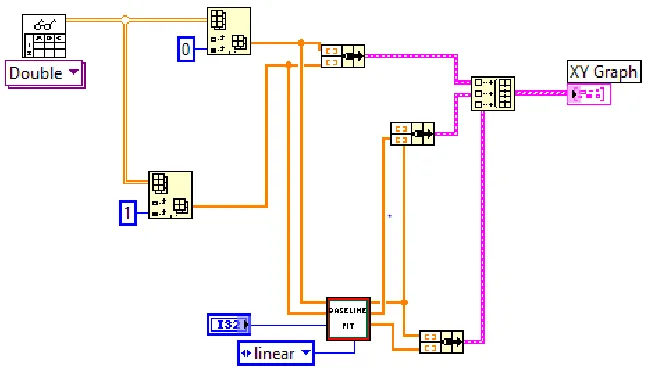
The labVIEW program for background correction is shown. The program reads the input data and then performs the baseline correction of the spectrum, and plots the original spectra, baseline as well as the background corrected
Read Data From spreadsheet
Split the data into X and Y using array index
Create a graph from the X and Y data
Find the polynomial fit of the spectrum
Perform extension of the spectrum
Stop Start
Create baseline filter
ISSN(Online): 2320-9801
ISSN (Print): 2320-9798
I
nternational
J
ournal of
I
nnovative
R
esearch in
C
omputer
and
C
ommunication
E
ngineering
(An ISO 3297: 2007 Certified Organization)
Vol. 3, Issue 5, May 2015
spectra in the final graph as seen. The original data is indexed to acquire the XY data where X axis is the wavelength and the Y axis is the intensity of the scattered radiations for the particular wavelength.
Figure 1: The program with subVI for baseline correction.
V. RESULTS
As seen in the figure the background fluorescence has been reduced. The result can be varied according to the variation in the baseline parameters. In this case the number of iterations is 8 and cut off frequency of 10000 is selected. The spectra is that of Calcium Chloride. The white color represents the original spectra, the green line is the baseline and the red color depicts the baseline corrected spectra.
ISSN(Online): 2320-9801
ISSN (Print): 2320-9798
I
nternational
J
ournal of
I
nnovative
R
esearch in
C
omputer
and
C
ommunication
E
ngineering
(An ISO 3297: 2007 Certified Organization)
Vol. 3, Issue 5, May 2015
VI. CONCLUSION
This paper has developed a LabVIEW based GUI for correction of the background in the spectra obtained as a result of Raman Spectroscopy for the identification of a sample chemical. It is seen that the method explained above provides us with satisfactory results of background correction.And its implementaion in Lab VIEW which a very good software for developing virtual instruments.
REFERENCES
[1]. Jianhua Zhao, Harvey Lui, David I. McLean, and Haishan Zeng “Automated Autofluorescence Background Subtraction Algorithm for Biomedical Raman Spectroscopy” Vol. 61,Issue 11,pp. 1225-1232 (2007)
[2]. Zhi-Min Zhang,a Shan Chen,a Yi-Zeng Liang,a* Zhao-Xia Liu,b Qi-Ming Zhang,b Li-Xia Ding,b Fei Yec and Hua Zhouc “An intelligent background-correction algorithm for highly fluorescent samples in Raman spectroscopy” 18 June 2009 Accepted: 18 August 2009 Published online in Wiley Interscience: (www.interscience.wiley.com).
[3]. Liming Xie , Xi Ling , Yuan Fang , Jin Zhang* and Zhongfan Liu “Graphene as a Substrate To Suppress Fluorescence in Resonance Raman Spectroscopy” J. Am. Chem. Soc., 2009, 131 (29), pp 9890–9891
[4]. P.J. Cadusch, M.M. Hlaing, S.A. Wade, S.L. McArthur, P.R. Stoddart “Improved Methods for Fluorescence Background Subtraction from Raman Spectra” arXiv:1306.4156 [cond-mat.mtrl-sci
[5]. Tiange Lan, Yonghua Fang, Wei Xiong and Chao Kong “Automatic baseline correction of infrared spectra” October 10, 2007 / Vol. 5, No.10 / Chinese optics letters 613.
[6]. Andrzej Kwiatkowski, Marcin Gnyba, Janusz Smulko, Pawel Wierzba “Algorithms of chemical detection using Raman Spectra” Metrol. Meas. Syst., Vol. XVII (2010), No. 4, pp. 549–560.
[7]. Xinwei Feng Zhongliang Zhu Peisheng Cong “A Novel Algorithm for Baseline Correction of Chemical Signals” 2009 Fifth International Conference on Natural Computation
[8]. Gang Li “Removing Background of Raman Spectrum Based on Wavelet Transform” 2009 ETP International Conference on Future Computer and Communication.
[9]. P.J. Cadusch, M.M. Hlaing, S.A. Wade, S.L. McArthur, P.R. Stoddart “Improved Methods for Fluorescence Background Subtraction from Raman Spectra”