Vol. 4, Issue 1, January 2015
Survey on Image Reconstruction Techniques
Using Multi-Focus Images
Rohita P. Patil1, Sneha P. Jatkar2
Assistant Professor, Dept. of ECE, Sinhgad’s Institute of Kashibai Navale College of Engg, Pune, Maharashtra, India 1
PG Student [VLSI & ES], Dept. of ECE, Sinhgad’s Institute of Kashibai Navale College of Engg, Pune,
Maharashtra, India2
ABSTRACT:Image reconstruction using multi-focus images is very novel approach used in many applications. The
different methods of image reconstruction by using multiple differently focused images on FPGA are described in detail in this paper. The effective method for FPGA implementation can be determined from this survey. From the comparison of survey papers the method of spatial frequency analysis based on three dimensional FFT is expensive. So the efficient method of image reconstruction can be designed with the help of dimension reduction and two dimensional FFT which is better in cost and quality. The Block-RAMs on FPGA limits the image size. So the problem of sizing of images is overcome by FPGA-based image reconstruction system by using an onboard DDR SDRAM. So the image reconstruction system based on Xilinx FPGA can be efficiently designed.
KEYWORDS: FPGA, FFT, IFFT, Image reconstruction
I.INTRODUCTION
Reconstruction of multi-view images by integrating images from multiple cameras is basic technology of new broadcasting and telecommunication media.In large scale applications such as remote sensing, image reconstruction is of great importance. It combines the relevant information from two or more source images into a single resultant image that describes the scene better and retains useful information from the source images. In order to generate a certain image such as an all-in-focus image by using multiple differently focused images, conventional methods usually analyze each acquired image independently and merge them into a desired image. These methods are not easy to extend for merging of many images, for example, to restore textures of complex scenes. Previously, a method in which generation of free viewpoint images directly from multi-focus imaging sequences without any depth estimation is proposed. The method realizes reconstruction of image by applying a certain 3D filter to the sequence, but the cost of 3D FFT is expensive.[1] So, there are more efficient image reconstruction techniques are present. The efficient and accurate image reconstruction is done from 3D multi-focus imaging sequences by adopting dimension reduction technique. In this the integration of the 3D sequence into a single 2D image is made and then just by applying a 2D filter to the image, desired image are reconstructed which reduces the cost of the system.
This method consists of deterministic processes which are parallel and does not have conditional branches. Hence, it is an effective method for the implementation to the FPGA hardware. The image reconstruction on Xilinx FPGA will be done, but the number of Block-RAMs on the FPGA limits the image size. The FPGA-based image reconstruction systems by using an onboard DDR SDRAM and processing the divided blocks repeatedly can be done. The realized system can work even for larger image sizes without any drawbacks[2].
The paper is organized as follows: Section I gives an Introduction to the Image reconstruction ,Section II describes different image reconstruction techniques and there implementation processes and section III gives the comparison of the reviewed papers. The conclusions are drawn in Section IV.
II. SURVEY OF IAMGE RECONSTRUCTION TECHNIQUES
Vol. 4, Issue 1, January 2015
techniques and Frequency domain techniques are used for combining the images. Spatial domain techniques process image pixels to achieve the desired result while frequency domain methods first transfer the image into frequency domain by applying Fourier transform. The resultant image is obtained by performing inverse Fourier transform. Many researchers were contributed their work towards proposing a method of reconstructing free viewpoint image directly from multi-focus image sequences. Different methods, techniques are proposed for the reconstruction of image from multiple images.
1) Paolo Favaro, Stefano Soatto introduced a novel approach of shape from defocus, in this the problem of inference of the three-dimensional structural geometry of a scene from a set of de-focused images is discussed[6]. Generally, in shape from defocus, the method of extracting geometry from scene also requires deblurring the given input images. General approach of bypassing the task relies on approximation of the scene locally by a plane which is parallel to the image. But they proposed a method to infer 3D geometry of scene from a set of defocused images which involves computation of orthogonal operators which are regulated through singular value decomposition. When the value of PSF is unknown, they proposed efficient & simple method that gives a group of projection operators of blurred images and then these operators are used to estimate the three dimensional structural geometry of a particular scene from blurred images.
2) K. Kodama, H. Mo, and A. Kubota introduced a method of image generation based on integrating multiple differently focused images. In this they assumed that the geometrical blurring model is used for defocusing the images and then by using a method of convolution for three-dimensional blur, they combined the obtained images on imaging planes and spatial frequencies of objects. In this way they reconstructed a focused image from the obtained images based on analysis of spatial frequency using three-dimensional FFT. In this firstly the blurs of acquired images are determined using the relative locations between traces of a ray-set which comes from a certain point in the scene which is shown in Fig 1.
Fig.1a A ray-set that is focused on ′ or ′ Fig .1b The space after transform
Fig.1 The structure of ray-sets that compose blurs
Scene analysis of acquired images is done by using the blurring model which consists of convolution of ( , , ) and
ℎ( , , ) . here the ( , , ) is generated by extracting the intensity given by each ray-set just where it is focused. The
3D blur geometry is determined by the density of the ray-set in the space separately where the ray-sets are focused. Hence the ℎ( , , )is the 3-D blur function which provides an impulse of function at the origin. So, the acquired images can be expressed as the convolution of the three dimensional information of the scene and the 3D blurring function which is given by,
( , , ) =ℎ( , , )∗ ( , , ) …… (1)
Multi-focus image sequence g(x,y,z) is composed of acquired multiple differently focused images as 3- D information, and f(x,y,z) corresponds to 3-D information of a scene except occlusion. By using a convolution of a 3-D blurring filter
h(x,y,z),they combined f(x,y,z) and g(x,y,z) in a space-invariant equation. First, they integrated acquired multiple differently focused images into 2-D information as shown in Fig.3. So a new 2-D image is defined as follows,
Vol. 4, Issue 1, January 2015
, ( , ) =∫ ( + ( 0− ), + ( 0− ), ) ……(2) where ( , , 0) corresponds to the image acquired when focusing at infinity. Similarly, integrate 3-D information
( , , ) and ℎ( , , ) to 2-D information , ( , ) and , ( , ) , respectively. Then, obtain a 2-D space-invariant
equation as follows,
, ( , ) = , ( , )∗ , ( , ) ……(3) Reconstructed free viewpoint image as,t(x, y) in the frequency domain is given as follows,
, ( , ) =) , ( , ) , ( , ) ……(4)
Fig. 2 A Three dimensional blur combines the scene and the acquired images
3) Kazuya Kodama, Hiroshi Mo, Akira Kubota proposed a novel method for image generation by integrating multiple differently focused images as structured three-dimensional information. The integrated image sequence is analysed in the frequency domain and transformed to desired images directly without any depth estimation. A three-dimensional filter derived from the geometrical blurring model combines spatial information of the scene and the image sequence with a space-invariant equation using a convolution. By transforming the equation into the frequency domain, they preserved frequency components of the scene on the sequence. Then, they designed linear filters that transforms the components into various images with different viewpoints and blurs. The dimension reduction technique [4] is used in this method which is illustrated in fig.3
( , , ) = ( , , ) ∗ ( , , )
( , )
: : :
: : :
′ ′ ′
Integration
, ( , ) = , ( , ) ∗ , ( , )
FFT
, ( , ) = , ( , ) , ( , )
Fig.3 Dimension Reduction Technique
Vol. 4, Issue 1, January 2015
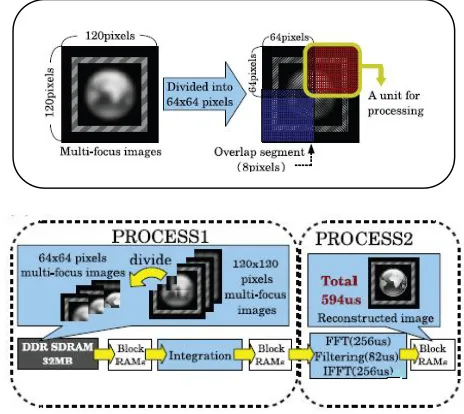
FPGA-based free viewpoint image reconstruction systems by using an onboard DDR SDRAM and processing the divided blocks of 64 × 64 pixels repeatedly. In this the free view point image is reconstructed with the help of 3D blurring filter, spatial frequency analysis and the dimension reduction technique[2].The whole process is implemented on FPGA using the DDR SDRAM blocks which is given in fig 4.
Fig. 4 Dividing Image block into 64 × 64 pixels and Process pipelining
III. COMPARISON OF IAMGE RECONSTRUCTION TECHNIQUES
Comparison of above described papers is given in following Table 1.
Table.1 Comparison of different techniques
Sr.No Used Method Advantages Disadvantages
1. Method of Shape from defocus that is the problem of deriving the 3D structural geometry of a scene from a set of defocused images.
1.Robust to noise
2.Can be used effectively to estimate depth
3.Can be implemented in real time
4.
1.Complexity is more
2. Combination of Spatial filtering and 3D convolution Filtering
1.Different viewpoint are considered
1.Real-time
implementation is critical 2.Expensive
3. Combination of Blurring model, spatial filtering and 3D filtering
1.Different viewpoint are considered
2.Robust to noise
1.Real-time
implementation is critical 2.Expensive
4. Method of Dimension reduction and 2D FFT and pipelining structure
1.Easy to implement 2.Algorithum is easy 3.Inexpensive
1.Sometimes becomes lengthy procedure
IV.CONCLUSION
Vol. 4, Issue 1, January 2015
drawbacks. So, the free viewpoint image reconstruction can be done with the help of filters for multi-focus images, and its preliminary implementation with simplified filters to FPGA can be done in future.
REFERENCES
1. Yusuke Minato, Kazuya Kodama, Takayuki Hamamoto,“ Free viewpoint image reconstruction by using linear filters for multi-focus images on
FPGA” Proceedings of 3DSA2013,P1-1,2013.
2. Izawa I., Hamamoto, T., Kodama K., “A Study On High-Quality Free Viewpoint Image Reconstruction Systems Using Multi-Focus Images By
FPGA-Based Signal Processing”, Proceedings of 2010 IEEE 17th International Conference on Image Processing ,pp.413-416, 2010
3. I.Izawa, K.Kodama, and T.Hamamoto, “Free viewpoint image reconstruction from 3-D multi-focus imaging sequences and its implementation
by FPGA-based processing,” in Proc. of IEEE International Conference on Signal and Image Processing Applications, pp. 415–418.,2009
4. X.Ou, T.Hamamoto, and K.Kodama, “Efficeient free viewpoint image reconstruction from multi-focus imaging sequences based on dimension
reduction,” in Proc. of IEEE International Symposium on Intelligent Signal Processing and Communication Systems, pp.152–155. ,2007
5. K. Kodama, H. Mo, and A. Kubota, “Free Viewpoint, Iris and Focus Image Generation by Using a Three-Dimensional Filtering based on
Frequency Analysis of Blurs,” in Proc. IEEE ICASSP, pp. 625-628.,2006
6. P.Favaro and S.Soatto, “A geometric approach to shape from defocus,” IEEE Trans. On Pattern Analysis And Machine Intelligence, vol. 27, pp.