ISSN (Print) : 2320 – 3765 ISSN (Online): 2278 – 8875
I
nternational
J
ournal of
A
dvanced
R
esearch in
E
lectrical,
E
lectronics and
I
nstrumentation
E
ngineering
(An ISO 3297: 2007 Certified Organization)
Vol. 4, Issue 6, June 2015
Different EBG Structures for UWB Band Pass
Filter
Sridhar Raja. D
Asst. Professor,Department of Electronics & Instrumentation, Bharath University, Chennai, India
ABSTRACT: In this paper different EBG structures are discussed and applied to deign band pass filter for ultra wide band application. The advantage of EBG structures the compactness and performance of the filter where different structures posses different performance .In this three different types of structures are investigated and applied to design UWB BPFs. The structures are Uniplanar compact–EBG (two structures) namely model 1 and model 2 and Foliated UC-EBG. The design is simulated using advanced design system using method of moments. The performance of filter is compared by their insertion loss and return loss.
KEYWORDS: Bandpass filter, electromagnetic bandgap (EBG), ultra wideband (UWB), wideband filter.
I. INTRODUCTION
The Ultra-wideband (UWB) technology is being reinvented recently with many promising modern applications. In particular, the UWB radio system has been receiving great attention from both academy and industry since the Federal Communications Commission (FCC) release of the frequency band from 3.1 to 10.6 GHz for commercial communication on applications in February 2002[1]. In an UWB system, an UWB band pass filter (BPF) is one of the key passive components to keep the spectrum of the signals to meet the FCC limits, or used in the UWB pulse generation and reshaping.
In such a system, an UWB filter is one of the key components, which should exhibit a wide bandwidth with low insertion loss over the whole band. In order to meet the FCC limit, good selectivity at both lower and higher frequency ends and flat group-delay response over the whole band are required .Over the last years, thedesign of wide and ultra-wide Bandpass filters is generating a great interest due to the fast development of broadband wireless communication systems. Traditional methods to implement ultra-wide bandpass filters usually introduce spurious bands .These un-desired bands become an important drawback for ultra-wide bandpass filters performance due to their proximity to the pass-band of interest. [2-5]
The recent research and development practical applications of EBG structures have improved realizing compact EBG structures filters. EBG structure recently is developed rapidly due to its unique properties to suppress the propagation of surface wave in microstrip filters. EBG structure is also known as a high impedance surface due to its ability to suppress the propagation of surface wave at the certain operational frequency. This structure is also has ability to block the effect of mutual coupling effect in array application.
FILTER THEORY
In designing a filter, the following important parameters are generally considered. • Pass bandwidth
• Stop band attenuation and frequencies • Input and output impedances
• Return loss • Insertion loss • Group delay
ISSN (Print) : 2320 – 3765 ISSN (Online): 2278 – 8875
I
nternational
J
ournal of
A
dvanced
R
esearch in
E
lectrical,
E
lectronics and
I
nstrumentation
E
ngineering
(An ISO 3297: 2007 Certified Organization)
Vol. 4, Issue 6, June 2015
IL (dB) =10log (Pi/PL) = -10 log(1-|Г|2) Where PL=Pi - Pr, if the filter is lossless
and Г is the voltage
reflection coefficient given by |Г|2 = Pr/Pi The return loss of the filter is defined by RL (dB) =10log (Pi/Pr) = -10log|Г|2)
which quantifies the amount of impedance matching at the input port.
The group delay is important for the multi-frequency or pulsed signals to determine the frequency dispersion or deviation from constant group delay over a given frequency band and is defined by
Td= [1/2π]*[dФt/df]
Where Фt is the transmission phase.
II. PROPOSED EBG STRUCTURE
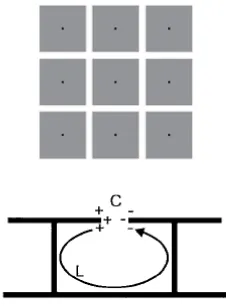
The conventional EBG structure has a wide band-gap and compact nature. The inductor L results from the current flowing through the connecting via. The gap between the conductor edges of two adjacent cells introduces equivalent capacitance C. Thus a two dimensional periodic LC network is realized which results in the frequency band-gap and the center frequency of the band-gap is determined by the formula [6-8]
ω = 1/√LC
From above equation it can be seen that in order to achieve an even more compact EBG structure, the equivalent capacitance C and inductance L should be increased. But in the EBG design procedure, if the dielectric material and its thickness have been chosen, the inductance L cannot be altered. Therefore, only the capacitance C can be enlarged . [9,10]
BASIC PRINCIPLE OF EBG STRUCTURE
The basic design of EBG structure is shown in figure 4 known as mushroom like EBG structure. This structure has frequency range where the surface impedance is very high. The equivalent LC circuit acts as a two-dimensional electric filter in this range of frequency to block the flow of the surface waves.. The inductor L results from the current flowing through the visa, and the capacitor C due to the gap effect between the adjacent patches. Thus, the approach to increase the inductance or capacitance will naturally result in the decrease of band-gap position.[11,12]
Figure 1: 2D EBG structure.
Central frequency of the band gap is given by; fc= 1/(2π√LC)
ISSN (Print) : 2320 – 3765 ISSN (Online): 2278 – 8875
I
nternational
J
ournal of
A
dvanced
R
esearch in
E
lectrical,
E
lectronics and
I
nstrumentation
E
ngineering
(An ISO 3297: 2007 Certified Organization)
Vol. 4, Issue 6, June 2015
The bandwidth of the electromagnetic band gap is given by;[13,14]
DESIGN OF PROPOSED UWB FILTERS
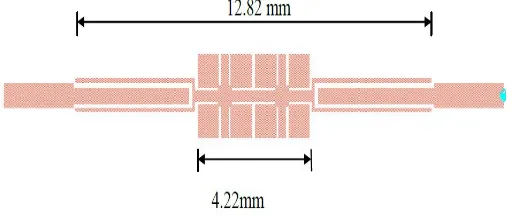
In this proposed model three uwb band pass filter are designed and simulated also compared wi. All BPFs are fabricated with thickness of 0.635 mm on an RT/Duroid substrate with a dielectric constant of 10.2 . The schematics of uniplanar compact–EBG (UC–EBG) structure 1 , uniplanar compact–EBG (UC–EBG) structure 2 Foliated UC-EBG structure are shown in fig 2,3 and4 respectively. The inter digital coupled lines used in all BPFs have a coupling peak at the center frequency of 6.85 GHz. Simple EBG Embedded Multi Mode Resonator UWB BPF is also shown in fig 2. There simulation as been done using ADS Momentum simulator
Fig 2.Uniplanar compact–EBG (UC–EBG) BPF using structure 1
Fig.3.Uniplanar compact–EBG (UC–EBG) BPF using structure 2
ISSN (Print) : 2320 – 3765 ISSN (Online): 2278 – 8875
I
nternational
J
ournal of
A
dvanced
R
esearch in
E
lectrical,
E
lectronics and
I
nstrumentation
E
ngineering
(An ISO 3297: 2007 Certified Organization)
Vol. 4, Issue 6, June 2015
2 4 6 8 10 12 14
0 16
-20 -15 -10 -5
-25 0
Frequency
M
a
g
.
[d
B
]
S12
SIMULATION RESULTS
Insertion loss for Uniplanar compact–EBG
(UC–EBG) structure 1 BPF
Insertion loss for Uniplanar compact–EBG
(UC–EBG) structure 2 BPF
ISSN (Print) : 2320 – 3765 ISSN (Online): 2278 – 8875
I
nternational
J
ournal of
A
dvanced
R
esearch in
E
lectrical,
E
lectronics and
I
nstrumentation
E
ngineering
(An ISO 3297: 2007 Certified Organization)
Vol. 4, Issue 6, June 2015
PERFORMANCE COMPARSION OF DIFFERENT EBG STRUCTURE
For Frequency range between 3.1 to 10.6 GHz
EBG structures Insertion loss
dB
(UC–EBG) structure 1 BPF 0dB
(UC–EBG) structure 2 BPF 1dB
Foliated UC-EBG filter UC-EBG
Less than 2dB
III. CONCLUSION
In this, three UWB BPFs with three EBG structures are investigated and simulated. There results have been compared by simulated using ADS Momentum simulator. The result shows that the EBG structure 1 has good insertion loss compare to other two structures. This is because of the less deformation in the structure,
REFERENCES
[1]FCC, Revision of Part 15 of the Commission’s Rules Regarding Ultra-Wideband Transmission Systems Federal Communications Commission, [2] Lydia Caroline M., Vasudevan S.,"Growth and characterization of l-phenylalanine nitric acid, a new organic nonlinear optical material", Materials Letters, ISSN : 0167-577X, 63(1) (2009) pp. 41-44.
Tech. Rep. ET-Docket 98-153, FCC02-48, Apr. 2002.
[3] H. Ishida and K. Araki, “Design and analysis of UWB bandpass filter,” in Proc. IEEE Top. Conf. Wireless Comm. Tech., Oct. 2003, pp.457–458. [4] Langeswaran K., Gowthamkumar S., Vijayaprakash S., Revathy R., Balasubramanian M.P., "Influence of limonin on Wnt signalling molecule in HepG2 cell lines", Journal of Natural Science, Biology and Medicine, ISSN : 0976-9668, 4(1) (2013) PP. 126-133.
[5] C.-L. Hsu, F.-C. Hsu, and J.-T. Kuo, “Microstrip bandpass filters for ultra-wideband (UWB) wireless communications,” in IEEE MTT-S Int.Dig., Jun. 2005, pp. 679–682.
[6] Jayalakshmi T., Krishnamoorthy P., Ramesh Kumar G., Sivamani P., "Optimization of culture conditions for keratinase production in Streptomyces sp. JRS19 for chick feather wastes degradation", Journal of Chemical and Pharmaceutical Research, ISSN : 0975 – 7384, 3(4) (2011) PP.498-503.
[7] W. Menzel, M. S. R. Tito, and L. Zhu, “Low-loss ultra-wideband (UWB) filters using suspended stripline,” in Proc. Asia-Pacific Microw.Conf., Dec. 2005, vol. 4, pp. 2148–2151.
[8] Jebaraj S., Iniyan S., "Renewable energy programmes in India", International Journal of Global Energy Issues, ISSN : 0954-7118, 26(4Mar) (2006) PP.232-257.
[9] K. Li, D. Kurita, and T. Matsui, “An ultra-wideband bandpass filter using broadside-coupled microstrip-coplanar waveguide structure,” in IEEE
MTT-S Int. Dig., Jun. 2005, pp. 675–678.
[10] Gopalakrishnan K., Prem Jeya Kumar M., Sundeep Aanand J., Udayakumar R., "Thermal properties of doped azopolyester and its application", Indian Journal of Science and Technology, ISSN : 0974-6846, 6(S6) (2013) PP. 4722-4725.
[11] J.-S. Hong and H. Shaman, “An optimum ultra-wideband microstrip filter,” Microw. Opt. Technol. Lett., vol. 47, no. 3, pp. 230–233, Nov.2005. [12] L. Zhu, S. Sun, and W. Menzel, “Ultra-wideband (UWB) bandpass filters
using multiple-mode resonator,” IEEE Microw. Wireless Compon.Lett., vol. 15, no. 11, pp. 796–798, Nov. 2005.
[13]F.-R. Yang, K.-P. Ma, Y. Qian, and T. Itoh, “A uniplanar compact photonic-bandgap (UC-PBG) structure and its applications for microwave circuit,” IEEE Trans. Microw. Theory Tech., vol. 47, no. 8,pp. 1509–1514, Aug. 1999.
[14]Microstrip Filters for RF/Microwave Applications JIA-SHENG HONG,M. J. LANCASTER ,JOHN WILEY & SONS, INC 29
[15]Application of Electromagnetic Bandgaps to the Design of Ultra-Wide Bandpass Filters With Good Out-of-Band Performance. IEEE TRANSACTIONS ON MICROWAVE THEORY AND TECHNIQUES, DECEMBER 2006
[16]Recent Development of Ultra-Wideband (UWB) Filters IEEE 2007 International Symposium on Microwave, Antenna, Propagation, and EMC Technologies.
[17] D.Kalaivani, Mrs.M.Indirani & Dr.A.Mukunthan, A Theoretical Study of Primary Nucleation Kinetics of L-Histidine Bromide: Semi Organic Optical Single Crystal, International Journal of Innovative Research in Science, Engineering and Technology, ISSN: 2319-8753,pp 4192-4197, Vol. 2, Issue 9, September 2013
[18] D.Prakash and Dr. A.Mukunthan, A Theoretical Study of Internal Pressure And Free Volume for Single Molecule of a Sample Liquid, International Journal of Innovative Research in Science, Engineering and Technology, ISSN: 2319-8753,pp 7252-7257, Vol. 2, Issue 12, December 2013
[19] Dr. A. Mukunthan & Ms.S.Sudha, FTIR Spectroscopic Features of Blood Serum of Diseased and Healthy Subjects (Animals), International Journal of Innovative Research in Science, Engineering and Technology, ISSN: 2319-8753, pp 2035-2040 Vol. 2, Issue 6, June 2013
ISSN (Print) : 2320 – 3765 ISSN (Online): 2278 – 8875
I
nternational
J
ournal of
A
dvanced
R
esearch in
E
lectrical,
E
lectronics and
I
nstrumentation
E
ngineering
(An ISO 3297: 2007 Certified Organization)
Vol. 4, Issue 6, June 2015
[21] Dr. M. Ganesan, Mergers and Acquisitions, International Journal of Innovative Research in Science, Engineering and Technology, ISSN: 2319-8753,pp 9081-9085, Vol. 3, Issue 2, February 2014