FPGA Implementation of Memory Efficient
DA-Based LMS Adaptive Filter
D.Venkatesh
1, S.Sruthi
2PG Student, Dept. of ECE, Shree Institute of Technical Education, Tirupati, A.P, India1 Assistant Professor, Dept. of ECE, Shree Institute of Technical Education, Tirupati, A.P, India2
ABSTRACT: In this paper, an productive implementation of adaptive filter is presented which reduces the area and power consumed by the Least Mean Square (LMS) algorithm. To achieve the lesser area and power efficient the memory based structures are replaced with the MAC units. The LUTs are memory based units used for the design of the filter. Distributed Arithmetic is a bit serial-computational action and uses parallel look up tables apprise and equal implementation of filtering and weight updated operations to appliance high throughput filter rates irrespective of the filter length. The least mean square algorithm adaption is functioned to update the weight and abate the mean square the error between the assessed and chosen output. The weight increment block based adders and a subtractor cell is exchanged by carry save adder in order to reduce area difficulty. It comprises of multiplexers, small LUTs and practically half number of adders contrasted to the Distributed Arithmetic based design.
KEYWORDS: Adaptive filter, circuit optimization, Distributed Arithmetic (DA), Least Mean Square algorithm (LMS).
I. INTRODUCTION
Finite Impulse Response (FIR) filters are one of the key building blocks of many signal processing applications in communication systems. Channel equalization, interference cancellation and matched filtering are some variety of FIR filter applications. Recently, software defined radio (SDR) application has increased the demand for reconfigurable communication systems capable of multi standard operations. Hence, the programmable and reconfigurable FIR filter architectures are needed for next generation communication systems with low power consumption, low complexity and high speed operation requirements. The major bottleneck in FIR filter implementation is coefficients multipliers, which are traditionally implemented by add/sub/shift operations [1].
Digital filters are the essential units for digital signal processing systems. Traditionally, digital filters are achieved in Digital Signal Processor (DSP), but DSP-based solution cannot meet the high speed requirements in some applications for its sequential structure. Now a day's Field Programmable Gate Array (FPGA) technology is widely used in digital signal processing area because FPGA-based solution can achieve high speed due to its parallel structure and configurable logic, which provides great flexibility and high reliability in the course of design and later maintenance [3].
mathematical forms of adaptive filters as opposed to their specific realizations in software or hardware. By choosing a particular adaptive filter structure, one specifies the number and type of parameters that can be adjusted.
Fig.1: Block diagram of adaptive filter
The adaptive algorithm is used to update the parameter values of the system can take on a myriad of forms and is often derived as a form of optimization procedure that minimizes an error criterion that is useful for the task at hand. In this section, we present the general adaptive filtering problem and introduce the mathematical notation for representing the form and operation of the adaptive filter. We then discuss several different structures that have been proven to be useful in practical applications. We provide an overview of the many and varied applications in which adaptive filters have been successfully used finally, we give a simple derivation of the least-mean-square (LMS) algorithm, which is perhaps the most popular method for adjusting the coefficients of an adaptive filter, and we discuss some of this algorithm‟s properties. As for the mathematical notation used throughout this section, all quantities are assumed to be real-valued. Scalar and Vector quantities shall be indicated by lowercase (x) and uppercase-bold (X) letters, respectively. We represent scalar and vector sequences or signals as x (n) and X (n), respectively, where n denotes the discrete time or discrete spatial index, depending on the application [12].
Here w represents the coefficients of the FIR filter tap weight vector, x(n) is the input vector samples, z-1 is a delay of one sample periods, y(n) is the adaptive filter output, d(n) is the desired echoed signal and e(n) is the estimation error at time n. The aim of an adaptive filter is to calculate the difference between the desired signal and the adaptive filter output, e(n). This error signal is fed back into the adaptive filter and its coefficients are changed algorithmically in order to minimize a function of this difference, known as the cost function. In the case of acoustic echo cancellation, the optimal output of the adaptive filter is equal in value to the unwanted echoed signal. When the adaptive filter output is equal to desired signal the error signal goes to zero. In this situation the echoed signal would be completely cancelled and the far user would not hear any of their original speech returned to them.
III. EXISTING SYSTEM
Fig.2: Conventional DA-based implementation of four-point inner product
However, we find that when the APC approach is combined with the OMS technique, the two‟s complement operations could be very much simplified since the input address and LUT output could always be transformed into odd integers. However, the OMS technique in cannot be combined with the APC scheme since the APC words generated according to odd numbers. Moreover, the OMS scheme does not provide an efficient implementation when combined with the APC technique. In this brief, we therefore present a different form of APC and combined that with a modified form of the OMS scheme for efficient memory based multiplication [4].
IV. PROPOSED SYSTEM
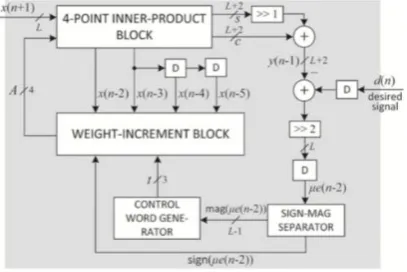
The proposed structure of DA-based adaptive filter of length N = 4is shown in Fig. 3. It consists of a four-point inner product block and a weight-increment block along with additional circuits for the computation of error value e(n) and control word t for the barrel shifters. The four-point inner-product block includes a DA table consisting of an array of 15 registers which stores the partial inner products yl for 0 < l ≤ 15 and a 16 : 1 multiplexor (MUX) to select the
content of one of those registers. Bit slices of weights A = {w3l w2l w1l w0l} for 0 ≤ l ≤ L − 1 are fed to the MUX as
control in LSB-to- MSB order, and the output of the MUX is fed to the carry-save accumulator. After L bit cycles, the carry-save accumulator shift accumulates all the partial inner products and generates a sum word and a carry word of size (L + 2)bit each. The carry and sum words are shifted added with an input carry “1” to generate filter output which is subsequently subtracted from the desired output d(n) to obtain the error e(n) [4].
Fig. 3: Proposed structure of DA-based LMS adaptive filter
IMPLEMENTATION OF THE LMS ALGORITHM
The main reason for the LMS algorithms popularity in adaptive filtering is its computational simplicity, making it easier to implement than all other commonly used adaptive algorithms. For each iteration the LMS algorithm requires 2N additions and 2N+1 multiplications (N for calculating the output, y(n), one for 2e(n) and an additional N for the scalar by vector multiplication) [4].
V. RESULTS AND DISCUSSION
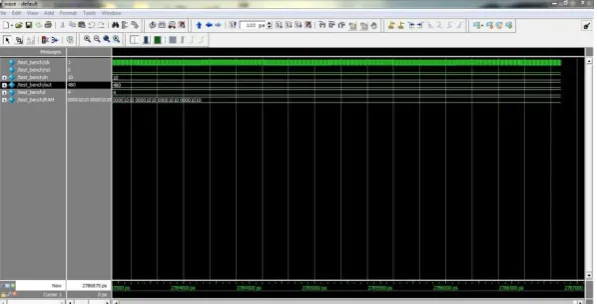
The simulation waveform shown below is the desired output response for the conventional DA based FIR filter. The output is simulated using Xilinx Model sim simulator based on ALTERA stater edition 6.4 a. and is shown in figure 4.
Fig. 4: FIR Filter
The figure 5 shows the simulation results obtained for the proposed DA based LMS adaptive filter, which is extension work of conventional DA based LMS filter. The results obtained are satisfactory due to the replacement of MACs instead of memory based units.
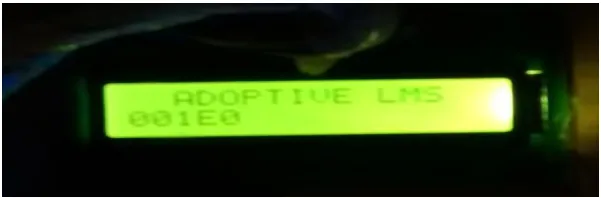
Fig .6: LMS output on Spartan 3E Kit
The figure 6 shows the proposed LMS output on the Spartan 3E FPGA board. The improvement and optimization of DA algorithm has made the operation speed faster and occupy less memory to obtain satisfactory results.
VI. CONCLUSION
We have suggested an efficient pipelined architecture for low-power, high-throughput, and low-area implementation of DA-based LMS adaptive filter. Throughput rate is significantly enhanced by parallel LUT update and concurrent processing of filtering operation and weight-update operation. From the simulation the LMS adaptive filter has the reduced size LUT when compared to conventional DA based adaptive filter and the memory efficiency of LMS adaptive filter is verified using Spartan 3E FPGA kit.
REFERENCES
[1] S. Haykin and B. Widrow, Least-Mean-Square Adaptive Filters. Hoboken, NJ, USA: Wiley, 2003.
[2] M. Keerthi, Vasujadevi Midasala, S Nagakishore Bhavanam, Jeevan Reddy K, "FPGA Implementation Of Distributed Arithmetic For FIR Filter," in International Journal of Engineering Research & Technology on Vol.1 - Issue 9 (November - 2012).
[3] S. A. White, “Applications of the distributed arithmetic to digital signal processing: A tutorial review,” IEEE ASSP Mag., vol. 6, no. 3, pp. 4– 19, Jul. 1989.
[4] Sang Yoon Park and Pramod Kumar Meher, "Low-Power, High-Throughput, and Low-Area Adaptive FIR Filter Based on Distributed Arithmetic," in Circuits and Systems II: Express Briefs, IEEE Transactions on (Volume:60 , Issue: 6 ), pp. 346-350.
[5] D. J. Allred, H. Yoo, V. Krishnan, W. Huang, and D. V. Anderson, “LMS adaptive filters using distributed arithmetic for high throughput,”
IEEE Trans. Circuits Syst. I, Reg. Papers, vol. 52, no. 7, pp. 1327–1337, Jul. 2005.
[6] R. Guo and L. S. DeBrunner, “Two high-performance adaptive filter implementation schemes using distributed arithmetic,” IEEE Trans. CircuitsSyst. II, Exp. Briefs, vol. 58, no. 9, pp. 600–604, Sep. 2011.
[7] R. Guo and L. S. DeBrunner, “A novel adaptive filter implementation scheme using distributed arithmetic,” in Proc. Asilomar Conf. Signals, Syst., Comput., Nov. 2011, pp. 160–164.
[8] P. K. Meher and S. Y. Park, “High-throughput pipelined realization of adaptive FIR filter based on distributed arithmetic,” in VLSI Symp. Tech.Dig., Oct. 2011, pp. 428–433.
[9] M. D. Meyer and P. Agrawal, “A modular pipelined implementation of a delayed LMS transversal adaptive filter,” in Proc. IEEE Int. Symp. CircuitsSyst., May 1990, pp. 1943–1946.
[10] P. K. Meher, Jul. 2008, “New approach to look-up-table design and memory-based realization of FIR digital filter,” IEEE Trans. Circuits Syst. I, Reg. Papers, vol. 57, no. 3, pp. 592–603.
[11] P. K. Meher, April 2010, „LUT Optimization for Memory-Based Computation,‟ IEEE Trans on Circuits & Systems-II, pp.285-289.