ISSN(Online): 2319-8753 ISSN (Print): 2347-6710
I
nternational
J
ournal of
I
nnovative
R
esearch in
S
cience,
E
ngineering and
T
echnology
(A High Impact Factor, Monthly, Peer Reviewed Journal) Visit: www.ijirset.com
Vol. 8, Issue 8, August 2019
Facial Expressions Recognition Based Using
LBP and SVM Classifier
Bhupendra Singh, Ravndra Kumar Sharma, Rakesh Kumar Saxena, Ms. Ragini Malviya
Research Scholar (EI&C), IET, Alwar, Rajasthan, India
Assistant Professor, IET, Alwar, Rajasthan, India
Professor, Global Institute of Technology, Jaipur, Rajasthan, India
Assistant Professor, Noida Institute of Engineering and Technology, Uttar Pradesh, India
ABSTRACT: Facial expression analysis is a remarkable and demanding problem, and impacts significant applications in various fields like human-computer interaction and data-driven animation. Developing an efficient facial representation from the original face images is a crucial step for achieving facial expression recognition. Facial representation based on statistical local features, Local Binary Patterns (LBP) is practically assessed. Several machine learning techniques were thoroughly observed on various databases. LBP features- which are effectual and competent for facial expression recognition are generally used by researchers Cohn Kanade is the database for present work and the programming language used is MATLAB. Firstly, face area is divided in small regions, by which histograms, Local Binary Patterns (LBP) are extracted and then concatenated into single feature vector. This feature vector outlines a well-organized representation of face and is helpful in determining the resemblance among images.The FR system was configured in verification mode using Eigen face approach derived on these LBP based histogram feature vectors. The FER system was configured for multi-class facial expression classification mode using Support Vector Machine (SVM).
KEYWORDS: LBP, SVM, facial expression, Gaussian filter
I. INTRODUCTION
Facial expression recognition (FER) has become a hot research topic of human-computer interaction (HCI) and drawn a lot of attention due to its great potential in multimedia applications, e.g. digital entertainment, customer service, driver monitoring and so on. HCI would become more friendly and natural if computers arable to recognize affects as human beings, which can benefit from solving FER problems.FER aims to analyze and classify a given facial image into one of the six commonly used emotion types where the six emotion categories are angry, disgust, fear, happy, sad and surprise. Numerous algorithms of FER have been Proposed in the literatures during the past several years, including expression recognition from frontal and non-frontal facial images. Comparing to frontal FER, non-frontal FER is more challenging and more applicable in real scenarios. However, only a small part of algorithms among the proposed various Methods address this challenging issue. For both frontal And non-frontal FER problems, a general Recognition
framework appeared in most of previous
ISSN(Online): 2319-8753 ISSN (Print): 2347-6710
I
nternational
J
ournal of
I
nnovative
R
esearch in
S
cience,
E
ngineering and
T
echnology
(A High Impact Factor, Monthly, Peer Reviewed Journal) Visit: www.ijirset.com
Vol. 8, Issue 8, August 2019
II. RELATED WORK
In existing system, several methods are used to extract image face features vector, which presents small inter-person variation. This feature vector is feed to a multilayer perceptron to carry out the face recognition or identity verification tasks. Proposed system consists in a combination of Gabor and Eigen faces to obtain the feature vector. Evaluation results show that proposed system provides robustness against changes in illumination, wardrobe, facial expressions, scale, and position inside the captured image, as well as inclination, noise contamination and filtering. Proposed scheme also provides some tolerance to changes on the age of the person under analysis. Evaluation results using the proposed scheme with identification and verification configurations are given and compared with other feature extraction methods to show the desirable features of proposed algorithm.Two image representation approaches called non-negative matrix factorization (NMF) and local non-negative matrix factorization (LNMF) have been applied to two facial databases for recognizing six basic facial expressions. A principal component analysis (PCA) approach was performed as well for facial expression recognition for comparison purposes. We found that, for the first database, LNMF outperforms both PCA and NMF, while NMF produces the poorest recognition performance. Results are approximately the same for the second database, with slightly performance improvement on behalf of NMF. new facial expression recognition method based on Local Fisher Discriminate Analysis (LFDA) is proposed. LFDA is used to extract the low-dimensional discriminator embedded data representations from the original high-dimensional local binary patterns (LBP) features. The K nearest- neighbour (KNN) classifier with the Euclidean distance is adopted for facial expression classification. The experimental results on the popular JAFFE facial expression database demonstrate that the best accuracy based on LFDA is up to 85.71%, outperforming the used Principal Component Analysis (PCA), and Linear Discriminate Analysis (LDA
III. PROPOSED APPROCH
In This process proposed a face descriptor, using the algorithm local binary pattern (LBP), for facial expression recognition. Hence LBP is used to extract the feature information of emotion-related features by using the directional information and ternary pattern in order to take the fine edge in the face region while the face having the smooth regions. This proposed method has better than the other existing, by extracting the histogram-based face description methods that divide the face into a small blocks and then the sample codes uniformly. Then the grid to construct the face descriptor while sampling expression related information at different scales is classified Dimension reduction by extracting discriminating features is based on the idea of maximizing the total scatter of the data while minimizing the variance within classes. It can be seen that the feature values for the six classes are highly merged, which can result in a high misclassification rate. Please note that the actual number of features could be more than three, however, for the sake of visualization, the first three features were picked in order to create. Accordingly, this work employs a robust feature. This is easy to explain, has good predictive ability, and computationally, it is less expensive than other existing methods. As mentioned before that the existing HCRF utilizes diagonal covariance Gaussian distributions in the feature function and does not guarantee the convergence of its parameters to some specific values at which the conditional probability is modelled as a mixture of normal density functions. Because of this property, the existing HCRF losses a lot of information. This is one of the main disadvantages of the existing HCRF model. In order to solve this limitation, we explicitly involve full covariance Gaussian distributions in the feature functions at the observation level.
ISSN(Online): 2319-8753 ISSN (Print): 2347-6710
I
nternational
J
ournal of
I
nnovative
R
esearch in
S
cience,
E
ngineering and
T
echnology
(A High Impact Factor, Monthly, Peer Reviewed Journal) Visit: www.ijirset.com
Vol. 8, Issue 8, August 2019
real-life scenarios. We tested a large group of wavelets and decomposed them up to four levels to classify weed images into weeds with broad leaves versus weeds with narrow leaves classes. This employed to reduce the feature space by extracting only the most meaningful features. Finally, the features provided by SVMs for classification. The proposed method was tested on a database of 1200 samples, which is a much larger database size than that studied previously (200-400 samples).
Fig.1 Proposed Block Diagram
ISSN(Online): 2319-8753 ISSN (Print): 2347-6710
I
nternational
J
ournal of
I
nnovative
R
esearch in
S
cience,
E
ngineering and
T
echnology
(A High Impact Factor, Monthly, Peer Reviewed Journal) Visit: www.ijirset.com
Vol. 8, Issue 8, August 2019
Pre-processing means "preparation" of the sample/image to introduce it to an algorithm for specified task: tracking targets, recognition, feature extraction, etc.Data pre-processing is a data mining technique that involves transforming raw data into an understandable format. Real-world data is often incomplete, inconsistent, and/or lacking in certain behaviors or trends, and is likely to contain many errors. Data pre-processing is a proven method of resolving such issues.
We can convert our data files (.xlsx) into .mat files and align the data. The purpose of optimization is to achieve the “best” design relative to a set of prioritized criteria or constraints. Selecting the suiting features are important to the mode land considerably influence the results. Quality and quantity of the features have great impact on whether the model is good or not. In order to improve the prediction model, different Data pre-processing techniques were applied Data integration is to combine data from multiple sources into a coherent store. In integration processing, the redundant data problem always occur, since the same real world entity, attribute values from different sources have different names, or one attribute may be a derived attribute in another table. Therefore, researchers should carefully identify real world entities from multiple data sources by using correlation analysis. Otherwise, careful integration of the data from multiple sources may help to reduce/avoid redundancies and inconsistencies and improve mining speed and quality [9]. The presented system has a architecture. It is composed of different modules connected by dependencies the input image and the recognition results the storage of the face representation is shown by the Face Gallery. Images taken from data set gallery the first module deals with Resize & Normalization followed by processing this pre-processing module converts a color image into its grey-scale representation, then it performs face detection. The detected face is further extracted from the image in the next step. This module also detects the face of object in the detected face region and transforms and resizes The face The feature extraction module is used to create the face representation. It detects the SIFT key-points and creates a set of SIFT descriptors for a representation of the face image. The next module is used to select the most representative face vectors in order to create a precise face model the algorithm implemented within this module then face recognition. A recognized face is compared to the face models stored in the Face Gallery and the most similar model is chosen as the recognized one. The last confidence measure module is dedicated to identifying whether the recognition result is correct or not followed by classifier.
ISSN(Online): 2319-8753 ISSN (Print): 2347-6710
I
nternational
J
ournal of
I
nnovative
R
esearch in
S
cience,
E
ngineering and
T
echnology
(A High Impact Factor, Monthly, Peer Reviewed Journal) Visit: www.ijirset.com
Vol. 8, Issue 8, August 2019
Fig.3 Proposed flow Diagram
STRUCTURE: This feature describes the structure of the image or the locations of objects in the image in contrast to each other. For example, an image includes different objects such as tree, bird, cat etc.
SHAPE: From the human point of view shape is a high-level concept but from the mathematical view shape is a low-level element. In pattern recognition, shape is described as a function of position and direction simply as a connected curve within a 2D field [7]. Shape features can be used for medical applications for example for cervical cell classification or for content-based image retrieval systems where color features are not useful [8]
ISSN(Online): 2319-8753 ISSN (Print): 2347-6710
I
nternational
J
ournal of
I
nnovative
R
esearch in
S
cience,
E
ngineering and
T
echnology
(A High Impact Factor, Monthly, Peer Reviewed Journal) Visit: www.ijirset.com
Vol. 8, Issue 8, August 2019
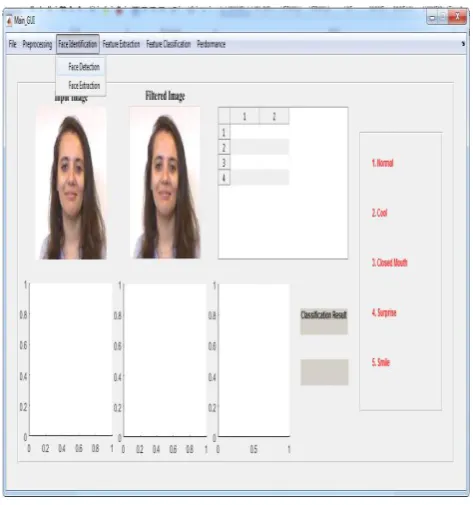
Fig. 5 GUI Window input image
FEATURE EXTRACTION: Large amounts of data are used to represent an image, so the analysis of an image needs a large amount of memory and thus takes more time. In order to reduce the amount of data, an image is represented using a set of features. Feature extraction is a primitive type of pattern recognition and it is very important for pattern recognition. This step extracts some features such as color, shape, and texture. Features contain the relevant information of an image and will be used in image Processing (e.g. searching, retrieval, storing). It
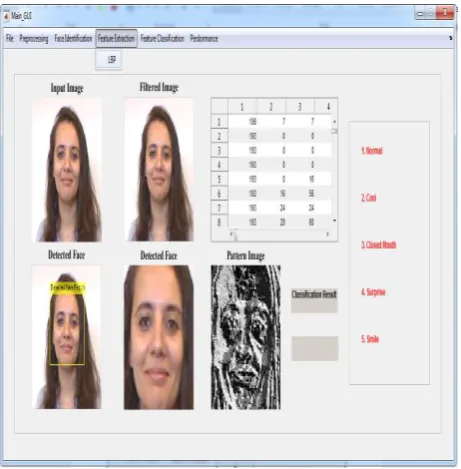
Fig. 6 GUI detected image
ISSN(Online): 2319-8753 ISSN (Print): 2347-6710
I
nternational
J
ournal of
I
nnovative
R
esearch in
S
cience,
E
ngineering and
T
echnology
(A High Impact Factor, Monthly, Peer Reviewed Journal) Visit: www.ijirset.com
Vol. 8, Issue 8, August 2019
color signal is an extension from scalar signals to vectoamr-signals. The color can be represented by an average color (three scalars) or a color histogram (three functions). Color features can be derived from a histogram of the image. The multi-dimensional histogram is used for the multi-color image from a brightness histogram, the color features are derived as RGB components.
Fig 7 GUI detected image
This module also detects the face of object in the detected face region and transforms and resizes the face. The feature extraction module is used to create the face representation.
ISSN(Online): 2319-8753 ISSN (Print): 2347-6710
I
nternational
J
ournal of
I
nnovative
R
esearch in
S
cience,
E
ngineering and
T
echnology
(A High Impact Factor, Monthly, Peer Reviewed Journal) Visit: www.ijirset.com
Vol. 8, Issue 8, August 2019
CLASSIFICATION :The goal of a classifier is to compare the features of a test face image with those of the template and give the final decision in terms of some similarity measures. For face identification, the most widely used classifier is the Nearest Neighbor (NN) classifier. An important issue for designing the NN classifier is how to measure the similarity. A direct way is to measure how similar the two compared images are. Another possible way is to compute the distance between the two image features.
Fig 9 feature value Window
Fig 10 GUI smile image
ISSN(Online): 2319-8753 ISSN (Print): 2347-6710
I
nternational
J
ournal of
I
nnovative
R
esearch in
S
cience,
E
ngineering and
T
echnology
(A High Impact Factor, Monthly, Peer Reviewed Journal) Visit: www.ijirset.com
Vol. 8, Issue 8, August 2019
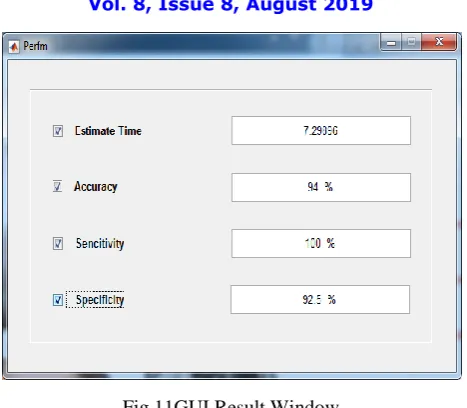
Fig 11GUI Result Window
Module is used to select the most representative face vectors in order to create a precise face model the algorithm implemented within this module
IV. CONCLUSION
Object detection and tracking is an important task in computer vision field. In object detection and tracking it consist of two major processes, object detection and object tracking. Object detection in video image obtained from single camera with static background that means fixing camera is achieved by background subtraction approach. In this thesis, we tried different videos with fixed camera with a single object and multiple objects to see it is able to detect objects. Motion based systems for detecting and tracking given moving object of interest can be created. Using SIFT feature extraction first feature of the object and the frame has detected to match the interested object. Since for feature extraction, SIFT algorithm has been used so tracker is invariant to representation of interested object we proposed a model mainly improve the current work and find that the local facial features and expressions are correlated. We divide the facial area on the basis of the cognitive neurological theory to recognize and compare with the theory. It is conducive to the future expressions recognition with the existence of occlusion and other complex conditions. We use LBP codes to describe the images and take into account the distances between the points of the image distribution in binary space that can’t be measured directly in European distance. Finally, the basic emotion classification model and the circumflex emotion model based on dimension space theory are discussed and contrasted.
Table 1.Confusion Matrix and Automatic Facial Expression Recognition Performance
Normal Cool Surprise Closed Mouth
Smile Normal 20 05 0 0 0
Cool 2 25 0 1 0
Surprise 0 1 25
Closed Mouth
1 0 0 24 4
ISSN(Online): 2319-8753 ISSN (Print): 2347-6710
I
nternational
J
ournal of
I
nnovative
R
esearch in
S
cience,
E
ngineering and
T
echnology
(A High Impact Factor, Monthly, Peer Reviewed Journal) Visit: www.ijirset.com
Vol. 8, Issue 8, August 2019
REFERENCES
1. Face Recognition Using DRLBP and SIFT Feature Extraction M. Sushama E.Rajinikanth 2018 International Conference on Communication
and Signal Processing (ICCSP)
2. Representation of Pose Invariant Face Images Using SIFT Descriptors Nthabiseng Mokoena ; Kishor Nair2018 International Conference on
Advances in Big Data, Computing and Data Communication Systems (icABCD)
3. PNN-SIFT: An enhanced face recognition and classification system in image processing W. Sylvia Lilly Jebarani ; T. Kamalaharidharini 2017
4th International Conference on Electronics and Communication Systems (ICECS)
4. Robust face recognition and classification system based on SIFT and DCP techniques in image processing W. Sylvia Lilly Jebarani ; T.
Kamalaharidharini 2017 International Conference on Intelligent Computing and Control (I2C2)
5. Image matching with SIFT feature Rajkumar N. Satare ; S. R. Khot 2018 2nd International Conference on Inventive Systems and Control
(ICISC)
6. B. Moghaddam, C. Nastar and A. Pentland, “A Bayesian similarity measure for deformable image matching,” Image and Vision Computing,
vol. 19, no. 5, pp. 235-244, 2001.
7. B. Shan, “A Novel Image Correlation Matching Approach,” JMM, vol. 5, no. 3, 2010.
8. David G Lowe, “Distinctive Image Features from Scale-Invariant Keypoints,” International Journal of Computer Vision, vol.50, No. 2, 2004,
pp.91-110.
9. .E. Karami, M. Shehata, A. Smith, “Image Identification Using SIFT Algorithm: Performance Analysis Against Different Image
10. Deformations,” in Proceedings of the 2015 Newfoundland Electrical and Computer Engineering Conference,St. john’s, Canada, November,
2015.
11. M. Güzel, 'A Hybrid Feature Extractor using Fast Hessian Detector and SIFT', Technologies, vol. 3, no. 2, pp. 103-110, 2015.
12. Liang-Chi Chiu, Tian-Sheuan Chang, Jiun-Yen Chen and N. Chang, 'Fast SIFT Design for Real-Time Visual Feature Extraction', IEEE Trans.
On Image Process., vol. 22, no. 8, pp. 3158-3167, 2013.
13. Mehrabian, J. A. Russell, ”An approach to environmental psychology”, Cambridge, MA, US: The MIT Press, 1974.
14. P. Ekman, W. V. Friesen, ”Facial action coding systema technique for the measurement of facial movement”, Palo AltO: Consulting
Psychologists Press, pp. 271-302, 1978.
15. P. Lucey, J. F. Cohn, T. Kanade, J. Saragih, Z. Ambadar, and I. Matthews, ”The Extended Cohn-KanadeDataset (CK+) A complete dataset for