Optimization of Mechanical Stir Casting
Parameters for Fabrication of Al5083-Sic
Alloy Composite through Taguchi Method
Gopireddy Ashok Reddy
1, N Govind
2P.G. Student, Department of mechanical Engineering, RVR&JC Engineering College, Chowdavaram, Guntur,
Andhra Pradesh, India1
Associate Professor, Department of mechanical Engineering, RVR&JC Engineering College, chowdavaram, Guntur,
Andhra Pradesh, India2
ABSTRACT: The “composite material” is composed of a discrete reinforcement & distributed in a continuous phase of matrix, In Aluminium matrix composite (AMC) one constitutes is aluminium which forms network i.e. matrix phase and another constitute serve as reinforcement which is generally ceramic or non metallic hard material. The basic reason of metals reinforced with hard ceramic particles or fibers are improved properties than its original material like strength, stiffness etc. Stir casting process is mainly used for manufacturing of particulate reinforced metal matrix composite (PMMC). Properties of these materials depend upon many processing parameters and selection of matrix and reinforcements. This paper presents an overview of stir casting process, process parameter, & preparation of AMC material by using aluminium as matrix form and SiC as reinforcement by varying proportion. The optimization and effect of variables such as amount of SiC, stirring speed and quenching type were investigated using arobust
design of experiment (DOE), namely,Taguchi
method,withtwofactoriallevels.Thesignal-to-noise(S/N)ratio(„largerisbetter‟) for hardness and(„smaller is best‟) for wear resistance were used as response variables.
KEYWORDS: Text detection, Inpainting, Morphological operations, Connected component labelling.
I. INTRODUCTION
Now days with the modern development need of developments of advanced engineering materials for various engineering applications goes on increasing. To meet such demands metal matrix composite is one of reliable source. Composite material is one of the reliable solutions for such requirement. In composites, materials are combined in such a way as to enable us to make better use of their parent material while minimizing to some extent the effects of their deficiencies. The simple term „composites‟ gives indication of the combinations of two or more material in order to improve the properties. In the past few years, materials development has shifted from monolithic to composite materials for adjusting to the global need for reduced weight, low cost, quality, and high performance in structural materials. Driving force for the utilization of AMCs in areas of aerospace and automotive industries include performance, economic and environmental benefits. In AMC one of the constituents is aluminum, which forms percolating network and is termed as matrix phase. The other constituent is embedded in this aluminum and serves as reinforcement, which is usually non-metallic and commonly ceramic such as SiC, Al2O3 etc.
method is one of the best tools to optimize parameters for composite devel- opment.Ceschini et alindicated that the amount of rein forced material, process temperatures, types of wett ability agent, stirring method and stirring duration play key roles in determination of the final physical and mechanical properties of aluminium alloys fabricated by stircasting.
II. EXPERIMENTAL PROCEDURE
Materials: Aluminum alloy 5083 was selected as matrix alloy for synthesis of AMCs. The chemical compositions are shown in Table 1. Silicon Carbide particulates were used as reinforcement material and average particle size was 40 to 60 µm (SiCp-β, 99+%pure).
Plan of investigation:
The research work was planned to be carried out in the following steps:
Identifying the important controllable process parameters.
Finding the range of identified parameters viz. weight fraction of reinforcement, stirrer speed and quenching
type.
Developing the composite design matrix.
Producing the stir-cast specimen as per design matrix.
Conducting hardness test and wear test recording the values.
Developing the hardness model and checking the adequacy.
Results and discussion.
The experimental plan was formulated considering three parameters (variables) and two levels based on the Factorial Design technique. The levels of these variables chosen for experimentation are given in Table 2. Synthesis of aluminum alloy SiC composites casting was done according to composite design matrix. Four samples each with 3% and 6% weight fraction of SiC of composites were fabricated by stir casting.
Table 1: Composition of AA 5083 Al alloy
Element Zn Fe Ti Cu Si Pb Mn Mg Cr Al
% 0.03 0.173 0.04 0.0181 0.16 0.014 0.526 5.13 0.097 Balance
Table 2: Parameters and their levels
Level
Weight % of SiC (W)
Stirring speed
(RPM) Quenching
+1 3 450 Air
Table 3: Design Matrix
Expt. No. W S T
1 +1 +1 +1
2 +1 +1 -1
3 +1 -1 +1
4 +1 -1 -1
5 -1 +1 +1
6 -1 -1 -1
7 -1 -1 +1
8 -1 +1 -1
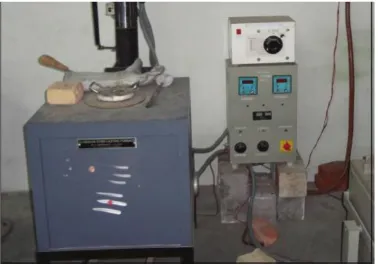
III.EXPERIMENTATION
IV.RESULTSANDDISCUSSIONS Hardness Test:
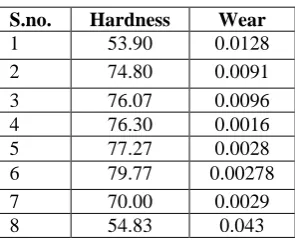
Hardness Test Brinell hardness test was performed to measure the hardness of the specimens. A force of 250kg was applied on the specimens by indenter of diameter 5mm for 10 seconds. The depression formed was studied under the microscope and the Brinell hardness number was calculated accordingly. Three readings were taken at different positions on the specimens to get maximum accurate results. The readings are then plotted on the table 4 shows the observed readings and results.After completing the experiments according to the L8 orthogonal array parametric combinations, hardness and wear resistance for each work piece is calculated. For the calculated values of hardness signal to noise ratios(S/N ratio) are obtained by using statistical tool MINITAB 17.
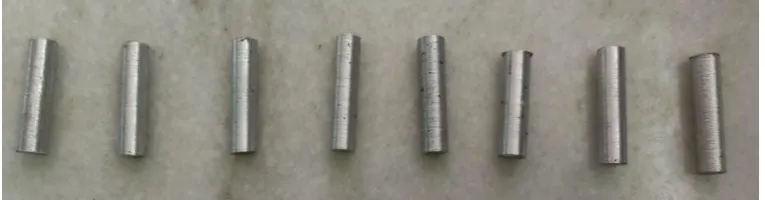
Figure 2: Work pieces after hardness test
Table 4:Hardness and wear values
S.no. Hardness Wear
1 53.90 0.0128
2 74.80 0.0091
3 76.07 0.0096
4 76.30 0.0016
5 77.27 0.0028
6 79.77 0.00278
7 70.00 0.0029
8 54.83 0.043
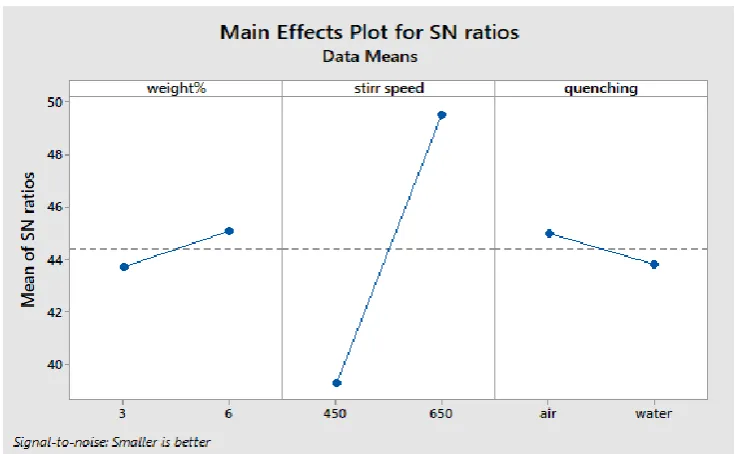
Figure 3: Main Effects plot for SN ratios of hardness v/s factors
Table 5: Response Table for Means
Level Weight% Stir speed Quenching
1 70.27 65.20 69.31
2 70.47 75.53 71.42
Delta 0.20 10.34 2.11
Rank 3 1 2
Wear Test:
Wear resistance testing was done on Pin-On-Disc machine at load of 10N and rotational speed of disc of 477.46rpm. Standard cylindrical pin wear testing sample was prepared on the lathe machine having dimensions of 8mm diameter and 1inch length as shown in Figure 4
Following parameters were used to perform wear test. Load (N)-10 Newton,
Disk Rotation speed-477.46rpm. Track radius-60mm,
Figure 5: Main Effects plot for SN ratios of wear v/s factors
Table 6: Response Table for Means
Level Weight% Stir speed Quenching
1 0.008275 0.016925 0.007025
2 0.012870 0.004220 0.014120
Delta 0.004595 0.012705 0.007095
Rank 3 1 2
The effect of input parameters on the wear resistance can be studied by analysing the data in MINITAB17 and can obtain the response table, response graph by which the effects of input parameters can be studied. From the response table the wear rate minimum at sic 3% stir speed 450rpm and work pieces cooled at air temperature. From the response table the wear resistance mainly effected by stir speed, quenching type, weight% of sic.
V. CONCLUSION
This study determined the effects of SiC weight%, quenching type and mechanical stirring on hardness and wear resistanceofAl5083composite.The robustL8orthogonalarrayofTaguchimethodwithtwolevels of main factors was used to optimize the fabrication parameters. Analysis of signal-to-noise (S/N) ratio of the responses was also conducted to quantify the variations in hardness and wear.
mechanical properties of the composite. The speed of the stirring played a more important role in improving thehardness of the material. The amount of SiC% exhibited the least effect on both properties of the composite.
REFERENCES
[1] Optimization of Mechanical Behavior of AA 5083 Nano Sic Composites Using Design of Experiment Sharma S1 and Rana RS2 1Maulana Azad National Institute of Technology, Bhopal, Madhya Pradesh, India 2Assistant Professor, Department of Mechanical Engineering, Maulana Azad National Institute of Technology, Bhopal, Madhya Pradesh, India.
[2] Mechanical Properties of Al-SiC Metal Matrix Composites Fabricated by Stir Casting Route Rajesh Agnihotri and Santosh Dagar.
[3] Prabu SB, Karunamoorthy L, Kathiresan S, Mohan B. Influence of stirring speed and stirring time on distribution of particles in cast metal matrix composite. J Mater Process Technol. 2006; 171(2):268.
[4] Evaluation of Mechanical and Tribological Properties of Al 5083 - ZrSiO4 - TiO2 Hybrid Composite T. Hariprasad1, Dr. K.Srinivasan2, Dr. Channankaiah3, S.Rajeshkumar4.
[5] Hashim j (2010), “Metal matrix composites: production by the stir casting method”, Journal of Materials Processing Technology 92-93. [6] Rajesh Kumar, Parshuram M., “Preparation Of Aluminum Matrix Composite by Using Stir Casting Method” IJEAT, Vol-3, (2013). [7] Experimental evaluation of aluminium alloy reinforced with silicon carbide M.Palanivendhan1, Yash Nigam2, Kshitij Trivedi3.