Based on Parity Sets
Xiaofeng Xie1and Tian Tian1
National Digital Switching System Engineering & Technological Research Center, P.O.Box 407, 62 Kexue Road, Zhengzhou, 450001, China.tiantian [email protected]
Abstract. Division property is a distinguishing property against block ciphers proposed by Todo at EUROCRYPT 2015. To give a new ap-proach to division property, Christina et al. proposed a new notion called the parity set at CRYPTO 2016. Using parity sets, they successfully took further properties of S-boxes and linear layers into account and found im-proved distinguishers against PRESENT. However, the time and memory complexities to compute parity sets are expensive. In this paper, we intro-duce the idea of meet-in-the-middle to the integral distinguisher search along with a variety of techniques to reduce computation complexity. As a result, we obtain a new distinguisher against 9-round PRESENT which has 22 balanced bits.
Keywords: Division property·Parity set ·Integral attacks· Meet-in-the-middle·PRESENT.
1
Introduction
Division property was a technique proposed by Todo at EUROCRYPT 2015 to search integral distinguishers against block ciphers [Tod15,KW02]. Todo applied this technique to structural evaluation against both the Feistel and the SPN con-structions and attacked the full MISTY1 [Tod17]. After that, many improved techniques based on division property were proposed [SWW17,TIHM17,Tod16]. At FSE 2016, Todo and Morii introduced bit-based division property and made it effective to find distinguishers against non-S-box-based ciphers [TM16]. Al-though some more accurate integral distinguishers could be found by using bit-based division property, it could not be applied to ciphers whose block length is more than 32 because of its high time and memory complexities. Based on Todo’s work, Xiang et al.converted the distinguisher search algorithm based on bit-based division property into an MILP problem at ASIACRYPT 2016 [XZBL16]. They used this method to analyze serval lightweight block ciphers and obtained a series of improved results including a 9-round PRESENT distinguisher with only one balanced bit. This distinguisher is the best known distinguishers with respect to the round number.
of the PRESENT S-box and the PRESENT linear layer, leading to serval im-proved distinguishers against reduced-round PRESENT. Since more properties of the S-box and the linear layer are utilized, parity sets can find more accurate better integral characteristics. But the problem is that, though the authors did not point out, it requires higher time and memory complexities than division property does. Our work aims at reducing time and memory complexities when using parity sets to search integral distinguishers.
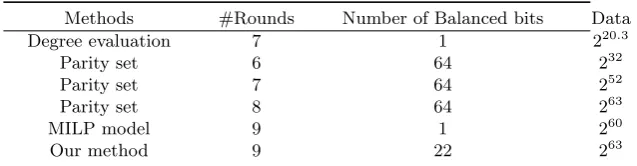
Table 1.Integral characteristics against PRESENT
Methods #Rounds Number of Balanced bits Data Reference
Degree evaluation 7 1 220.3 [WW13]
Parity set 6 64 232 [BC16]
Parity set 7 64 252 [BC16]
Parity set 8 64 263 [BC16]
MILP model 9 1 260 [XZBL16]
Our method 9 22 263 Sect. 5
Our work aims at reducing time and memory complexities when using parity sets to search integral distinguishers. To achieve this goal, we revisit the def-inition of division property and parity set. As a result, we find it is possible to introduce the idea of meet-in-the-middle into the distinguisher search, which permits us to reduce time and memory complexities. Before the proposal of our new search framework, we introduce a new concept which is called the term set and investigate the propagation rules of the term set through different block cipher operations in this paper. The term set of an output bit describes all the terms contained in the algebraic normal form(ANF) of this output bit. Recall that the vectors contained in the parity set correspond to all the terms whose parity over the input set is odd. Then if none of the term in the ANF of an output bit is contained in the parity set, which means the intersection of the parity set and the term set is empty, then we can make a conclusion that this output bit is balanced. Thus, our idea is dividing the n-round propagation of the parity set into n1-round propagation of the parity set and (n−n1)-round propagation of the term set and transforming the distinguisher search problem into the comparison of these two sets. Moreover, to improve the efficiency of the involved set comparisons, we propose two useful techniques: size reduction of parity/term sets and multiple comparisons. As illustrations, we perform ex-tensive experiments on PRESENT, and find a 9-round distinguisher with 22 balanced output bits. Table 1 shows the comparison of our distinguisher and previous ones.
distinguisher search techniques in detail. Section 5 applies our new techniques to PRESENT. Finally, conclusions are drawn in Section 6.
2
Preliminaries
2.1 Notation
Notation 1 (Hamming Weight) Forx ∈Fn
2, denote bywt(x)the hamming weight ofx, which is the number of 1’s appearing inx. Forx∈Fn1
2 ×F n2
2 ×. . .×
Fnm
2 , wherex= (x1,x2, . . . ,xm),xi∈Fn2i (0< i≤m), denote W(x) = (wt(x1), wt(x2), . . . , wt(xm))∈Zm.
Notation 2 (Bit Product Function) Let u,x∈Fn
2. Denote
xu= n ∏
i=1 x[i]u[i].
Foru,x∈Fn1
2 ×F n2
2 ×. . .×F nm
2 , wherex= (x1,x2, . . . ,xm)andu= (u1,u2, . . . ,um), define bit product function as
xu= m ∏
i=1 xui
i .
Notation 3 (Comparison between Vectors) Fora,b∈Zm, denotea≥b if ai ≥bi for all 0< i ≤m, and a >bif a≥b but a̸=b. It is obvious that a>bif and only if xa is divisible by xb.
Foru ∈Fn
2, let us denote
P rec(u) ={v∈Fn2 :v≤u}, Succ(u) ={v∈Fn2 :u≤v}. It is worth noticing that the setP rec(u) includes all the elementsv∈Fn
2 such that xu is divisible by xv and the setSucc(u) includes all the elementsv∈Fn 2 such thatxvis divisible byxu.
Notation 4 (Comparison between Sets) Let A and B be two sets whose elements are inFn2. Denote A≥B if there exist a∈A andb∈B with a≥b, and denote AB if no such couple exists.
Proposition 1. Let A andB be two sets whose elements are in Fn2 with A≥ B. If there are a1,a2 ∈ A,b1,b2 ∈ B such that a2 ≥ a1 and b1 ≥ b2, then A\ {a1} ≥B\ {b1}.
6 6 6
6 6 6 6 6 6 6 6 6 6 6 6 6
6 6 6
6 6 6 6 6 6 6 6 6 6 6 6 6
6 6 6
6 6 6 6 6 6 6 6 6 6 6 6 6
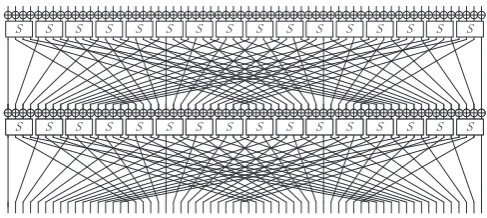
Fig. 1.Round function of the block cipher PRESENT
a2≥b if a1=a; a ≥b2if b1=b;
a2≥b2if a1=aandb1=b; a ≥b if a1̸=aandb1̸=b. Thus, it can be seen thatA\ {a1} ≥B\ {b1}holds.
Notation 5 (Round Function) Let F be a permutation of Fn2 defined by F:x= (x1, x2, . . . , xn)7→y= (y1, y2, . . . , yn).
Then every yi can be seen as a Boolean function on x1, x2, . . . , xn, denoted by yi =Fi(x). For a positive integerr, we denoteFr as a composition ofr permu-tations F, andF−r as its inverse permutation.
Remark 1. We denoteEras ar-round cipher wherer∈Z, andEr
i as the ANF of thei-th output bit.
2.2 PRESENT
PRESENT is an example of SPN construction proposed in 2007 and consists of 31 rounds. The block length is 64 bits and two key lengths of 80 and 128 bits are supported [BKL+07]. Its round function is depicted in Figure 1.
The S-box used in PRESENT is a 4-bit S-box which is a permutation ofF42. The ANFs of four coordinates are giving by
S1(x1, x2, x3, x4) =x1⊕x3⊕x4⊕x2x3,
S2(x1, x2, x3, x4) =x2⊕x4⊕x2x4⊕x3x4⊕x1x2x3⊕x1x2x4⊕x1x3x4, S3(x1, x2, x3, x4) = 1⊕x3⊕x4⊕x1x2⊕x1x4⊕x2x4⊕x1x2x4⊕x1x3x4, S4(x1, x2, x3, x4) = 1⊕x1⊕x2⊕x4⊕x2x3⊕x1x2x3⊕x1x2x4⊕x1x3x4.
As a result, the xor of these two coordinates
S2⊕S4= 1⊕x1⊕x2x3⊕x2x4⊕x3x4
only has degree 2. Moreover, it can be observed that every term inS2⊕S4has a multiple inS2andS4respectively. Based on this observation, we could improve the efficiency of PRESENT distinguisher search in Section 4.
2.3 Division Property and Parity Sets
In the following we will introduce the division property, parity set, and the propagation rules of the parity set.
Definition 1 (Division Property [Tod15]). Let X be a multiset whose el-ements belong to Fn
2. ThenX is said to have the division property Dkn when it fulfills the following conditions: For u ∈Fn
2, the parity of xu over all elements inX is always even when wt(u)< k.
In this definition,X is a multiset, but we focus on sets in this paper. For further study of division property, please refer to [Tod15] and [SHZ+15] in detail.
Definition 2 (Parity Set [BC16]). Let X be a set whose elements belong to
Fn
2. The parity set of X is denoted byU(X)and is defined by
U(X) ={u∈Fn2 :⊕ x∈X
xu = 1}.
Remark 2. If the parity set U(X) ofX is known, then the division property of X is given byDnk where
k= min
u∈U(X)wt(u).
By definitions, it can be seen that parity sets always contain more informa-tion than division property does. Besides, we shall show that the parity set could exploit further properties of S-layers and linear layers. As a result, the distin-guisher search algorithm based on the parity set can find more accurate integral distinguishers generally.
In the following, we choose affine subspaces ofFn
2 as input sets, and review the propagation rules of the parity set through operations of the SPN construction.
Propagation rule 1 (Key Addition) LetXbe a set whose parity set isU(X). Then
U(k+X)⊆ ∪ u∈U(X)
Succ(u)
for any k∈Fn 2.
Propagation rule 2 (S-Box) Let S be a permutation of Fn
2 and X be a set with the parity set U(X). Then the parity set ofS(X)satisfies
In [BC16], the authors defined the set
V s(u) ={v∈Fn2 : xu appears in the ANF ofSv(x)},
and presented the look-up table ofV s(u) for the PRESENT S-box, see [BC16, Table 1]. In [BC16, Table 1], all 4-bit words are represented in hexadecimal number, and the rightmost bit of the word corresponds to the least bit.
As for the S-layer, the authors regarded it as the concatenation of several independent S-boxes. The propagation rule can be described as following.
Propagation rule 3 (S-Boxes) LetS be a permutation ofFmt
2 which consists oftparallel independent S-boxes overFm
2 :S(x1,x2, . . . ,xt) = (S(x1), S(x2), . . . , S(xt)). For an input set X contained inFmt
2 whose parity set is U(X), we have
U(S(X))⊆ ∪
(u1,u2,...,ut)∈U(X)
V s1(u1)×V s2(u2)×. . .×V st(ut).
Propagation rule 4 (S-Box with Key Addition) Now consider the propa-gation where key addition is inserted before the S-boxes. Let U(X)be the parity set of the input set. Then the parity set after a key addition and a S-box satisfies
U(S(X+k))⊆ ∪ u∈U(X)
∪
v∈Succ(u) V s(v).
In [BC16], the authors defined the set
VS(u) = ∪
v∈Succ(u) V s(v).
The authors also presentedVs(u) for allu ∈F4
2 for the PRESENT S-box, see [BC16, Table 2].
For the proofs of these propagation rules, please refer to [BC16]. The distin-guisher search algorithm based on the division property and the search algorithm based on the parity set are similar [TM16,BC16]. In these two algorithms, we should give the initial parity set U(X)(or initial division property) of an input set X first, and then compute the parity set (or division property) after a r-round propagation, say U(Er(X)). If the parity set of outputs does not include all the unit vectors (or the output set does not satisfy all the division proper-ty of order 1), a distinguisher is found. But the sets can be very large when the round number is high, which decides time and memory complexities when searching distinguishers. Thus, our work mainly focus on how to improve the search algorithm in respect of time and memory complexities.
3
Term Set and Their Propagation Rules
3.1 Term Set
Definition 3 (Term Set). Let f(x) be an n-variable Boolean function. The term set of f(x)denoted byT(f), is the subset of Fn
2 defined by T(f) ={u∈Fn2 :xuappears in the ANF of f(x)}. In order to find a distinguisher, we need to compareT(Er
i) with U(Er(X)) and verify whether T(Er
i) U(Er(X)). Now the problem is how to calculate T(Er
i). To solve this problem, we focus on its propagation rules for round func-tions of iterated ciphers. With propagation rules we can obtain a setAsatisfying T(Eir)⊆A, thusAU(Er(X)) impliesT(Eir)U(Er(X)).
Actually, the propagation process of the term set corresponds to the calcula-tion process of ANFs. To calculateEir(x), a simple and direct method is to com-puteEr−1(x) first. This means calculatingEj(x) =Ej−1(E(x)) for 0< j≤r−1 recursively. Then calculateEr
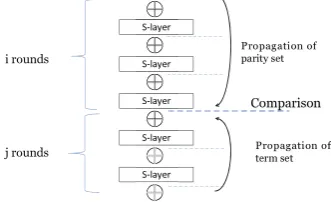
i(x) byEir(x) =Ei(Er−1(x)). In this case we need to storeEj(X) forj= 1,2, . . . , r−1. However, asjincreases the scale ofEj(X) will increase dramatically and we will run out of memory soon. Hence, to reduce memory, we propose to calculateEij(x) upside-down (please refer to Figure 2), which means calculatingEr
i(x) by recursively computing Eij(x) =Eij−1(E(x)), (0< j≤r).
Take 2-round PRESENT andE12(x) for example. Let us denote the output variables of theith round by (y1i, yi2, . . . , y64i ) for 1≤i≤2 and the input variables of the first round by (y01, y20, . . . , y064). First we compute
E11(x) =x1⊕x3⊕x4⊕x2x3. This actually means that
y21=y11⊕y31⊕y14⊕y12y31. Then we calculateE2
1(x) by
E12(x) =E11(E(x)) =E1(x)⊕E3(x)⊕E4(x)⊕E2(x)E3(x)
= (x1⊕x3⊕x4⊕x2x3)⊕(x9⊕x11⊕x12⊕x10x11)⊕(x13⊕x15⊕x16⊕x14x15)
⊕(x5⊕x7⊕x8⊕x6x7)·(x9⊕x11⊕x12⊕x10x11). (1) This means that
y12= (y01⊕y03⊕y04⊕y20y03)⊕(y90⊕y110 ⊕y120 ⊕y010y011)⊕(y013⊕y015⊕y160 ⊕y140 y150 )
⊕(y50⊕y70⊕y80⊕y06y07)·(y09⊕y110 ⊕y012⊕y010y011). Hence, it can be seen that (1) is the desirable ANF for E2
1(x).
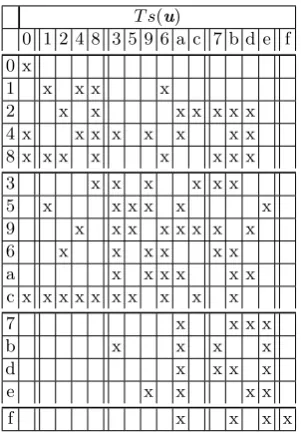
Table 2.SetsT s(u) for all possible inputs for the S-box of PRESENT.
T s(u)
0 1 2 4 8 3 5 9 6 a c 7 b d e f
0 x
1 x x x x
2 x x x x x x x
4 x x x x x x x x
8 x x x x x x x x
3 x x x x x x
5 x x x x x x
9 x x x x x x x x
6 x x x x x x
a x x x x x x
c x x x x x x x x x x
7 x x x x
b x x x x
d x x x x
e x x x x
f x x x x
3.2 Propagation through S-box
Proposition 2. Let S be an S-box over Fm
2. Denote
T s(u) ={v∈Fm2 :xv appears in the ANF of Su(x)}.
Then for anm-variable Boolean function f with the term setT(f), we have T(f(S(x)))⊆ ∪
u∈T(f) T s(u).
Proof. Since
f(S(x)) = ⊕ u∈T(f)
Su (x),
we have
T(f(S(x)))⊆ ∪ u∈T(f)
{v∈Fm2 :xvappears in the ANF of Su(x)}= ∪ u∈T(f)
T s(u).
3.3 Propagation through S-boxes
Proposition 3. LetS be a permutation ofFmt2 which consists oftparallel inde-pendent S-boxes overFm2, namely,S(x1,x2, . . . ,xt) = (S1(x1), S2(x2), . . . , St(xt)). For anmt-variable Boolean functionf with the term setT(f), we have
T(f(S(x)))⊆ ∪ (u1,u2,...,ut)∈T(f)
T s1(u1)×T s2(u2)×. . .×T st(ut).
Proof. From Subsection 3.1, we know T(f(S(x)))⊆ ∪
u=(u1,u2,...,ut)∈T(f)
T s(u).
Now the problem is how to find all v= (v1,v2, . . . ,vt) such thatxv contained in Su(x). Since only Sui
i (xi) may contain x vi
i , it follows that v∈ T s(u) if and only if vi ∈ T si(u) for 1 ≤ i ≤ n. Therefore, it can be seen that T s(u) ⊆ T s1(u1)×T s2(u2)×. . .×T st(ut).
3.4 Propagation through Key Addition
Proposition 4. Letf be ann-variable Boolean function with the term setT(f). For anyk∈Fn
2, the term set off(k⊕x) = (x1⊕k1, x2⊕k2, . . . , xn⊕kn)satisfies T(f(k⊕x))⊆ ∪
u∈T(f)
P rec(u).
Proof. For anyk∈Fn
2, lety=k⊕x. We have yv= (x⊕k)v=⊕
u≤v
xukv⊕u.
It follows that
T(f(k⊕x)) = ∪ u∈T(f)
{xvkv⊕u,v≤u} ⊆ ∪ u∈T(f)
P rec(u).
This completes the proof.
3.5 Propagation through One Round
Now we consider the round function where the round key is added before the S-boxes in the SPN constructions. Because the propagation of the term set is upside-down, the S-box is always before key addition when calculating term sets (please refer to Figure 2). Let f be an n-variable Boolean function. Then the term set after one round encryption can be deduced by Subsections 3.3 and 3.4, i.e.,
T(f(S(x⊕k)))⊆ ∪ u∈T(f)
∪
v∈T s(u)
In the discussions of parity sets and term sets, we consider the round function where the round key is inserted before S-Layer. Thus, in the subsequent discus-sions, the round function E always implies that there is a round key addition before S-Layer. We can also search distinguishers by term sets only. In detail, if there exists an element u ∈ Fn
2 such that no elementv contained in T(Eri) satisfiesv≥u, then ar-round distinguisher whose input set isP rec(u) is found. However, the time and memory complexities of this method will be huge as well. Thus, we take advantage of the meet-in-the-middle technique so that the term set and the parity set could be combined to reduce time and memory complexities.
4
New Searching Techniques for Integral Distinguishers
Based on the Parity Set
In this section, we introduce our improved distinguisher search techniques in detail.
4.1 A meet-in-the-middle framework
For an input setX and a round functionE, denote the parity set afterr-round encryption asU(Er(X)), i.e.,U(Er(X)) is the set that contains all theu’s such
that ⊕
x∈Er(X)
xu = 1.
Now we regard then-bit state in ther-th round as variablesx= (x1, x2, . . . , xn), and consider the ANF of each output bit. If all the terms appearing in the ANF ofyi can not be divisible by any term in{xu :u∈ U(Er(X))}, then this output bit is balanced. Based on this observation, we improve the integral distinguisher search by utilizing the meet-in-the-middle technique which divides the n-round propagation of parity sets inton1-round propagation of parity sets and (n−n1 )-round propagation of ANF. An outline of this framework is given in Figure 2. This search framework is similar to the one used in [YHSS16], which is applied to search impossible differential distinguishers. Here we utilize term sets to describe the ANFs of output bits and transform the distinguisher search problem into the comparison of term sets and parity sets.
Note that it was mentioned in [BC16] that one of the difficulties for finding a distinguisher is that the distinguisher property must hold for every secret key k∈Fn2. Hence, for a Boolean functionf, we use
∪
k∈Fn
2
T(f(k⊕x)) = ∪ u∈T(f)
P rec(u)
to propagate term sets from f(x) tof(k⊕x). To guarantee the correctness of the algorithm, we utilize
∪
(u1,u2,...,ut)∈T(f)
Fig. 2.Outline of our framework against SPN constructions
to propagate term sets fromf(x) tof(S(x)) when searching distinguishers. Sim-ilar propagation model is used on parity sets as well, i.e., we evaluate parity sets after key addition by
U((k⊕X))⊆ ∪ k∈Fn
2
U(k⊕X) = ∪ u∈U(X)
Succ(u)
and
U((S(X))) = ∪
(u1,u2,...,ut)∈U(X)
V s1(u1)×V s2(u2)×. . .×V st(ut).
Our distinguisher search algorithm consists of five steps which can be described as following.
Step 1 Round division: Choose the propagation round numbers of the parity set and the term set respectively. Let us denoter1as the propagation round number of parity set andr2 as the propagation round number of term set, wherer1+r2=r.
Step 2 Choose an input set: Choose an input setX.
Step 3 Parity sets calculation:Calculate the parity setU(Er1(X)). Step 4 Term sets calculation:Calculate the term setsT(Er2
i ) for 1≤i≤n.
Step 5 Sets comparison: Compare U(Er1(X)) with T(Er2
i ) for 1 ≤i ≤ n. If
U(Er1(X)) T(Er2
i ), then the i-th output bit in r-round encryption is balanced. If none of such intersections are empty, then choose another input setX and go to Step 2.
In order to compare parity sets with term sets efficiently in Step 5, we pro-pose some novel techniques in the following subsections. Firstly, we propro-pose a technique to reduce the size of sets during propagation. Secondly, we introduce the multiple comparison technique which could achieve quick comparisons.
4.2 Reduce the Sizes of Sets
satisfies ∪
k∈Fn
2
T(f(k⊕x)) = ∪ u∈T(f)
P rec(u),
for some Boolean functionf. This leads to the following observation.
Observation 2 Let U(Er1(X)) be the parity set participating in comparison.
SinceT(f(x⊕k))is a union of sets of the formP rec(u), if we findv∈T(f(x)) andu∈ U(Er1(X))with u≤v, then there must be an element v′∈P rec(v)⊆
T(f(x⊕k))such that v′=u, which means the output bit may be unbalanced.
Corollary 1. Let X be a set of elements in Fn
2. The i-th output bit of the (r2+r1)-round encryption is balanced over the input X if and only if T(f)
U(Er1(X)).
Based on Corollary 1, the comparison step in our technique against SPN constructions is converted into checking whetherT(f)≥ U(Er1(X)). Corollary
1 leads to the following size reduce operation.
Size Reduce Operation.We denote the size reduce operation on a term set T(Eri(x)) by Rt(T(Eir(x))), and the size reduce operation on a parity set
U(Er1(X)) byRu(U(Er1(X))). For the term setT(Er
i(x)), the operationRt re-moves all the elementsv∈T(Er
i(x)) such that there is an elementv′ ∈T(Eri(x)) with v′ ≥ v. As for a parity set, the operation Ru removes all the elements u∈ U(Er1(X)) such that there is an elementu′∈ U(Er1(X)) withu≥u′.
It can be deduced from Proposition 1 that the comparison result ofT(Er i(x)) andU(Er1(X)) is the same as the comparison result ofRt(T(Er
i(x))) andRu(U(Er1(X))). This guarantees the correctness of the technique using the size reduce operation.
It can be seen that by reducing the size of sets, the time complexity of compar-ison step can be reduced to a great extent. However, during the experiment, we find the complexity of the size reduce operation is still too costly and may even increase the whole complexity of our technique. Therefore, we combine the size reduce technique with propagation rules in the following.
4.3 Propagation Combined with Size Reduction
Notation 6 ForX⊆Fn2, define
M ax(X) = ∪ x∈X
P rec(x) and M in(X) = ∪ x∈X
Succ(x).
Remark 3. Let X ⊆Fn
2. It is obvious that M ax(Rt(T(f))) =M ax(T(f)) and M in(U(X)) =M in(Ru(U(X)). Thus, if the term setT(f) is a union ofP rec(u), then we can just storeX =Rt(T(f)) instead ofT(f), since we can recoverT(f) byT(f) =M ax(X).
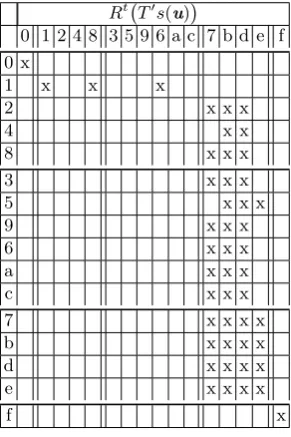
Table 3.ReducedT′s(u) for all possible inputs for the PRESENT S-box.
Rt(T′s(u))
0 1 2 4 8 3 5 9 6 a c 7 b d e f 0 x
1 x x x
2 x x x
4 x x
8 x x x
3 x x x
5 x x x
9 x x x
6 x x x
a x x x
c x x x
7 x x x x
b x x x x
d x x x x
e x x x x
f x
M ax(u) according to the propagation rule T(f(k⊕x)) = ∪
u∈T(f)
P rec(u).
As a result, we can only store Ru(T(f)) instead of the whole T(f) after key addition to reduce the memory complexity, where eachu∈Rt(T(f)) represents the setM ax(u).
Since
M ax(u)−−−→S(x) ∪ v∈P rec(u)
T s(v),
we define
T′s(u) = ∪ v∈P rec(u)
T s(v).
Then, we have
T(f)−−−−−→x=(x⊕k) M ax(Rt(T(f)))−−−−→x=S(x) ∪ v∈Rt(T(f))
T′s(v).
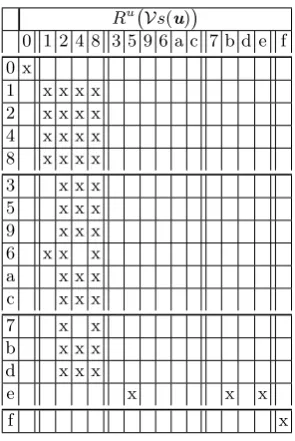
Table 4.ReducedVs(u) for all possible inputs for the PRESENT S-box
Ru(Vs(u))
0 1 2 4 8 3 5 9 6 a c 7 b d e f
0 x
1 x x x x 2 x x x x 4 x x x x 8 x x x x 3 x x x 5 x x x 9 x x x 6 x x x a x x x c x x x
7 x x
b x x x d x x x
e x x x
f x
the size reduce with S-Layer propagation rule directly, which means the term set through S-layer is evaluated byRt(T′s(u)) instead ofT′s(u).
We showT′s(u) andRt(T′s(u)) for all possible inputs for PRESENT S-box in Tables 2 and 3 respectively. Note that the propagation based on Rt(T′s(u)) only achieves size reduce partly. The effect of reduction depends on the length of blocks. However, in this subsection, we consider a 4-bit S-box as a block. To achieve a further reduction, we propose the further reducing look-up table in Subsection 4.4.
For the parity set, we can only storeRu(U(X)) after every key addition. Let
U(X) be an arbitrary parity set. Then we have
M in(U(X))−−−−→S(x⊕k) ∪ v∈Ru(U(X))
Vs(v).
The propagation rule of key addition and the outline in Figure 2 make it suitable to apply the size reduce operation to parity sets propagated after key addition. Similarly, we proposeRu(V(u)) for propagation of parity sets. Table 4 shows the Ru(V(u)) for all possible inputs for PRESENT S-box.
6 6 6
6 6 6 6 6 6 6 6 6 6 6 6 6
6 6 6
6 6 6 6 6 6 6 6 6 6 6 6 6
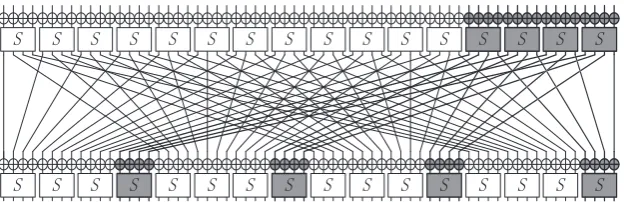
Fig. 3.Work model of super S-box in PRESENT
4.4 Further Reducing Look-up Table
As mentioned in Subsection 4.3, when combining the size reduce with propa-gation, the effect of reduction depends on the length of blocks. The effect of reduction would be better as the length of blocks increases. Consequently, we regard a 16-bit super S-box as a block in this subsection to achieve a further reduction.
Observation 3 The super S-boxes in PRESENT can work independently in the 2-round encryption. (refer to the Fig 3)
Based on Observation 3, we can easily construct a 2-round propagation table for the super S-box by calculating
U(S(P(S(X))))
for all possible inputs, where S is a permutation ofF4n
2 , which consists of four PRESENT S-boxes
S(x1,x2,x3,x4) = (S(x1), S(x2), S(x3), S(x4))
and P changes the position of coordinations of elements in parity sets. Next, we reduce the parity set U(S(P(S(X)))) for all possible inputs X. Thus, we construct a reduced table for 2-round propagation Ru(U(S(P(S(X))))). The reduced table of the term set can be constructed in the same way. There is no doubt that the sizes of sets propagated in this way are smaller than the one propagated byRu(VS′(u)) andRt(T′s(u)). Furthermore, since this propagation table passes through two rounds, the time complexity can also be reduced. The greatest advantage is that it even reduces the time complexity in propagation. Note that this technique requires little memory, but improves the algorithm to a great extent.
4.5 Multiple Comparison
and check whetheru≤v. But it still requires a high time complexity even when we take the advantage of size reduce technique. Thus, we provide a multiple comparison technique to achieve quick comparisons.
Theorem 1. LetAandBbe two sets whose elements are inFn
2. IfA≥B, then max
u∈Awt(u)≥minv∈Bwt(v).
Proof. If A > B, then a>b for somea ∈A and some b ∈B. It can be seen that
max
u∈Awt(u)> wt(a)> wt(b)>minv∈Bwt(v). IfA=B, then it is trivial that the result holds.
Theorem 2. If u,v∈Fnt
2 satisfy u≥v, thenW(u)≥W(v). Proof. Ifu≥v, thenu[i]≥v[i] for 0< i≤nt. Thus, we have
wt(uj) = n ∑
k=1
u[k+n·j]≥ n ∑
k=1
v[k+n·j] =wt(vj).
Since W(x) = (wt(x1), wt(x2), . . . , wt(xm)) ∈ Zm and wt(vj) ≤ wt(uj) for 0< i≤nt, it follows thatW(v)≥W(u).
Theorem 3. If u,v∈Fn
2 satisfy u>v, then we have u>v when regard them as integers.
Proof. Sincev[i]≤u[i] for 0< i≤nand the inequality holds at least for one i, it can be seen that
n ∑
i=1
u[i]·2i−1> n ∑
i=1
v[i]·2i−1.
Based on the above three theorems, we propose the following multiple com-parison technique.
The Multiple Comparison Technique.Let U and T be the parity set and the term set participate in comparison. The multiple comparison technique can be described as follow.
Step 1 Obtain the minimum weight of parity sets m= min
u∈Uwt(u) and the maximal weight of term sets
M = max v∈T wt(v).
Step 2 Let
A={u:u∈ U and wt(u)> M} and
B={v:v∈T and wt(u)< m}.
According to Theorem 1, we removeA from U and remove B from T, i.e.,
U =U \Aand T=T\B.
Step 3 Take an elementtfromT, and regard elements inU andT as inF162 ×
F16
2 ×F162 ×F162 . Let us denote
C={u:u∈ U andW(u)≤W(t)}.
Thus, only an elementu∈C can satisfyu<tby Theorem 2. Let D={v:v∈T andW(v) =W(t)}.
IfC=∅, then we removeD fromT, i.e.,T =T\D, and go to Step 5. IfC̸=∅, then regard the elements in U andDas inF4
2×F42×. . .×F42. Let C′={u:u∈ U andW(u)< W(t)} and D′ ={v∈D, W(v) =W(t)}. IfC′ =∅, then removeD′ from T i.e.,T = (T\D′). IfC′ ̸=∅, then go to Step 4.
Step 4 We judge whetherD′≥C′ holds. IfD′ C′, thenT =T\D′ and go to Step 5. Otherwise, we find an elementu∈ U and an element v∈T such that u <v, then we stop comparison and deduce thatT ≥ U. Besides, to make this comparison fast, we sortC′ in ascending order by corresponding an elementu∈C′ to an integer∑63i=0u[i]·2i. Then for everyv∈D′, based on Theorem 3, we only need to compare vwith the elements u ∈C′ such that∑63i=0u[i]·2i<∑63i=0v[i]·2i.
Step 5 If T ̸= ∅, take another t and go to Step 3. If T = ∅, then we stop comparison and make a conclusion thatT U.
This technique filters the terms using the divisibility condition under degree order and alphabet order respectively. Its effect in time complexity is observable, and we will illustrate this improvement in detail by the application to PRESENT.
5
Application to PRESENT
To illustrate our techniques, we apply our algorithm to PRESENT distinguisher search in this section.
5.1 Search Rule Based on Observation 1
Table 5.The search rule ofS2 andS4 in the PRESENT S-box.
STEP1 RESULT STEP2 RESULT FURTHER RESULT JudgeS2⊕S4 balanced JudgeS2 balanced S4 is balanced
unbalanced S4 is unbalanced
Not balanced S2 andS4 are unbalanced
the property ofS3next. The search rule ofS2andS4is presented as follows. As illustrated in Observation 1, the degree of S2⊕S4 is 2. Hence, S2⊕S4 maybe balanced even ifS2andS4are unbalanced. Moreover, every term ofS2⊕S4has a multiple in S2 and S4 respectively, which means the term set of S2⊕S4 is included in the term sets ofS2andS4respectively. Accordingly, we propose the search rule ofS2 and S4 of the PRESENT S-box in Table 5, which is based on Proposition 5.
Proposition 5. Let X be the input set of encryption E. If E1(X)⊕E2(X)is balanced over all the inputs. Then, the parity of these two output bits over all the inputs are the same.
Proof. We already know⊕x∈X(E1(X)⊕E2(X)) = 0 which means ⊕
x∈X(E1(X))⊕ ⊕
x∈XE2(X) = 0, thus, the parity of ⊕
x∈XE1(X) and ⊕
x∈XE2(X) are the same.
5.2 Our Results
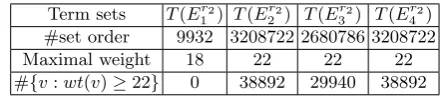
First, we try to find 10-round PRESENT distinguishers by our technique, but the search result of the rightmost output bit is unbalanced for all the input sets with dimension 63. It seems that this output bit has the simplest and the lowest degree ANF among 64 output bits, our result shows that the PRESENT probably has no 10-round integral distinguishers by only using the division property. Second, we focus on the 9-round PRESENT, and find a distinguisher with 22 balanced output bits. When searching the 9-round distinguisher against PRESENT, we set the round numberr1 of parity set propagation as 5 and propagation round number r2 of term set as 4. We take the input:
(aaaaaaaaaaaaaaaa aaaaaaaaaaaaaaaa aaaaaaaaaaaaaaaa aaaaaaaaaaaaaaac) as an example. The order of the setU(Er1(X)) is 320347578. The minimal weight
of parity set is 22 and
#{u∈ U(Er1(X), wt(u) = 22}= 59875200.
Table 6.Experimental data during distinguisher search against 9-round PRESENT Term sets T(Er2
1 ) T(E
r2 2 ) T(E
r2 3 ) T(E
r2 4 )
#set order 9932 3208722 2680786 3208722
Maximal weight 18 22 22 22
#{v:wt(v)≥22} 0 38892 29940 38892
first and second step in multiple comparison is also obvious. PRESENT’s 9-Round Distinguisher
Input:
(aaaaaaaaaaaaaaaa aaaaaaaaaaaaaaaa aaaaaaaaaaaaaaaa aaaaaaaaaaaaaaac),
Output:
(????????????b3?bb3????????????b2?bb2 ????????????b1?bb1 bbbbbbbbbbbbbbbb), where ‘c’ means a constant bit, ‘a’ means an active bit, ‘?’ means an unknown bit, and ‘b’ means a balanced bit. Besides, the bits with the same notation bi means their addition is balanced.
6
Conclusions
In this paper, we propose a concept called the term set to propagate some in-formation of ANF. With term sets, we improve the distinguisher search method based on the parity set both in terms of memory and time complexities. From the relation between the parity set and the bit-based division property, it can be seen that the term set could also be applied to improve the distinguisher search method based on bit-based division property similarly. Applying our techniques to other SPN ciphers will be one subject of our future work.
References
[BC16] Christina Boura and Anne Canteaut. Another view of the division property. In Matthew Robshaw and Jonathan Katz, editors,Advances in Cryptology - CRYPTO 2016 - 36th Annual International Cryptology Conference, Santa
Barbara, CA, USA, August 14-18, 2016, Proceedings, Part I, volume 9814
ofLecture Notes in Computer Science, pages 654–682. Springer, 2016.
[BKL+07] Andrey Bogdanov, Lars R. Knudsen, Gregor Leander, Christof Paar,
Ax-el Poschmann, Matthew J. B. Robshaw, Yannick Seurin, and C. VikkAx-elsoe. PRESENT: an ultra-lightweight block cipher. In Pascal Paillier and In-grid Verbauwhede, editors,Cryptographic Hardware and Embedded Systems - CHES 2007, 9th International Workshop, Vienna, Austria, September
10-13, 2007, Proceedings, volume 4727 ofLecture Notes in Computer Science,
pages 450–466. Springer, 2007.
[KW02] Lars R. Knudsen and David A. Wagner. Integral cryptanalysis. In Joan Dae-men and Vincent RijDae-men, editors,Fast Software Encryption, 9th Interna-tional Workshop, FSE 2002, Leuven, Belgium, February 4-6, 2002, Revised
Papers, volume 2365 ofLecture Notes in Computer Science, pages 112–127.
[SHZ+15] Bing Sun, Xin Hai, Wenyu Zhang, Lei Cheng, and Zhichao Yang. New
observation on division property.IACR Cryptology ePrint Archive, 2015:459, 2015.
[SWW17] Ling Sun, Wei Wang, and Meiqin Wang. Automatic search of bit-based divi-sion property for ARX ciphers and word-based dividivi-sion property. In Tsuyoshi Takagi and Thomas Peyrin, editors,Advances in Cryptology - ASIACRYP-T 2017 - 23rd International Conference on the ASIACRYP-Theory and Applications of Cryptology and Information Security, Hong Kong, China, December
3-7, 2013-7, Proceedings, Part I, volume 10624 ofLecture Notes in Computer
Science, pages 128–157. Springer, 2017.
[TIHM17] Yosuke Todo, Takanori Isobe, Yonglin Hao, and Willi Meier. Cube attacks on non-blackbox polynomials based on division property. In Jonathan Katz and Hovav Shacham, editors, Advances in Cryptology CRYPTO 2017 -37th Annual International Cryptology Conference, Santa Barbara, CA, USA,
August 20-24, 2017, Proceedings, Part III, volume 10403 ofLecture Notes in
Computer Science, pages 250–279. Springer, 2017.
[TM16] Yosuke Todo and Masakatu Morii. Bit-based division property and applica-tion to simon family. In Thomas Peyrin, editor,Fast Software Encryption -23rd International Conference, FSE 2016, Bochum, Germany, March 20-23,
2016, Revised Selected Papers, volume 9783 of Lecture Notes in Computer
Science, pages 357–377. Springer, 2016.
[Tod15] Yosuke Todo. Structural evaluation by generalized integral property. In Elisabeth Oswald and Marc Fischlin, editors,Advances in Cryptology - EU-ROCRYPT 2015 - 34th Annual International Conference on the Theory and Applications of Cryptographic Techniques, Sofia, Bulgaria, April
26-30, 2015, Proceedings, Part I, volume 9056 ofLecture Notes in Computer
Science, pages 287–314. Springer, 2015.
[Tod16] Yosuke Todo. Division property: Efficient method to estimate upper bound of algebraic degree. In Raphael C.-W. Phan and Moti Yung, editors,
Paradigms in Cryptology - Mycrypt 2016. Malicious and Exploratory Cryp-tology - Second International Conference, Mycrypt 2016, Kuala Lumpur,
Malaysia, December 1-2, 2016, Revised Selected Papers, volume 10311 of
Lecture Notes in Computer Science, pages 553–571. Springer, 2016.
[Tod17] Yosuke Todo. Integral cryptanalysis on full MISTY1. J. Cryptology, 30(3):920–959, 2017.
[WW13] Shengbao Wu and Mingsheng Wang. Integral attacks on reduced-round PRESENT. In Sihan Qing, Jianying Zhou, and Dongmei Liu, editors, In-formation and Communications Security - 15th International Conference,
ICICS 2013, Beijing, China, November 20-22, 2013. Proceedings, volume
8233 ofLecture Notes in Computer Science, pages 331–345. Springer, 2013. [XZBL16] Zejun Xiang, Wentao Zhang, Zhenzhen Bao, and Dongdai Lin. Applying MILP method to searching integral distinguishers based on division property for 6 lightweight block ciphers. In Jung Hee Cheon and Tsuyoshi Takagi, editors,Advances in Cryptology - ASIACRYPT 2016 - 22nd International Conference on the Theory and Application of Cryptology and Information
Security, Hanoi, Vietnam, December 4-8, 2016, Proceedings, Part I, volume
10031 ofLecture Notes in Computer Science, pages 648–678, 2016.
Network and System Security - 10th International Conference, NSS 2016,
Taipei, Taiwan, September 28-30, 2016, Proceedings, volume 9955 ofLecture