Open Access
Research
Measuring the functional sequence complexity of proteins
Kirk K Durston*
1, David KY Chiu
2, David L Abel
3and Jack T Trevors
4Address: 1Department of Biophysics, University of Guelph, Guelph, ON, N1G 2W1, Canada, 2Department of Computing and Information Science, University of Guelph, Guelph, ON, N1G 2W1, Canada, 3Program Director, The Gene Emergence Project, The Origin-of-Life Foundation, Inc., 113 Hedgewood Drive Greenbelt, MD 20770-1610, USA and 4Department of Environmental Biology, University of Guelph, Guelph, ON, N1G 2W1, Canada
Email: Kirk K Durston* - [email protected]; David KY Chiu - [email protected]; David L Abel - [email protected]; Jack T Trevors - [email protected]
* Corresponding author
Abstract
Background: Abel and Trevors have delineated three aspects of sequence complexity, Random Sequence Complexity (RSC), Ordered Sequence Complexity (OSC) and Functional Sequence Complexity (FSC) observed in biosequences such as proteins. In this paper, we provide a method to measure functional sequence complexity.
Methods and Results: We have extended Shannon uncertainty by incorporating the data variable with a functionality variable. The resulting measured unit, which we call Functional bit (Fit), is calculated from the sequence data jointly with the defined functionality variable. To demonstrate the relevance to functional bioinformatics, a method to measure functional sequence complexity was developed and applied to 35 protein families. Considerations were made in determining how the measure can be used to correlate functionality when relating to the whole molecule and sub-molecule. In the experiment, we show that when the proposed measure is applied to the aligned protein sequences of ubiquitin, 6 of the 7 highest value sites correlate with the binding domain.
Conclusion: For future extensions, measures of functional bioinformatics may provide a means to evaluate potential evolving pathways from effects such as mutations, as well as analyzing the internal structural and functional relationships within the 3-D structure of proteins.
Background
There has been increasing recognition that genes deal with information processing. They have been referred to as "subroutines within a much larger operating system". For this reason, approaches previously reserved for computer science are now increasingly being applied to computa-tional biology [1]. If genes can be thought of as informa-tion-processing subroutines, then proteins can be analyzed in terms of the products of information interact-ing with laws of physics. It may be possible to advance our knowledge of proteins, such as their structure and
func-tions, by examining the patterns of functional informa-tion when studying a protein family.
Our proposed method is based on mathematical and computational concepts (e.g., measures). We show here that, at least in some cases in sequence analysis, the pro-posed measure is useful in analyzing protein families with interpretable experimental results.
Abel and Trevors have delineated three qualitative aspects of linear digital sequence complexity [2,3], Random Published: 6 December 2007
Theoretical Biology and Medical Modelling 2007, 4:47 doi:10.1186/1742-4682-4-47
Received: 25 January 2007 Accepted: 6 December 2007
This article is available from: http://www.tbiomed.com/content/4/1/47
© 2007 Durston et al; licensee BioMed Central Ltd.
Sequence Complexity (RSC), Ordered Sequence Com-plexity (OSC) and Functional Sequence ComCom-plexity (FSC). RSC corresponds to stochastic ensembles with minimal physicochemical bias and little or no tendency toward functional free-energy binding. OSC is usually pat-terned either by the natural regularities described by phys-ical laws or by statistphys-ically weighted means. For example, a physico-chemical self-ordering tendency creates redun-dant patterns such as highly-patterned polysaccharides and the polyadenosines adsorbed onto montmorillonite [4]. Repeating motifs, with or without biofunction, result in observed OSC in nucleic acid sequences. The redun-dancy in OSC can, in principle, be compressed by an algo-rithm shorter than the sequence itself. As Abel and Trevors have pointed out, neither RSC nor OSC, or any combina-tion of the two, is sufficient to describe the funccombina-tional complexity observed in living organisms, for neither includes the additional dimension of functionality, which is essential for life [5]. FSC includes the dimension of functionality [2,3]. Szostak [6] argued that neither Shan-non's original measure of uncertainty [7] nor the measure of algorithmic complexity [8] are sufficient. Shannon's classical information theory does not consider the mean-ing, or function, of a message. Algorithmic complexity fails to account for the observation that 'different molecu-lar structures may be functionally equivalent'. For this rea-son, Szostak suggested that a new measure of information–functional information–is required [6]. Chiu, Wong, and Cheung also discussed the insufficiency of Shannon uncertainty [9,10] when applied to measur-ing outcomes of variables. The differences between RSC, OSC and FSC in living organisms are necessary and useful in describing biosequences of living organisms.
Consider two main uses for the proposed method for measuring FSC, which incorporates functionality: 1) com-parative analysis of biosequence subgroups when explicit time lag is known; and 2) typicality analysis between biosequence subgroups when there is no explicit time lag. In the first case, such as an evolutionary time scale, an increase or decrease in FSC between an earlier gene or pro-tein and a later gene or propro-tein can be measured, evaluat-ing its possible degradations and/or functional effects due to various changes such as insertions, deletions, muta-tions and rearrangements. In the second case, a large set of aligned sequences representing a protein family can be subdivided according to phylogenetic relationships derived from typicality of species groupings and the FSC for each subgroup measured. This is important when eval-uating the emergence or evolution of viral or microbial strains with novel functions such as in the comparisons of the Chlamydia family genomes [11]. An analysis may reveal the extent of the difference in FSC between one functional group and the other, as well as the modular
interactions of the internal relationship structure of the sequences [12].
The ability to measure FSC would be a significant advance in the ability to identify, analyze, compare, and predict the metabolic utility of biopolymeric sequences. Muta-tional drift, emerging pathogenic viral and microbial spe-cies/strains, generated mutations, acquired heritable diseases and mutagenic effects could all be evaluated quantitatively. Furthermore, In vitro experiments using SELEX [13-15] to study transitions in possible early ribozyme family growth could then be evaluated in a quantitative, as well as qualitative and intuitive fashion. Evolutionary changes, both actual and theoretical, can also be evaluated using FSC.
It is known that the variability of data can be measured using Shannon uncertainty [16]. However, Shannon's original formulation when applied to biological sequences does not express variations related to biological functionality such as metabolic utility. Shannon uncer-tainty, however, can be extended to measure the joint vari-able (X, F), where X represents the variability of data, and
F functionality. This explicitly incorporates empirical knowledge of metabolic function into the measure that is usually important for evaluating sequence complexity. This measure of both the observed data and a conceptual variable of function jointly can be called Functional Uncer-tainty (Hf) [17], and is defined by the equation:
H(Xf(t)) = -∑P(Xf(t)) logP(Xf(t)) (1)
where Xf denotes the conditional variable of the given sequence data (X) on the described biological function f
which is an outcome of the variable (F). For example, a set of 2,442 aligned sequences of proteins belonging to the ubiquitin protein family (used in the experiment later) can be assumed to satisfy the same specified function f, where f might represent the known 3-D structure of the ubiquitin protein family, or some other function com-mon to ubiquitin. The entire set of aligned sequences that satisfies that function, therefore, constitutes the outcomes of Xf. Here, functionality relates to the whole protein fam-ily which can be inputted from a database. The advantage of using H(Xf(t)) is that changes in the functionality
Functional bioinformatics is emerging as an important area of research [18-20]. Even though the term 'biological function' has been freely used for specific experimenta-tion, there is no generally consistent usage of the term. According to Karp [21], biological functionality can refer to biochemical specified reactions, cellular responses, and structural properties of proteins and nucleic acids. It can be defined or specified at the global level (i.e., the entire organism), locally at the sub-molecular level, or applica-ble to the whole molecule. Hence confusion exists in interpreting its meaning. Karp [21] recognized that bio-logical function is a complex concept. Using Webster, he refers to 'specially fitted' action or 'normal and specific contribution' of a part to the economy of the whole. Func-tion can be related to cellular components (e.g., macro-molecules, proteins or small molecules) that interact and catalyze biochemical transformations. In specific applica-tions, it can be a local function of an enzyme such as the substrate that is acted on, or the ligands that activate or inhibit the enzyme. In more systemic integrated func-tions, it may refer to pathways, single or multiple, in a hierarchical, nested scope [22,23]. In general, it is a chal-lenge 'to define a single best set of biologically acceptable rules for performing this decomposition' [21].
In our approach, we leave the specific defined meaning of functionality as an input to the application, in reference to the whole sequence family. It may represent a particular domain, or the whole protein structure, or any specified function with respect to the cell. Mathematically, it is defined precisely as an outcome of a discrete-valued vari-able, denoted as F={f}. The set of outcomes can be thought of as specified biological states. They are pre-sumed non-overlapping, but can be extended to be fuzzy elements. In order to get a meaningful calculation in measuring FSC, the measure should be statistically signif-icant in practice [7,10], much larger than zero when relat-ing to the sequences. When sequences are chosen that are unrelated to the function to be analyzed, or are simply arbitrarily ordered or randomly generated sequences, then the measure of FSC will be small and statistically not sig-nificant. For example, if many sequences that do not share the same function f, are mistakenly included within an aligned set representing some particular function, we should expect the measure of FSC of that set to be degraded, possibly even to a very small value. However, when the specified functionality is chosen meaningfully (even in part), then FSC can be interpreted.
Consider further, when a biosequence is mutated, the mutating sequence can be compared at two different time states going from ti to tj. For example, ti could represent an ancestral gene and tj a current mutant allele. Different sequences sharing the same function f (as outcomes of the variables denoted respectively as Xf, Yf) can also be
com-pared at the same time t. Within a sequence, any change of a monomer in the sequence represents a single step change that may or may not affect the overall function. Sequence reversals, gene splits, lateral transfers, and mul-tiple point mutations can also be quantified between the two states ti, tj. The limits of the change in functional uncertainty between the two states can then be evaluated at t = ti and t = tj.
The change in functional uncertainty (denoted as ΔHf) between two states can be defined as
ΔH (Xg(ti), Xf(tj)) = H(Xg(tj)) - H(Xf(ti)) (2)
where Xf (ti) and Xg (tj) can be applied to the same sequence at two different times or to two different sequences at the same time. ΔHf can then quantify the change in functional uncertainty between two biopolymeric states with regard to biological functionality. Unrelated bio-molecules with the same function or the same sequence evolving a new or additional function through genetic drift can be compared and analyzed. A measure of ΔHf can increase, decrease, or remain unchanged.
Biological function is mostly, though not entirely deter-mined by the organism's genetic instructions [24-26]. The function could theoretically arise stochastically through mutational changes coupled with selection pressure, or through human experimenter involvement [13-15]. A time limit can be set in some situations to evaluate what changes to Xf(ti) might be possible within that limit. For example, an estimation of the evolutionary limits pro-jected over the next 10 years could be computed in this approach for any particular strain of the HIV virus. The specifics of the function (as an outcome of the function variable) can remain constant, or it can be permitted to vary within a range of efficiency. The limit may be deter-mined by what is permitted metabolically. There is often a minimum limit of catalytic efficiency required by the organism for a given function.
highest uncertainty permitted by the physical constraints of the system, the set of functional options, if there are any, will therefore be a subset of the permitted options, assuming the constraints for the physical system remain constant. If the ground state permits only one sequence, then there is no possibility of change in the functional uncertainty of the system.
The null state, a possible outcome of F denoted as ø, is defined here as a special case of the ground state of highest uncertainly when the physical system imposes no con-straints at all, resulting in the equi-probability of all possible sequences or options. Such sequencing has been called "dynamically inert, dynamically decoupled, or dynami-cally incoherent" [28,29]. For example, the ground state of a 300 amino acid protein family can be represented by a completely random 300 amino acid sequence where functional constraints have been loosened such that any of the 20 amino acids will suffice at any of the 300 sites. From Eqn. (1) the functional uncertainty of the null state is represented as
H(Xø(ti))= - ∑P(Xø(ti)) log P(Xø(ti)) (3)
where (Xø(ti)) is the conditional variable for all possible equiprobable sequences. Consider the number of all pos-sible sequences is denoted by W. Letting the length of each sequence be denoted by N and the number of possi-ble options at each site in the sequence be denoted by m,
W = mN. For example, for a protein of length N = 257 and
assuming that the number of possible options at each site is m = 20, W = 20257. Since, for the null state, we are
requiring that there are no constraints and all possible sequences are equally probable, P(Xø(ti)) = 1/W and
H(Xø(ti))= - ∑(1/W) log (1/W) = log W. (4)
The change in functional uncertainty from the null state is, therefore,
ΔH(Xø(ti), Xf(tj)) = log (W) - H(Xf(ti)). (5)
Physical constraints increase order and change the ground state away from the null state, restricting freedom of selec-tion and reducing funcselec-tional sequencing possibilities, as mentioned earlier. The genetic code, for example, makes the synthesis and use of certain amino acids more proba-ble than others, which could influence the ground state for proteins. However, for proteins, the data indicates that, although amino acids may naturally form a nonran-dom sequence when polymerized in a dilute solution of amino acids [30], actual dipeptide frequencies and single nucleotide frequencies in proteins are closer to random than ordered [31]. For this reason, the ground state for biosequences can be approximated by the null state. The
value for the measured FSC of protein motifs can be cal-culated by relating the joint (X, F) pattern to a stochastic ensemble, the null state in the case of biopolymers that includes any random string from the sequence space.
A. Functional uncertainty as a measure of FSC
The measure of Functional Sequence Complexity, denoted as ζ, is defined as the change in functional uncer-tainty from the ground state H(Xg(ti)) to the functional state H(Xf(ti)), or
ζ = ΔH (Xg(ti), Xf(tj)). (6)
The resulting unit of measure is defined on the joint data and functionality variable, which we call Fits (or F unc-tional bits). The unit Fit thus defined is related to the intu-itive concept of functional information, including genetic instruction and, thus, provides an important distinction between functional information and Shannon informa-tion [6,32].
Eqn. (6) describes a measure to calculate the functional information of the whole molecule, that is, with respect to the functionality of the protein considered. The function-ality of the protein can be known and is consistent with the whole protein family, given as inputs from the data-base. However, the functionality of a sub-sequence or par-ticular sites of a molecule can be substantially different [12]. The functionality of a sub-molecule, though clearly extremely important, has to be identified and discovered. This problem of estimating the functionality as well as where it is expressed at the sub-molecular level is currently an active area of research in our group.
To avoid the complication of considering functionality at the sub-molecular level, we crudely assume that each site in a molecule, when calculated to have a high measure of FSC, correlates with the functionality of the whole mole-cule. The measure of FSC of the whole molecule, is then the total sum of the measured FSC for each site in the aligned sequences.
Consider that there are usually only 20 different amino acids possible per site for proteins, Eqn. (6) can be used to calculate a maximum Fit value/protein amino acid site of 4.32 Fits/site. We use the formula log (20) - H(Xf) to cal-culate the functional information at a site specified by the variable Xf such that Xf corresponds to the aligned amino acids of each sequence with the same molecular function
equations presented thus far to predict that there are about 1049 different 121-residue sequences that could fall
into the Ribsomal S12 family of proteins, resulting in an evolutionary search target of approximately 10-106 percent
of 121-residue sequence space. In general, the higher the Fit value, the more functional information is required to encode the particular function in order to find it in sequence space. A high Fit value for individual sites within a protein indicates sites that require a high degree of func-tional information. High Fit values may also point to the key structural or binding sites within the overall 3-D struc-ture. Since the functional uncertainty, as defined by Eqn. (1) is proportional to the -log of the probability, we can see that the cost of a linear increase in FSC is an exponen-tial decrease in probability.
For the current approach, both equi-probability of mono-mer availability/reactivity and independence of selection at each site within the strand can be assumed as a starting point, using the null state as our ground state. For the functional state, however, an a posteriori probability esti-mate based on the given aligned sequence ensemble must be made. Although there are a variety of methods to esti-mate P(Xf(t)), the method we use here, as an approxima-tion, is as follows. First, a set of aligned sequences with the same presumed function, is produced by methods such as CLUSTAL, downloaded from Pfam. Since real sequence data is used, the effect of the genetic code on amino acid frequency is already incorporated into the outcome. Let the total number of sequences with the specified function in the set be denoted by M. The data set can be represented by the N-tuple X = (X1, ... XN) where N denotes the aligned sequence length as mentioned earlier. The total number of occurrences, denoted by d, of a specific amino acid "aa" in a given site is computed. An estimate for the probability that the given amino acid will occur in that site Xi, denoted by P(Xi = "aa") is then made by dividing the number of occurrences d by M, or,
P(Xi = "aa") = d/M. (7)
For example, if in a set of 2,134 aligned sequences, we observe that proline occurs 351 times at the third site, then P ("proline") = 351/2,134. Note that P ("proline") is a conditional probability for that site variable on condi-tion of the presumed funccondi-tion f. This is calculated for each amino acid for all sites. The functional uncertainty of the amino acids in a given site is then computed using Eqn. (1) using the estimated probabilities for each amino acid observed. The Fit value for that site is then obtained by subtracting the functional uncertainty of that site from the null state, in this case using Eqn. (4), log20. The individ-ual Fit values for each site can be tabulated and analyzed. The summed total of the fitness values for each site can be
used as an estimate for the overall FSC value for the entire protein and compared with other proteins.
B. Measuring changes in FSC
In principle, some proteins may change from a non-func-tional state to a funcnon-func-tional state gradually as their sequences change. Furthermore, iso-enzymes in some cases may catalyze the same reaction, but have different sequences. Also, certain enzymes may demonstrate varia-tions in both their sequence and their function. Finally, a single mutation in a functional sequence can sometimes render the sequence non-functional relative to the origi-nal function. An example of this effect has been observed in experiments with the ultrabiothorax (Ubx) protein [17,33].
From Eqn. (6), the FSC of a biosequence can be measured as it changes with time, as shown in Figure 1. When meas-uring evolutionary change in terms of FSC, it is necessary to account for a change in function due to insertions, dele-tions, substitutions and shuffling. Evolutionary change that involves a change from a non-functional state that is not in the null state, or from an existing function fa to a
modified function fb that is either different in terms of effi-ciency or function, is given by
ζE = ΔH (Xfa(ti), Xfb(tj)). (8)
The sequences (corresponding to Xfa with initial function
fa) have two components to it, relative to that of Xfb (with resulting mutated function fb). The static component is that portion of the subsequence that must remain within the permitted sequence variation of the original biosequence with function fa while, at the same time, enabling the new
function fb. The mutating component is the portion of Xfa
that must change to achieve either the new function fb, where the new function is to be understood as either a new level of efficiency for the existing function, or a novel function different from fa. This is a convenient simplifica-tion, assuming that the two components are separate according to the aligned sites. Currently we are also stud-ying scenarios when the two components may be mixed, possibly at different times. The mutating component can be assumed to be in the null state relative to the resulting sequences of Xfb. Since the mutating component is the
only part that must change, we can ignore the static com-ponent provided we include the probability of it remaining static during the mutational changes of the mutating com-ponent.
of Eqn. (9) to limit search areas around known biose-quences that are observed, such as protein structural domains, to see what other possible states within that range might have some selective advantage. In this way, possible evolutionary paths for the formation of certain protein families might be reconstructed. For example, using this method, it might be possible to predict, say, future viral strains within certain limits.
Intuitively, the greater the reduction in FSC a mutation produces, the more likely the mutation is deleterious to the given function. This can be evaluated using known mutations introduced individually into a set of aligned, wild-type sequences to measure the change in FSC. The results could then be ranked. Operating under the hypothesis that mutations producing the greatest decrease in FSC are most likely to be deleterious, experimental investigations into certain genes with certain mutations could be prioritized according to how negatively they affect FSC.
Results and Discussion
For the 35 protein families analyzed, a measure of FSC in Fits for each site was computed from their aligned sequence data on PFAM. The results for the families, as well as an array of randomly (uniformly) generated
sequences and an ordered 50-mer polyadenosine sequence are shown in Table 1. They reveal significant aspects of FSC described below.
First, as observed in Table 1, although we might expect larger proteins to have a higher FSC, that is not always the case. For example, 342-residue SecY has a FSC of 688 Fits, but the smaller 240-residue RecA actually has a larger FSC of 832 Fits. The Fit density (Fits/amino acid) is, therefore, lower in SecY than in RecA. This indicates that RecA is likely more functionally complex than SecY. The results for the array of random sequences and for a 50-mer poly-adenosine sequence formed on Montmorillonite show that ΔHf distinguishes FSC from RSC and OSC. The results for the array of random sequences are shown in the sec-ond from the last row of Table 1, and indicate that ran-dom sequences, which are an example of RSC, tend to have an FSC of approximately 0 Fits. The results of the highly ordered 50-mer polyadenosine, which is an exam-ple of OSC, are shown in the last row of Table 1, and indi-cate an FSC of approximately 0 Fits. This is consistent with Abel and Trevors' prediction that neither OSC nor RSC can contain the functional sequence complexity observed in biosequences.
Changing measure of FSC over time Figure 1
Changing measure of FSC over time. The measured value ζ of a biosequence S can change over time with mutation events. Changes in FSC between ti and tj may indicate changes in the amount of order or randomness of the sequence. If OSC and RSC are represented as a continuum (as shown at left), a functional sequence at time t will have a FSC and time value as well as OSC/RSC values. If, as shown at right, OSC, RSC, FSC and time are represented as a 4-dimensional space, then a func-tional sequence S(ti) will have discrete FSC, OSC, RSC and time values.
FSC
time
ζ
(t )
ζ
(t )
i
j
RSC
OSC
i
i
j
j
FSC
time
ζ
(t )
i
RSC
OSC
S (t )
i
A plot of FSC vs. protein length for the 35 selected protein families is shown in Figure 2. The x-intercept was found to be approximately 23 amino acids. For the 35 protein fam-ilies analyzed, there were no points corresponding to any protein families in the lower right area of the plot. The right hand plot in Figure 2 shows the average number of Fits/site for the 35 protein families analyzed. For our small sample of 35 protein families, we found no points between 0 and 1.3 Fits/site.
To demonstrate some ways in which our approach can be applied to proteins, ubiquitin was chosen. A sample plot of FITs/site and amino acid conservation for each site, is shown in Figure 3 for Ubiquitin. Data for the first 5 sites in the aligned set was not available from PFAM. The con-servation value was obtained by subtracting the total number of different options observed at a given site, from the total possible options. In this case, 20 different amino acids. If all 20 amino acids were permitted at a site, then the conservation value was 0. A maximum value of 19 would obtain if only 1 amino acid was observed at the
Table 1: FSC of Selected Proteins
length (aa) Number of Sequences Null State (Bits) FSC (Fits) FSC Density Fits/aa
Ankyrin 33 1,171 143 46 1.4
HTH 8 41 1,610 177 76 1.9
HTH 7 45 503 194 83 1.8
HTH 5 47 1,317 203 80 1.7
HTH 11 53 663 229 80 1.5
HTH 3 55 3,319 238 80 1.5
Insulin 65 419 281 156 2.4
Ubiquitin 65 2,442 281 174 2.7
Kringle domain 75 601 324 173 2.3
Phage Integr N-dom 80 785 346 123 1.5
VPR 82 2,372 359 308 3.7
RVP 95 51 411 172 1.8
Acyl-Coa dh N-dom 103 1,684 445 174 1.7
MMR HSR1 119 792 514 179 1.5
Ribosomal S12 121 603 523 359 3.0
FtsH 133 456 575 216 1.6
Ribosomal S7 149 535 644 359 2.4
P53 DNA domain 157 156 679 525 3.3
Vif 190 1,982 821 675 3.6
SRP54 196 835 847 445 2.3
Ribosomal S2 197 605 851 462 2.4
Viral helicase1 229 904 990 335 1.5
Beta-lactamase 239 1,785 1,033 336 1.4
RecA 240 1,553 1,037 832 3.5
Bac luciferase 272 1,900 1,176 357 1.3
tRNA-synt 1b 280 865 1,210 438 1.6
SecY 342 469 1,478 688 2.0
EPSP Synthase 372 1,001 1,608 688 1.9
FTHFS 390 658 1,686 1,144 2.9
DctM 407 682 1,759 724 1.8
Corona S2 445 836 1,923 1,285 2.9
Flu PB2 608 1,692 2,628 2,416 4.0
Usher 724 316 3,129 1,296 1.8
Paramyx RNA Pol 887 389 3,834 1,886 2.1
ACR Tran 949 1,141 4,102 1,650 1.7
Random sequences 1000 500 4,321 0 0
50-mer polyadenosine 50 1 0 0 0
site. From Figure 3, it can be observed that a high conser-vation value usually corresponded to a high measured FSC value. The measurement is also affected by the number of amino acids observed which could be different for different sites. For example, site 37 shows 20 observed amino acids, but still a relatively high value of 2.9 Fits. Conservation of a site reflects the degree of variations which is affected by both the number of observed amino acids and their frequency of observation in the alignment [12]. For example, if a site is observed to be dominated by only a few amino acids even though all the amino acid types are observed, its measured FSC could still be high.
From the plot in Figure 3, one can observe which sites have higher measured FSC value. An arbitrary lower cutoff limit of 3.32 Fits/site was chosen to indicate high meas-ured FSC sites, presumed to be significantly associated with the functionality of the whole molecule. A more rig-orous statistical analysis can also be used as well as other types of measures based on dependency [12]. All sites exceeding that lower cutoff value were examined. A total of seven sites were found that had a high value that was between 3.32 Fits/site and the maximum of 4.32 Fits/site. These sites were located on a 3-D model of ubiquitin (1AAR.pdb) as shown in Figure 4. Out of the 7 sites, 6 where located on the binding domain containing the binding site Lys-48 [34]. The site with the maximum FIT value was site 47, immediately next to the binding site. Surprisingly, the binding site itself was poorly conserved,
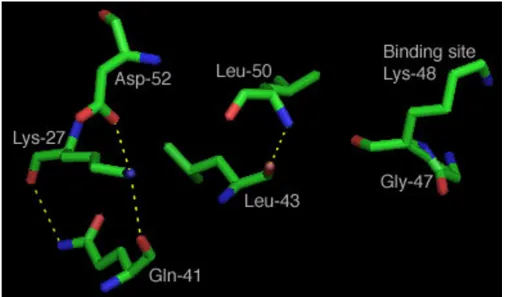
with an amino acid conservation value of only 1, albeit a relatively high value of 2.91 Fits. Five of the remaining 6 sites were found to be clustered in the area of the binding site, with bonds between Leu-50 and Leu-43, as well as between Gly-41, Lys-27, and Asp-52, as shown in Figure 5. Since these sites had the highest FSC values in ubiquitin, we infer that they play a critical role in either binding, or in the structure of the binding site domain for that pro-tein. The fact that of the top seven sites, one was immedi-ately adjacent to the binding site, and five others were located on the structure supporting the binding site lends support for our hypothesis that high FIT values can be used to locate key functional components of a protein family.
In this paper, we have presented an important advance in the measurement of the FSC of biopolymers. It was assumed that aligned sequences from the same Pfam fam-ily, could be assigned the same functionality label. Even though the same functionality may not be applicable to individual sites, site independence and significance was assumed and the measured FSC of each site was summed. However, further extension of the method should be con-sidered [12,35]. For example, if dependency of joint occurrences is detected between the outcomes of two var-iables X3 and X4 in the aligned sequences, then the N-tuple representation of the sequences could be transformed into a new R-tuple YR where these outcomes of X3 and X4 are represented as outcome by a single variable Y3 as shown in Measuring FSC for 35 protein families
Figure 2
Figure 6. An outcome of the two variables in X3 and X4 cor-respond to a hypercell in YR. A more accurate estimate of FSC could then be calculated. We are currently consider-ing this more general scenario.
The measurement in Fits of the FSC provides significant information about how specific each monomer in the sequence must be to provide the needed/normal biofunc-tion. The functional information measures the degree of challenge involved in searching the sequence space for a sequence capable of performing the function. In addition, Fits can be summed for every sequence required to achieve a complete functional biochemical pathway and inte-grated cellular metabolism, including regulatory proteins. In principle, it may be possible to estimate a FSC value for an entire prokaryotic cell where the genome has been sequenced and all translated proteins are known. Simpler genomes in viruses may be an excellent example for this kind of analysis. That is, further analysis of the FSC values will provide a starting point to reveal important informa-tion about the processes for an entire organism such as the virus.
Conclusion
A mathematical measure of functional information, in units of Fits, of the functional sequence complexity observed in protein family biosequences has been designed and evaluated. This measure has been applied to diverse protein families to obtain estimates of their FSC. The Fit values we calculated ranged from 0, which describes no functional sequence complexity, to as high as 2,400 that described the transition to functional complex-ity. This method successfully distinguishes between FSC and OSC, RSC, thus, distinguishing between order, ran-domness, and biological function.
Methods
The following is a brief summary of the methods used (additional file 1). A more detailed description is availa-ble as an online supplement. Eqn. (6) was applied to 35 protein families or protein domain families, to estimate the value of the FSC for any protein included within that family. A program was written, using Python, to analyze the two-dimensional array of aligned sequences for a pro-tein family and is available online (additional files 2, 3, 4, 5, 6, 7, 8, and 9). The data for the arrays was obtained
Measure of FSC/site for ubiquitin Figure 3
Measure of FSC/site for ubiquitin. The plot shows how the FSC value varies between sites for a protein family of ubiquitin. At site 37, all 20 amino acids are observed, with a relatively high Fit value of 2.9. It indicates that measure of FSC also depends on the number of amino acid types observed as well as the distribution of frequencies of each type.
Ubiquitin FITs/Site
Total FIT value = 185
0
1
2
3
4
5
1 5 9 13 17 21 25 29 33 37 41 45 49 53 57 61 65 69 73
Aligned Site Number
0
2
4
6
8
10
12
Fits/site
amino acid conservation
11
2
4
3
5
6
7
triplet bond
bonded pair
Fits
C
onser
from the Pfam database [36]. Eqn. (7) was used to esti-mate the probability for each amino acid at each site.
Competing interests
The author(s) declare that they have no competing inter-ests.
Authors' contributions
KD helped develop the formulation and measure of FSC, wrote the software, carried out the analysis and drafted the manuscript. DC developed, together with KD, the basic formula of functional entropy and evaluated the different mathematical forms. DC provided suggestions to the experimental design and its interpretations. DLA's contri-butions included defining/delineating the three subsets of
sequence complexity and their relevance to biopolymeric information, contributing to the first draft of the paper, critiquing KD's quantification methodology, contributing references, and coining the term "fits" for "functional bits" as the unit of measure of Functional Sequence Com-plexity (FSC). JT participated in the design and coordina-tion of the study. All authors read and approved the final manuscript.
Location of high Fit value sites for ubiquitin Figure 4
Location of high Fit value sites for ubiquitin. Six of the seven highest Fit value sights in ubiquitin are shown in cyan in this MacPyMOL model of 1AAR. The site with the highest Fit value in the entire protein was Gly-47, immediately next to the Lys-48 binding site, a possible indication that it plays a key role in permitting Lys-Lys-48 to undergo binding. The other 5 sites appear to perform a critical role in the conformation of the binding domain.
Leu-50 (#3)
Gly-47 (#1) Binding Site Lys-48
Leu-43 (#4)
Gln-41 (#7) Lys-27 (#2)
Calculated bonds for high Fit value sites in binding domain Figure 5
Calculated bonds for high Fit value sites in binding domain. A 3rd-order component was observed between Lys-27,
Detecting higher order dependencies Figure 6
Detecting higher order dependencies. A biosequence of L sites can be represented as an L-discrete space XL. A pairwise relation between sites 3 and 4 can be represented as a single event at site 3 in an R-discrete space YR. The FSC value computed
after the aligned sequence data has been converted to YR would yield a more accurate measurement of FSC.
X 3
X L
X 4
Event association
of two events X
and X to form a
Y 3
single event in Y .
3
Additional material
Acknowledgements
The research is supported by the National Sciences and Engineering research Council (NSERC) of Canada, Discovery Grant, the Korean Research Foundation Grant (KRF-2004-042-C00020) of one of the authors.
References
1. Gerstein MB, Bruce C, Rozowsky JS, Zheng D, Du J, Korbel JO, Emanuelsson O, Zhang ZD, Weissman S, Snyder M: What is a gene, post-ENCODE? History and updated definition. Genome Res 2007, 17:669-681.
2. Abel DL: Is Life Reducible to Complexity? In Fundamentals of Life Edited by: Palyi G, Zucchi C, Caglioti L. Paris: Elsevier; 2002:57-72.
3. Abel DL, Trevors JT: Three subsets of sequence complexity
and their relevance to biopolymeric information. Theoretical biology & medical modelling 2005, 2:29.
4. Ertem G, Ferris JP: Sequence- and regio-selectivity in the montmorillonite-catalyzed synthesis of RNA. Origins of life and evolution of the biosphere 2000, 30:411-422.
5. Abel DL, Trevors JT: Self-Organization vs. Self-Ordering
events in life-origin models. Physics of Life Reviews 2006,
3:211-228.
6. Szostak JW: Functional information: Molecular messages.
Nature 2003, 423:689.
7. Shannon C: Part I and II: A mathematical theory of communi-cation. The Bell System Technical Journal 1948, XXVII:379-423.
8. Gammerman A, Vovk V: Kolmogorov complexity: sources,
the-ory and applications. The Computer Journal 1999, 42:252-255. 9. Wong AKC, Chiu DKY: An event-covering method for effective
probabilistic inference. Pattern Recognition 1987, 20:245-255.
10. Chiu DKY, Wong AKC, Cheung B: Information discovery
through hierarchical maximum entropy discretization and synthesis. In Knowledge Discovery in Databases Edited by: Piatetsky-Shapiro G, Frawley WJ. Cambridge, Massachusetts: MIT Press; 1991:125-114.
11. Chiu DKY, Rao G: The 2-level pattern analysis of genome com-parisons. WSEAS Transactions on Biology and Biomedicine 2006,
3:167-174.
12. Chiu DKY, Wang Y: Multipattern consensus regions in multiple aligned protein sequences and their segmentation. EURASIP Journal on Bioinformatics and Systems Biology 2006, 2006:1-8. 13. Ellington AD, Szostak JW: In vitro selection of RNA molecules
that bind specific ligands. Nature 1990, 346:818-822.
14. Tuerk C, Gold L: Systematic evolution of ligands by exponen-tial enrichment: RNA ligands to bacteriophage T4 DNA polymerase. Science (New York, NY 1990, 249:505-510.
15. Robertson DL, Joyce GF: Selection in vitro of an RNA enzyme that specifically cleaves single-stranded DNA. Nature 1990,
344:467-468.
16. Liao H, Yeh W, Chiang D, Jernigan RL, Lustig B: Protein sequence entropy is closely related to packing density and hydropho-bicity. Protein Engineering, Design & Selection 2005, 18:59-64. 17. Durston KK, Chiu DKY: A functional entropy model for
biolog-ical sequences. Dynamics of Continuous, Discrete & Impulsive Systems, Series B 2005.
18. Backofen R, Bernhart SH, Flamm C, Fried C, Fritzsch G, Hackermuller J, Hertel J, Hofacker IL, Missal K, Mosig A, et al.: RNAs everywhere: genome-wide annotation of structured RNAs. J Exp Zoolog B Mol Dev Evol 2006.
19. Chaparro-Riggers JF, Polizzi KM, Bommarius AS: Better library design: data-driven protein engineering. Biotechnol J 2006. 20. Oti M, Brunner H: The modular nature of genetic diseases.
Clin-ical genetics 2007, 71:1-11.
21. Karp PD: An ontology for biological function based on molec-ular interactions. Bioinformatics 2000, 16:269-285.
22. Gao L, Chiu DKY: Classification algorithms and analyzing func-tionality of protein families. In Data Mining VI, Data Mining, Tex Mining and Their Business Applications Edited by: Zabnasi A, Brebbia CA, Ebecken NFF. Southampton, Boston: WIT Press; 2005:431-443. 23. Chiu DKY, Chen X, Wong AKC: Association between statistical and functional patterns in biomolecules. Atlantic Symposium on Computational Biology and Genome Information Systems and Technology, Mar15–17; Durham, N.C. U.S.A 2001:64-69.
24. Griesemer J: What is "epi" about epigenetics? Ann N Y Acad Sci 2002, 981:97-110.
Additional File 1
Methods. Additional details of the methods used in this project Click here for file
[http://www.biomedcentral.com/content/supplementary/1742-4682-4-47-S1.rtf]
Additional File 2
Main Program. A copy of the coding for the main program used in this paper
Click here for file
[http://www.biomedcentral.com/content/supplementary/1742-4682-4-47-S2.doc]
Additional File 3
AminoFreq. A required module for the main program Click here for file
[http://www.biomedcentral.com/content/supplementary/1742-4682-4-47-S3.doc]
Additional File 4
ColTot. A required module for the main program Click here for file
[http://www.biomedcentral.com/content/supplementary/1742-4682-4-47-S4.doc]
Additional File 5
Convert. A required module for the main program Click here for file
[http://www.biomedcentral.com/content/supplementary/1742-4682-4-47-S5.doc]
Additional File 6
DistEnt. A required module for the main program Click here for file
[http://www.biomedcentral.com/content/supplementary/1742-4682-4-47-S6.doc]
Additional File 7
FormArray. A required module for the main program Click here for file
[http://www.biomedcentral.com/content/supplementary/1742-4682-4-47-S7.doc]
Additional File 8
StripName. A required module for the main program Click here for file
[http://www.biomedcentral.com/content/supplementary/1742-4682-4-47-S8.doc]
Additional File 9
P53DNADom. A sample data set for the reader Click here for file
Publish with BioMed Central and every scientist can read your work free of charge
"BioMed Central will be the most significant development for disseminating the results of biomedical researc h in our lifetime."
Sir Paul Nurse, Cancer Research UK
Your research papers will be:
available free of charge to the entire biomedical community
peer reviewed and published immediately upon acceptance
cited in PubMed and archived on PubMed Central
yours — you keep the copyright
Submit your manuscript here:
http://www.biomedcentral.com/info/publishing_adv.asp
BioMedcentral
25. Kobayashi H, Kaern M, Araki M, Chung K, Gardner TS, Cantor CR, Collins JJ: Programmable cells: interfacing natural and engi-neered gene networks. Proc Natl Acad Sci USA 2004,
101:8414-8419.
26. Oyama S: The Ontogeny of Information: Developmenal Systems and Evo-lution (science and cultural theory) Durham, N.C.: Duke University Press; 2000.
27. Yockey HP: Information theory, evolution and the origin of life. Information Sciences 2002, 141:219-225.
28. Rocha LM: Evolution with material symbol systems. Bio Systems 2001, 60:95-121.
29. Rocha LM, Hordijk W: Material representations: from the
genetic code to the evolution of cellular automata. Artificial life 2005, 11:189-214.
30. Steinman G, Cole MN: Synthesis of biologically pertinent pep-tides under possible primordial conditions. Proc Natl Acad Sci USA 1967, 58:735-742.
31. Weiss O, Jimenez-Montano MA, Herzel H: Information content of protein sequences. Journal of theoretical biology 2000, 206:379-386. 32. Barbieri M: The Organic Codes: An Introduction to Semantic Biology
Cam-bridge: Cambridge University Press; 2003.
33. Ronshaugen M, McGinnis N, McGinnis W: Hox protein mutation and macroevolution of the insect body plan. Nature 2002,
415:914-917.
34. Cook WJL, Carson M, Chen Z, Pickart C: Structure of a Diubiq-uitin Conjugate and a Model for Interaction with UbiqDiubiq-uitin Conjugating Enzyme (E2). The Journal of Biological Chemistry 1992,
267:16467-16471.
35. Wong AKC, Wang Y: Pattern discovery: a data driven
approach to decision support. Systems, Man and Cybernetics, Part C, IEEE Transactions on 2003, 33:114-124.