R E S E A R C H A R T I C L E
Open Access
Interprofessional clinical training in mental
health improves students
’
readiness for
interprofessional collaboration: a
non-randomized intervention study
Michael Marcussen
1*, Birgitte Nørgaard
2, Karen Borgnakke
3and Sidse Arnfred
1Abstract
Background:Over the past decades, the health sector in general has increasingly acknowledged the effectiveness of interprofessional clinical training in enhancing teamwork. In psychiatry, however, knowledge of the benefits of collaborative clinical training is sparse. This study aimed to investigate the impact of interprofessional training on students’readiness for interprofessional collaboration in a psychiatric ward.
Methods:An intervention study assessed interprofessional clinical training in a training ward. Undergraduate students from the disciplines of medicine, nursing, psychotherapy, pedagogy, and social work were allocated either to an intervention group receiving interprofessional training or to a comparison group receiving conventional clinical training. Outcomes were assessed using the Readiness for Interprofessional Learning Scale (RIPLS) and the Assessment of Interprofessional Team Collaboration Scale (AITCS). Linear mixed regression was used to compare differences in mean scores postintervention, adjusted for baseline score, gender, and profession.
Results:Mean postintervention scores were higher in the intervention group (n= 87) than in the comparison group (n= 108) for both scales (overall sum score). For the RIPLS, the mean difference was 2.99 (95% CI 0.82 to 5.16;p= 0. 007); for the AITCS it was 8.11 (95% CI 2.92–13.30;p= 0.002). Improvement in readiness for interprofessional learning and team collaboration in the intervention group remained statistically significant after adjustment for baseline differences between the two groups.
Conclusion:Students’ self-reported readiness for interprofessional learning and their team collaboration were improved after interprofessional clinical training. Still, further studies of both the processes and the long-term effects of undergraduate IPE in mental healthcare are needed. The study was registered March 62,017 on ClinicalTrials.gov: NCT03070977 (Retrospectively registrered).
Keywords: Interprofessional education, IPE, Team collaboration, Psychiatry
Background
Many professionals working in mental healthcare have insufficient skills to participate effectively in interprofes-sional teamwork [1], and collaboration among team
members continues to pose a challenge [1–4]. This
might be due to professional cultures and poor
commu-nication [1, 2], which has consequences for the quality
of care (i.e. errors and poor service delivery). For that reason, collaborative practices are increasingly being introduced in wards, as they have shown their
effective-ness for mentally ill people with complex needs [5–7].
Interprofessional education (IPE) continues to be pro-posed by policymakers in mental healthcare as a means of improving collaborative practices and patient care, i.e. teamwork is invoked as by policymakers as effective to
prevent relapse and manage chronic conditions [5, 6].
IPE is assumed to be effective to enhance collaborative
practice despite challenges to demonstrate its
* Correspondence:[email protected]
1Department of Clinical Medicine, University of Copenhagen and Psychiatry
Slagelse, Region Zealand, Fælledvej 6, 4200 Slagelse, Denmark Full list of author information is available at the end of the article
effectiveness in clinical education in mental health [2,4, 8, 9]. The World Health Organization (WHO) defines
IPE as settings in which“(…) students from two or more
professions learn about, from and with each other to en-able effective collaboration and improve health
out-comes” [6]. However, previous studies have reported
challenges attached to IPE, such as logistical barriers to plan IPE sessions, when students come from different programs and universities. Moreover, IPE sessions is challenged by different academic levels of the students and prior experiences to interprofessional collaboration [8,9]. Acknowledging the difficulties involved in achiev-ing interprofessional collaboration, WHO recommends that the fostering of IPE begin at undergraduate level [6]. Various IPE initiatives for undergraduates have been described, some of which have taken place in clinical set-tings where students from different healthcare
profes-sions work together [10–13]. Hospitals are increasingly
establishing such clinical training wards [10, 12, 13] but, to date, only initiatives in other specialties have been de-scribed [10,11,14–16]. Interprofessional clinical training
aims to improve students’ attitudes toward and
aware-ness of other professions and their roles, and to advance teamwork and collaborative competencies. However, demonstrating change in interprofessional attitudes and
behavior remains difficult and, in some settings—such as
mental health education—IPE remains underresearched
[1, 17]. Those studies that have been undertaken in mental health education contexts have produced limited
results. Marcussen et al.’s (2018) systematic review of
the effects of undergraduate IPE in mental health prac-tice found only eight studies qualifying for inclusion [17]. This calls for intervention studies with more
rigor-ous research designs and methods [1, 17] . Therefore,
this study contributes to the sparse literature in the field of undergraduate IPE in clinical mental health. Addition-ally, Anderson et al. [18] proposed the role of question-naires as establishing a baseline for regular assessment of change. We used a similar approach. Moreover, given
the positive results gained in other specialties, we set out to investigate whether similar results could also be achieved in psychiatric wards.
Thus, we investigated the impact of interprofessional
training on students’ readiness for interprofessional
collaboration in a psychiatric ward. The study took place
during 2016–2018 in the Department of Adult
Psychiatry in Slagelse, Denmark. The department has four inpatient wards, an outpatient clinic, and an emergency ward, serving a mixed urban and rural district.
An interprofessional training ward was established in the department for students of medicine, nursing, peda-gogy, physiotherapy, and social work. The organization of the clinical training ward was inspired by the work of Nørgaard et al. [19] and aimed to create a new environ-ment for learning, to enable students learn from each other and develop their competences in interprofessional collaboration and reflection [20]. Reflection is consid-ered a key strategy in interprofessional training [21,22]. The intervention was studied in a prospective clinical trial, which enabled a robust comparison between those who had been exposed to the intervention and the com-parison group. This paper describes the assessment and its results.
Methods
Design
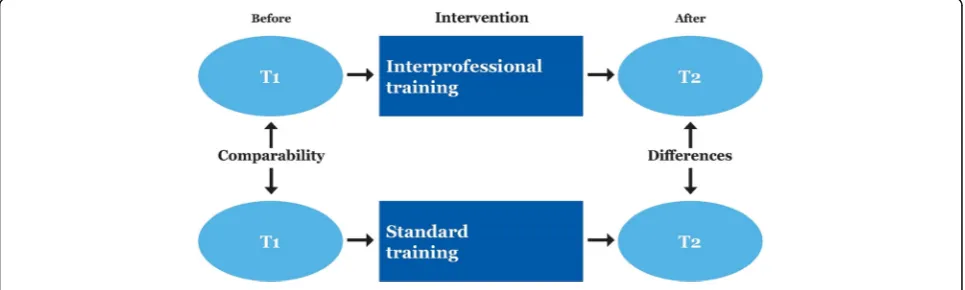
We designed a prospective clinical trial with a
compari-son group, as shown in Fig.1. The intervention followed
the time of clinical placement. The students in the inter-vention group received interprofessional clinical training, while those in the comparison group received conven-tional clinical training. Data collection took place from October 2016 to March 2018. Self-report questionnaires were administered to both groups before and after clinical training. The design allowed us to determine the changes that occurred (by comparing the scores after clinical training (T2) with those from the baseline (T1))
[20]. The study was registered on ClinicalTrials.gov (NCT03070977), and conducted in accordance with the CONSORT guidelines [23].
Participants and setting
The study participants were students on clinical place-ments in psychiatric inpatient wards. The patients, who were aged 18 years and above, suffered from psychiatric disorders such as schizophrenia, psychosis, major depres-sion, bipolar disorder, or severe personality disorder.
The 195 students who were eligible for participation were studying medicine (in the 5th year), nursing (2nd and 3rd years), physiotherapy (3rd year), social and healthcare (2nd year), pedagogy (3rd year), and social work (2nd year). Furthermore, the learning outcomes were discipline specific, however, the self-reported out-comes in this study were the same for both groups. Although the timing of interprofessional clinical training differed for the various professions, the students were assumed to have reached a stage in their education at which they had developed a professional identity and
were capable of contributing to interprofessional
learning.
The students from each of the professions were evenly allocated to the intervention and the comparison group by course administrators from their universities and col-leges, with no involvement of the research team.
Intervention
In 2015, an interprofessional study unit was established with 17-beds. This psychiatric ward was organized in 3 clinical care teams including professionals from medi-cine, nursing, psychology, pedagogue, social work, and the patient, as well as students. A facilitator team was responsible for the interprofessional training. In medio 2016 the facilitation team completed a course facilitating interprofessional collaboration and training. The inter-vention involved the total staff participation in an initial workshop. The intervention consisted of two types of ac-tivities: clinical care teamwork (mainly supervised by in-structors from each of the participating professions) and interprofessional group tutorial sessions led by instruc-tors with extensive experience in delivering IPE. In
addition to strengthening students’ own professional
roles, the training aimed to increase their knowledge of
other professionals’ roles and to develop
interprofes-sional collaboration.
The students participated in a workshop with group discussions, small-group work, and PowerPoint presen-tations introducing the primary diagnoses found in the ward and the responsibilities of each of the health pro-fessions involved in care. These scenarios provided a basis for instructor-facilitated discussions related to living with a psychiatric disorder, understanding the
patients and their backgrounds, and the roles of health-care teams.
Interprofessional group turorial
To improve their reflection on clinical practice [2] and
to strengthen their knowledge of the patients’treatment
and care, all students met once a week for interprofes-sional group tutorial. Besides the IPE facilitation team responsible for planning the group tutorial, a nurse facilitator was present during all sessions.
The group tutorial required the students to prepare and deliver a presentation to their peers and instructors.
The patient’s view of the condition, and how it was
man-aged in the ward, were obligatory elements of the
pre-sentations, as was the presenter’s suggestions for
improvements facilitated through interprofessional col-laboration. In subsequent group discussions facilitated by the tutors, interprofessional practices and challenges in the care of patients with complex needs were highlighted. Every session was structured on real patients, i.e.: a patient suffering from severe mental dis-orders such as schizophrenia and co-occurring substance use disorders traditionally received treatments for their two disorders from two different sets of clinicians in parallel treatment systems.
Clinical care teams
In the training ward, the students’clinical training was
organized in care teams of between three and ten
stu-dents [7, 13] alongside with the professionals. Weekly
conferences were held with each team to ensure that the care and treatment were well planned and well coordi-nated. To further support this aim, the conferences were attended by permanent staff, the patient, and his or her family during hospitalization. The students were distrib-uted between the care teams for supervision, which took place in collaboration with the IPE facilitators.
Comparison group
Students in the comparison group continued their usual discipline-specific training during their clinical place-ment, with no structured interprofessional training. Their clinical training was organized in a uniprofessional structure, as opposed to the team-organized structure used in the intervention group.
Outcome measures
Readiness for Interprofessional learning
Self-reported readiness for interprofessional learning were measured using the scale with the same name (RIPLS), as modified by McFadyen et al. [24], which has
been found to have good internal consistency [25–27].
The Danish four-subscale version with 29 items applied here has been validated and culturally adapted by
Nørgaard et al. [27]. The learning scale assesses
Team-work and Collaboration, Negative Professional identity, Positive Professional identity, and Roles and Responsibil-ities [28] using a five-point Likert scale: (Strongly dis-agree (1), Disdis-agree (2), Undecided (3), Agree (4), Strongly agree (5)).
Team collaboration
To gain insight into the students’self-reported level of
collaboration, we used the Assessment of Interprofes-sional Team Collaboration Scale (AITCS) of Orchard et al., with 47 items in four subscales (Partnership,
Cooperation, Coordination, and Shared decision
making), using a 5-point Likert scale [29]: (Never (1), Rarely (2), Occasionally (3), Most of the time (4), Always (5)). We employed the Danish version validated by Hellman et al. [30], with 37 items distributed on three
subscales (Partnership/Shared decision making,
Cooperation, and Coordination).
Ethical considerations
The students were informed of the project and its pur-pose immediately before participation. Responding to the questionnaire was considered to constitute voluntary consent to participation. Data were entered into the EasyTrial online Clinical Trial Management system. Data were labelled with unique identifiers, and all per-sonal identifiers were removed or disguised during ana-lysis to preclude personal identification. Raw data are available as supplementary files (Additional files1 and2). The study was approved by the Danish Data Protection Agency (2008-58-0020), and thus required no further
ethical approval, according to Danish legislation (16–
000014).
Analysis
The sample size was calculated on the basis of a type I error (α) of 5% and a type II error (β) of 20% (with a power of 80%). We used a standard deviation of eight points, based on findings from an intervention study [31] using the RIPLS (our primary outcome). Anticipat-ing a withdrawal rate of 20%, we allocated 90 partici-pants to each group.
The participants were described in terms of gender and profession. To investigate subscale assumptions, we conducted a confirmatory factor analysis at baseline on the full dataset of students. Internal consistency between
items was assessed using Cronbach’s alpha. Both scales
(RIPLS and AITCS) use a Likert scale. The scale scores were treated as interval as recommended in previous studies [32,33]. We initially used unpaired t-tests to as-sess mean score differences at baseline. Differences over
time were explored using the paired sample t-test. The
postintervention mean scale scores were compared between groups and over time using linear mixed regres-sion, and adjusted for gender, profesregres-sion, and baseline scores. The Bonferroni test was used to correct the sig-nificance level when multiple comparisons were made. All statistical analyses were performed using SPSS (IBM Corp. Released 2018. IBM SPSS Statistics for Windows, Version 24.0. Armonk, NY: IBM Corp).
Results
Population
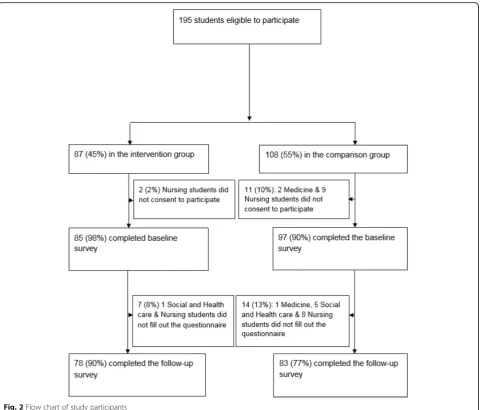
In Fig.2, we present the flow of participants through the
study. A total of 87 students were allocated to the inter-vention group, with 108 in the comparison group. Base-line and postintervention data were collected for 78/87 intervention group participants (98%) and 83/108 for the comparison group participants (77%), respectively. As
Table 1 shows, baseline characteristics were comparable
between the intervention and the comparison
participants.
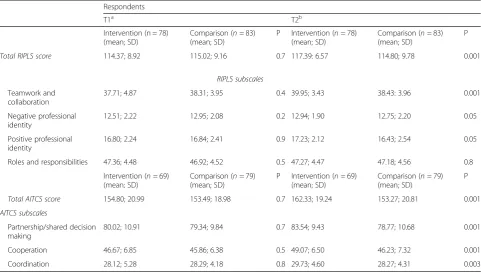
On both scales, the baseline scores for the intervention group and the comparison group were comparable, as
evident from the estimates andp-values (Table2).
Both scales were tested for internal reliability, and
Cronbach’s alpha was estimated at 0.77 (RIPLS) and 0.97
(AITCS) in overall reliability, which is considered acceptable [27].
Effect of interprofessional training
The mean scores (overall summed scores) on both scales increased for the students in the intervention group after completion of the interprofessional clinical training. As
seen in Table 2, the pre- and post total RIPLS scores
were 114.37–117.39 in the intervention group and
115.02–114.80 in the comparison group. This
improve-ment for the intervention group was statistically
signifi-cant (p= 0.001). Similarly, the pre- and post total AITCS
scores were 154.80–162.33 in the intervention group
and 153.49–153.27 in the comparison group,
respect-ively. This improvement for the intervention group was also significant (p= 0.001).
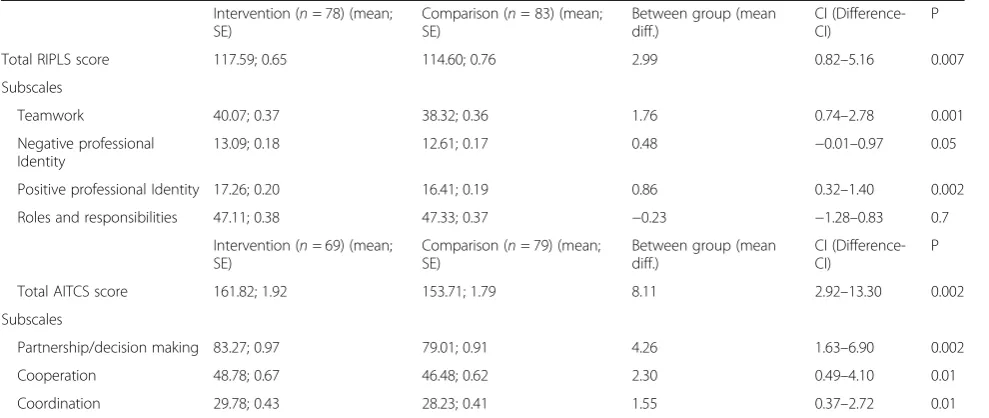
Table 3 presents the differences in the mean scores
Fig. 2Flow chart of study participants
Table 1Gender and profession of responding students
Respondents
T1 T2
Intervention (n= 85) n (%) Comparison (n= 97) n (%) Pa Intervention (n= 78) n (%) Comparison (n= 83) n (%) Pa
Gender
Male 14 (16.5) 12 (12.4) 0.4 14 (18.0) 11 (13.3) 0.4 Female 71 (83.5) 85 (87.6) 66 (82.1) 72 (86.8)
Profession/Study
Nurse 44 (51.8) 51 (52.6) 0.09 38 (48.7) 43 (51.8) 0.1 Medical 14 (16.5) 17 (17.5) 14 (18.0) 16 (19.3)
Social and healthcare 20 (23.5) 29 (29.9) 19 (24.4) 24 (28.9) Otherb 7 (8.2) 0 (0.0) 7 (9.0) 0 (0.0)
T1Time 1 (baseline) measurement,T2Time 2 measurement (after clinical training). Social and healthcare = nursing assistant
a
Chi-square test
b
baseline characteristics (Table 3). The mean difference between the two groups was: 2.99 (95% CI 0.82 to 5.16;
p = 0.007) in total RIPLS score with an effect size,
Cohen’s d of 0.4. The improvement in the total score for
the intervention group was statistically significant for
the subscales as well: 1.76 (95% CI 0.74 to 2.78; p =
0.001) regarding teamwork and collaboration, plus 0.86
(95% CI 0.32 to 1.40;p= 0.002) for positive professional
identity. No significant differences were found between the two groups in terms of negative professional identity, and roles and responsibilities. The mean difference in
total AITCS score was 8.11 (95% CI 2.92–13.30; p =
0.002) with an effect size, Cohen’s d of 0.5, which is
con-sidered as a moderate effect [34, 35]. For partnership
and shared decision-making, this was 4.26 (95% CI
1.63–6.90; p = 0.002); for cooperation, 2.30 (95% CI
0.49–4.10; p = 0.01); for coordination, 1.55 (95% CI
0.37–2.72; p = 0.01). Both scales showed that the mean
score difference in the intervention group was larger than that of the comparison group, although adjustment (by gender, age and professions) minimized the differ-ence (Table3).
Discussion
This intervention study has found that interprofessional clinical training yield a moderate improvement in
stu-dents’ self-reported readiness for interprofessional
learning. Likewise, moderate improvements were also
found in the intervention group in terms of students’
self-reported team collaboration, as compared to the comparison group. Consistent results were found using both the RIPLS scale and the AITCS scale. We likewise found significant improvements in the professional iden-tity of the intervention group students as team members. In terms of roles and responsibilities, no significant
dif-ferences were identified between the groups— a lack of
difference for which no clear explanation emerged. How-ever, Barnett et al. found a similar result in their inter-vention study of interprofessional attitudes arising from shared learning in mental health (36)]. Likewise, the sys-tematic review of Marcussen et al. [17] concluded that students of mental health responded well to IPE, espe-cially in terms of improved collaboration skills and more positive views of other professions’contributions.
The significantly improved RIPLS and AITCS scores found after interprofessional training in our study cor-roborates the findings of previous studies showing that interventions using active training methods lead to higher RIPLS scores and larger difference in mean score than interventions using passive methods [37]. Our
study’s use of active training methods seems to have had
a moderate effect. Similarly, Pollard et al. [38] found that students value practical interprofessional experience over what can be gained in simulated environments in Table 2Crude scores at baseline and postintervention
Respondents
T1a T2b
Intervention (n = 78) (mean; SD)
Comparison (n= 83) (mean; SD)
P Intervention (n= 78) (mean; SD)
Comparison (n= 83) (mean; SD)
P
Total RIPLS score 114.37; 8.92 115.02; 9.16 0.7 117.39: 6.57 114.80; 9.78 0.001
RIPLS subscales
Teamwork and collaboration
37.71; 4.87 38.31; 3.95 0.4 39.95; 3.43 38.43: 3.96 0.001 Negative professional
identity
12.51; 2.22 12.95; 2.08 0.2 12.94; 1.90 12.75; 2.20 0.05 Positive professional
identity
16.80; 2.24 16.84; 2.41 0.9 17.23; 2.12 16.43; 2.54 0.05 Roles and responsibilities 47.36; 4.48 46.92; 4.52 0.5 47.27; 4.47 47.18; 4.56 0.8
Intervention (n= 69) (mean; SD)
Comparison (n= 79) (mean; SD)
P Intervention (n= 69) (mean; SD)
Comparison (n= 79) (mean; SD)
P
Total AITCS score 154.80; 20.99 153.49; 18.98 0.7 162.33; 19.24 153.27; 20.81 0.001
AITCS subscales
Partnership/shared decision making
80.02; 10.91 79.34; 9.84 0.7 83.54; 9.43 78.77; 10.68 0.001 Cooperation 46.67; 6.85 45.86; 6.38 0.5 49.07; 6.50 46.23; 7.32 0.001 Coordination 28.12; 5.28 28.29; 4.18 0.8 29.73; 4.60 28.27; 4.31 0.003
RIPLSReadiness for Interprofessional Learning Scale,SDStandard deviation,AITCSAssessment of Interprofessional Team Collaboration Scale
a
Independent Samplest-test
b
university settings. Moreover, they seem to appreciate training these skills alongside experienced professionals, and with real patients in real contexts [38]. Reeves and
Pauzé [1, 4] have emphasized undergraduate learners’
benefit from the inclusion of real-world thinking in IPE. With regard to the impact of IPE in mental health education, the quality of evidence is critical to advan-cing our understanding of ways of improving IPE. Studies undertaken in mental health contexts have so
far produced limited or disappointing results.
Barnett’s study (36)] conducted in a youth mental
health service has shown a strengthening of students’
positive attitudes toward other professions and inter-professional learning following participation in an IPE workshop. An IPE study in mental health by Priest et al. [8] has clarified roles and practical collaboration, although no change in professional identity was found. Many challenges were identified by Priest et al. [8], including some that arose from differences in aca-demic levels among student groups, their previous experience, and assessment. Studying an in-service IPE initiative among community mental health teams, Reeves and Freeth [2] showed that while the educa-tional input was well received, wider success was elu-sive, as already agreed plans for collaboration were not implemented. Our systematic review of the effects of interprofessional education in mental health prac-tice found only eight studies qualifying for inclusion [17]. This calls for more rigorous research designs
and methods [1, 4, 17]. However, despite these
chal-lenges, it remains important to offer collaboration
with future colleagues as a foundation for effective teamwork in mental health treatment and care.
The baseline RIPLS scores for the participants in this study were almost identical to those found in a large Australian sample of undergraduate paramedic and nursing students [39] and in a UK sample of nursing and psychology students [8]. Both studies found benefits related to IPE; however, investigation of the effect of IPE in relation to more than two disciplines has been sparse and previous results may thus not be comparable with those published here.
Both Wakely et al. [40] and Wellmon et al. [41] found improvement after interprofessional clinical training similar to our findings: The pre- and post RIPLS scores for the subscale: team work and collaboration were in Wakely’s study 38.5–41.0 and in Wellmon’s study 37.91–
39.91, respectively. As seen in Table 2the pre- and post
RIPLS scores in our study were 37.71–39.95 in the
inter-vention group.
Also, when using the AITCS scale, we found statisti-cally significant improvements in teamwork in the inter-vention group. We can thus corroborate the results of a Canadian study [42] that used the AITCS survey to investigate attitudes of interprofessional collaboration in an IPE unit (a 30-bed inpatient medical unit). However, our results and the Canadian results also indicate that many areas of teamwork still need to be addressed, such as the need for organizational support for teamwork. So far, only a few studies have substantiated the positive effects of educational outcomes within mental health
educational research [1, 17]. This may be due to a
Table 3Estimates of RIPLS and AITCS over time and between groupsa b
Intervention (n= 78) (mean; SE)
Comparison (n= 83) (mean; SE)
Between group (mean diff.)
CI (Difference-CI)
P Total RIPLS score 117.59; 0.65 114.60; 0.76 2.99 0.82–5.16 0.007 Subscales
Teamwork 40.07; 0.37 38.32; 0.36 1.76 0.74–2.78 0.001 Negative professional
Identity
13.09; 0.18 12.61; 0.17 0.48 −0.01–0.97 0.05 Positive professional Identity 17.26; 0.20 16.41; 0.19 0.86 0.32–1.40 0.002 Roles and responsibilities 47.11; 0.38 47.33; 0.37 −0.23 −1.28–0.83 0.7
Intervention (n= 69) (mean; SE)
Comparison (n= 79) (mean; SE)
Between group (mean diff.)
CI (Difference-CI)
P Total AITCS score 161.82; 1.92 153.71; 1.79 8.11 2.92–13.30 0.002 Subscales
Partnership/decision making 83.27; 0.97 79.01; 0.91 4.26 1.63–6.90 0.002 Cooperation 48.78; 0.67 46.48; 0.62 2.30 0.49–4.10 0.01 Coordination 29.78; 0.43 28.23; 0.41 1.55 0.37–2.72 0.01
IPEInterprofessional clinical training,StandardStandard clinical training (Comparison group),RIPLSReadiness for Interprofessional Learning Scale,SEStandard error,AITCSAssessment of Interprofessional Team Collaboration Scale
a
Linear mixed regression (with Bonferroni correction)
b
number of different factors, such as the challenges in-herent in the measurement of outcome assessments, dif-ferent objectives within teams, and differences in local contexts [2,8].
Strengths and limitations
The interprofessional training approach was a strength of this study, which appears to have supported the stu-dents in gaining interprofessional skills. The experimen-tal design enabled robust analysis of changes in students’ attitudes in both the intervention group and comparison group. The lower response rate in the comparison group (77%) than in the intervention group (90%) should be noted, as it may have weakened the generalizability of these findings. It is reassuring, however, that the response rates were similar across the study groups (i.e., the future professions). Although allocation to interven-tion or comparison group was not random, the alloca-tion procedure was completely independent of the study hypothesis. This is similar to the approach taken in
pre-vious IPE studies [43, 44]. No baseline differences were
identified between intervention and comparison groups. Both the scales (RIPLS and AITCS) used here to meas-ure readiness for interprofessional learning and team collaboration have previously been validated for use with
healthcare students [27,29,30], and thus allow for
com-parison with similar studies. We identified weak internal consistency in the RIPLS subscale: Roles and Responsi-bilities (with a Cronbach’s alpha = 0.59). This is also
re-ported in previous studies [26, 27, 45]. Although the
difference in the length of the clinical training periods of the student groups is a limitation, it is one that our
study shares with several previous IPE studies [7–9, 36,
46]. The findings are based on self-reported measures of readiness for interprofessional learning and team collab-oration. Completion of the surveys was voluntary, and it is possible that the students self-reported views may not be representative of all participants in the inclusion period.
Implications for mental health education
The findings of this study indicate that training in inter-professional wards can meet its objectives, and that interprofessional clinical training can be effective in fos-tering positive attitudes toward working with other pro-fessions. Furthermore, it is possible that embedding IPE learning within the context of hospital wards and using
a team-based approach may enhance students’ learning
and their ability to translate IPE principles into “
real--world” thinking. These tentative explanations require
further exploration in studies using qualitative method-ologies, as well as in prospective, long-term studies [47]. Process evaluations of future IPE interventions may help clarify which elements have the strongest impact on
learning outcomes, so that these can be optimized, as suggested by our systematic review of IPE in mental health to undergraduates [17]. In considering the out-comes of this study, it may be relevant to stress the ben-efits of having an established teaching team with excellent skills in facilitating the integration of students in interprofessional settings.
Conclusion
Students’ self-ported readiness for interprofessional
learning and their team collaboration were improved after interprofessional clinical training, as compared with clinical training as usual. The present study contributes key information to the planning of interventions in organizational settings. Nevertheless, further studies of both the processes and the long-term effects of under-graduate IPE in mental healthcare are needed.
Additional files
Additional file 1:RIPLS Spreadsheet. Readiness for Interprofessional Learning Scale (RIPLS) dataset. (XLSX 57 kb)
Additional file 2:AITCS Spreadsheet. Assessment of Interprofessional Team Collaboration Scale (AITCS) dataset. (XLSX 46 kb)
Abbreviations
AITCS:Assessment of Interprofessional Team Collaboration Scale; IPE: Interprofessional education; RIPLS: Readiness for Interprofessional Learning Scale
Acknowledgements
The authors gratefully acknowledge the support of the respective departments, the students who participated, and the professionals who facilitated their recruitment.
Availability of data materials
All supporting data are included as additional files.
Funding
This research was funded by the Department of Psychiatry in Region Zealand, Denmark.
Authors’contributions
All authors contributed to the design of the project. MM and SA were involved in the development of the intervention. MM performed the statistical analysis. MM, BN and SA wrote the first draft of the manuscript. All authors reviewed and revised the manuscript. All authors read and approved the final manuscript.
Ethics approval and consent to participate
The study was approved by the Danish Data Protection Agency (2008-58-0020), and thus required no further ethical approval, according to Danish legislation (16–000014).
Consent for publication
Not applicable.
Competing interests
The authors declare that they have no competing interests.
Publisher’s Note
Author details
1Department of Clinical Medicine, University of Copenhagen and Psychiatry
Slagelse, Region Zealand, Fælledvej 6, 4200 Slagelse, Denmark.2Department
of Public Health, University of Southern Denmark, Copenhagen, Denmark.
3Department of Media, Cognition and Communication, University of
Copenhagen, Copenhagen, Denmark.
Received: 3 October 2018 Accepted: 10 January 2019
References
1. Pauzé E, Reeves S. Examining the effects of interprofessional education on mental health providers: findings from an updated systematic review. J Ment Health. 2010;19(3):258–71 Available from:http://www.ncbi.nlm.nih. gov/pubmed/20441490. Accessed 16 Jan 2019.
2. Reeves S, Freeth D. Re-examining the evaluation of interprofessional education for community mental health teams with a different lens: understanding presage, process and product factors. J Psychiatr Ment Health Nurs. 2006;13(6):765–70.
3. Reeves S, Perrier L, Goldman J, Freeth D, Zwarenstein M. Interprofessional education: effects on professional practice and healthcare outcomes (update). Cochrane Database Syst Rev. 2013;3(3):CD002213 Available from:
http://www.ncbi.nlm.nih.gov/pubmed/23543515. Accessed 16 Jan 2019. 4. Reeves S. A systematic review of the effects of interprofessional education on
staff involved in the care of adults with mental health problems. J Psychiatr Ment Health Nurs. 2001;8(6):533–42 Available from:https://onlinelibrary.wiley. com/doi/full/10.1046/j.1351-0126.2001.00420.x. Accessed 16 Jan 2019. 5. WHO. Integrating mental health into primary care: A global perspective.
WHO Libr. Department of Mental Health and Substance Abuse, World Health Organization; 2008. Available at:http://www.who.int/mental_health/ resources/mentalhealth_PHC_2008.pdf.
6. World Health Organization. Framework for Action on Interprofessional Education & Collaborative Practice. Practice [Internet]. 2010;1–63. Available from:http://apps.who.int/iris/bitstream/handle/10665/70185/WHO_HRH_ HPN_10.3_eng.pdf;jsessionid=
A00596EFF3560E997CA01C44E96696F1?sequence=1. Accessed 16 Jan 2019. 7. Kinnair D, Anderson E, van Diepen H, Poyser C. Interprofessional education in mental health services: learning together for better team working. Adv Psychiatr Treat. 2014;20(1):61–8 Available from:https://www.cambridge.org/ core/journals/advances-in-psychiatric-treatment/article/interprofessional- education-in-mental-health-services-learning-together-for-better-team-working/C0D897C0F48F3F57A0AB1144381BCBBC. Accessed 16 Jan 2019. 8. Priest HM, Roberts P, Dent H, Blincoe C, Lawton D, Armstrong C.
Interprofessional education and working in mental health: in search of the evidence base. J Nurs Manag. 2008;16(4):474–85.
9. Furness PJ, Armitage H, Pitt R. An evaluation of practice-based interprofessional education initiatives involving service users. J Interprof Care. 2011;25(1):46–52.
10. Wahlstrom O, Sanden I. Multiprofessional training ward at Linkoping University: early experience. Educ Heal. 1998;11(2):225–31. 11. Ponzer S, Hylin U, Kusoffsky A, Lauffs M, Lonka K, Mattiasson AC, et al.
Interprofessional training in the context of clinical practice: goals and students’ perceptions on clinical education wards. Med Educ. 2004;38(7):727–36. 12. Lindblom P, Scheja M, Torell E, Åstrand P, Felländer-Tsai L. Learning
orthopaedics: assessing medical students’experiences of interprofessional training in an orthopaedic clinical education ward. J Interprof Care. 2007;21(4):413–23.
13. Hylin U, Nyholm H, Mattiasson A-C, Ponzer S. Interprofessional training in clinical practice on a training ward for healthcare students: a two-year follow-up. J Interprof Care. 2007;21(3):277–88 Available from:http://www.tandfonline. com/doi/full/10.1080/13561820601095800. Accessed 16 Jan 2019.
14. Wahlström O, Sandén I, Hammar M. Multiprofessional education in the medical curriculum. Med Educ. 1997;31(6):425–9.
15. Hylin U, Lonka K, Ponzer S. Students’approaches to learning in clinical interprofessional context. Med Teach. 2011;33(4):e204-10.
16. Jacobsen F, Fink AM, Marcussen V, Larsen K, Bæk Hansen T. Interprofessional undergraduate clinical learning: results from a three year project in a Danish Interprofessional training unit. J Interprof Care. 2009;23(1):30–40.
17. Marcussen M, Norgaard B, Arnfred S. The effects of Interprofessional education in mental health practice: findings from a systematic review. Acad Psychiatry. 2018.
18. Anderson E, Smith R, Hammick M. Evaluating an interprofessional education curriculum: a theory-informed approach. Med Teach. 2016:385-94. 19. Nørgaard B, Draborg E, Vestergaard E, Odgaard E, Jensen DC, Sørensen J.
Interprofessional clinical training improves self-efficacy of health care students. Med Teach. 2013;35(6):e1235-42.
20. Reeves S, Boet S, Zierler B, Kitto S. Interprofessional education and practice guide no. 3: evaluating interprofessional education. J Interprof Care. 2015; 29(4):305–12.
21. Hammick M, Dornan T, Steinert Y. Conducting a best evidence systematic review. Part 1: from idea to data coding. BEME guide no. 13. Med Teach. 2010;32(1):3–15.
22. Hammick M, Freeth D, Koppel I, Reeves S, Barr H. A best evidence systematic review of interprofessional education: BEME guide no.9. Med Teach. 2007;29(8):735–51.
23. Moher D, Hopewell S, Schulz KF, Montori V, Gøtzsche PC, Devereaux PJ, et al. CONSORT 2010 explanation and elaboration: updated guidelines for reporting parallel group randomised trials. BMJ. 2010:28-55.
24. McFadyen AK, Webster V, Strachan K, Figgins E, Brown H, McKechnie J. The readiness for Interprofessional learning scale: a possible more stable sub-scale model for the original version of RIPLS. J Interprof Care. 2005;19(6):595–603. 25. Curran VR, Sharpe D, Flynn K, Button P. A longitudinal study of the effect of
an interprofessional education curriculum on student satisfaction and attitudes towards interprofessional teamwork and education. J Interprof Care. 2010;24(1):41–52.
26. King S, Greidanus E, Major R, Loverso T, Knowles A, Carbonaro M, et al. A cross-institutional examination of readiness for interprofessional learning. J Interprof Care. 2012.
27. Nørgaard B, Draborg E, Sørensen J. Adaptation and reliability of the readiness for inter professional learning scale in a Danish student and health professional setting. BMC Med Educ. 2016;16(1):1-9.
28. McFadyen AK, Webster VS, MacLaren WM, O’Neill MA. Interprofessional attitudes and perceptions: results from a longitudinal controlled trial of pre-registration health and social care students in Scotland. J Interprof Care. 2010;24(5):549–64.
29. Orchard CA, King GA, Khalili H, Bezzina MB. Assessment of Interprofessional team collaboration scale (AITCS): development and testing of the instrument. J Contin Educ Heal Prof. 2012;32(1):58–67.
30. Hellman T, Jensen I, Orchard C, Bergström G. Preliminary testing of the Swedish version of the assessment of Interprofessional team collaboration scale (AITCS-S). J Interprof Care. 2016:499-504.
31. Darlow B, Coleman K, McKinlay E, Donovan S, Beckingsale L, Gray B, et al. The positive impact of interprofessional education: a controlled trial to evaluate a programme for health professional students. BMC Med Educ. 2015:1-9.
32. Carifio J, Perla R. Resolving the 50-year debate around using and misusing Likert scales. Med Educ. 2008:1150–2.
33. Jamieson S.“Use and misuse of Likert scales”: commentary reply. Med Educ. 2005:971.
34. Malling B, Bested KM, Skjelsager K, Østergaard HT, Ringsted C. Long-term effect of a course on in-training assessment in postgraduate specialist education. Med Teach. 2007:966-71.
35. Wassertheil S, Cohen J. Statistical power analysis for the behavioral sciences. Biometrics. 1970:588.
36. Barnett T, Hoang H, Cross M, Bridgman H. Interprofessional practice and learning in a youth mental health service: a case study using network analysis. J Interprof Care. 2015;29(5):512–4.
37. Mansouri M, Lockyer J. A meta-analysis of continuing medical education effectiveness. J Contin Educ Heal Prof. 2007:6-15.
38. Pollard K, Rickaby C, Miers M. Evaluating student learning in an interprofessional curriculum: the relevance of pre-qualifying inter-professional education for future inter-professional practice. Heal San Fr 2008; Available from:https://www.researchgate.net/publication/254949457_ Evaluating_student_learning_in_an_interprofessional_curriculum_the_ relevance_of_pre-qualifying_inter-professional_education_for_future_ professional_practice. Accessed 16 Jan 2019.
39. Williams B, Webb V. A national study of paramedic and nursing students’ readiness for interprofessional learning (IPL): results from nine universities. Nurse Educ Today. 2015:e31–7.
41. Wellman R, Gilin B, Knauss L, Linn MI. Changes in student attitudes toward interprofessional learning and collaboration arising from a case-based educational experience. J Allied Health. 2012:26-34.
42. Prentice D, Jung B, Taplay K, Stobbe K, Hildebrand L. Staff perceptions of collaboration on a new interprofessional unit using the assessment of Interprofessional team collaboration scale (AITCS). J Interprof Care. 2016:823-5. 43. Richards DA, Hill JJ, Gask L, Lovell K, Chew-Graham C, Bower P, et al. Clinical
effectiveness of collaborative care for depression in UK primary care (CADET): cluster randomised controlled trial. BMJ. 2013:1-10.
44. Curran V, Heath O, Adey T, Callahan T, Craig D, Hearn T, et al. An approach to integrating interprofessional education in collaborative mental health care. Acad Psychiatry. 2012;36(2):91–5 Available from:http://www.ncbi.nlm. nih.gov/pubmed/22532196. Accessed 16 Jan 2019.
45. Mahler C, Berger S, Reeves S. The readiness for Interprofessional learning scale (RIPLS): a problematic evaluative scale for the interprofessional field. J Interprof Care. 2015:289-91.
46. Kinnair DJ, Anderson ES, Thorpe LN. Development of interprofessional education in mental health practice: adapting the Leicester model. J Interprof Care. 2012;26(3):189–97.