An Abnormal Crowd Behavior Detection
Algorithm Based on Fluid Mechanics
Xiaofei Wang
College of Electronics and Information Engineering, Sichuan University, Chengdu, China Arts & Sciences College of Sichuan Normal University, Chengdu, China
Email:[email protected]
Mingliang Gao
School of Electrical & Electronic Engineering, Shandong University of Technology, Zibo, China Email: [email protected]
Xiaohai He, Xiaohong Wu, Yun Li
College of Electronics and Information Engineering, Sichuan University, Chengdu, China Email: [email protected], [email protected], [email protected]
Abstract— Abnormal crowd behavior detection is an advanced topic researched in fields of computer vision and digital image processing. The problems such as diversity of monitoring scene, different crowd density and mutual occlusion among crowds etc result in a low recognition rate for abnormal crowd behavior detection. In order to solve these problems, this paper combines a streakline model based on fluid dynamics with an abnormal behavior detection method presented by Hassner et al., and proposes a modified algorithm to improve the recognition accuracy of abnormal crowd behavior. Finally, the validity and accuracy of the algorithm are verified via a large amount of challenging real-world surveillance videos.
Index Terms—Streakline, Streak flow, Abnormal crowd behavior detection, Support vector machine
I. INTRODUCTION
With the development of social economy, density of population in the city is much higher. The occurrence of abnormal crowd behaviors such as group fight and illegal gathering will pose a hazard to social public security. Therefore, abnormal crowd behavior detection becomes a topic in video monitoring with great value for study. However, it is difficult to detect abnormal crowd behavior owing to the following factors: large numbers of crowd targets, different velocity of crowd objects, occlusion among objects, difficulty in eliminating background interference, obvious variances in different crowd objects, etc. At present, scholars at home and abroad have made many achievements on abnormal crowd behavior detection. Wang et al [1] applies improved spatial-temporal characteristics with adaptive sizes to describing the crowd behavior. Kratz et al [2] makes use of a gradient-based spatial-temporal model to describe
Corresponding author: Xiaohai He. E-mail: [email protected]
motion information of the scene and realizes the local abnormal crowd behavior detection using the HMM. Xu et al [3] extracts crowd behavior characteristics using LBP-TOP algorithm, builds a LDA model through training the texture characteristics, and finally detects the local abnormal crowd behavior. Algorithms above which mainly adopt spatial-temporal characteristics, gradient characteristics or texture characteristics to describe crowd behaviors for local abnormal crowd behavior detection, but they lack of description on global characteristics of crowd behavior and cannot represent the motion information of crowd scene completely. Therefore, understanding the crowd behaviors in whole scene, without knowing the actions of individuals, is often advantageous. Recently, some approaches based on hidden Markov model [4, 5], Lagrangian coherent structures [6], social force model [7], Markov random field [8] ,chaotic invariants [9] and kinematic features[10] have been proposed to detect the abnormal behavior in crowded scenes and can provide excellent performance on some benchmarks [7, 9]. However, in the situations where the video has very low resolution, camera jitter, or the speed of objects in the video is too fast or too slow, etc., they may fail to detect the abnormal behavior in crowded scenes. The abnormal crowd behavior recognition method based on Violence Flows descriptor proposed in Ref. [11] begins with the computation of optical flow between consecutive frames and well adapts to the above video set, but the recognition accuracy needs to be enhanced. Comparing with the optical flow computation method, the streakline model proposed by Mehran et al. [12] can represent spatial and temporal changes of flow in crowded scenes more accurately. With the rapid development of crowd behavior analysis, this model has drawn a great deal of attention recently [13-20].
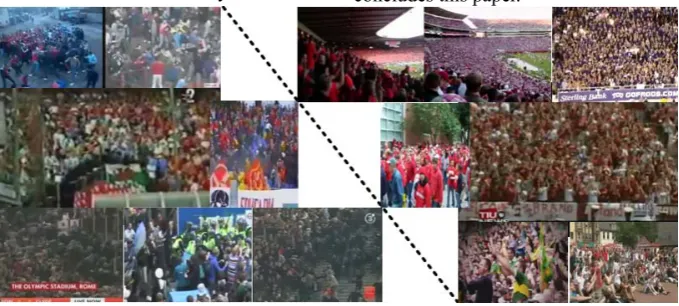
challenging real-world surveillance videos with high
crowd density (as shown in Fig. 1). For the sake of accomplishment of this goal, we combine the streakline model with the method in Ref. [11] and propose an
improved method for detecting abnormal crowd behavior. The remainder of this paper is organized as follows. Section Ⅱ describes streakline model briefly. In Section
Ⅲ, we present the process of our improved abnormal
crowd behavior detection algorithm. Experimental results and analysis are provided in Section Ⅳ, and Section Ⅴ
concludes this paper.
Figure 1. Examples of normal (top-right) and abnormal (bottom-left) crowd behavior in real-world videos.
II. STREAKLINE MODEL
In fluid mechanics and flow visualization [21], streakline is well known as a tool for measurement and analysis of the flow. A streakline is the collection of all particles which are initialized at a particular pixel. With regard to fluid mechanics, a streakline can be defined as locations of all particles at a given time passing through a particular point. It can be computed by initializing a set of particles at every time instant in the field and propagating them with time based on the optical flow field. This results in a set of paths, each belonging to one point of initialization.
To explain how streaklines are calculated, let ( ( ), ( ))p p
i i
x t y t be a particle position at time t ,
initialized at point p and frame i for i , 0,1, 2,...,
t = T. The position of particle through point p at any time instant t is computed as described in Ref. [12].
( 1) ( ) ( ( ), ( ), )
( 1) ( ) ( ( ), ( ), ),
p p p p
i i i i
p p p p
i i i i
x t x t u x t y t t
y t y t v x t y t t
+ = +
+ = + (1)
where u and v are optical flow field. This brings a set of curves, all beginning with point p. In order to represent the streaklines more clearly, Fig. 2 gives the example of streaklines showing on every 10th row and column.
Figure 2. A visualization of the strealines.
For the purpose of fluid visualization, streaklines can transport a color material along the flow, and propagate changes in the flow along their path. Similarly, the streaklines are allowed to propagate velocities by the instantaneous optical flow ( , )T
u v
Ω = at the time of initialization, along the flow like a material. To this end, an extended particle ias a set of position and initial velocity is defined as follows
{ ( ), ( ), , },
i i i i i
P = x t y t u v (2)
where ( ( ), ( ), )p p
i i
i
u =u x i y i i and vi =v x i y i i( ( ), ( ), )ip ip .
To represent the flow more completely in the whole scene, a new motion field, named as streak flow
( ( , )T
s u vs s
Ω = ), is constructed based on streaklines. Streak flow can provide motion information of the flow for a period of time and capture crowd motions better in a dynamically changing flow. The computation of usis
described as follows, and the computation of vs is
U=
[ ]
u
i (3)where uiÎPi , "i p, , the streak flow in the x
direction at each pixel is computed.
Equation (1) implies that each particle Pi has three
neighboring pixels (nearest neighbors). It is reasonable to consider ui being the linear interpolation of the three
neighboring pixels. Hence, the definition of ui is as
follows
1 s( )1 2 s( )2 3 s( )3 i
u =a u k +a u k +a u k (4)
where kjis the index of a neighboring pixel, and ajis
the known basis function of the triangulation of the domain for thej-th neighboring pixel [12]. Each ( )u ks i is computed using a triangular interpolation formula. For all the data points in U , a linear system of equations is formed using (4)
Aus =U (5)
where aiare entries of the matrix A, and usis the least
square solution of (5). More details can be found in Ref. [12].
III. IMPROVED ABNORMAL CROWD BEHAVIOR
DETECTION ALGORITHM
In the Ref. [11], for a given sequence of video frames
1 2
{ , , , }T
Seq= f f ⋅⋅⋅ f , the optical flow between consecutive frames is firstly calculated. Compared with the optical flow, the streak flow with strong capacity of resisting disturbance [12] described in section Ⅱ is
better able to describe information of the whole scene accurately. Therefore, in our algorithm, we substitute the optical flow vector in the original with the streak flow vector
, , , ,
( , )
x y t x y t
s s
u v so as to describe the motion information of the whole scene. x y t, , respectively
represent location and coordinate of pixel px y t, , as well
as subscript of the video frame, , ,
x y t
s
u denotes the value
of streak flow at px y t, , in x direction and
, ,
x y t
s
v denotes the value of streak flow at px y t, , in y direction. Refer to Ref. [11], only the magnitudes of these vectors are considered:
2 , , 2 , , , , ( x y t x y t)
x y t s s
m = u + v (6)
Although flow vectors encode meaningful temporal information, their magnitudes are arbitrary quantities. In order to describe the scene information better, the similarities of flow-magnitudes is considered. For each pixel, we obtain a binary indicator Bx y t, , , reflecting the
significance of the change of magnitude between frames:
, , , , 1 , ,
1 if
0 othervise
x y t x y t
x y t
m m thr
B =
⎧
⎨
− − ≥⎩
(7)where thr is the mean of the magnitude variations of the streak flow between frames, shown as follows:
,
, , , , 1 0, 0
(| |)
x rows y cols
x y t x y t
x y m m thr rows cols = = − = = − = ×
∑
(8) where rows and cols respectively indicates the number of rows and columns.Equation (7) provides us with a binary, magnitude-change, significance map for each frame. For each pixel, a mean magnitude-change map by simply averaging these binary values is computed as follows
, 1 , ,.
x y x y t
t
B B
T
=
∑
(9)For a given sequence of frames Seq, our improved descriptor is a vector of frequencies of quantized values
,
x y
, ,
x y t
m
, ,
x y t
B
,
x y B
, ,
x y t B
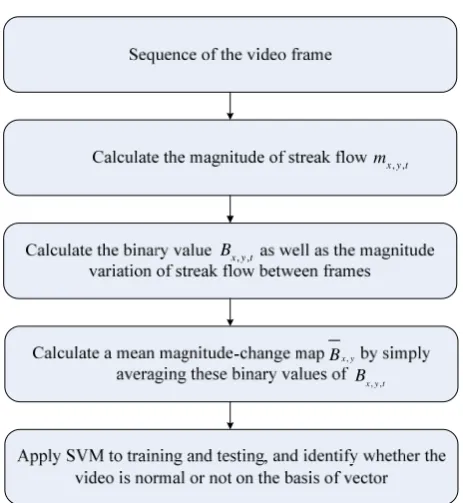
Figure 3. The architecture of our improved method
IV. EXPERIMENTS AND DISCUSSIONS
Some experiments are done to verify the validity and accuracy of our improved method for abnormal crowd behavior detection by comparing with the algorithm in Ref. [11]. The experiments are conducted on an Intel(R) Core(TM) 2 Duo 2.93GHz with 2GB memory and the Windows XP operating system. The software platform is built in Visual studio 2008. The VIF database [22] is used, in which video is artificially divided into video clips including normal behaviors and abnormal behaviors. For the accomplishment of target proposed in section Ⅰ,
100 video clips including 50 normal videos and 50 abnormal videos are selected from the database. In the experiment, we choose 30% of normal and abnormal videos respectively as a training set, and rest 70% as a test set. The mean prediction accuracy (ACC) is adopted as an assessment index for the algorithm, according to ROC curve theory,
.
TP TN ACC
P N
+ =
+ (10)
where TP is the number of true positive samples, TN is the number of true negative samples, P is the number of positive samples and N is the number of negative samples.
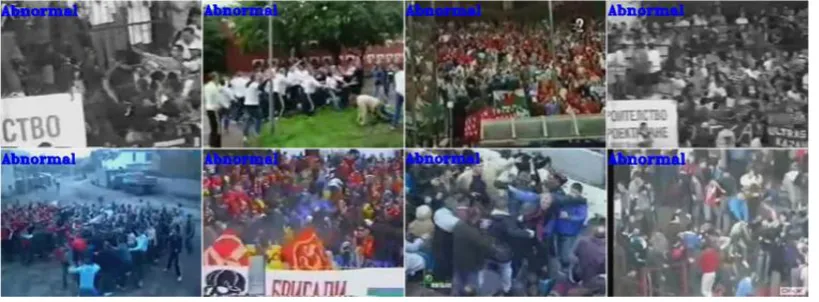
The accuracy comparison of different algorithms according to (10) is shown in table 1. From this table, it is shown that the algorithm in our paper can get a higher accuracy on abnormal crowd behavior detection. Recognition results of partial normal videos obtained by using our algorithm for detecting abnormal behaviors are shown in Fig. 4, marked as “Normal”, while recognition results of partial abnormal videos acquired by using our algorithm for detecting abnormal behaviors are shown in Fig. 5, marked as “Abnormal”.
TABLE 1:
ACCURACY COMPARISON OF DIFFERENT ALGORITHMS
Method Accuracy
Ref. [11] 75.1 %
Our method 92.3 %
Figure 5. Recognition results of partial abnormal videos
V. CONCLUSION
In order to improve the accuracy of abnormal crowd behavior detection, an improved algorithm combining the streakline model based on fluid dynamics with Hassner’s method is proposed in our paper. The algorithm adopts magnitude variation of the streak flow to describe the crowd behavior in the scene, and combines with SVM to detect and identify abnormal crowd behavior. Finally, many challenging real-world videos are used to validate our improved algorithm. Experimental results show that our method can perform better in the accuracy of abnormal crowd behavior detection.
ACKNOWLEDGEMENT
This work is supported by NSAF under Grant No. 11176018.
REFERENCES
[1] B. Wang, M. Ye, X. Li et.al, “Abnormal crowd behavior detection using size-adapted spatio-temporal features,”
International Journal of Control Automation and Systems,
vol. 9, pp. 905-912, 2011.
[2] K. kratz Lnishino, “Anomaly detection in extremely crowded scenes spatio-temporal motion pattern models,” in:
Proc. CVPR, pp. 1446-1453, 2009.
[3] J. Xu, S. Denman, C. Fookes et.al, “Unusual event detection in crowded scenes using bag of LBPs in spatio-temporal patches,” in: Proc. DICTA, pp. 549-554, 2011.
[4] E. L. Andrade, S. Blunsden, and R. B. Fisher, “Hidden markov models for optical flow analysis in crowds,” in:
Proc. ICPR, pp. 460-463, 2006.
[5] E. L. Andrade, S. Blunsden, and R. B. Fisher, “Modeling crowd scenes for event detection,” in: Proc. ICPR, pp.
175-178, 2006.
[6] S. Ali and M. Shah, “A lagrangian particle dynamics approach for crowd flow segmentation and stability analysis,” in: Proc.CVPR, pp. 1-6, 2007.
[7] R. Mehran, A. Oyama, and M. Shah, “Abnormal crowd behavior detection using social force model,” in: Proc. CVPR, pp. 935-942, 2009.
[8] J. Kim and K. Grauman, “Observe locally, infer globally: A space-time MRF for detecting abnormal activities with incremental updates,” in Proc. CVPR, pp. 2921-2928, 2009.
[9] S. Wu, B. E. Moore and M. Shah, “Chaotic invariants of lagrangian particle trajectories for anomaly detection in
crowded scenes,” in: Proc.CVPR, pp. 2054-2060, 2010.
[10] S. Ali and M. Shah, “Human action recognition in videos using kinematic features and multiple instance learning,”
IEEE Trans. Patt. Anal. Mach. Intell., vol. 32, pp. 288-303,
2010.
[11] T. Hassner, Y. Itcher and O. Kliper-Gross, “Violent flows: Real-time detection of violent crowd behavior,” in: Proc. CVPRW, pp. 1-6, 2012.
[12]R. Mehran, B. E. Moore and M. Shah, “A streakline representation of flow in crowded scenes,” in Proc. ECCV,
439-452, 2010.
[13] N. M. Nayak, B. Song and A. K. Roy-Chowdhury, “Dynamic modeling of streaklines for motion pattern analysis in video,” in: Proc.CVPRW, pp.39-46, 2011.
[14] N. M. Nayak, A. T. Kamal and A. K. Roy-Chowdhury, “Vector field analysis for motion pattern identification in video,” in: Proc. ICIP, pp. 2089-2092, 2011.
[15] X. M. Zhao and G. Medioni, “Robust unsupervised motion pattern inference from video and applications,” in: Proc. ICCV, pp. 715-722, 2011.
[16] S. Wu and H. S. Wong, “Joint segmentation of collectively moving objects using a bag-of-words model and level set evolution,” Pattern Recogn., vol. 45, pp. 3389-3401, 2012.
[17] N. Scherf, C. Ludborzs, K. Thierbach et al, “A fluid registration approach to cell tracking,” Curr. Med. Imaging Rev., vol. 9, pp.102-112, 2013.
[18] N. M. Nayak, Y. Y. Zhu and A. K. Roy-Chowdhury, “Vector field analysis for multi-object behavior modeling,”
Image Vision Comput., vol. 31, pp. 460-472, 2013.
[19] Y. Hu, Y. Zhang and L. S. Davis, “Unsupervised abnormal crowd activity detection using semiparametric scan statistic,” in: Proc.CVPRW, pp. 767-774, 2013.
[20] X. F. Wang, X. M. Yang, X. H. He, et al, “A high accuracy flow segmentation method in crowded scenes based on streakline,” Optik, vol. 125, pp. 924-929, 2014.
[21] J. J van Wijk, “Image based flow visualization,” in: Proc. CGIT, pp. 745-754, 2002.
[22]http://www.openu.ac.il/home/hassner/data/violentflows/ind ex.html.
Xiaofei Wang is currently pursuing a
Mingliang Gao a faculty member of
School of Electrical & Electronic Engineering at Shandong University of Technology. His main research interests include meta-heuristic optimization, analysis of motion, and tracking in image sequences.
Xiaohai He received his Ph.D. degree
in Biomedical Engineering in 2002 from Sichuan University, China. He is a professor in College of Electronics and Information Engineering at Sichuan University. Dr. HE is a senior member of the Chinese Institute of Electronics. He is an Editor of both the Journal of Information and Electronic Engineering and the Journal of Data Acquisition & Processing. His research interests include image processing, pattern recognition, image communication.
Xiaohong Wu received Ph.D. degrees
in school of electronics and information engineering from the Sichuan University in 2008. She is an associate professor in school of electronics and information engineering from the Sichuan University. Research interests include image processing, computer vision, statistical pattern recognition and circuit and system.
Yun Li is pursuing a master's degree at