INTERNATIONAL JOURNAL OF ENGINEERING SCIENCES
& MANAGEMENT
EFFICIENT ALGORITHM FOR SPEECH ENHANCEMENT USING
DIFFERENT ADAPTIVE FILTER
Divyashri Sanjiv Shisode
1, Dr. A. J. Patil
2P.G. Student
1, Professor
2[email protected]
1Department of Electronics and Telecommunication Engineering
Shri Gulabrao Deokar College of Engineering, Jalgaon
ABSTRACT
Enhancement means the improvement in the value or quality of something, when applied to speech, this simply means the improvement in intelligibility and/or quality of a degraded speech signal by using signal processing tools. The enhancement of noisy speech is a challenging research field with numerous applications. The speech enhancement is one of the effective techniques to solve speech degraded by noise, that the speech recognitions performance in noisy environment should be investigated. In this paper, we investigated the speech enhancement by applying adaptive LMS, NLMS and UNANR filter with different communication channel and amplitude modulation. The noise removal is very important in many applications like telephone conversation, image transformation and speech recognition, etc. The corruption of speech due to presence of additive background noise causes severe difficulties in various communication environments. Compression and analyze the performance of LMS, NLMS and UNANR on the basis of SNR V/S SNR present in this paper.
Keywords: Speech Enhancement, LMS, NLMS, UNANR, Modulation, Channel.
INTRODUCTION
The Speech enhancement aims to improve speech quality by using various algorithms. This technology has grown widely in telecommunication. Speech recognition/enhancement is the inter-disciplinary subfield of computational linguistics that develops methodologies and technologies that enables the recognition and translation of spoken language into text by computers. There are lots of speech enhancement software’s in the market which improves the performance of the speech recognition but speech recognizers have various problems like noise interference, noise distortion which degrades the speech signal in communication system. In real time environment speech signals are corrupted by several forms of noise such as manmade noise examples car noise, background noise and also they are subjected to distortion caused by communication channels; examples are room reverberation, low-quality microphones, etc. In the figure 1 shown the speech enhancement system.
Fig.1: Speech Enhancement System
UNANR ALGORITHM
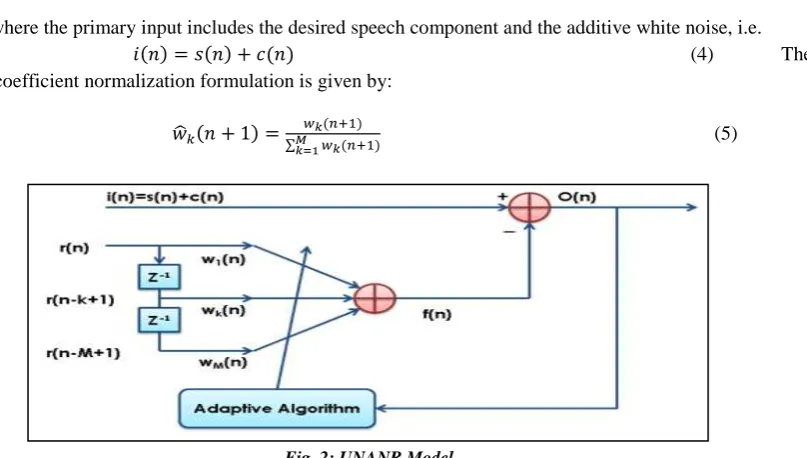
The UNANR model of the system performs the function of adaptive noise estimation. The UNANR model of order M, as shown in figure 2, is a transversal, linear, finite impulse response (FIR) filter. The response of the filter f(n) at each time instant (sample) n can be expressed as,
Where Wm(n) represents the UNANR coefficients, and r(n − m + 1) denotes the reference input noise
at the present (m = 1) and preceding m − 1, (1 < m ≤ M), input samples. In order to provide unit gain at DC, the UNANR coefficients should be normalized such that:
∑𝑀𝑚=1𝑤𝑚(𝑛) = 1 (2)
The adaptation process of the UNANR model is designed to modify the coefficients that get convolved with the reference input in order to estimate the noise present in the given speech signal. To provide the estimated speech signal component, ŝ(n), at the time instant n, the output of the adaptive noise-reduction system subtracts the response of the UNANR model f(n) from the primary input i(n), i.e.,
𝑠̂(𝑛) = 𝑜(𝑛) = 𝑖(𝑛) − 𝑓(𝑛) (3)
where the primary input includes the desired speech component and the additive white noise, i.e. 𝑖(𝑛) = 𝑠(𝑛) + 𝑐(𝑛) (4) The
UNANR coefficient normalization formulation is given by:
𝑤̂𝑘(𝑛 + 1) =
𝑤𝑘(𝑛+1)
∑𝑀𝑘=1𝑤𝑘(𝑛+1)
(5)
Fig. 2: UNANR Model
COMMUNICATION CHANNEL
(
AWGN
)
It is a basic noise model used in information theory to mimic the effect of many random processes that occur in nature. The modifiers denote specific characteristics:
a) 'Additive' because it is added to any noise that might be intrinsic to the information system.
b) 'White' refers to idea that it has uniform power across the frequency band for the information system. It is an analogy to the color white which has uniform emissions at all frequencies in the visible spectrum. c) 'Gaussian' because it has a normal distribution in the time domain with an average time domain value of
zero.
BLOCK DIAGRAM
Fig. 3: Block Diagram of the project
SIMULATION AND RESULTS
The main idea in this project is to recover the clean speech signal from a sample corrupted with background noise through a telephone conversation. The performances of the adaptive filters are compared with respect to the variation in SNR (dB). The used modulation techniques are AM and FM and the considered channels are AWGN and Rician fading channel. Under speech enhancement techniques, for improving quality of adaptive filters a newly emerging filter is used i.e. UNANR. This filter’s performance is compared with two traditionally used adaptive filters; LMS and NLMS. The above considered technologies have been combined using the MATLAB R2013a (8.1.0.604) 64-bit, Now for different cases for the performance evaluation, the selected range of SNR is -2.5dB to 30dB.
A. Performance of AM is used with AWGN channel
In this case AM is selected to transmit the whole speech signal after addition of background noise at the transmitter side. AWGN channel is selected as a communication channel for transferring the speech signal. In AWGN channel, channel noise gets added to the speech signal. At the receiver side first AM demodulation is performed then speech signal is passed through one of the adaptive filter. Firstly LMS filter is selected and PSNR signal parameters are recoded. Secondly NLMS filter is selected for the same received demodulated speech signal. And at the last UNANR filter is selected for the same received demodulated speech signal. Graphs have been plotted to check the performance of the adaptive filters. Graphs are plotted between SNR v/s PSNR.
Fig. 4.: Adaptive filtering for AM with AWGN channel
B. Performance of AM with Rician fading channel
-5 0 5 10 15 20 25 30 35 40
8 10 12 14 16 18 20 22 24 26
Performance analysis of adaptive filters for AM Modulation in AWGN Channel
SNR(dB)
P
S
N
R
(d
b)
In this case AM is selected to transmit the whole speech signal after addition of background noise at the transmitter side. Rician fading channel is selected as a communication channel for transferring the speech signal. In Rician fading channel, channel noise gets added to the speech signal. At the receiver side first AM demodulation is performed then speech signal is passed through one of the adaptive filter. Firstly LMS filter is selected and PSNR signal parameters are recoded. Secondly NLMS filter is selected for the same received demodulated speech signal.
Fig. 5: Adaptive filtering for AM with Rician fading channel
CONCLUSION
The speech enhancement is one of the effective techniques to solve speech degraded by noise, that the speech recognitions performance in noisy environment should be investigated. This project work presented the speech enhancement through LMS, NLMS and UNANR. The comparison and analysis of performances of these adaptive filters have been done through plotted graphs. From all the performed experiments it is apparent that NLMS and UNANR filters have better performance than LMS.
REFERENCES
I. M. Yasin et al. “Performance Analysis of LMS and NLMS Algorithms for a Smart Antenna System” International Journal of Computer Applications Vol.- 4. No.9, August 2010.
II. I. Y. Soon, et al. “Noisy speech enhancement using discrete cosine transform”, Speech Communication, vol. 24, pp. 249-257, 1998.
III. Md Zia Ur Rahman et al., “Filtering Non-Stationary Noise in Speech Signals using Computationally Efficient Unbiased and Normalized Algorithm” , International Journal on Computer Science and Engineering, Vol. 3 No. 3 Mar 2011.
IV. Sayed. A. et al. “A Family of Adaptive Filter Algorithms in Noise Cancellation for Speech Enhancement” International Journal of Computer and Electrical Engineering, Vol. 2, No. 2, April 2010. V. Priyanka Gupta et al. “Performance Analysis of Speech Enhancement Using LMS, NLMS and UNANR
algorithms” IEEE 2015 (IC4_5230).
VI. B. Widrow, et al. “Adaptive noise cancelling: Principles and applications” , Proc. IEEE, vol. 63, pp.1692-1716, Dec. 1975.
VII. L. Stasionis, et al. “Selection of an Optimal Adaptive Filter for Speech Signal Noise Cancellation using C6455 DSP”, Electronics and Electrical Engineering. Kaunas: Technological, 2011.
-5 0 5 10 15 20 25 30 35 40
-25 -20 -15 -10 -5 0 5 10 15
Performance analysis of adaptive filters for AM Modulation in Rician Channel
SNR(dB)
P
S
N
R
(d
b
)
VIII. Md Zia Ur Rahman et al. “Filtering Non-Stationary Noise in Speech Signals using Computationally Efficient Unbiased and Normalized Algorithm” International Journal on Computer Science and Engineering (IJCSE), Vol. 3 No. 3 Mar 2011.
IX. Lalit P. Patil et al. “Efficient algorithm for Speech Enhancement using Adaptive filter” International Journal of Electrical, Electronics and Computer Engineering Vol.-3, issue-1, 2014.
X. Aditya Bali et al. “Performance of LMS Algorithm Derivatives in De-Noising: A Comparative Study” International Journal of Electrical, Electronics and Computer Systems (IJEECS), Volume -2, Issue-5, 2014.
XI. Satgur Singh et al. “A LMS and NLMS Algorithm Analysis for Smart Antenna” International Journal of Advanced Research in Computer Science and Software Engineering, Volume 5, Issue 4, 2015.
XII. Parag A. et al. “Performance Analysis of Adaptive Filters for Speech Signal” Global Journal of Advanced Engineering Technologies and Sciences, Vol. 2, issue 4, 2015.
XIII. Marvin R. Sambur et al. “Adaptive Noise Canceling for Speech Signals”, IEEE Transactions on Acoustics, Speech, And Signal Processing, Vol. Assp-26, No. 5, October 1978.
XIV. Upen Dalal “Wireless Communication” Oxford University Press, fourth impression 2011. Pp 365-413, pp 591-633.