Abstract
In the fast changing economic environment the success of banking depends upon technology, people and customer. eCRM which is the latest buzz word in the corporate sector, is perceived as one of the effective tool in the direction by the banks. eCRM emerges from the internet and web technology to facilitate the implementation of CRM. This study compares the level of eCRM service quality offered by different banks in Haryana state.Data were collected from the bank customers using survey method. Four banks, two from public sector namely State bank of India and Punjab national bank and two from private sector namely HDFC and ICICI were taken.Using gap analysis the results clearly indicated that account holders expectations regarding eCRM services in the selected banks were met by the selected banks of Haryana.
Keywords: Customer relationship management (CRM), e-Customer relationship management, eCRM services.
1. Introduction
Electronic customer relationship management (eCRM) plays a key role in banking sector. Earlier in banking sector it was untypical to find website interactions in one database, agreements in an administration system, call center history in another and payment history in accounting system. Though difficult to do but integrating such a huge information system could provide valuable insight into financial customer's behavioural pattern, preferences and signals for intended behaviors.One solution of this was Electronic Customer Relationship Management (eCRM).
Electronic customer relationship management (eCRM) plays a key role in banking sector. eCRM is being adopted by the banks because it increases customer loyalty and customer retention by improving customer satisfaction. This results into long term profits because organisations using eCRM incur less cost of recruiting new customer while experience increases customer retention [1] ,[2].
2. Review of Literature
As the new millennium progresses, the business world is focusing more attention on issues concerning customer satisfaction, customer retention, and customer loyalty. The last several years
eCRM- Service Quality
witnessed the rise in the uses of information and communication technologies in dealing issues mention above. The term 'IT-enabled services' encompasses many activities carried out through computer networks and the Internet, including inter-organizational commerce, intra-organizational transactions, and transactions involving the individual consumer. The impact of IT made a substantial difference in business-to-customers (B2C) transactions. The IT seemed to offer almost unlimited possibilities. Indeed, numerous firms had already experienced its considerable benefits [3]. One of the consequences of the development of the IT was the emergence of the World Wide Web, an Internet service that organized information according to hypermedia and hyperlink paradigms [4]. Some organisations had invested in the Web, often with the objective of using it as a way to maximize resources.
The study by Berry (1983) was the pioneer work in customer relationship management. In this study Berry formally introduced the term customer relationship management into the literature, but several ideas of relationship marketing had emerged much before. Berry (1983) defined customer relationship management as attracting, maintaining and enhancing customer relationships in multi-service organizations [5]. Berry and Persuraman (1991) proposed that customer relationship management concerned attracting, developing and retaining customer relationships [6]. Berry stressed that the attraction of new customers should be viewed only as intermediate step in the marketing process. Customers were more likely to form relationships with individuals and with the organisations they represented than with goods (Berry, 1995) [7].
Ahmed Tanveer (2009) in his thesis entitled "Electronic Customer Relationship Management in Online Banking" investigated how banks maintain their customer relations using eCRM technologies by comprising two banks one from Sweden and second from Denmark. The findings indicated that banks use eCRM for mass customization, customer profiling, self service, one to one interaction and automatic locks in flow of financial data like security prices which ultimately results in relationship between perception and satisfaction, commitment and loyalty which underlines the significance of CRM in service industry and employing CRM may only strengthen the relationship between perceptions and up-buying and cross buying which is all in support of introducing CRM in service sector[8].
LehalManbeena (2012) work on Customer Relationships and Information Systems as a competitive strategy in Banking sector: A theoretical framework described that a bank can enjoy competitive advantage of its customers for a long time by building mutually beneficial relationships that increase switching costs and thus cannot be easily replicated [9].
3. Objective of the Study
The main objective of this paper is to compare the level ofeCRM service quality offered by different banks in Haryana State.
4. Research Methodology
In the present paper exploratory research cum descriptive research design had been adopted. As the main purpose of this study was to gain familiarity with various aspects of eCRM services provided by selected banks of India in Haryana and to achieve new insights into it. Four banks two from public namely State bank of India and Punjab national bank and two from private sector namely HDFC and ICICI were taken. Data were collected from 1,000 customers using survey method through questionnaires out of these 848 were useable responses. In order to select the bank customers Non probability sampling technique was used. For analyzing the data the techniques,mean,median,standard deviation ,multiple correlation and gap analysis were used.
5. Results and Analysis
The advent of ICT had transformed the traditional commercial model and system of providing customer related banking services into electronic Customer Relationship Management (eCRM). Banking organizations all over the world were finding electronic Customer Relationship Management (eCRM) as a new platform for insurance business of the future (Werbach, 2000). No other ICT applications had achieved a rapid growth in as short time as eCRM in the world.
To compare the level of ecrm service quality offered by different banks,seven service dimensions were taken.The dimensions were Reliability, Responsiveness, Competence, Easy to use, Product portfolio,security and convenience. Service quality of different banks were compared on the basis of these dimensions. The various questions were asked from the respondents related to these dimensions. What qualities will possessed by the banks and what qualities the banks have were compared by using the gap analysis. The details were as under
Overall Gap Score of eCRM services provided by the selected banks of Haryana :
Overall GAP scores, both Unweighted and Weighted were tabulated in Table 4.1. All values were explained by mean, median and standard deviation.
Table 4.1 : Overall GAP Score (n=848)
Mean Median Std. Deviation
Overall Unweighted GAP Score 0.69 0.71 0.34
Overall average Unweighted GAP score for the total of 848 respondents was 0.69. It was in positive zone meaning thereby that the accountholder' perceptions were more than their expectations. Accountholder perceived the eCRM services provided to them were of good quality.
When importance weights were also taken into consideration the resultant overall Weighted GAP Score (9.31) was also positive. In USA-General sample in 1990, East Midlands UK outpatients in 1995 and Vassa Finland outpatients in 1996, Average Weighted GAP Score was negative, while it was zero in Scottish-Public Library services in 1995 and was positive in Scottish-Home Help service in 1995 (Dalrymple, 1995). This reaffirmed that banking organizations of India were providing the quality eCRM services to their accountholder [11].
Overall Importance Weights For Dimensions of eCRM services:
Average Importance Weights were compiled and tabulated in Table 4.2 and graphically showed in Graph No1
Table 4.2 : Overall Dimension wise Importance Weights (n=848)
Rel
ia
b
il
it
y
R
e
sp
o
n
si
v
e
n
es
s
C
o
m
p
et
e
n
ce
E
as
y
t
o
u
se
P
ro
d
u
ct
P
o
rt
fo
li
o
S
e
cu
ri
ty
C
o
n
v
en
ie
n
ce
Mean 15.19 14.46 1 1.60 16.24 9.36 16.80 16.70
Median 15.00 15.00 1 0.00 15.00 10.00 15.00 15.00
Std. Deviation 3.60 3.73 3.78 3.87 2.63 4.17 3.94
Graph No. 1
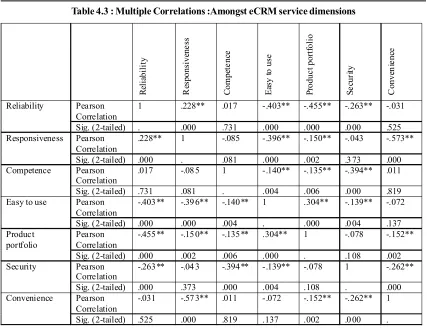
Table 4.3 : Multiple Correlations :Amongst eCRM service dimensions R el ia b il it y R es p o n si v en e ss C o m p et e n ce E as y t o u se P ro d u c t p o rt fo li o S e cu ri ty C o n v en ie n ce
Reliability Pearson Correlation
1 .228** .017 -.403** -.455** -.263** -.031
Sig. (2-tailed) . .000 .731 .000 .000 .0 00 .525 Responsiveness Pearson
Correlation
.228** 1 -.085 -.396** -.150** -.043 -.573**
Sig. (2-tailed) .000 . .081 .000 .002 .3 73 .000 Competence Pearson
Correlation
.017 -.08 5 1 -.140** -.135** -.394** .011
Sig. (2-tailed) .731 .081 . .004 .006 .0 00 .819 Easy to use Pearson
Correlation
-.403** -.39 6** -.140** 1 .304** -.139** -.072
Sig. (2-tailed) .000 .000 .004 . .000 .0 04 .137 Product
portfolio
Pearson Correlation
-.455** -.15 0** -.135** .304** 1 -.078 -.152**
Sig. (2-tailed) .000 .002 .006 .000 . .1 08 .002 Security Pearson
Correlation
-.263** -.04 3 -.394** -.139** -.078 1 -.262**
Sig. (2-tailed) .000 .373 .000 .004 .108 . .000 Convenience Pearson
Correlation
-.031 -.57 3** .011 -.072 -.152** -.262** 1
Sig. (2-tailed) .525 .000 .819 .137 .002 .0 00 .
** Correlation is significant at the 0.01 level (2-tailed).
• Overall dimensions Wise Gap Score :
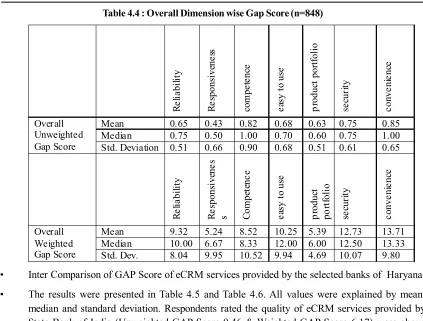
Table 4.4 clearly showed overall dimension wise average Unweighted and Weighted gap score of different dimensions of eCRM service quality.
Table 4.4 : Overall Dimension wise Gap Score (n=848) R e li a b il it y R e sp o n si v en e ss co m p e te n ce e as y t o u se p ro d u ct p o rt fo li o se cu ri ty c o n v e n ie n ce Overall Unweighted Gap Score
Mean 0.65 0.43 0.82 0.68 0.63 0.75 0.85 Median 0.75 0.50 1.00 0.70 0.60 0.75 1.00 Std. Deviation 0.51 0.66 0.90 0.68 0.51 0.61 0.65
R e li a b il it y R e sp o n si v en e s
s Co
m p et en c e e as y t o u se p ro d u ct p o rt fo li o se cu ri ty c o n v e n ie n ce Overall Weighted Gap Score
Mean 9.32 5.24 8.52 10.25 5.39 12.73 13.71 Median 10.00 6.67 8.33 12.00 6.00 12.50 13.33 Std. Dev. 8.04 9.95 10.52 9.94 4.69 10.07 9.80
• Inter Comparison of GAP Score of eCRM services provided by the selected banks of Haryana:
• The results were presented in Table 4.5 and Table 4.6. All values were explained by mean, median and standard deviation. Respondents rated the quality of eCRM services provided by State Bank of India (Unweighted GAP Score 0.46 & Weighted GAP Score 6.17) were above than their expectations and higher than the other the selected banks .
Table 4.5 : Inter Comparison of GAP Scores of the selected banks of Haryana
Name of Bank Unweighted
GAP Score
Weighted GAP Score
State Bank o f India Mean 0.46 6.17
Median 0.80 11.14
Std. Deviation 0.34 4.82
Punjab National Bank Mean 0.06 0.74
Median 0.69 9.48
Std. Deviation 0.36 5.02
Industrial Credit and Investment Corpo ration of India
Mean 0.05 0.65
Median 0.49 6.67
Std. Deviation 0.18 2.59
Housing Developmen t Finance Corpo ration
Mean 0.06 0.89
All of these banking organizations of India were accorded positive GAP SCORE (Unweighted and Weighted) that meant the accountholder using the eCRM services offered by these banking organizations perceived eCRM services better than their expectations.
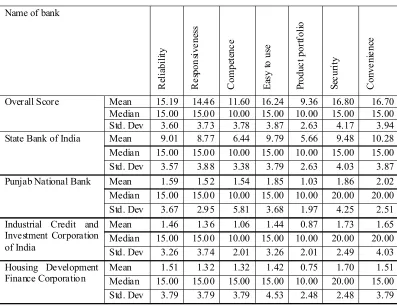
Table 4.6 : Comparison of Importance Weights of Selected banks of Haryana
Name of bank
R el ia b il it y R e sp o n si v e n es s C o m p et en c e E as y t o u se P ro d u c t p o rt fo li o S ec u ri ty C o n v e n ie n ce
Overall Score Mean 15.19 14.4 6 11.60 16.24 9.36 16.80 16.70 Median 15.00 15.0 0 10.00 15.00 10.00 15.00 15.00 Std. Dev 3.60 3.7 3 3.78 3.87 2.63 4.17 3.94 State Bank of India Mean 9.01 8.7 7 6.44 9.79 5.66 9.48 10.28 Median 15.00 15.0 0 10.00 15.00 10.00 15.00 15.00 Std. Dev 3.57 3.8 8 3.38 3.79 2.63 4.03 3.87 Punjab National Bank Mean 1.59 1.5 2 1.54 1.85 1.03 1.86 2.02 Median 15.00 15.0 0 10.00 15.00 10.00 20.00 20.00 Std. Dev 3.67 2.9 5 5.81 3.68 1.97 4.25 2.51 Industrial Credit and
Investment Corporation of India
Mean 1.46 1.3 6 1.06 1.44 0.87 1.73 1.65 Median 15.00 15.0 0 10.00 15.00 10.00 20.00 20.00 Std. Dev 3.26 3.7 4 2.01 3.26 2.01 2.49 4.03 Housing Development
Finance Corporation
Mean 1.51 1.3 2 1.32 1.42 0.75 1.70 1.51 Median 15.00 15.0 0 15.00 15.00 10.00 20.00 15.00 Std. Dev 3.79 3.7 9 3.79 4.53 2.48 2.48 3.79
Reliability, Responsiveness, and Competence service dimensions of eCRM services quality offered by the selected banks. Product Portfolio was accorded the worst perceived quality dimension amongst all the selected banks of India. Meaning thereby, that the accountholder were ready to compromise on Reliability, Responsiveness of employees of the selected banks, Competence and different types of product/policies offered by selected banks of India.
Table 4.7: Comparison of Unweighted and Weighted Gap Scores of Selected banks of Haryana
R el ia b il it y R e sp o n si v e n es s C o m p e te n c e E a sy t o u se P ro d u c t p o rt fo li o S ec u ri ty C o n v en ie n ce
Overall Sco re
Dimension wise Unweighted Gap Score
Mean 0 .65 0.43 0.82 0.68 0.63 0.75 0.85 Median 0 .75 0.50 1.00 0.70 0.60 0.75 1.00 Std. Dev 0 .51 0.66 0.90 0.68 0.51 0.61 0.65 Overall Sco re
Dimension wise weighted Gap Score
Mean 9 .32 5.24 8.52 10.25 5.39 12.73 13.71 Median 1 0.00 6.67 8.33 12.00 6.00 12.50 13.33 Std. Dev 8 .05 9.95 10.52 9.94 4.69 10.07 9.79 State Bank of India
Dimension wise Unweighted Gap Score
Mean 0 .44 0.22 0.54 0.47 0.37 0.53 0.69 Median 0 .75 0.50 1.00 0.80 0.60 0.75 1.00 Std. Dev 0 .43 0.79 0.96 0.80 0.56 0.64 0.60 State Bank of India
Dimension wise weighted Gap Score
Mean 6 .24 2.28 5.09 6.79 3.01 8.60 11.14 Median 1 0.00 5.00 10.00 12.00 6.00 15.00 20.00 Std. Dev 6 .71 11.8 3 10.66 11.29 4.97 10.15 8.35 Punjab National Bank
Dimension wise Unweighted Gap Score
Mean 0 .02 0.04 0.10 0.05 0.11 0.06 0.03 Median 0 .50 0.33 0.33 0.20 1.40 0.75 0.33 Std. Dev 0 .62 0.36 1.03 0.36 0.54 0.43 0.39 Punjab National Bank
Dimension wise weighted Gap Score
Mean 0 .08 0.56 1.01 0.83 1.12 1.02 0.54 Median 1 5.00 15.0 0 10.00 15.00 10.00 20.00 20.00 Std. Dev 3 .67 2.95 5.81 3.68 1.97 4.25 2.51 Industrial Credit and Investment
Corporatio n of India Dimension wise Unweighted Gap Score
Mean 0 .03 0.06 0.07 0.07 0.05 0.03 0.03 Median 0 .50 0.50 0.67 0.80 0.40 0.25 0.00
Std. Dev 0 .34 0.29 0.53 0.10 0.20 0.29 0.33 Industrial Credit and Investment
Corporatio n of India
Dimension wise weighted Gap Score
Mean 0 .55 0.87 0.74 1.03 0.39 0.54 0.44
Median 5 .00 7.50 6.67 12.00 4.00 5.00 0.00
Std. Dev 6 .23 4.76 5.12 2.51 1.26 5.58 5.86 Housing Develop ment Finance
Corporatio n
Dimension wise Unweighted Gap Score
Mean 0 .05 0.05 0.05 0.06 0.05 0.08 0.05 Median 0 .50 0.50 0.00 1.00 0.60 1.25 0.67
Std. Dev 0 .19 0.39 0.87 0.58 0.35 0.63 0.34
Housing Develop ment Finance Corporatio n
Dimension wise weighted Gap
Average importance weight were compiled and tabulated in table 4.7. State Bank of India was accorded the best Unweighted and Weighted gap score in all the seven quality dimensions of eCRM services offered (Reliability 0.44 and 6.24, Responsiveness 0.22 and 2.28, Competence 0.54 and 5.09, Easy to use 0.47 and 6.79, Product portfolio 0.37 and 3.01, Security 0.53 and 8.60, and Convenience 0.69 and 11.14). Accountholder of Punjab National Bank accorded best Unweighted and Weighted gap score in two dimensions (Competence 0.10 and 1.01, and Product portfolio 0.11 and 1.12) of eCRM service quality following State Bank of India. Respondents accorded best Unweighted and Weighted gap score in two dimensions (Responsiveness 0.06 and 0.87, and Easy to use 0.07 and 1.03) of eCRM service quality offered by Industrial Credit and Investment Corporation of India following State Bank of India. Housing Development Finance Corporation was accorded the best Unweighted and Weighted score (0.08 and 1.51 respectively) in Security service dimension of eCRM services following State Bank of India. These findings could be appreciated from Table 4.7.
The results of the above analysis indicated that the attributes of Security (16.80), Convenience (16.70), and Easy to use (16.24) had been identified by the respondents to be the most important dimensions of eCRM services quality in the selected banks. All of the service quality dimensions of eCRM services were found to have positive gap, implying that accountholder's expectations regarding the eCRM services in the selected banks were met by the selected banks of India.
6. Conclusion
The main objective of the present research work was to assess the level of quality of electronic customer relationship management (eCRM) services offered by the selected banks. The accountholders/ respondents view point on the traditional mechanism of services delivery regarding the eCRM services offered by the selected banks had been studied. This study demonstrated the usefulness of the GAP analysis as a measure of service quality. This not only highlights areas for specific action and also addresses perceived service shortcomings. The study of using eCRM services facilities offered by the selected banks revealed, inter-alia,
• that the overall unweighted (0.69) and overall weighted (9.31) GAP score both were in positive zone meaning thereby that the accountholders/respondents' perceived the eCRM services provided to them were of good quality.
• that the overall dimension wise unweighted and weighted gap score in all of the dimensions of eCRM services were found to have positive gap, implying that respondents expectation regarding eCRM services dimensions were met by the selected banks. Accountholders /respondents were consistently more satisfied with convenience dimension [both in unweighted (0.85) and weighted (13.71) gap score] which was ranked higher than all other service dimensions.
• that there was a significant correlation, both positive and negative, existing between most of the dimensions of eCRM services offered by the selected banks. that the accountholders/respondents rated the quality of eCRM services provided by State Bank of India[both unweighted (0.46) and weighted (6.17) GAP score] were above than their expectations and higher than the other selected banks.. The State Bank of India was also accorded the best Unweighted and Weighted gap score in all the seven quality dimensions of eCRM services offered.
It is pertinent to note that all the selected banks were providing eCRM services at or above par than expected by their respective accountholders/ respondents. However, the perception level of State Bank of India accountholders/respondents was significantly higher than the accountholders/ respondents of remaining the selected banks.
• Although all the selected banks were providing eCRM services at or above par than expected by their customers. As quality improvement is a never ending process, governing bodies of these banks should train personnel professionally and upgrade information communication technologies to improve overall customers' experiences and satisfaction. The best way for the management is to look at the improvement of the physical facilities for eCRM services, training of the personnel and providing precise information on all functions related to eCRM services offered by the banks.
• The results of the study indicated that the GAP scale could make a valuable contribution by enhancing the understanding of the quality of eCRM services in banking sector of Haryana. The measurement scale also serves to identify symptoms and the underlying problems that inhibit the effective provision of quality eCRM services in banking sector of Haryana.
7. References
1. Kavita (2006), "e-CRM in banking Services" M.Phil Dissertation submitted to M.D University Rohtak.
2. Mittal R. K. and Kumra, R. (2001). E-CRM in Indian Banks, Delhi Business Review, 2 (1), 73-78.
3. Geyskens, I., Gielens, K. and Dekimpe, M.G. (2002). The market valuation of internet channel additions. Journal of Marketing, 66(2), 102-119.
4. Joseph, B., Cook, W. and Javalgi R.R.G. (2001). Marketing on the Web: how executives feel, what businesses do. Business Horizons, 44(4), 32-40.
6. Berry and Persuraman (1991). Marketing Services - Competing through Quality. New York: Free Press.
7. Berry (1995). Relationship Marketing of Services, Growing Interest, Emerging Perspectives. Journal of Academy of Marketing Science, 23(Fall), 236-45.
8. Ahmed, Tanveer (2009). Electronic customer relationship management in online banking. Lulea University of technology, 5(23), 435-448
9. Lehal, Manbeena. (2012). Customer Relationships and Information Systems as a competitive strategy in Banking sector: A theoretical framework. GIAN JYOTI E-JOURNAL, 1(2), 9.
10. Melodi, G.O., Olufayo, T.O., and Gbadamosi, T.T. (2012) Appraisal of Customer Relationship Management in the Banking Sector: A study of four selected Banks in Lagos State. International Journal of Arts and Commerce, 1(5), 224-234.
11. Pedhiwal, G. L and Tale, J. Sanjay (2011). Analytical study of CRM: As a strategic tool in Banking sector in Western Vidarbha with reference to Akola District, Golden Research Thoughts, 1(3) 1-4.