Research Article
CODEN: IJPNL6
DEVELOPMENT AND VALIDATION OF A NEW STABILITY INDICATING HPLC
METHOD FOR QUANTIFICATION OF PROCESS RELATED AND DEGRADATION
IMPURITIES OF BICALUTAMIDE IN TABLET DOSAGE FORMS
Palleshwar Rao G*
1, JVLNS Rao
2, Lanka A. Rama Prasad
1and Srinivasu Pamidi
11
Analytical R&D, Hetero Drugs Ltd, Hyderabad, Andhra Pradesh, India.
2University College of Pharmaceutical Sciences, Andhra University, Visakhapatnam, India
*Corresponding author e-mail:
[email protected], [email protected]
ABSTRACT
The present work aims to develop and validate a stability indicating liquid chromatographic method for the estimation of process related and degradation impurities of Bicalutamide in tablet dosage form. Chromatographic separation was achieved on Waters Symmetry C18, (150 mm x 4.6 mm) 3.5 m particle size column using 0.1%v/v trifluoro acetic acid and 0.05%w/v sodium-1-octane sulphonic acid in water and 0.1%v/v trifluoroacetic acid in acetonitrile the ratio of 65:35 as mobile phase in isocratic elution mode. The analytes were monitored by a photo diode array (PDA) detector set at 270 nm and the flow rate was kept at 1.2mL/min. The method was validated in terms of Specificity, Precision, Ruggedness, Accuracy, Robustness and Linearity as per ICH guidelines.
Keywords: Bicalutamie, HPLC, degradation impurities, stability indicating and method validation
INTRODUCTION
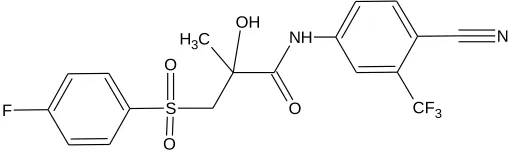
Bicalutamide (BIC) is chemically known as
N-[4-cyano -3- (trifluoromethyl) phenyl] -3- [ (4-fluorophenyl) sulfonyl] -2-hydroxy-2-methyl propanamide. Bicalutamide is an oral non-steroidal anti-androgen1, 2 with the empirical formula C18H14F4N2O4S and is an off-white powder that is
practically insoluble in water. Bicalutamide acts as a pure anti-androgen by binding to the androgen receptor (AR) and preventing the activation of the AR and subsequent up regulation of androgen responsive genes by androgenic hormones. In addition, bicalutamide accelerates the degradation of the androgen receptor. It competitively blocks the growth-stimulating effects of androgens on prostate tumors3 Bicalutamide has been used as a molecular template for the design of selective androgen receptor modulators (SARMs) such as Andarine4 and Ostarine. A number of methods have been published for the estimation of Bicalutamide using UV-Visible Spectrophotometry 5,6 and HPLC method using UV detector7-9 in plasma10-12 were reported. Even though various methods are reported in the literature, for
estimation of process related and degradation impurities, no simultaneous HPLC method had been reported so far for the analysis of degradation products in the tablet dosage form of BIC. A new simple stability indicating reverse phase isocratic HPLC method has been developed to separate all in process impurities and degradation impurities as well. Present method has been validated as per ICH, current industrial trend and acceptable analytical practices.
MATERIALS AND METHODS
Chemicals and Reagents: All the reagents were of analytical-reagent or HPLC grade unless stated otherwise. Milli-Q-water was used throughout the experiment. Trifluoric acetic acid (Merck, Mumbai, India), Sodium 1-octane sulphonic acid (Merck, Mumbai, India) and acetonitrile (J.T.Baker, Germany), were used. Bicalutamide standard, related impurity standard and tablet dosage form was obtained from Hetero Labs Ltd (Hyderabad, India). Related compound A and Related compound B were procured from USP (USA).
International Journal of Pharmacy
Instrumentation: The HPLC system was composed of 2695 Water alliance system fitted with 2996 PDA detector with Empower2 software. Analytical column used for this method is Symmetry C18®, (150 mm x 4.6 mm) 3.5 m particle size.
Optimization of Chromatographic conditions:The
analysis was carried out on Symmetry C18®, (150 mm x 4.6 mm) 3.5 m particle size, column maintained at 35°C. The solution A consisting of 0.1%v/v trifluoro acetic acid and 0.05%w/v sodium 1-octane sulphonic acid, and solvent B consisting of 0.1%v/v trifluoro acetic acid in acetonitrile in the raio of 65:35 v/v were pumped at a flow rate of 1.2 mL/min in isocratic mode. Before delivering the mobile phase into the system, it was degassed and filtered through 0.22 µm PVDF filter using vacuum. The injection volume was 20µL and the detection was performed at 270 nm using a photo diode array (PDA) detector. Various compositions of solution A and solution B with different ion-pairing agents were tested for this study.
Standard solution preparation (5µg/mL): About
25mg of Bicalutamide working standard was accurately weighed and transferred into a 100 mL volumetric flask, about 60mL of diluent was added and sonicated. Diluted to volume with diluent and mixed. Transfer 2 mL of the above solution into a 100mL volumetric flask and diluted to volume with diluent.
Resolution solution Preparation: Accurately
weighed and transferred about each 2.5 mg of USP Related compound-B and Bicalutamide working standard into a 50 ml volumetric flask. Add about 5 ml of acetonitrile, sonicated to dissolve and diluted to volume with diluent. Further dilute 5 ml of the above solution to a 50 ml diluent and mixed.
Sample Preparation (1000µg/mL): Ten tablets were separately weighed and grounded to fine powder. An amount equivalent to about 50mg of Bicalutamide was transferred into a 50mL volumetric flask and dissolved in 30mL quantity of diluent and sonicated. Made up the volume with diluent and mixed. A portion of the above solution was filtered through 0.22µm membrane filter and discarded first few mL of the filtrate.
RESULTS AND DISCUSSION
Optimum separation between USP related compound A(isomer 1& isomer 2) USP related compound B, Des fluoro analogue impurity, 2-Fluoro isomer impurity and des hydroxyl analogue impurity was
achieved with optimized conditions. Above proposed method was validated as per ICH guidelines and current industrial practices, results are presented.
Method validation
The aim of method validation was to confirm that the present method was suitable for its intended purpose as described in ICH guidelines Q2 (R1)13. The described method has been extensively validated in terms of specificity, precision, linearity, accuracy, limit of detection (LOD) and quantification (LOQ), and robustness. The precision was expressed with respect to the intra- and inter-day variation in the expected drug concentrations. The accuracy was expressed in terms of percent recovery of the known amount of impurities added to the sample preparation.
System suitability: System suitability tests are an integral part of a liquid chromatographic method, and they were used to verify that the proposed method was able to produce good resolution between the peaks of interest with high reproducibility. The system suitability was determined by injecting resolution solution and six replicate injections from freshly prepared standard solutions and analyzing each solute for their peak area, theoretical plates (N), resolution (R) and tailing factors (T). System suitability requirements for the proposed method are (i) the resolution (R) between Bicalutamide and Bicalutamide related compound B isomer should not be less than 2.0, from resolution solution (ii) the theoretical pates (T) should not be less than 3000 for Bicalutamide peak from standard solution, (iii) the % of RSD for peak areas of bicalutamide peak from replicate injections of standard solutions is not less than 5.0. The results of the system suitability test in comparison with the required limits are shown in
Table 1. According to the results presented, the proposed method fulfills these requirements within the accepted limits.
Forced degradation studies: Forced degradation studies were performed to provide an indication of the stability indicating property and specificity of the proposed method. Intentional degradation was attempted to stress conditions like Thermal degradation (at 105° C), acid hydrolysis (using 0.1 N HCl), base hydrolysis (using 0.1 N NaOH), and oxidative degradation (using 3.0% H2O2) to evaluate
the ability of the proposed method to separate degradation products from each other and active ingredients as well. To check and ensure the homogeneity (peak purity) of BIC peak in the stressed sample solutions, photo diode array detector was employed.
Linearity: The linearity of the method was tested in order to demonstrate proportional relationship of response versus analyte concentration over the working range. It is usual practice to perform linearity experiments over a wide range of analyte. This gives confidence that the response and concentration are proportional and consequently ensures that calculations can be performed using a single reference standard/working standard, rather than the equation of a calibration line. The linearity of detector response to different concentrations of impurities was studied by preparing a series of solutions using TDF, LAM and their related substances at five different concentration levels ranging from LOQ to 150% of specification (0.3%). The data were subjected to statistical analysis using a linear-regression model; the regression equations and coefficients (r2) are given in Table 2. The results have indicated good linearity.
Limit of detection and quantification: The Limit of detection (LOD) and Limit of quantification (LOQ) are established based on the concentration of the analyte that would yield signal-to-noise ratios of 3 for LOD and 10 for LOQ respectively. LOD and LOQ were determined by measuring the magnitude of analytical background by injecting blank samples and calculating the signal-to-noise ratio for each compound by injecting a series of solutions until the S/N ratio 3 for LOD and 10 for LOQ. The results are given in Table 2.
Precision: Six sample solutions were prepared using single sample lot of tablet dosage form of Bicalutamide by spiking with 0.2% w/w of each impurity and the precision of the method was tested. The % RSD indicates that proposed method has got acceptable level of repeatability.
Ruggedness (Intermediate precision): Ruggedness is
the intraday variation obtained at different
concentration levels, and is expressed in terms of RSD calculated for each day. The RSD values were found to be below 4.1% (for all impurities). The intermediate precision is the interday variations calculated for six sample preparations in each set expressed in terms of % RSD values. Results indicate the proposed method has got a good intermediate precision. The ruggedness of the method was determined by analyzing the same samples in triplicate for 2 days by another instrument by a different analyst with different lots of reagents and columns.
Accuracy: Accuracy of the proposed method was
established by recovery experiments. This study was employed by spiking of known amounts of related compounds into the sample solution of at LOQ level, 50%, 100% and 150% of specification level (0.2%), in triplicate and injected into the chromatographic system. The resulting mixtures were analyzed as described in proposed method. Results obtained from recovery studies are given in Table 4.
Robustness: The robustness of an analytical
procedure is a measure of its capacity to remain unaffected by small, but deliberate, variations in method parameters, and provides an indication of its reliability during normal usage. In the present study, an experimental design was planned for robustness testing varying some conditions, e.g. Flow rate, column temperature, variation of organic phase ratio in the mobile phase and filter variability. The results are shown in Table 4. It can be seen that, with every employed condition, there were no dramatic changes in the chromatographic behavior of impurities. All parameters have been observed within the limits required for system suitability tests.
Stability of Analytical solutions: The stability of the resolution, standard and sample solutions are tested at regular intervals. The stability of solutions was determined by comparing results with freshly prepared standard solutions. The differences in values were within 0.05% for known and unknown impurities and 0.2% for total impurities upto 48hrs.
CONCLUSION
suitability, specificity, linearity, LOD, LOQ values, precision, accuracy and robustness of the proposed technique were obtained during the validation studies.
The developed method is also stability-indicating and can be used for the routine analysis of combined tablet dosage form of Bicalutamide and also check
the purity and stability of the active substance in pharmaceutical dosage forms.
ACKNOWLWDGEMENTS
The authors are thankful to Hetero Drugs Ltd, Jeedimetla, and Hyderabad for providing the necessary facilities to complete this research work. Table 1: System suitability data
Parameter Result Resolution (R) between Bicalutamide and
Ralated compound B
2.4
Theoretical Plates (T) 11056
%RSD 0.9
Table 2: Linearity data
Impurity name Range (ppm) % Y Intercept r2 LOD LOQ Related compound A 0.36-3.12 0.15 0.9997 0.015 0.036 Related compound B 0.33-3.05 0.28 0.9998 0.012 0.033 Des Fluoro analogue impurity (BTRC06) 0.21-2.98 0.22 0.9993 0.008 0.021 2-Fluoro isomer impurity (BTRC 05) 0.28-3.41 0.60 0.9995 0.011 0.028 Des hydroxy analogue impurity (BTRC07) 0.32-3.02 0.19 0.9995 0.001 0.032
Table 3: Precision and Intermediate precision data
Impurity name %RSD precision %RSD ruggedness Overall %RSD
Related compound A 1.2 2.1 1.8 Related compound B 3.6 0.9 2.2 Des Fluoro analogue impurity (BTRC06) 4.1 3.6 3.2 2-Fluoro isomer impurity (BTRC 05) 2.3 1.8 2.1 Des hydroxy analogue impurity (BTRC07) 3.4 3.0 3.1
Table 4: Accuracy data
Impurity name %Recovery a Related compound A 94.32 Related compound B 96.15 Des Fluoro analogue impurity (BTRC06) 96.84 2-Fluoro isomer impurity (BTRC 05) 95.16 Des hydroxy analogue impurity (BTRC07) 93.25 a: average of three determinations
S
NH
F
O O
C H3
OH
O CF3
N
Figure 1: Chemical structure of Bicalutamide
Figure 2: Specimen Chromatogram of Standard solution
Figure 3: Specimen Chromatogram of Spiked sample solution
REFERENCES
1. Fradet Y. Bicalutamide (Casodex) in the treatment of prostate cancer. Expert. Rev. Anticancer Ther.,2004; 4: 37-48.
2. S Budavari, The Merck Index, 13th Edn., Merck & Co., Inc., Whitehouse Station, NJ, 204:2001.
3. Cockshot ID. Bicalutamide clinical pharmacokinetics and metabolism. Clin. Pharmacokinet., 2004; 43:855–78.
4. Chen J, Kim J, Dalton JT. Discovery and therapeutic promise of selective androgen receptor modulators. Mol. Interv., 2005; 5 (3): 173-88.
5. M Swamivelmanickem, AR Gomes, R Manavalan, D Satyanarayana. Determination and validation of UV spectrophotometric method for the estimation of Bicalutamide tablet. Int. J. Chem Tech Res., 2009; 1(4):1189-93.
6. Jitendra Nath Muduli, Sunitha rani Patra, Mrutyunjay Banarjee. Validated UV spectrophotometric method for estimation of tablet dosage form, Int. J. Pharm. Res. Dev., 2008; 2(12):58-62.
7. R Nageswara Rao, A Narasa Raju, D Nagaraju. Isolation and characterization of process related impurities and degradation products of bicalutamide and development of RP-HPLC method for impurity profile study. J. Pharm. Biomed. Anal., 2006; 42:347.
8. A Lakshmana Rao, G Taraka Ramesh, JVLNS Rao. Development and validation of RP-HPLC method for the estimation of Bicalutamide in pure and pharmaceutical dosage forms. Rasayan J. Chem., 2009; 2(2): 512-5.
9. R Nageswara Rao, A Narasa Raju, R Narsimha. Isolation and characterization of process related impurities and degradation products of bicalutamide and development of RP-HPLC method for impurity profile study. J. Pharm. Biomed. Anal., 2008; 46 (3): 505-19.
10. R Torok, A Bor, G Orosz, F Lukacs, DW Armstrong, A Peter. Determination of Bicalutamide in Biological fluids. J. Chrom., A, 2005; 1098: 75.
11. BoraKim, JunHwa Shim, SeungHwan Lee, Kyung-Sang Yu, Seo Hyun Yoon and Joo-Youn Cho.,Liquid Chromatography Tandem Mass Spectrometry Determination of Bicalutamide in Human Plasma and Application to a Bioequivalence Study. Bioanal Biomed., 2011, 3(5): 98-102.
12. Bing Wang, Ben-Jie Wang, Chun-Min Wei, Xiang-Lin Kong, Rui-Chen Guo. Bioequivalence of bicalutamide capsules and tablets in Chinese healthy volunteers, J.Chineses Pharm.Sci., 2007; 16 (3): 183-186.