Prashant Richarya Associate Professor
Chhatrapati Shivaji Institute of Technology, Durg India
Abstract
Speckle Noise filters tries to restore the reflectivity of radar assuming that multiplicative speckle noise id present in the image. Some of the best known filters, namely the Lee filter, Kuan filters or Frost, are adaptive filters which are based on the local statistics that is computed within a fixed size square window. Therefore, the speckle is reduced as a function of heterogeneity that is measured by the local coefficient of variation. As the radar reflectivity suffer significant variations due to the occurrence of strong scatters or the structural features (lines or edge) in processing windows, this type of speckle filtering is not so effective. This paper presents an algorithm for the filtering using Directional Smoothing Filter. SAR images can be used in a myriad of earth observation applications covering areas in global monitoring, mapping, charting, and land use planning. There is also the area of natural resource management, including forestry agriculture, water quality monitoring and wildlife habitat management. With such a diverse set of applications a wide variety of system requirements: the challenge of including SAR image compression in a system is to preserve sufficient information content of the imagery, while providing better noise removal from the SAR image. Thus by removing noise and by preserving the information the proposed method allow high data transmission rates and archival ratios.
Keywords: Directional Smoothing Filter (DSF), Artificial Intelligence (AI), Electromagnetic (EM), Synthetic Aperture Radar (SAR), Shuttle Imaging Radar (SIR)
________________________________________________________________________________________________________
I. INTRODUCTION
A radar system illuminates an area with microwave pulses and records the strength and travel-time of the returned signals. This allows the distance (or range) of the reflecting objects to be determined. As in an optical instrument the resolution of such a system is affected by the size of the aperture: a larger aperture gives a finer resolution. However, the aperture size cm not be increased beyond some practical limits. Therefore, it should search for other solutions in order to generate high resolution images. Synthetic aperture radar (SAR) is a coherent system in that it retains both the phase and magnitude of the backscattered echo signal. It can be attached to a moving platform, either a satellite or an aircraft. As the radar moves, pulses are transmitted at a fixed repetition rate. The return echoes pass through the receiver and are recorded in an 'echo store'. Because the radar is moving relative to the ground, the returned echoes are Doppler shifted (negatively as the radar approaches a target; positively as it moves away). Comparing the Doppler-shifted frequencies to a reference frequency allows many returned signals to be "focused" on a single point, effectively increasing the length of the antenna that is imaging that particular point.
Fig. 1: SAR Image Formation
There are no clear-cut boundaries in the continuum from image processing at one end to computer vision at the other. However, on useful paradigm is to consider three types of computerized processes in this continuum: low-, mid- and high-level processes. Low-level processes involve primitive operations such as image pre-processing to reduce noise, contrast enhancement and image sharpening. Image compression is important for the storage and transmission of Synthetic Aperture Radar (SAR) images. The success of the operating SAR systems such as the Sea sat-A SARI the Shuttle Imaging Radar (A and SIR-B)missions, together with the recent launch of the Canadian Radars at satellite and numerous airborne SAR systems, has stimulated considerable interests in both airborne and space borne SAR as a remote sensing tool. However the large amount of data collection planned for current and future SAR missions poses a severe problem for existing data handling, archiving, and distribution systems. Thus, there is a necessity of SAR image compression for effective storage and transmission of these images. To alleviate the conflict between the increasing demands of SAR data transmission and a need for viable high rate data transmission channels, many techniques have been proposed to meet the anticipated data flow requirements. Compression of image data could reduce the data volume and significantly decrease both the transmission and archive costs.
SAR images can be used in a myriad of earth observation applications covering areas in global monitoring, mapping, charting, and land use planning. There is also the area of natural resource management, including forestry agriculture, water quality monitoring and wildlife habitat management. With such a diverse set of applications a wide variety of system requirements: the challenge of including SAR image compression in a system is to preserve sufficient information content of the imagery, while providing compression ratios large enough to allow high data transmission rates and archival ratios. Speckle reduction is usually required before many other image analysis operations; many speckle filters have been designed which can be used; there are many successful image compression algorithms available for optical or noise-free images. Speckle noise reduction is usually performed in the spatial domain. The frequently-used multiplicative speckle mode1 is assumed. After a logarithmic operation, speckle noise is converted into additive noise which remains uncorrelated in the wavelet domain.
Image denoising is one of the prime areas of digital image processing. It is the process of removal or reduction of degradations that are incurred while the image is being obtained [2]. Degradation comes from blurring as well as noise due to electronic and photometric sources. Blurring is a form of bandwidth reduction of the image caused by the imperfect image formation process such as relative motion between the camera and the original scene or by an optical system that is out of focus. When aerial photographs are produced for remote sensing purposes, blurs are introduced by atmospheric turbulence, aberrations in the optical system and relative motion between camera and ground. In addition to these blurring effects, the recorded image is corrupted by noises too. A noise is introduced in the transmission medium due to a noisy channel, errors during the measurement process and during quantization of the data for digital storage. Each element in the imaging chain such as lenses, film, digitizer etc. contributes to the degradation. Presence of noise is very common issue in digital images. A wide variety of noise models are associated with digital images. An important subset of noise is the Impulse noise. It is a special type of noise which can have many different origins. Images are often corrupted by impulse noise caused by malfunctioning of cameras sensor cells, transmission errors, faulty memory locations or timing errors in analog-to-digital conversion. Salt and pepper noise is a type of impulse noise which can corrupt the image, where the noisy pixels can take only the minimum and the maximum values in the dynamic range. In an 8 bit gray scale image the minimum and the maximum pixel values are 0 and 255 respectively. Efficient suppression of noise in an image is a very important issue. De-noising finds extensive applications in many fields of image processing. Image De-noising is an important pre-processing task before further feature extraction, texture analysis etc.
The purpose of De-noising is to remove the noise while retaining the edges and other detailed features as much as possible. Conventional techniques of image de-noising using linear and nonlinear techniques have already been studied and analyzed for efficient de-noising scheme. In the present work efforts are made to design a filter which processing of image like segmentation.
The proposed work concentrates on the issues of de-noising the digital images corrupted with high density speckle using an improved median filter. The aim of the undertaken work in this thesis includes.
1) Study of various noise models associated with digital images and the filtering techniques used to restore the corrupted images.
2) Implementation of Directional smoothing filter for removal of multiplicative noise in SAR images.
compression. Speckle is an inherent phenomenon in coherent imaging systems. Speckle noise not only obscures image scene contents. But it reduces image’s visual performance by weakening or breaking the inter-pixel correlation. Consequently, in order to compress SAR images more efficiently. It is desirable to reduce speckle noise improve for better image. Another consideration in designing SAR image denoising algorithms is that SAR images are usually of large size; as such these different regions may exhibit a variety of information content which are of differing levels of interest for different users.
III. PROPOSED METHOD
If the image information interferes with impulsive noise [16], filters based on the robust order-statistic theory provide an efficient solution. Note that the direct extension of the order-statistic theory to colour images is impossible due to their vectorial nature [18]. Therefore, the observed samples are ordered according to specially developed distance functions. Reducing speckle noise is an important content for SAR image interpretations. There are many methods to smooth speckle noise, such as multilook processing technique and filtering processing algorithms. Multilook processing decreases image spatial resolution at the cost of increasing radiation resolution. Mean and median filters can preferably restrain speckle noise. But both of the mare non-adaptive filters [15] and speckle noise is multiplicative [16], so the saving textures are not satisfactory. Then a lot of locally adaptive statistics filters based on multiplicative speckle noise were developed.
A filter that can be used to match elliptically-shaped regions that are aligned with the co-ordinate axes is given by:
( , )
f x y = 1 if
2 2
1
2 2
x y
a b
and 0 otherwise (1)
Where ‘a’ and ‘b’ are the axes lengths. The values of ‘a’ and ‘b’ define the scale of the filter and their ratio defines the aspect ratio or the elongatedness of the ellipses. To match elongated regions at an arbitrary orientation θ with the x-axis, it can use the matrix of rotation to transform each of the points inside the ellipse. These yields:
( , )
f x y = 1 if
2 2
( sin co s ) ( sin co s )
2 2
x y x y
a b
1 and 0 otherwise. (2)
It is easy enough to see that the filter described in Equation (1) cannot be written in the form f1(x) and f2(y) and is therefore not separable. Consequently, the filtering cannot be divided into two stages of row-wise filtering and column wise filtering. Any oriented smoothing filter, f, is such that
f(x,y)≠f(-x,y), f(x,y)≠f(x,-y), f(x,y)=f(-x,-y) (3)
The two inequalities are a result of the meaning of “oriented”, since the orientation we mean is with respect to the coordinate axes. The symmetry constraint is imposed by the low-pass nature of the filters. Suppose a low-pass filter, f(x, y)exists that is both oriented and separable. Then, we can write: f(x, y)=g1(x) × g2(y) This, along with the inequalities of Equation (3) yields:
g1(x) × g2(y) ≠ g1(x) × g2(−y) (4) g1(x) × g2(y) ≠ g1(−x) × g2(y) (5) For any value of (x, y) where f(x, y) ≠0 (so that neither g1(x) nor g2(y) is zero) So this yields,
g1(x) ≠ g1(−x)g2(y) ≠ g2(−y) (6)
This implies that within the region of support of the filter functions h1(x) and h2(y) can be defined such that: g1(x) = h1(x) × g1(−x)
g2(y) = h2(y) × g2(−y) (7)
This, along with the symmetry constraint of Equation (2) yields h1(x) = h2(y)-1 which would lead us to the absurd conclusion that the filter values in the x and y directions are dependent, unless the functions h1(x) and h2(y) are constant. Hence, there exists no low-pass filter, f(x, y), that is both oriented and separable.
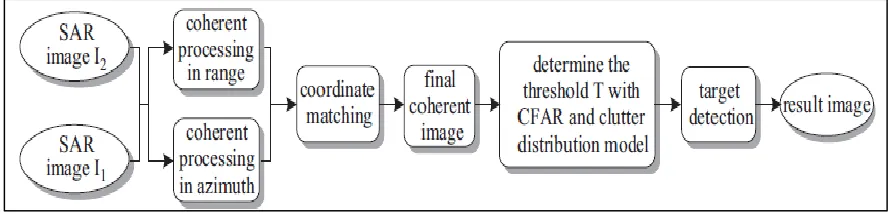
Flow Chart
Fig. 2: Flow Chart
IV. RESULT
The quantitative parameters which has been used to compare the image quality are the PSNR value and the MSE Value.
PSNRindB = 10 Log10 (
2552
MSE) (8)
MSE =∑ ∑ {Y(i,j)−Ỹ(i,j)} 2 j
i
M×N (9)
Where PSNR stands Peak Signal to Noise Ratio, MSE stands for Mean Square Error, MxN is size of the image, Y represents the original image, y denotes the denoised image. A Higher PSNR indicates the reconstruction is of higher quality when the two
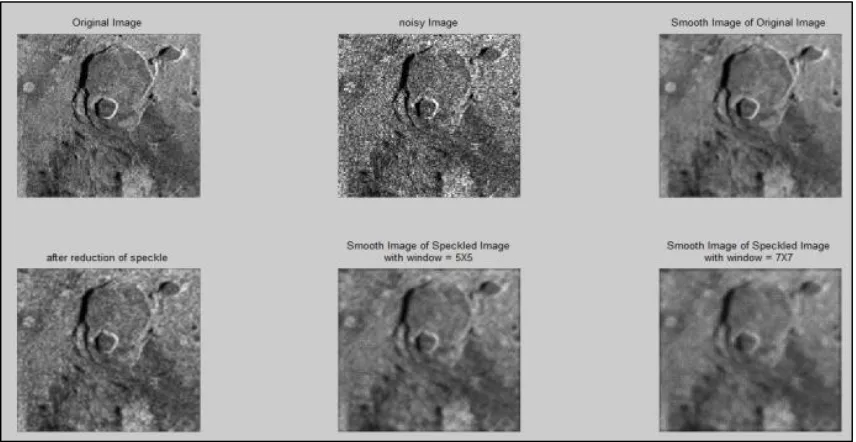
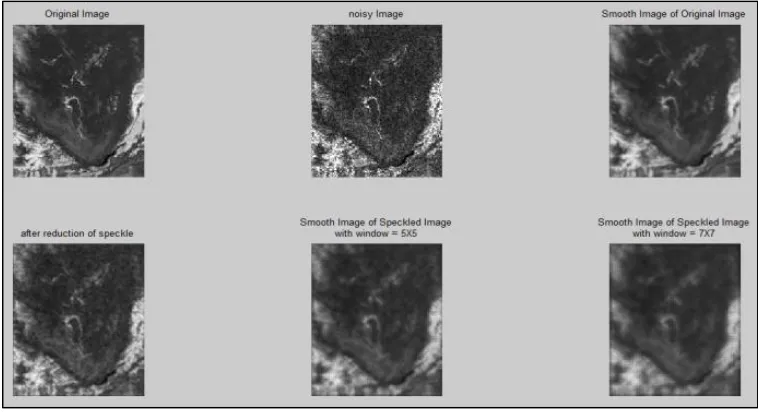
images are identical. The results obtained on some of the images are as shown below.
Fig. 4: Speckle Reduction Using DSF Filter and Obtained PSNR=18.99
Fig. 5: Speckle Reduction Using DSF Filter and Obtained PSNR=17.63
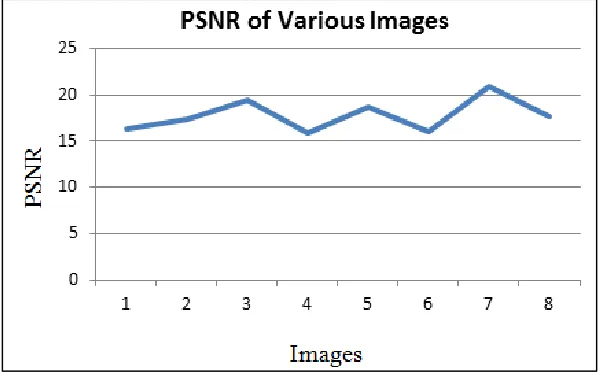
The table shown below compares the PSNR value obtained by Vikrant Bhateja et al. S.
No. Images
PSNR (Lee Filter) Vikrant Bhateja et al.
PSNR (Proposed DSF Filter) (in db)
MSE (Proposed DSF Filter)
Size of Image (in Pixel)
Time Complexity (in Sec.)
1 SAR_1 13.53 16.39 0.13 149x149 3.94
2 SAR_2 --- 17.29 0.16 427x460 43.7
3 SAR_3 --- 19.40 0.08 150x116 3.49
4 SAR_4 --- 15.93 0.11 81x145 2.55
5 SAR_5 --- 18.75 0.05 135x135 3.60
6 SAR_6 --- 16.02 0.15 137x108 3.03
7 SAR_7 --- 20.86 0.18 150x115 3.47
8 SAR_8 --- 17.63 0.08 137x150 3.92
Fig. 6: PSNR Graph of the Obtained Result
V. CONCLUSION
The proposed work develops a method for SAR image denoising. A primary requirement of such methods is that they should take into account the characteristics of SAR images which are different from optical images. Therefore it needs to adopt approaches specifically for SAR images to achieve the goal of SAR denoising. The problem of SAR speckle reduction has been related and studied simultaneously. Although traditionally this topic has been studied separately, the method has placed these two topics in a framework for development. In addition to its role in image denoising the proposed speckle smoothing method makes use of the so-called hierarchical correlation to identify edges from noise. The output value as can be seen in the table informs that the processing of the image provide higher PSNR value and low MSE value. Possible improvements concern mainly the selection of the different parameters involved in the filtering strategy. One issue regards the spatial extent of the window used for estimating the local time functions hence the paper utilized a finite spatial window with specified size for limiting the calculations.
REFERENCES
[1] Ehsan Nadernejad, Jari Korhonen , Soren Forchhammer, and Nino Burini, “Enhancing perceived quality of compressed images and video with anisotropic
diffusion and fuzzy filtering”, Signal Processing: Image Communication , www.elsevier.com/locate/image, 2013.
[2] Bhabesh Deka, and Prabin Kumar Bora, “Removal of correlated speckle noise using sparse and over complete representations”, Biomedical Signal
Processing and Control, www.elsevier.com/locate/bspc, 2013.
[3] Jacopo Grazzini and Pierre Soille, “Edge-preserving smoothing using a similarity measure in adaptive geodesic neighbourhoods”, Pattern Recognition
www.elsevier.com/locate/pr 2009.
[4] Shi-qi Huang , Dai-zhi Liu, Gui-qing Gao and Xi-jian Guo, “A novel method for speckle noise reduction and ship target detection in SAR images”, Pattern
Recognition , www.elsevier.com/locate/pr, 0031-3203/$ -seefrontmatter © 2009 Elsevier Ltd.
[5] Rastislav Lukac, Bogdan Smolka, Konstantinos N. Plataniotis and Anastasios N. Venetsanopoulos, “Selection weighted vector directional filters”,
Computer Vision and Image Understanding 94, 2004, 140–167.
[6] Rafael C. Gonzalez, Richard E. Woods, Steven L. Eddins "Digital Image Processing Using MATLAB", 2004.
[7] Mirzavandi M.,Yazdi M., “A Logarithmic Threshold Contourlet Based Method for Speckle Noise Reduction Of Medical Ultrasound Images” Canadian
Journal on Image Processing and Computer Vision Vol. 3 No. 1, March 2012 .
[8] Chedsada Chinrungrueng, Aimamorn Suvichakorn, “Fast Edge-Preserving Noise Reduction for Ultrasound Images”, IEEE Transactions on Nuclear
Science, Vol. 48, No. 3, 2001.
[9] N. K. Ragesh, A. R. Anil, Dr. R. Rajesh, “Digital Image Denoising in Medical Ultrasound Images: A Survey”, ICGST AIML-11 Conference, Dubai, UAE,
12-14 April 2011.
[10] I. Pitas, A. Venetsanopoulos, “Nonlinear Digital Filters: Principles and Applications”, Kluwer Academic Publishers, Norwell, USA, 1999.
[11] Mohan A Chimanna and S. R. Khot, “Robustness of video watermarking against various attacks using wavelet Transform Techniques and Principle
Component Analysis”, Information Communication and Emedded Systems (ICES), 2013, 613-618.
[12] Sk. Habiba and D. Niranjanbabu, “Advance Digital Video Watermarking based on DWT-PCA for Copyright Protection”, Int. Journal of Engineering
Research and Applications, Vol. 4, Issue 10, 2014, 73-78.
[13] Mahalakshmi B.V and Anand M.J, “Adaptive Wavelet Packet Decomposition for Efficient Image Denoising By Using Neigh Sure Shrink Method”,
International Journal of Computer Science and Information Technologies (IJCSIT), Vol. 5 (4), 2014, 5003-5009.
[14] Majid Masoumi and Shervin Amiri, “Content Protection in Video Data Based on Robust Digital Watermarking Resistant to Intentional and Unintentional
Attacks”, The International Arab Journal of Information Technology, Vol. 11, No. 2, March 2014.
[15] D. Hari Hara Santosh, Naveen Kumar Sarva, Lakshmi Sunitha G., V.S.V. Harish, “Robust Video Watermarking Algorithm Using Discrete Wavelet
Transform”, International Journal of Emerging Technology and Advanced Engineering, Volume 3, Issue 5,2013, 360-366.
[16] Jagannath Sethi, Sibaram Mishra, Prajna Parimita Dash, Sudhansu Kumar Mishra, Sukadev Meher, “Image Compression Using Wavelet Packet Tree”,
ACEEE Int. J. on Signal & Image Processing, 2(1), 2011, 41-43.
[17] Maniccam S. S. &Bourbakis N.G., “SCAN based lossless image compression and encryption. Information Intelligence and Systems”, Proceedings
[23] Mostafa S.A.K, Tolba A.S, Abdelkar F.M & Elhindy H. M., “Video watermarking scheme based on principal component analysis and wavelet transform”, International Journal of Computer Science & Network Security, 2009, 9: 45-53.
[24] Matis P G, Kanocz T, Ridzon R &Levicky D., “Video watermarking based on DWT”, SCYR 2010 - 10th Scientific Conference of Young Researchers –
FEI TU of Kosice, 2010.
[25] Huang H. Y., Yang C.H. & Hsu W. H., “A video watermarking technique based on pseudo-3-D DCT and quantization index modulation”, IEEE
Transaction on Information Forensics and Security, 5, (4), 2010, 625-637.
[26] Patel H., Patoliya J., Panchal P. & Patel R.N., “Digital Robust Video Watermarking using 4-level DWT”, International Journal of Advanced Engineering
Technology 1.3 :101-113, 2010.
[27] Arbi M. E., Koubaa M., Charfeddine M. & Amar C. B., “A dynamic video watermarking algorithm in fast motion areas in the wavelet domain”, Multimedia Tools and Applications 55.3, 2011, 579-600.
[28] Vikrant Bhateja, Anubhav Tripathi, and Anurag Gupta, “An Improved Local Statistics Filter for Denoising of SAR Images”, Springer International