Grid Analysis using PSAT Software
Vishnu Manoharan C Melvin Antony K M
UG Student UG Student
Department of Electrical & Electronics Engineering Department of Electrical & Electronics Engineering JECC, Kerala, India JECC, Kerala, India
Abstract
Power flow analysis is the backbone of power system analysis. This research paper evaluates the value of magnitude and phase angle of voltage at each node/bus and the real and reactive power flowing in each transmission line between the interconnected buses. To execute this analysis, there are techniques of mathematical calculations that have lots of steps depending on the size of the system. This process is time consuming and difficult to perform by hand because lots of calculations and iterations are involved this paper covers the modelling and the transient stability analysis of the Grid by using Matlab Power System Analysis Toolbox (PSAT) package.
Keywor ds: Power System Analysis Toolbox (PSAT), Voltage Stability, Smart Grid, Flexible AC Transmission System (FACTS)
________________________________________________________________________________________________________
I. INTRO DUC TIO N
Reliable and affordable electrical power is essential to the modern society. The modern electrical power systems cater the de mands in wide range of areas which include the major components such as generators, transformers, transmission lines, motors and etc. The availability of new advanced technologies has made a smarter, more efficient and sustainable grid to ensure a higher reliability of electrical power supplied to mankind. Regarded as the next generation power grid, smart grid has transformed the interconnected network between electricity consumers and electricity suppliers. The smart grid system involves transmission, distribution an d generation of electricity. In a smart grid, the operation of power systems infrastructure has evolved into a dynamic design instead of a static design.
As smart grid technology and its adoption are expanding throughout the world, realization in smart grid protection is important. Protection plays an important role to ensure realization of power grid reliability, security, and efficiency in generation, transmission, distribution and control network. Voltage problems have been a subjec t of great concern during planning and operation of power systems due to the significant number of serious failures believed to have been caused by this phenomenon. It is therefore necessary to develop Voltage stability Analysis (VSA).
In this paper we are experimenting with the designing, performance and the expansion of Madakkathara 400kV substation with the inclusion of renewable energy resources by the way of simulation, Fault Analysis, Voltage Stability Analysis and addition of Renewable Energy Resource based on the results revealed.
II. SIMULATIO N
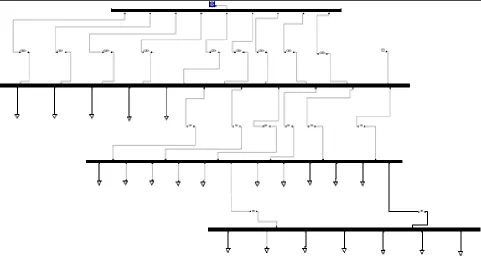
Fig. 1: Single line diagram of M adakkathara 400kV substation
III. SIMULATIO N RESULT
Fig. 2: Single line diagram of M adakkathara subsation drawn in PSAT
Simulation analysis specified the network statistics of Madakkathara substation a nd it is displayed in the below tables. Table – 1
Based on the simulation result, we look forward for fault analysis, voltage stability analysis and addition of renewable ener gy resource to extend the Madakkathara grid.
A. Fault Analysis
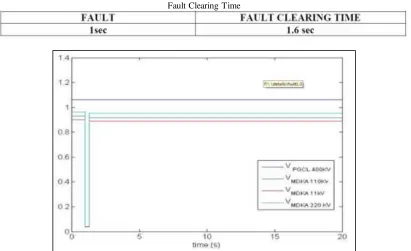
Fault analysis aims to determine the causes that have led to certain failure to take preventive measure to avoid that .It is Important to emphasis dual function of fault analysis. Here, we are applying fault on 220kv bus which is shown in Fig.3. All the parameters of Slack bus, Transformers and load are kept same as were in above base model of Madakkathara substation.
Fig. 3: Fault Analysis
The Voltage profiles of all buses are studied at different Fault clearing time. Main aim is to find the critical clearing time of fault in 220kv bus. In table 2, we are applying fault is applied at 1sec and clearing time at 1.6sec. From the figure 4, we can see that system become unstable because voltage of 11kv bus goes beyond the value 0.9p.u.
In table 3, we are applying fault at 1 sec and the clearing time at 1.3sec. From the figure 5, we can see that the system is stable. All buses lies between the range 0.9 to 1.1p.u.
Table - 3 Fault clearing time
Fig. 5: Bus voltage graphical representation when fault clearing time is at 1.3 seconds
The system is stable when we clear the fault at 1.3seconds. So the critical clearing time of the system is 1.3 seconds.
B. Maximum Load Stability
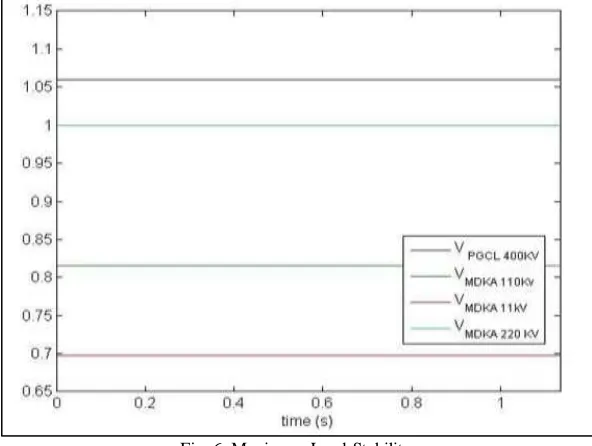
Voltage stability is also known as Load stability. The power systems are heavily stressed due to increased loading and this l eads to voltage stability problem. The Maximum Load that can be given to the system will be the multiple of 3.9 with the a ctual load value. After the value 3.9 the system will be unstable which is shown in the figure 6.
Fig. 6: M aximum Load Stability
C. Addition of Renewable Energy Resource
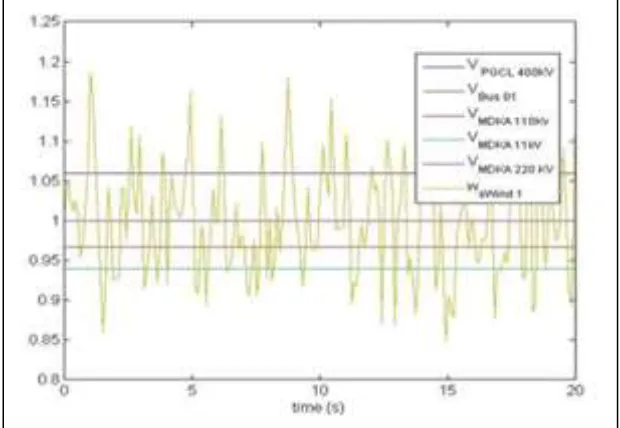
Madakkathara 400kV substation. The table5 shows the voltage of each bus after integration of Wind energy. In 11 kV bus we added static condenser for better voltage stability at each bus and reduction of reactive power.
Fig. 7: Addition of renewable energy in M adakkathara substation Table – 4
M aximum voltage after addition of renewable source in M adakkathara substation
IV. CO NC LUSIO N AND FUTURE SC O PE
In this paper we present Voltage Stability analysis using PSAT. The main information obtained from the power -flow analysis are the real and reactive power flowing in each line, magnitude and phase angle of the voltage at each bus. Also, we analysed transient stability and maximu m load stability of Madakkathara 400kV substation. We expand Madakkathara 400kV substation by adding wind farm. The high reactive power values need to be compensated using either the conventional compensators such as reactors, capacitor banks, and tap changing transformers or the use of FACTS devices.
It is important for planning future expansion of power systems as well as in determining the best operation of existing systems without any losses.
REFERENC ES
[1] Sarmad Majeed Malik, and Akif Zia Kha, “Implementation of Intelligent AGC in PSAT for optimal use in smart Grids”, IEEE International conference on Intelligent Energy and Power systems (IEPS), pp.312-323, Nov.2014.
[2] L. Wang, and D. Chen, “Extended—term dynamic simulation for AGC with smart grids”, Proc. IEEE PES general Meeting, pp.456. [3] F. Milano, “An open source power system analysis toolbox”, IEEE transactions on power system, pp.199 -1206, Aug-2005.
[4] Keyhani A, and Chatterjee, “Automatic Generation control structure for smart power grids”, IEEE Transactions on smart grid, pp.1310-1316, Sept-2012. [5] Sohan Chopde, and Sumit Patil, “Influence of grid connected solar and wind energy on small signal stability”, IEEE International conference on