Page 119 www.ijiras.com | Email: [email protected]
Contract Management Practices And Contract Damages In
Developing Countries: Evidence From Ghana
Richard Agbanyo
Department of Economics, University of Cape Coast, Ghana
Martin Luther Obeng
McPalmas Company Limited, Ghana
I. INTRODUCTION
The provision of public goods and services is a key function of governments across the globe. To ensure good governance and to provide public goods and services effectively, many countries have taken to decentralisation and adopted the local government system. Ghana, like many other countries has tried to give impetus to national efficiency by undertaking political and administrative decentralisation since the inception of the 1992 constitution. The Ghana Local Government Act, 1993 (ACT 462) gives backing to local assemblies to implement national policies and make bylaws in their respective jurisdictions including contracting.
―Under pressure to do more with less, governments have moved from direct service provision to providing services by contract‖ (Brown & Potoski, 2003). Thus contracting is an integral part of doing business in the public sector with both
private partners and other public agencies. Contracting is conceptualised here as the process of delegating a government‘s business process to third parties or external agencies.
Advocates of such alternative service delivery arrangements promote competitive contracting with promises of efficiency, cost savings, and improved effectiveness (Brown & Potoski, 2003). Thus contracting has a number of potential benefits when government agencies are conceptualised as monopoly service providers (Landau, 1969; Niskanen, 1971; and Savas, 1987; Brown & Potoski, 2003).
However, with reference to a growing number of incomplete, unsuccessful, and corrupt contract arrangements, critics contend that ―contracting creates numerous accountability problems, sacrifices service quality for efficiency and cost savings, often does not result in improved efficiency and cost savings, and ultimately ‗hollows‘ the state‖ Abstract:
Purpose: Many countries fall short of proper contract management practices hence the prospects of contracting often turn unpleasant mainly due to contract damages. This paper argues that rigorous contract management can offer reasonable solution. The paper therefore seeks to assess the effects of contract management practices and contract damages of local governments in Ghana.
Design/methodology/approach: The study is a cross sectional survey and is rooted in the positivist paradigm. The paper used primary data collected between 5th September and 30th November 2014 with a sample of 98 local assemblies in Ghana. Cross tabulations, correlation coefficient (r) and Ordinary Least Square estimates were used in the analysis.
Findings: The study found out that contract management has significant negative effects on contract damages.
Originality/value: To the best of our knowledge, this would be the first empirical study on the adherence of state agencies to contract management principles in Ghana. It is also the first to combine the two variables despite their generally believed association.
Recommendations: It has been recommended that assemblies strongly adhere to the principles of contract management; specially the principles of contract need assessment, contractor selection, contract writing, execution, monitoring, closing and commitment of state agencies to contracting.
Page 120 www.ijiras.com | Email: [email protected] (de Leon & Denhardt, 2000; Milward, 1996; Milward, Provan,
& Else, 1993; Brown & Potoski, 2003, p 1). Thus contracting does not always deliver on these promised benefits. While some research supports the efficiency and cost-savings claims (Miranda & Lerner, 1995; Perry & Babitsky, 1986), recent reviews of the empirical literature suggest this support is mixed (Boyne, 1998; Hirsch 1995; Lavery, 1999).
One major challenge of contracting is high cost (not cost of production) but as a result of breach of contracts with its resultant damages. A breach of contract is a failure to do what one has agreed to do in a contract. Missing in the contracting debate is rigorous analysis of the capacity to manage and compliance to contracting process on the parts of both governments and contract vendors.
THE PROBLEM STATEMENT
Governments of developing countries may be irrelevant without the provision of public goods and services. Therefore, any development that obstructs this essential function of government should call for concern. Even though contracting has become a sure way of providing most government services, many countries fall short of proper contract management practices hence the prospects of contracting often turn unpleasant in these countries. In Uganda for example, Agaba & Shipman, (2007) asserted that many public firms did not follow prescribed contract practices. While Agaba and Shipman (2008) revealed absence of contract management implementation plan in the country.
The result is contract damages on the part of the state agencies. The contract damages of the USA (Johnson, 2011; Rosenbaum & Williams, 2002) and the over 270 million British pounds claimed by Raytheon Co. RTN from the UK government (CBC News, 2014) as well as the damages of Sandown Travel Ltd (Republic of South Africa, 2012) and the Daleen Alta De Swardt (Republic of South Africa, 2006) in South Africa can be cited from developed countries.
In the case of Ghana, the government spends millions of dollars each year on contract damages. The government of Ghana incurred GH₵ 642 million as judgment debts between 2001 and 2011 with GH₵ 276 million paid in 2010 alone (Ghana Government, 2013). Unfortunately, breach of contracts constituted majority of the payment made during the period under review. Notable amongst these payments include GH¢ 52 million paid to Alfred Woyome, EUR 94 Million paid to CP. Indications are that there could be further judgment debts to be paid by government in respect of contract breaches and untimely abrogation (Ahamed, 2012).
The questions that come to mind are whether state agencies adhere to state laws and guidelines when entering into these contracts? Should governments wait for such huge costs to be incurred and then come in to investigate and prosecute perpetrators, all at additional cost? Is there no way to avoid these costs? If indications are that there could be more contract damages, then there is the need to investigate adherence to contract principles in Ghana. For this paper believes that if contract management is properly carried out, the worst situation would be nullification of contracts which may not involve damages.
RESEARCH OBJECTIVES
The main objective of this paper was to assess the effects of contract management and contract damages in local governments of Ghana. Specifically, the paper sought to: measure the adherence of local governments to contract
management principles and
estimate the effects of contract management on contract damages in local governments of Ghana.
RESEARCH HYPOTHESES The paper hypothesised that:
H1: The level of adherence of Ghanaian local governments to contract management practices is low.
H2: Contract management has no significant effects on contract damage in the local governments of Ghana.
II. LITERATURE REVIEW
This section consists of the components of contracting, theories that underpin the study, principles of contracting as well as the previous studies in the area.
COMPONENTS OF CONTRACT MANAGEMENT
Literature identified four key components of every contract. These include setting up the contract management team, managing relationships, managing service performance, and contract administration. Setting up the contract management team determines when the contract management team should be set up, the structure of the team, the attributes of the personnel involved and any initial and ongoing training needs while managing relationships stablishes relationships, communication routes and systems, and the active support and enhancement of them throughout the life of the project so that a sustainable partnership of trust and respect is maintained.
Managing service performance assesses whether the
services being delivered by the service provider meet the required standards, whether remedial measures are effective and whether there are any trends evident in the provision of the services while contract administration ensures obligations and responsibilities defined under the contract are met, ensuring under-performance, risks, payment of the unitary charge, reporting and change are all managed effectively so that value for money and continuous improvement are achieved.
THEORETICAL FRAMEWORK
Page 121 www.ijiras.com | Email: [email protected] interests. Agency theory is concerned with the conflicting
goals between the principal and agent in obtaining their respective objectives and is focused on mechanisms related to obtaining information, selecting the agent, and monitoring the agent‘s performance.
PRINCIPLES OF CONTRACT MANAGEMENT
This paper agrees with the Office of the Legislative Auditor (2002) on the summary of basic principles of contract management for state agencies. These include 18 principles which have been put into six broad categories as follows:
ASSESSING THE NEED FOR THE CONTRACT: 1)
Identifying what services are needed; 2) determining why the services are needed and how they will benefit the agency and state; and 3) considering a range of alternatives to determine how the needed services can best be provided.
SELECTING THE CONTRACTOR: 4) developing criteria
to objectively evaluate how well potential contractors can meet the needs of the agency and state; 5) select the ―best value‖ for the state; and 6) ensure that there is no employee or organisational conflict of interest.
WRITING THE CONTRACT: 7) clearly defining roles,
responsibilities, and performance expectations of the contractor and agency staff; 8) identifying a variety of tools to monitor contract and contractor performance; 9) linking payment to the satisfactory completion of specific contract tasks or services, which should be spread throughout the life of the contract; and 10) addressing the extent to which the state owns the final product.
EXECUTING THE CONTRACT: 11) obtaining all
necessary signatures on the contract before work begins; 12) ensuring that funds are available before work begins.
MONITORING THE CONTRACT: 13) maintaining
expertise within the agency to effectively manage contractors; 14) periodically evaluate the progress of the contract and determine if it is prudent to continue; and 15) follow up on results of monitoring reviews, audits, and investigations.
CLOSING THE CONTRACT: 16) ensuring that all
deliverables are satisfactorily completed before making final payment; 17) evaluate the contractor‘s performance and make written evaluations available for other state agencies; and finally, 18) use the final work product as intended.
EMPIRICAL LITERATURE
A number of researches have been conducted on organisational contract management process capability. For instance, Contract Management Maturity Model (CMMM) was first developed and then applied to an Air Force space systems contracting agency (Rendon, 2003). The CMMM was then applied at various Air Force, Army, and Navy contracting agencies for the purpose of assessing contract management process capability and identifying process improvements, as well as obtaining empirical data for use in characterising the state of contract management process capability throughout the Department of Defence (Rendon, 2008). Gottschalk and
Solli-Saether (2005) researched various management theories and identify core competence management and stakeholder management as the most theory-based critical success factors for information technology outsourcing.
The project management literature provides some insight on critical factors for project success. Rubin and Seeling (1967) introduce success and failure factors for projects and conclude that a project manager‘s performance is determined more by the size of projects previously managed as opposed to the project manager‘s experience. Avots (1969) identifies project manager selection, project termination, and top management support as factors related to project failure. Baker, Murphy, and Fisher (1983) propose using perceived performance as the measure for project success, instead of the usual triple constraints of cost, schedule, and performance.
Particularly related to organisational success factors, Frame (1999) identifies seven key elements that lead to organisational competence in project management: 1) clearly defined and well-formulated procedures for performing work, 2) access to information needed to perform work effectively, 3) sufficient quantities of human and material resources, 4) opportunities for training and education, 5) clearly defined visions of where the organisation is headed, 6) a culture of openness, and 7) institutionalisation of project management. Crawford (2002) analyses and compares many of the results of the previous studies of project success factors and identifies the top six factors as: 1) planning; 2) monitoring and control, team selection, and technical performance; 3) communication, leadership, strategic direction, and team development; 4) monitoring and control (risk), organisational support, and stakeholder management; 5) organisational structure; and 6) project definition and stakeholder management (client). Finally, in a survey of over 150 project management professionals, Baccarini and Collins (2003) identify fifteen critical factors for project success.
Literature search reveals other studies on critical success factors for procurement projects which include Panayiotou et al (2004), Klafft (2009), Quayle (2005), Vaidya et al (2006), Khanapuri et al (2011) and (Kejuo, 2012). Similarly, there are studies on critical success factors for specific aspects of procurement. For examples include Trent and Monczka (1994); Monczka, Petersen, Handfield, and Ragatz (1998); Gottschalk and Solli-Saether (2005); and Angeles and Nath (2007). While others such as Hughes (1986); Morris and Hough (1987) identified various factors related to project failure or success.
The literature also identifies best practices and lessons learned in federal government contract management. Cohen and Eimicke (2008) identify twenty problems in government contracting that fall into five categories: 1) problems relating to letting contracts, 2) communication issues, 3) contractor internal management issues, 4) government contract management issues, and 5) environment or external issues.
Page 122 www.ijiras.com | Email: [email protected] Authority, deliberate controlling of competition,
non-compliance with provisions of the law, splitting of contracts into smaller lots, lack of funds and non-cooperativeness of suppliers, as the major challenges militating against the implementation of the Public Procurement Law.
CONTRACT TERMINATION AND DAMAGES
Studies on contract termination and damages are scant compared to contract management. Termination of a contract may be explained as the act or process of putting an end to a contract. When properly executed, a contract is legally binding, meaning that one party may have the right to sue the other in the event that the terms of the contract are violated in some way.
According to Ahamed (2012), contract can be nullified, that is, not enforceable for various reasons. Moreover, most contracts have a clause that specifies how to rightfully terminate the them. Termination may also be appropriate with an automatically renewing contract. If one party wishes to stop the contract from automatically renewing, they must act within a certain amount of time before the renewal date.
When a contract is wrongfully terminated by a contract party, the other party can fight for his right to perform by seeking redress in court. Thus any unfulfilled obligation would result in a breach and the aggrieved party can seek some form of relief for the breach. These reliefs or remedies can be in different forms including financial compensation in respect of the breach (Ahamed, 2012). This is more interested in financial damages which the claimant may be entitled to should his right be vindicated. That is contract damage in this paper is the amount of money awarded by court to winner of a court case and payable by the losing party.
It is however believed that prudent contract management practices can help curb the menace. In fact, 65% of respondents in a study conducted by Aberdeen Group (2007) reported that contract management has improved their enterprises‘ exposure to financial and legal risk. Aikins (2012) also suggested some solutions to Ghana‘s judgement debt issue some of which are to resource and expand the role of Ghana Audit Service; the Ministry of Finance and Economic Planning should also serve as Financial Gatekeeper; only professional lawyers with technical competence should handle legal matters; implement procedures to make contract abrogation a rare occurrence; review and enforce procurement laws and properly administer contracts to avoid liability; reform government procurement processes and implement best practices; create an environment of politics-administration dichotomy in the municipal, metropolitan and district assemblies; and implement judgment debt handling procedures as part of debt management policy; the rest are to review, improve and enforce financial management laws and policy; resource the nation‘s courts; provide orientation on ethics of governance to government officials; implement an integrated government-wide information system and investigate and take legal action if needed.
III. METHODOLOGY
This section focuses on the research design, brief overview of the country (Ghana), population, sample and sampling procedure, data collection instrument and procedure, and the analytical framework of the study.
STUDY DESIGN
The study is cross sectional and it is enshrined in the Positivist Paradigm. Positivism predominates in science and assumes that science quantitatively measures independent facts about a single apprehensible reality (Healy & Perry, 2000). The principles of positivism ensure quantifiable observations that lead to quantitative statistical analysis. BRIEF OVERVIEW OF GHANA
Ghana officially called the Republic of Ghana, is a sovereign multinational state and unitary presidential constitutional democracy, located along the Gulf of Guinea and Atlantic Ocean, in the sub region of West Africa. Ghana is the 82nd largest country in the world and 33rd largest country on continental Africa by land mass and it is bordered by the Ivory Coast in the west, Burkina Faso in the north, Togo in the east and the Gulf of Guinea and Atlantic Ocean in the south (Jackson, 2001). The country is a constitutional democracy divided into ten administrative regions and 216 local assemblies (GSS, 2014). The local assemblies (district, municipal and metropolitan) are the second-level administrative subdivisions of Ghana.
POPULATION, SAMPLE AND SAMPLING PROCEDURE The 216 local governments constituted the study population which are made up of 6 metropolitan 49 municipal, 161 district assemblies (Ghana Government, 2012). Procedures for determining sample size for continuous variables using Cochran‘s (1977) formulas was followed as shown below. The sample size is given as:
= = 105.40 (1)
Where t = value for selected alpha level of .025 in each tail = 1.96
Where s = estimate of standard deviation in the population = 1.167.
Where d = acceptable margin of error for mean being estimated = .21.
Therefore, for a population of 216, the required sample size is 105. However, since this sample size exceeds 5% of the population (216*.05=10.8), Cochran‘s (1977) correction formula was used to calculate the final sample size. These calculations are as follows:
(2) Where n1 is the final sample size, n0 is the sample size
calculated at the first stage while pop is the population size.
Page 123 www.ijiras.com | Email: [email protected] However, the sample size for the study has been rounded
up to 110 local government assemblies. The sample size, representing 50.93% of the population, was deemed large enough to enable meaningful conclusions on the population. The composition of the sample followed multi-stage probabilistic and proportional sampling techniques.
To begin the process, quota was given to each region depending on the number of assemblies in the region. Again, within each region, quota was assigned to the metropolises, municipalities and districts. Simple random sampling was then used to select the individual assemblies from a sampling frame. Finally, the contract manager or the project coordinator for each selected assembly was chosen purposively as the first respondent.
As a way of cross checking the accuracy of the data, another member of the contract management committee (if applicable) was also chosen by convenience sampling to respond to the questionnaires. This gives rise to two respondents from each selected assembly. However, where there were discrepancies in the figures, averages were calculated to arrive at one figure for each assembly.
At the end, enough information was gathered on ninety-eight (98) assemblies. The 98 responses represent a response rate of eighty-nine point zero nine percent (89.09%).
MEASUREMENT OF VARIABLES
Contract damages (CD) or contractual judgement debt which is the dependent variable in this study was captured as continuous variable in Ghana Cedis (currency). It is the average of contract damages incurred by the assemblies over the period of 2011 to 2013. Contract management (CM) is an index, computed based on series of questions that centred on adherence of the assemblies to contract management principles and best practices. There were 46 statements with 5-point Likert scale in all and by implication, CM index was expected to range from 46 to 230 with 230 being the highest degree of adherence and 46 being the lowest.
For taking definite decisions, a grand mean and standard deviation have been calculated for contract management index, which were 168.95 and 44.12 respectively. Therefore, all assemblies were divided into three categories on the basis of mean and standard deviation scores to give another variable, Contract management level (CMlev) as:
CMlev CM Score
High more than 213.07
Average 124.83 – 213.07
Low less than 124.83
Thus assemblies were classified as low performers, average performers and high performers using the mean and standard deviation of CM index. Higher score implies that the assembly‘s adherence to the principles and best practices is high hence its management is deemed high, while low score implies that the assembly‘s adherence to principles and best practices is its performance is low.
Education (EDU) denotes the highest academic qualification of the respondent. InST denotes in-service training and it captures the number of contract management related workshops or seminars the respondent has ever attended. RUR is rural dummy indicating locality of the
assembly. Districts are considered rural while metropolis and municipalities are taken to be urban settings following the World Bank‘s classification where metropolises and municipalities are given urban grants but districts are not. The measurement of the variables is summarised in Table 1.
Variable Description Measurement CD Contract damages In Ghana Cedis
CM Contract management Indices
CMlev Level of CM 0 = low
1 = average 3 = high EDU The highest level of
respondent‘s education
1 = secondary 2 = diploma 3 = first degree
4 = masters 5 = PhD
InST In-service training Number of
workshops or seminars attended.
RUR Locality 1 = rural
0 = urban Source: Author’s construct, 2014
Table 1: Measurement of variables
DATA AND DATA COLLECTION PROCEDURE
The study used primary data which was collected using a well-designed questionnaire-cum checklist. The data was collected with the help of trained research assistants under the supervision of the researchers. The questionnaires were self-administered both online and on paper because of the wide coverage of the study and also all the respondents could read and write but some may not have access to reliable internet service.
The instrument was pre-tested in ten local assemblies. The pre-test was done to make certain that the research instrument was appropriate and understandable. Also it was to ensure the validity, reliability and unbiasedness of the data to be collected. Data from the pre-test was also used to estimate the parameters of the population so as to select appropriate sample size for the study.
METHODS OF ANALYSIS
Cross tabulations, Pearson correlation coefficient (r) and Ordinary Least Square estimates were used in the analysis.
The empirical equation to be estimated is given as
Where CD is contract damages or contractual judgement debt, CM is contract management indices, EDU is education, InST is in-service training, RUR is a dummy for rural assembly and µ is the error term.
RELIABILITY OF THE STUDY
Some measures were taken to ensure that the conclusions drawn in the paper are warranted. Broad aspects of the constructs were considered for measurement. The linktest was conducted to ensure that the model was correctly specified
Page 124 www.ijiras.com | Email: [email protected] (see Table 5). Collinearity diagnostics was carried out with the
Collin test (Appendix I) and suggested that the variance inflation factors (VIF) and the tolerance of the variables in the model are within the acceptable range.
IV. DATA ANALYSIS/ FINDINGS
The analysis involves 98 local assemblies which were created at least four years preceding the study and had information on their contract damages and the relevant characteristics under study. This gave a response rate of 89.09%.
THE PROFILE OF THE STUDY‘S RESPONDENTS
The characteristics of the respondents and the assemblies were examined before the relationships were explored and results were summarised in Table 2.
Variable Frequency Percent
Sex
Male 87 88.8
Female 11 11.2
Level of education
Diploma 11 11.2
First degree 31 31.6
Masters 56 57.1
Contract management level
Low 23 23.5
Average 59 60.2
High 16 16.3
Mean Std. Dev. Min Max
Contract manag’t 168.949 44.11708 90 220
Contract damages 403346.4 1039646 0 4644538
In-service training 3.122449 2.887104 0 11
Age of respondent 39.34 7.295 23 58
Contract damages 403346.4 1039646 0 4644538
Age of assembly 10.59 5.633 4 22
Source: Field work, 2014
Table 2: Descriptive statistics
The result shows a very high gender inequality in leadership position in the assemblies. As many as 87 (88.8%) were male while only 11 (11.2%) were female. Majority, 56 (57.1%), of the respondents had master‘s degree in different areas of studies. It can also be observed that on average, a respondent in this study is about 39 years of age while the youngest is 23 years and the oldest is 58 years old.
The dependent variable of the study, contract damages, has a minimum value of zero (0) and a maximum value of Four Million Six Hundred and Forty-Four Thousand Five Hundred and Thirty-Eight Ghana Cedis (GHȼ 4,644,538.00). The table also suggests that on average, an assembly in this study incurred Four Hundred and Three Thousand, Three Hundred and Forty-Six Ghana Cedis forty pesewas (GH¢ 403,346.40) as contract damage in the three years preceding
the study. Finally, contract management score has a maximum value of 220 and a minimum value of 90. The average score however stands at 168.949.
THE RELATIONSHIP BETWEEN CONTRACT
MANAGEMENT AND CONTRACT DAMAGES
Karl Pearson‘s coefficient of correlation has been used to find a relationship between contact management and contract damages. Given the large standard deviations of the variables and the assumption of linearity in the analysis, the natural logs of the variables were taken. This was done to smoothen the data.
c. damage Contract mgt Cont. damage 1.0000
Contract mgt -0.6191*** 1.0000
***. Correlation is significant at the 0.01 level.
Table 3: Correlation between contract management and contract damages
The correlation coefficient of - 0.6191 indicates a strong negative relationship between adherence to contract management principles and contract damages. That is the more an assembly adheres to contract management principles and best practices, the lower the contract damages and vice versa.
THE EFFECTS OF ADHERENCE TO CONTRACT
MANAGEMENT ON CONTRACT PRINCIPLES
DAMAGES
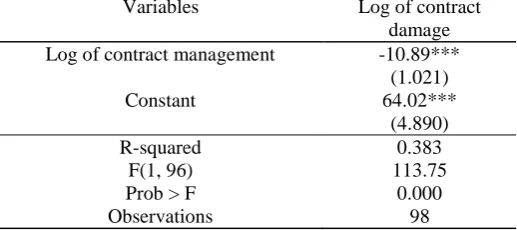
Given that the correlation coefficient could not explain the causal relationship between adherence to contract management and contract damages, regression analysis was employed to examine the causal relation. The coefficient of determination was 38.33 percent suggesting that contract management could explain 38.33 percent of the variance in assemblies‘ contract damages, all other things being equal.
Variables Log of contract
damage Log of contract management -10.89***
(1.021)
Constant 64.02***
(4.890)
R-squared 0.383
F(1, 96) 113.75
Prob > F 0.000
Observations 98
Robust standard errors in parentheses *** p<0.01, ** p<0.05, * p<0.1 Source: Field Survey, 2014
Page 125 www.ijiras.com | Email: [email protected] The post estimation statistics show that the model was
robust (see F and the R2). An R2 of 0.3832 implies the model is robust and that changes in contract damages can be explained by changes in contract management. The implication is that adherence to contract management principles and best practices is a sure way to reduce contract damages or judgement debts in Ghana.
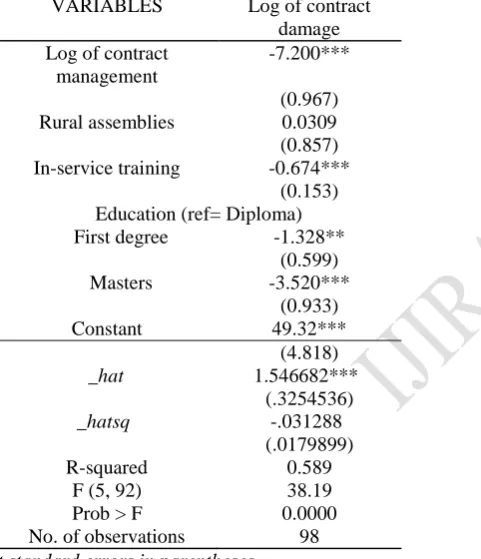
This result, though necessary, may not be realistic because variables do not behave in isolation. Many variables are interrelated hence the need to control for other factors in a multiple regression (Table 5). Here too, the F statistic of 38.19 with a p-value of 0.000 indicate that the hypothesis that all the coefficients of the predictors except the constant is zero is rejected. The R2 suggests that all the explanatory variables together explain 58.90 percent of the changes in the dependent variable. The significance of _hat and _hatsq also suggested that the model has no specification problem.
VARIABLES Log of contract damage Log of contract
management
-7.200*** (0.967) Rural assemblies 0.0309 (0.857) In-service training -0.674***
(0.153) Education (ref= Diploma) First degree -1.328**
(0.599)
Masters -3.520***
(0.933)
Constant 49.32***
(4.818)
_hat 1.546682***
(.3254536)
_hatsq -.031288
(.0179899)
R-squared 0.589
F (5, 92) 38.19
Prob > F 0.0000
No. of observations 98
Robust standard errors in parentheses *** p<0.01, ** p<0.05, * p<0.1 Source: Field Survey, 2014
Table 5: Multivariate OLS estimates of contract damages
The coefficient of contract management is significant in explaining the changes in contract damages. It is significant at one percent level and has a negative effect. The coefficient of -7.200 means that a one percent increase in adherence to contract management reduces contract damages by -7.2 percent, all things being equal.
Given that the adherence to these principles is highly significant in reducing contract damages, it is prudent to pay attention to them. These include 22 principles which can be put into seven broad categories as follows: assessing the need for the contract, selecting the contractor, writing the contract, executing the contract, monitoring the contract, closing the contract and commitment of state agencies to contracting.
V. CONCLUSIONS
Following the analysis and findings of this paper concludes that contract damages exist at the local governments in Ghana and that contract management has negative effects on contract damages. That is proper contract management reduces contract damages. The paper found correlation coefficient of - 0.6191 indicating a strong negative relationship between contract management and contract damages. In addition, a one percent increase in adherence to contract management principles and best practices reduces contract damages by 7.2 percent, all other things being equal.
Adherence to contract management principles is low in the local governments of Ghana. The study revealed that as many as 23 representing 23.5 percent of the 98 assemblies studied were classified as low performing assemblies while only 16 (16.3%) were identified as high performing assemblies and the rest 59 (60.2%) performed on average given their adherence to the principle and best practices of contract management.
VI. RECOMMENDATIONS
Based on the findings and the conclusions, the paper recommends that:
That local governments should seriously adhere to the principles of contract management specially, the principles of contract need assessment, contractor selection, contract writing, contract execution, contract monitoring, contract closing and commitment of state agencies to contracting.
That local governments should make sure that funds for projects be sought and made ready before any contract is awarded.
Local governments should make sure that the bidding process is elucidated by organising workshops to educate their contract managers on the procurement procedures. Contract management should be in the hands of only
contract experts or professionals.
The academic background of contract staff should be taken seriously. Specifically, a contract manager should have at least masters in his or her area of study.
The Auditor General Department should not concentrate on contract damage issues in only the central government. Attention should be given to the local governments as well since the issue exists there as well.
LIMITATIONS OF THE STUDY
Page 126 www.ijiras.com | Email: [email protected] DIRECTION FOR FURTHER STUDIES
Further studies could consider a time series analysis of the contract damages at the national level.
APPENDICES
Variable VIF SQRT
VIF
Tolerance R2 Eigenval Cond
Index Lncont.
management
1.21 1.10 0.8245 0.1755 0.3664 3.4511
Rural 1.05 1.02 0.9555 0.0445 0.2435 4.2328
In-service training
1.30 1.14 0.7681 0.2319 0.0252 13.1522
Education 1.19 1.09 0.8379 0.1621 0.0016 52.9868
Mean VIF 1.19
Appendix 1: Collinearity Diagnostics (using Collin test)
REFERENCES
[1] Aberdeen Group. (2007). Contract Lifecycle Management and the CFO: Optimizing Revenues and Capturing Savings. Aberdeen Group Inc. Boston, Massachusetts. [2] Agaba, E. & Shipman, N. (2007). ―Public Procurement
Reform in Developing Countries: The Ugandan Experience.‖ In G. Piga & K. V. Thai (Eds.), Advancing Public Procurement: Practices, Innovation and Knowledge-Sharing (pp. 373-391). Boca Raton, FL: Pr Academics Press.
[3] Agaba, E. & Shipman, N. (2008). Public Procurement Reforms in developing Countries: The Uganda Experience.
[4] Ahamed, B. (2012). The Issue of Contracts and Judgment Debts in Ghana. Accessed on the 18th July, 2014 from http://www.ghanaweb.com
[5] Aikins, S. K., (2012). Ghana‘s Judgment Debt and Financial Governance Problems: Recommended Practical Solutions. Modern Ghana. Accessed on the 18th July, 2014 from http://www.modernghana.com.
[6] Ameyaw, C., Mensah, S. & Osei-Tutu, E. (2012). Public procurement in Ghana: The implementation challenges to the Public Procurement Law 2003 (Act 663).
International Journal of Construction Supply Chain
Management, 2(2) 55-65.
[7] Angeles, R., & Nath, R. (2007). ―Business-to-Business E-procurement: Success Factors and Challenges to Implementation.‖ Supply Chain Management: An
International Journal, 12 (2), 104-115.
[8] Arrow, K. (1985). Chapter 2: The Economics of Agency
in Principals and Agents: The Structure of Business. Eds.
J.W. Prattt and R.J. Zeckhauser. Boston, M A: Harvard Business School Press. pp. 37-50.
[9] Avots, I. (1969). ―Why Does Project Management Fail?‖
California Management Review, 12, 77-82.
[10] Baccarini, D., & Collins, A. (2003). Project Success—A Survey. Journal of Construction Research, 5 (2), 211-231.
[11] Baker, B. N, Murphy, D.C., & Fisher, D. (1983). Factors Affecting Project Success. In D. I. Cleland and W. R.
King (Eds.), Project Management Handbook, 669-685. New York: Van Nostrand Reinhold.
[12]Boyne, G. A. (1998). Bureaucratic Theory Meets Reality: Public Choice and Service Contracting in U.S. Local Government. Public Administration Review 58(6): 474– 84.
[13] Brown, T. L. & Potoski, M. (2003). Contract-Management Capacity in Municipal and County Governments. Public Administration Review, 63(2).
[14]CBC News. (2014). British Colombia Teachers' Federation wins $2M in Damages from Province. CBC News, Jan 27, 2014 6:39 PM PT, British Colombia. [15] Cochran, W. G. (1977). Sampling Techniques (3rd ed.).
New York: John Wiley & Sons.
[16] Cohen, S., & Eimicke, W. (2008). The Responsible Contract Manager: Protecting the Public Interest in an
Outsourced World. Washington, DC: Georgetown
University Press.
[17] Crawford, L. (2002). Profiling the Competent Project Manager. In D. P. Slevin, D. I. Cleland, and J. K. Pinto (Eds.), The Frontiers of Project Management Research,
151-176. Newton Square, PA: Project Management Institute.
[18]De Leon, L. & Denhardt, R. A. (2000). The Political Theory of Reinvention. Public Administration Review 60(2): 89–97.
[19] Frame, D. L. (1999). Project Management Competence: Building Key Skills for Individuals, Teams, and
Organizations. San Francisco: Jossey-Bass.
[20] Ghana Government (2012). Break Down of Metropolitan, Municipal and District Assemblies in Ghana. Retrieved 17th march, 2013 from http://www.ghanadistricts.com. [21] Ghana Government (2013). Government Pays GH₵ 642m
in Judgment Debt, Government of Ghana Official Website. http://www.ghana.gov
[22] Ghana Statistical Service (2014). "Population projection by sex, 2010 to 2014, National". Retrieved 3 August 2014.
[23] Gottschalk, P., & Solli-Saether, H. (2005). ―Critical Success Factors from IT Outsourcing Theories: An Empirical Study.‖ Industrial Management & Data
Systems, 105(6), 658-702.
[24]Healy, M. & Perry, C. (2000). Comprehensive criteria to judge validity and reliability of qualitative research within the realism paradigm. Qualitative Market Research, 3(3), 118-126.
[25]Hirsch, W.Z. (1995). Contracting Out by Urban Governments: A Review. Urban Affairs Review 30(3): 458–72.
[26] Hughes, M. W. (1986). ―Why Projects Fail: The Effects of Ignoring the Obvious.‖ Industrial Engineering, 18: 14-18.
[27] Jackson, J. G. (2001) Introduction to African
Civilizations, Citadel Press, p. 201, ISBN 0806521899.
[28] Khanapuri, V. B., Nayak, S., Soni, P., Sharma, S., & Soni, M. (2011). Framework to Overcome Challenges of Implementation of E-procurement in Indian Context. International Conference on Technology and Business Management.
Page 127 www.ijiras.com | Email: [email protected] projects. A case study of MTN Nigeria. Master‘s thesis,
Royal Institute of Technology.
[30] Klafft, M. (2009). E-Procurement for Consumers: Success Factors and Technology Acceptance. SSRN eLibrary.
[31]Landau, M. (1969). Redundancy, Rationality, and the Problem of Duplication and Overlap. Public
Administration Review 39(6), 346–58.
[32] Lang, K. A. (2006). Cognition, Agency Theory and Organizational Failure: A Saskatchewan Wheat Pool Case Study. Master thesis, Department of Agricultural Economics, University of Saskatchewan.
[33]Lavery, K. (1999). Smart Contracting for Local
Government Services: Processes and Experience.
Westport, CT: Praeger.
[34]Milward, H. B. (1996). Symposium on the Hollow State: Capacity, Control and Performance in Interorganizational Settings. Journal of Public Administration Research and Theory 6(2), 193-95.
[35]Milward, H. B., Keith, G. P., & Else B. A. (1993). What Does the Hollow State Look Like? In Public
Management: The State of the Art, edited by Barry
Bozeman, 309–22. San Francisco, CA: Jossey-Bass.
[36]Miranda, R., & Lerner, A. (1995). Bureaucracy, Organizational Redundancy, and the Privatization of Public Services. Public Administration Review 55(2): 193–200.
[37] Monczka, R. M., Petersen, K. J., Handfield, R. B., & Ragatz, G. L. (1998). ―Success Factors in Strategic Supplier Alliances: The Buying Company‘s Perspective.‖
Decisions Sciences, 29 (3), 553-577.
[38] Morris, P. W., & Hough, G. H. (1987). The Anatomy of
Major Projects. New York: John Wiley & Sons.
[39] Office of the Legislative Auditor (2002). Contract Management Principles and Practices. Minnesota statutes and Department of Administration guideline. Retrieved from www.auditor.leg.state.mn.us/ on20th March, 2013. [40] Panayiotou, N., Tatsiopoulos I., & Gayialis, S. (2004)
―An E – procurement System for Government Purchasing‖. International Journal of Production Economics, 90, 79 -102.
[41]Perry, J. L., & Babitsky, T. (1986). Comparative Performance in Urban Bus Transit: Assessing
Privatization Strategies. Public Administration Review
46(1): 57–66.
[42] Quayle, M. (2005). The Real Management Implications of E-Procuremet: The Importance of Involving People. Journal of General Management. 31(1), 23-39.
[43] Rendon, R. G. (2003). A Systematic Approach to
Assessing Organizational Contract Management
Maturity. Unpublished doctoral dissertation, School of
Business, Argosy University, Orange County, CA. [44] Rendon, R. G. (2008). Procurement Process Maturity:
Key to Performance Measurement. Journal of Public
Procurement, 8 (2): 200-214.
[45] Rendon, R. G. (2009). Contract Management Process
Maturity: Empirical Analysis of Organizational
Assessments (Technical Report NPS-CM-09-124). Naval
Postgraduate School, Monterey, CA.
[46] Rendon, R. G. (n.d.). Critical Success Factors in Government Contract Management. Unpublished article. Graduate School of Business and Public Policy at the Naval Postgraduate School in Monterey, California.
[47]Republic of South Africa. (2006). De Swardt versus
House of Trucks [2006] SCA 33 (RSA). The Supreme
Court of Appeal of South Africa. South Africa.
[48]Republic of South Africa. (2012). In the Matter between Sandown Travel (pty) Ltd versus Cricket South Africa. South Gauteng High Court Johannesburg. South Africa.
[49]Rosenbaum, S. J. & Williams, G. M. (2002). Recovering Money Damages Against the United States: A New Landscape That Is More Favourable to Plaintiffs. Bureau of National Affairs Inc., Washington, D.C.
[50] Rubin, I. M., & Seeling, W. (1967). Experience as a Factor in the Selection and Performance of Project Managers. IEEE Trans Eng Management, 14 (3), 131-134.
[51] Trent, R. J., & Monczka, R. M. (1994). Effective Cross-Functional Sourcing Teams: Critical Success Factors.
International Journal of Purchasing and Materials
Management, 30(4), 3-11.