Page | 1
PROPERTIES AND PERFORMANCE OF E-BIODIESEL WITH
CETANE IMPROVER ON VARIABLE COMPRESSION RATIO
ENGINE
Pratapsinh S. Chougule1, Dr.R.M.Warkhedkar2.
1ME Student-Heat Power Engineering, Govt. College of Engg., Karad, India 2Department of Mechanical Engineering, Govt. College of Engg., Karad, India.
Abstract
In the transport sector, a Major source of energy is from diesel engine. Karanja oils have a great potential to be alternative fuel for diesel engines. Use of non edible oil is helpful for food security. Blend of biodiesel, ethanol and diesel fuel improve some properties compared with biodiesel diesel blends and ethanol biodiesel blends. Addition of ethanol (CN-6 to 8) lowers cetane number of blend with the addition of cetane improver it can be overcome. This paper consist of investigation of properties of karanja biodiesel, karanja biodiesel with 15% ethanol and cetane improver(3ml) and karanja biodiesel with 20% ethanol and cetane improver (3ml). Also the performance of these blends investigated with the help of variable compression ratio engine taking 15,16,17,18 as a compression ratio. Addition of cetane improver (2-EHN), lower ignition delay and improve combustion quality. The effect of these blends on Brake Specific Fuel Consumption (BSFC), Brake Thermal Efficiency (BTE), Indicated Thermal Efficiency (ITE), Volumetric Efficiency, Mechanical Efficiency, Exhaust Gas Temperature (EGT) is Studied. From experimental result it is found that additional lubricity gives better output with minimum frictional loss as compared with conventional diesel. Cetane improver which gives better combustion characteristics reduces ignition delay and maximum amount of fuel burnt nearer to TDC and no fuel remain for the after combustion stage or exhaust pipe combustion. Lower heating value give less heat generation which causes lower exhaust gas temperature.
Introduction
Fossil fuel demand increases worldwide on the other hand fast depletion of the reserve of fossil fuel influences to overcome this, researcher around the world highly concentrate their attention towards biodiesel production. In the transport sector, a Major source of energy is from diesel engine. Diesel engines are predominantly used in locomotives, large trucks and for marine propulsion. Owing to their higher thermal efficiency and lower fuel consumption, they have become increasingly attractive for smaller trucks and passenger cars also. But higher NOx (oxides of Nitrogen) emissions from diesel engine
remain a major problem in the pollution aspect [7]. Vegetable oils have a great potential to be alternative fuel for diesel engines [2]. However using raw vegetable oils for diesel engine can cause numerous engine related
problems. The higher viscosity and lower volatility of vegetable oil compared with diesel lead to serve engine deposits, injector choking and piston ring sticking. However these effects can be reduced or eliminated through Transesterification of vegetable oil to form an ester.
Fig.1 World primary energy production in 2014 by Source [1]
The process of transesterification moves glycerine from the triglycerides and replaces it with radicals from the alcohol used for the conversion process. The term biodiesel commonly refers to fatty acid methyl or ethyl esters made from vegetable oils or animal fats, whose properties are good enough to be used in diesel engines. Karanja biodiesel blend showed reduction in carbon monoxides (CO), Total Hydrocarbons (THC) and particulate emissions however slight increase in NOx
emissions in an unmodified transportation engine. One Prospective method to reduce NOx and smoke simultaneously in normal diesel engines is to use oxygenated fuels to provide more oxygen during combustion. Blend of biodiesel, ethanol and diesel fuel may improve some properties compared with biodiesel diesel blends and ethanol biodiesel blends [8]. The change in oxygen concentration causes change in the structure of the flame and hence changes the duration of combustion. It is suggested that flame temperature reduction is the most important factor influencing NOx
formation [6]. Ethanol having cetane number 6-8, with the addition of more concentration of ethanol results decrease in cetane number of blend. Lower cetane number increases ignition delay it results in higher Hydrocarbons (HC) and NOx emissions [7].
Biodiesel Preparation Method:
Page | 2
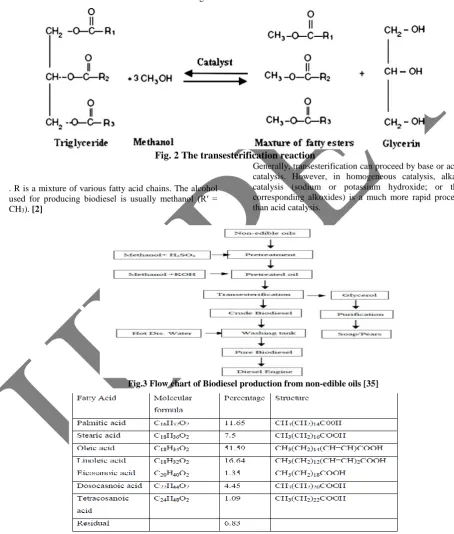
Although blending of oils and other solventsand micro emulsions of vegetable oils lowers the viscosity, engine performance problems such as carbon deposit and lubricating oil contamination still exist. Pyrolysis produces more biogas line than biodiesel fuel. Transesterification is by far the most common method for the production of biodiesel. As the name suggests it is the conversion of one ester into other. When the original
ester is reacted with an alcohol, the transesterification process is called alcoholysis. The transesterification is an equilibrium reaction and the transformation occurs essentially by mixing the reactants. However, the presence of a catalyst (typically a strong acid or base) accelerates considerably the adjustment of the equilibrium. In order to achieve a high yield of the ester, the alcohol has to be used in excess.
Fig. 2 The transesterification reaction
. R is a mixture of various fatty acid chains. The alcohol used for producing biodiesel is usually methanol (R′ = CH3). [2]
Generally, transesterification can proceed by base or acid catalysis. However, in homogeneous catalysis, alkali catalysis (sodium or potassium hydroxide; or the corresponding alkoxides) is a much more rapid process than acid catalysis.
Fig.3Flow chart of Biodiesel production from non-edible oils [35]
Page | 3
Properties of biodiesel1. Karanja Biodiesel blends with Ethanol 15% and 20% D ie se l B 1 0 E 1 5 B 2 0 E 1 5 B 3 0 E 1 5 B 4 0 E 1 5 B 5 0 E 1 5 B 6 0 E 1 5 820 840 860 Density Calorific Value Fuel Density (kg/m 3 ) 39000 40000 41000 42000 43000
Calorific Value (kJ/kg)
Fig.4 Variation of density and calorific value with increasing concentration of biodiesel (ethanol 15%)
D ie se l B 1 0 E 2 0 B 2 0 E 2 0 B 3 0 E 2 0 B 4 0 E 2 0 B 5 0 E 2 0 B 6 0 E 2 0 820 840 860 Density Calorific Value Fuel Density (kg/m 3 ) 37000 38000 39000 40000 41000 42000 43000
Calorific Value (kJ/kg)
Fig.5 Variation of density and calorific value with increasing concentration of biodiesel (ethanol 20%)
2. Karanja Biodiesel Blends
Fig.6 Variation of density and calorific value with increasing concentration of biodiesel Experimental Methodology
The standard available engines (with fixed compression ratio) can be modified by providing additional variable combustion space. There are different arrangements by which this can be achieved. Tilting cylinder block method is one of the arrangements where the compression ratio can be changed without change is
combustion geometry. With this method the compression ratio can be changed within designed range without stopping the engine.
D ie se l B 1 0 B 2 0 B 3 0 B 4 0 B 5 0 B 6 0 820 840 860 Density Calorific Value Fuel Density (Kg/m 3 ) 40000 40500 41000 41500 42000 42500 43000
Page | 4
Photo:1 Experimental Setup The tilting cylinder block arrangement consists of atilting block with six Allen bolts, a compression ratio adjuster with lock nut and compression ratio indicator. For setting a chosen compression ratio, the Allen bolts are to be slightly loosened. Then, the lock nut on the adjuster is to be loosened and the adjuster is to be rotated
to set a chosen compression ratio by referring to the compression ratio indicator and to be locked using lock nut. Finally all the Allen bolts are to be tightened gently. The compression ratios considered for conducting the experiments are 15, 16, 17, and 18.
Photo 2. Arrangement for change in compression ratio.
Fig.7 Principle of tilting block assembly
Adjuster
CR
indicator
Tilt
Block
Page | 5
Result and Discussion
1. Brake Specific Fuel Consumption (BSFC)
Brake specific fuel consumption (BSFC) is the amount fuel energy consumed per unit of brake power developed
per hour. It is inversely proportional to thermal efficiencies.
0 20 40 60 80 100
0.25 0.30 0.35 0.40 0.45 0.50 0.55 0.60 0.65 0.70
BSFC (kg/ kW hr)
Load (%)
Diesel B10E15 B20E15 B30E15 B40E15 B50E15 B10E20 B20E20 B30E20 B40E20 B50E20 B10 B20 B30 B40 B50
Fig.8 Graph showing BSFC Vs Load at compression ratio 18
Graph shows BSFC increases with increase in load. At lower load BSFC decreases for B10E15, B30E15, B10E20, B10, B20, B30 but form 60% above load it increases expect B10E15 with respect to Diesel. All remaining fuel shows increased BSFC at all load conditions. Maximum BSFC increase of 9% with B40E20 blend. Fig.10 and Fig.11 shows, all blends have high BSFC for all load condition at lower compression ratio. It is because of the increased clearance volume and lower pressure and temperature range.
Lower heating value of the blends is the main reason behind increased BSFC. To compensate lower heating value fuel consumption increases which gives higher BSFC. For higher compression ratio, high pressure and temperature generated inside the cylinder causes ignition
advance and by which it shows some % decrease in BSFC at 60% load condition for some blends. B10E15 blend having less density than diesel it may helpful for spray formation and effective combustion, which result in decrease in BSFC at full load condition in compression ratio 18.
2. Brake Thermal Efficiency (BTE)
Page | 6
0 20 40 60 80 100
0 5 10 15 20 25 30
BTE (%)
Load (%)
Diesel B10E15 B20E15 B30E15 B40E15 B50E15 B10E20 B20E20 B30E20 B40E20 B50E20 B10 B20 B30 B40 B50
Fig.12 Graph showing BTE Vs Load at compression ratio18
0 20 40 60 80 100
0 5 10 15 20 25 30
BTE (%)
Load (%)
Diesel B10E15 B20E15 B30E15 B40E15 B50E15 B10E20 B20E20 B30E20 B40E20 B50E20 B10 B20 B30 B40 B50
Page | 7
0 20 40 60 80 100
0 5 10 15 20 25 30
BTE (%)
Load (%)
Diesel B10E15 B20E15 B30E15 B40E15 B50E15 B10E20 B20E20 B30E20 B40E20 B50E20 B10 B20 B30 B40 B50
Fig.14 Graph showing BTE Vs Load at compression ratio16
0 20 40 60 80 100
0 5 10 15 20 25 30
BTE (%)
Load (%)
Diesel B10E15 B20E15 B30E15 B40E15 B50E15 B10E20 B20E20 B30E20 B40E20 B50E20 B10 B20 B30 B40 B50
Fig.15 Graph showing BTE Vs Load at compression ratio15
Fig.13 shows E-15% blends decreased BTE at lower load and nearly same on full load condition.E-20 blends have increased BTE after 50% load. B40E20 and B20E20
Page | 8
Fig.14 shows all blends have decrease in BTE at all loadconditions as compared with conventional diesel fuel. Maximum decease in BTE obtained at 60% load. Fig.15 shows deceased BTE for all blends at all load conditions. This is because of lower heating value and inferior combustion.
The reason behind increased BTE is may be because of higher lubricity and more complete combustion for E20 biodiesel blends.
3. Indicated Thermal Efficiency (ITE)
0 20 40 60 80 100
45 50 55 60 65 70 75 80 85 90
ITE (%)
Load (%)
Diesel B10E15 B20E15 B30E15 B40E15 B50E15 B10E20 B20E20 B30E20 B40E20 B50E20 B10 B20 B30 B40 B50
Fig.16 Graph showing ITE Vs Load at compression ratio18
0 20 40 60 80 100
45 50 55 60 65 70 75 80 85
ITE (%)
Load (%)
Diesel B10E15 B20E15 B30E15 B40E15 B50E15 B10E20 B20E20 B30E20 B40E20 B50E20 B10 B20 B30 B40 B50
Fig.17 Graph showing ITE Vs Load at compression ratio 17
Page | 9
0 20 40 60 80 100
45 50 55 60 65 70 75 80 85 90
ITE (%)
Load (%)
Diesel B10E15 B20E15 B30E15 B40E15 B50E15 B10E20 B20E20 B30E20 B40E20 B50E20 B10 B20 B30 B40 B50
Fig.18 Graph showing ITE Vs Load at compression ratio 16
0 20 40 60 80 100
45 50 55 60 65 70 75 80
ITE (%)
Load (%)
Diesel B10E15 B20E15 B30E15 B40E15 B50E15 B10E20 B20E20 B30E20 B40E20 B50E20 B10 B20 B30 B40 B50
Fig.19 Graph showing ITE Vs Load at compression ratio 15
From above all graphs of ITE it is clear that ITE decrease for all biodiesel blends. Reason for that is high fuel consumption and lower heating value.
4. Volumetric Efficiency ( ƞvol )
Page | 10
0 20 40 60 80 100
78 79 80 81 82 83 84 85 86
Volumetric Efficiency (%)
Load (%)
Diesel B10E15 B20E15 B30E15 B40E15 B50E15 B10E20 B20E20 B30E20 B40E20 B50E20 B10 B20 B30 B40 B50
Fig.21 Graph showing Volumetric Efficiency Vs Load at compression ratio 18
0 20 40 60 80 100
79 80 81 82 83 84 85 86 87
Volumetric Efficiency (%)
Load (%)
Diesel B10E15 B20E15 B30E15 B40E15 B50E15 B10E20 B20E20 B30E20 B40E20 B50E20 B10 B20 B30 B40 B50
Fig.22 Graph showing Volumetric Efficiency Vs Load at compression ratio 17
Page | 11
0 20 40 60 80 100
78 79 80 81 82 83 84 85 86 87
Volumetric Efficiency (%)
Load (%)
Diesel B10E15 B20E15 B30E15 B40E15 B50E15 B10E20 B20E20 B30E20 B40E20 B50E20 B10 B20 B30 B40 B50
Fig.23 Graph showing Volumetric Efficiency Vs Load at compression ratio 16
0 20 40 60 80 100
79 80 81 82 83 84 85 86
Volumetric Efficiency (%)
Load (%)
Diesel B10E15 B20E15 B30E15 B40E15 B50E15 B10E20 B20E20 B30E20 B40E20 B50E20 B10 B20 B30 B40 B50
Fig.24 Graph showing Volumetric Efficiency Vs Load at compression ratio 15
Page | 12
5. Mechanical Efficiency ( ƞmech )0 20 40 60 80 100
0 10 20 30 40 50 60
Me
cha
nic
al Eff
ic
ie
nc
y (
%
)
Load (%)
Diesel B10E15 B20E15 B30E15 B40E15 B50E15 B10E20 B20E20 B30E20 B40E20 B50E20 B10 B20 B30 B40 B50
Fig.25 Graph showing Mechanical Efficiency Vs Load at compression ratio18
0 20 40 60 80 100
0 10 20 30 40 50 60
Me
cha
nic
al Eff
ic
ie
nc
y (
%
)
Load (%)
Diesel B10E15 B20E15 B30E15 B40E15 B50E15 B10E20 B20E20 B30E20 B40E20 B50E20 B10 B20 B30 B40 B50
Page | 13
0 20 40 60 80 100
0 10 20 30 40 50 60
Me
cha
nic
al Eff
ic
ie
nc
y (
%
)
Load (%)
Diesel B10E15 B20E15 B30E15 B40E15 B50E15 B10E20 B20E20 B30E20 B40E20 B50E20 B10 B20 B30 B40 B50
Fig.27 Graph showing Mechanical Efficiency Vs Load at compression ratio16
0 20 40 60 80 100
0 10 20 30 40 50 60
Me
cha
nic
al Eff
ic
ie
nc
y (
%
)
Load (%)
Diesel B10E15 B20E15 B30E15 B40E15 B50E15 B10E20 B20E20 B30E20 B40E20 B50E20 B10 B20 B30 B40 B50
Fig.28 Graph showing Mechanical Efficiency Vs Load at compression ratio 15
All graphs of mechanical efficiency shows increase for all blends of biodiesel. This may be because of the additional lubricity which helps to reduce frictional power. Also addition of cetane improver decreases ignition delay period and improve combustion characteristics.
Page | 14
0 20 40 60 80 100
150 200 250 300 350 400 450
Exhaust Gas Temperature (
o
C)
Load (%)
Diesel B10E15 B20E15 B30E15 B40E15 B50E15 B10E20 B20E20 B30E20 B40E20 B50E20 B10 B20 B30 B40 B50
Fig.29 Graph showing EGT Vs Load at compression ratio 18
0 20 40 60 80 100
150 200 250 300 350 400 450
Exhaust Gas Temperature (
o
C)
Load (%)
Diesel B10E15 B20E15 B30E15 B40E15 B50E15 B10E20 B20E20 B30E20 B40E20 B50E20 B10 B20 B30 B40 B50
Page | 15
0 20 40 60 80 100
150 200 250 300 350 400 450
Exhaust Gas Temperature (
o
C)
Load (%)
Diesel B10E15 B20E15 B30E15 B40E15 B50E15 B10E20 B20E20 B30E20 B40E20 B50E20 B10 B20 B30 B40 B50
Fig.31 Graph showing EGT Vs Load at compression ratio 16
Fig.29 shows all blends of E15 and E20 biodiesel shows decrease in EGT. B30E15 blend show maximum decreased EGT compared with diesel.
Fig.30 and 31 shows almost all blends of biodiesel show nearly same EGT as compared with diesel fuel. B50E20 blend have higher EGT at compression ratio 17.
Difference in exhaust gas temperature of conventional diesel and biodiesel is about 20-30°C
Page | 16
0 20 40 60 80 100
150 200 250 300 350 400 450
Exhaust Gas Temperature (
o
C)
Load (%)
Diesel B10E15 B20E15 B30E15 B40E15 B50E15 B10E20 B20E20 B30E20 B40E20 B50E20 B10 B20 B30 B40 B50
Fig.32 Graph showing EGT Vs Load at compression ratio 15
Conclusion
I. Properties of Biodiesel Blends-Increasing concentration of biodiesel in base diesel, increases density and on the other hand decreases heating value. II. Brake specific fuel consumption- Increased fuel
density causes higher brake specific fuel consumption. Higher fuel density gives poor spray formation and combustion characteristics.
III. Brake thermal efficiency- Additional lubricity given by the biodiesel blends decreases frictional losses, increases brake thermal efficiency up to 25%. On the other hand lower heating value and inferior combustion combinedly gives lower brake thermal efficiency for higher concentration.
IV. Indicated thermal efficiency- Lower heating value form less heat inside the combustion chamber gives less indicated power.
V. Mechanical efficiency- Addition of cetane improver sometimes called as ignition enhancer reduces ignition delay period and improve combustion quality. Also
additional lubricity gives better output with minimum frictional loss as compared with conventional diesel. VI. Exhaust gas temperature-Cetane improver which
gives better combustion characteristics reduces ignition delay and maximum amount of fuel burnt nearer to TDC and no fuel remain for the after combustion stage or exhaust pipe combustion. Lower heating value give lower heat generation which causes lower exhaust gas emissions
VII. For CR 15- B10E15, B20E15 gives better performance with respect to BTE, ƞMech.
VIII. For CR 16- B20E20 and B10E15 gives better performance with respect to BTE, ƞMech.
IX. For CR 17- B10E15, B30E15, B10E20 gives better performance with respect to BTE, ƞMech.
Acknowledgment-
Special thanks to Mrs. Supriya N Bobade. Indian Biodiesel Corporation Baramati for availability of biodiesel.
Referances
[1] BP.BP statistical review of world energy; 2014 [2] Lin Lin, Zhou Cunshan, Saritporn Vittaypadung, Shen
Xiangqian, Dong Mingdong. Opportunities and
challenges for biodiesel fuel.Applied Energy 2011; 88: 1020-1031.
[3] Risk Governance Guidelines for Bioenergy Policies,2009
[4] Subodh K. Sharma, Asim Choudhury, Pinaki Sarkar, Subhashis Biswas,Anil Singh, Pradeep K. Dadhich, Ajay K. Singh, Suman Majumdar,Arti Bhatia, Madhu Mohini,
Rajesh Kumar,C. S. Jha,M. S. R. Murthy,N. H.
Ravindranath, Jayant K. Bhattacharya, M.
Karthik,Sumana Bhattacharya and Rita
Chauhan;Greenhouse gas inventory estimates for
India,CLIMATE CHANGE; PROJECTIONS AND
IMPACT FOR INDIA,CURRENT SCIENCE, VOL. 101, NO. 3, 10 AUGUST 2011,405-415
[5] INCCA Indian Network for Climate Change
Assessment, India: Greenhouse Gas Emissions
Page | 17
[6] Heywood J B 1988 Pollutant formation and control.Internal combustion engine fundamentals Int.edn (New York: Mc-Graw Hill) pp 572–577
[7] S. Adinarayana, YMC Sekhar , BVA Rao & M. Anil Prakash.Biodiesel as an Alternate Fuel in a Diesel Engine with the Cooled Exhaust Gas Recirculation–A Measure to Reduce Harmful Emissions. International Journal of Applied Research In Mechanical Engineering (IJARME), ISSN: 2231 –5950, Volume-1, Issue-2, 2011 [8] Huseyin Aydin a, Cumali llkilic. "Effect of ethanol blending with biodiesel on engine performance and exhaust". Applied Thermal Engineering 30 (2010) 1199– 1204
emissions in a CI engine
[9] Magin Lapureta, Octavio Armas, Jose Rodriguez-Fernandez, "Effect of biodiesel fuel on diesel engine emissions", Progress in energy and combustion section 34(2008): 198-223.
[10] Mustafa Canakci, Ahmet Erdil, Erol Arcaklioglu, "Performance and exhaust emissions of a biodiesel engine.", Applied Energy 83(2006): 594-605.
[11] Anand K, Sharma R P, Mehta P S, "Experimental investigation on combustion, performance and emission characteristics of neat karanji biodiesel and its methanol blend in diesel engine.", Biomass and bio energy (2011); 35(1):533-541.
[12] Prakash N, Arul Jose A, Devnesan MG, Viruthagiri T, "Optimization of karanja oil transesterification.",
Indian Journal of chemical Technology
(2006);13(5):505-509.
[13] N. Stalin and H. J. Prabhu. “PERFORMANCE
TEST OF IC ENGINE USING KARANJA BIODIESEL BLENDING WITH DIESEL.” ARPN Journal of Engineering and Applied Sciences.VOL. 2, No. 5, OCTOBER 2007
[14] A K agerwal, K. Rajamanoharan, "Experimental investigation of performance and emission of Karanja oil and its blends in a single cylinder agricultural diesel engine", Applied Energy 86(2009):106-112.
[15] Ramchandra S. Jahagidar, Eknath R. Deore, Milind S. Patil, Purushottam S. Desale. “Performance Characterization of Single Cylinder DI Diesel Engine Fueled with Karanja Biodiesel”.Proceedings of the World Congress on Engineering 2011 Vol III,WCE 2011, July 6 - 8, 2011, London, U.K.
[16] N Panigrahi, M.K.Mohanty, A.K.Pradhan,
"Nonedible karanja bio-diesel- A sustainable fuel for CI engine.” International Journal of Engineering Research and Applications (2012):853-860
[17] Lohith.N, Dr. R.Suresh, Yathish.K.V. “Experimental Investigation of Compressed Ignition Engine Using Karanja Oil Methyl Ester (KOME) as Alternative Fuel." International Journal of Engineering Research and Applications (IJERA) ISSN: 2248-9622. Vol. 2, Issue4, July-August 2012, pp.1172-1180
[18] H. M. Dkariharmadhi, Puli Ravi Kumar, S. Srinivasa Rao. "Performane and emission of CI engine using blends of biodiesel and diesel at different injection pressures." International Journal of Applied Research in Mechanical Engineering (IJARME) ISSN: 2231 –5950, Vol-2, Iss-2, 2012
[19] Gautam Solasa, Nariganani SD. Satdeep, T Raghu Krishna Prasad, G. Suresh Babu., "Diesel Engine
performance improved by using cetane improver.", International Journal of Engineering and Advanced Technology (2013) Vol-2; Issue-4
[20] Ganesh Singh Chauhan, Abhishek Chakraborty, Dr. Rashmi Shah. "Experimentation on Chemical Feasibility of Karanja Seed Oil to Use as In Diesel Engines Using 4-Stroke Single Cylinder DI Diesel Engine Test Rig." International Journal of Engineering Research and Applications (IJERA) ISSN: 2248-9622 Vol. 3, Issue 4, Jul-Aug 2013, pp.2308-2313
[21] P. L. Naik, D. C. Katpatal."Performance Analysis of CI Engine using Pongamia Pinnata (Karanja) Biodiesel as an Alternative Fuel." International Journal of Science and Research (IJSR), ISSN: 2319-7064, Volume 2 Issue 8, August 2013,pp 445-450.
[22] Dr. V Naga Prasad Naidu, Prof. V.Pandu Rangadu. "Experimental investigations on a four stoke diesel engine operated by karanja bio diesel blended with
diesel."International Journal of Application or
Innovation in Engineering & Management (IJAIEM) ISSN 2319 - 4847, Volume 3, Issue 7, July 2014,pp 221-225
[23] Ajay V. Kolhe, R.E.Shelke and S.S.Khandare. "Performance, emission and combustion characterisics of a variable compression ratio diesel engine fueled with karanja biodiesel and its blends."International Journal of Applied Engineering and Technology ISSN: 2277-212X,2014 Vol. 4 (2) April-June, pp.154-163
[24] Aman Hira, Shailendra Singh, Dr.Ashok Choube, "Performance and emission characteristics of CI engine using blends of ethanol and biodiesel with diesel", International Journal of Engineering Research And Technology (2010) Vol-1, Issue 5:2278-2284.
[25] P. Satge de Caro, Z. Mouloungui, G. Vaitilingomb, J.Ch. Berge. "Interest of combining an additive with diesel–ethanol blends for use in diesel engines." Fuel 80 (2001) 565–574
[26] Wu Yu,Gen CHEN, Zuohua HUANG."Influence of cetane number improver on performance and emission of common-rail diesel engine fueled with biodiesel-methanol blend."Fuel Energy:2011,5(4):412-418 [27] Bang-Quan He, Shi-Jin Shuai, Jian-Xin Wang, Hong He. "The effect of ethanol blended diesel fuels on
emissions from a diesel engine." Atmospheric
Environment 37 (2003) 4965–4971
[28] R. Subramanian, G. Rajendiran, R. Venkatachalam,
N. Nedunchezhian, K. Mayilsamy. "Studies on
performance and emission charactristics of multycylinder diesel engine using hybrid fuel blends as fuel."Journal of scientific and industrial research, Vol.70 July 2011, pp 539-543.
[29] Selvaraj K, Shanmugam A. "STUDY OF PERFORMANCE AND EMISSION CHARACTERISTICS OF DI DIESEL ENGINE FUELED WITH BLENDS OF
ETHANOL AND DUAL BIODIESEL(JATROPHA,
PONGAMIA PINNATA) WITH DIESEL. Journal of Chemical and Pharmaceutical Sciences ISSN: 0974-2115,Special Issue 6: March 2015, pp 74-78.
Page | 18
[31] P.R. Ayyappan, P.Karthikeyan. "An ExperimentalInvestigation on the Effect of Cetane Improver with Biodiesel in CI Engine."International Journal of Innovative Research in Science, Engineering and Technology, Volume 3, Special Issue 3, March 2014, pp1123-1126
[32] A. Gurusamy, V.Gnanamoorthi, P.Purushothaman, L.Vijayabaskar. "IMPACT OF IGNITION ENHANCER
ON PERFORMANCE AND EMISSION
CHARACTERISTICS OF BIODIESEL BUTANOL
BLENDS IN DI-DIESEL ENGINE." Journal of Chemical and Pharmaceutical Sciences, ISSN: 0974-2115, Special Issue 9: April 2015,pp-77-80
[33] Gerhard Knothe, Jon Van Gerpen, Jürgen Krahl “The Biodiesel Handbook” AOCS Press Champaign, Illinois, 2005.
[34] Brajesh Kumar Mishra and Dr. Rajat Kumar. "The Production Of Biodegradable Fuel From Non-edible Oilseed In India: A Review." IOSR Journal of Applied Chemistry (IOSRJAC) ISSN : 2278-5736 Volume 1, Issue 1 (May-June 2012), PP 43-46.