An Isomorphic New Algorithm for Finding
Convex Hull with a Maximum Pitch of the
Dynamical Base Line Guided by Apexes
Distributing Characteristics
Zhou Qihai
Research Institute of Information Technology Application, School of Economic Information Engineering, Southwestern University of Finance and Economics, Chengdu, 610074, China
Email: [email protected]
Huang Tao
Research Institute of Information Technology Application, School of Economic Information Engineering, Southwestern University of Finance and Economics, Chengdu, 610074, China
Email: Huang [email protected]
Wu Hongyu,
Research Institute of Information Technology Application, School of Economic Information Engineering, Southwestern University of Finance and Economics, Chengdu, 610074, China
Email: [email protected]
Abstract—In this paper, a representative algorithm convex
hull with half-dividing and recurrence is commented; and according to the isomorphic fundamental theorem of the convex hull construction, and guided by the isomorphic distributing characteristics of a convex hull’s the apexes, a more efficient new algorithm to find a convex hull based on the dynamical base line with a maximum pitch of the dynamical base line is given. The general characters of the new algorithm are: 1) find out the outside-most poles which are the leftmost, rightmost, topmost and bottommost points of the given 2D point set, i.e. the four initial poles which have the maximum or the minimum coordinate value of the X or Y axis among all the points in the given 2D point set; 2) divide the original distributed domain into four sub-domains with the initial poles; 3) in every sub-domain, construct a current pole with a maximum pitch to its base line based on the last pole got just dynamically and sequentially, and draw the rims of this convex polygon with these poles for intelligent approximating for a convex hull of the given 2D point set step by step.
Index Terms—isomorphic, convex hull algorithm, maximum
pitch, dynamical base line, apexes distributing characteristics
I. INTRODUCTION
A convex hull can be applied in intelligent information technology (e.g. cluster analysis in data mining, as well as security informatics). Many literatures explained the vital significance and many studies of the research, improvement and enhancement about the convex hull
algorithms of 2D point set or a set of segments (hereafter called convex hull for short) and its efficiency [1-8]. This
paper will comment on another representative convex hull algorithm with half-dividing recurrence, then a new more efficient algorithm to find a convex hull based on the dynamical base line with a maximum pitch is given by us according to the isomorphic fundamental theorem of the convex hull construction
II. THE DESCRIPTIONS OF THE PROBLEM OF 2DCONVEX
HULL AND THE CONVEX HULL ALGORITHM
DEFINITION 1: Suppose that Q is the polygon in given plane, Q1(x1,y1), Q2(x2,y2), ..., Qn(xn,yn) are the
spots of Q. If any line segment QiQj(i≠j, 1≤i≤n,
1≤j≤n<+∞)is all not outside Q, then Q is called a convex polygon. Suppose that the 2D point set S={Pi(xi,yi)│
1≤i≤m, 3≤m<+∞} is composed by the spots which are in the given plane. If the apexes of polygon Q belong to S, and Q is the least Convex Polygon which covers all points in S, then Q is called the convex hull of the 2D point set S. How to seek the convex hull in given 2D point set S={Pi(xi,yi)│1≤i≤m, 3≤m<+∞} is called 2D
Convex Hull problem. An algorithm which could produce 2D convex hull of the given 2D point set is called 2D Convex Hull algorithm.
III. THE COMMENTARY OF 2DCONVEX HULL
Since the 20th century 70's, the 2D Convex Hull problem’s complexity and its application importance had caused the domestic and foreign experts quite to pay attention to the convex hull algorithms, and proposed such as the Gift Wrapping convex hull algorithm, the Graham scan convex hull algorithm, the half-dividing convex hull algorithm, and so on[5]. Here, this paper only
comments on a representative algorithm convex hull with half-dividing.
The Synopsis of the half-dividing Convex Hull Algorithm The literature [1], explained the half-dividing convex
hull algorithm which is based on half-dividing technical and the recurrence method, the algorithm’s efficiency is higher than the Gift Wrapping convex hull algorithm and the Graham Scan convex hull algorithm, its total running time is t(m)=O(m log m).
The method of half-dividing convex hull algorithm could be summarized as follows:
Step 0: The point Pi(xi,yi) in 2D point set S satisfies xi ≤xi+1 and 1≤i≤m-1, 3≤m<+∞, makes the leftmost point
Pleft and the rightmost point Pright of the initial 2D point
set as the end points of the line of demarcation, which divides S into two sub-domains Sup and Slow. (For example in Figure 1: when m=11, the points with minimum or maximum x-coordinate are the leftmost point Pleft, rightmost point Pright, and it also divides the
point set S into the upper sub-domain Sup={P2,P4,P6,P8,
P9} and the lower sub-domain Slow={P3,P5,P7,P10}.)
Step 1: Execute the sub-algorithm UH(Sup), in order to
produce the upper convex hull.
① If m≤3, then all of the points in point set Sup are the
convex hull’s apexes, and return these points; otherwise, carry out ② of Step 1.
② According to the principle of dividing these points
almost equally, it divides the point set Sup into two
sub-domains Sup1 and Sup2.
③ Taking Sup1 as the new Sup, executes the upper
convex hull sub-algorithm UH(Sup) recursively, and
produces Sup1’s convex hullup1.
④ Taking Sup2 as the new Sup, executes the upper
convex hull sub-algorithm UH(Sup) recursively, and
produces Sup2’s convex hullup2.
⑤ Draw the common tangent of convex hullup1 and
convex hullup2 (For example the imaginary line Q8Q7
shown in Figure 2), in order to merge convex hullup1 and
convex hullup2 into convex hull Qup.
Step 2: Transfer recursion sub-algorithm UH(Slow), in
order to produce the lower Convex Hull.
① If m≤3, then the points in the point set Slow are the
convex hull’s apexes, and return to the points; Otherwise, carryout ② of Step 2.
② According to the principle of dividing these points
almost equally, it divides the point set Slow into two
sub-domains Slow1 and Slow2.
③ Take Slow1 as the new Slow, transfer the lower
convex hull recursion sub-algorithm UH(Slow) recursively,
and produce the Slow1’s convex hulllow1.
④ Take Slow2 as new Slow, transfer the lower Convex
Hull recursion sub-algorithm UH(Slow) recursively, and
produce the Slow2’s convex hulllow2.
⑤ Structure the common tangent of convex hulllow1
and convex hulllow2 (For example, the imaginary line
Q2Q3 shown in Figure 2), in order to merge convex
hulllow1 and convex hulllow2 into convex hull Qlow.
Step 3: Merge the upper convex hull Qup and the lower
convex hull Qlow into final convex hull Q (For example
the convex polygon Q1Q2Q3Q4Q5Q6Q7Q8 shown in
Figure 2).
O
Figure 1. Divide 2D point set S into upper and lower sub-domains Sup, Slow
P (the leftmost
point: Pleft)P1
S
上
P8
P5
P2
P4
P6
P3
P9
P10
P11(the rightmost point: Pright
X Y
Upper common tangent line Q7Q8
Q8
X O
Q5
Lower common tangent line Q2Q3
Q2
Q7 Y
Q1
Q4
Q3
Q6
Qlow1
Qup2
Qlow2
Figure 2. The Upper and Lower common tangent Qup1Qup2 , Qlow1Qlow2 of convex hull Q
Q
Qup1
(P2 0)
Q2 0
Figure 3. The Initial apexes, sub-domains of convex hull, and dynamical base line with a maximum pitch
Q1,0(P1,0) (P4,0
X (P3,0)Q3,0
Q1,2
S
2S
3S
1S
4Q4,0
Px j
Q0
The Weakness of the half-dividing Convex Hull Algorithm It is not difficult to see that the main shortcomings of half-dividing convex hull algorithm are:
1st, because of the recursion, the algorithm’s efficiency is not high. 2nd, only speaking of the upper convex hull production processing, in the trapezoid which take the
common tangent QiQi+1 as a waist, take the line of
demarcation as another waist, and select the line of the direction of X coordinate of the points Qi and Qi+1 as the
upper and lower underside (in fact, it may expand to: produce the quadrangle PleftPrightQi+1Qi which takes the
upper common tangent QiQi+1 as one side, the line of
demarcation PleftPright as its opposite side, while Qi+1Pleft as
another side, and QiPright as its opposite side), the more
points Sup1, Sup2 have, the more invalid sides of
sub-convex hull the algorithm have; So it may reduce the algorithm efficiency. (As shown in Figure 2: Many invalid sides and redundancy processing in non-convex hull Q.)
IV. ISOMORPHIC CHARACTERISTICS ANALYSIS OF CONVEX HULL’S APEXES DISTRIBUTING
In order to improve and raise further the algorithm efficiency, it is necessary to research on the important natures which is about that an algorithm of convex hull has closed relation to the distributing characteristics of the distributed domain of 2D point set.
DEFINITION 2: The domain where all point in a given 2D point set S={Pi(xi,yi)│1≤i≤m, 3≤m<+∞} distribute is
called the distributed domain of 2D point set S.
DEFINITION 3: In a given 2D point set S={Pi(xi,yi)│
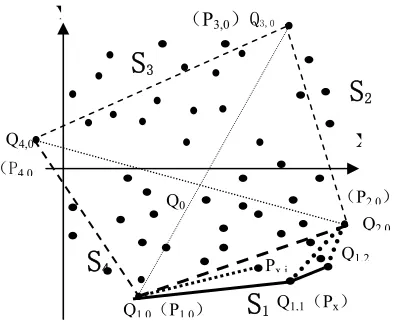
1≤i≤m, 3≤m<+∞}, the points which have the maximum (or minimum) x-coordinate, or maximum (or minimum) y-coordinate where if there are more than one points have the same maximum (or minimum) x-coordinate then only the points which have maximum (or minimum) y-coordinate, are called the outside-most points. Among these outside-most points (in general speaking as shown in Fig. 3, there are four outside-most points which could be recorded as the point P1,0, P2,0, P3,0 and P4,0 in 2D point
set S), the bottommost one, the rightmost one, the topmost one and the leftmost one are just the bottommost apex, the rightmost apex, the topmost apex and the leftmost apex, of a convex hull Q of 2D point set S separately, so they could be still recorded as the apex Q1,0,
Q2,0, Q3,0 and Q4,0 separately. The line segment Q1,0Q3,0
and Q2,0Q4,0 are called the diameters of a convex hull Q
of S; the point of intersection Q0 of the diameters of a
convex hull Q is called the center of a convex hull Q. The 4 parts of distributed domain of 2D point set S is divided by the diameter line Q1,0Q3,0 and Q2,0Q4,0 are called
distributed sub-domains recorded as sub-domain S1 (to which apex Q1,0 and Q2,0 belong), S2 (to which apex Q2,0
and Q3,0 belong), S3 (to which apex Q3,0 and Q4,0
belong)and S4 (to which apex Q4,0 and Q1,0 belong). The
line segment Q1,0Q2,0, Q2,0Q3,0, Q3,0Q4,0 and Q4,0Q1,0 are
called the initial base lines which belong to a convex hull Q.
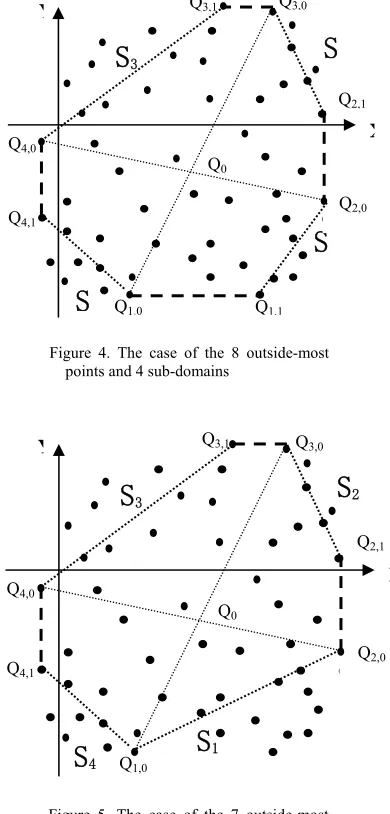
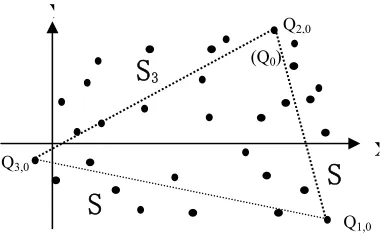
It is important that we must pay attention to the cases of the outside-most points should be divided into many kinds. For example: the general case with 4 outside-most points is shown as Figure 3; the more general cases with
4~8 outside-most points are shown as Figure 4~8;
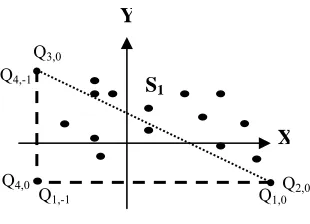
while the degenerated cases with 3 outside-most points or
less than 4 sub-domains are shown as Figure 9~18. So
the upper limit case is that there are 8 outside-most points (which may be recorded as the apex Q1,0, Q1,1, Q2,0, Q2,1,
Q3,0, Q3,1, Q4,0, Q4,1) and 4 sub-domains (which may be
recorded as the apex S1, S2, S3, S4) separately as shown as
Figure 5. But the number of the distributed sub-domains
may be degenerated to 0~3 which are named by S0~S3
(where S0 means the empty sub-domain) as shown in
Figure 9~18. Therefore, the definition 6 should be
discussed and expanded further, which is not given in this paper as space limited. Obviously, some of other typical
degenerated cases can be shown as Figure 19~21.
V. THE CONVEX HULL NEW ALGORITHM WITH A
MAXIMUM PITCH OF THE DYNAMICAL BASE LINE Q3,0
Y
S
Q1,1X
Figure 4. The case of the 8 outside-most points and 4 sub-domains
Q1,0
S
S
3S
Q4,0
Q0
Q2,0
Q2,1
Q4,1
Q3,1
S
4X
Q1,0
Q3,1
S
2S
3S
1Q4,0
Q0 Y
Q2,0
Q2,1
Q4,1
Figure 5. The case of the 7 outside-most points and 4 sub-domains
The convex hull problem was proposed in 20th century, and its algorithm research began in the 70’s, spreads in the 80’s, extremely in the 90’s. However since the 21st century, the traditional convex hull algorithm research appeared the awkward predicament which bogs down. In order to change the case, guided by Isomorphic Fundamental Theorem of a Convex Hull Construction and based on Isomorphic Apexes Distributing
Characteristics, some new algorithms were given out by me and my researching team continuingly since 2005 [9-10].
In this paper, a new convex hull algorithm is given.
A theoretical Basis of the Convex Hull New Algorithm with a Maximum Pitch of the Dynamical Base Line
The Isomorphic Fundamental Theorem of a Convex Hull Construction, proposed by Professor Zhou Qihai, is the theoretical basis of the new convex hull algorithm. The Isomorphic Fundamental Theorem of a Convex Hull Construction: The 2D point set is S={Pi(xi,yi)│1≤i≤m,
3≤m<+∞}, the apex set of convex polygon Q is
Figure 6. The case of the 6 outside-most points and 4 sub-domains
Q1,0
S
4X
Q3,1
S
2S
3S
1Q4,0
Q0 Y
Q2,0
Q4,1
Q3,0
Figure 7. The case of the 5 outside-most points and 4 sub-domains
S
4X
Q1 0
S
2S
3S
1Q4,0
Q0 Y
Q2,0
Q4,1
Q3 0
X
S
S
S
Q4,0
Q
Y
Q2,0
Q1,0
Figure 8. The case of the 4 outside-most points and 3 sub-domains
Q3 0
X
S
S
3S
Q3,0
(Q0) Y
Q1,0
Figure 9. The case of the 3 outside-most points and 3 sub-domains
Q2,0
Figure 10. The case of the 4 outside-most points and 2 sub-domains
X
S
1S
2Q3,0 Y
Q1,0
Q2,1
Q0
Q2,0
Figure 11. The case of the 3 outside-most points and 2 sub-domains
X
S
1S
2Q3,0
(Q0) Y
Q1,0
R={Qi(xi,yi) | 1≤i≤n≤m<+∞, 3≤n, 3≤m}. If convex
polygon Q is the convex hull in 2D point set S, then: i. (Apex to interior point) Interior Point of Convex Hull Irrelevant Theorem: All apexes Qi(xi,yi) of convex
hull Q must not be in the difference set of S and R, namely Qi(xi,yi)
∉
S-R, 1≤i≤n≤m<+∞, where 3≤n,3≤m.ii. (Apex to apex) Apex of Convex Hull Independent Theorem: Any apex Qk(xk,yk) of convex hull Q must not
be in the set R-{Qk}, namely Qk(xk,yk)
∉
R-{Qk}, where1≤k≤n≤m<+∞, 3≤n.
They could be proved as follows:
Figure 12. The case of the 3 outside-most points and 1 sub-domain
X
S
1Q4,0
(Q0) Y
Q1,0
Q2,1
Q0
Q2,0
Figure 13. The case of the 3 outside-most points and 1 sub-domain
X
S
1Q2,0
(Q0) Y
Q1,0 Q1,1
Q2,0
Q3,0 Y
Q1,1
X
Figure 14. The case of the 8 outside-most points and 1 sub-domain
Q1,0
S
1Q4,0
Q0
Q2,1
Q4,1
Q3,1
Q2,0
Q3,0 Y
Q1,1
X
Figure 15. The case of the 8 outside-most points and 0 sub-domain
Q1,0
Q4,0
Q
Q2,1
Q4,1
Q3,1
Figure 16. The case of the 8 outside-most points and 0 sub-domain (all interior points are inside of the convex hull of the outside-most points)
Q2,0
Q3,0 Y
Q1,1
X
Q1,0
Q4,0
Q0
Q2,1
Q4,1
Q3,1
Figure 17. The case of the 8 outside-most points and 0 sub-domain (all interior points are at the sides of the convex hull of the outside-most Q2,0
Q3,0 Y
Q1,1
X
Q1,0
Q4,0
Q0
Q2,1
Q4,1
i. Suppose any apex of convex hull Q satisfied Qk(xk,yk)∈S-R, 1≤k≤n; Then the apex Qk(xk,yk)
∉
R (itindicates that the apex Qk(xk,yk) should be the interior
point of the convex hull Q). But R is the set of apexes,
therefore we may know the apex Qk(xk,yk)∈R.
Obviously, both are contradictory. Therefore the first proposition is right. (It shows that any interior point of the convex hull Q must not be the apex of the convex hull.)
ii. Suppose the point Qk is one of the apexes of the
convex hull Q, then it has two most neighboring apexes at two sides of the point Qk at least, there are Qk-1 and Qk+1
(Qk∈R; if k-1=0, then set the value of k-1 be n; if
k+1=n+1, then set the value of k+1 be 1). Obviously, the
three points compose a triangle Qk-1QkQk+1, but the
position of the apex Qk is invariable, and it only relates to
its coordinate position, while has nothing with the coordinate position of the points Qk and Qk+1. Analogizes
by this, we may know that the position of the apex only relate to its coordinate position, not the coordinate position of the neighboring points Qi and Qj (i≠k, j≠k,
i≠j, Qk∈R, Qi∈R, Qj∈R). So any apex of the convex
hull is independent in other apexes.
Therefore, the above fundamental theorem is right. Based on the Isomorphic Fundamental Theorem of a Convex Hull Construction, the authors believed that the isomorphic improvement and optimization trend of the convex hull algorithm, which will be the main short cut to enhance the efficiency of the Convex Hull algorithm in the future without doubt, must be:
1) According to the Interior Point Irrelevant Theorem, on the one hand we should make the distributed domain of pole (actually apex) minimizing, namely makes the distributed domain of apex as small as possible to reduce the invalid process load when judging the poles; on the other hand determine object directly, namely let the object approach the poles as far as possible to largely enhances the direct focalization of the Convex Hull’s poles object.
2) According to the Convex Hull Apex Independent Theorem, on the one hand we could embark from the different initial object in order to improve, optimize and innovate new parallel Convex Hull algorithms; On the other hand, to different view of the processing, transform and create new parallel Convex Hull algorithm. Therefore, in the process of producing Convex Hull, we could reduce the distributed domain of poles as far as possible. The Convex Hull algorithm only finds out every pole (namely each end point of every side of Convex Hull) quickly and directly in as small as possible distributed domain.
Basic Definition and Structure of the New Algorithm The following will summarize a new algorithm to find a convex hull based on dynamical base line with a maximum pitch which is according to the Isomorphic Fundamental Theorem of Convex Hull Construction.
DEFINITION 2: The distributed domain of every point in 2D point set S={Pi(xi,yi)│1≤i≤m, 3≤m<+∞} is called
the S distributed domain. In set S, the outside-most points which have the maximum or minimum x-coordinate, y-coordinate are recorded:
Figure 19. The case of the 3 outside-most points and 1 sub-domain
X S1
Q4,-1
Y
Q4,0 Q Q2,0
1,0
Q3,0
Q1,-1
Y
X
Figure 20. The case of the 3 outside-most points and 0 sub-domain
Q3,0
Q1,0
Q2,0
Figure 21. The case of the 3 outside-most points and 1 sub-domain
X
Q4,-1
Y
Q4,0 Q Q2,0
1,0
Q3,0
Q1,-1
Figure 18. The case of the 8 outside-most points and 0 sub-domain (all the given points are just all the apexes of the convex hull)
Q4,1
Q4,0
Q1,0
Q2,0
Q3,0
Q2,1 Y
X
Q Q3,1
P(1)(x1=min{xi │ 1≤i≤m, 3≤m<+∞},y1) , P(2)(x2,
y2=min{yi │ 1≤i≤m, 3≤m<+∞}) , P(3)(x3=max{xi │
1≤i≤m, 3≤m<+∞},y3),P(4)(x4, y4=max{yi│1≤i≤m,
3≤m<+ ∞}); The outside-most points P(1), P(2), P(3)and P(4)
are called initial poles of convex hull Q and recorded as Q1,0, Q2,0, Q3,0 and Q4,0. The line segment Q1,0 Q3,0 and
Q2,0Q4,0 are called the line of demarcation of the convex
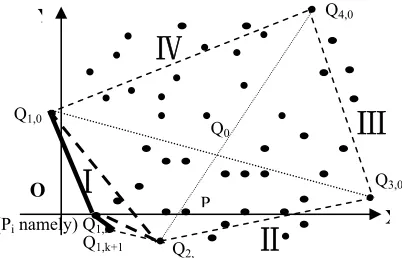
hull. The intersection of the two line segments is called the centrifugal point of convex hull. The two lines of demarcation divide the original distributed domain into four sub-domains which are sub-domain I, II, III& IV called as sub-domains of 2D point set (shown as in Figure 22).
According to the above, this paper proposes a more efficient new algorithm to find a convex hull based on dynamical base line with a maximum pitch that is guided by the Isomorphic Fundamental Theorem of the Convex Hull Construction. The algorithm’s thought may be structured as follows:
Step 0: Initialization Processing.
①"Structure the line of demarcation and sub-domain of the distributed domain" processing: Produce the convex hull Q’s line of demarcation Q1,0Q3,0 & Q2,0Q4,0,
and divide the initial 2D point set S into four sub-domains I, II, III and IV, make the points Pi(xi,yi) satisfy
xi≤xi+1 in every sub-domain.
②"Minimize the distributed domain and its
sub-domain" processing: Delete the centrifugals which are in the quadrilateral Q1,0Q2,0Q3,0Q4,0 (Attention: It may
degenerates to triangle Q1,0Q2,0Q3,0), and the new domain
is still expressed as S.
Step 1: Mark the sub-domain I as S1. Take the point
Q1,0 as the initial pole (i. e. initial apex), take the line
Q1,0Q2,0 as the initial base line. Seek for the poles (i. e.
apex) in the sub-domain S1 of convex hull Q (The pole is the apex. Obviously, the line segment which is composed by tow closest neighboring poles would form a side of the convex hull Q). That is:
①"Seek for the next new pole" processing: When there still have unresolved point P1,j∈S1, find out the point P1,j
of which the pitch from the base line Q1,kP1,j to Q2,0Q1,k is
maximum (Namely satisfies ∠Q2,0Q1,kPi=max{∠Q2,0
Q1,kP1,j|P1,j∈S1}), (Note: If the points of the maximum
pitch sre not only, then only leave the one among which is farthest from the pole Q1,k). Keep the point Pi as new
poles Q1,k+1 in order, where 0≤k.
②"Minimize Sub-domain S1" processing: In S1, delete
all interior points of triangle Q2,0Q1,kQ1,k+1, and the new
sub-domain S1 is still expressed as S1. Take the line
Q2,0Q1,k+1 as the new base line recorded as Q2,0Q1,k still.
Return to ① of Step 1.
Step 2: Mark the sub-domain II as S1. Take the point
Q2,0 as its initial pole, take the line Q2,0Q as its initial base
line. Seek for the poles in the sub-domain S1. Namely: ①When S1 has the unresolved point, find out the point
Pi of which the pitch from the base line Q2,kQ3,0 to
Q3,0Q2,k is maximum (Namely satisfies ∠Q3,0Q2,kPi
=max{∠Q3,0Q2,kP2,j|P2,j∈S1}), keep the point Pi as new
poles Q2,k+1 sequentially, where 0≤k .
②In S1, delete all interior points of triangle Q3,0Q 2,kQ2,k+1, and the new sub-domain S1 is still expressed as
S1. Take the line Q3,0Q2,k+1 as the new base line recorded
as Q3,0Q2,k still. Return to ① of Step 2.
Step 3: Mark the sub-domain III as S1. Take the point
Q3,0 as the initial pole, take the line Q3,0Q4,0 as the initial
base line. Seek for the poles in the sub-domain S1.
Namely:
①When S1 has the unresolved point, find out the point
Pi of which the pitch from the base line Q3,kQ4,0 to
Q4,0Q3,k is maximum (Namely satisfies ∠Q4,0Q3,kPi
=max{∠Q4,0Q3,kP3,j|P3,j∈S1}), keep the point Pi as new
poles Q3,k+1 in order,where 0≤k.
② In S1, delete all interior points of triangle
Q4,0Q3,kQ3,k+1, and the new sub-domain S1 is still
expressed as S1. Take the line Q4,0Q3,k+1 as the new base
line recorded as Q4,0Q3,k still. Return to ① of Step 3.
Step 4: Mark the sub-domain IV as S1. Take the point
Q4,0 as the initial pole, take the line Q4,0Q1,0 as the initial
base line. Seek for the poles in the sub-domain S1.
Namely:
①When S1 has the unresolved point, find out the point
Pi of which the pitch from the base line Q4,kQ1,0 to
Q1,0Q4,k is maximum (Namely satisfies ∠Q1,0Q4,kPi
=max{∠Q1,0Q4,kP4,j|P4,j∈S1}), keep the point Pi as new
poles Q4,k+1 in order, where 0≤k.
② In S1, delete all interior points of triangle
Q1,0Q4,kQ4,k+1, and the new sub-domain S1 is still
expressed as S1. Take the line Q1,0Q4,k+1 as the new base
line recorded as Q1,0Q4,k still. Return to ① of Step 4.
Finally, the convex polygon Q which is composed by the line segments which link the apexes orderly in sub-domains I, II, III and IV must be the convex hull Q in 2D limited point set.
The Mathematical Proof of the Key Technology and Core Foundation of the New Algorithm
The key technology and the core foundation of the new algorithm are the following two important propositions:
i. The apex of the convex hull Q has nothing to do with "The minimizing processing of distributed domain and its sub-domain".
Figure 22. The Initial apexes, sub-domains of convex hull
Q1,k+1 O
Q4,0
Ⅱ
(Pi namely) Q1,k
Ⅲ
Ⅳ
Ⅰ
X
Q3,0
Q1,0
P Q0 Y
ii. The point Pi must be an apex of convex hull Q in 2D
point set.
Its mathematic certification as follows:
i. In the minimizing processing of the distributed domain and its sub-domain, we only delete the interior points of the convex hull Q; therefore according to the Interior Point Irrelevant Theorem and the Apex Independent Theorem, we know that the apexes of convex hull Q must be in the distributed domains or its sub-domain after the minimizing processing.
ii. For the purpose of unified narrating, take Q1,0 as Q5,0
in Figure 22, and record the initial base line Q4,0Q1,0 as
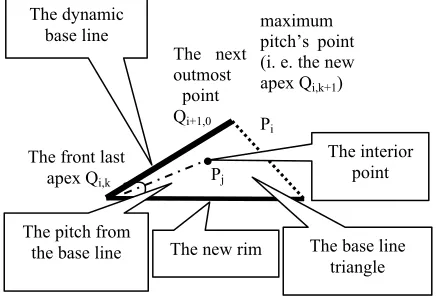
Q4,0Q5,0 at the same time. As shown in Figure 23, set Qi,0
be the initial apex of current sub-domain Si, (Attention:
Qi,0 is certainly the outside most point in 2D limited point
set), the next outside most point is Qi+1,0, the initial base
line as Qi,0Qi+1,0, find out the point Pi of which the pitch
from the base line to Q i+1,0Qi,k is maximum. Because Pi
satisfies Pi=max{∠Qi+1,0Qi,kPi,j|Pi,j∈S1}, and also
satisfies "If the points of the maximum pitch is not only one, then only leave the farthest one". Thus, any point Pj in S1 must satisfies ∠Qi+1,0Qi,kPi≥∠Qi+1,0Qi,kPj, namely
the point Pj must be in △Q i+1,0Qi,kPi, or just in the rim
Qi,kPi at the most. (Attention: To the next case, their
length must be satisfied Qi,kPj<Qi,kPi). Therefore, the
point Pi must be an apex of convex hull Q.
VI. CONCLUSIONS
The algorithm that is proposed in this paper not only in the running time and space complexity but also the efficiency, obviously surpasses the Gift Wrapping convex hull algorithm, the Graham scan convex hull algorithm, the half-dividing convex hull algorithm and so on. Moreover, it is very easy to be transformed into its parallel algorithm. Therefore, it will enhance the speed of constructing 2D convex hull effectively, and could improve and enhance the application level and the working efficiency of the 2D convex hull in the imagery processing, the writing decomposes, the pattern recognition, the object classification, the computation graph, the fingerprint recognition, the telemeter remote control, the thing recognizes, the geological prospecting, the space & sky using, and so on.
REFERENCE
[1] Chen Guoliang. Parallel computation structure algorithm programming. Higher education publishing house, 2002. [2] Zhou Peide. Computation geometry algorithmic analysis
and design. Qinghua University publishing house, 2000. [3] Greg Aloupis. A History of Linear-time Convex Hull
Algorithms for Simple Polygons. Http://En.Wikilib. Com/Wiki/Talk:Convex_hull
[4] Joseph O'Rourke, Computational Geometry in C (2nd Edition), Chap. 3 "Convex Hulls in 2D", 1998
[5] C. Barber, D. Dobkin, And H. Huhdanpaa. The Quickhull algorithm for convex hulls. ACM Trans. On Mathematical Software, 22:469-483, 1997
[6] D.G. Kirkpatrick & R. Seidel, The Ultimate Planar Convex Hull Algorithm. SIAM Jour. Comput. 15, 287-299 ,1986 [7] Franco Preparata & Michael Shamos, Computational
Geometry: An Introduction, Chap. 3 "Convex Hulls: Basic Algorithms",1985
[8] M. Kallay, The Complexity of Incremental Convex Hull Algorithms in Rd. Info. Proc. Letters 19, 197 ,1984 [9] Zhou Qihai,Wu Hongyu. A New Parallel Algorithm for
Finding Convex Hull Based on COW with Clusters, 2-Domains and 2-Directions. In: (2007 International Symposium on Distributed Computing and Applications to Business, Engineering and Science) DCABES 2007 PROCEEDINGS:28-32.China: Hubei Science and Technology Press, August 2007.
[10]Zhou Qihai, Huang Tao, Wu Hongyu, Li Zhongjun, Lin Xun. A New Algorithm for Finding Convex Hull with a Maximum Pitch of the Dynamical Base Line. In: Proceedings of The first International Workshop on Knowledge Discovery and Data Mining WKDD2008:630-634. USA: IEEE Computer Society, January, 2008 Figure 23. The illustrated figure for proving to
the core part of the new algorithm The front last
apex Qi,k
The next outmost
point Qi+1,0
Pj
The dynamic base line
The new rim
maximum pitch’s point (i. e. the new apex Qi,k+1)
Pi
The pitch from the base line
The interior point