
ISSN (Online): 2320-9364, ISSN (Print): 2320-9356
www.ijres.org Volume 4 Issue 4 ǁ April. 2016 ǁ PP.16-24
A Novel Method to Build a Fuzzy Decision Tree Based On Hedge
Algebras
Lan L V T
1, Han N M
1, Hao N C
2 1Information Technology Faculty, Hue University of Science, Hue University, Vietnam 2Department of Testing, Hue University, Vietnam
Abstract: The training set plays an important role in the training process. When the value domains of the attributes are not homogenous, that is, their values may be in number or linguistic, we need a method to treat the inhomogeneous data of the training set. Hedge algebra is a useful tool to make the training set homogeneous by changing the values of mixed domain to a homogeneous data domain that only contains linguistics or number values. In the homogeneous process of the value domains, we have to know the values min and max. However, in reality, we do not know both of the values min and max exactly. In this paper, we present a method to determine the linguistic values when we only know the sub-interval [1, 2] without knowing the super-interval [min, max] exactly.
Keywords: Training data set, Linguistic values, Hedge algebras, Fuzzy decision tree.
I.INTRODUCTION
Let M is a training data set, all elements in M have a common set of structures, including the pair <attribute, value>, one of these attributes represents class and attributes are called predictive attributes or classification attributes. The classification is finding the rules for putting objects into one of the classes based on a training data set. There are many approaches classification problems, such as: Fisher linear discriminant function, Naïve Bayes, Logistic, neural networks, decision trees, ... In which, the decision tree method is popular due to its method of visualization, understanding and its performance [2,18]. To build a decision tree, at each node in the need to determine an appropriate attribute to check, divide the data into subsets. On the training sample M, basically, the classification algorithms must perform two steps:
Step 1: Selected A attribute with values a1, a2,…, an ;
Step 2: With A attribute is selected, we create a node of the tree and then divided the samples corresponding to this node into the corresponding set M1, M2, ..., Mn; Then again performed [17]. This is the
division with the results obtained from step 1, this means that the quality of the resulting tree depends largely on choosing attributes and dividing the samples in each node. Because of this, the algorithm must calculate the amount of information received on the attributes and select the corresponding attributes have the best information to make the split node on the tree, in order to reach the tree with fewer nodes but has high predictability [2,12,18].
In the real world, business data is very diverse and complex because they are stored to serve many different jobs, many attributes were homogeneous domain before saving value, but also exist many domain attributes value not homogeneous [5,7,8,12]. When the attributes is not a homogeneous pattern appears in
training sample, learning algorithms to build the tree can not proceed. Hence, the need to pre-process data to obtain homogenised training data set. The problem is that we have to deal with how to get the result is positive.
Example 1. For data table DIEUTRA stored on the laptop buying customer at a company as Table 1, we want to select the training sample to build decision trees to predict whether customers buy.
Table 1. The training set with some inhomogeneous attributes (Salary)
CardID Full name Habitat Knowledge Household
economy
Salary Computer
M01087 Le Van Binh Rural Law Not good Low No
M02043 Nguyen Thi Hoa City IT Not good 52 Yes
M02081 Tran Binh Tham City History Not bad 20 Yes
M02046 Tran Thi Huong City History Rather High Yes
M03087 Nguyen Thi Lai Rural History Rather High No
M03025 Vu Tuan Hoa Rural IT Rather Very high Yes
M03017 Le Ba Linh City Law Not bad 35 No
M04036 Bach An Lai City Law Rather 100 Yes
M04042 Vu Quang Bình Rural Law Not bad Very high Yes
M04083 Nguyen Thi Hoa Rural IT Not bad Less low Yes
M05041 Lê Xuan Hoan City IT Not good 55 Yes
M05080 Tran Que Chung Rural History Not bad 50 No
In recent years, hedge algebra is researched by many authors in the country and foreign authors and have significant results, especially in reasoning approximately and fuzzy control problem [1, 6, 11 -17, 21]. The use of hedge algebra to handing the domain of linguistic values are not homogeneous data showed very positive results [6, 8].
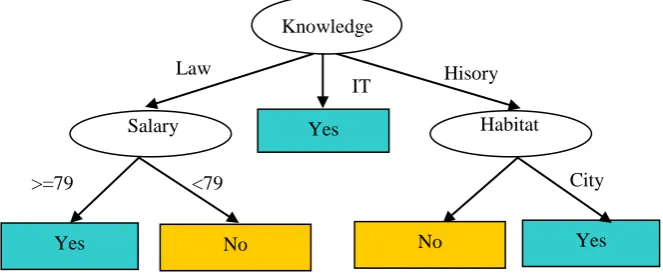
For example, domain of attribute Salary in Table 1 are homogeneous following: {Less high, low, possibly high, less low, high, high, very high, less low, very high, possibly high, very high, less low, possibly high, possibly high } or domain of value after quantitative linguistic values following: {45, 24, 52, 34, 64, 64, 79, 35,100, 50, 79, 40, 55, 50} with classical domain of value Salary in training data set is determined Dom(Salary ) = [min,max] = [20,100]. The decision tree is obtained after training shown in Figure 1 [8].
However, the quantitative linguistic values, do not always do well to find the value min, max in the data set. With the domain can not find the classical domain of value [min,max] in the attribute is considering of training date set, we had to ask the opinion of experts to identify them and then continue to work, as collective training data set in table 2, we ask experts to determine [min,max] = [20,100] and then continue.
Table 2. Training data set with attribute Salary can not find domain [min,max]
Habitat Knowledge Household Economy Salary Computer
City Law Not good Less high No
Rural Law Not good Low No
City IT Not good Possibly high Yes
City History Not bad Very low Yes
City History Rather High Yes
Rural History Rather 65 No
Rural IT Rather Very high Yes
City Law Not bad 30 No
City Law Rather Very high Yes
City History Not bad Possibly high Yes
Rural Law Not bad Very high Yes
Rural IT Not bad Less low Yes
City IT Not good Possibly high Yes
Rural History Not bad Possibly high No
The opinions of experts not always done and more can not take full advantage of the information stored in the training data set. In this paper, we will present a way to be able to quantify the value of linguistic not find classical value domain [min,max] in the attributes are considered of training data set based on hedge algebra.
II. HEDGEALGEBRA
Hedge algebra is one approach to detecting the algebraic structure of the value domain of the linguistic variable. In view of algebra, each value domain of the linguistic variable X can be interpreted as an algebra AX = (X, G, H, ), in which Dom (X) = X is the term domain of linguistic variable X is generated from a set of
Yes No
Yes Salary
Hisory Law
IT
>=79 <79
Rural
City Habitat
No Yes
Fig 1. Decision tree is created after homogeneity of values
semantically ordering relation on X, it is induced from the natural qualitative meaning of terms. Order structure induced directly so is the difference compared to other approaches.
When we add some special elements, then hedge algebra become an abstract algebra X = (X, G, H, , , ), which , are two operators taking the limit of the set terms is generated when affected by the hedges in H. Alternatively, if the symbol H(x) = {h1…hpx/h1, …hpH}, then x = infimumH(x) and x=supremumH(x). Thus, hedge algebra X is built on a foundation of hedge algebra AX= (X, G, H, ), where X = H(G), and are two additional operators. Then X = XLim(G) with Lim(G) is the set of elements limited: xLim(G), uX: x = u or x = u. The limitation elements are added to hedge algebra X to make the new calculation meant and so X = (X, G, H,, , ) called complete hedge algebra [1,6].
Definition 2.1. LetXbe a hedge algebra. A function f : X[0,1] is called quantitative semantics function of X if h, kH+ or h, kH- and x, y X, we have :
) ( ) ( ) ( ) ( ) ( ) ( ) ( ) ( y f ky f y f hy f x f kx f x f hx f
For a hedge algebra X and quantitative semantic function, we can define fuzziness of vague. Let f is a quantitative semantics function of X. Consider any x X, fuzziness of x is measured by the diameter of the set f(H(x)) [0,1].
Definition 2.2. LetXbe a hedge algebra. A function fm: X[0,1] is said to be a fuzziness measure of term in X if satisfied the following conditions:
1) fm(c)+ fm(c+) = 1 and
0 ,)
(
)
(
i p i qi
u
fm
u
h
fm
for uX. In this case, fm is called complete;2) For the constants 0, W and 1, fm(0) = fm(W) = fm(1) = 0.
3) For x, yX, h H,
) ( ) ( ) ( ) ( y fm hy fm x fm hx fm
That is, this proportion does not depend on specific elements and, hence, it is called the fuzziness measure of the hedge and denoted by (h).
Proposition 2.1. For each fuzziness measure fm on X the following statement hold: 1) fm(hx) = (h)fm(x), for every xX
2) fm(c-) + fm(c+) = 1
3)
0 , ) ( ) ( i p i q
ic fmc
h
fm , c {c, c+}
4)
0 , ) ( ) ( i p i q
ix f m x
h
f m , for every xX
5)
1 ) ( q i i h
and
p i i h 1 ) (
, where , > 0 and + = 1.
Definition 2.3. Let fm be a fuzziness measureon X.A mapping: X [0,1] which is induced by fm on X , is defined as follows:
1) (c) = W-.fm(c-) and (c+) = W + .fm(c+) 2) If 1jp then:
j i j j i jjx x Sgn h x fmhx h x fmh x
h 1 ) ( ) ( ) ( ) ( ) ( ) (
1
) ( ) ( ) ( ) ( ) ( ) (
j i
j j i
j
jx x Sgnh x fmhx hx fmh x
h
where
1 1 ( ) ( )( ) { , }2 j q j
j Sgn h x Sgn h
w h x h x
Definition 2.4. A mapping IC: Dom(Ai) [0,1] use change the value in R into [0,1] defined as follows: - If LDAi = và DAi then Dom(Ai) we have: 1 max
max min
(
)
IC w
, với Dom(Ai) = [min,max] is a classical domain of value of Ai.
- If DAi, LDAi then Dom(Ai) we have IC() = {*(maxLV)}/max, với LDAi = [minLV, maxLV] is a domain of linguistic value of Ai. If we select parameters W and fuzziness measure of the hedges so that
(maxLV) 1.0 then ({*(maxLV)}/max)
min max
max
1
III.QUANTITATIVELINGUISTICVALUESWHENNOTFINDCLASSICALDOMAINOFVALUE
For any inhomogeneities attribute A, we will change it to linguistic values and then to change about homogeneous values. In training data set was given in table 1, we will build a hedge algebra Salary as follows:
XSalary= ( XSalary, GSalary, HSalary, ), với GSalary= {high, low},
H+Salary = {more, very}, H-Salary = {possibly, less}, where very > more and less > possibly ; WSalary = 0.6, fm(low) = 0.4, fm(high) = 0.6, (very) = 0.35, (more) = 0.25, (possibly) = 0.20, (less) = 0.20.
Thus, we have : fm(very low) = 0.35 × 0.4 = 0.14, fm(more low) = 025 × 0.4 = 0.10, fm(less low) = 0.2 × 0.4 = 0.08, fm(possibly low) = 0.2 × 0.4 = 0.08. Because very low < more low < low < possibly low < less low so :
I(very low) = [0,0.14], I(more low) = [0.14,0.24], I(possibly low) = [0.24,0.32], I(less low) = [0.32,0.4]. We have: fm(very high) = 0.35 × 0.6 = 0.21, fm(more high) = 025 × 0.6 = 0.15, fm(less high) = 0.2 × 0.6 = 0.12, fm(possibly high) = 0.2 × 0.6 = 0.12. Because less high < possibly high < high < more high < very high so:
I(less high) = [0.4,0.52], I(possibly high) = [0.52,0.64], I(more high) = [0.64,0.79], I(very high) = [0.79,1]. Thus, given USalary= {45, low, 52, 34, high, high, very high, 35, 100, 50, very, less low, 55, 50}, [min,max] = [20,100].
We have computed and obtain: IC() = {0.45, 0.24, 0.52, 0.34, 0.64, 0.64, 0.79, 0.35, 1, 0.50, 0.79, 0.4, 0.55, 0.50}. The vague of attribute Salary are :
{less high, low, possibly high, less low, high, high, very high, less low, very high, possibly high, very high, less low, possibly high, possibly high}
so after quantitative values of attribute Salary will be obtain values: {45, 24, 52, 34, 64, 64, 79, 35,100, 50, 79, 40, 55, 50}.
However, the process of quantitative the linguistics values above only feasible if we can find a classical domain of value [min,max] of attribute is considering, here is [20, 100 ]. In case, this domain is not found, the algorithm is not inapplicable.
3.1. Quantitative the linguistic values when knowing a sub interval of [min, max] and all values of IC()
Let Ai is a inhomogeneities attribute, then we have Dom(Ai) = DAi LDAi but marginal value [min,
max] respectively classical domain of value DAi of Ai do not determine, we have known a sub interval [1, 2] respectively linguistic value [LV1, LV2] of LDAi and all vague quantitative of IC().
For example attribute Salary in Table 2, vague of attribute Salary are {less high, low, possibly high, less low, high, high, very high, less low, very high, possibly high, very high, less low, possibly high, possibly high }. IC() = {0.45, 0.24, 0.52, 0.34, 0.64, 0.64, 0.79, 0.35, 1, 0.50, 0.79, 0.4, 0.55, 0.50}. Here, we do not know [min, max] respectively linguistic value [minLV, maxLV] = [very low, very high] but knowing sub interval is [1, 2] = [30, 65] respectively linguistic value is [LV1, LV2] = [less low, more high].
Then, because IC() = 1 max max min
so all values of
in between [1, 2] will be right with thisrule. Because value
will be proportioned to the radius f(H(x)) [0,1], mean, if1 2
IC(2) and
1 2
1 2
( ) ( )
IC w IC w
when all IC(1), IC(2) on the same side of W. Thus, linguistic value
quantitative is computed as follows:
Step 1: For that linguistic value respectively in [LV1, LV2], we have: )
2 1 1
(
( ) IC w
Step 2: For that linguistic value respectively in [LV2, maxLV], we compute the sequential increase, according to interval LV2..maxLV, where 2
2
( ) ( i)
i
IC w IC w
and shifted position LV2 into the position I have just found.
Step 3: For that linguistic value respectively in [minLV, LV1], we compute sequential decrease according interval LV1..minLV, where 1
1
( )
( i)
i
IC w IC w
and shifted positions back into position LV1 i have just
found.
Example 2. Let XSalary be a hedge algebra to describe inhomogeneous attributes Salary in table 2 as follows: XSalary= ( XSalary, GSalary, HSalary, ), where GSalary= {high, low}, H
+
Salary = {more, very}, H
-Salary = {possibly, less}. WSalary = 0.6, fm(low) = 0.4, fm(high) = 0.6, (very) = 0.35, (more) = 0.25, (possibly) = 0.20, (less) = 0.20. Domain of linguistic values is {less high, low, possibly high, less low, high, high, very high, less low, very high, possibly high, very high, less low, possibly low, possibly high}. IC() = {0.45, 0.24, 0.52, 0.34, 0.64, 0.64, 0.79, 0.35, 1, 0.50, 0.79, 0.4, 0.55, 0.50}. Knowing sub interval have domain of value is [1, 2] = [30, 65] corresponding with domain of linguistic value is [LV1, LV2] = [less low, more high]. We have:
fm(very low) = 0.35 × 0.4 = 0.14, fm(more low) = 025 × 0.4 = 0.10, fm(less low) = 0.2 × 0.4 = 0.08, fm(possibly low) = 0.2 × 0.4 = 0.08. Because very low < more low < low < possibly low < less low so :
I(very low) = [0, 0.14], I(more low) = [0.14, 0.24], I(possiby low) = [0.24, 0.32], I(less low) = [0.32, 0.4]. fm(very high) = 0.35 × 0.6 = 0.21, fm(more high) = 0.25 × 0.6 = 0.15, fm(less high) = 0.2 × 0.6 = 0.12, fm(possibly high) = 0.2 × 0.6 = 0.12. Because less high < possibly high < high < more high < very high so: I(less high) = [0.4, 0.52],I(possibly high) = [0.52, 0.64], I(more high) = [0.64, 0.79], I(very high) = [0.79, 1].
Setp 1: Compute that have linguistic value in[less low, more high]
less low= IC(less low)(2-1)+1 =0.4(65-30)+30=44
less high= IC(ess high)(2-1)+1 =0.52(65-30)+30=48
possiby high = IC(possiby high)(2-1)+1 = 0.64(65-30)+30=52
Step 2: Compute that have linguistic value in[more high, very high]
more high = 2 × IC(possibly high)/IC(more high) = 65 × 0.64 / 0.52 = 80
very high= 2 × IC(more high)/IC(very high) = 80 × 0.79 / 0.64 = 99
Setp 3: Compute that have linguistic value in[very low, less low]
possibly low= 1 × IC(less low)/IC(possibly low) = 30 × 0.32 / 0.4 = 24
more low= 1 × IC(possibly low)/IC(more low) = 24 × 0.24 / 0.32 = 18
very low= 1 × IC(more low)/IC(very low) = 18 × 0.14 / 0.24 = 10
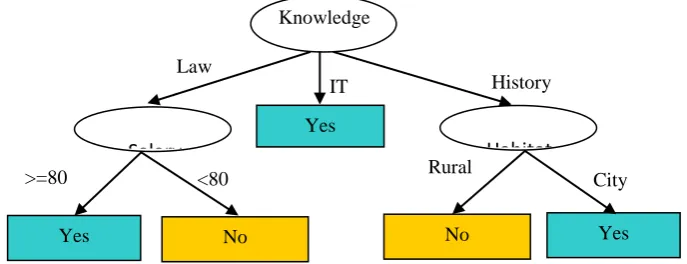
Thus, the domain of value after values quantitative are : {48, 18, 52, 30, 80, 80, 99, 30, 99, 52, 99, 30, 52, 52}. Decision tree after training shown in figure 2.
Yes Knowledge
No
Yes
Salary
History Law
IT
>=80 <80 Rural City
Habitat
No Yes
3.2. Quantitative the linguistics values when knowing a sub interval of [min, max] and do not determine
all values of IC()
Let Ai is a inhomogeneities attribute, then we have Dom(Ai) = DAi LDAi but marginal value [min,
max] respectively classical domain of value DAi of Ai do not determine, we have known a sub interval [1,2] respectively linguistic value [LV1,LV2] of LDAi , mean (LV1) = IC(1) and (LV2) = IC(2). And then, we have to find the remaining values of IC(i), mean IC(i) satisfyIC(i) < IC(1) or IC(i) > IC(2).
Because IC() = 1 max
max min
so all values of
in between [1, 2] will be right with this rule,mean IC() =
1 2
2
1
where 21. Therefore, we can build a hedge algebra respectively. According method to build a hedge algebra in section 2, we have fuzziness of values in hedge algebra are a sub interval of [0,1]. So, a set of this sub interval of the value of the same level long will create partitions of [0.1]. Partition with values greater lengths from going smoother and infinitely greater length when the length of the interval in the partition decreases to 0.Therefore, the linguistic value is a linear ordering so we will divide the corresponding sub interval into smaller partitions to determine the length of the interval [0, (i)] or [(i), 1], so that we can determine the values for the linguistic values. This is where to calculate the IC() not in interval [1, 2] by dividing the interval in succession to determine the IC (i) respectively. Thus, we have stepped to compute as follows:
Step 1: Building a hedge algebra in [1, 2] to compute values of IC() respectively of values in [1, 2] này.
Step 2: Compute partitions of IC() is repeated as follow: 1) If i < 1 then:
- Partitioned [0, (1)] into [0, (i)] and [(i), (1)] - Compute fm(hi) ~ fm(h1) × I(1) and fm(h1) = fm(h1) - fm(hi) 2) If i > 2 then:
- Partitioned [(2), 1] into [(2), (i)] và [(i), 1] - Compute fm(hi) ~ fm(h2) × I(2) và fm(h2) = fm(h2) - fm(hi)
3) Compute values of IC(i) and i at position i. Assign position i are the position 1 and continue to compute backward with the remaining value with i < 1 or assigned position i are the position 2 and continue charging forward with the remaining value i > 2.
Step 3: Quantitative the linguistic values with the calculation section 1, where known, all values of IC ().
Example 3. Let a training data set as Table 3. We will quantify the linguistic values of attribute Salary.
Table 3. A training data set with inhomogeneous attribute Salary and can not find domain [min,max]
Habit Knowledge Household Economy Salary Computer
City Law Not good 48 No
Rural Law Not good Low No
City IT Not good 53 Yes
City History Not bad Very low Yes
City History Rather High Yes
Rural History Rather 80 No
Rural IT Rather Very high Yes
City Law Not bad 30 No
City Law Rather 80 Yes
City History Not bad 50 Yes
Rural Law Not bad Very high Yes
Rural IT Not bad Less low Yes
City IT Not good 55 Yes
Rural History Not bad 50 No
Because a training data set with inhomogeneous attribute Salary so we have to homogeneous values of attribute Salary. We have: Dom(Salary) = DSalarryLDSalarry.DSalarry = {30, 48, 50, 53, 55, 80}; 1 = 30; 2 = 80. LDSalarry = {very low, low, less low, high, very high}. The linguistic values with classical value outside [1,
2]:{less low, very high}.
XSalarry= ( XSalarry, GSalarry, HSalarry, ), where GSalarry= {high, low}, H+Salarry = {More, Very}, H-Salarry= {possibly, less}. WSalarry = 0.4, fm(low) = 0.4, fm(high) = 0.6, (very) = 0.35, (more) = 0.25, (possibly) = 0.20, (less) = 0.20. We have: fm(very low) = 0.35 × 0.4 = 0.14, fm(more low) = 0.25 × 0.4 = 0.1, fm(possibly low) = 0.2 × 0.4 = 0.08, fm(less low) = 0.2 × 0.4 = 0.08,
Becase very low < more low < low < possibly low < less low so: I(very low) = [0, 0.14], I(more low) = [0.14, 0.24], I(possibly low) = [0.24, 0.32], I(less low) = [0.32, 0.4].
fm(very high) = 0.35 × 0.6 = 0.21, fm(more high) = 025 × 0.6 = 0.15, fm(possibly high) = 0.2 × 0.6 = 0.12, fm(less high) = 0.2 × 0.6 = 0.12,
Because less high < possibly high < high < more high < very high, so: I(less high) = [0.4, 0.52], I(possibly high) = [0.52, 0.64], I(more high) = [0.64, 0.79], I(very high) = [0.79, 1].
Dom(Salary) = {48, low, 53, very low, high, 80, very high, 30, 80, 50, very high, less low, 55, 50}.
Let 1 = 80 XSalary, thus for every Num(Salary), IC() = {0.36, 0.24, 0.46, _, 0.64, 1, _, 0, 1, 0.40, _, 0.32, 0.50, 0.40}.
Step 2: The values outside the interval is computed by finding the appropriate partitions of the fuzzy interval to insert outliers in this interval..
Because very high >more high, so we will partition [0.79,1] respectively with |I(large)|. Thus, we have:
fm(very high) ~ fm(more high) × I(more high) = 0.21 × 0.79 = 0.17. So I(more high) = [0.79, 0.96], I(very high) = [0.96, 1]. Thus, very high = 97.
Because very low < more low so we will partition [0, 0.14] respestively with |I(low)|. fm(very low) ~ fm(more low) × I(more low) = 0.14 × 0.14 = 0.02. So I(more low) = [0.02, 0.14], I(very low) = [0, 0.02]. Thus,
very low = 4.
Step 3: Compute IC() with [1, 2] = [4, 97] is repeated. Thus, we have: IC() = {0.47, 0.24, 0.52, 0, 0.64, 0.81, 1, 0.27, 0.81, 0.49, 1, 0.40, 0.54, 0.49}.
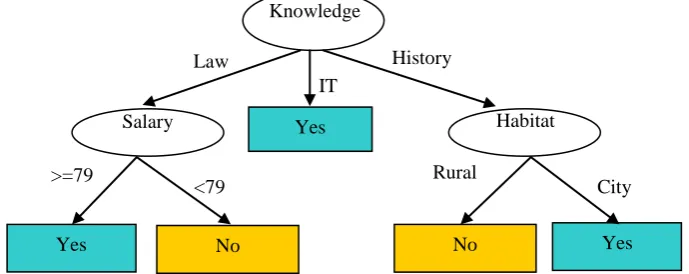
Thus, attribute Salary is quantitative have values are: {48, 26, 52, 4, 64, 79, 97, 29, 79, 50, 97, 41, 54, 50}. Decision tree after training shown by Figure 3.
3.3. Evaluation
The decision tree which is created after dealing with the values outside the interval [min, max] as shown in Figure 3 is feasible because it shows the similarity with the tree in the Figure 1 created by the dataset completely determined in the interval [min,max] and in accordance with the expert opinion.
In case we cannot deal with the values outside the interval [min,max] as the proposal, it means that we bypass the values outside the interval [min,max] in the training set and it is considered as the “error” cases. Now, we have IC() = {0.36, 0.24, 0.46, 0.64, 1, 0, 1, 0.40, 0.32, 0.50, 0.40}. The decision tree which is created after the learning process is shown in the Figure 4.
Yes Knowledge
No
Yes Salary
History Law
IT
>=79
<79 Rural City
Habitat
No Yes
Compare to the tree created by the training set completely determined in the interval [min,max] or with the best expert opinion as shown in the Figure 4, we recognized that the tree shown in the Figure 4 does not reflect the reality. This fact is completely suitable because dealing with by this way causes the training set to be lost seriously. Thus, the quantifying method for the linguistic value when we do not know the interval [min,
max] and only know the sub-interval con [1,2] as proposed is feasible.
IV.
CONCLUSION
This paper evaluated the complexity of the training data set are selected from business data, analyze the variety of domains of attribute values and complexity indicates the quantitative the linguistic values. On the basis of hedge algebra, by considering efficiency as homogeneous as values of attributes not homogeneous in the sample according to the linguistic value or classical value, the paper points out a way knowledge to be able to identify clear value for the linguistic value in limited conditions, so that we can train the decision tree consistent with reality.
REFERENCES
[1]. D. T. Long, “A method to build rule fuzzy systems semantic-based hedge algebra and application to classification”, Mathematic doctor thesis, IOIT, 2010.
[2]. D. V. Ban, L. M. Thanh, L. V. T. Lan, “A method for choosing a training set and a learning algorithm to build a decision tree in data mining”, Journal of Computer Science and Cybernetics, vol. 23, no. 4, pp. 317-326, 2007.
[3]. N. C. Ho, “Fuzzy set theory and soft computing”, Collection of lectures in Autumn school about fuzzy systems and applications, Mathematical Institute of Vietnam, pp. 51-92, 2006.
[4]. N. C. Ho, “A topological completion of refined hedge algebras and a Model of fuzziness of linguistic terms”, Fuzzy Set and Systems, vol. 158, no. 4, pp. 436-451, 2007.
[5]. N. C. Hao, N. C. Ho, “An approach for approximate data in fuzzy databases”, Journal of Computer Science and Cybernetics, vol. 23, no. 2, pp. 110-121, 2007.
[6]. N. C. Hao, “Fuzzy databases with data manipulating based on hedge algebra”, Mathematic doctor thesis, IOIT, 2008.
[7]. L. V. T. Lan, “Dependency data of training set and its effect on the classification in data mining”, Hue University Journal of Research, vol. 19, no. 53, pp. 55-64, 2009.
[8]. L. V. T. Lan, N. M. Han, N. C. Hao, “An approach for choosing a training set to build a decision tree based on hedge algebra”, Proceeding of the 6th National Conference on Fundamental and Applied Information Technology Research (FAIR), Publisher of Natural Sciences and Technology, 2013, pp. 251-258.
[9]. A. K. Bikas, E. M. Voumvoulakis and N. D. Hatziargyriou, “Neuro-Fuzzy Decision Trees for Dynamic Security Control of Power Systems”, Intelligent System Applications to Power Systems (ISAP), 15th International Conference, Curitiba, 2009, pp. 1-6.
[10]. A. Chida, “Enhanced Encoding with Improved Fuzzy Decision Tree Testing Using CASP Templates”, Computational Intelligence Magazine, IEEE, vol. 7, issue 4, pp 55-60, 2012.
[11]. Chang, Robin L. P. Pavlidis, “Fuzzy Decision Tree Algorithms”, Man and Cybernetics, IEEE, vol. 7, issue 1, pp 28-35, 2007.
P. Dorian, “Data Preparation for Data Mining”, Morgan Kaufmann, 1999. Yes Knowledge
No
Yes Habitat
History Law
IT
City
Rural Rural City
Habitat
No Yes
[13]. R. A. Daveedu, S. Jaya, D. Lavanya, “Construction of Fuzzy Decision Tree using Expectation Maximization Algorithm”, International Journal of Computer Science and Management Research, vol. 1, issue 3, pp 416-424, 2012.
[14]. A. Fernandez, M. Calderon, E. Barrenechea, “Enhancing Fuzzy Rule Based Systems in Multi-Classication Using Pairwise Coupling with Preference Relations”, EUROFUSE Workshop Preference Modelling and Decision Analysis, Public University of Navarra, Pamplona, Spain, 2009, vol. 9, pp. 39-46.
[15]. FA. Chao Li, Juan sun, Xi-Zhao Wang: “Analysis on the fuzzy filter in fuzzy decision trees”, Proceedings of the Second International Conference on Machine Learxung and Cybernetics, 2003, vol. 3, pp. 1457 – 1462.
[16]. K. Sachdeva, M. Hanmandlu, A. Kumar, “Real Life Applications of Fuzzy Decision Tree”, International Journal of Computer Applications, vol. 42, no. 10, pp 24-28, 2012.
[17]. A. H. Hefny, S. A. Ghiduk, A. A. Wahab, “Effective Method for Extracting Rules from Fuzzy Decision Trees based on Ambiguity and Classifiability”, Universal Journal of Computer Science and Engineering Technology, Cairo University, Egypt., vol. 1, pp 55-63, 2010.
[18]. H. T. Bao, “Introduction to knowledge discovery and data mining”, Institute of Information Technology, National Center for Natural Science for Technology, 2000. [Online] Available: http://www.jaist.ac.jp/~bao
[19]. N. C. Ho, H. V. Nam, “An algebraic approach to linguistic hedges in Zadeh's fuzzy logic”, Fuzzy Sets and Systems, vol.129, issue 2, pp. 229-254, 2002.
[20]. S. Moustakidis, G. Mallinis, N. Koutsias, J. B. Theocharis, V. Petridis, “SVM-Based Fuzzy Decision Trees for Classification of High Spatial Resolution Remote Sensing Images”, Geoscience and Remote Sensing, IEEE, vol.129, issue 2, pp 149-169, 2012.

![Fig 4. The decision tree created without dealing with the values outside the interval [min, max]](https://thumb-us.123doks.com/thumbv2/123dok_us/1995100.1658896/8.595.118.467.89.240/fig-decision-tree-created-dealing-values-outside-interval.webp)