Research Article
CODEN: IJPNL6
ANALYTICAL METHOD DEVELOPMENT AND VALIDATION OF DUTASTERIDE
WITH TAMSULOSIN IN PHARMACEUTICAL CAPSULE DOSAGE FORM BY
RP-HPLC METHOD
*Priyadarshani S Bansode
1, Chetan Singh Chauhan
2, Preeti Gopaliya
3, Chatrapal singh
3,
Ravindra Kamble
3, Mahendra Singh Ranawat
3, Sujata S Bansode
41
Faculty of Pharmacy, Pacific Academy of Higher Education and Research University, Udaipur,
Rajasthan, India
2
B N Institute of Pharmaceutical Sciences, Udaipur, Rajasthan, India
3B N College of Pharmacy, Udaipur, Rajasthan, India
4Goverment college of Pharmacy, Amravati, Maharashtra, India
*Corresponding author e-mail: [email protected]
ABSTRACT
Analytical method development & validation play important roles in the discovery development & manufacture of pharmaceuticals. Reversed phase HPLC (RP-HPLC) has a non-polar stationary phase and an aqueous, moderately polar mobile phase. A mixture of buffer solution and methanol in the ratio of (45:55). Drugs showed maximum absorbance at 280 nm for Dutasteriod and 225 nm for Tamsulosin. The % Accuracy is within limit (98.0 – 102.0 %) with %RSD less than 2%. The Precision RSD of Assay of six sample preparations was found to be 2.0%. The correlation coefficient value should not be less than 0.995 over the working range. The validation was performed as per International Conference on Harmonization (ICH) guidelines.
KEYWORDS: Dutasteriod, Tamsulosin, Reversed phase HPLC (RP-HPLC).
INTRODUCTION
Benign prostatic hyperplasia (BPH), also
called benign enlargement of the prostate
(BEP), adenofibromyomatous hyperplasia and benign prostatic hypertrophy, is an increase in size of
the prostate. BPH involves hyperplasia of
prostatic stromal and epithelial cells, resulting in the formation of large, fairly discrete nodules in the periurethral region of the prostate. When sufficiently large, the nodules compress the urethral canal to cause partial, or sometimes virtually complete, obstruction of the urethra, which interferes with the normal flow of urine(1). It leads to symptoms of urinary hesitancy, frequent urination, dysuria (painful urination), increased risk of urinary tract infections, and urinary retention. Although prostate specific antigenlevels may be elevated in these patients
because of increased organ volume and
inflammation due to urinary tract infections, BPH does not lead to cancer or increase the risk of cancer.
Combination Therapy with Dutasteride and
Tamsulosin: Treatment of Benign Prostatic
Hyperplasia. Pharmacological treatment of
symptomatic benign prostatic hyperplasia (BPH) has become a fairly established modality (4). Approaches
include blockade of α-adrenoreceptors and
suppression of androgens. Patients eligible for drug treatment are those with mild to moderate symptoms of BPH and no strong indications for surgery.
α-receptor blockers generally improve urinary
symptoms and peak urinary flow rates 2 to 4 weeks after introduction of therapy. Because of minor adverse effects, selective α1-blockers are preferred over nonselective drugs(2). Tamsulosin, Prazosin, Terazosin and Alfuzosin are extensively studied and widely used in BPH treatment. 5-aredctase (5AR) therapy induces reduction in prostate volume (PV)
International Journal of Pharmacy
and relief in symptoms of bladder outlet obstruction. However, the only two drugs which seem to be of major interest in BPH treatment are Dutasteride and Finasteride. Future approaches in medical treatment of BPH might be combination therapy of α1-blockers and 5 α-reductase.(3)
DUTASTERIDE: (5,6,7)
Dutasteride is a dual 5-α-reductase inhibitor that inhibits conversion of testosteron to conversion dihydrotestosterone (DHT).Dutasteride is approved by the Food and Drug Administration (FDA) for treatment of benign prostatic hyperplasia (BPH) and prescribed off-label for treatment of male pattern baldness(MPB).
Description of drug
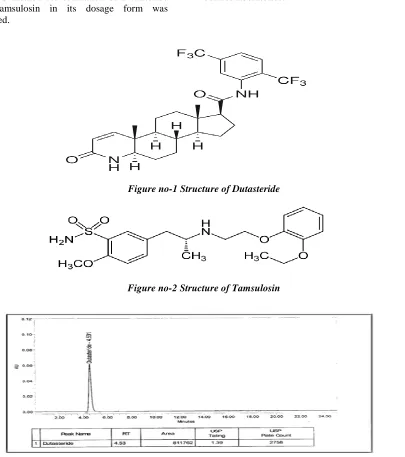
CHEMICAL NAME- (5α, 17β)-N-{2,5 bis(trifluoromethyl) phenyl}-3-oxo-4-azaandrost-1-ene-17-carboxamide.
EMPIRICAL FORMULA- C27H30F6H2O2
TAMSULOSIN:
Tamsulosin is a selective α1 receptor antagonist that
has preferential selectivity for theα1A receptor in the
prostate versus the α1B receptor in the blood
vessels.[5]When alpha 1 receptors in the bladder neck and the prostate are blocked, this causes a relaxation in smooth muscle and therefore less resistance to urinary flow. Due to this the pain associated with BPH can be reduced.
Description of drug
CHEMICAL NAME- (R )-5-(2-{[2-(2-
ethoxyphenoxy)ethyl]amino}propyl)-2-methoxybenzene-1-sulfonamide.
EMPIRICAL FORMULA- C20H28N2O5S
MATERIALS AND METHODS
Dutasteride (DUTA) and TAMSULOSIN (TAMSU) supplied by Zydus Cadila Healthcare.
ESTIMATED METHODOLOGY FOR
DUTASTERIDE:
Mobile phase preparation: 90 parts of Acetonitrile (HPLC grade) and 10 part of water (HPLC grade) was mixed well. And sonicate for 15min to remove the gases impurity. Then filter the mobile by using filtration assembly containing 0.45µ pore filter paper to remove small particals.
Preparation of Diluent: Prepared a mixture of
Acetonitrile: water in the ratio of 90: 10 which was
used as diluents for dilution of standard stock solution.
Stock solution of DUTA (1000 g/mL): An
accurately weighed quantity of Dutasteride
working/reference standard about 50 mg was transferred into 50 mL volumetric flask and dissolve in diluents and diluted up to the mark with diluent to give a stock solution having strength 1mg/ml (1000 µg/ml).
Working standard solution of DUTA: Accurately
pipette out 5 ml of dutasteride stock solution into 50ml volumetric flask and diluted up to mark with diluent. Shake wellgive a solution having strength 0.1mg/ml (100 µg/ml) (DUTA)
Sample preparation (100 g/mL): 20 capsules were accurately weighted and pith capsules. The oil from the 20 capsules were drawn out. The empty shells of 20 Capsules were dipped into the Chloroform for 10 min. After that shells of capsules were dried at room temperature. The weight of empty shells taken for the net content of oil. The each capsule contain 350mg of oil in which 0.5mg of dutasteride. The weight of oil equivalent to 2.5mg of dutasteride was taken into 25ml of volumetric flask. Volume makes up to mark with diluents. So that concentration of dutasteride was 100µg/ml obtained.
ESTIMATED METHODOLOGY FOR
TAMSULOSIN:
Buffer preparation: Dissolve 1.277g of disodium
hydrogen phosphate anhydrous (Na2HPO4) and 0.136
g potassium dihydrogen orthophosphate (KH2PO4) in
about 500 ml of milliQ water. Adjust the pH 7.0 using dilute solution of orthophosphate acid and mix. Filter the solution through 0.45 µm membrane filter.
Mobile phase preparation: Prepare a degassed
mixture of buffer solution and methanol in the ratio of (45:55)
Preparation of Diluent: Prepared a mixture of
Acetonitrile: water in the ratio of 90: 10 which was used as diluents for dilution of standard stock solution.
Standard solution (8 g/mL): Transfer an accurately weight quantity of about 40 mg of Tamsulosin Hydrochloride working standard to a 250 ml volumetric flask. Add about 100 ml of methanol and sonicate to dissolve.
Sample preparation (8 g/mL): Weigh accurately counted 20 capsules. Open the capsules and remove pellets. Again weigh the capsules (with soft gelatin capsules). Calculate the average net content of pellets. Transfer an accurately weight pellets equivalent to 2 mg of Tamsulosin Hydrochloride to a 250 ml of volumetric flask. Add 30 ml of 1 N sodium hydroxide and sonicate for 30 minutes. Add 70 ml of methanol and further sonicate for 15 min. make volume up to the mark with mobile phase and mix. Filter the solution through 0.45 µm Millipore PVDF filter, collect the filtrate by discarding first 5 ml of the filtrate.
RESULT AND DISCUSSION
HPLC method development, optimization and validation of Dutasteride
Selection of detection wavelength: Drugs showed
maximum absorbance at 280 nm for Dutasteriod and 225 nm for Tamsulosin.
Selection of mobile phase: Dutasteride is freely soluble in acetonitrile. acetonitrile was used to optimize the retention time of late eluting drug. Mobile phase ACN:Water in the ratio of 90:10 was give good and symmetric peak shape and finalized as mobile phase.
Determination of solubility of dutasteride: It was observed that dutasteride was soluble in water, and freely soluble in methanol, acetonitrile, 0.1 N HCL, 0.1 N NaOH . dutasteride showed highest stability below pH 7.0. So Diluent chosen was ACN:Water (90:10), which showed good solubility and stability also.
Selection of Column Temperature: An inclusion of column temperature (35°C) has minimized day-to-day variation of retention time due to fluctuations in the ambient temperature; along with this peak sharpening and shortening of run time were observed.
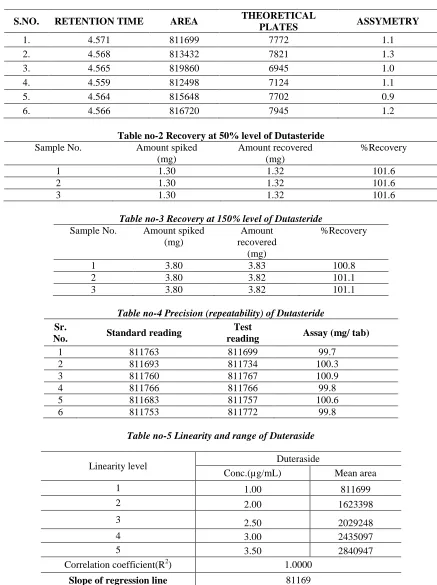
System suitability: Calculations of System Suitability parameters were present in table 1 and Figure no-3.
Application of developed method to pharmaceutical formulation
The proposed validated method was successfully applied to the sample solution was analyzed in optimized chromatographic condition.
Method validation:(8)
Accuracy:- The % Accuracy is within limit (98.0 – 102.0 %) with %RSD less than 2%.So the method is accurate.
Precision:
Method precision (repeatability):The RSD of Assay of six sample preparations was found to be 2.0%
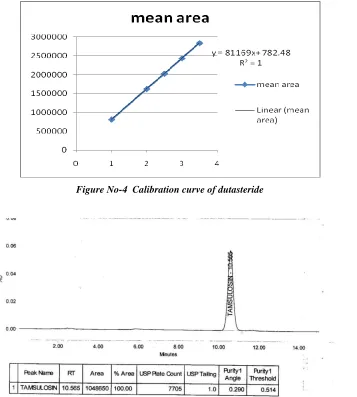
Linearity and range:- The correlation coefficient value should not be less than 0.995 over the working range.
HPLC method development, optimization and validation of Tamsulosin
Selection of detection wavelength: Drugs showed
maximum absorbance at 225 nm. So the wavelength selected for the determination of Tamsulosin was 225 nm.
Determination of solubility of Tamsulosin: It was observed that Tamsulosin was soluble in water, and freely soluble in methanol, 0.1 N HCL, 0.1 N NaOH . Tamsulosin showed highest stability below pH 7.0. So Diluent chosen was Buffer : methanol (45:55), which showed good solubility and stability also.
Selection of Column Temperature: An inclusion of column temperature (35°C) has minimized day-to-day variation of retention time due to fluctuations in the ambient temperature; along with this peak sharpening and shortening of run time were observed.
System suitability:- Calculations of System Suitability parameters were present in table 6 and Figure no-5.
Application of developed method to pharmaceutical formulation: The proposed validated method was successfully applied to the sample solution was analyzed in optimized chromatographic condition.
Method validation of Tamsulosin:-
Accuracy:- Accuracy for individual and mean at each level should be between 98.0% to 102.0% with RSD not more than 2.0%.
Precision:
Linearity and range:- The correlation coefficient value should not be less than 0.995 over the working range.
CONCLUSION
In this “Analytical method development and
validation of dutasteride with tamsulosin in pharmaceutical capsule dosage form by RP-HPLC method” it include:
Methods including RP-HPLC, LC-MS,
Spectrophotometric etc, were reviewed for the estimation of Dutasteride with Tamsulosin in human plasma as well as pharmaceutical formulations.
RP-HPLC method for estimation of Dutasteride with Tamsulosin in its dosage form was developed.
The developed RP-HPLC method was validated
for linearity and range, accuracy, method and intermediate precision,system suitability and applied to pharmaceutical formulation.
For the simultaneous estimation of Dutasteride with Tamsulosin is a simple, fast and reliable RP-HPLC method was developed and validated in capsule
dosage forms. The developed method was
successfully applied for the analysis of Dutasteride and tamsulosin. The method shows a good performance with respect to specificity, linearity, sensitivity, accuracy, precision, selectivity. So the proposed method can be used in routine quality control laboratories.
Figure no-1 Structure of Dutasteride
Figure no-2 Structure of Tamsulosin
Figure No-4 Calibration curve of dutasteride
Figure no-5 Chromatogram of Standard for System Suitability
Table no-1 System sutability Parameters of Dutasteride
Table no-2 Recovery at 50% level of Dutasteride
Sample No. Amount spiked
(mg)
Amount recovered (mg)
%Recovery
1 1.30 1.32 101.6
2 1.30 1.32 101.6
3 1.30 1.32 101.6
Table no-3 Recovery at 150% level of Dutasteride
Sample No. Amount spiked
(mg)
Amount recovered
(mg)
%Recovery
1 3.80 3.83 100.8
2 3.80 3.82 101.1
3 3.80 3.82 101.1
Table no-4 Precision (repeatability) of Dutasteride Sr.
No. Standard reading
Test
reading Assay (mg/ tab)
1 811763 811699 99.7
2 811693 811734 100.3
3 811760 811767 100.9
4 811766 811766 99.8
5 811683 811757 100.6
6 811753 811772 99.8
Table no-5 Linearity and range of Duteraside
S.NO. RETENTION TIME AREA THEORETICAL
PLATES ASSYMETRY
1. 4.571 811699 7772 1.1
2. 4.568 813432 7821 1.3
3. 4.565 819860 6945 1.0
4. 4.559 812498 7124 1.1
5. 4.564 815648 7702 0.9
6. 4.566 816720 7945 1.2
Linearity level Duteraside
Conc.(µg/mL) Mean area
1 1.00 811699
2 2.00 1623398
3 2.50 2029248
4 3.00 2435097
5 3.50 2840947
Correlation coefficient(R2) 1.0000
Slope of regression line 81169
Table no-6 Calculation of System Suitability of Tamsulosin
Table no-7 Recovery at 50% level of Tamsulosin
Sample No. Amount spiked
(mg)
Amount recovered (mg)
%Recovery
1 1.25 1.26 101.6
2 1.25 1.26 101.6
Table no-8 Recovery at 150% level of Tamsulosin
Sample No. Amount spiked
(mg)
Amount recovered (mg)
%Recovery
1 3.75 3.76 100.8
2 3.75 3.77 101.1
Table no-9 Precision (repeatability) of Tamsulosin Sr.
No. Standard reading
Test
reading Assay (mg/ tab)
1 1048022 1054584 99.7
2 1048022 1060690 100.3
3 1048022 1065156 100.9
4 1048022 1056138 99.8
5 1048022 1064570 100.6
6 1048022 1056557 99.8
Table no-10 Linearity and range of Tamsulosin
Linearity level
Tamsulosin Conc.
( µg/mL) Mean area
1 1.25 524893
2 2.00 843648
3 2.50 1056142
4 3.00 1265694
5 3.75 1577252
Correlation coefficient(R2) 1.0000
Slope of regression line 421096
Y-intercept 786
REFERENCES
1. Matsushima H, Takanuki K, Kamimura H, Watanabe T and Higuchi S. Drug Metabolism, 2003; 26(3): 240-245. 2. Kamat SS, Vele VT, Choudhari VC, Prabhune SS. AJ. Chem, 2008; 20(1): 5514-5518.
3. Lippncott WW. Remington the Science and Practice of pharmacy 21st ed., (I): PP- 667. 4. Roehrborn CG. Prostate Cancer Prostatic Dis, 2006; 9:121-5.
5. Indian Pharmacopoeia. Published by Government of India Ministry of Health and Family welfare, 1996, 554- 556 6. Surendra NP. A text book of Medicinal Chemistry Synthesis and Biochemical Approach. 3rd ed., 2003, PP- 373 – 374.
7. K.D. Tripathi. Essential of Medical Pharmacology. 5th ed., PP- 181.
S.NO. RETENTION TIME AREA THEORETICAL
PLATES ASSYMETRY
1. 10.571 1046068 7770 1.0
2. 10.568 1045255 7816 1.0
3. 10.565 1048650 7705 1.0
4. 10.559 1045012 7823 1.1
5. 10.564 1047282 7769 1.0