Page 334 www.ijiras.com | Email: [email protected]
E-Banking In India: Progress And Challenges
Seharish J Ansari
Research Scholar, Dept of Economics, AMU, Aligarh
Prof. Nisar A Khan
Professor, Dept of Economics, AMU, Aligarh
I. INTRODUCTION
The way payments system in India has undergone several changes over the past thirty five years and has been continuously evolving, it seems a silent revolution has been sweeping the country as this process has been hardly noticed by the spectators. The barter system of exchange was prevalent as a means of settlement of economic transactions before the advent of money. But when the concept of money evolved, the payments system changed and all the economic transactions were settled through money. The paper money, i.e. currency notes issued by the RBI, that is now used for settlement of payments, has in itself gone through various changes, as earlier precious metals like gold and silver were used as a medium of payments which got replaced by coins made of these metals and issued by the Government. This is how the current mode of payments system has evolved.
The evolution of the banking system has further contributed to the changes that have taken place in the mechanism of settlement of payments in the country. It has now become much easier for the people to open bank accounts and keep their hard earned money under safe custody and that too at a low remuneration. Not only this, the account holders
can even opt for making payments of an economic transaction by transferring money from their accounts to other account holders in their banks and account holders of other banks as well. A cheque was the financial instrument through which these transfers would take place. Setting up of cheque clearing houses was among the other measures undertaken to improve the infrastructure and build an environment for the convenient operation of this payments system. Earlier the electronic mode of payment was restricted to making huge and lump sum payments for large value transactions, but with the passage of time, this mode is now-a-days used for making petty payments for small value transactions as well as it is more convenient to do so.
The paper is divided into 9 sections. Section 1 includes the introduction to e-payments in India followed by review of earlier studies in Section 2. Section 3 and Section 4 deal with the objectives of the study and database and research methodology, respectively. The evolution of payments system in India is discussed in Section 5 whereas, Section 6 deals with the steps undertaken to promote e-banking in India. Further Section 7 explains the status of e-payments during the post demonetisation period. In Section 8 the opportunities and
Abstract: The banking sector around the globe is experiencing an IT revolution and the Indian banking sector is no exception to it. In order to maintain their survival in the liberalised, privatised and globalised market environment and to meet the demands of tech-savvy customers, Indian banks have adopted the usage of IT in their operations. As a consequence of the sweeping changes and developments taking place in the information technology, E-banking has emerged from such an innovative development. In its Vision Statement, the RBI has set the objective to promote electronic payments in order to move towards a cashless society. Further the formation of National Payments Corporation of India (NPCI) in 2009 as an umbrella organisation for all the retail payments in India set a stage for development of retail electronic payments by providing enough opportunities to move towards a cashless society. As a result, the retail electronic payment system in India has progressed in recent years. The present study endeavours to analyse the progress and challenges of e-banking in India from 2011 to 2016. Further the study also attempts to throw some light on the status of retail electronic payments in post demonetisation period.
Page 335 www.ijiras.com | Email: [email protected] challenges of e-banking in India are discussed followed by the
conclusion in Section 9.
II. REVIEW OF LITERATURE
Jain, Megha & Popli, G.S. (2012) in their article have tried to analyse the extent of computerisation and banking innovations in the public sector banks of India. They have also identified certain challenges being faced by the banking sector in the implementation of IT solutions in various spheres. Their study showed that 97.8 percent commercial banks were fully computerised at the end of March 2010. Whereas, on the other hand all the branches of SBI were fully computerized at the end of the same period. It also revealed the increase in the spread of NEFT and RTGS at the end of May 2012 and at March end 2012, 49 banks with a customer base of 13 million provided mobile banking service in India. The study’s conclusion proved that the Indian Banking industry had come a long way providing greater convenience, transparency, new segments and improved bank-customer relationship.
Lal, Roshan & Saluja, Rajni (2012) tried to address the technological concerns in banking sector. The study focused on the analysis of trends and progress of banking in India on parameters like ATMs, computerisation of bank branches, retail electronic payment methods, etc. published by RBI in various reports. The study concluded that banks need to make special arrangements to ensure 100% data security online and for this technically trained staff and experts need to be employed. Further the study noted that in spite of making sincere efforts in installation of electronic delivery channels and technology into the system, the Indian banks still need to make the general public in the system fully aware of the concept of internet banking. And for this, more and more seminars and workshops on the usage of internet banking especially for those who are ATM or computer illiterate should be organised. Bank employees are also required to be given adequate training in the field of internet banking to enhance efficiency and effectiveness of digital banking.
Manikyam, K. Ratna (2014) reviewed the impact of liberalization, privatization & globalization on Indian banks and analysed the resultant opportunities and challenges. The study entails a thorough summary of banking structure in India based on secondary data collected from journals, books, periodicals etc. The conclusions revealed that the post liberalisation era has undoubtedly spread new opportunities of growth in India, but has at the same time posed some serious challenges like high transaction costs, diminishing consumer loyalty, intense competition from foreign banks, privacy & safety of online data and transaction, etc. The tuff competition given by the banks around the globe has compelled the banks in India to rethink their policies and strategies and timely upgrade technology to meet the demands of the tech-savvy customers. Further the study also emphasized on building knowledge-driven, learning organizations in this rapidly evolving operational environment.
Chauhan, V. and Choudhary, V. (2015) discussed the challenges and opportunities of internet banking in India. The study also focused on the two-fold benefits of internet banking-from the perspective of customers as well as banks
and the then status of internet banking in India. The study concluded that with the adoption of modern technology by the banks and efforts made by the Government to promote the concept of e-banking, internet banking has become a popular means of carrying out financial transactions.
Dhananjay, B. (2015) studied the progress of retail electronic payment system in India in recent years. The setting up of NPCI in 2009 has paved a way for the opportunity to move towards digital transactions and therefore a comparison has been made the period before the formation of NPCI and after the formation of NPCI. Using T-test the contribution of NPCI was assessed and it was found that various innovative services were offered by the NPCI and retail electronic payments gained momentum after the setting up of NPCI.
The above studies have focused on the technological concerns in the banking sector, opportunities and challenges of internet banking in particular, etc. They have not focused e-banking and all the components of electronic payments, its progress and challenges in India. This study attempts to fill this gap.
III. OBJECTIVE OF THE STUDY
E-Banking is fairly a new concept in the electronic mode of payments in the Indian banking sector as compared to its developed counterparts. National Payments Corporation of India (NPCI) was set up in December 2008 as an umbrella organisation for all the retail payments in India and the study period starts after the setting up of NPCI because it is after the setting up of NPCI that the concept of e-banking gained momentum in India. Therefore, the main objectives of the study are:
Endeavours to address the various aspects in which the realm of e-banking in India is expanding as well as the challenges it encounters along the way.
The progress of e-banking in India has been measured by comparing the growth rates in terms of various components of electronic payments such as number of ATMs and Point of Sales (POS) deployed, number of credit and debit cards issued and their volume of transactions, the volume and value of transactions done through NEFT, RTGS and mobile banking.
Further an attempt has been made to study the status of e-banking in India post demonetisation in November 2016.
IV. DATABASE AND METHODOLOGY
Page 336 www.ijiras.com | Email: [email protected] (November 2016 to May 2017) by computing the Growth Rate
and CAGR of the various components of e-payments.
V. EVOLUTION OF PAYMENT SYSTEMS IN INDIA The development of information and communication technology is yet another factor that has contributed to the evolution of the payments system around the globe, and in India too it has played a crucial role. The advent of several instruments of payments has led to the availability of different modes and methods for the settlement of payment as in the modern world of today. The retail payments system of India has become strong enough when compared to its developed counterparts, and in terms of its variety and efficiency, perhaps even better than some of them. In order to guide the use of ICT for the benefit of the banking sector in general and payments system in particular, it has periodically constructed various committees, such as Rangarajan Committee I and II, Saraf Committee, Patil Committee, Burwan Working Group, etc.
In 2000, the Government of India enacted the IT Act, which came into effect from October 17, 2000. With the enactment of this Act, electronic transactions and other forms of e-commerce were provided legal recognitions. The regulatory authority of financial system in India, i.e. the Reserve Bank of India (RBI), has been continuously monitoring and reviewing the legal and other requirements of payments and settlements system, so that it develops on sound lines and the challenges related to it do not pose threats to financial stability. Further, recognizing that the payment system should meet the international standards, from 1998 onwards, the RBI has been continuously bringing out a Payment System Vision document for every three years, to provide an indicative roadmap for the banks and RBI in order to enhance the usage of ICT in the banking sector in India. The latest vision document is for the period 2015-18. The vision document of 2018 reiterates the commitment of the RBI to encourage greater use of electronic payments by all the -sections of the society so as to achieve a “less cash society”. The main objective is to ensure that a robust payments infrastructure is established in the country to increase accessibility, availability, interoperability and security.
The RBI plays a pivotal role in the development of India’s payment and settlement systems for both large-value and retail payments. For a long time in India, cheques and cheques clearing system were the main instrument and system of payments. The central bank played a pioneering role in automating the paper-based clearing system in the mid 1980s and the manual cheque clearing system was replaced by Magnetic Ink Character Recognition (MICR). Despite the efficient clearing of cheques through MICR, there still existed certain inherent challenges with the cheque clearing system. Therefore, in order to reduce the cheque payment system, the RBI introduced an electronic funds transfer system and Electronic Clearing Services (ECS Credit and Debit) in the 1990s. The ECS in itself has undergone many changes, from being a local system to a regional system and then to a national level system. The Special Electronic Fund Transfer (SEFT) system was introduced in April 2003 (subsequently
discontinued in March 2006, after the implementation of the National Electronic Fund Transfer (NEFT) system in November 2005) and the Real-Time Gross Settlement (RTGS) system in March 2004. The RBI operates the RTGS, which has replaced the paper-based interbank clearing system and settles a sizeable volume of large-value and time-critical customer transactions. The RBI introduced the National Electronic Fund Transfer (NEFT) system in November 2005. Together with ECS, this forms the electronic retail payment infrastructure. The National Electronic Clearing Services (NECS) system was implemented in September 2008, with the aim to centralise the Electronic Clearing Service (ECS) operation and bring uniformity and efficiency to the system. At present, the NECS settles only credit transfers. Cheque Truncation System (CTS) was introduced after almost twenty years of MICR in New Delhi in 2008 to improve efficiency in the paper-based clearing system and the standardisation of features of cheques with built-in fraud prevention measures have been included in the CTS-2010 cheque standards. Immediate Payments System (IMPS) is yet another instant real-time inter-bank electronic funds transfer system in India, which offers services 24*7 throughout the year including holidays. It was officially launched in 2010. Aadhar Payments Bridge System (APBS) is yet another addition in the systems of electronic funds transfer and is used to facilitate bulk and repetitive subsidy payments to Aadhar-linked bank accounts of the beneficiaries. The entry of non-bank players into the sphere of payments system is yet another important development in the payments and settlements system in India. Prepaid Payment Instruments (PPI) are currently being issued by the non-bank players, including mobile and digital wallets. To bridge the ATM infrastructure gap between the urban and rural areas, White Label ATMs (WLA) have also been set up. Currently, there are various types of payments instruments offered by the Indian banks and other financial institutions in order to meet out the different requirements of its customers, depending upon different circumstances, such as bank accounts, cheques, debit cards, credit cards, Prepaid Payments Instruments (PPI), etc. Depending upon the time criticality and cost sensitivity of the users, there are various systems to meet out the requirements of remittances, such as National Electronic Fund Transfer (NEFT), National Automated Clearing House (NACH), Real Time Gross Settlement (RTGS), Unstructured Supplementary Service Data (USSD), Immediate Payments Services (IMPS), Aadhar Enabled Payments System (AEPS), Unified Payments Interface (UPI). Electronic systems such as Electronic Clearing Service (ECS), National Automated Clearing House (NACH) and Aadhar Payment Bridge System (APBS), etc. are used to meet out the requirements for making bulk and repetitive payments.
Year Internet
Users**
Penetration (% of Pop)
World Population
Non-Users (Internetless)
1Y User Change
1Y User Change
World Pop. Change
2016* 3,424,971,237 46.1 % 7,432,663,275 4,007,692,038 7.5 % 238,975,082 1.13 % 2015* 3,185,996,155 43.4 % 7,349,472,099 4,163,475,944 7.8 % 229,610,586 1.15 % 2014 2,956,385,569 40.7 % 7,265,785,946 4,309,400,377 8.4 % 227,957,462 1.17 % 2013 2,728,428,107 38 % 7,181,715,139 4,453,287,032 9.4 % 233,691,859 1.19 % 2012 2,494,736,248 35.1 % 7,097,500,453 4,602,764,205 11.8 % 262,778,889 1.2 % 2011 2,231,957,359 31.8 % 7,013,427,052 4,781,469,693 10.3 % 208,754,385 1.21 %
Page 337 www.ijiras.com | Email: [email protected]
*Estimate for July 1, 2016
**Internet User = Individual who can access the Internet at home, via any device type and connection
Table 1: Number of Internet Users in India
Table 1 depicts the status of internet users in India as a proportion of its population from 2011 to 2016. It is evident that the number of users of internet have increased from 2,231,957,359 to 3,424,971,237 in 2016, which is around 53.45 percent increase during the period. The penetration of internet as a ratio of population has also increased from 31.8% in 2011 to 46.1% in 2016. On the other hand, the number of non-users of internet have shown a decline during the same period of time. This means that with the passage of time, people are becoming more aware about the internet and its uses.
YEAR ATM AGR
(%)
POS AGR
(%)
NO. OF O/S CREDIT CARDS AGR (%) NO. OF O/S DEBIT CARDS AGR (%)
2011* 87355 - 618756 - 17672337 - 263796762 -
2012 95686 9.5 660920 6.81 17653818 -0.10 278282839 5.49
2013 114014 19.15 854290 29.26 19538329 10.67 331196720 19.01
2014 160055 40.38 1065984 24.78 19181567 -1.83 394421738 19.09
2015 181398 13.33 1126735 5.70 21110653 10.06 553451553 40.32
2016 199099 9.76 1385668 22.98 24505219 16.08 661824092 19.58
CAGR 19.99 18.20 6.34 21.57
Source: Compiled from Bank wise ATM/POS/Card Statistics, Reserve Bank of India and Report
on Trends and Progress of Banking in India 2015-16 and RBI website.
Data as on end of financial year.
*Data as on December 2011 due to unavailability of data for March end.
Table 2: Number of Electronic Delivery Channels
The statistics of number of ATMs, POS deployed and the number of outstanding credit and debit cards during 2011-2016 is depicted in Table 2. The number of ATMs (on-site and off-site) deployed increased from 87355 in December 2011 to 199099 in March end 2016, which is almost doubled in a span of six years, at a CAGR of 19.99 percent. The number of Point of Sales (POS) also showed a similar pattern and increased at a CAGR of 18.20 percent during the study period. The number of Credit Cards and Debit Cards also depicted a continuous increase during the entire study period. The number of credit cards increased at a CAGR of 6.34 percent, whereas Debit cards increased at a much higher CAGR of 21.57 percent during the period of study. The increase in the number of Debit cards issued increased at a double rate from 19.09 percent in 2014 to 40.32 percent in 2015. This immense growth rate can be due to the implementation of Pradhan Mantri Jan Dhan Yojana under which RuPay Debit cards were issued to every account holder. The growth rates are quite impressive in context of a developing country like India where a majority of its population is illiterate and unaware of online services being offered by the banks.
Table 3 depicts the statistics relating to the number of electronic transactions done by the customers of Indian banks through various internet/electronic banking delivery channels, namely credit and debit cards, ATMs, POS, mobile banking, NEFT and RTGS during 2011-2016. The number of transactions through credit cards during the study period increased at a CAGR of 22.25 percent whereas the number of transactions done through Debit cards increased at a CAGR of 12.33 percent. NEFT and RTGS transactions increased at a CAGR of 53.56 percent and 15.50 percent respectively. The number of transactions done through mobile banking
increased at the highest CAGR of 106.20 percent during the study period. This increase in mobile banking may be attributed to the fact that although the majority of the population of the country may not be having access to electricity but are using smart phones due to its availability at cheap prices. YEA R CRE DIT CAR DS* AGR (%) DEBIT CARD S* AG R (%) NEFT (in Million s) AG R (%) RTGS (in Million s) AGR (%) MOB . BAN KIN G AG R (%)
2011 2833
0241
- 473567 465
- 16.36 - 479526 0
- 1047
251 -
2012 2894
6816
2.18 501700 545
5.94 27.11 65.7 1
633961 4
32.21 3123 105
8.22
2013 3584
2252
23.82 527381 264
5.12 47.09 73.7 0
729439 6
15.06 6400 973
104. 96
2014 4640
1963
29.46 628478 994
19.1 7
82.83 75.9 0
863550 4
18.39 1073 9917
67.7 9
2015 5734
4220
23.58 700310 861
11.4 3
106.8 28.9 4
967273 9
12.01 1975 7203
83.9 6
2016 7283
2925
27.01 844590 741
20.6 0
129.2 21.0 1
986409 1
1.98 4947 6880
150. 42
CAG R
22.25 12.33 53.56 15.50 106.2
0
Source: Source: Compiled from Bank wise ATM/POS/Card Statistics, Reserve Bank of India and Report on Trends and Progress of Banking in India 2015-16 and RBI website. Data as on end of financial year.
*Data as on December 2011 for Credit and Debit cards due to unavailability of data for March end.
Table 3: Number of Transactions Through Electronic Delivery Channels
YEAR CREDIT CARDS* (in Rs. Million) AGR (%) DEBIT CARDS* (in Rs. Million) AGR (%) NEFT (in Rs.Billion) AGR (%) RTGS (in Rs.Billion) AGR (%) MOBILE BANKING (Rs.'000) A GR (%) 2011 85326.01 1291189.66 1503.81 59916 846277.32
2012 89582.44 4.99 1363701.77 5.62 2403.89 59.85 67174 12.11 2325320.7 1 74.77
2013 112710.3 25.82 1623278.66 19.03 3602.48 49.86 77410 15.24 9919293 3 26.58
2014 147149 30.56 1881869.58 15.93 5312.25 47.46 81774 5.64 34070602 2 43.48
2015 181331.9 23.23 2095763.04 11.37 7173.09 35.03 87421 6.91 169138295 3 96.43
2016 229746.2 26.70 2380453.66 13.58 10226.4 42.57 100045 14.44 572803968 2 38.66
CAGR 23.31 13.71 46.03 10.23 279.53
Source: Compiled from Bank wise ATM/POS/Card Statistics, Reserve Bank of India and Report on Trends and Progress of Banking in India 2015-16 and RBI website.
Data as on end of financial year.
*Data as on December 2011 for Credit and Debit cards due to unavailability of data for March end.
Table 4: Volume/Value of Transactions Through Electronic Banking Delivery Channels
In Table 4 the volume/value of the electronic transactions carried out through various electronic banking delivery channels is presented. The statistics revealed that the volume of transactions carried out through Credit cards and Debit cards increased at a CAGR of 23.31 percent and 13.71 percent respectively. Whereas those transactions carried out through NEFT and RTGS increased happened to increase at a CAGR of 46.03 percent and 10.23 percent respectively. In case of the volume/value of transactions also, mobile banking increased at the highest CAGR of 279.53 percent during the entire study period.
VI. STEPS UNDERTAKEN TO PROMOTE E-BANKING IN INDIA
Page 338 www.ijiras.com | Email: [email protected] The IT Act was enacted with effect from October 17,
2000 and provided legal recognition to electronic transactions and also including other means of e-commerce.
The Basel Committee on Banking Supervision set up in 2001 has defined the principles of risk management in e-banking with the primary focus on adapting, extending and tailoring the existing risk management framework to the internet banking setup.
The National Payments Corporation of India (NPCI) was set up in 2008 as an umbrella for all the retail payments in India, by the guidance and support of RBI and Indian Banks’ Association (IBA). It was allowed by the RBI to increase the number of mobile banking services and also widen the Immediate Payments Service (IPS) During the last five years, the number of transactions through the organisation has increased multi-fold and the services offered by it has increased from just inter-bank ATM transactions to 24x7x365 Immediate Payments Service, Electronic Benefit Transfer, Automated Clearing House, RuPay Debit Cards for domestic payments, etc.
Acting upon the recommendations of Damodaran Committee (2011) the RBI has issued guidelines for the banks to ensure a totally secured and protected internet banking, zero liability of customers on loss of any online transactions, etc. customers can file a complaint regarding any shortcomings in the banking sector including internet banking.
The Digital India programme was launched by the Government of India on July 1, 2015 with the vision to transform the country into a digitally empowered economy.
The Unified Payments Interface (UPI) was launched by National Payments Corporation of India (NPCI) on April 11, 2016. But it is regulated by RBI. It facilitates the instant transfer of funds between two bank accounts on a mobile platform. It is an improvement over Immediate Payment Service (IMPS).
The Bharat Interface for Money (BHIM) app was launched on December 30, 2016 to facilitate easy and quick payments through Unified Payment Interface (UPI). It also intended to drive the economy towards cashless transactions and make e-payments directly through banks as a part of the demonetisation of Rs.500 and Rs.1000 currency notes in November 2016.
Cyber Swachhta Kendra (Botnet Cleaning and Malware Analysis Centre) is an initiative undertaken within the Digital India programme, to create a secure cyber space to make payments system more secure and efficient. It was set up in accordance with the objectives of National Cyber Security Policy, which works to create a secure cyber eco system in India.
Aadhar Enabled Payment System is yet another initiative under the Digital India programme. It is a service that empowers the customers to access their Aadhar-linked bank accounts and carry out the basic banking transactions such as cash deposit, balance enquiry, remittances, etc through a Banking Correspondent. DigiDhan Abhiyan is another initiative of the
Government of India with the aim to make aware the
households about using the various digital payments systems to carry out any digital transactions.
VII.POST DEMONETISATION SCENARIO On November 8, 2016 the Government of India announced demonetisation of two big denomination currency notes, i.e. currency notes of Rs.500 and Rs.1000 in order to curb corruption, drive black money out of circulation and curtail the use of illicit and counterfeit cash that fund illegal activities like terrorism. Following this there was a prolonged shortage of cash in the economy. Long queues in the banks and non-functional ATMs made it difficult to possess cash in hand. Therefore, people opted for making digital transactions. Several e-commerce companies hailed demonetisation as an opportunity to increase digital payments and reduce Cash on Deliver (COD) returns which would bring down their costs. The support of the Government has been in favour of promoting UPI for online payments. BHIM App was launched to enable cashless transactions after the demonetisation happened.
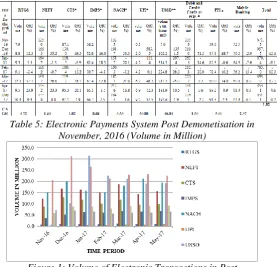
A further attempt was made to examine the electronic payments system post the demonetisation in November 2016 and Table 5 depicts the status of the same from November 2016 to May 2017. It was found that payments done through Unified Payments Interface (UPI) increased at the highest CAGR of 60.80 percent during this period. It is primarily because of the BHIM App that was developed by NPCI and based on UPI was launched in December 2016 to facilitate e-payments directly through banks. It was launched as a part of the 2016 demonetisation of the
Table 5: Electronic Payments System Post Demonetisation in November, 2016 (Volume in Million)
Figure 1: Volume of Electronic Transactions in Post Demonetisation Period
Page 339 www.ijiras.com | Email: [email protected] during the same period. Since USSD is an innovative payment
system that allows mobile banking transactions on basic feature mobile phones by simply dialing *99#, therefore it has registered a continuous increase in its usage. This mode of payment had made the possible for every common man to avail the banking services. Transactions through IMPS increased at a CAGR of 8.68 percent during the same period. Transactions done through Debit and Credit cards shot up in December 2016 at growth rate of 51.3 percent as a consequence of the demonetisation in November, when the circulation of high denomination currency notes declined. But in the very next month Debit and Credit card transactions declined primarily because of the availability of the new currency notes of Rs.500 and Rs.2000 in circulation. Mobile banking transactions decreased throughout the period and this may be due to the reason that the general public had faith in the Government of India’s initiatives towards cashless economy and so they preferred to use the BHIM App through UPI and USSD rather than mobile banking facility offered by the respective banks. NACH, CTS, PPI, NEFT and RTGS were among the other modes of electronic payments that registered a sluggish growth during this period.
VIII. OPPORTUNITIES AND CHALLENGES AHEAD There are certain opportunities in context of e-banking in India, which the Indian banks should take hold of in order to sustain their position in the competitive business environment. The banks need to increase the number of internet users by providing the computer literacy to its customers, because until and unless people have the knowledge of computer, they cannot opt for internet banking and rather would stick to the traditional mode of banking. Similarly, financial literacy is also equally essential for the increase in internet banking users in India. There is a significant impact of financial literacy on the use of internet banking. Therefore, banks should take up these opportunities and strive towards achieving the aim of digitisation of the industry as a whole.
The Indian banking sector faces certain challenges as far as the context of e-banking is concerned. The customers fear risk of security and privacy while making online transactions. There is always lack of trust factor which the customers feel at the time of making any online payment, transfer, etc. There is also less internet penetration in India especially in the rural sector and the customers lack awareness of the facilities or financial services being offered by their banks. Therefore, there is a need that the Indian banking sector works towards resolving these issues by ensuring security of all the online transactions and making its customers aware of all its services and the ways in which they can avail those services.
IX. CONCLUSION
Financial system is critical to the sound and effective functioning of the economy as a whole and banks are central to the financial system. Banking is an integral part of an economy. It is one of the main institutions that impinges on the economy and affects its performance. Some experts are of
the opinion that effectiveness of the banking system is one of the main pillars of economic development. It is the era where the banking sector around the globe is experiencing an IT revolution and the Indian banking sector is no exception. Gone are the times when the banks used to follow only the traditional methods of operations. With the advancement of technology and the availability of internet, the banking sector in India has become modernised. Internet based facilities are being offered by the banks to its customers. Through the implementation of internet banking, banks want to introduce the concept of IT based Enabled Services (ITES). The e-banking facilitates the customers as well as the banks. In the modernised world of today, the customer’s demand for banking is anytime, anywhere banking. This requires the banks to be able to meet out the expectations of the empowered and technically advanced customers. In response to the customer’s demands, the banks are required to be competent enough to provide innovative, robust, secured and optimised services.
The results of the study conclude that there in a continuous increase in the number of internet users as a proportion of the total increasing population during the entire study period. As a consequence, the statistics have shown the rate of increase in the number of e-banking delivery channels such as ATMs, POS, Credit and Debit cards, NEFT, RTGS, mobile banking, etc. during the period 2011 to 2016. The number of transactions and the volume/value of transactions carried out through these channels have also witnessed a continuous increase with a remarkable CAGR during the study period. The results revealed that out of all the various alternatives, mobile banking was the highly preferred mode of making online transactions, as the number and volume/value of transactions through mobile banking increased at the highest CAGR during the entire study period. This may be attributed to the fact of increased availability of smart phones at cheap prices. The statistics on the electronic modes of payment system in India post Demonetisation in November 2016 shows that UPI and USSD were only two modes of electronic payments that witnessed growth in usage during November 2016 and April 2017. Whereas the rest of the modes of electronic payments witnessed sluggish growth. The discussion about the opportunities and challenges provides insights to the policymakers about the hurdles of internet banking in India. The marketers need to consider the factors such as security and privacy risk and the issue of trust while devising the strategies and marketing policies for internet banking in India.
REFERENCES
[1] Joshua, A.J. and Koshy, M.P (2011) Usage Patterns of Electronic Banking Services by Urban Educated Customers: Glimpses from India. Journal of Internet Banking and Commerce, 16, pp 1-12.
Page 340 www.ijiras.com | Email: [email protected] [3] Manikyam, K. Ratna (2014), “Indian Banking Sector –
Challenges and Opportunities”, IOSR Journal of Business and Management, Volume 16, Issue 2. Ver. I, pp 52-61. [4] G. S. Sureshchandar, Chandrasekharan Rajendran, R. N.
Anantharaman (2003) Customer Perceptions of Service Quality in the Banking Sector of a Developing Economy: A Critical Analysis, International Journal of Bank Marketing, Vol. 21 Issue: 5, pp.233-242, doi: 10.1108/02652320310488411
[5] Chauhan, V and Chaudhary, V (2015), Internet Banking in India: Challenges and Opportunities in Indian Context, Journal of Management Sciences and Technology, Vol.2 (3) pp 29-40.
[6] Nidhi, K (2016) E-Banking in India: Challenges and Opportunities, International Journal of Science Technology and Management, Vol. 5, Issue 8.
[7] Narolia, V and Gupta, S.K. (2015), SWOT Analysis of Electronic Banking in India, International Journal in Commerce, IT and Social Sciences, Vol.2, Issue 10 pp 11-19.
[8] https://en.wikipedia.org/wiki/Online_banking, Access Date 15-03-2017.
[9] Lal, R and Saluja, R (2002) E-Banking: The Indian Scenario, Asia Pacific Journal of Marketing & Management Review, Vol. 1 (4) pp 16-25.
[10]Reserve Bank of India, Report on Trend and Progress of Banking in India, RBI Mumbai, Various Issues.
[11]RBI (2011). IT Vision of Reserve Bank of India 2011-2017. Accessed on March 15, 2017. http://www.rbi.org.in/scripts/PublicationVisionDocument s.aspx?Id=629.
[12]https://rbi.org.in/scripts/ATMView.aspx?atmid=71 Accessed on March 20, 2017.
[13]RBI Annual Report (2013), Payment and Settlement Systems and Information Technology, Accessed on March 21, 2017 http://rbidocs.rbi.org.in/rdocs/Annual Report/PDFs/P2_09PSS220813.pdf.
[14]RBI Report (2012a). National Strategy for Financial Education, Accessed March 15, 2017, http://rbidocs.rbi.org.in/rdocs/PublicationReport/Pdfs/NS FE016072012.pdf.
[15]http://www.digitalindia.gov.in/infrastructure, Accessed on March 18, 2017.
[16]https://www.rbi.org.in/SCRIPTs/PublicationReportDetail, Accessed on March 21, 2017.
[17]RBI Report (2001). Report on Internet Banking, Accessed on March, 27, 2017, https://www.rbi.org.in/SCRIPTs/ PublicationReportDetails.aspx?UrlPage=&ID=243#ch2
[18]RBI Press Release (2011). IT Vision of Reserve Bank of India 2011-2017, Accessed on March 21, 2017. https://rbi.org.in/SCRIPTs/BS_PressReleaseDisplay.aspx ?prid=23985
[19] RBI Annual Report (2013). Payment and Settlements and Information Technology, Accessed on March 21, 2017. https://www.rbi.org.in/scripts/AnnualReportPublications.a spx?Id=1155
[20] RBI Draft Report (2012). National Strategy for Financial Education, Accessed on March 21, 2017. https://www.rbi.org.in/SCRIPTS/PublicationDraftReports .aspx?ID=675
[21]Basel Committee on Banking Supervision, Accessed on March 27, 2017. https://www.google.co.in/webhp? sourceid=chrome-instant&ion=1&espv=2&ie=UTF-8#q =basel+committee+on+banking+supervision
[22]Internet Live Stats, Accessed on March 15, 2017. http://www.internetlivestats.com/
[23]RBI Data Releases, Accessed on March 15, 2017. https://rbi.org.in/scripts/ATMView.aspx?atmid=70 [24]RBI Annual Report (2011). Trends and Progress of
Banking in India. https://www.rbi.org.in/scripts/Annual Publications.aspx?head=Trend%20and%20Progress%20o f%20Banking%20in%20India
[25]RBI Annual Report (2012). Trends and Progress of Banking in India. https://www.rbi.org.in/scripts/Annual Publications.aspx?head=Trend%20and%20Progress%20o f%20Banking%20in%20India
[26]RBI Annual Report (2013). Trends and Progress of Banking in India. https://www.rbi.org.in/scripts/Annual Publications.aspx?head=Trend%20and%20Progress%20o f%20Banking%20in%20India
[27]RBI Annual Report (2014). Trends and Progress of Banking in India. https://www.rbi.org.in/scripts/Annual Publications.aspx?head=Trend%20and%20Progress%20o f%20Banking%20in%20India
[28]RBI Annual Report (2015). Trends and Progress of Banking in India. https://www.rbi.org.in/scripts/Annual Publications.aspx?head=Trend%20and%20Progress%20o f%20Banking%20in%20India
[29]RBI Annual Report (2016). Trends and Progress of Banking in India. https://www.rbi.org.in/scripts/ AnnualPublications.aspx?head=Trend%20and%20Progre ss%20of%20Banking%20in%20India