RESEARCH ARTICLE
ENHANCING CONJOINT ANALYSIS WITH HIERARCHICAL FACTOR ANALYSIS FOR
EFFICIENT ATTRIBUTE CLUSTERING
*,1
Intaka Piriyakul,
2Rapepun Piriyakul and
3Sutarat Juicharoen
1Department of Marketing, Faculty of Business, Srinakharinwirot University, Thailand 2Department of Computer, Faculty of Science, Ramkhamhaeng University, Thailand
3Assistant researcher in RajaphakPranakorn, University, Thailand
ARTICLEINFO ABSTRACT
Recently, competitive advantage was achieved by those firms able to develop their product/service to fulfill a consumer’s need. The market preferences following adequate evaluation of how people measure different features of an individual product. The product or service design using Conjoint analysis, a quantitative research tool widely employed in product management and marketing struggled the over information overload for decision-making in the ranking preference value. Our proposed method, the integration of Hierarchical Factor analysis and conjoint analysis, can improve the product design more efficiently. The experiment on electric pump design has found that the seven attributes were segmented into five clusters, and each cluster consisted of full factorial design with suitable product concepts for a man-kind decision-making.
INTRODUCTION
Product or Service design recently was interacting with several problems such as the dynamic consumer behavior, the impact of economic, technology and social change. The need for market-based product/service design has led to the development of many mathematical procedures for the
identification of “optimal” product/service profiles
(Balakrishnan and Jacob, 1996; Green, P. E., and Krieger, 1996). Most of the previous procedures utilize conjoint
analysis based on consumer preference data and
optimal/heuristic procedures to search for the best
combinations of attributes for a product to maximize consumer’s need.The most popular product design approach is conjoint analysis. This method is based on the full profile data collection. In a typical conjoint experiment, the researcher first constructs a set of alternatives or choice by combining several levels of each attribute. After that, the conjoint profiles are numerical ranking by a consumer. Normally, the researcher always constructs the conjoint full profiles. Consequently, the influence of each product/service attributes on the overall
evaluation can be estimated by each individual
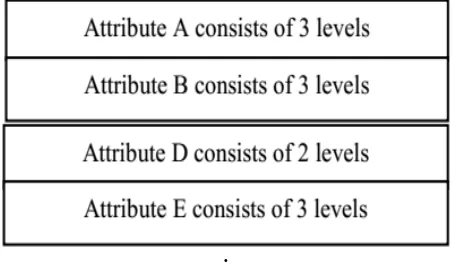
respondent/decision maker (Green ; Krieger and Wind, 2001) Due to the constraint of a number of choices for consumers’ selection, the traditional conjoint analysis is struggling the problem of information overload to make the decision. To solve this problem, many previous researchers such as (Anderson, 1982; Louviere, HensherandSwait, 2004) and (Louviere and Timmermans, 1990) were using a latent-segment attribute framework. Conjoint analysis is described through a set of attributes and their levels. The Info-graphic of measuring the consumers’ preferences as shown in Figure 1.
*Corresponding author:IntakaPiriyakul
Department of Marketing, Faculty of Business, Srinakharinwirot University, Thailand.
In case of figure 1, the number of factorial profiles (concepts) to be evaluated is 3 x 3 x 2 x 3 = 54 profiles. Numerous profiles cause two serious problems: (1) the inability to ranking all profiles and (2) the sparse vector analysis problem. To overcome these problems, we proposed “Hierarchical Factor Analysis for Efficient Attribute Clustering to Support Conjoint Analysis” (HFE) in the product design process.
Conjoint Analysis with Hierarchical Factor Analysis for Efficient Attribute Clustering: Previous HII is based on the idea that consumers process information in a hierarchical fashion if the decision situation is complex and the alternatives involve many attributes. This basic idea is based on a set of heuristics assumptions (Louviere and Timmermans, 1990). The application of this methodology assumes a two-step decision-making process (Johnson, 1988). In the first step, attributes are classified into a limited number of perceptual dimensions, called decision constructs (Oppewal and Virens, 2000). The second step involves the integration of the perceived scores of the constructs into an overall judgment for the alternative. The first step of HII uses logic and empirical evidence to segment the attribute which based on the designer. Apply the first step under process designer making is not applicable to the automatic process and the interaction effect provides by incorrect attribute segmentation impact to data analysis. Therefore, our study aims to apply Hierarchical Factor Analysis (HFE) to solve the mentioned problem before processing the next step with conjoint analysis. In addition to the ability of a consumer to evaluate preference product profiles.
Research Objectives
To construct an automatically attribute segmentation
with no interaction between the cluster by using Hierarchical Factor Analysis.
Article History:
Received 17th December, 2018
Received in revised form 24th January, 2019
Accepted 10th February, 2019
Published online 30th March, 2019
InternationalJournalof Recent Advances in Multidisciplinary Research
Vol. 06, Issue 03, pp.4719-4723, March, 2019
Keywords:
Figure 1. The product design attribute and number of level
To reduce Information overload in process of consumer
ranking product profiles.
Review of Literature
Product Design: Product design and process selection affect product quality, product cost, and customer satisfaction. If the product is not well designed or if the manufacturing process is not true to the product design, the quality of the product may suffer. Furthermore, the product has to be manufactured using materials, equipment, and labor skills that are efficient and affordable; otherwise, its cost will be too high for the market. We call this the product manufacturability—the ease with which the product can be made. Finally, if a product is to achieve customer satisfaction, it must have the combined characteristics of good design, competitive pricing, and the ability to fill a market need. This is true whether the product is pizzas or cars (Jehoshua et al., 1996). Product design is the process of defining all the features and characteristics of just about anything you can think of, from Starbuck’s cafe latte or Jimmy Dean’s sausage to GM’s Saturn or HP’s Desk Jet printer. Product design also includes the design of services, such as those provided by Salazar’s Beauty Salon, Big- Holiday program, or Federal Express. Consumers respond to a product’s appearance, color, texture, performance. All of its features, summed up, are the product’s design. Someone came up with the idea of what this product will look like, taste like, or feel like so that it will appeal to consumer. This is the purpose of product design. Product design defines a product’s characteristics, such as its appearance, the materials it is made of, its dimensions and tolerances, and its performance standards (Strack Werth, and Deutsch, 2006).The activities of product design must respond to the dynamic consumer behavior with depending on the external and internal factor. Then the task of design is complicated both in the dimension of Standardization or localization. In the Apple Company, for example, the standardization is “Globalization": Apple’s One-Size-Fits-All Approach. While the “Doi Chang” Thai cafe business uses the Localized Strategy, the product/service design can be differentiated on the domestic consumer (Hise, and Young-Tae, 2011). However, both Standardized and Localized Strategy also face the respondents’ burden on conjoint analysis practice.
Optimum Information for Decision-Making: The component
of product design consists of a three-dimensional product image (attribute); (1) symbolic image (2) functional image, and (3) emotional image. The symbolic image composes of the attribute of the brand, color, logo, package, etc. And for the functional image and emotional image, in which the product attributes are intangible.
The design elements of all dimensions are equally important for the consumer (Myers and Mullet, 2003); (Waldman, 1992). The emotional image, however, enlarges on this the esthetic and psychological benefit of the product and they also include the ambiance, image and “feel-good” elements of the product.The diversity of consumer product selection has expanded exponentially, such that the average American supermarket in 1976 carried 9,000 different unique products, whereas 15 years later that figure had ballooned to 30,000 (Waldman, 1992); (Anderson, 1991). The study of Iyengar and Lepper (Iyengar and Lepper, 2000) found that consumers who faced 24 options, as opposed to six options, were less willing to decide to buy anything at all, and those who did buy were less satisfied with their purchase. Such findings suggest that choice, to the extent that it requires greater decision making among options, can become burdensome and ultimately counterproductive. Although we do not argue that having no choice is good, recent commentaries have denounced the notion of ever-increasing choice, using words like “relentless” and “inescapable” (Mick, 2005). To describe this “tyranny of freedom”.To reduce the problems of conjoint analysis: Hair et al. (Hair; Anderson; Tatham, and Black, 1999) proposed the fractional factorial design in order to solve the main effects, Iyengar and Lepper (Iyengar and Lepper, 2000) used an orthogonal design to extract the correlation between attributes, and HII (Hierarchical Information Integration and Integrated Conjoint Analysis) was conducted by Louviere (Louviere, 1988) to solve the consumer’s decision-making process. HII is based on the basic human perception information theory (Louviere, 1988). The HII approach by sub-experiments overcomes the traditional conjoint analysis (Molin and Timmermans, 2009). With HII, the experiment must divide into two steps, the first step is to divide the attributes in construct and the second step are the experiment on each sub-construct with the traditional conjoint. Although the product designers control more data than they did, they’re still faced with some common impediments when clustering a construct of attributes, cross-channel customer experiment. Then to enhance the first step, we apply Factor analysis to be an automatic constructing group of related attributes and then using Eigenvalue to be a navigator for the hierarchical sub-experiment.
Factor Analysis (FA): Factor Analysis is a statistical
technique that is based on the correlation analysis of multi-variables. The main applications of the factor analytic techniques are: (1) to reduce the number of attributes, and (2) to detect similarity in the relationships between attributes, in order to classify attributes. (Friedman andSinuany-Stern, 1997) applied the Factor Analysis method to data reduction in decision-making units. Therefore, the Factor analysis can be used as a data reduction or structure detection method. There are two major types of FA: exploratory and confirmatory. Confirmatory FA is a much more sophisticated method used in the advanced stages of the research process to test a theory about latent processes. Attributes or features are carefully and specifically chosen to reveal underlying processes. To explain the method, there are three main stages in a typical FA technique (Easton, Murphy, Pearson, 2002)
Initial solution: Attributes (Variables), as indexes of
Extracting the factors: An appropriate number of components (Factors) are extracted from the inter-correlation matrix based on the initial solution. Due to the standardization method, there should be a certain rule to extract the selected effective factors.
Rotating the factors: Sometimes one or more variables
may load about the same on more than one factor, making the interpretation of the factors ambiguous. Thus, factors are rotated in order to clarify the relationship between the variables and the factors.
Beside to overcome the information overload of the decision maker, FA also reduces the interaction of the attributes between each attributes’ group. Conjoint analysis is evaluated on the hypothesis that there are main and interaction effects. The data analysis from the attributes in feature domain may explore issues such as the following
Suppose that the set of product attribute = {A, B, C, D}.
Then the value of the main effects are derived from A, B, C, and D.
The interaction effects are derived from AB, AC, AD,
BC, BD, CD, and ABCD.
The source of effects displays that if we use the heuristic approach to be a guide of segmentation, we will confront to against the hypothesis that there is no interaction in each cluster. The vector rotation option in FA will discard the interaction between cluster attributes as the orthogonal (Addelman, 1962) design. KMO (Kaiser-Meyer-Olkin) and Bartlet’s Test (The statistic is a measure of the proportion of variance among variables that might be common variance) are used to trade of the goodness of the segmentation. From the standard threshold of KMO, if the value is greater than 0.7 with Bartlet’s Test significant then the test is quite good.
Conjoint Analysis:Conjoint analysis is a term used to describe a product design technique that attempts to model consumers’ preferences as functions of the determinant attributes of products and services. In a typical conjoint experiment, the researcher first constructs a set of real or hypothetical products by combining several levels of each attribute. The combinations (conjoint profiles or factorial design) are then presented to selected consumers who provide their overall evaluations in the form of a ranking or numerical rating. Because the researcher constructs the conjoint profiles using experimental design procedures, the influence of each product/service attribute on the overall evaluation can be estimated for each individual respondent/decision maker (Green and Krieger, 1996; Strack; Werth and Deutsch, 2006).
The HFE Algorithms :The steps in product design analysis are as follows
1. Determine optimal optimum information from the
commonly used sample sizes. Choosing the optimal range of 6-12 choices (Iyengar and Lepper, 2000 ;Strack et al., 2006).
2. Let the group of consumer consists of N persons. And
then each person assign the score of ranking K attribute from number 1-K. The data set is matrix size (N x K).
3. Let the data set in step 2 to be segmented with Factor
Analysis (FA). Suppose that the result of FA is M factors, where M < K and F = {F1, F2,…, FM}.
In case the number of factorial choices (combination of the level of each attribute) in Fi is greater than 12 choices, Fi must be repeated segmentation again and then update set F.
4. Ascending sort set F = {F1, F2, F3…FM} by
eigenvalue.
5. Set Knowledge Set for process design: KM = NULL.
6. Do these step until F is NULL
6.1 To formulate factorial choices in Fi: For example, there are 2 attributes (A, B) and each attribute has 2 levels then (A1, A2, B1, B2) imply the factorial choices for preference evaluation by a consumer as decision maker is 2 * 2 = 4 choices. The data set for one decision maker is the PE matrix size (4 x 5) as the following pattern:
A1_B1 A1_B2 A2_B1 A2_B2 Preference
1 0 0 0 3
0 1 0 0 5
0 0 1 0 6
0 0 0 1 2
Preference is a selected decision value (maybe 0 to 10 or 0 to 100). 6.2 NK = Call Conjoint Analysis Procedure by sending Matrix PE
Update KM with NK.
End do.
/
Final Step 6.7. Implement product design using KM (the knowledge-based of the significance level of each attribute from step 6.
MATERIALS AND METHODS
Research objective is to conduct an appropriate method to solve the problem of overloading information in the stage of product design using conjoint analysis.
Our purpose frame work is listed as the following steps
The thirty customers as the sample of the consumer
population are unit of analysis to measure the value (1-8) of attributes significance.
The data set from step 1 was used to analyze based on
the hierarchical factor analysis to cluster the product attribute with the constraint of optimum information.
The cluster attribute product profile from the step 3 is
used to be preference ranking by a customer (based on our experiment).
The final step is the conjoint analysis to extract
information as the best attribute set to support for further process design.
Our experiment using the “Electrical Pump” as a product to design an assembly part with seven attributes.
RESULTS AND DISCUSSION
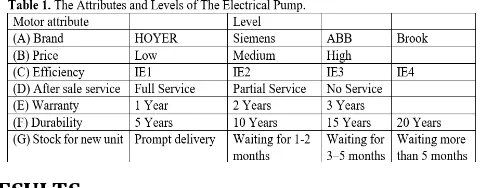
segmentation by using the Hierarchical Analysis is applied. The experiment product (electrical pump) composes of 7 attributes and sub level are represented in Table 1 and then for the experiment, we conduct 30 consumers onto the ranking using a score of 1 to 8 of each attribute. Finally, the attribute segmentation by using the Hierarchical Analysis is applied.
RESULTS
1. The experimental data set is as the following matrix size 30 x 8 (Table 2).
2. The output from Factor Analysis at the first level is illustrated as Table 3.
The analysis based on rotation method: Varimax with
Kaiser Normalization, has shown that there were three factors; factor 1= {Efficiency, After-sale-service}, factor2= {Warranty, Price}, factor 3 = {Stock for new unit, Durability}, factor4 = {Durability} and factor 5 = {Brand}. The attributes in each construct may be named Priced-Efficient, Maintenance, and Brand. With respect to the decision makers on the overloading information problem, the development of variable extraction on factor 1 must be clustered again. Consequently, the result has shown as Table 4
The relevance Statistics value KMO is 0.802 and Bartlett's Test is highly significant. Finally, our experiment can construct four factors of attribute: F1={Efficiency, After-sale-service}, F2 = {Warranty, Price}, F3 = {Stock for new unit}, F4= {Durability}, and F5 = {Brand}. The details in each construct defined by attributes and level have displayed in Table 5.
The next step was obtaining a factorial design for each sub-experiment by applying the traditional conjoint analysis.
3. The five experiments have conducted for decision-making into the preference value 0-10. Table 6 shows the example of the experiment on factor F1.
Table 6. The preference value ranking of one consumer as a decision maker
IE1 IE2 IE3 IE4 Ful_Ser Par_Ser No_Ser Preference
1 0 0 0 1 0 0 6
0 1 0 0 1 0 0 1
0 0 1 0 1 0 0 7
0 0 0 1 1 0 0 3
1 0 0 0 0 1 0 6
0 1 0 0 0 1 0 4
0 0 1 0 0 1 0 8
0 0 0 1 0 1 0 10
1 0 0 0 0 0 1 6
0 1 0 0 0 0 1 4
0 0 1 0 0 0 1 7
0 0 0 1 0 1 0 9
From our product design analysis with HFE algorithm, the data set (table 6) was sent to analyze by accessing conjoint analysis function and then return the standardized coefficient of the
beta of each level as the following format
.
The output from Table 7 implies that IE4 and Partial Service are the best levels of attributes: Efficiency and After-sale-service, with the weight ratio 0.375 and 0.526 respectively (IE1 and Full-Service are the zero based thresholds). And then the set of KM is updated with the notation KM = {IE4, After-sale-service}. Additional, for the further experiment set F2 to F5, the conjoint analysis procedure was called to process and return the best level of the attribute for updating KM. Finally, the knowledge set: KM = {E4, No Service, 3 years, Medium, Waiting for 3–5 months, 15 years, ABB}, was used to design a product, electrical pump. Formally type of product design specification consists of (1) Motor Efficiency is E4, (2) after sale service is No Service (3) the warranty is 3 years (4) Price is Medium (5) Stock for the unit is waiting for 3–5 months (6) Durability is 15 years, and (7) Brand is ABB.
Conclusion
of decision-making. The HFE does not only segment the attributes on the constraint of suitable information but also warranty that the attributes in each factor are not correlated. The integration of the preprocessing, hierarchical factor analysis, with traditional conjoint analysis, led to improving the product/service design, especially on the multi-dimension on consumers’ perception.
Limitation and Future Work
Our study based on the tangible attributes while the intangible attributes such as emotional, lifestyle and other cognitive values are more sensitively on consumers' mindset. Those intangible attributes are very difficult to evaluate and dynamic on the spatial and temporal dimension. However, the marketer should be improving the criteria to evaluate the invisible attributes for supporting the design task and product positioning design (Green and Krieger, 1993). For further study, the other aspect of design i.e. training or beauty course will be the beneficial experiment.
Recommendations
A differential advantage is when a firm's products or services differ from its competitors' offerings and are seen as superior. Advanced technology, patent-protected products or processes, superior personnel, and a strong brand identity are all drivers of differential advantage. These factors support wide margins and large market shares. To satisfy this beneficial contribution, the product/service design must rely on the effective and continuity process. Consequently with business performance to reduce cost on supply chain management: the preprocessor of conjoint analysis by using automatic plugin HFE algorithm, will enhance the product/service design process in the cost and precision dimension.
REFERENCES
Addelman, S. 1962. Orthogonal Main-Effect Plans for Asymmetrical Factorial Experiments. Technimetrics,4, 21– 46.1962.
Anderson, N.H. 1982. Methods of Information Integration Theory. New York: Academic Press.
Anderson, N.H. 1991. Foundations of Information Integration Theory. New York, Academic Press.
Balakrishnan, P. V. (Sundar) and Jacob, V. S.1996. Genetic
algorithms for product design. Management Science, 42(8),
1105-1 117.
Easton L., Murphy, D.J. and Pearson, J.N. 2002. Purchasing
performance evaluation: with data envelopment analysis.
European Journal of Purchasing and Supply Management,
8, 123–134.
Friedman, L. andSinuany-Stern, Z.1997. Scaling units via the
canonical correlation analysis in theDEAcontext. European
Journal of Operations Research, 100(3), 629-637.
Green, P. E.and Krieger, A. M. 1996. Individualized hybrid
models for conjoint analysis, Management Science, 42(6),
850-867.
Green, P.E. and Krieger, A.M. 2001. Conjoint Analysis with
Product-Positioning Applications, in Handbooks in
ORandMS.
Green, P.E., Krieger, A.M. and Wind, Y. 2001. Thirty Years of Conjoint Analysis: Reflections and Prospects.Interfaces, 31, S56–S73.
Hair, J.F., Anderson, R.E., Tatham, R.L. and Black, W.C. 1999. Multivariate Analysis. 5th ed. Madrid: Prentice Hall. Hise, R. and Young-Tae, C. 2011. “Are US companies employing standardization or adaptation strategies in their
international markets?”. Journal of International Business
and cultural studies, 4, 1-29.
Iyengar, S.and Lepper, M. 2000. “When choice is demotivating: Can one desire too much of a good
thing?.Journal of Personality and Social Psychology, 79,
995–1006. 2000.
Jehoshua Eliashberg, Gary L. Lilien, Morris, A. Cohen and
Teck, H. Ho. 1996.
“
New Product Development:ThePerformance and Time-to-Market Tradeoff”. Management
Science, 42(2), 173-186.
Johnson, M. 1988. Comparability and hierarchical processing in multi attribute choice, Journal of Consumer Research, 15, 303–314.
Louviere, J. J., Hensher, D. A.andSwait, J. D. 2003. Stated preference methods: Analysis and application. Cambridge, UK: Cambridge University Press.
Louviere, J.J. 1998. Analyzing Decision Making: Metric Conjoint Analysis. London:Sage University paper.
Louviere, J.J. and Timmermans, H.J.P. 1990. Hierarchical
Information Integration applied to residential choice
behavior. Geographical Analysis, 22, 127–145.
Louviere, J.J. and Timmermans, H.J.P. 1990. Using hierarchical information integration to model consumer responses to possible planning actions: recreation
destination choice illustration. Environment and Planning
A, 22, 291–309.
Mick, D. G. 2005. Choice writ larger. Newsletter of the Association for Consumer Research.Retrieved fromhttp:// www.acrwebsite.org/.
Molin, E.J.E. and Timmermans, J.P. 2009. Hierarchical Information Integration Experiments and Integrated Choice Experiments. Transport Reviews, 1–21, 2009.
Myers, J.H. and Mullet, G.M. 2003. Managerial Applications of Multivariate Analysis in Marketing. Chicago: American Marketing Association.
Oppewal, H. Virens, M. 2000. Measuring perceived service quality using integrated conjoint experiments. International Journal of Bank Marketing, 18(4), 154-169.
Strack, F., Werth, L.and Deutsch, R. 2006. “Reflective and impulsive determinants of consumer behavior”. Journal of Consumer Psychology, 16, 205–216.
Waldman, S. 1992. The tyranny of choice: Why the consumer revolution is ruining your life. New Republic, 22–25. 1992.