Toward a Complex System for Context Discovery to Index
Arabic Documents
Mohamed Salim El Bazzi
1*, Driss Mammass
1, Abdelatif Ennaji
2, Taher Zaki
11 Laboratory IRF-SIC, University Ibn Zohr, Agadir, Morocco. 2 Laboratory LITIS, University of Rouen, Rouen, France.
* Corresponding author. Tel.: (+212)653838855; email: [email protected] Manuscript submitted October 31, 2017; accepted January 20, 2018.
doi: 10.17706/jcp.13.8 955-962.
Abstract: Text indexing aims to take the full advantage of textual data to help intelligent programs to make relevant decisions. In order to explore a large amount of textual documents, and to disclose semantic information hidden in unstructured documents, like texts, an effective indexation system is required. In this paper, we propose a new approach for indexing Arabic texts. Based on the semantic proximity and taking into account the contexts contained in each document, our method is denoted contextual indexing. Several algorithms are used for keywords extraction, each of them emphasizes some criterion. However, we target the most descriptive keywords for each document. We also propose a new approach for document modeling. We compared the results obtained using our method with those obtained by an indexation system based on a standard statistical method. The experimental results demonstrate the performance of our approach.
Key words: Contextual indexation, semantic proximity, clustering, Arabic documents.
1.
Introduction
Indexing an amount of documents is to select its most representative descriptors in order to generate the list of indexing terms. It is a way of retrieving all the terms characterizing a document. Document indexing is an important step in the text mining process, because it determines how the knowledge contained in the documents is represented [1]. It takes place each time a document is added to the corpus.
The amount of information increases and the access to relevant information become a complex task. Clearly, the problem is not about the availability of information but its relevance to a particular context of use.
The context is the linguistic entourage of a textual element within the utterance in which it appears, that is to say, the series of units preceding it and following it. The term context refers to all the circumstances in which an act of enunciation takes place: cultural and psychological situation, experiences and knowledge of the world, Mutual representations that each one makes of his or her interlocutors, etc.
In this paper, we present a new approach based on context discorvery in order to select the most relevent keyword that describe best a given document. We denote this approach “Contextual indexation”.
2.
Related Works
Relevance is undoubtedly the fundamental question posed in text mining tasks. This subjective notion, which is essentially dependent on the user's point of view, has again been the subject of investigations within text classes in general and contexts in a particular way.
We can note a lack of representation of the context in text mining models especially for unstructured data. Classic models have been defined to assign a document to an already known classe.
The context is not a new concept in computer science, language theory and artificial intelligence already exploit this notion. With the emergence of information retrieval systems, the term is rediscovered and placed at the heart of debates without, however, being the subject of a clear and definitive consensus definition.
Hence, we define the context as a set of elements (phoneme, morpheme, sentence, etc.) which precede and / or follow a linguistic unit within a utterance.
The method we propose in this paper is mainly inspired by the nature of appropriate keywords, namely understandablesemantically and relevant to the document.
Mesleh et al. [2] applied an ANT colony optimization (ACO) as a feature space reduction mechanism with χ2 as a score function and then classified the Arabic documents using the SVM classifier.
Thabtah et al. [3] set up an Arabic categorization system using the naive Bayesian classifier based on the weighting characteristics provided by the χ2 test to classify a simple labeled database. The experimental
results, compared to the classified data set, show that the selection of characteristics often improves the accuracy of the classification by removing empty or rare terms.
Bawaneh et al. [4] compared the two classifiers, KNN (K Nearest Neighbor) and NB (Naïve Bayesian). The light stemmer was used as a characteristic and the TFIDF measurement as a weighting method for the characteristics. The KNN classifier was judged to be more efficient.
Kanaan et al. [5] classified the documents in Arabic with the expectation-maximization (EM) algorithm. The TFIDF measure is applied as a method of weighting the characteristic elements, while the naive Bayesian algorithm is used to calculate the labels of the documents, and finally the classification is made using the EM algorithm.
Raheel et al. [6] combined the Boosting method and the decision tree as a hybrid classifier. They used lemmatisation as a method of extracting the characteristics, and the TFIDF for the weighting. A comparison of the method was made with two classifiers, Bayesian Naïve (NB) and SVM (Support Vector Machine). The result shows that SVM and NB surpass the proposed approach.
Zaki et al. [7] extend the vector space model by combining the TF-IDF with the Okapi formula to extract relevant concepts that represent a document. It proposes a new measure that takes into account the notion of semantic neighborhood by using a measure of similarity between terms and combining the calculation of the TF-IDF-okapis with a core approach (radial-based function). This indexing approach allows a contextual and semantic search.
Al-Salemi et al. [8] used characteristics selection techniques such as mutual information, statistics χ2, information gain, ESG coefficient And Odds Ratio to reduce the size of feature space by eliminating items that are considered irrelevant for a category being studied.
Mansour et al. In their work [9], perform a morphological analysis of the document to extract the indexes. The authors propose a process of extraction of stems on the one hand, and of the nouns and verbs on the basis of rhymes and grammatical rules. A weight is then assigned to each stem taking into account its occurrence and introducing a function indicating how the word is spread out in the document.
probability of passing from the uni-gram model generated from the analyzed document to the N-gram. Similarly, the greater its probability of passing from the N-gram model from a reference corpus to an N-gram model generated by the processed document, the more the term candidate is informative.
Jamoussi [11] proposes a method of extracting key words based on the semantic representation of terms. In her work, Jamoussi presents two methods based on semantic distances, the Kullback-Leibler distance and the average mutual information to calculate the amount of information between two words or two classes of words. The new method introduced by Jamoussi is tested against a simple vector representation, with three unsupervised classifiers: the K-means algorithm, Kohonen maps and the Bayesian AutoClass network
As for zaki et al. [12], they introduce in there work the notion of semantic neighborhood. It proposes a hybrid system for the contextual and semantic indexing of Arabic documents, bringing an improvement to the classical models based on n-grams and the Okapi model. It calculates the similarity between the words using a hybridization of N-Grams okapi statistical measurements and a kernel function. In order to have a robust descriptor index, he used a semantic graph to model the semantic connections between terms with an auxiliary dictionary to increase the connectivity of the graph. First, the document is modeled by a graph. Then the graph is fed by a dictionary of concepts. The word weights are then calculated using a radial basis function. This has improved the performance of the indexing system. Zaki et al. adopt the k nearest neighbors as a method of classification and recall and precision as metrics of evaluation.
Liu et al. [13] propose a keyword extraction method based on semantic grouping which guarantees good semantic coverage of the document. The method makes it possible to extract the candidate terms which will be grouped in classes after having calculated the semantic links between these terms. This grouping consists in developing a set of reference words for each class. The reference words are used to extract the keywords after filtering the candidate terms.
3.
Proposed System of Contextualization
Fig. 1. System overview.
Most of the researches which are done in extracting unsupervised information focuses on the extraction of keywords, and few works offer methods for extracting the semantic relation between them. In this paper, we present a new approach for indexing text documents based on context discovery. Clustering methods are the main idea that leads to this approach. It is about grouping together sentences issued from the same document, and expressing a semantic proximity with each other. Our approach is composed of three steps: Segmentation: The first step is to define the text’s unit that will be taken into consideration to form
Clustering: The second step is gathering semantically close sentences onto clusters. In our experiment, we use iterative K-means with Euclidian distance as a metric.
Building Contexts: The third step is grouping the obtained sentences into clusters. Hence, each cluster represent a context. Each document will obviously have at least one context.
3.1.
Segmentation: Sentence Splitting
Sentence spliting is the process of dividing textual documents into meaningful units, that we concider as context. This is an intermediate process. Humans understand the sentence when reading text, and computers implements artificial methods to split meaningful sentences, which are the subject of our natural language processing. Texts have explicit sentence boundary markers which is punctuation.
Hence, we use punctuation signs to delimit a sentece. Since Arabic language do not have capital letters, our approach of splitting sentences is based on full stop, exclamation and interrogation points (“.”, “!”, “?”) cutting.
3.2.
Context Building
In order to enable an effective clustering process, the word frequencies need to be normalized in terms of their relative frequency of presence in the document and over the entire collection. In general, a common representation used for text processing is the vector space based TF-IDF representation. In the TF-IDF representation, the term frequency for each word is normalized by the inverse document frequency, or IDF. The inverse document frequency normalization reduces the weight of terms which occur more frequently in the collection. This reduces the importance of common terms in the collection, ensuring that the matching of documents be more influenced by that of more discriminative words which have relatively low frequencies in the collection (Fig. 1).
In addition, a sub-linear transformation function is often applied to the term frequencies in order to avoid the undesirable dominating effect of any single term that might be very frequent in a document. Text clustering algorithms are divided into a wide variety of different types such as agglomerative clustering algorithms, partitioning algorithms etc.
Different clustering algorithms have different tradeoffs in terms of effectiveness and efficiency.
In this work, we used iterative K-means as method of clustering. The advantage of this method is that it allocate the optimal K to each document.
3.3.
Document Modeling
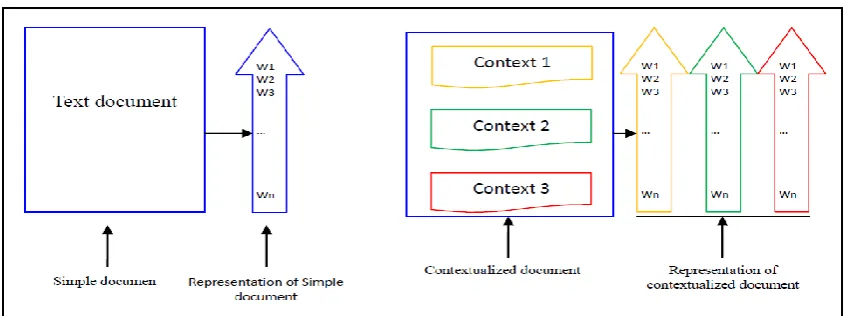
Fig. 2.Space Vector Modeling for a simple and a contextualized document.
score of each word according to the context. Thus, each document can be represented by a set of vectors, each vector modelise a given context (Fig. 2).
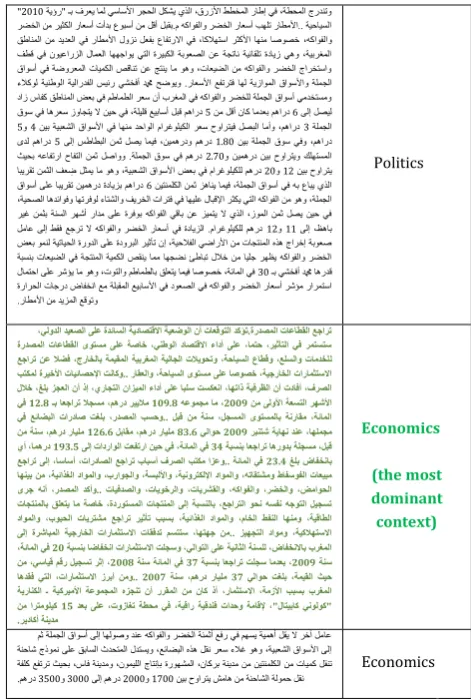
Then, for classification aim, every document is modeled by one vector wich is the must powerful vector (the vector with big scores). In other words, the most powerful vector represent the dominent context in a text. ،شٛشأرنا ٙف شًرغرع ،ٙنٔذنا ذٛؼصنا ٗهػ جذئاغنا حٚداصرللاا حٛؼظٕنا ٌأ خاؼلٕرنا ذكإذ جسذصًنا خاػاطمنا غظاشذ خلإٚؽذٔ ،حؼاٛغنا عاطلٔ ،غهغنأ خايذخهن جسذصًنا خاػاطمنا ٖٕرغي ٗهػ حصاخ ،ُٙغٕنا داصرللاا ءادأ ٗهػ ،اًرؼ ،ضساخنات حًٛمًنا حٛتشغًنا حٛناعنا . سامؼنأ ،حؼاٛغنا ٖٕرغي ٗهػ اصٕصخ ،حٛظساخنا خاساًصرعلاا غظاشذ ٍػ لاعف . ٌأ رئ ،٘ساعرنا ٌاضًٛنا ءادأ ٗهػ اثهع دغكؼَا ،آذار حٛفشظنا ٌأ خدافأ ،فشصنا ةركًن جشٛخلأا خاٛئاصؼلإا دَاكٔ ٍي ٗنٔلأا حؼغرنا شٓشلأا للاخ ،غهت ضعؼنا 2002 ّػًٕعي اي ، 802.8 غي ،ىْسد شٛٚلاي ـت اؼظاشذ لاع 82.8 ٙف . مثل ٍي حُع ،معغًنا ٖٕرغًنات حَسامي ،حئاًنا. شثُرش حٚآَ ذُػ ،آهًعي ٙف غئاعثنا خاسداص دغهت ،سذصًنا ةغؼٔ 2002 ٙنإؼ 8..8 متامي ،ىْسد ساٛهي 828.8 حثغُت اؼظاشذ اْسٔذت حهعغي ،مثل ٍي حُع ،ىْسد ساٛهي .3 ،حئاًنا ٙف ئ خادسإنا دؼفذسا ٍٛؼ ٙف ٗن 82..1 غهت ضافخَات ٘أ ،اًْسد 2..3 غظاشذ باثعأ فشصنا ةركي اضػٔ . حئاًنا ٙف ،حٛئازغنا دإًنأ ،بسإعنأ ،حغثنلأأ ،حَٛٔشركنلإا دإًنأ ،ّذامرشئ غافعٕفنا خاؼٛثي غظاشذ ٗنئ ،اعاعأ ،خاسداصنا خاٛفذصنأ ،خإٚخشنأ ،خاٚششمنأ ،ّكإفنأ ،شعخنأ ،طيإؽنا آُٛت ٍي ّظٕرنا مٛعغذ ٖشظ َّأ ،سذصًنا ذكأٔ . دإًنأ ،واخنا ػفُنا آُئ ،حٛلاطنا خاعرًُنات كهؼرٚ اي حصاخ ،جدسٕرغًنا خاعرًُنا ٗنئ حثغُنات ،غظاشرنا ٕؽَ ّغفَ خامفذذ ىغررع ،آرٓظ ٍي . ضٛٓعرنا دإئ ،حٛكلآرعلاا دإًنأ ،بٕثؽنا خاٚشرشي غظاشذ شٛشأذ ةثغت ،حٛئازغنا ًصرعلاا حثغُت اظافخَا خاساًصرعلاا دهععٔ ،ٙنإرنا ٗهػ حَٛاصنا حُغهن ،ضافخَلاات بشغًنا ٗنئ جششاثًنا حٛظساخنا خاسا 20 حُع ،حئاًنا ٙف 2002 حثغُت اؼظاشذ دهعع ايذؼت ، .3 حُع حئاًنا ٙف 2008 سٛؼ ٍي ،ٙعاٛل ىلس مٛعغذ ششئ ، ٙنإؼ دغهت ،حًٛمنا .3 حُع ،ىْسد ساٛهي 2003 صشتأ ٍئ . ،حيصلأا ةثغت بشغًنا اْذمف ٙرنا ،خاساًصرعلاا
،حٛلاس حٛلذُف خاذؼٔ حياللإ ،"لارٛتاك َٕٙنٕك" حٚساُكنا ـ حٛكشٛيلأا حػًٕعًنا ِضعُذ ٌأ سشمًنا ٍي ٌاك رأ ،ساًصرعلاا ذؼت ٗهػ ،خٔصاغذ حطؽي ٙف
81
كشٚ ٘زنا ،قسصلأا ػطخًنا ساغئ ٙف ،حطؽًنا ضسذُذٔ .شٚداكأ حُٚذي ٍي اشريٕهٛك م
حٚؤس" ـت فشؼٚ اًن ٙعاعلأا شعؽنا
2080
. حٛؼاٛغنا " ّكإفنأ شعخنا ساؼعأ ةٓهذ ساطيلأا
مؼفت عافذسلاا ٙف ،اكلآرعا شصكلأا آُي اصٕصخ ،ّكإفنأ شعخنا ٍي شٛصكنا ساؼعأ خأذت عٕثعأ ٍي ملأ مثل ٍػ حعذاَ حٛئامهذ جداٚص ْٙٔ ،حٛتشغًنا كغاًُنا ٍي ذٚذؼنا ٙف ساطيلأا لٔضَ لاًؼنا آٓظإٚ ٙرنا جشٛثكنا حتٕؼصنا قإعأ ٙف حظٔشؼًنا خاًٛكنا صلاُذ ٍػ طرُٚ اي ْٕٔ ،خاؼٛعنا ٍي ّكإفنأ شعخنا ضاشخرعأ فطل ٙف ٌٕٛػاسضنا .ساؼعلأا غفذشرف آن حٚصإًنا قإعلأأ حهًعنا شعخهن حهًعنا قإعأ ٙيذخرغئ ءلاكٕن حُٛغٕنا حٛناسذفنا ظٛئس ٙشخفأ محمد ػظٕٚٔ ٌأ بشغًنا ٙف ّكإفنأ ٗنئ مصٛن داص طافك كغاًُنا طؼت ٙف ىغاًطنا شؼع 8 ٍي ملأ ٌاك ايذؼت ىْاسد 1 لا ٍٛؼ ٙف ،حهٛهل غٛتاعأ مثل ىْاسد حهًعنا قٕع ٙف اْشؼع صٔاعرٚ . ٍٛت حٛثؼشنا قإعلأا ٙف آُي ذؼإنا واشغٕهٛكنا شؼع غٔاشرٛف مصثنا ايأٔ ،ىْاسد 3 ٔ 1 عنا قٕع ٙفٔ ،ىْاسد ٍٛت حهً 8.80 ٗنئ ظغاطثنا ًٍش مصٚ اًٛف ،ًٍْٛسدٔ ىْسد 1 غٔاشرٚٔ كهٓرغًنا ٖذن ىْاسد ٔ ًٍْٛسد ٍٛت 2.30 .حهًعنا قٕع ٙف ىْسد ٍٛت غٔاشرٚ سٛؽت ّػافذسا غافرنا ًٍش مصأٔ 82 ٔ 20 مصًٚ اي ْٕٔ ،حٛثؼشنا قإعلأا طؼت ٙف واشغٕهٛكهن ىْسد إعأ ٙف ّت عاثٚ ٘زنا اثٚشمذ ًٍصنا فؼ ِظ ٍٛرًُهكنا ًٍش ضْاُٚ اًٛف ،حهًعنا ق 8 قإعأ ٗهػ اثٚشمذ ًٍْٛسد جداٚضت ىْاسد مصٚ ٍٛؼ ٙف ،حٛؽصنا اْذئإفٔ آذشفٕن ءارشنأ فٚشخنا خاشرف ٙف آٛهػ لاثللإا شصكٚ ٙرنا ّكإفنا ٍي ْٕٔ ،حهًعنا شٛغ ًٍصت حُغنا شٓشأ ساذي ٗهػ جشفٕت ّكإفنا ٙلات ٍػ ضًٛرٚ لا ٘زنا ،صًٕنا ًٍش ٗنئ ،ظْات 88 ٔ 82 .واشغٕهٛكهن ىْسد ٌئ ،حٛؼلافنا ٙظاسلأا ٍي خاعرًُنا ِزْ ضاشخئ حتٕؼص مياػ ٗنئ ػمف غظشذ لا ّكإفنأ شعخنا ساؼعأ ٙف جداٚضنا حًٛكنا صمُٚ اًي آععَ ئغاثذ للاخ ٍي اٛهظ شٓظٚ ّكإفنأ شعخنا طؼت ًُٕن حٛذاٛؽنا جسٔذنا ٗهػ جدٔشثنا شٛشأذ ٛعنا ٙف حعرًُنا ـت ٙشخفأ محمد اْسذل حثغُت خاؼ .0 ششإٚ اي ْٕٔ ،خٕرنأ ىغاًطنات كهؼرٚ اًٛف اصٕصخ ،حئاًنا ٙف غلٕذٔ جساشؽنا خاظسد ضافخَا غي حهثمًنا غٛتاعلأا ٙف دٕؼصنا ٙف ّكإفنأ شعخنا ساؼعأ ششإي ساشًرعا لاًرؼا ٗهػ .ساطيلأا ٍي ذٚضًنا نا حًُشأ غفس ٙف ىٓغٚ حًْٛأ ممٚ لا شخآ مياػ قإعلأا ٗنئ ىش حهًعنا قإعأ ٗنئ آنٕصٔ ذُػ ّكإفنأ شعخ ٍي ٍٛرًُهكنا ٍي خاًٛك ممُذ حُؼاش ضرًَٕ ٗهػ كتاغنا زذؽرًنا لذرغٚٔ ،غئاعثنا ِزْ ممَ شؼع ءلاغ ْٕٔ ،حٛثؼشنا اشرٚ شياْ ٍي حُؼاشنا حنًٕؼ ممَ حفهك غفذشذ سٛؽت ،طاف حُٚذئ ،ًٌٕٛهنا ضارَات جسٕٓشًنا ،ٌاكشت حُٚذي ٍٛت غٔ 8300 ٔ 2000 ٗنئ ىْسد .000 ٔ .100 .ىْسد
Fig. 3. Original text.
4.
Experiments and Results
To evaluate our approach, we have used K Nearest Neighbor as a classifier. First, we conduct a test with the standard TFIDF system that represent a word by its weight. Then, we have attempted to classify each document by its most powerful vector extracted from the most dominant context.
4.1.
Corpus
To validate this new approach, we tested it on a varied corpus of 124 documents representing scripts of various lengths. Each article belong either to Economics, Politics or Sport.
Our experiments are at their beginning. So far, we have tested our system on a small database to approve its effectiveness. However, we develop a more complete corpus to test the efficiency of our coming algorithms.
4.2.
Classification Results
Text classification is an important part of the text mining process. It is providing a set of training data
حٚؤس" ـت فشؼٚ اًن ٙعاعلأا شعؽنا مكشٚ ٘زنا ،قسصلأا ػطخًنا ساغئ ٙف ،حطؽًنا ضسذُذٔ
2080 " شعخنا ٍي شٛصكنا ساؼعأ خأذت عٕثعأ ٍي ملأ مثمت.و ّكإفنأ شعخنا ساؼعأ ةٓهذ ساطيلأا.. حٛؼاٛغنا ،ّكإفنأ كغاًُنا ٍي ذٚذؼنا ٙف ساطيلأا لٔضَ مؼفت عافذسلاا ٙف ،اكلآرعا شصكلأا آُي اصٕصخ فطل ٙف ٌٕٛػاسضنا لاًؼنا آٓظإٚ ٙرنا جشٛثكنا حتٕؼصنا ٍػ حعذاَ حٛئامهذ جداٚص ْٙٔ ،حٛتشغًنا قإعأ ٙف حظٔشؼًنا خاًٛكنا صلاُذ ٍػ طرُٚ اي ْٕٔ ،خاؼٛعنا ٍي ّكإفنأ شعخنا ضاشخرعأ عنا ءلاكٕن حُٛغٕنا حٛناسذفنا ظٛئس ٙشخفأ محمد ػظٕٚٔ .ساؼعلأا غفذشرف آن حٚصإًنا قإعلأأ حهً داص طافك كغاًُنا طؼت ٙف ىغاًطنا شؼع ٌأ بشغًنا ٙف ّكإفنأ شعخهن حهًعنا قإعأ ٙيذخرغئ ٗنئ مصٛن 8 ٍي ملأ ٌاك ايذؼت ىْاسد 1 ْشؼع صٔاعرٚ لا ٍٛؼ ٙف ،حهٛهل غٛتاعأ مثل ىْاسد قٕع ٙف ا حهًعنا . ٍٛت حٛثؼشنا قإعلأا ٙف آُي ذؼإنا واشغٕهٛكنا شؼع غٔاشرٛف مصثنا ايأٔ ،ىْاسد 3 ٔ 1 ٍٛت حهًعنا قٕع ٙفٔ ،ىْاسد 8.80 ٗنئ ظغاطثنا ًٍش مصٚ اًٛف ،ًٍْٛسدٔ ىْسد 1 ٖذن ىْاسد ٔ ًٍْٛسد ٍٛت غٔاشرٚٔ كهٓرغًنا 2.30 فذسا غافرنا ًٍش مصأٔ .حهًعنا قٕع ٙف ىْسد سٛؽت ّػا ٍٛت غٔاشرٚ 82 ٔ 20 اثٚشمذ ًٍصنا فؼ ِظ مصًٚ اي ْٕٔ ،حٛثؼشنا قإعلأا طؼت ٙف واشغٕهٛكهن ىْسد ٍٛرًُهكنا ًٍش ضْاُٚ اًٛف ،حهًعنا قإعأ ٙف ّت عاثٚ ٘زنا 8 قإعأ ٗهػ اثٚشمذ ًٍْٛسد جداٚضت ىْاسد أ فٚشخنا خاشرف ٙف آٛهػ لاثللإا شصكٚ ٙرنا ّكإفنا ٍي ْٕٔ ،حهًعنا ،حٛؽصنا اْذئإفٔ آذشفٕن ءارشن شٛغ ًٍصت حُغنا شٓشأ ساذي ٗهػ جشفٕت ّكإفنا ٙلات ٍػ ضًٛرٚ لا ٘زنا ،صًٕنا ًٍش مصٚ ٍٛؼ ٙف ٗنئ ،ظْات 88 ٔ 82 مياػ ٗنئ ػمف غظشذ لا ّكإفنأ شعخنا ساؼعأ ٙف جداٚضنا .واشغٕهٛكهن ىْسد أذ ٌئ ،حٛؼلافنا ٙظاسلأا ٍي خاعرًُنا ِزْ ضاشخئ حتٕؼص طؼت ًُٕن حٛذاٛؽنا جسٔذنا ٗهػ جدٔشثنا شٛش حثغُت خاؼٛعنا ٙف حعرًُنا حًٛكنا صمُٚ اًي آععَ ئغاثذ للاخ ٍي اٛهظ شٓظٚ ّكإفنأ شعخنا ـت ٙشخفأ محمد اْسذل .0 لاًرؼا ٗهػ ششإٚ اي ْٕٔ ،خٕرنأ ىغاًطنات كهؼرٚ اًٛف اصٕصخ ،حئاًنا ٙف ا ٙف ّكإفنأ شعخنا ساؼعأ ششإي ساشًرعا جساشؽنا خاظسد ضافخَا غي حهثمًنا غٛتاعلأا ٙف دٕؼصن .ساطيلأا ٍي ذٚضًنا غلٕذٔ Politics ،ٙنٔذنا ذٛؼصنا ٗهػ جذئاسنا حٚداصرقلاا حٛؼظٕنا ٌأ خاؼقٕرنا ذكؤذ.جسذصًنا خاػاطقنا غجاشذ جسذصًنا خاػاطقنا ٖٕرسي ٗهػ حصاخ ،ُٙغٕنا داصرقلاا ءادأ ٗهػ ،اًرح ،شٛثأرنا ٙف شًرسرس ن غجاشذ ٍػ لاعف ،جساخنات حًٛقًنا حٛتشغًنا حٛناجنا خلإٚحذٔ ،ححاٛسنا عاطقٔ ،غهسنأ خايذخه ةركًن جشٛخلأا خاٛئاصحلإا دَاكٔ.. ساقؼنأ ،ححاٛسنا ٖٕرسي ٗهػ اصٕصخ ،حٛجساخنا خاساًثرسلاا ضجؼنا ٌأ رإ ،٘ساجرنا ٌاضًٛنا ءادأ ٗهػ اثهس دسكؼَا ،آذار حٛفشظنا ٌأ خدافأ ،فشصنا للاخ ،غهت ٍي ٗنٔلأا حؼسرنا شٓشلأا 900@ ّػًٕجي اي ، 80@0? ـت اؼجاشذ لاجسي ،ىْسد شٛٚلاي 890? ٙف ٙف غئاعثنا خاسداص دغهت ،سذصًنا ةسحٔ.. مثق ٍي حُس ،مجسًنا ٖٕرسًنات حَساقي ،حئاًنا شثُرش حٚآَ ذُػ ،آهًجي 900@ ٙنإح ?:0= متاقي ،ىْسد ساٛهي 89=0= ٍي حُس ،ىْسد ساٛهي حثسُت اؼجاشذ اْسٔذت حهجسي ،مثق :; ٗنإ خادسإنا دؼفذسا ٍٛح ٙف ،حئاًنا ٙف 8@:0< ٘أ ،اًْسد غهت ضافخَات 9:0; غجاشذ ٗنإ ،اساسأ ،خاسداصنا غجاشذ باثسأ فشصنا ةركي اضػٔ.. حئاًنا ٙف حٛئازغنا دإًنأ ،بسإجنأ ،حسثنلأأ ،حَٛٔشركنلإا دإًنأ ،ّذاقرشئ غافسٕفنا خاؼٛثي آُٛت ٍي ، ٖشج َّأ ،سذصًنا ذكأٔ.. خاٛفذصنأ ،خإٚخشنأ ،خاٚششقنأ ،ّكإفنأ ،شعخنأ ،طيإحنا خاجرًُنات قهؼرٚ اي حصاخ ،جدسٕرسًنا خاجرًُنا ٗنإ حثسُنات ،غجاشرنا ٕحَ ّسفَ ّجٕرنا مٛجسذ ٕثحنا خاٚشرشي غجاشذ شٛثأذ ةثست ،حٛئازغنا دإًنأ ،واخنا ػفُنا آُئ ،حٛقاطنا دإًنأ ،ب ٗنإ جششاثًنا حٛجساخنا خاساًثرسلاا خاقفذذ ىسررس ،آرٓج ٍي.. ضٛٓجرنا دإئ ،حٛكلآرسلاا حثسُت اظافخَا خاساًثرسلاا دهجسٔ ،ٙنإرنا ٗهػ حَٛاثنا حُسهن ،ضافخَلاات بشغًنا 90 ،حئاًنا ٙف حُس 900@ حثسُت اؼجاشذ دهجس ايذؼت ، :> حُس حئاًنا ٙف 900? س مٛجسذ شثإ ، ٍي ،ٙساٛق ىق ٙنإح دغهت ،حًٛقنا ثٛح :> حُس ،ىْسد ساٛهي 900> اْذقف ٙرنا ،خاساًثرسلاا صشتأ ٍئ.. حٚساُكنا ـ حٛكشٛيلأا حػًٕجًنا ِضجُذ ٌأ سشقًنا ٍي ٌاك رأ ،ساًثرسلاا ،حيصلأا ةثست بشغًنا ذؼت ٗهػ ،خٔصاغذ حطحي ٙف ،حٛقاس حٛقذُف خاذحٔ حياقلإ ،"لارٛتاك َٕٙنٕك"
8< ٛك ٍي اشريٕه .شٚداكأ حُٚذي Economics (the most dominant context) ىش حهًعنا قإعأ ٗنئ آنٕصٔ ذُػ ّكإفنأ شعخنا حًُشأ غفس ٙف ىٓغٚ حًْٛأ ممٚ لا شخآ مياػ حُؼاش ضرًَٕ ٗهػ كتاغنا زذؽرًنا لذرغٚٔ ،غئاعثنا ِزْ ممَ شؼع ءلاغ ْٕٔ ،حٛثؼشنا قإعلأا ٗنئ نا ٍي خاًٛك ممُذ حفهك غفذشذ سٛؽت ،طاف حُٚذئ ،ًٌٕٛهنا ضارَات جسٕٓشًنا ،ٌاكشت حُٚذي ٍي ٍٛرًُهك ٍٛت غٔاشرٚ شياْ ٍي حُؼاشنا حنًٕؼ ممَ 8300 ٔ 2000 ٗنئ ىْسد .000 ٔ .100 .ىْسد Economics
(tagged documents) to the classification system. The task then is to determine a classification model that is able to affect the right class for a new document.
To evaluate the classification performance, three metrics are used: precision, recall and F-measure.
Table 1. Classification Results
Precision Recall F-measure
TF IDF indexation 0.619 0.6 0.609
Contextual indexation 0.805 0.8 0.802
Table 1 shows different results for each measure. These results are expressed through the recall, precision and F-measure criteria. In particular, they show the relevance of using contextual indexation which greatly improves the measures’ performances.
The first method (TF IDF) is basic, it represents each document by a vector of characteristics coming from the frequency weighting. However, in our proposed approach, after carrying out all the contextualization steps, the system provides a number of vectors that correspond to the number of contexts per document. Then, our system represents each document by the most significant vector that corresponds to the most dominant context in a given document.
4.3.
Discussion
Compared to other languages, the Arabic language has a very rich morphological variation and extremely complex syntactic and flexional characteristics, which is one of the main reasons why the lack of research methods in the field of treatment of Arabic. Indexing and classification of texts are important tasks of text mining process. A typical process of text classification consists of the following steps: pre-processing, indexing, dimension reduction, and classification.
Statistical approaches represent the text a list of weighted keywords. This representation is adapted to capture the frequency of occurrence of a word and ignores the structural and semantic information of the document. However, it is not suitable for modeling semantics. This type of technique offers good results in specific cases, However, taking into account the semantics, it is clear that the approach we have proposed improves the classification results.
Experimental evaluation of the classifier is the final step of the indexing process. It usually tries to evaluate the effectiveness of a classifier, namely its ability to make categorization decisions. There are many measures for this purpose, each highlighting a particular property of the system. The documents processing in the Arabic language is confronted with another problem, that of the evaluations of the methods on the corpus. In most works on Arabic texts, and in the absence of a free standard corpus, authors construct their own corpus. They choose the number of categories and their themes. For each category the documents are collected manually. Documents belonging to several categories are eliminated. However, in order to test the accuracy of the different methods, they must be applied to the same corpus, even more so that a method proves its effectiveness it must be applied to several corpus of different themes.
5.
Conclusion
The semantic proximity between words must be highlighted when we deal with complex and unstructured documents such as texts in Arabic. For this purpose, it is essential to broaden our reflection to the adapted representation models to the nature of our resources. For this aim, we studied the research model based on the contextual indexation model.
have introduced our clustering contribution to formalize the adaptation of the model based on the semantic proximity. The advantage of this model is that it does not need a preliminary glossary to identify terms in order to assign them a weight, since the identification of terms is made simply from a document processing.
References
[1] EL Bazzi, M. S., & Mammass, D. (2017). A graph based method for Arabic document indexing.
Proceedings of 2017 International Conference on Information and Digital Technologies (IDT) (pp. 308-312).
[2] Mesleh, A. (2007). Support vector machines based Arabic language text classification system: Feature selection comparative study. Proceedings of the 12th WSEAS International Conference on Applied Mathematics (pp. 11–16).
[3] Thabtah F., Eljinini, M., Zamzeer, M., & Hadi, W. (2009). Naïve bayesian based on Chi square to categorize Arabic data. Proceedings of the 11th International Business Information Management Association Conference (IBIMA) Conference on Innovation and Knowledge Management in Twin Track Economies, IBIMA’2009 (pp. 930–935).
[4] Bawaneh, M. J., Alkoffash, M. S., & Al Rabea, A. I. (2008). Arabic text classification using K-NN and Naive bayes. Journal of Computer Science, 4, 600-605.
[5] Kanaan G., Yaseen, M., Al-Shalabi, R., Al-Sarayreh, B., & Mustafa, A. (2009). Using EM for text classification on Arabic. Proceedings of the Second International Conference on Arabic Language Resources and Tools.
[6] Raheel, S., & Dichy, J. (2010). An empirical study on the feature qs type effect on the automatic classification of Arabic documents. Proceedings of the 11th International Conference on Computational Linguistics and Intelligent Text Processing, CICLing’80 (pp. 673–686).
[7] Zaki, T., Mammass, D., & Ennaji, A. (2010). A semantic proximity based system of Arabic text indexation.
International Conference on Image and Signal Processing (ICISP).
[8] Al-Salemi, B., & Aziz, M. J. A. (2011). Statistical Bayesian learning for automatic Arabic text categorization. Journal of Computer Science, 7(1), 39-45.
[9] Mansour N., Haraty, R. A., Daher, W., & Houri, M. (2008). An auto-indexing method for Arabic text.
Information Processing and Management, 44(4), 1538-154.
[10]Tomokiyo, T., & Hurst, M. (2003). A language model approach to keyphrase extraction. Proceedings of the ACL Workshop on Multiword Ex- Pressions.
[11]Jamoussi, S. (2009). Une nouvelle représentation vectorielle pour la classification sémantique. TAL, 50.
[12]Zaki, T., Mammass, D., Ennaji, A., & Nicolas, S. (2014). A kernel hybridization NGram-Okapi for indexing and classification of Arabic documents. Journal of Information and Computing Science, 9(2), 141-153. [13]Liu, Z., Peng, L., Yabin, Z., & Maosong, S. (2009). Clustering to find exemplar terms for keyphrase
extraction. Proceedings of the 2009 Conference on Empirical Methods in Natural Language Processing
(pp. 257-266).
Driss Mammass is professor of higher education at the Faculty of Sciences, University Ibn Zohr, Agadir Morocco. He received a doctorat in mathematics in 1988 from Paul Sabatier University (Toulouse - France) and a doctorat d'Etat-es-sciences degrees in mathematics and image processing from University Ibn Zohr Agadir Morocco, in 1999. He supervises several Ph.D theses in the various research themes of mathematics and computer science. He used to be director of High School of Technology Agadir and the head of IRF-SIC laboratory.
Abdelati Ennaji has been an associate professor at the University of Rouen since 1993. He received his Ph.D from the University of Rouen in 1993 in the fields of machine learning and pattern recognition. His major scientific interest include incremental technics for statistical and hybrid machine learning, data analysis and clustering. The main applications of these activities concern pattern recognition problems and Arabic text mining and recognition.