Analyzing the Effect of Denial of Service Attack
on Network Performance
Basil Peter Nisanth Krishnan
PG Student Assistant Professor
Department of Electronics and Communication Department of Electronics and Communication Toc H Institute of Science and Technology, Ernakulam, Toc H Institute of Science and Technology, Ernakulam,
Kerala, India Kerala, India
Abstract
Networks are prone to security attacks, and wireless infrastructure network is more vulnerable. The number of people preferring Wireless networks compared to the wired network has seen an expansion of user base owing to the fast and easy installation of wireless infrastructure. Security issues also increases proportionally as the number of users increases. One of the major security issues witnessed in wireless networks is denial-of service (DoS) attack. A denial-of service (DoS) attack can be defined as an attempt to make the network resource unavailable to its intended users, which may be to temporarily interrupt or suspend services of a host connected to the Internet. Therefore it is imperative to understand the extent of, the effect of denial of service attack on normal network performance. In this paper the effect on network performance due to Denial of Service attack is evaluated by measuring the throughput, number of packets received and the number of packets lost and then comparing it with a network which is not under attack.
Keywords: Denial of Service Attacks, Mac Spoof, Access point, IEEE 802.11, WLAN
________________________________________________________________________________________________________
I. INTRODUCTION
When you Wireless networking presents many advantages Productivity improves because of increased accessibility to information resources. Network configuration and reconfiguration is easier, faster, and less expensive. However, wireless technology also creates new threats and alters the existing information security risk profile. For example, because communications takes place "through the air" using radio frequencies, the risk of interception is greater than with wired networks. If the message is not encrypted, or encrypted with a weak algorithm, the attacker can read it, thereby compromising confidentiality. Although wireless networking alters the risks associated with various threats to security, the overall security objectives remain the same as with wired networks: preserving confidentiality, ensuring integrity, and maintaining availability of the information and information systems.
Wireless Network technology, while replete with the conveniences and advantages described above has its share of downfalls. For a given networking situation, wireless Networks may not be desirable for a number of reasons. Most of these have to do with the inherent limitations of the technology. The disadvantages of using a wireless network are: Security, Range, Reliability, and Speed. Wireless Networks present a host of issues for network managers. Unauthorized access points, broadcasted SSIDs, unknown stations, and spoofed MAC addresses are just a few of the problems addressed in WLAN troubleshooting. The common types of wireless network attacks are:
Accidental association
When a user turns on a computer and it latches on to a wireless access point from a neighbouring company’s overlapping network, it is a security breach in that proprietary company information is exposed
Malicious association
“Malicious associations” are when wireless devices can be actively made by crackers to connect to a company network through their cracking laptop instead of a company access point (AP).
Denial of service
Denial of Service attack is an attempt to make computer resources unavailable to its legitimate users. A Denial-of-Service attack (DoS) occurs when an attacker continually bombards a targeted AP (Access Point) or network with bogus requests, premature successful connection messages and failure messages.
describes about the different types of denial of service attacks and the real time importance of analysing the effect of DoS. In Section III, the Simulation Environment is explained and the results are shown in section IV, Sections V includes the conclusion and future scope.
II. DENIAL OF SERVICE ATTACK
Denial of Service Attack, according to Chung-Hsin Liu et al (2010) is an attempt by the hacker to utilize the network in place of the authenticated user [1] .The most common DoS attacks are attacks on computer networks and bandwidth. The wireless local area network commonly uses WEP (Wired Equivalent Privacy) encryption technology. Although it has encryption mechanism, but the WEP encryption mechanism has serious structural design deficiencies which lead to a DoS attacks. United States Computer Emergency Readiness Team (US-CERT) defines symptoms of denial-of-service attacks WHICH INCLUDE unusually slow network performance (opening files or accessing web sites), unavailability of a particular web site, dramatic increase in the number of spam emails received—(this type of DoS attack is considered an e-mail bomb [2]) and long term denial of access to the web or any internet services.
There are two general forms of DoS attacks: those that crash services and those that flood services.
Teardrop attacks
In teardrop attack mangled IP fragments are send with overlapping, over-sized payloads to the target machine. This can crash various operating systems because of a bug in their TCP/IP fragmentation re-assembly code.
Nuke
A Nuke is an old denial-of-service attack against computer networks consisting of fragmented or otherwise invalid ICMP packets sent to the target, achieved by using a modified ping utility to repeatedly send this corrupt data, thus slowing down the affected computer until it comes to a complete stop.
HTTP POST DoS attack
The HTTP POST attack sends a complete, legitimate HTTP POST header, which includes a 'Content-Length' field to specify the size of the message body to follow. However, the attacker then proceeds to send the actual message body at an extremely slow rate (e.g. 1 byte/110 seconds). Due to the entire message being correct and complete, the target server will attempt to obey the 'Content-Length' field in the header, and wait for the entire body of the message to be transmitted, which can take a very long time. The attacker establishes hundreds or even thousands of such connections, until all resources for incoming connections on the server (the victim) are used up, hence making any further (including legitimate) connections impossible until all data ha s been sent.
R-U-Dead-Yet? (RUDY)
This attack targets web applications by starvation of available sessions on the web server. RUDY keeps sessions at halt using never-ending POST transmissions and sending an arbitrarily large content-length header value.
Distributed attack
A distributed denial-of-service (DDoS) attack occurs when multiple systems flood the bandwidth or resources of a targeted system, usually one or more web servers. Such an attack is often the result of multiple compromised systems (for example a botnet) flooding the targeted system with traffic. When a server is overloaded with connections, new connections can no longer be accepted. The major advantages to an attacker of using a distributed denial-of-service attack are that multiple machines can generate more attack traffic than one machine, multiple attack machines are harder to turn off than one attack machine, and that the behaviour of each attack machine can be stealthier, making it harder to track and shut down.
Sophisticated low-bandwidth Distributed Denial-of-Service Attack
III. SIMULATION ENVIRONMENT
The simulation was done in NS2 .Network Simulator (Version 2), widely known as NS2, is simply an event driven simulation tool that has proved useful in studying the dynamic nature of communication networks. Simulation of wired as well as wireless network functions and protocols (e.g., routing algorithms, TCP, UDP) can be done using NS2. In general, NS2 provides users with a way of specifying such network protocols and simulating their corresponding behavior.
NS2 is an event driven, object oriented network simulator enabling the simulation of a variety of local and wide area networks. It implements different network protocols (TCP, UDP), traffic sources (FTP, web, CBR, Exponential on/off), queue management mechanisms (RED, Drop Tail), routing protocols (Dijkstra) etc. NS2 is written in C++ and Otcl to separate the control and data path implementations. The simulator supports a class hierarchy in C++ (the compiled hierarchy) and a corresponding hierarchy within the Otcl interpreter (interpreted hierarchy).
The normal network scenario consisted of a base station node and three user nodes. In the next scenario a base station node and three user nodes were again considered. But this time the user node 2 was under a distributed denial of service attack by 5 nodes.
Table -1 Simulation Parameters Simulation Setup Routng protocol AODV
Topography 6279*481 m2
No. of mobile nodes 9
No. of attackers 5
Traffic type CBR
Simulation time 110s
MAC protocol IEEE 802_11
IV. RESULT AND DISCUSSION
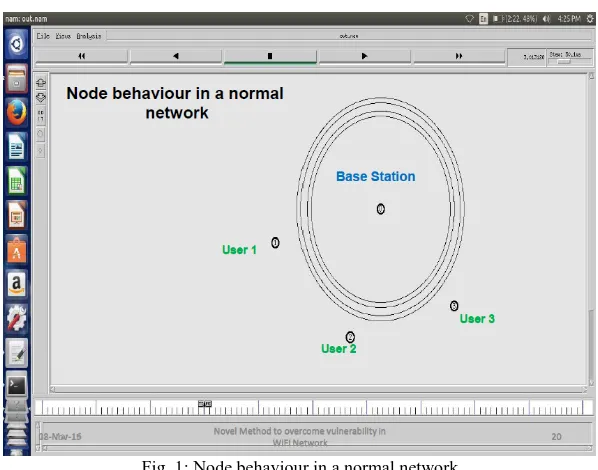
Fig. 1: Node behaviour in a normal network
Fig. 1 shows the behaviour of a node in a normal network scenario. Here the base station node communicates with the user nodes. In fig. 2 the user node 2 is under attack by 5 attacking nodes.
Fig. 2: Node behaviour under denial of service attack (DoS)
Fig. 5: Rate vs. Number of packets received
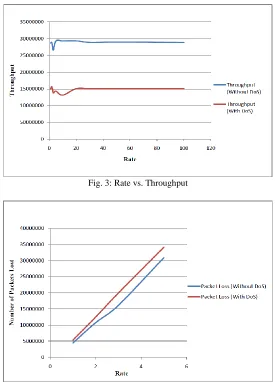
In the fig 4, it shows the graph of rate vs. Number of packets received. Packet Loss increases when the node is under attack. In Fig 5, Rate Vs. Number of packets received is plotted. From the graph it is very clear that The number of packets received also considerably decreases when the node is under DoS attack. Denial of Service attack can greatly affect the network performance. When the number of nodes is increased to say 100 or 1000 then it’s seen that the website crashes due to Denial of Service attack.
V. CONCLUSION
The Denial of Service Attack may result in blocking out the legitimate users from the network and denial of availability of the network resources to the user. In this paper an analysis was done to understand the impact of Denial of Service attack on the network performance. It was evaluated in network simulator 2 and the performance was compared against parameters like throughput, number of packets lost and packets received. It was seen that the performance of a network is greatly affected when a network is under denial of service attack. Therefore it is imperative that we find optimum solutions to overcome the issue.
REFERENCES
[1] Chung-Hsin Liu & Yong-Zhi Huang, “The analysis for DoS and DDoS attacks of WLAN” , In Proc of IEEE Second International Conference on
MultiMedia and Information Technology, pp.108-111, 2010
[2] McDowell, Mindi (November 4, 2009). "Cyber Security Tip ST04-015 - Understanding Denial-of-Service Attacks". United States Computer Emergency
Readiness Team. Archived from the original on 2013-11-04. Retrieved December 11, 2013.
[3] Ben-Porat, U.; Bremler-Barr, A.; Levy, H. (2013-05-01)."Vulnerability of Network Mechanisms to Sophisticated DDoS Attacks". IEEE Transactions on Computers 62 (5): 1031–1043.Doi:10.1109/TC.2012.49. ISSN 0018-9340.
[4] Farooq Anjum, Subir Das, Praveen Gopalakrishnan, Latha Kant & Byungsuk Kim. “Security in an Insecure WLAN Network”, In Proc of IEEE
International Conference on Wireless Networks, Communications and Mobile Computing, pp. 292-297, 2005
[5] Guo, F., &Chiueh, T. C., "Sequence number-based MAC address spoof detection", In Proc of 8th international conference on Recent Advances in Intrusion
Detection, Vol. No. 3858, pp. 309-329, Springer Berlin Heidelberg 2006.
[6] Yong Sheng, Keren Tan, Guanling Chen, David Kotz1 & Andrew Campbell, “Detecting 802.11 MAC Layer Spoofing Using Received Signal Strength”, In
Proc of IEEE the 27th Conference on Computer Communications, 2008
[7] Chung-Hsin Liu & Yong-Zhi Huang, “The analysis for DoS and DDoS attacks of WLAN” , In Proc of IEEE Second International Conference on
MultiMedia and Information Technology, pp.108-111, 2010
[8] Zhang Laishun, Zhang Minglei, & GuoYuanbo, “ A Client puzzle based defense mechanism to resist DoS attacks in WLAN”, In Proc of IEEE International
Forum on Information Technology and Applications., pp. 424-427, 2010
[9] Jeich Mar,Yow-Cheng Yeh & I-Fan Hsiao, “An ANFIS-IDS against De authentication DOS attacks for a WLAN”, In Proc of IEEE International
Symposium on Information Theory and its Applications (ISITA), , pp.548-553, 2010