Group Decision Making Coordinating
Characteristic Analysis and Modeling of Water
Resource Allocation and Scheduling
Wei Huang and Xingnan Zhang
National Engineering Research Center of Water Resources Efficient Utilization and Engineering Safety, College of Hydrology and Water Resources, Hohai University, Nanjing, P. R. China
Email: [email protected]
Chenming Li and Jianying Wang
College of Computer and Information Engineering Hohai University, Nanjing, P. R. China
Abstract—Group decision-making management is an important issue in water management reform and development. The lacking of effective communication and cooperation is the major defects of the existing group decision-making models. Based on the in-depth analysis of the coordinating characteristic in group decision making, this study proposed a multi-layer dynamic model of water resource allocation and scheduling. This model focuses on effective communication and coordination. In order to solve the problem of poor convergence of multi-round decision-making process in water resource allocation and scheduling, the scheme-recognized cooperative satisfaction index and scheme-adjusted rationality index are introduced. An optimization algorithm based on the effective distance of group utility is proposed, which can solve the problem about coordination of limited resources-based group decision-making process. The simulation results show that the proposed model has better convergence than the existing models.
Keywords—Dynamic Group Decision-Making, Multi-layer Dynamic Model, Optimization Algorithm, Water Management
I. INTRODUCTION
The current water allocation and management can not adapt to the request for the water management institutional reform in China. Because the water resource management requires building up cooperative mechanism of parts participant, democratic consultation, common decision, individual responsibility and efficient execution mechanism, the water regulation should transform individual making mode to group decision-making mode. It is a hot topic that how to set up a good communication and coordination mechanism among different organizations to form a feasible group making process in water resource transfer group decision-making model.
Many researchers have conducted many researches on group decision-making problem. For example, Karamouz M [1] studied comparative weight of water quality
parameters in group decision-making. Ananda J [2] research on forest management and planning using group decision-making. Mata F [3]study multigranular fuzzy linguistic context problem in group decision-making. Saaty Tl [4] studied policy and psychology problems in group decision-making, Herrera F [5] worked over isomerism information problems in group decision-making, and so on. However, there is little work applying group decision-making method to the field of water resource configuration and transfer.
Other researchers such as the References [6-10] expatiate the selection of water resource decision-making scheme is not a individual decision-making problem but a group decision-making problem, which mainly pay attention to water resource field such as water resource bearing capacity, instead of group decision-making problem of how to cooperate efficiently.
Based on the coordinating characteristic in group decision making and the characteristic of water resource configuration, a multi-layer dynamic model of water resource allocation and scheduling is proposed in the paper. This model is a objection, layer, multi-time interval, multi-restriction and multi-round decision-making process on the basis of cooperation. In order to solve the problem of poor convergence of multi-round decision-making process in water resource allocation and scheduling, the scheme-recognized cooperative satisfaction index and scheme-adjusted rationality index is introduced and an optimization algorithm based on the effective distance of group utility is applied in the proposed model. At last, this model is preliminary validated on the Swarm simulation platform.
II. THE MULTI-LAYER DYNAMIC MODEL
consistent with group interaction. After deeply analyzing multi-round group decision-making, Hackman [12] advised to attach importance to decision makers’ initial preferences, found out the adjacent scheme to every decision maker’s initial preference. This model needs introducing scheme-recognized cooperative satisfaction degree index and scheme-adjusted rationality index to impel multi-round convergence.
A. Objective system analysis on inter-basin water transfer management system
Nowadays, most water resource configured objective system concerns three core objectives, which are society, economy and ecology, and they are described as multi-objective solution problems below [13].
Z=max{ ( ), ( ), ( )}S W E W E Wc u . (1)
where S W( )、E Wc( )、E Wu( ) represents the social objective, the economical objective and the ecological objective respectively, and W is called water resource vector which denotes all kinds of available water resource.
In this paper, satisfaction is the core objective of the inter-basin water transfer system configuration.
(a) Social objectives: ① Satisfaction degree of urban
water for life, ② Satisfaction degree of country water for
life, ③ Urban environmental health degree ④ Country
environmental health degree, ⑤ Region employment
rate, ⑥ Urban level of income, ⑦ Country level of
income.
(b) Economical objectives: ① Industrial structure
rationality, ② Industrial development insurance rate, ③
Region short-term input-output efficiency, ④Region
long-term input-output efficiency, ⑤ GDP rate of rise, ⑥
Region economical implement degree.
(c) Ecological objectives: ①Urban environmental
water-use insurance rate, ② Country environmental
water-use insurance rate, ③ Ecological sustainable sound
development degree, ④ BOD discharge, ⑤ COD
discharge.
B. Cooperative multi-layer dynamic group decision-making model
The usual group decision-making means that the groups can select the optimal scheme from many different ones, and form their collective preference. It is generally described as the following: If there are multiple making schemes, they constitute a decision-making scheme set; several decision makers compose decision-making group. Then the decision-making group selects or sorts the scheme set based on the individual preference. Although the members’ individual preference in the group has not changed, the result of the decision-making will be different with the different group decision-making rules.
The usual group decision-making may not have the adequate coordination. In order to overcome the problem,
this paper provides the multilayer dynamic group decision-making coordination model. Firstly, it divides the group of decision-making into several layers (such as layer 1,2, ..., K, K + 1,... .). Then it constructs the scheme set about group decision-making. Finally, according to the threshold value of group satisfaction, the satisfactory scheme sequence will be obtained, through many times consolation by the decision-making groups which distribute in the same layer or between different layers. C. Models and algorithm
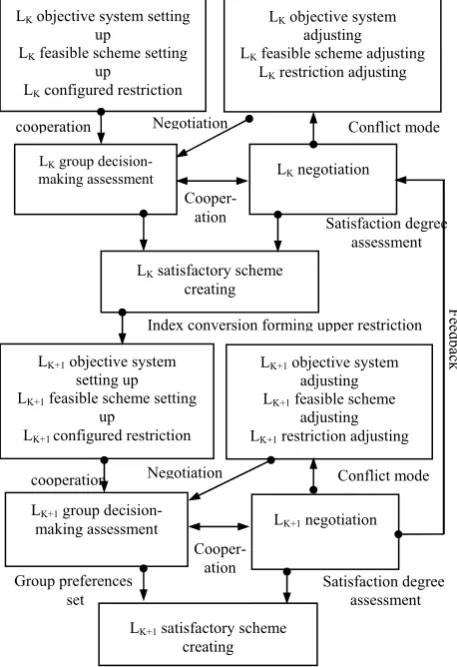
The main sections of cooperative multi-layer dynamic group decision-making conclude ①Objective system
setting up and feasible scheme drawing out, objective system and feasible scheme checking, ② Group
decision-making assessment, ③ Cooperative and conflict analysis, ④ Scheme adjusting, and so on. Cooperative multi-layer
dynamic group decision-making model is shown as Fig. 1.
The algorithm of cooperative multi-layer dynamic group decision-making model is described as follows.
Figure 1. Cooperative multi-layer dynamic group decision-making model
1 k
Step According to the (K-1)th layer’s guidance restriction and the Kth layer’s macroscopical objective concept, each decision maker’s scheme advices and so on, the cooperative group organizes layer K expert group to build up the Kth layer’s objective system, feasible
Feedback
Satisfaction degree assessment
Group preferences set
cooperation Negotiation Conflict mode
Index conversion forming upper restriction LK objective system setting
up
LK feasible scheme setting
up
LK configured restriction
LK group
decision-making assessment LK negotiation
LK+1 satisfactory scheme
creating
LK objective system
adjusting LK feasible scheme adjusting
LK restriction adjusting
LK satisfactory scheme
creating
LK+1 objective system
setting up LK+1 feasible scheme setting
up
LK+1 configured restriction
LK+1 objective system
adjusting LK+1 feasible scheme
adjusting LK+1 restriction adjusting
LK+1 group
decision-making assessment LK+1 negotiation
Cooper- ation
Negotiation
Satisfaction degree assessment cooperation
Cooper- ation
scheme group and the Kth layer’s constraint conditions of each scheme.
2 k
Step The preparation for cooperators’ negotiation.
① Adjustable threshold interval θ θmin, ave of group
satisfaction degree scheme recognized is set.
② The maximum number of interaction rounds is I
which is promised with decision makers together.
③ Cooperators organize the round(i+1) negotiation. 3
k
Step With the organization of cooperative group, each decision makers group begins to the round i scheme negotiation.
①Decision makers construct judgment matrix of
objective system.
②Decision makers describe initial preferences of
schemes.
③ Cooperators organize interchange and
peer-assessment of preferences information among decision makers.
④On the condition of observing other decision
makers’ preferences, decision makers adjust their scheme index according to constraint satisfaction.
⑤ Cooperators observe each decision makers’ scheme
adjusting, if adjusting exists, rational judgment is done. If it is rational, turn to ③, otherwise, keep preference before
adjusting (seemed as no adjusting). If there is no adjusting in this round, or i>I interactive round exceeds threshold, then turn to ⑥.
⑥ Solution set of group satisfactory comes into being.
If group satisfactory degree exceeds the threshold θave,
then turn to 5 k
Step , otherwise, turn to Stepk4.
4 k
Step Cooperative group organizes experts to analyze conflict and adjust objectives, schemes and constraints.
① According to the historical interactive information,
conflicted pattern is analyzed and abstracted, conflicted point and consensus point are distinguished.
② If the groups’ adjusting intension for objectives,
schemes and constraints is entirely reasonable, objectives, schemes and constraints are properly adjusted according to basic constraints, i=i+1, then turn to 2
k
Step , the round(i+1) negotiation is done.
③ If the groups’ adjusting intension for objectives,
schemes and constraints is unreasonable, then the threshold of satisfactory degree is adjusted. If it is no less than θmin, then turn to Step5k. Otherwise, turn to
6 k
Step .
5 k
Step According to the threshold of group’s satisfactory degree, satisfied schemes are sorted in the group satisfied solution set, the optimal scheme is found, the lower decision-making’s constraint set is arranged, the approbatory protocol of decision-making groups’ scheme for this layer is impelled, and penalized cost μ protocol violated is promised. Then the algorithm comes into the layer(K+1), when this layer ends.
6 k
Step The cooperative group of the Kth layer organizes experts to compute cost of choice scheme. If the whole utility of the scheme is lower than μ, then the
scheme and constraints opinions for the upper (K-1)th layer come into being, which is fed back to (K-1)th layer’s cooperative group, otherwise, objectives, schemes and constraints should be adjusted, and bonus-penalty factor should be added, then turn to 2
k
Step .
D. Cooperative satisfactory degree index recognized by scheme
There are some questions in group preferences consistent for cooperative multi-layer dynamic group decision-making. These questions include (1) Basic assumption does not accord with the facts. (2) Average value can not present the other party’s satisfactory degree to solve the above problems, this model adopts a kind of cooperative satisfactory degree definition and computing method.
Assume the k th layer l th multi-layer cooperative dynamic group decision-making sub-system k
l
mcgc has scheme created frame k
P , k k, ,k k
P =<A G R > ,
1 2
( , ,..., )
k k k k
m
A = a a a is scheme index set (attribute set),
1 2
( , ,..., k)
k k k k
q
G = g g g is objective function set,
1 2
( , ,..., )k
k k k k
t
R = r r r is constraint function set. In this frame, there is N groups scheme to choose,
1 2
( , ,..., )
k k k k
n
VA = VA VA VA , k i
VA is a group of constraints for
k
A which satisfies evaluation, ( 1, 2,..., )
m
k k k k
i i i i
VA = va va va . For _ k
i l
agent ∈group d , the objective function set and constraint function set of k 1
j
mcgc + which belongs to
i
agent are
1
1 1 1 1
1 2
( , ,..., k )
k k k k
q
G g g g
+
+ = + + + ,
1
1 1 1 1
1 2
( , ,..., k )
k k k k
t
R r r r
+
+ = + + +
respectively. Thus, the satisfactory analysis for the scheme of agenti is a multi-objective optimization
problem on the condition of k 1
G+ and k 1
R+ :
1
1
1 1 1
1 2
1 1 1
1 2
max { ( ), ( ),..., ( )}
. . ( ) ( ) ... ( )
1... 0
k k
k k k k k k
q
k k k k k k
t
k i
g A g A g A
s t r A r A r A
i m a + + + + + + + + ⎧ ⎪ ⎪ ⎪ ∧ ∧ ∧ ⎨ ⎪ = > ⎪ ⎪⎩ (2)
Assume S is the constraint space in 2.2, Z the objective satisfied to space, and S is m-dimensional real value space, Z is (qk+1)-dimensional real value space. Z is image set under objective constraints of S.
Definition 2-1: Pareto solution set p
Z ⊆Z, *p p
z Z ∀ ∈ , are values of a group of attribute value k
p
VA which are
1 1
1 1 1
1 1 2 2
( ( ), ( ),..., k k ( ))
p p k k p k k p k k
p p q q p
z = z =g + VA z =g + VA z + =g ++ VA , there is no other attribute values VA*k, which make:
1 1 1 1
* * 1
( ) ( ) ( ) ( ), , 1... ,
k k k k k k k k
i i p j j p k
g + VA >g + VA ∧g + VA ≥g + VA i j= q+ i≠ j Definition 2-2: Arbitrary two Pareto solutions are indistinctive, there is an indistinctive utility function U,
which satisfies 1 1
1
( k ) ( k ), , 1... ,
i j k
If emphasized distinction, objective preferences could be weighed, and utility function can be represented as
1 1
1
( k ) ( k ), , 1... ,
i i j j k
Uω Δg + =U ωΔg + i j= q+ i≠ j.
Essentially, in-distinction utility function is a normalization function for objective space N.
Definition 2-3: The ideal expectation solution of space S is the maximum extremum z0 of each objective
function which satisfies Z, 1
0 0 0 0
1 2
( , ,..., qk )
z = g g g + , the minus ideal expectation solution is minimum extremum 0
z of
each objective function, 1
0 0 0 0
1 2
( , ,..., qk ) z g g g
+
= . The
maximum and minimum extremum describe Z as an N-dimensional closed interval, and for two N-dimensional space, they represent rectangular area. Thus, the sum of indistinctive utility of arbitrary two Pareto solutions on Z is equal.
Assume the definition of the Euclidean distance between two N-dimensional vectors
1 ( , ,..., ),11 12 1n 2 ( , ,..., )21 22 2n
z = z z z z = z z z is 1 2
1
| |
N
i i
i
L z z =
=
∑
− .Under indistinctive utility U, Z is mapped onto space U
Z , thus, there are above theorem.
Theorem 3-3: In U
Z , | 1up u0| | 2up u0|
z −z = z −z , i.e., the distance between arbitrary two Pareto solutions and ideal expectation solution is equal, where z1up and z2up are the
two Pareto solutions, which are the two corresponding mappings constrained by U in space U
Z .
It is easily to conduct theorem 3-3 according to definition.
Definition 2-4: If the satisfactory degree of individual h for scheme i demotes as h
i
ρ , then,
1 1 1
0 0 0 0 0
1 1 1
( | | | |)/ | |
1
0
k k k
j
q q q
k
i i i i i i
i j i
h i
g g va g g g
ρ + + + = = = ⎧ − − − − ⎪ ⎪⎪ =⎨ ⎪ ⎪ ⎪⎩
∑
∑
∑
(3)Because individuals form three spaces in multi-objective optimizing, i.e., Pareto solution space, constrained satisfied feasible space and constrained unsatisfied feasible space, satisfactory degree is divided into three layers, that is, when Pareto is satisfied, satisfactory degree equals to 1, when constrained infeasibility is satisfied, satisfactory degree equals to 0, when constrained feasibility is satisfied, it means the different index between ideal expectation solution of a feasible scheme and decision-making individuals and this scheme.
E. Rationality index of scheme adjusting
Definition 2-4: For N decision makers, if scheme can not achieve their constrained space, the scheme itself is invalid and needs adjusting. Introducing simple multi-number rules, if the scheme can have intersection with most of group constrained spaces, it is regarded as reasonable, multi-number constraint condition is δ ,
δ =0.5 in default. If satisfactory degree of which has
intersection averagely exceeds given thresholdθ , it is regarded as feasible.
The rationality form of the scheme is described as: Assume there is scheme VA*k, the objective constrained
space of N decision makers is i, 1..
Z i= N respectively, the threshold of group satisfactory degree is θ , multi-number constraint condition is δ, then,
Invalid scheme can be represented as:
*
( ) , 1..
i k i
z VA Z i N
∀ ∉ =
Reasonable scheme can be represented as:
*
{ | (i k) i, 1.. }
S= i z VA ∈Z i= N , |S|/N>δ.
Feasible scheme can be represented as
* 1
( k)/
N i VA i N ρ θ = >
∑
.F. Group scheme concentrated method
Assume z is scheme set, z={ , ,..., }z z1 2 zN , R is
preference relationship set, { i, j | i , j , i j, , 1.. }
R= <z z > z ∈z z ∈z z Rz i j= N , j i
ρ is satisfactory degree of decision maker i for scheme j, thus, the group concentration of M decision makers is described as Fmass=<z R, , ,ρ M >.
Steps:
1
Step ρi of every decision maker for z comes into being, ( , ,...,1 2 N)
i i i i
ρ = ρ ρ ρ
2
Step ρ* ( , ,...,ρ ρ*1 *2 ρ*N)
= of every scheme is computed,
* 1
(M )/
i i j j M ρ ρ = =
∑
3Step The scheme set belongs to *
1
(M )/
i i j j M ρ ρ θ =
=
∑
> isselected, z' { , ,..., },= z z1' 2' z'N' N'≤N
4
Step Using AHP method, every decision maker creates judgment matrix for z' based on this layer objective system.
5
Step According to every decision maker’s judgment matrix, preference sequencing for z' is created,
1 2 '
' ' '
( ') , ,..., N
i i i i
R z =<z z z > , the satisfactory degree sorting
'
( )
i j
O z for the scheme is described, which means the satisfactory degree sorting of decision maker i to scheme
' j
z . If N zi( )'j is the priority for ordinal number in R zi( '),
then ( )' ( )' j
i j j i
O z =N z ρ expresses the satisfactory degree sorting.
6
Step The scheme z'j of
'
1
max M i( ),j 1.. '
i
O O z j N =
=
∑
=is chosen.
III. EVOLVED COOPERATIVE MECHANISM BASED ON DISTANCE OPTIMIZATION OF GROUP UTILITY
Assume conflicted player set is P P, =( , ,..., )p p1 2 pn in
decision process, and colony action strategy space is
1 2
, ( , ,..., )n
S S= S S S , where Si is the strategy space
1 2
( , ,..., )
n
i i
attribute sequencing globally observed by player is assumed as A=( , ,..., )a a1 2 am , the attribute values is
0 [min ,max ]0 0
i i i
va ∈ a a under global constraints, and the attribute values is 0 [min ,max ]0 0
i i i
va ∈ a a under objective constraints of decision maker j. As well, the unit effectiveness concession on attribute ai is
*( )
l i
U a
Δ .
Definition 3-1: Normalized utility distance is boundary distance j( )
t i
U a , denoted by j( ) | 0 j|
t i i i
U a =va −va :
j( ) || min 0 max | / 2 | min0 j max | / 2 |j
t i i i i i
U a = a − a − a − a (4)
where j( )
t i
U a is the distance between center points of two normalized utility region, where t expresses the tth round adjusting.
Definition 3-2: Group adjusting inclination is described as index vector distance optimization after group adjusting, i.e., shortened degree than the last distance, and is denoted as B a( )i
1
1 1
( ) | N j( ) | | N j ( ) |, 1..
i t i t i
j j
B a U a U− a i M
= =
=
∑
−∑
= (5)Definition 3-3:Attribute value intersection function f
( , ) 1 00 0
j
i i
j
i i
va va f i j
va va ⎧ ∩ ≠ Φ ⎪
=⎨
∩ = Φ
⎪⎩ (6)
① Cooperators’ cooperative strategy
Rule 1: Sort attributes by the values of B a( )i from big
to small, abstract adjustable attributes from the sequence, if
1 ( , ) N
j
f i j α =
>
∑
(αcan choose most rules, such as N/2), then find out the next attribute from the sequence, until the attribute of1 ( , ) N
j
f i j α = >
∑
can not be satisfied, which is taken as global optimized adjusting attribute, and do*( )
l i
U a
Δ adjusting.
Rule 2: If the decision maker doesn’t do any adjusting, then give the penalty equals to K *( )
l i
U a
Δ , where K is more than 1.
Rule 3: If the decision maker does the optimized adjusting, the judgment is the effects of the sharpen degree for current conflict inclined to smooth, i.e., B a( )i
has inclined trend, then preference compensated encouragement can be given.
Rule 4: If the decision maker’s adjusting is not the optimized one, then no rewards and punishment is given.
② Decision makers’ cooperative strategy
Rule 1: Observe global optimized adjusting attribute, if property with its own strength in the tolerance range of adjustment of preferences. The preference sequence is adjusting according to global optimized adjusting attribute.
Rule 2: If the utility is incompatible with attribute adjusting preference, i.e., loss utility is too much, then by observed other conflicted attributes, the most adjacent personal preference structural attributes is chosen, and
yielded, which can help to bring about new optimized group inclination.
Because group preference opinions embody in cooperators’ adjusting, decision makers’ game is implicated in decision makers and cooperators.
IV. SIMULATIONS
This paper does simulated experiment on Swarm simulated platform making use of parts statistic data published in references [14-17], which simulates group decision-making composed of three decision makers and a cooperator. Swarm is the software platform designed for building up models in complicated adaption system. In 1955, SFI released beta version of Swarm (see: http://www.swarm.org/index.php/Main_Page).
Accompanying with version 1.1 announced in April, 1998, Swarm published a version which can run on Window95/98/NT. In 1999, Swarm provided supports for Java. This paper simulates on eclipse calling for Swarm-2.2-java class library by using Java language, where the simulation model cuts down some parts in system in order to express the main parts of the model. This experiment aims at model rationality and validity, so the results are imperfect. There is deviation between experiment results and actual situation, which assesses all kinds of index comparative to development trend in intake area. Simulation results have referenced meaning for qualitative or semi-quantitative assessment objective system.
① Satisfied concentration in preference independent
Taking the initial configuration set in Reference [18], the assumption that decision makers prefer the independence of decision-makers concerned only with the coordinator of all the constraints, the satisfaction depends on the coordination tendency of those. Simulated results are shown as Fig.2 and Fig. 3.
The abscissa of simulated figure represents time varying, and the ordinate shows water users’ satisfactory degree varying in upstream, midstream and downstream regions.
From the Fig. 2 we can see that if the cooperators consider mandatory step, i.e., prescriptive plan, the random distribution of satisfactory degree can hardly converge. Reference [18] configuration can cause high satisfactory degree upstream, but low satisfactory degree downstream, and the average satisfactory degree is not high. From the algorithm design idea, under independent assumption and mandatory strategy, the reference standard of decision makers is unique, without considering later effect. As well, each decision maker’s strategy is irrelevant, while the conditions are independent, which can not be interacting, thus, the random characteristic of satisfactory degree shows the rationality of algorithm function designing and implementation.
shown in Fig. 3. In the design of algorithm, modulation of the personal preferences of utility can make the decision maker’s strategy stable, so the satisfactory degree will converge, and the results shown in the figure correspond to the design aim of the algorithm. However, only
irreconcilable conflict compromise is referenced, the satisfactory degree is low.
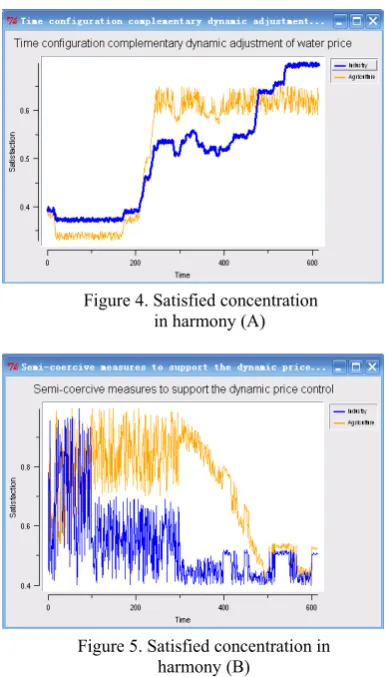
② Satisfied concentration in harmony
Taking the initial configuration set in Reference [18], the decision maker and the cooperator are assumed to adopt correlated preference, that is, other participants’ preference are considered, and the personal strategy is modulated according to group preference inclination, and the simulated results are shown in Fig. 4 and Fig. 5. If the different price of water used in peak period and valley period is introducing, in the situation of complementary configuration in the time of water used, satisfactory degree in long term is high, and increases year by year, while the velocity of convergence is fast, which are shown in Fig. 4. Meanwhile, the results accord with the long term benefit configuration of preference in the algorithm design.
If the cooperator adopts semi-constraint measure, coordinating with price control, that is, the cooperator takes modulation strategy in utility according to personal preference inclination, then, because decision maker has small range of choice and there is no obvious utility advantage in the complementation between group and personal preference, the satisfactory degree vibrates
randomly in a certain range, and it can converge in long term while the velocity of convergence is slow, which is in hesitation or on the line and shown in Fig. 5. The results have correlation with the users’ decidability after uniformly processing utility of personal preference. However, the preference utility modulation has no
obvious utility gain, thus, decision makers maybe have random choices in multi-round game, but it can be in the status of cooperation in long-term game, comparing with relative little utility differences.
V. CONCLUSION
Water resource transfer group decision-making is a decision-making process of multi-objective, multi-layer, multi-period, multi-constraint and multi-round, and cooperation is its core feature. This paper proposes a group decision-making method which is MCGD (Multi-layer Cooperative Dynamic Group Decision) corresponding to the need of water resource allocation and scheduling, which combines multi-objective group decision-making, multi-layer group decision-making, multi-period group decision-making, multi-attribute group making, multi-round group making and so on. Differing from other group decision-making models, the decision-decision-making process of MCGD concerns more about cooperation, which is achieved by multi-round repeated cooperation, and the Pareto optimized solution can satisfy multi-party.
The characteristic of cooperative multi-layer dynamic group decision-making is adopting group decisions by the Figure 2. Satisfied concentration in
preference independent (A)
Figure 3. Satisfied concentration in preference independent (B)
Figure 4. Satisfied concentration in harmony (A)
greatest extent, the results satisfying multi-part by cooperation, instead of non-completed compromised equivalent solution. By cooperation and compromise, the decision makers are impelled to develop avoiding conflicts, thus, the integral optimized solution is got on the condition of satisfactory to every party. This decision-making mode corresponds to the dynamic configuration of limited water resource.
ACKNOWLEDGMENT
This work is supported by the National Nature Science Foundation of China (No.50479018), and the Fundamental Research Funds for the Central Universities of China (No. 2009B20414).
REFERENCES
[1] M. Karamouz, A.K. Nokhandan, R. Kerachian, “Design of on-line river water quality monitoring systems using the entropy theory: a case study” J. Environmental monitoring and assessment, vol. 155, pp. 63-81, 2009.
[2] J. Ananda, G. Herath, “A critical review of multi-criteria decision making methods with special reference to forest management and planning” J. Ecological Economics, vol. 68, pp. 2535-2548, 2009.
[3] F. Mata, L. Martínez, E. Herrera-Viedma, “An adaptive consensus support model for group decision-making problems in a multigranular fuzzy linguistic context” J. Fuzzy Systems, IEEE Transactions on, vol. 17, pp. 279-290, 2009.
[4] T.L. Saaty and K. Peniwati, “Group Decision Making” J. Socio-Economic Planning Sciences, 2007.
[5] F. Herrera, L. Martinez and P.J. Sánchez, “ Managing Non-homogeneous Information in Group Decision Making,” J. European Journal of Operational Research. vol. 166, pp. 115-132, 2005.
[6] H. Wang, D.Y. Qin and J.H. Wang, “Concept of System and Methodology for River Basin Water Resources Programming” J. Shuili Xuebao. vol. 33, pp. 1-6, 2002. [7] S.Y. Chen, X.C. Huang and D.F. Li, “A Multi-Objective
and Group-Decision-Making Model of Water Resources and Macro-Economic Sustainable Development in Dalian” J. Shuili Xuebao. vol. 34, pp. 42-48, 2003.
[8] Z.M. Xu, “A Scenario-Based Framework for Multicriteria Decision Analysis in Water Carrying Capacity” J. Journal of Glaciolgy and Geocryology. vol. 21, pp. 99-106, 1999. [9] G.D. Cheng, “Evolution of the Concept of Carrying
Capacity and the Analysis Framework of Water Resources Carrying Capacity in Northwest of China” J. Journal of Glaciolgy and Geocryology. vol. 24, pp. 361-366, 2002. [10]S. Hajkowicz, “Cutting the Cake: Supporting
Environmental Fund Allocation Decisions” J. Journal of Environmental Management. vol. 90, pp. 2737-2745, 2009.
[11]Y. Peng, “Dynamic Group Decision Making and It's Application” PhD thesis, Southwest Jiaotong University, 2006.
[12]J. Hackman and R. Kaplan, “Interventions into Group Process: An Approach to Improving the Effectiveness of Group” J. Decision Sciences. vol. 5, pp. 459-480, 1974. [13]Y.L. Feng, W.X. Han and H.J. Wang, “Study on the
Sustainable Development Oriented Optimal Allocation to Region Water Resources” J. Systems Engineering-theory & Practice. vol. 23, pp. 133-138, 2003.
[14]China National Bureau of Statistics Of. China City Statistical Yearbook. China Statistics Press. 2007.
[15]China National Bureau of Statistics Of. Anhui Statistical Yearbook 2007 [ISO]. China Statistics Press. 2007. [16]China China National Bureau of Statistics Of. Jiangsu
Statistical Yearbook 2007 [ISO]. China Statistics Press. 2007.
[17]China National Bureau of Statistics Of. Shandong Statistical Yearbook 2007 [ISO]. China Statistics Press. 2007.
[18]S.B. Wang, “Study on Rational Water Resources Allocation Oriented to User's Demand” PhD thesis, Xi'an University of Technology, 2007.
Wei Huang is a PhD student in National Engineering Research
Center of Water Resources Efficient Utilization and Engineering Safety, and College of Hydrology and Water Resources, Hohai University, Nanjing, P.R. China. He received his MSc in Water Science and Engineering Department of UNESCO-IHE in the Netherlands in 2007. His current research interests include hydroinformatics, water resources system modeling and environmental assessment.
Xingnan Zhang is a professor in National Engineering
Research Center of Water Resources Efficient Utilization and Engineering Safety, and College of Hydrology and Water Resources, Hohai University, Nanjing, P.R. China. He received his Ph.D. degree in Hydrology and Water Resources from Hohai University in 1988. His current research areas include water science and engineering, hydroinformatics.
Chenming Li is an associate professor in College of Computer
and Information Engineering, Hohai University, Nanjing, P.R. China. He received his B.S., M.S. and Ph.D.degree in Computer Applications Technology from Hohai University, in 1993, 2003 and 2010, respectively. He is a senior member of China Computer Federation, and Chinese Institute of Electronic,his current research interests include information processing system and its applications, complex system modelling and simulation.
Jianying Wang received his PhD from Hohai University,