Performance Analysis and Improvement of LT
Codes over AWGN Channels
Lina Wang*
Department of Communication Engineering, School of Computer and Communication Engineering, University of Science and Technology Beijing, Beijing, China
Email: [email protected]
Wei Tang
Department of Communication Engineering, School of Computer and Communication Engineering, University of Science and Technology Beijing, Beijing, China
Email: [email protected]
Abstract—LT codes, the first universal erasure-correcting codes, have near-optimal performance over binary erasure channels for any erasure probability, but exhibit high bit error rate and error floor over the noisy channels. This paper investigated the performance of LT codes over the additive white Gaussian noise channels. We designed the systematic LT codes through reconstructing the bipartite graph and proposed a modification of the encoding scheme for the systematic LT codes to eliminate the cycles in generator matrix. With the proposed encoding scheme, the systematic LT codes are almost left-regular. Consequently, two types of the systematic LT codes, left-regular right-regular and left-right-regular right-irright-regular LT codes, were considered from the perspective of bit error rate. For the left-regular right-irregular LT code, we modified the degree distributions and proposed three kinds of check-node degree distributions. And then we analyzed the performance of the above-mentioned systematic LT codes with the proposed encoding scheme and different degree distributions. Simulations results show that the performance of the systematic LT codes with the proposed encoding scheme outperforms that of the conventional LT codes and the bit error rate of the systematic LT codes declines more than one order compared with that of the conventional LT codes. Finally, we proposed a class of the concatenated code, which serially concatenate the conventional LT codes with the systematic LT codes adopting the proposed encoding scheme. The performance of the proposed concatenated code was evaluated through simulations.
Index Terms—LT codes, systematic codes, encoding scheme, degree distribution, additive white Gaussian noise channel
I. INTRODUCTION
In recent years rateless codes [1], which were originally designed for reliable transmission over the binary erasure channels (BEC), were studied extensively. Unlike classical fixed-rate codes, digital rateless codes potentially generate a limitless block of information and exhibit excellent performance over time-varying channels
without the need of channel state information (CSI) at the transmitter side. The first efficient and practical realization of rateless codes was proposed by Michael Luby in [2], termed LT code. LT codes are rateless in the sense that a possibly limitless number of output symbols can be generated in the encoding of a finite number of message symbols. Each receiver can successfully decode when it receives a given number of output symbols. LT codes have also been referred to as fountain codes in the literature [3]. The fundamental structure of conventional LT codes is the same as an irregular nonsystematic low-density generator matrix (LDGM) code [4], and as pointed out in [5] LDGM codes exhibit a high error floor which does not mitigate with increasing block length. The encoding and decoding complexity of LT codes grows with block length. In addition, LT codes hadn’t a fixed encoding cost. Shokrollahi addressed this problem by Raptor codes in [6], an extension of LT codes with linear time encoding and decoding. In Raptor code, a LT code is preceded by a high-rate code which is called erasure-correcting pre-code and its sole purpose is to fix the encoding cost. At decoding phase, only a fraction of the source symbols are decoded by LT code layer and the remaining is done by the pre-code layer. Examples of the pre-code include low-density parity check (LDPC) codes [7] and Tornado codes [8]. The success of LT and Raptor codes in design of high rate codes for the BEC extended the ideas of rateless codes for noisy channels such as the additive white Gaussian noise (AWGN) channels [9-14], binary memoryless symmetry (BMS) channels [15], block-fading channels [16], and relay channels [17]. A family of systematic rateless codes that are universally capacity-approaching on a BEC regardless of the channel erasure rate was proposed in [18]. Some new studies about LT and Raptor codes, such as lower and upper bounds on the asymptotic average error probability, and a method to optimize the pre-code layer for a given LT degree distribution, were provided in [19]. Ref. [20] studied the graph-based LT code and Raptor code, and presented the result that optimal degree distribution of the LT code depended on the rate of the pre-coder on a
*
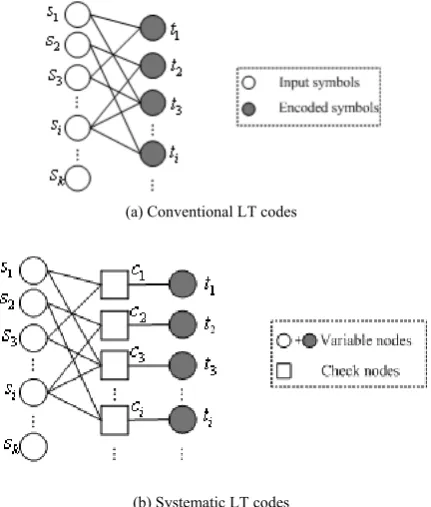
(a) Conventional LT codes
(b) Systematic LT codes
Figure 2. The bipartite graph of LT codes.
noiseless channel such as the BEC or the AWGN channels with high signal-to-noise rate (SNR).
As we know LT codes exhibit excellent performance over the BEC but suffer from high bit error rate (BER) and error floor over the noisy channels. The aim of this paper is to study the performance of LT codes over the AGWN channel with binary phase shift keying (BPSK) modulation. One of the disadvantages of LT codes is that they are not systematic. This means that the input symbols are not necessarily reproduced among the output symbols. The straightforward idea of transmitting the input symbols prior to the output symbols produced by the coding system is easily seen to be flawed, since this does not guarantee a high probability of decidability from any subset of received output symbols [6]. So far systematic LT codes have received little attention as compared to nonsystematic LT codes. Moreover, in many practical situations systematic codes may be preferred. For instance, if the channel quality is relatively good, coding complexity can be reduced by eliminating the need for decoder-doping, and the less parity bits are required as compared to the nonsystematic LT codes. In addition, systematic LT codes exhibit better performance than their nonsystematic counterparts for low fixed code rates. We therefore considered the systematic LT codes and call the nonsystematic LT codes over the BEC as the conventional LT codes in this paper. We designed the systematic LT codes through reconstructing the bipartite graph of the conventional LT codes. To eliminate the cycles in generator matrix, we proposed an improved encoding scheme for the systematic LT codes. With the proposed encoding scheme, the systematic LT codes are almost left-regular. So there are two types of systematic LT codes, namely left-regular right-regular LT code and left-regular right-irregular LT code. In this paper, we considered the above-mentioned systematic LT codes from the perspective of BER. For the left-regular right-irregular LT code, we modified the degree distributions of LT codes and proposed three kinds of appropriate check-node degree distributions. And then we analyzed the performance of the above-mentioned systematic LT codes with the proposed encoding scheme respectively through simulations. In the last place, we serially concatenated the conventional LT codes with the proposed systematic LT codes and proposed a novel concatenated code. The simulations to evaluate the performance of the serially concatenated codes were carried out with MATLAB.
II. LTCODES AND SOFT DECODING
LT codes simple hard-decision decoding scheme has high performance over the BEC other than the noisy channels. Consequently, a soft decoding scheme, Belief Propagation (BP) [18], similar to the LDPC has been adopted. However, when the encoded symbols of the conventional LT codes go through the AWGN channel and the receiver tries to decode them with the BP algorithm, the conventional LT codes suffer from high BER and error floor. Two reasons are responsible for the poor performance. One reason is that a suitable parity
check matrix is not found, the other reason is that the input symbols which do not go through the channel lack the prior information for the BP algorithm. Therefore we have to think out another LT codes whose performance is acceptable over the AWGN channels.
To make the k bits input symbols s = ( s1, s2, …, si, …,
sk ) get their prior probability p(si), we let them go through the channel. And then we naturally get a kind of the systematic LT codes. At the same time, the fact that the result of add modulo-2 (XOR) operations between the binary numerals is zero helps us establish parity check relationship in the bipartite graph.
The bipartite graph of conventional LT codes is shown in Fig. 1 (a), which is composed of input and encoded symbols. The bipartite graph of the systematic LT codes is shown in Fig. 1 (b), which is composed of variables and check nodes.
The input symbols and the encoded symbols t = (t1, t2, …, ti, …) can be treated as variables nodes and c = (c1, c2, …, ci, …) is the check nodes as described in LDPC codes [7]. In fact it is more similar to the bipartite graph of LDGM codes [4] which is a particular instance of LDPC codes. However, they are their own characteristics. The systematic LT codes which is a kind of rateless codes still can generate infinite encoded symbols as it does over the BEC in theory; the code rate of the LDGM codes is fixed in advance. Furthermore, we get the generator matrix Gp in the encoding process of the LT codes and then the parity check matrix H is got; as for the LDGM codes, the parity check matrix is known for both the sender and receiver and the generator matrix is converted from the parity check matrix before encoding.
encoding process when decoding overhead is low. The decoding overhead is defined as γ = n / k, where n is the number of the encoded symbols. Usually, N = k lg ( k /δ) (where δ is the erasure probability) encoded symbols are required in order for the probability that all k input symbols are chosen to encode at least once to be (1-δ) [3]. So we consider all input symbols are chosen not uniformly but by their degrees to decline the lowest decoding overhead that required for decoding successfully over the noise channels.
At the same time, the successful decoding process of LT codes over the BEC heavily depends on the degree-1 encoded symbols. However, degree-1 encoded symbols do not contribute to the BP decoding process. On the contrary, they are responsible for the high error floor [13]. Consequently we modify the degree distribution of the check nodes and decline the probability that degree-1 variable nodes appear. The Ideal Soliton Distribution and the Robust Soliton Distribution [2] are not adopted for the soft decoding. New optimal degree distribution of the check nodes will be found out. We will describe the degree distributions in Section V.
Ref. [21] presented the soft decoding algorithms for LDPC codes. These algorithms are applicable to our systematic LT codes. We prefer the log-likelihood-ratio-based belief propagation (LLR-BP) decoding algorithm on the AWGN channels.
III. PROPOSED ENCODING SCHEME FOR SYSTEMATIC LT CODES
With the encoding process of conventional LT codes, we get the part of the generator matrix Gp. If the input symbols are chosen uniformly, the cycles in the generator matrix unavoidably come into being. Cycles in the bipartite graph lead to the BP algorithm with no natural termination [22]. Different sets are used to construct 4-cycle free LDPC codes in [23]. We consider an improved encoding algorithm to ensure cycle-free bipartite graph. On the basis of the encoding algorithm in [13], we propose a modification of the encoding scheme with no cycles of length 4 or 6 when the number of encoded symbols can be compared with the number of input symbols. However, the cycles of length 4 or 6 cannot be avoided if in the extreme case n / k >> 1.
Let Ωc(x) be the degree distribution of check nodes. Then we have Ωc(x) = ω1 + ω2x + ω3x2 + … + ωixi-1 + … + ωkxk-1, where ωi is the fraction of checks nodes having degree i. Although LT codes are rateless in theory, we set the maximum encoded symbols n.
The proposed encoding scheme for our systematic LT codes is described as follows.
While the number of encoded symbols no reaching n Step 1: generate di according to Ωc(x) for the ith encoded symbols;
Step 2: sort all input symbols based on their degrees; If exist the degree-0 input symbols
Step 3: randomly choose di input symbols from the input symbols whose degree is 0.
Else
Step 3.1: Reset the candidate set Q with all input
symbols.
While j≤di, forthe jth chosen input symbols. Step 3.2: The jth input symbols is randomly
chosen from the candidate set Q whose degrees are minimum. And the chosen input symbol is excluded from Q;
Step 3.3: Eliminate potential cycles of length 4.
Gather the existing check nodes which are neighbors of the 1st to (j-1)th chosen input
symbols as a set P. Gather the neighbors of check nodes of P as the set U. Exclude U from Q.
Step 3.4: Eliminate potential cycles of length 6.
Gather the check nodes from
P
as the set v. Exclude the input symbols that are neighbors of check nodes in v from Q.End while End if
Step 4: Compute the value of the module-2 sum of the
chosen di input symbols as the value of the ith encoded symbol.
End while
In the above-mentioned encoding process, we get a k × n sparse matrix Gp. Obviously, the generator matrix is G = [ I | Gp ], where I is a k × k unit matrix [24]. Inspired by the second type of LDGM codes in [25], I can be more than a unit matrix. And combined with the principle of Irregular Repeat-Accumulate (IRA) Codes in [26], we think about a new kind of accumulate LT codes, which have the similar idea with Accumulate Rateless (AR) Codes proposed in [27].
The encoding process can be denoted as u = s × G = [ s | t]. The encoded symbols are denoted as u = ( u1, u2, …, ui, …, uk+n ) = [ s | t]. The code rate of these codes is R =
k / ( k + n ). Thus decoding overhead of the systematic LT codes can be defined as
k
n
/
=
γ
(1)The total number of edges between the check nodes and the variables nodes is a constant. So we have
)
1
(
−
=
c vn
d
d
k
.The average degree of variables nodes is
)
1
(
−
=
cv
d
d
γ
(2)To guarantee that every input symbol is selected in encoding process, γ should be greater than or equal to
)
1
/(
1
d
c−
. However, if the decoding overhead is veryhigh, the cycles come into being to decline the performance.
IV. RIGHT-REGULAR SYSTEMATIC LTCODES
First, let us consider a type of systematic LT codes whose check-node degrees are all the same with each other. Similar to the LDPC codes, we define this type of LT codes as the left-regular right-regular systematic LT codes. Both the extrinsic information transfer (EXIT) charts [28] and simulation tools are used to evaluate the performance of this type of codes. In fact, each variable-node degree is also approximately
d
v with the proposed encoding scheme.A. EXIT Chart Based Analysis
The convergence behavior of LT codes can be determined through EXIT chart analysis. In [29], it has been determined that the waterfall region of an LDGM code depends on the check-node degrees. Here, the aim of the convergence threshold analysis is to illustrate that the proposed modification of the encoding method for LT codes will not affect the check-node degree and lead to significant performance degradation in the waterfall region.
For the analysis, the variable nodes are referred to as the variable-node decoder (VND) and check nodes are referred to as the check-node decoder (CND) [30].
For the VND, the output EXIT function can be computed as
2 ch 2
a_vnd 1
e_vnd
=
J
(
d
−
1
)[
J
−I
]
+
σ
I
v (3)where
σ
ch2=
4
/
σ
n2=
8
RE
b/
N
0 ,σ
n2 is the noise variance of the AWGN channel with BPSK modulation,)
2
/(
1
/
20 n
b
N
R
E
=
σ
is the normalized SNR.For the CND, the output EXIT function can be computed as
))
1
(
1
(
1
1 a_cnde_cnd
J
d
J
I
I
=
−
c−
−−
(4)The definition of
J
(
σ
)
is given in [28]. That is∫
+∞ ∞ −− −
−
−
+
−
=
πσ
ε
σ
)
1
(
2
)
ε σ σ(
1
ε)
d
(
2 1 [( 2/2)2/2 2]e
b
e
J
(5) To predict the convergence thresholds, the LT codes with check-node degree dc = 7, 10, 13 are chosen respectively when the decoding overhead γis equal to 1.1 and R is equal to 0.476. The EXIT curve of the left-regular right-left-regular systematic LT code is shown in Fig. 2 using (3), (4) and (5).
In Fig. 2, it can be seen that the corresponding convergence thresholds of the check-node degrees dc = 7, 10, 13 are -0.1dB, 1.1dB, 1.9 dB respectively.
Figure 2. The EXIT charts of VND and CND.
B. Simulation Results and Analysis
We evaluate the performance of the proposed encoding scheme on the systematic LT codes over the AWGN channel through simulations. We compare the left-regular right-left-regular systematic LT codes with the conventional LT codes and analyze the simulation results.
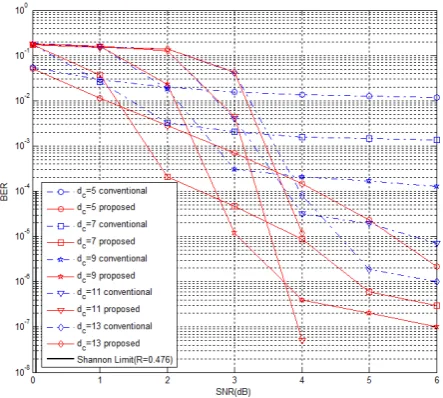
With the restriction of hardware, the number of input symbols k is 1000 and the cycles of length 4 are eliminated in this paper. The maximum iterations of the LLR-BP decoding algorithm are 50 and initial value of the decoding overhead γis equal to 1.1. The code rate R is equal to 0.476. The simulation result is depicted in Fig. 3.
Figure 3. Performance comparisons between the proposed LT encoding scheme and the conventional LT encoding process.
thereby enhancing the performance of the BP decoding algorithm.
At the same time, the error floors of the conventional LT codes decline with the increase of the check-node degree. The LT codes with the proposed encoding scheme follow the same rule. In addition, when SNR is greater than 4dB and the check-node degree dc is 13, we do not find any error in the left-regular right-regular systematic LT code. However, the proposed encoding scheme does not help for declining the convergence thresholds.
Then we analyze the effect of decoding overhead on BER. When the decoding overhead γis equal to 1.3, the code rate R is equal to 0.435. Fig.4 presents the curve of BER vs. SNR.
Figure 4. BER performance of left-regular right-regular LT code for different decoding overhead.
In Fig.4, it can be found that when the decoding overhead γ increases from 1.1 to 1.3, the BER declines faster in waterfall region and the error floors are lower when dc is less than or equal to 8. Interestingly, the slopes of the error floors are all increased. When γis equal to 1.3, the code rate R is equal to 0.435 and the corresponding Shannon limit with BPSK modulation is almost -0.118dB. Note that, for BER = 10-5, the best check-node degree is dc = 9.
From Fig. 3 and Fig. 4, we also observe that the convergence thresholds of the systematic LT codes with check-node degrees dc = 7, 10, 13 are 0dB, 1dB, 2dB respectively. The predicted convergence thresholds in Fig. 2 match very well with the simulation results.
V. RIGHT-IRREGULAR SYSTEMATIC LTCODES
In this section, we consider the left-regular right-irregular systematic LT codes and analyze the effect of different check-node degree distributions on the performance of the systematic LT codes.
According to the results of the LT codes with check-node degree dc = 9, we present a kind of check-node degree distribution with the average degree
d
c=
9
. For i = 4, 5, …, 12, we have5285 . 0 1785 . 0 0112 . 0 ) ( 2 − + −
= i i
i
ω (6)
And then this first kind of check-node degree distribution is as follows.
12 11 10 9 8 7 6 5 4 1 0070 . 0 0851 . 0 1409 . 0 1743 . 0 1885 . 0 1743 . 0 1409 . 0 0850 . 0 0070 . 0 ) ( x x x x x x x x x x c + + + + + + + + = Ω (7)
According to [12] and [15], we modify the degree distribution to eliminate the cycle of length 4 for the proposed encoding scheme and present the next two degree distributions as follows.
30 29 13 12 11 10 9 8 7 6 5 4 3 2 2 038 . 0 011 . 0 001 . 0 0025 . 0 0035 . 0 018 . 0 127 . 0 33 . 0 2015 . 0 1204 . 0 0065 . 0 0415 . 0 0295 . 0 011 . 0 ) ( x x x x x x x x x x x x x x x c + + + + + + + + + + + + + = Ω (8)
The average check-node degree is dc=8.2379+1. The third check-node degree distribution is given in (9).
43 41 13 12 11 10 9 8 7 6 5 4 3 2 3 021 . 0 010 . 0 001 . 0 0021 . 0 00301 . 0 011 . 0 122 . 0 345 . 0 1951 . 0 107 . 0 069 . 0 0524 . 0 0395 . 0 022 . 0 ) ( x x x x x x x x x x x x x x x c + + + + + + + + + + + + + = Ω (9)
The average degree of the check-node degree distribution is dc=8.0771+1.
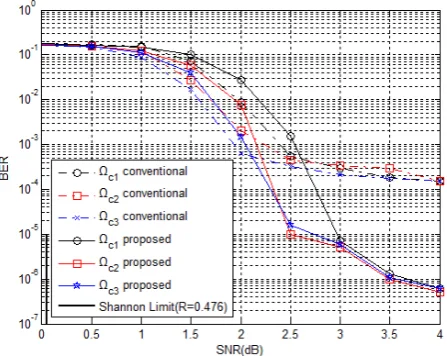
We analyze the effect of the different check-node degree distributions on the performance of the systematic LT codes over the AWGN channel through simulations. The decoding overhead γis equal to 1.1. Other simulation parameters are all the same with those set in Section IV. The result is shown in Fig. 5.
Figure 5. BER performance of left-regular right-irregular systematic LT codes for different SNR.
with the proposed encoding scheme also obviously suffer much lower error floors compared with the LT codes with the conventional encoding process in Fig. 5. Therefore the proposed encoding scheme can also greatly enhance the BP decoding performance for the left-regular right-irregular systematic LT codes.
From Fig. 5, we also see that the performance of the three kinds of degree distribution is partially similar each other when the SNR is less than 1dB and greater than 3dB. The BER declines with the increase of the SNR. But in the waterfall region the performance is quite different. For the first degree distribution in (7), the performance with the proposed encoding scheme is almost the same with the left-regular right-regular systematic LT code with check-node degree dc = 9. For the second degree distribution in (8), the performance has a better tradeoff between the performance of waterfall region and the performance of error floor. For the BER = 10-5, the SNR
of the second degree is almost 2.5dB. The difference between it and the Shannon limit is 2.403dB.
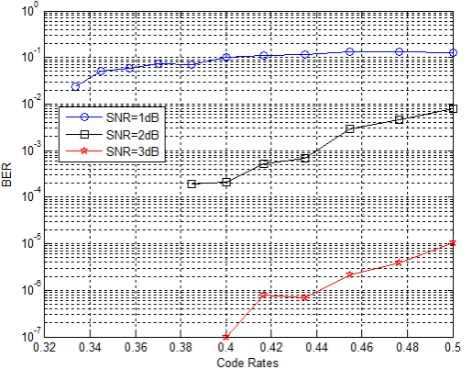
With the second degree distribution in (8), we analyze the performance of the left-regular right-irregular systematic LT codes for different SNR when their code rates changes. As shown in Fig. 6, the BER curve declines with the reducing of the code rates. All the BER curves follow the same rule. For all the code rates, the higher the SNR, the lower the BER. In our simulations, the left-regular right-irregular systematic LT codes have the lowest BER when the SNR is 3dB. Compared with the case with SNR=1dB, the BER declines more than five orders.
Figure 6. BER performance of left-regular right-irregular systematic LT codes for different code rate.
VI. SERIALLY CONCATENATED LTCODES
In this section, we propose a class of serially concatenated LT codes. Similar to [31] and [32], the conventional LT code is used as the part of the serially concatenated codes. We try to serially concatenate the conventional LT code with the systematic LT codes adopting the proposed encoding scheme. The systematic
LT codes are used as the inner codes and the conventional LT code is used as the outer code. The block diagram of the communication system is described in Fig. 7.
Figure 7. Block diagram of the communication system.
The established communication system consists of a binary source, an outer conventional LT encoder, an inner systematic LT encoder, a BPSK modulator, AWGN channel, a BPSK demodulator, an inner systematic LT decoder, an outer conventional LT decoder and a sink. The encoder and decoder of inner systematic LT codes and the channel are equivalent to the BEC for the outer conventional LT code.
For the outer conventional LT code, the Robust Soliton Distribution is adopted, whose parameters are c = 0.03 and δ= 0.5. The outer LT encoding process is u1 = s
× G1.
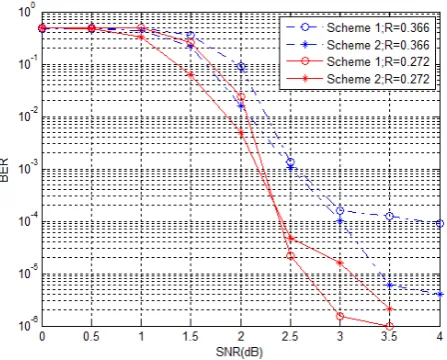
Two types of the inner systematic LT codes are selected. One is the left-refular right-regular systematic LT code with dc = 9. This concatenated code scheme is referred to as Scheme 1. The other is the left-regular right-irregular systematic LT codes with the second degree distribution in (8). This concatenated code scheme is referred to as Scheme 2. The encoded symbols of inner systematic LT codes pass through the AWGN channel. The inner encoding process is u2 = u1 × G2. The generator
matrix is G2 = [ I | P2 ]. And then the encoded symbols are u2 = [ u1 | t2].
The task of the inner systematic LT decoder is not accurately decoding all n = kγ1 bits encoded symbols of
the outer conventional LT code but decoding at least k bits encoded symbols of the outer code. That can avoid the effect of error propagation phenomenon on the LT decoding process.
First, a group of simulation parameters is as follows. The decoding overhead γ1 of the outer conventional LT
code is 1.6. And the overhead γ2 of the inner systematic
LT codes is 1.3. Thus the overall code rate R is equal to 0.272.
Second, we choose another group of simulation parameters. The decoding overhead γ1 of the outer
conventional LT code is 1.3. And the decoding overhead γ2 of the inner systematic LT codes is 1.1. Thus the
Figure 8. Performance of the serially concatenated codes.
We can see from Fig. 8 that the convergence threshold of Scheme 2 is smaller than that of Scheme 1. For the code rate R = 0.272, the error floor of Scheme 1 is lower than that of Scheme 2. But for the higher code rate R = 0.366, the error floor of Scheme 2 is also much lower than that of Scheme 1. The waterfall region of Scheme 2 also declines faster than that of Scheme 1.
VII. CONCLUSION
In this paper, we investigated the performance of LT codes over the AWGN channel. LT codes are a well-known family of rateless codes in binary erasure channels (BEC). They will suffer from high bit error rate and error floor over the noisy channels when they are used for the noisy channels. To improve the performance of LT codes over the AWGN channel, we reconstructed the bipartite graph of the LT codes and proposed a modification of the encoding scheme. This scheme can eliminate the cycles in generator matrix. With the proposed encoding scheme, the two types of systematic LT codes, left-regular right-regular and left-right-regular right-irright-regular LT codes, are formed. And then we considered these two types of LT codes from the perspective of bit error rate. Through modifying the degree distributions, we proposed three kinds of check-node degree distribution for the left-regular right-irleft-regular LT code. The proposed systematic LT codes exhibit the better performance than the conventional LT codes. For the proposed systematic LT codes, the waterfall region declines faster and error floor declines more than one order.
In addition, we proposed a concatenated code, which serially concatenate the outer conventional LT code and the inner proposed systematic LT code. Simulation results show the feasibility of the serially concatenated codes proposed in this paper. In the future work, we will try our best to improve the performance of the serially concatenated codes.
ACKNOWLEDGMENT
This work was supported in part by the Fundamental Research Funds for the Central Universities (FRF-TP-12-088A) and Scientific Research Funds.
REFERENCES
[1] J. W. Byers, M. Luby and M. Mitzenmacher, “A digital
fountain approach to asynchronous reliable multicast,”
IEEE Journal on Selected Areas in Communications, vol. 20, pp.1528-1540, October 2002.
[2] M. Luby, “LT codes,” The 43rd Annual IEEE Symposium
on Foundations of Computer Science, pp.271-280, 2002. [3] D. J. C. MacKay, “Fountain codes,” IEE Proceedings of
Communications, vol. 152, pp.1062-1068, December 2005.
[4] J. Garcia-Frias and W. Zhong, “Approaching shannon
performance by iterative decoding of linear codes with
low-density generator matrix,” IEEE Communications
Letters, vol. 7, pp.266-268, June 2003.
[5] D. J. C. MacKay, “Good error-correcting codes based on very sparse matrices,” IEEE Transactions on Information Theory, vol. 45, pp.399-431, March 1999.
[6] A. Shokrollahi, “Raptor codes,” IEEE Transactions on Information Theory, vol. 14, pp.2551-2567, June 2006. [7] R. G. Gallager, “Low-density parity-check codes,” IRE
Transactions on Information Theory, vol. 8, pp. 21-28, January 1962.
[8] M. Luby, M. Mitzenmacher, A. Shokrollahi and D.
Spielman, “Efficient erasure correcting codes,” IEEE Transactions on Information Theory, vol. 52, pp.569-584, February 2001.
[9] R. Palanki and J.Yedidia, “Rateless codes on noisy
channels,” IEEE International Symposium on Information Theory, pp.37, July 2004.
[10]K. Wu, Zh. Zhang, Y. Huo and Sh. Yang, “Accumulate
rateless codes for AWGN channel,” 3rd International
Conference on Communications and Networking, pp.100-104, August 2008.
[11]K. Boyle, P. Lin and C. Yu, “Rareless unequal error
protection codes for the additive white Gaussian noise channel,” IEEE Military Communications Conference, pp.1-6, October 2009.
[12]I. Hussain, M. Xiao and L. K. Rasmussen, “LT coded
MSK over AWGN channels,” 6th International
Symposium on Turbo Codes and Iterative Information Processing (ISTC), pp.289-293, September 2010.
[13]I. Hussain, M. Xiao and L. K. Rasmussen, “Error floor analysis of LT codes over the additive white Gaussian
noise channel,” 2011 IEEE Global Telecommunications
Conference (GLOBECOM 2011), pp.1-5, December 2011. [14]I. Hussain, M. Xiao and L. K. Rasmussen, “Unequal error
protection of LT codes over noisy channels,” IEEE
Swedish Communication Technologies Workshop (Swe-CTW), pp.19-24, October 2012.
[15]O. Estasmi and A. Shokrollahi, “Raptor codes on binary memoryless symmetric channels,” IEEE Transactions on Information Theory, vol. 52, pp.2033-2051, May 2006. [16]J. Castura, Y. Mao and S. Draper, “On rateless coding over
fading channels with delay constraints,” IEEE
International Symposium on Information Theory, pp.1124-1128, July 2006.
[17]J. Castura and Y. Mao, “Rateless coding for wireless relay
channels,” IEEE Transactions on Wireless
Communications, vol. 6, pp.1638-1642, May 2007.
[18]X. Yuan and P. Li, “On systematic LT codes,” IEEE
[19]A.Venkiah and C. Poulliat, “Some new results on LT and Raptor codes,” European Wireless Conference, pp.999-1004, April 2010.
[20]A. Tarable and S. Benedetto, “Graph-based LT and Raptor
codes,” IEEE International Symposium on Information
Theory, pp.2061-2065, July 2008.
[21]J. Chen, “Reduced-complexity decoding of LDPC codes,”
IEEE Transactions on Communications, vol. 53, pp.1288-1299, August 2005.
[22]R. K. Frank, J. F. Brendan and H. Loeliger, “Factor graphs
and the sum-product algorithm,” IEEE Transaction on
Information Theory, vol. 47, pp. 498-519, February. 2001. [23]M. Esmaeili and M. Javedankherad, “4-Cycle free LDPC
codes based on difference sets,” Communications, IEEE Transactions on, vol. 60, pp.3579-3586, December 2012. [24]K. Liu and J. García-Frías, “Error floor analysis in LDGM
codes,” IEEE International Symposium on Information
Theory Proceedings (ISIT), pp.734-738, June 2010.
[25]Y. Kumano and T. Ohtsuki, “On construction of
concatenated low-density generator matrix codes,” IEEE Pacific Rim Conference on Communications, Computers and Signal Processing, pp.442-445, August 2007.
[26]H. Jin, A. Khandekar and R. J. McEliece, “Irregular repeat-accumulate codes,” 2nd International Symposium onTurbo Codes and Related Topics, pp.1-8, September 2000.
[27]K. Wu, Zh. Zhang, Y. Huo and Sh. Yang, “Accumulate
rateless codes for AWGN channel,” 3rd International
Conference on Communications and Networking, pp.100-104, August 2008.
[28]S. T. Brink, “Convergence behavior of iteratively decoded
parallel concatenated codes,” IEEE Transactions on
Communications, vol. 49, pp.1727-1737, October 2001. [29]C. Change, Z. Mao and H. Lee, “A fast BER evaluation
method for LDGM codes,” Journal of the Franklin
Institute, vol. 347, pp.1368-1373, September 2010. [30]S. T. Brink, G. Kramer and A. Ashikhmin, “Design of
low-density parity-check codes for modulation and detection,”
IEEE Transactions on Communications, vol. 52, pp.670-678, April 2004.
[31]M. Gonzalez-Lopez, F. J. Vazquez-Araujo, L. Castedo, J. Garcia-Frias, “Serially-concatenated low-density generator matrix (SCLDGM) codes for transmission over AWGN
and Rayleigh fading channels,” IEEE Transactions on
Wireless Communications, vol. 6, pp.2753-2758, August 2007.
[32]R. Y. S. Tee, T. D. Nguyen, L. L. Yang, L. Hanzo,
“Serially concatenated Luby transform coding and bit-interleaved coded modulation using iterative decoding for the wireless Internet," 63rd IEEE Vehicular Technology Conference, 2006. VTC 2006-Spring, vol. 1, pp.22-26, May 2006.
Lina Wang was born in Heilongjiang on April 22nd, 1977. She graduated in Electronic Engineering from the Heilongjiang University in 1999. He received the M.S. and Ph.D Degrees in Communication and Information System from the Harbin Institute of Technology in 2001 and 2004 respectively.
Since 2004 she has been with the Department of Communication Engineering of the University of Science and Technology Beijing, where she is currently an Associate Professor. Her present interests lie in the area of deep space communications, satellite communications, fountain codes and cognitive radio.
She is the author of more than 30 technical papers. She has published two books: Satellite Communication Systems (Beijing, China: National Defence Industry Press, 2006) and Modern Communication Technologies (Beijing, China: National Defence Industry Press, 2009). She is presently responsible, at the University of Science and Technology Beijing, for the projects dealing with fountain codes for deep space communications.
Wei Tang was born Hubei in 1988. In 2011, he graduate in