RESEARCHARTICLE
A context-sensitive conceptual
framework for activity modeling
Rahul Deb Das, Stephan Winter
Department of Infrastructure Engineering, The University of Melbourne, Australia
Received: October 8, 2015; returned: December 11, 2015; revised: February 1, 2016; accepted: February 21, 2016.
Abstract: Human motion trajectories, however captured, provide a rich spatiotemporal data source for human activity recognition, and the rich literature in motion trajectory analysis provides the tools to bridge the gap between this data and its semantic interpreta-tion. But activity is an ambiguous term across research communities. For example, in urban transport research activities are generally characterized around certain locations assuming the opportunities and resources are present in that location, and traveling happens between these locations for activity participation, i.e., travel is not an activity, rather a mean to over-come spatial constraints. In contrast, in human-computer interaction (HCI) research and in computer vision research activities taking place “along the way,” such as “reading on the bus,” are significant for contextualized service provision. Similarly activities at coarser spatial and temporal granularity, e.g., “holidaying in a country,” could be recognized in some context or domain. Thus the context prevalent in the literature does not provide a precise and consistent definition ofactivity, in particular in differentiation to travel when it comes to motion trajectory analysis. Hence in this paper, a thorough literature review studies activity from different perspectives, and develop a common framework to model and reason human behavior flexibly across contexts. This spatio-temporal framework is conceptualized with a focus on modeling activities hierarchically. Three case studies will illustrate how the semantics of the term activity changes based on scale and context. They provide evidence that the framework holds over different domains. In turn, the frame-work will help developing various applications and services that are aware of the broad spectrum of the term activity across contexts.
1
Introduction
With the emergence of pervasive and mobile computing, and especially location-based ser-vices, there has been a growing interest in a theoretical framework facilitating the process-ing and sharprocess-ing of activity information more effectively between human and computer [12,42,56,71,72]. While individual disciplines have worked towards their own frame-works, we will demonstrate that they are incompatible, and an overarching framework is still lacking.
In principle, activity, and synonymously action, requires agency, or a purposeful, goal-directed performance that is available to awareness [89]. Based on the usage of the word activityin natural language, WordNet [17] defines activity as any specific behavior or an action or bodily function. In this view, travel, which is understood here as any purpose-ful, goal-directed change of location, is an activity (or action). Furthermore, any complex travel can be composed of simpler activities, some of them forming travel activities them-selves (such as “taking the bus on the way to work”), and others are non-travel or station-ary activities (such as “reading the papers on the bus”). In contrast to many other disci-plines, human-computer interaction research (HCI) actually applies this understanding by modeling activity from a purely motivational, goal-oriented, and operational perspective [41,42,43] where the activity is motivational and oriented towards an objective. Actions (which are subsumed by activity) required to perform the activity are oriented towards goals and realization of the entire phenomena happens through operations. HCI assumes activity as interaction of a subject with an object to fulfill certain needs through mediation which may involve the process of externalization and internalization [42]. Thus in HCI activity is characterized mostly by the why, what, and how, but less so by the where (loca-tion) and when (time), despite most activities being generally constrained by space or time or both. Obviously this understanding can cope with travel as well as non-travel activities. In pervasive computing, the common subject of research into activity recognition are human motion trajectories [82], whether captured, for example, from diaries [84], social networks [13], checkpoints or cordons [15], GPS [92,95], or CCTV cameras [76]. Accord-ingly, a variety of disciplines, from geography over data mining [29,61,78,81,93] to com-puter vision [3], provide tools for motion analysis. But across these disciplines activity remains an ambiguous term, to the point of direct contradiction. For example, in (urban) transport research activity generally bears semantics related to times spent at home, work, restaurants, or shops [40,52,91], and is the cause for travel between the locations of these activities [40]. In this view, travel is not considered as an activity, rather an undefined mean to overcome spatial constraint [79]. In contrast, pervasive and mobile computing (e.g., in its desire to provide context-aware travel support) and similarly computer vision (in its desire of scene recognition) consider motion central: here activity generally refers to locomotion defined at a finer granularity such as walking, running, or moving body parts [3,5,80,69]. Trajectory data mining (from the data end, e.g., [95]) and time geography (from the con-ceptual end, e.g., [30]), both taking a space-time approach to modeling, accept motion as well as stationary activities, and structure behavioral patterns by disruptive changes in the motion trajectory.
well as HCI would see this commute trip as a concatenation of locomotion activities such as walking, taking a bus, and then a train, especially since HCI aims to provide purposeful information for each of these commuting segments. This argument can be carried forward for an even finer level of granularity. There are other activities being part of the commute, such as buying a ticket for the public transport, buying and drinking a coffee while trans-ferring from bus to train, waiting for the train at the platform, or reading a newspaper on the train. Again, HCI research is keen to capture these activities as well in order to pro-vide appropriate information services, such as smart ticketing, recommendations of coffee places, or newsfeeds related to places of interest.
These examples illustrate a semantic gap in the notion of activity between the disci-plines involved with human mobility in the city. This gap exists despite the vagueness inherent in all definitions. For example, whether a worker going out for lunch, a tourist strolling in a city, or a person jogging in the evening, is “traveling” or “pursuing an activ-ity” is not clear in travel demand modeling. From an HCI perspective it is hard to decide whether a transfer between bus and train, or grabbing a coffee-to-go between, is an activity. In the above examples, it is evident that the concept of activity depends on the context within which the analysis takes place. The context determines an appropriate (default) level of granularity in space and time—always allowing for abstraction (zooming out) or refinement (zooming in) should a change of context require so. A closely related property of activities revealed by the examples above is their nestedness. A person can do a number of activities in sequence that form an aggregate activity (e.g., the above described commuting trip as a sequence of walking and taking the bus), and even two activities at the same time (e.g., traveling by bus and reading a newspaper as part of the commute). Although Word-Net does not draw any distinction betweenactivityandaction, there is a semantic gap in the conceptualization of activity structure in different domains including HCI, transportation science, cognitive science, public health research, mobile computing, and context-aware location based services. This calls for a hierarchical approach to modeling activities, which we will provide by activities that consist of actions in one context, and in another context these actions becoming activities themselves consisting of actions.
Assuming a trajectory indicates the intention of the agent to participate in different spatio-temporal setups to fulfill certain needs, it is possible to model or retrieve activities from a given trajectory or parts thereof. However, this process is determined by context, which defines the semantics of need (and hence of the activity). In addition, there is no precise correspondence between the concept of activity and the mobility patterns extracted from motion trajectories. Hence, in this paper we present a conceptual analytical frame-work that aims to bridge the semantic gap between trajectories and activities on one hand, and the disciplines’ understanding of activity on the other, the latter through integration ofactivity theoryand space-time concepts in an urban environment. With our distinction of activity as an abstract concept oriented towards certain needs and actions defined at concrete granularities of space and time, we hypothesize that the semantics of activity de-pend on the spatial and temporal granularity suggested by context. Shifts in granularity will enable processing motion trajectories and representing activity knowledge in various contexts facilitating flexible, i.e., appropriate and relevant information representation or provision. Heregranularityrelates to the concept of scale in space and time and also level of details in contextual perspective. In this paper we will explore the following research questions.
• Is travel an activity?
• How can activity knowledge be represented at different contexts?
• Can a raw trajectory be used for activity modeling at urban scale?
This research work contributes to the existing knowledge in the following ways, such as:
• Currently there exists a trajectory ontology [35] that represents the knowledge of a trajectory conceptualization. There also exists few activity ontology in indoor [50] or based on its components [47]. But there is no attempt made so far to model activities on trajectories at different contexts and how that can maintain a smooth and con-nected knowledge flow from one contextual level to another contextual level. Thus the proposed framework is novel and improving the existing work not by replacing them, rather by enriching them with more structured way.
• This research also goes beyond the existing trajectory ontology [35] by extending a trajectory ontology to activity ontology withactoras the key concept. Unlike earlier work [35] this paper illustrates the entire ontology and its knowledge base through instantiating the relevant concepts and using few SPARQL queries.
• This research incorporates the concept of a set of needs defined in human-scale devel-opment [54], and the notion of space and time in the existing activity theory in HCI. Thus the framework bridges the gap between the notion ofactivityin spatial science, transport geography, HCI, and other domains.
The rest of the paper is organized as follows. After introducing the research questions, hypothesis, and objective in Section 1, a thorough literature review in Section 2 on motion analysis, activity recognition in mobile computing and activity modeling from the perspec-tive of cogniperspec-tive science is followed by Section 3. Section 3 is based on the conceptual framework that governs how activities can be modeled from a trajectory at different con-texts through formal semantics and a reasoning scheme. Section 4 implements the model and illustrates different contexts as a function of granularity. Section 5 discusses the frame-work and its efficacy in different contexts followed by conclusions and future research di-rection in Section 6.
2
Background
The interest in activities of this paper is driven by the challenges of motion analysis to model activity out of trajectories under different contexts, as studied by various disciplines. Hence there is a need to revisit all the conceptualizations of activities prominent in these different disciplines, and bring them together on a common ground. This section discusses the state of the research in the various disciplines.
2.1
Activity in time geography
time. Constraints such as opening hours can be represented by interrupting the space-time station over periods. Other activities are linked to change of location (“travel” on urban scale), which is similarly linked to opportunity and affordance.
In time geography this is represented by non-stationary segments of a person’s tra-jectory; a mediated travel, on board a vehicle, would be represented by a non-stationary bundle of the person’s and the vehicle’s trajectory, although there exists some amount of space-time uncertainties in one’s movement behaviour [90]. Again other activities do not depend on location and time: interaction with systems, in terms of ubiquitous computing, can happen anywhere, anytime. With the emergence of information and communication technology (ICT) the concept of time geography has been extended from a physical space to a virtual space, and this transformation led to change in activity pattern in urban envi-ronment [79]. For example, in order to buy an air ticket people no longer need to go to the airline’s office (located in a physical space); rather people can purchase the ticket online (in a virtual space). Golledge and Stimson [25] explained collective activities in terms of two space-time paths and their relationships such as whether the space-time paths are meeting over a certain time window (co-location in time), whether the paths are meeting over a cer-tain geographical space (co-location in space), or whether the two space-time paths meet over a given space and time window (co-existence). The idea can be extended for multiple individuals and their collective activity pattern through space-time bundle [59]. Couclelis discussed how ICT influences a gradual transformation in activity pattern through frag-mentation and reorganization of activity over a given space [11].
However, there is still physical interaction with a tangible part of the world: be it a phys-ical space or virtual space. An activity in physphys-ical space requires interaction with different objects and at the same time an activity in a virtual space requires at least an internet en-abled smartphone or computing device to enter in that virtual space and perform different activities (such as e-banking, teleconference) [79]. In all these cases especially, during the interaction with the smartphone, e.g., to start an app and to browse through the “pages,” and all this while the individual is somewhere at some time. Thus, activities are generally oriented towards certain objects in the world, and hence the properties of the given object are an important facet, especially its availability and its affordance. These properties can be expressed as spatio-temporal constraints by time geography. But time geography lacks guidance on the level of granularity with which these space-time constraints should be formulated for a particular analysis, and it also lacks the notion of the cognitive constraints what objects in space facilitate to offer [73].
2.2
Situated action modeling, activity theory, and distributed cognition
The concept of activity has also been reflected in situated action modeling where the basic unit of analysis is “the activity of person-acting in setting” [62]. The focus of situated action modeling is the person and the setting. A setting is conceptualized as the relation between the person and the arena within which the person is acting (the concept of arena is equi-valent to the concept of environment or world in activity theory and affordance theory). Lave [49] mentioned arena as a stable institutional framework. If a person is shopping in a supermarket, then the particular supermarket is an arena of the institution supermarket.
which consists of subject, object, actions, and operations. Each of these layers can be broken down into finer layers with growing complexity of expressiveness. For example, an activity can be broken down into actions, which can be broken down into subactions, which can again be broken down into sub-subactions, and so on. A subject in activity theory can be a person or a group of persons or an organization having an objective that motivates them to perform an activity in relation to the environment [49,51]. Hence, actions are goal-directed: they contribute to performing an activity. However a goal can be achieved by different actions. For example, a person caneatfood at a restaurant or at home in order to achieve the activity “having a meal.” On the other hand operations are unconscious. An action becomes an operation over routine execution, and vice versa, an operation may be lifted to an action if there is a sudden change in the condition or the environment such that a routine is interrupted and conscious decisions have to be made. Thus the constituents of activity can change their semantics. In the HCI literature [65] as well as in wayfinding and navigation [31,62,86] actions are termed “tasks.” However, here we will use consistently the term action.
The concept of activity has also been explored in distributed cognition. In distributed cognition, the unit of analysis is a cognitive system which consists of individuals and ar-tifacts with which the individuals interact [36,62]. Distributed cognition considers indivi-duals, artifacts and the environment as a system, unlike traditional cognitive science that concentrates on an individual’s cognitive aspects [63]. Distributed cognition analyses how individuals coordinate and share their actions to perform a goal.
None of these three theories looks at activity in the light of space, time, and context. Thus, in this paper we explore different activities based on location, time, needs, and con-text. We further set our scope to an individual’s interactions with systems in an urban sphere, i.e., we neglect activities that go beyond urban scale (e.g., traveling a country), or are confined to the private space (e.g., house cleaning), or to the own body (e.g., gestur-ing). An elementary activity in the urban sphere is traveling from one location to another location to fulfill certain need(s). An earlier work by Hirtle and colleagues [31] discussed how granularity impacts on the conceptualization of an action or activity in the context of navigation. We use a similar concept to explore travel activities in urban context at different granularities. From the perspective of context-aware computing, the wordcontextcan de-fined as “any information that characterizes a situation of an entity where the entity could be a person or a physical object at a different spatial scale (including a location) which are relevant to the interaction between a human user and the application” [14]. The entities also include the user and the application as well.
In this paper, we will extend the concept of activity from activity theory and develop a con-ceptual framework to model activity out of a trajectory that explains an agent’s movement behavior and activity knowledge from a given trajectory.
2.3
Granularity in movement behavior
Since traveling is an important facet in daily life as travel embeds various activities (or actions) we will look into previous work on how travel has been modeled at different spatial and temporal granularity. Traveling is a type of movement hence we will use travel and movement interchangeably to indicate changing location in some urban con-text. Movement is a continuous phenomenon. However, movement history is captured in a discretized way, whether recorded by sensors or by human reports post-travel. The recording is by waypoints. The movement can be perceived at different level of details and thus can represent varying information. This level of detail at which the world is perceived at a given context is known as granularity: a certain grain size at which a phenomenon is perceived [32].
“Our ability to conceptualize the world at different granularities and to switch among these granularities is fundamental to our intelligence and flex-ibility.”
J. R. Hobbs (1985)
The time-ordered set of waypoints of an agent and its interaction with its environment can be refined by additional waypoints, or coarsened by thinning out. Structurally equiva-lent to space-time paths in time geography [58], lifelines, or in their discrete form, lifeline threads, have been suggested in order to model movement behaviour in terms of precisely defined geometrical structures with varied granularity [58]. A lifeline is a time-ordered set of waypoints an individual has passed through or occupied for a given time period [34]. Similarly, lifeline beads are equivalent to space-time prisms, and a lifeline necklace is equivalent to sequence of space-time prisms [34,58]. On a coarser granularity a lifeline bead can be transformed into a lifeline trace that contains only starting point and ending point. A necklace can be transformed into a convex hull that connects all the rim points and generalizes the movement behaviour of an individual over a time period [34].
Since activity is contextual and depends on the details of analysis and any occurrence is a function of time, temporal granularity plays an important role in defining an activity. Hornsby developed a set of temporal zoom operators to shift the temporal granularity over the identity states of an object and other objects that links during any transitional change [34]. There are also instances of work on spatial granularities for place descriptions [75]. Hornsby and Egenhofer showed how a refinement operation can enhance the granularity and explores more information on temporal, spatial, and speed aspects whereas an abstrac-tion operaabstrac-tion does the opposite and reduces the informaabstrac-tion content [34]. A fine grained lifeline model reveals more activity or action information as more relevant timestamps and locations that were otherwise unknown. At the same time a coarser grained representation can simplify the knowledge and give a general trend or high level activity knowledge.
wayfinding depends on previous knowledge of the agent in the environment. Tenbrink and Winter proposed a framework for variable granularity in wayfinding and navigation. They have considered linear (1D) and areal (2D) granularities, and elaboration [85]. In the framework developed by Tenbrink and Winter, they have represented 1D granularity as a line with segments of varying lengths. 2D granularity has been represented by polygons. Both 1D and 2D granularities are finite and discrete since network structure and zoom le-vels are finite and discrete, whereas elaboration is infinite since a route description can be enumerated at infinite level. They also discussed how route directions and descriptions can vary with varied details depending on person’s knowledge of the environment, travel direction, location and more specifically pragmatic information needs. They have drawn a comparison on flexibility in providing direction information by humans and machines. The granularity of human-provided route descriptions is more adaptable to the information need than that of a machine. Machine generated route directions do not consider varied information needs based on travel direction and a-priori knowledge of the environment. Motivated by the works of Norman [64] and Kuipers [48], Timpf has studied the notion of granularity on spatial knowledge representation on a mobile device depends on the exist-ing knowledge in the world (in terms of signage, landmarks, spatial cues), knowledge in the head (cognitive map of a place), and knowledge in the pocket (information contained in a mobile device in terms of maps and other spatial information) [31,86]. Timpf has de-veloped a threefold framework for any wayfinding activity such as wayfinding from place A to place B and this activity consists of three tasks (actions) such as planning, tracking, and assessing. Each of these tasks can be implemented through different operations such as operations that implement planning task include information gathering, finding routes, determining constraints, producing instructions. Operations that implement the tracking task include orientations, tracking locations, and comparisons to plan. Operations that im-plement the assessing task include assessing instructions and determining complexity of routes [86].
With technological advancement recently there is a growing need of incorporating HCI in urban context for providing information to mobile information seekers for various location-based services (LBS). The information can be related to route recommendation [44] or activity recommendation [12]. In both the cases spatio-temporal granularity and relevance play vital role in disseminating the information in the user’s context [31,33,70]. Hirtle and colleagues explored the influence of activities on relevance and granularity of route information by analysing different lexical indicators corresponding to certain activ-ity types. They argued the concept of activactiv-ity is a relative notion [31]. Hirtle and others showed an example (Table1) where taking a friend to an emergency room in a hospital is an activity that forms different actions (tasks) such as drive the car as fast as possible or call an ambulance, park the car next to the emergency room, and take the friend to the emergency room. Whereas at a finer granularity if “driving the car to the hospital” is con-sidered as an activity then this can be broken down into different tasks such as “planning the fastest route,” “tracking the position,” and assessing the movement behavior of oneself to reach the destination effectively and quickly.
Hirtle and colleagues also mentioned routine navigation (traveling) can be assumed as action to fulfill a purpose of an activity whereas in some cases navigation itself can be seen as an activity such as hiking, sailing, or jogging [31].
that depends on the nature of analysis or the problem at hand. Based on the activity and its granularity relevant route directions and wayfinding information can be disseminated that would influence certain travel based actions at decision points or at planning, tracking or assessing phase during a travel. It turns out that the linguistic ambiguity between activity and action in Section1, already addressed in the hierarchies of activity theory in Section
2.2, can further be supported by the concept of granularity.
Activity Take a friend to emergency
room at the hospital Visit a friend at the hospital Purpose Get medical help fast Socialize
Action 1 Drive your car to the hospital Drive your car to the hospital
Goal As fast as possible,
fastest route Take shortest path
Action 2 Park next to
emergency room Park where available
Goal Nearest parking space Least expression
Action 3 Go to emergency room Go to main entrance
Goal As fast as possible Find directory or
information booth
Action 4 Go to friend’s room
Goal Try not to get lost
Table 1: Activity and actions for different activity targeted to a same location [31].
2.4
Concept of affordance
Objects in the environment offer different degrees of action potential which is contextual and often assessed by the agent or subject given the specific action. These offerings for ac-tion potential are considered as affordance of given object in the environment. The concept of affordances is rooted in affordance theory [22,23] which was motivated by the propo-sitions of Gestalt psychology that governs perception as a whole rather than through its constituents [45]. Gibson linked the affordance of an object in the environment with the properties of both the object and the agent who needs to carry out a given action [83]. His initial concept of affordance was centred purely on visual spatial perception [23]. Some researchers put more emphasis on properties of the environment rather than agent’s part [87]. Overall, this concept is similar to the motive with the object in activity theory.
differently by the agents, a suitability model for a restaurant has been studied depending on different actions it may offer such as eating, reading, socializing [39]. Affordance theory has also been used to evaluate the suitability measure for urban networks for pedestrians [38].
Inspired by Gibson’s affordance theory of agent-environment mutuality, Zaff argued affordance can be characterized with respect to an agent and its context and its properties. This enables affordance to be viewed as a measurable aspect only in the context of an agent [94]. Norman explored affordance of everyday things such as telephones, radios, or doors [64]. On the other hand Gaver viewed affordance from the perspective of agent’s socio-cultural and intentional aspects [21].
Raubal and Moratz developed a relational functional model for affordance-based agent framework by extending the traditional affordance theory through integration of cognitive aspects, situational aspects, and social constraints [74]. In this model they have categorized affordances into three classes such as physical affordance, social-institutional affordance, and mental affordance. Their model is based on abstract functional representation of dif-ferent affordance aspects and operational aspects of an agent. In this model, physical affor-dance is characterized by physical structure of the agent and the object, spatial cognitive capability of the agent, and a goal. Physical affordance is constrained by social-institutional affordance. However, in a spatio-temporal environmental setup an agent chooses cer-tain affordances based on its requirements and decision strategy, which gives rise to third category of affordances called mental affordances which are manipulated and processed mentally. Based on the action and environmental condition the agent perceives different affordances and performs an internal operation which depends on the agent’s historical experience with the object. This results in an internal outcome. Following this stage, an agent executes an external operation (we would say: an action) that results in an external outcome through some changes in the external environment [74].
Affordance theory reasons the usability of an object to fulfill certain need(s) at a given context which can be connected to activity theory, namely the mean that satisfies an objec-tive of an activity or a goal of an action. In the framework of this paper affordance has a place in relationship to the needs of a person and the properties of a location at a particular time, in the spirit—but not at the detail—of Raubal and Moratz [74].
2.5
Concept of activity in travel demand modeling
In the field of transport engineering a long-standing challenge is predicting transport de-mand. Methodologically two approaches can be distinguished: the (still prevalent) four-step model of trip generation, trip distribution, mode choice and route choice, and the (substantially more complex) activity-based travel demand models [57]. Unlike the four-step model, the activity-based approach in transportation science estimates travel demand by assuming theactivityhas to be performed, instead of locations have to be visited, in order to satisfy economical, physical, and social needs. The needs can be of two types [37]: a) Subsistence needs: basic needs such as clothing, food, income from work or school; and b) Socio-cultural and user defined needs: various needs based on leisure and recreation.
opportunities are dispersed at different locations and for certain time duration. Hence in order to use a particular resource an individual should change their position, giving rise to travel from one location to another location in order to use certain resources and opportu-nities. Thus in activity-based travel demand models travel is viewed as a derived demand for activity participation in space and time.
Existing activity-based travel demand models consider activities are constrained by lo-cation (resources, opportunities) and needs. However, such models are not specific about the granularity of the location or time of an activity. The models mainly consider activities for longer duration at a given location such as home, office, school, or shops since they describe activities over the course of a day. The needs for travel depend on several factors such as activity type, individual role and responsibilities in the family, life style, space time and budget constraint, individual demographic profile [40]. The activities themselves are modeled through activity patterns. But activity-based travel demand models cannot rea-son about the modeling of activity through actions. In this paper we explore and model activities at different granularities, which supplements activity-based travel demand mo-dels through more reasoning capability and more flexibility to extract activity knowledge at different level of detail.
2.6
Concept of activity in pervasive and mobile computing
Existing research in pervasive or mobile computing or even public health research ge-nerally aims at recognizing activities at a micro level using low level sensor signals. Since these activities are ubiquitous hence in some literature these activities are also termed as activities of daily living (ADL). The concept of ADL is generally concerned with physical activities involving body part movements. Understanding such activities and behaviour from users’ perspective can allow computing systems to help the users to perform given tasks [1]. Humans are always active in some sense to some extent and understanding their active state is important in a number of situations, such as in public health research. Medical science has focused on a patient’s needs and their emergency situations based on their activities and modeling the rehabilitation task [8], understanding individual lifestyle such as brushing teeth [9], hand washing or taking food [4], medication intake [66]. In urban analytics it is important to understand a person’s mobility state [7]. Understanding and recognizing activity is also important in many entertainment and sports scenarios to respond based on user’s need. For example, in gesture based gaming models, such as Nin-tendo Wii, Microsoft Kinect, Philips DirectLife, or Nike’s context-aware shoes, can improve user interaction with the environment and improve physical fitness by providing feedback especially in sports activities [6].
Activity recognition research used to be performed in a constrained research environ-ment, for example, using still images and video cameras through image processing and analysis [3,60]. In order to address more realistic, there has been a shift to exploring ADL using different sensors on smart-phones or sensors worn on body parts.
smart-phone based accelerometer and microphones can be used to detect micro-activities such as walking, sitting, running, climbing stairs, jumping, or talking [9]. Bao and col-leagues used accelerometers at different parts of the body to understand different activities [5]. However, this sensor data is subject to significant noise caused by varying position and orientation in relation to the body. In addition, it is still a challenge to distinguish different concurrent activities (e.g., walking while talking over phone).
Based on the notion of location-based services and ADL in mobile computing, activities can be categorized into two types: a) high level activity based on location and stay time such as work; and b) the micro-level activities based on body movements such as walking, running, or climbing stairs. This distinction is relevant for interpreting trajectories at dif-ferent levels of granularity. Even adaptive sampling can be implemented in order to better manage the battery resources [10,68].
Until 1990, activity recognition research was mainly focused on gesture detection. A more recent classification of activities, based on the complexity of the activity, shows four different levels: gestures, actions, interactions, and group activities [3]. Aggarwal and Ryoo discussed the methodological framework to model and detect activities at different layers, such as single layer and multiple layers. Aggarwal and Ryoo also highlighted different approach-based perspectives to address activity at different levels, such as from a space-time perspective, a sequential approach, and a hierarchical approach. This can further be broken down into space-time volume, trajectories, different space-time feature based, exemplar-based, state-based, statistical, syntactic, and descriptive [3].
Single layer approaches are simple in the sense that the active state is recognized based on sequence of images. Multiple layer (hierarchical) approaches consists of simple actions for modeling complex activities. Aggarwal and Ryoo demonstrated different categoriza-tion schemes for taxonomic activity classificacategoriza-tion, such as statistical approaches and syn-tactic approaches based on grammar syntax involved with sequential notion. Aggarwal and Ryoo aim at classifying activities at all levels, starting from individual bodily move-ment (gestures), individual simple activities (actions), engagemove-ment of an individual with another individual or an object (interactions), or coordinating among themselves (group activities) [3]. However the model developed by Aggarwal and Ryoo is more focused on activity recognition, not activity modeling per se at different contexts. Hence the distinc-tion between activity and acdistinc-tion is blurred. They also do not address the conceptualizadistinc-tion of needs and goals. Their work is also targetted towards computer vision research, where analysis of an activity can be performed from images or videos.
granularity in activity knowledge. However the work cannot explain activity and action from need-based, goal-based, and contextual perspectives.
Figo and colleagues explored different techniques used in activity recognition [18]. Their focus was on low-level bodily movement, such as jumping, running, and walking. Their main focus was to detect the activities in order to enable different context-aware services based on user’s active state. Figo and colleagues have compared the activity de-tection performance of different features either captured in the time domain, frequency domain, or symbolic representation. In order to correctly detect a user’s active state, Figo and colleagues have discussed the efficacy of using different features computed from ac-celerometer data, such as root mean square metric, signal correlation coefficient, sample difference, zero-crossings, DC component, spectral energy, information entropy, Euclidean, and non-Euclidean distance [18]. Their results demonstrate in three-activity situations that frequency domain techniques are more robust than time domain techniques.
Bulling and colleagues gave an overview on activity recognition research with a focus on low level physical activities. They discussed specific challenges in activity recognition such as a proper definition of activity and diverse nature of activities. Bulling and col-leagues pointed out taxonomic classification of activities based on different aspects, such as metabolic activities which are widely used in the medical sector [6], as well as time use pattern [67]. Bulling and others also discussed the low-level implementation of the models and class imbalance problems during the training phase along with the diverse nature of sensor signals, and the trade-off between sampling duration and accuracy [6].
In order to detect activities at different levels, there has already been a significant thrust on integrating various sensors to generate a rich movement and activity data to understand travel behavior. However, there is no clear definition of activity in the field of mobile com-puting or public health research so far. In this paper, the ontological framework that has been designed can address the different levels of activity in activity recognition research.
2.7
Ontologies in trajectory modeling and activity reasoning
Ontologies are an efficient way to represent domain knowledge in a formal way. Ontology has been defined as “explicit specification of conceptualization” [27,28]. Ontologies can be of different types by the nature of their knowledge representation. There are several top level ontologies developed through logical design patterns such as DOLCE [20] and BFO [26] which are independent of any particular domain. On the other hand ontologies are also developed with a domain specific focus based on content patterns, such as the above mentioned semantic trajectory ontology [35]. With the emergence of Linked Data and Semantic Web (web 3.0) enormous amounts of trajectory data sets are now generated, processed based on semantic relations between different entities and their properties over time [35,47].
However while modeling a context-aware computing system with a focus on move-ment behaviour of an agent it is important to understand its context and the intention of the movement. That can only be understood from the activity (and actions) the agent performs at a given location and time. Additional information, such as a road network or a point-of-interest database, is often used to enrich the trajectory to extract the activity information [82].
their model in four stages. In the first stage a geocoding operation was performed based on character matching followed by shopping activity ontology development. In the third stage inferencing rules are defined for semantic query followed by a 3D topological model. However the model developed by Lee and others cannot model activity from different contexts in a hierarchical approach. Thus, the model fails to address different situations at different granularity.
In the activity modeling domain, Kuhn developed an ontology based on the semantics of natural language in terms of activities and actions and different entailment relations among the verbs [47]. Scheider and Janowicz suggested a framework for a place reference system where the authors mentioned the actions agents perform to refer to a given place [77].
To the best of authors’ knowledge there has been no attempt made so far on model-ing and formalizmodel-ing activity from a semantic trajectory. There has, however, been work presented on a general content-based trajectory ontology [35], on which we will base our framework. Their flexible, self-contained, and reusable semantic trajectory ontological de-sign pattern is based on the atomic unit of fixes or spatio-temporal points. We will extend [35] by fusing with an activity ontology, introducing the conceptactoras a connecting con-cept.
3
Conceptual framework
In this paper a semantic trajectory based activity ontology framework has been developed withactivityas the central concept. The conceptual framework consists of an activity layer and a semantic trajectory layer withactorbeing the common concept between two layers. The conceptactorused in this paper is same as the conceptsubjectused in HCI.
The framework has been developed based on a content-based ontology pattern which involves two independent ontologies: an activity ontology and a semantic trajectory on-tology. The semantic trajectory ontology is based on the design pattern of [35] which is extended in this paper, and applied not on trajectory semantics as such, but on activities. And also [35] develops rather a general content-based trajectory ontology that was not in-stantiated in different context. In our model we have inin-stantiated each concept with data properties and object properties and fused it with an activity ontology and developed a more complex ontology. In order to model any ontology, typical queries are considered that capture generic use cases (GUC) and guide the ontology design. The GUCs are as-sumed to be optimal for developing an ontology with a possibility of inferring new facts during reasoning phase. Here, the competency questions are as follows:
1. What activity actor X has participated in contextCi?
2. What action(s) actor X has performed from time stampt1tot2at a contextCi?
3. Extract the actions (ANk
j) involved in an activityAYjat a contextCi?
4. Extract the trajectories that have at least one transfer at contextCi? 5. Extract the action(s) that are not spatially or temporally constrained? 6. What action(s) have been performed over a segmentSi?
3.1
Context-based recursive activity model
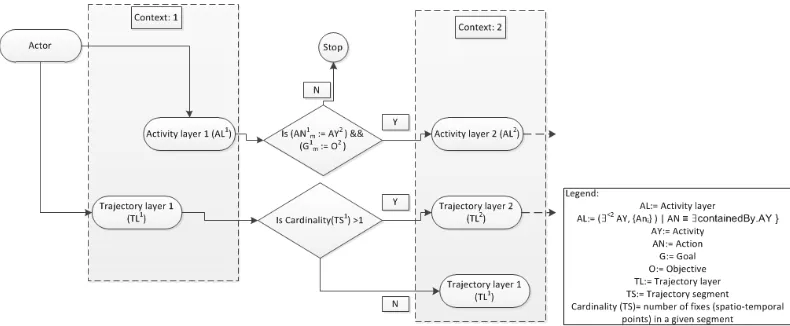
The semantics of activity depends on a context. Hence by changing the context the se-mantics of activity also changes recursively and represents a nested structure at different granularity. By changing a situation or shifting through granularity (hence changing the context completely or partially), the object(s) of interests also changes vis-a-vis an activity structure. Action plays an important role in activity modeling. An activity (AY) is charac-terized by its objective (O), and an action (AN) is characcharac-terized by its goal (G). A shift in granularity or change in situation can transform an objective to goal(s) at finer granularity or a goal to an objective at a coarser granularity (Figure1).
Figure 1: Context-based recursive activity model.
3.2
OWL formalization
The ontology has been formalized and encoded in Web Ontology Language (OWL) which is based on description logic (DL). OWL has been successfully used in semantic web for knowledge representation and developing ontologies that can share information between humans and machines. OWL is standardized by the World Wide Web Consortium (W3C). OWL-DL has been used in previous literature as to improve the readability, reasoning abil-ity, and compactness of concepts and relationships.
explained in detail, in order to focus on the contextual model rather than the intricacies of DL. Interested readers can refer to [46] for further background to DL.
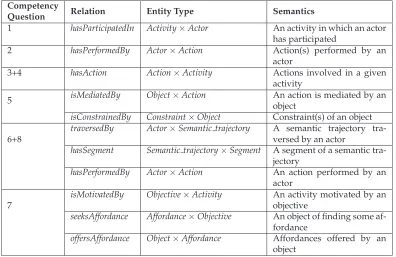
In order to address the competency questions above, basic relations (roles) are deve-loped based on any two entities from a set of concepts CS (see Table2). Some of the key concepts are formalized as follows:
CS = {Actor, Activity, Objective, Need, Action, Object, Affordance, Con-straint, Objective, Semantic trajectory, Segment, Fix, Device}
Competency
Question Relation Entity Type Semantics
1 hasParticipatedIn Activity×Actor An activity in which an actor has participated
2 hasPerformedBy Actor×Action Action(s) performed by an actor
3+4 hasAction Action×Activity Actions involved in a given activity
5 isMediatedBy Object×Action An action is mediated by an object
isConstrainedBy Constraint×Object Constraint(s) of an object
6+8
traversedBy Actor×Semantic trajectory A semantic trajectory tra-versed by an actor
hasSegment Semantic trajectory×Segment A segment of a semantic tra-jectory
hasPerformedBy Actor×Action An action performed by an actor
7
isMotivatedBy Objective×Activity An activity motivated by an objective
seeksAffordance Affordance×Objective An object of finding some af-fordance
offersAffordance Object×Affordance Affordances offered by an object
Table 2: Basic relations and their entity types.
3.2.1 Actor
Actoris an agent that has an objective to fulfill, at least one need, and interacts with at least one object by performing respective actions that in turn enable the actor to participate in an activity. Actor can be instantiated by a specific person or a vehicle in an urban environment. The conceptactorcan be defined as a subclass of someagenthaving some need and objective and performs some actions and participating in an activity. The concept ofactorcan be formalized as follows:
Axiom 1.
Actor⊑ ∃subclassOf.Agent⊓ ∃hasNeed.Need⊓hasObjective.Objective
3.2.2 Activity
Activityis a contextual phenomenon in which an actor participates to fulfill its need(s). An activity consists of actions and motivated by an objective to satisfy the need(s) of the respec-tive actor.Activitycan be defined as having some action is motivated by some objective. A simple DL formalization of anactivityconcept can be expressed as follows:
Axiom 2.
Activity⊑ ∃hasAction.Action⊓ ∃isMotivatedBy.Objective
3.2.3 Action
Actionis one of the atomic units of the semantic trajectory based activity model. An action is contextual phenomenon that is embedded in an activity at a given context which is per-formed by an actor and directed by a goal and generally achieved by affordance. Actions involve a complex interaction of an actor to its surrounding objects and hence an action is generally mediated by a given object. An actioncan be defined as something that is performed by some actor and is directed by exactly one goal and mediated by objects and achieved by corresponding affordance.
Axiom 3.
Action⊑ ∃isPerformedBy.Actor⊓ ∃!isDirectedBy.Goal
⊓isAchievedBy.Affordance⊓isMediatedBy.Object
3.2.4 Context
Contextis any information that characterizes a situation that is relevant to the interaction of an actor with the objects in its environment in order to participate in a given activity. In this research a context must have exactly one actor and exactly one activity and one or more than one actions. The notion of context will be used to instantiate each concepts at different situations.Contextcan be expressed as something that has exactly one unique actor and an activity.
Axiom 4.
Context⊑ ∃!hasActor.Actor⊓ ∃!hasActivity.Activity
3.2.5 Object
Axiom 5.
Object⊑ ∃!offersAffordance.Affordance⊓isConstrained{(true),(f alse)} ⊓∃isConstrainedBy.Constraint
3.2.6 Semantic trajectory
Asemantic trajectoryconsists of temporally indexed fixes in terms of(xi, yi, ti)that repre-sent an agent’s (actor’s) movement history supplemented by additional background infor-mation and domain knowledge. The definition of semantic trajectory varies in different research with additional knowledge to enrich the semantics. However the basic represen-tation of a semantic trajectory involves a set of fixes and having an actor and activity. Here having an actor and activitymeans the semantic trajectory is the movement record of an actor in terms of fixes who is shifting its position in order to perform some activity. But in order to make the formalization simple, the conceptsemantic trajectoryis formalized as follows:
Axiom 6.
Semantic trajectory⊑ ∃!hasActor.Actor⊓ ∃hasFix.Fix⊓ ∃!hasActivity.Activity
3.2.7 Segment
Asegmentis a part of a semantic trajectory that is traversed by an actor. A segment is represented by a starting fix(xi−n, yi−n, ti−n)and an ending fix(xi, yi, ti)where∀n, ti−n< ti. The starting fix ofsegmentiis the ending fix ofsegmenti−1if there is no semantic gap or
hole (a deliberate gap) between i and i-1. A deliberate gap happens when the user turns off the GPS by her own from the concerns related to privacy or battery drainage or any other reason. A semantic gap is generally considered in this research when there is a signal loss in urban canyon or indoor environment such as a tunnel. The following formalization of a segment can be encoded as follows
Axiom 7.
Segment⊑ ∃!startsFrom.Fix⊓ ∃!endsAt.Fix
3.2.8 Fix
Afix is another atomic unit in a semantic trajectory based activity model. A fix can be defined by its data property in the form of a spatio-temporal point(xi, yi, ti), and in a more abstract but understandable form such as a semantic name (home, restaurant, office) and a unique identification for a given semantic trajectory. A fix can be captured by a location or positioning sensor or by manual reporting. The formalization of a fix can be encoded as follows:
Axiom 8.
4
Implementation and evaluation
The ontology has been implemented in Protege, an ontology editor supporting OWL-DL. The model has been encoded in Java with each concept as a class. Unlike a functional language (such as Haskell) Protege provides more expressiveness in terms of DL and flexi-bility through its graphical user interface and object-oriented paradigm. Protege also offers a distributed environment to share and query a knowledge base using Jena-Fuseki web server.
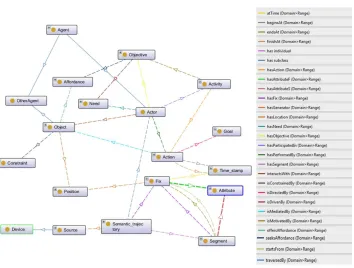
In order to develop the model, first a high-level content based ontology is developed through some concepts and object properties (Figure2). The model is then instantiated in three different contexts (see illustration section). In this research each context is modeled separately. We assume if a given query cannot generate a satisfactory result in one context then it will assess the next context until all the contexts are evaluated (without any conflict) or a search result is found. The ontology has been checked through HermiT Reasoner in Protege [24]. HermiT provides a subsumption checking and logical consistency checking in order to validate an ontology.
The raw trajectory collected for this framework is first preprocessed in two steps a) noise removal, and, b) coordinate transformation. A raw trajectory can give only geometrical in-formation. In order to semantically enrich the raw trajectory and convert it to a semantic trajectory, infrastructure information (route network), domain knowledge (opening time of market), and other situational aspects (focus of analysis at a given granularity) are con-sidered. Figure3shows a flow chart how a raw trajectory is transformed into a semantic trajectory.
Figure4illustrates the implementation in terms of all the entities in the ontology. Each panel contains a set of entities (concepts, object properties, data properties, and indivi-duals). The arrow annotated with an alphabet shows the direct connection between dif-ferent entity types. For example, connectionasignifies a concept (in class hierarchy panel) may have individual(s). Connectionbandcsignify each concept is related to another con-cept or an individual by an object property. Connectiondshows each individual and their data properties.
4.1
Illustration
In this paper, three contexts are considered based on three different situations on a same trajectory. Since these three sets of contextual information are extracted from the same trajectory, each context shows a given level of granularity.
A trajectory (Fig.5) shows Joe’s movement history from his home to market (00:00:00 AM to 11:48:00 AM), a part of his movement trajectory of the day. However the same approach can be used for an entire trajectory with defined context. Table3 shows Joe’s travel diary on 13th June, 2015 from 00:00:00 AM to 11:48:00 AM.
Figure 2: Semantic trajectory based activity ontology.
Figure 3: Raw trajectory to semantic trajectory conversion.
The model has also been tested by issuing SPARQL queries at different contexts. The queries are kept simple, for illustration purposes, but can easily be made more complex and nested based on information needs at a finer granularity and situations which is subject to the design of knowledge base in a given context.
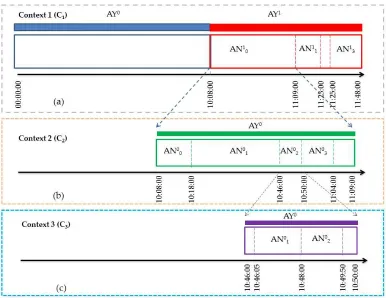
In Figure6AYindicates activity andAN indicates action. The Figure6shows how a singular (atomic) action(AN1
0)in context layerC1(in Figure6a) becomes activity(AY 0
)in context layerC2which is broken down into four new actionsAN
0
Figure 4: Ontology implementation in Protege.
start time end time Action/Activity Transfer
0:00:00 10:08:00 Home
10:08:00 10:18:00 Walk transfer 0
10:18:00 10:46:00 Bus
10:46:00 10:50:00 Walk transfer 1
10:50:00 11:04:00 Train
11:04:00 11:09:00 Walk transfer 2
11:09:00 11:48:00 Market
Table 3: A portion of travel diary.
to 3 (in Figure6b). One of the singular actions inC2(in Figure6b) is again transformed to
activity inC3with four new actions (in Figure6c).
In order to make the activity (AY) and action (AN) defined in each context easily identifiable by the readers, the following notations are used.
Ci AYk=kthactivity in Contexti
Ci ANjk=j th
action inkthactivity in Contexti
Figure 5: Joe’s home to market travel record (Trajectory 13062015). The shift in position over time is from south to north. The figure shows on refining the granularity from
(a→b→c), more action knowledge is discovered. Inawalking action is not properly visible. Inband Figurecwalking action (in green dots) is visible which took place while
Joe was changing from bus mode to train mode.
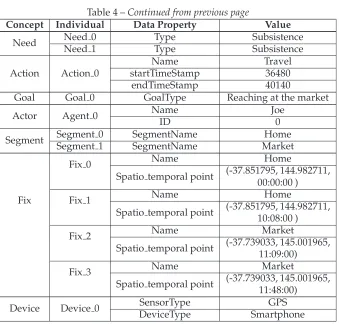
time spent at certain locations during travel (such as transfer or having coffee or buying tickets) and does not give much emphasis on travel-based activities (activities embedded in a travel) or travel as action (Table4). Conforming with the travel demand models, in Context 1 travel is a phenomenon of changing location from home to market over a given route network. Thus, in Context 1 two activities are presented in the knowledge base such as (being at) home(C1 AY
0
)and (shopping at) market(C1 AY 1
)without giving any treat-ment totravel, with an assumption that there is no other activity embedded in this travel and left it as a singular (atomic) action(C1 AN
1
0). Figure 6a also shows some possible
actions(C1 AN11, C1 AN21, C1 AN31)in the market place such as shopping at two different
shops(C1 AN11, C1 AN31)and changing the location from one shop to another within the
market(C1 AN21). However actions such as(C1 AN11, C1 AN21, C1 AN31)are not furnished
Figure 6: Context based recursive activity layers on temporal zooming.
Context 1: Number of activity: 2
Situation: Fill out a Travel Survey form for travel demand analysis
Concept Individual Data Property Value
Activity Activity 0
Name Being at home
ActivityType semantic
Duration 36480
start time 13062015 00:00:00 end time 13062015 10:08:00 start location (-37.851795, 144.982711)
end location (-37.851795, 144.982711)
Activity Activity 1
Name Shopping at market
ActivityType semantic
Duration 2340
start time 13062015 11:09:00 end time 13062015 11:48:00 startLocation (-37.739033, 145.001965)
Table 4 –Continued from previous page
Concept Individual Data Property Value
Need Need 0 Type Subsistence
Need 1 Type Subsistence
Action Action 0
Name Travel
startTimeStamp 36480
endTimeStamp 40140
Goal Goal 0 GoalType Reaching at the market
Actor Agent 0 Name Joe
ID 0
Segment Segment 0Segment 1 SegmentNameSegmentName MarketHome
Fix
Fix 0 Name Home
Spatio temporal point (-37.851795, 144.982711, 00:00:00 )
Fix 1 Name Home
Spatio temporal point (-37.851795, 144.982711, 10:08:00 )
Fix 2 Name Market
Spatio temporal point (-37.739033, 145.001965,11:09:00)
Fix 3 Name Market
Spatio temporal point (-37.739033, 145.001965, 11:48:00)
Device Device 0 SensorType GPS
DeviceType Smartphone
Table 4: Knowledge base schema for Context 1.
Context 2 (Figure6b) illustrates a knowledge base for transport mode analysis (“How did you go to the market?”) which is a refinement of Context 1, and may be an important facet in urban analytics and various context-aware location-based services.
Although the analysis is made on the same trajectory as that of Context 1, the infor-mation needs in both the contexts are different. Hence, there is a change in activity and action characterization between the contexts. In Context 2 the activity is the travel from home to market(C2 AY
0
)with actions are transfer 0(C2 AN 0
0), travel on train(C2 AN 0 1),
transfer 1(C2 AN 0
2), travel on bus(C2 AN 0
3)(see Figure6b, Table3, Table5). Accordingly,
Context 2: Number of activity: 1
Transport mode analysis from home to market
Concept Individual Data Property Value
Activity Activity 0
Name Travel from home to market
ActivityType Semantic
Duration 3660
start time 13062015 10:08:00 end time 13062015 11:09:00 startLocation (-37.851795, 144.982711)
endLocation (-37.739033, 145.001965)
Need Need 0 Type Subsistence
Action Action 0
Name transfer 0
startTimeStamp 36480
endTimeStamp 37080
Action
Action 1
Name Travel on bus
startTimeStamp 37080
endTimeStamp 38760
Action 2
Name transfer 1
startTimeStamp 38760
endTimeStamp 39000
Action 3
Name travel on train
startTimeStamp 39000
endTimeStamp 39840
Action 4
Name Walk to market
startTimeStamp 39840
endTimeStamp 40140
Goal
Goal 0 GoalType Getting on the bus
Goal 1 GoalType Reaching the bus stop at the train station
Goal 2 GoalType Getting on thebus
Goal 3 GoalType Reaching the train station at the market
Goal 4 GoalType Getting to the
market
Actor Agent 0 Name Joe
ID 0
Segment
Segment 0
SegmentName Home to bus stop1
startTimeStamp 36480
startLocation (-37.851795, 144.982711)
endTimeStamp 37080
endLocation (-37.852669, 144.983735)
Segment 1
SegmentName Bus stop1 to bus stop2
startTimeStamp 37080
startLocation (-37.852669, 144.983735)
endTimeStamp 38760
Table 5 –Continued from previous page
Concept Individual Data Property Value
endLocation (-37.788104, 144.994969)
Segment 2
SegmentName Bus stop2 to train stop1
startTimeStamp 38760
startLocation (-37.788104, 144.994969)
endTimeStamp 39000
endLocation (-37.788112, 144.994975)
Segment 3
SegmentName Train stop1 to train stop2
startTimeStamp 39000
startLocation (-37.788112, 144.994975)
endTimeStamp 39840
endLocation (-37.788639, 144.995391)
Segment 4
SegmentName Train stop2 to market
startTimeStamp 39000
startLocation (-37.788112, 144.994975)
endTimeStamp 40140
endLocation (-37.739033, 145.001965)
Fix
Fix 0 Name Home
Spatio temporal point (-37.851795, 144.982711, 10:08:00)
Fix 1 Name Bus stop1
Spatio temporal point (-37.852669, 144.983735,10:18:00)
Fix 2 Name Bus stop2
Spatio temporal point (-37.788104, 144.994969, 10:46:00)
Fix 3 Name Train stop1
Spatio temporal point (-37.788112, 144.994975, 10:50:00)
Fix 4 Name Train stop2
Spatio temporal point (-37.788639, 144.995391, 11:04:00)
Fix 5 Name Market
Spatio temporal point (-37.739033, 145.001965, 11:04:00)
Object
Object 0 Name Bus stop
isAgent FALSE
Object 1 Name Bus
isAgent FALSE
Object 2 Name Train stop
isAgent FALSE
Object 3 Name Train
isAgent FALSE
Object 4 Name route network
isAgent FALSE
Table 5 –Continued from previous page
Concept Individual Data Property Value
Affordance Obj0 Affordance0 Type positive
Offering Embarking and
disembarking
Obj1 Affordance0 Type positive
Offering Mediated travel
Obj2 Affordance0 Type positive
Offering Embarking and
disembarking
Obj3 Affordance0 Type positive
Offering Mediated travel
Obj4 Affordance0 Type positive
Offering Navigation
Device Device 0 SensorType GPS
DeviceType Smartphone
Table 5: Knowledge base schema for Context 2.
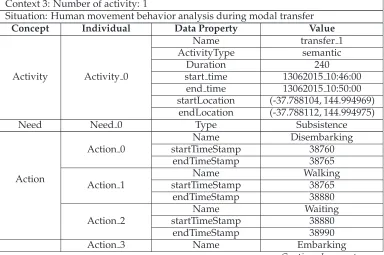
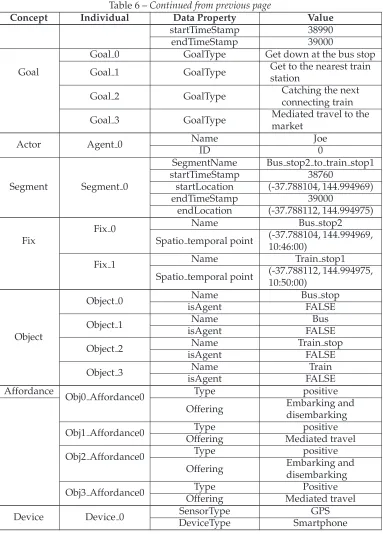
Context 3 (Figure6c, Table6) demonstrates human movement behavior during transfer which is analyzed in order to support any potential non-travel activities along. A trans-fer involves at least disembarking from a vehicle, walking a given distance from point of arrival to point of departure, waiting for next connecting vehicle, and embarking on that vehicle.
Context 3: Number of activity: 1
Situation: Human movement behavior analysis during modal transfer
Concept Individual Data Property Value
Activity Activity 0
Name transfer 1
ActivityType semantic
Duration 240
start time 13062015 10:46:00 end time 13062015 10:50:00 startLocation (-37.788104, 144.994969)
endLocation (-37.788112, 144.994975)
Need Need 0 Type Subsistence
Action
Action 0
Name Disembarking
startTimeStamp 38760
endTimeStamp 38765
Action 1
Name Walking
startTimeStamp 38765
endTimeStamp 38880
Action 2
Name Waiting
startTimeStamp 38880
endTimeStamp 38990
Action 3 Name Embarking
Table 6 –Continued from previous page
Concept Individual Data Property Value
startTimeStamp 38990
endTimeStamp 39000
Goal
Goal 0 GoalType Get down at the bus stop
Goal 1 GoalType Get to the nearest train station
Goal 2 GoalType Catching the next
connecting train
Goal 3 GoalType Mediated travel to the market
Actor Agent 0 Name Joe
ID 0
Segment Segment 0
SegmentName Bus stop2 to train stop1
startTimeStamp 38760
startLocation (-37.788104, 144.994969)
endTimeStamp 39000
endLocation (-37.788112, 144.994975)
Fix
Fix 0 Name Bus stop2
Spatio temporal point (-37.788104, 144.994969, 10:46:00)
Fix 1 Name Train stop1
Spatio temporal point (-37.788112, 144.994975, 10:50:00)
Object
Object 0 Name Bus stop
isAgent FALSE
Object 1 Name Bus
isAgent FALSE
Object 2 Name Train stop
isAgent FALSE
Object 3 Name Train
isAgent FALSE
Affordance
Obj0 Affordance0 Type positive
Offering Embarking and
disembarking
Obj1 Affordance0 Type positive
Offering Mediated travel
Obj2 Affordance0 Type positive
Offering Embarking and
disembarking
Obj3 Affordance0 Type Positive
Offering Mediated travel
Device Device 0 SensorType GPS
DeviceType Smartphone
In order to test the model, SPARQL queries are issued at different contexts. In Context 2, all the activities and corresponding action information are retrieved from the knowledge base (Figure7). Since Context 2 contains only one activity hence the output produces only one activity (travel from home to market) with corresponding five actions that are required to perform that activity.
Figure 7: SPARQL query in Context 2:Extract all the activities and actions in Context 2.
In context 3, a more complex query is issued to extract all the actions along Segment 0 (Figure8). From these illustrations it can be seen that Context 1 conforms with the trans-portation domain, where understanding the causes behind people’s travel behavior has been a long standing research endeavor (which is generally addressed by travel surveys in different sorts). Context 2 purports the domain of mobile computing and context-aware computing (along with transportation science) where one may be interested to know a person’s current active state in terms of modality and movement behavior and customize different location based and context-aware services. Context 3 aligns with public health research where one is more interested in a person’s low level movement behavior such as whether standing or walking or running.
Figure 8: SPARQL query in Context 3:Extract all the actions along Segment 0.
at a finer granularity (may be the spatial dimension can be transformed into a Cartesian coordinate in indoor or a qualitative information say Room 1 to Room 2).
The main interest of this paper lies in trajectory based activity modeling in urban envi-ronment. Hence, the three case studies shown with their corresponding knowledge bases use a single trajectory in different contexts can easily be extended or shrunk at different spatial and temporal scope.
5
Discussion
In this research, a framework of activities has been developed, implemented as an ontology, and tested for three different contexts. The three contexts illustrate that activity can be modeled for different contexts with different semantics, or level of spatial and temporal granularity. The contexts presented in this paper are all related to each other in terms of a common need. We have shown how action in one activity layer (in one context) can be transformed to an activity in another layer (in another context). In terms of refinement of granularity the presented contexts are ordered in terms of space and time from coarsest to finest granularity (see Figure6):
Context 1≺Context 2≺Context 3
Hence, Context 3 can be viewed at a finer granularity than that of Context 1. The three contexts show how on refining the granularity more information is revealed at a given segment. For example, in Context 1, the most relevant information required is time spent at a given location (such as home or market) which is characterized as activity and hence any more detailed information pertaining to travel (such as modes and transfers) is irrelevant and is presented as single (atomic) action in the knowledge base (Figure6a, knowledge base for Context 1). Whereas in Context 2, since the way of movement is now relevant, detailed information about transport modes and transfers are presented in the knowledge base, together with further object and affordance information (Figure6b, knowledge base for Context 2). Context 3 shows again more details but here only for a shorter movement segment (within a constrained spatial and temporal scope), such as transfer (Figure 6c, knowledge base for Context 3).
This research started out with four research questions (see Section 1), reviewed below.
What is an activity and what is an action in human behavior at urban scale? Based on a context, an activity is the interaction of an agent with its environment to satisfy some need(s). In order to satisfy a need, agent follows an objective. An objective is composed of goals set by the agent which are constrained by the affordances offered by object(s). Each activity contains one or more actions which are oriented towards an object (that offers affordance) to fulfill a given goal. However the concept of activity and action is highly context-sensitive. On spatial and temporal zooming and by changing the situation, the semantics, and role of an activity or action changes in a given context.
Based on the illustration presented in this paper (Figure6), the concept of “activity and action” is aligned with “process and event” in spatial information science. An activity re-sembles a process; an action contained in an activity rere-sembles an event. But as established, context plays an important role in defining an activity or action. Hence, context would also affect the conceptualization of a process and event, both of which can be refined or simpli-fied, changing the semantics (a process may transform into an event at a given context and vice versa).
Is travel an activity? It has been illustrated that the ambiguity lies in context-dependency. In Context 1 travel is not an activity (Table4); rather it induces some activities that are not possible at a current location. Hence a travel can be viewed as an action in Context 1. This bridges the gap between the notion of activity in HCI and activity in travel demand modeling.
However, at a different situation, travel can be viewed as an activity with embedded actions (see Context 2 in Table5, Figure6b) that also conforms some of the earlier literature where travel has been considered as activity [31]. On a coarser granularity and a different context, say, for an activity “holidaying in Melbourne” with a need of recreation, travel can also be considered as an action. However changing position in a same campus (university or office) or indoor environment (one terminal to another terminal in an airport or train station, one floor to another floor in a same building) are left for future work.
![Table 1: Activity and actions for different activity targeted to a same location [31].](https://thumb-us.123doks.com/thumbv2/123dok_us/1157001.1617780/9.612.164.467.200.372/table-activity-actions-different-activity-targeted-location.webp)