© 2013 Electronic Journal of Science Education (Southwestern University) Retrieved from http://ejse.southwestern.edu
Lights, Camera, Action! Developing a Methodology to Document Mainstream Films’ Portrayal of Nature of Science and Scientific Inquiry
Catherine M. Koehler
Southern Connecticut State University Mark A. Bloom
Dallas Baptist University Ian C. Binns
University of North Carolina at Charlotte
Abstract
This study explores the development of a methodology to analyze how nature of science (NOS) and scientific inquiry (SI) are portrayed in mainstream films. We demonstrate this methodology using the films, Contact and Twister, as they are commonly used in earth/space science classrooms. We investigate the following research question: how do mainstream films present NOS and SI? Using a qualitative approach to examine the instances in which NOS and SI were observed in the film, we developed a template that assists the viewers in identifying these incidences visually. Not only can this instrument be used to determine when NOS and SI are portrayed in mainstream films, it can also be used to create a visual fingerprint depicting the number of incidents in which each construct is displayed. We suggest that these fingerprints can be used to help teachers understand how NOS and SI are addressed in selected mainstream films normally used in secondary science classrooms.
Correspondence concerning this manuscript should be addressed to: Catherine M. Koehler, Southern Connecticut State University, Department of Science Education & Environmental Studies, 300 Crescent Street, New Haven, CT 06511, email: [email protected], (860) 543-1510
Keywords: nature of science, scientific inquiry, films
Introduction
Electronic Journal of Science Education ejse.southwestern.edu Although closely related and often conflated, it is important to note the distinction between these two constructs. Lederman (2004) contends that NOS is “the epistemological underpinnings of the activities of science” and SI is the “process by which scientific knowledge is developed” (p. 308).
NOS can be considered an epistemology of science, one way of knowing, and inherent in the development of scientific knowledge (Lederman, 1992). Philosophers of science have debated the merits and tenets of NOS, but for use in this study, NOS will be defined by the seven tenets described by Lederman, Abd-El-Khalick, Bell, and Schwartz (2002) as: tentative, empirical, socially and culturally embedded, subjective, creative, distinguishing between observations and inferences, as well as between laws and theories.
SI, rooted in work by Schwab (1962), contends that, “knowledge won through enquiry is no knowledge merely of facts, but of the facts interpreted” (p. 14). The National Science Education Standards (NSES) (NRC, 1996) suggests that inquiry is a step beyond “science as a process” and supports the notion that students combine “processes of science and scientific knowledge, critical thinking, and scientific reasoning to develop an understanding of science” (p. 105). The categories of SI used in this investigation are based on the description of nature of scientific inquiry in Schwartz, Lederman and Lederman (2008) and NRC (2000). These descriptors include: (1) scientific questions guide all investigations, (2) there are multiple methods of scientific investigations, (3) there is a distinction between data and evidence, (4) there is a justification of scientific knowledge, (5) recognition and handling of anomalous data, and (6) the community of science practice develops and accepts scientific knowledge. These tenets and descriptors will be used in the development of our fingerprint discussed later in this paper.
The scientific endeavor goes beyond work in a science laboratory, and DeBoer (2000) argues that one aspect of scientific literacy is the ability to understand reports and discuss science that appears in the popular media. Schubert (2009, p. 14) advocates further exploration into the impact of “outside curriculum” on learners‟ outlooks, and pays special attention to popular culture such as video games, music, and film. Others have argued that popular media, especially television and movies, have blurred the lines between fact and fiction when it comes to science, have created misunderstandings regarding NOS, and have corroded the public‟s critical thinking skills that have hindered scientific literacy (Barnett & Kafka, 2007; National Science Board [NSB], 2000; Nowotny, 2005). The Science and Engineering Indicators report (NSB, 2000) also suggests that this treatment of science could be harmful to the public understanding of science.
Electronic Journal of Science Education ejse.southwestern.edu argue that the use of science fiction films to teach science can motivate more students to learn the subject where traditional methods have been unsuccessful.
As a means to change the current paradigm in science education, one must consider that teaching and learning science should go beyond the realm of “nebulous scientific facts floating in the cosmos of knowledge that are meaningless to the learner” (Koehler, 2006, p. 2). The scientific context in which these facts are taught provides the learner with a framework and context to support the subject matter they are learning. From the perspective of situated cognition theory, all learning is contextually situated (Brown, Collins, & Duguid, 1989), and scientific inquiry can be better understood when authentic scientists‟ practices and experiences are provided as examples for students to observe (van Rens, Pilot, & van der Schee, 2010).
Egan (1997) describes the historical aspects of educational schemes and strategies that have been used for “initiation of the young into the knowledge, skills, values, and commitments of the adult members of the society” (p. 10). He emphasizes the role of storytelling as the “most powerful technique invented” to achieve this goal. He credits the vivid imagery of stories with making the material easier to remember, and for “shaping the hearers‟ emotional commitment to those contents” (p. 10). As technology has advanced, stories are frequently told through cinema and television. We argue that the storytelling found in mainstream films can depict the scientific endeavor and encourage discussions of NOS and SI.
It is well documented in the literature that, even after explicit NOS instruction, both preservice and inservice teachers fail to demonstrate an adequate understanding in their classrooms (Abd-El-Khalick, 2001; Abd-El-Khalick, Bell & Lederman, 1998; Bell, Lederman, Abd-El-Khalick, 2000; Bloom, Binns, & Koehler, in revision; Lederman, 2007; Moss, Abrams & Robb, 2001; Moss & Koehler, 2004; Schwartz & Lederman, 2002). Perhaps the remaining difficulty in explicit classroom instruction is that, too often, it fails to provide the visual images necessary for “shaping the hearers‟ emotional commitment to the content” as Egan (1997) recommends. This study investigates the creation of a methodology that, when applied, can provide examples of NOS and SI using visual imagery from the films, Contact and Twister.
Literature Review
Representation of Nature of Science in Mass Media
To date, only two studies have examined the representation of NOS in television and none have addressed it in films. Collins (1987) and Dhingra (2003) addressed how one aspect of NOS was portrayed in television; the notion that science is tentative. Collins (1987) found that the two documentaries included in his study portrayed science as overly certain or absolute. Only in those cases where the science content is considered to be fringe science did the programs illustrate that science is tentative. However, in each case, the implication was made that this was merely temporary and that future research would remove the uncertainty.
Electronic Journal of Science Education ejse.southwestern.edu documentaries and educational type programs (e.g. Bill Nye the Science Guy) presented science as a “set of facts with a high degree of certainty” (p. 252). Although these examples demonstrate some research in this area, much more is needed to fully understand how films present NOS.
Representation of Scientific Inquiry in Mass Media
While there has been more research on media representation of SI than on NOS, only one article specifically addressed this issue. Hornig (1990) examined two television episodes of NOVA to see how they addressed the nature of scientific inquiry. She found that these programs focused less on the process of science and more on the product of science. Hornig concluded that the shows hid the nature of scientific inquiry from the audience. Later research that focused on films came to similar conclusions. Weingart, Muhl, and Pansegrau (2003) found in their analysis of 222 films covering eight decades that the process of science was the overarching theme where roughly 20% showed scientists working in a secret basement laboratory, more than 20% showed scientists conducting research in the field, and 42% showed scientists working alone.
Elena (1997) was the only investigation to report that a film, at least partially, presented an authentic representation of scientific inquiry. In this research, he did not analyze a science fiction film, but instead, the biopic, Madame Curie (1943). His argued that the film presented Marie Curie more as a research assistant than as a leading scientist. This misrepresentation of the role of women in science is stereotypical, yet inaccurate.
Science consultants have a role in the production aspect of films, and both Frank (2003) and Kirby (2011) indicated that in some cases, these consultants have influenced how films present the work of scientists. For example, in the film Dante’s Peak, science consultants successfully changed how filmmakers portrayed scientific inquiry to illustrate how scientists actually study volcanoes. Frank (2003) found that these consultants convinced the filmmakers to portray science as more fallible. He noted that one consultant stated:
…there was never enough emphasis on how limited our knowledge is, how much guesswork is involved…And so we cast him [Pierce Brosnan] as a much more…we changed the scripts to make him a much more credible person in terms of voicing his concerns and the doubts that all volcanologists have during eruptions. Which hadn‟t been present before. And so we instead - we basically showed the fallibility of our profession. (p. 458)
Similarly, science consultants from the National Severe Storm Laboratory (NSSL) changed their role as depicted in the film, Twister. Originally, the role portrayed them as “the bad guys,” but when the film was completed, their role ended up being “an advisory capacity group” (Frank, 2003, p. 458). Both researchers, Frank (2003) and Kirby (2011), found that science consultants can influence dialogue in a film as well as the design of scientists‟ workspaces.
Electronic Journal of Science Education ejse.southwestern.edu authentic scientific inquiry as well as scientific workspaces in films, more of an effort needs to be made to portray the process of science as something that takes months, even years, to unfold instead of a few days (Ribalow, 1997).
Purpose
Although some research presents how science is portrayed in the media, it is apparent that more research is needed in understanding how NOS and SI are represented in films. We argue that NOS and SI can be better appreciated by learners of science when presented in the context of stories played out in films. It is the characters who break the mold of stereotypical scientists in the labs with whom the learners become emotionally connected and perhaps remember the most. These gaps in the literature led to the research question investigated in this study, how do mainstream films present NOS and SI? In this paper, we describe the development of a template that assists viewers in identifying incidences of NOS and SI representation in mainstream films. Using this template, we then create a NOS and SI fingerprint to depict the number of times certain NOS tenets and SI aspects are portrayed in two films; Contact and
Twister. With this methodology, we can create corresponding fingerprints for other science related films, and subsequently, develop instructional strategies that use films to teach these constructs. Our intent, with the use of mainstream films, is to evoke an emotional trigger and visual imagery that can provide the necessary stimulus to affect lasting and relevant learning of the important science concepts. This paper addresses the process that we took to dissect incidents of NOS and SI in two mainstream films. In future work, we will describe strategies that use this template for NOS and SI instruction in the science classroom.
Methods
This project used a qualitative methodology to investigate mainstream science fiction films to identify the number of incidents when NOS and SI were demonstrated as well as the ways in which they were portrayed. Three independent researchers from three different universities were involved in this study, each bringing to the table an expertise in the understandings of NOS and SI. Two films were chosen for this initial analysis, Contact and
Twister. These films were selected because they were previously used by two of the researchers as an aide in teaching earth/space science in their secondary science classrooms. Additionally,
Contact is considered to be one of the best films to portray how scientific research is conducted (Fraknoi, 2003). Although these films are somewhat dated, we felt that our familiarity with them would be advantageous to pilot this methodology. It is our intent to apply this methodology to more recent films after we have thoroughly explored its application.
Electronic Journal of Science Education ejse.southwestern.edu We chose first to view Contact then applied what we learned from this methodology to our viewing of Twister. Contact was examined independently several times by each researcher, and each screening served different purposes. During our initial viewings, we independently determined if NOS and SI was sufficiently present in order to be useful for analysis in this study. To analyze each film, a general template that listed the seven tenets of NOS and the descriptors of SI was developed. After lengthy discussions, we determined that more clarity was necessary to capture the essence of each tenet of NOS. We, therefore, divided each NOS tenet into subcategories. Similar subcategories were inductively derived in prior research on NOS (Bloom, 2008; Bloom et al., in revision), thus we followed this lead.
Nature of Science (NOS) Subcategory Development
Each NOS subcategory qualitatively describes a specific aspect of its respective tenet. Although many of the NOS subcategories described here were used in prior research (Bloom, 2008; Bloom et al., in revision), it should be noted that additional subcategories also emerged through researcher discussions and reviewing of the films. When appropriate, these additional subcategories were incorporated into the overarching tenets of NOS. For example, for the NOS tenet, creativity, three subcategories emerged to better describe this construct: scientists use creativity and imagination to: (1) develop research questions; (2) conduct experiments, and (3) formulate explanations of observations. Using these descriptors, the viewer could determine how scientists use their creativity in the scientific endeavor. Similar subcategories for each tenet of NOS can be found in Table 1. These subcategories emerged through grounded theory approach (Creswell, 2013; Patton, 2002).
Table 1
Tenets of NOS and Subcategories NOS Tenet Subcategories
Tentative (T) Scientific knowledge changes and is reliable Scientific knowledge is gained
Prior knowledge is revised
Empirical (E) All science knowledge is based on empirical evidence
Subjective (S) Scientists interpret data using a theoretical perspective
The same data can be interpreted differently by different scientists because of background knowledge and professional context
Creative (C) Scientists use creativity and imagination to develop research questions Scientists use creativity and imagination to design experiments
Scientists must use creativity and imagination to formulate explanations of observations
Observations and Inferences (O/I)
Observations are directly accessible to the sense or by instrumentation that extends the senses
All knowledge is partially observable & inferential Inferences are created by scientists to explain observations
Some scientific knowledge is inferential and lacks direct observation evidence
Predictions: Inferences can be of a predictive nature (the inference may be confirmed in the future)
Electronic Journal of Science Education ejse.southwestern.edu Socially/Culturally
Embedded (SC)
Social and cultural values guide questions that scientists ask
Social and cultural values influence the ways in which scientists conduct research to advance scientific knowledge
Social and cultural values can advance or impede scientific progress
Science‟s Intersection with Faith: (1) Purpose of science to discover TRUTH; (2) Faith and knowledge are often in conflict; (3) A scientist can hold dual conceptions of science and faith
Political Aspects of Science: (1) scientists vying for priority of discovery for recognition; (2) funding of science often plays out because of national priorities Ethics of science: The junction between danger and data collection
Theories and Laws (TL)
Theories are inferred explanatory statements of natural phenomena Laws are descriptive generalizations of natural phenomena Both theories and laws are based on substantial evidence
Both theories and laws can change with new evidence or revision of evidence There is no hierarchical nature between theories and laws
Scientific Inquiry (SI) Subcategory Development
Similarly to what was noted during initial viewings of Contact, the initial descriptors of NOSI as adapted from Schwartz et al. (2008), did not completely describe what we found in association to SI in the films. We applied the same rationale to NOSI and developed associated subcategories for these descriptors. Five broad categories of SI emerged and were defined as: (1) questions, (2) scientific process, (3) explanations, (4) communication, and (5) places of work. An example of subcategories in the description of “scientific process,” emerged as follows: (1) there is no single scientific method, (2) the scientific process is iterative, and (3) tools are created to drive the scientific process. Similar subcategories of SI can be found in Table 2. These subcategories also emerged through grounded theory approach (Creswell, 2013; Patton, 2002). Table 2
Aspects of Scientific Inquiry (SI) and Subcategories Scientific Inquiry (SI) Subcategories
Questions (Q) All scientific investigations begin with a question (as informed by observations) Procedures are guided by the question (as informed by observations)
Scientific Process (SP) There is no single scientific method The methods of science are iterative
Tools are created to drive the scientific process
Explanations (E) Explanations are a combination of data collected and interpretations of existing knowledge which is already known
Explanations are tested for validity and reliability
Communication (C) The community of science practice develops and accepts scientific knowledge
Places to work (W) Laboratory Field work
Electronic Journal of Science Education ejse.southwestern.edu
Development of Templates Used to View the Films and to Produce Fingerprints
This multi-step approach to analysis used in this investigation began with author-developed templates for tenets of NOS and the aspects of SI. These templates were initially guided by the literature and provided the general structure that listed the tenets of NOS and the aspects of SI. These templates were used to collect data while watching the films. We were concerned that the addition of the NOS subcategories could potentially contradict the intent of each tenet. To address this concern, a panel of experts (n=4) whose work is grounded in NOS and SI research provided guidance for the subcategories. The panel of experts reviewed the NOS subcategories and made comments to clarify each tenet. We used these comments to further refine our template. This methodology followed the preliminary analyses of Contact, and served to refine the template and ground it in the data (Patton, 2002).
The units of analysis in Tables 1 and 2 were used as the template while viewing the film
Contact (and later Twister) as step one in the process. These templates were completed while watching the films to identify specific scenes where these constructs were explicitly depicted. Using inductive coding, the researchers systematically documented both the time in which the tenet or subcategory was portrayed as well as a brief description of the scene. After each researcher viewed and coded the film using the code from the template, the researchers met to discuss the findings. Through weekly Skype discussions, we came to consensus as we compared segments of the films that identified NOS and/or SI and determined which tenet or subcategory was demonstrated in which scenes. Constant comparative methodology was used to systematically examine and redefine variations on the subcategory codes (Patton, 2002). As new codes emerged during the analysis, the template was reconfigured so it could be used universally with viewing any film. Triangulation of the data was a key component in this analysis; the independent analysis of each researcher was continually compared to the others, thus reducing inherent bias by providing validity and inter-coder agreement (Creswell, 2013; Patton, 2002).
Example of a Fingerprint
Figures 1 and 2 provide examples of the data compiled using the templates for the film,
Contact. Note that the starting time (in hours:minutes:seconds from the beginning of the film) in which the incident occurs is included in these figures. For research purposes, we chose the term incident to be the appearance of a subcategory that was viewed. This starting time notation was used for easier inclusion in this manuscript. In the full fingerprint, we include a descriptor of the incident which informs the user of the duration of clip. It was our intent to create a user-friendly teaching tool to assist teachers in choosing tenets of NOS and aspects of SI that are visible in each film. We further identified the starting time of an incident by including the DVD/Blu-Ray Disc “chapter” number, as it was the most useful way to locate these incidents within the films. For use in the classroom, the teacher can choose how many scenes/chapters to preview given their available time for instruction. The number located in parentheses adjacent to the broad tenet is the number of incidents we found in the film. Dividing the units of analysis into distinct domains (NOS, SI) from each template created a visual representation, which we call a fingerprint as step two in the process.
Aspects of Nature of Science Time (DVD chapter #)
Tentativeness
Electronic Journal of Science Education ejse.southwestern.edu New Knowledge is Gained 0:59:00 (17) 1:08:00 (19) 1:33:15 (26) Prior Knowledge is Revised 0:30:00 (9) 0:40:40 (12) 0:54:00 (15)
Empirical
All Science Knowledge is Based On Empirical Evidence 0:08:41 (3) 0:18:40 (6) 0:25:35 (8)
Subjective
Scientists interpret data using a theoretical perspective 0:40:40 (11) 0:42:00 (11) 0:42:40 (11) The same data can be interpreted differently by different scientists
because of their backgrounds 0:14:40 (5) 0:26:24 (8) 0:48:30 (13)
Creative
Scientists must use creativity and imagination to formulate
explanations of observations 0:17:22 (6) 0:54:00 (15) 0:59:00 (17) Scientists use creativity and imagination to conduct experiments 0:33:00 (10) 0:59:30 (17)
Observations and Inferences
Observations are directly accessible to the senses or by
instrumentation that extends the senses 0:46:50 (12) 1:52:00 (32) 2:01:00 (34) All knowledge is partially observable & inferential
Inferences are created by scientists to explain observations 0:35:45 (11) 0:42:00 (11) 0:53:00 (15) Some Scientific Knowledge is Inferential and lacks direct observable
evidence 1:13:00 (21) 2:10:10 (38)
Predictions: Inferences can be of a predictive nature (the inference may be confirmed in the future)
Retrodictions: Inferences can be of a retrodictive nature (inferring what has happened in the past)
Socially and Culturally Embedded
Social and cultural values guide the questions that scientists ask 0:10:40 (3) 0:14:40 (5) 0:26:00 (8) Social and cultural values influence the ways in which scientists
conduct research to advance scientific knowledge 0:33:00 (10) 0:57:10 (16)
Social and cultural values can impede scientific progress 0:26:00 (8) 0:42:40 (11) 0:44:00 (12) Science's Intersection with Faith (28x): (1) Purpose of science to
discover TRUTH; (2) Faith and knowledge are often in conflict; (3) A scientist can hold dual conceptions of science and faith.
0:14:38 (5) 0:15:20 (5) 0:24:50 (7)
Political Aspects of Science (15x): (1) Scientists vying for priority of discovery for recognition; (2) funding of science often plays out because of national priorities
0:14:00 (5) 0:14:40 (5) 0:26:15 (8)
Ethics of science (5x): the junction between danger and data
collection 1:18:50 (23) 1:20:00 (24) 1:20:30 (24)
Theories and Laws
Theories are inferred explanatory statements 2:10:12 (38) Laws are descriptive generalizations
Theories and laws are based on substantial evidence
Theories and laws can change with new evidence or revision of evidence
Non-hierarchical nature of theories and laws
Figure 1. An example of the NOS fingerprint for the film, Contact. (DVD chapter # appears in the parentheses)
Aspects of Scientific Inquiry Time (DVD chapter #)
Electronic Journal of Science Education ejse.southwestern.edu All scientific investigations begin with a question (as informed by
observations) 0:01:00 (1) 0:51:22 (14) 1:21:45 (24)
Procedures are guided by the question (as informed by observations) 0:38:00 (11)
Scientific Process
There is no single scientific method 0:08:41 (3) 0:31:23 (10) 0:46:50 (12) The methods of science are iterative
Tools are created to drive the scientific process
Explanations
Explanations are a combination of data collected and interpretations
of existing knowledge which is already known 0:09:45 (3) 0:35:15 (11) 1:07:00 (19) Explanations are tested for validity and reliability 1:29:00 (26) 1:52:00 (32)
Communication
The community of science practice develops and accepts scientific
knowledge 0:11:00 (3) 0:43:15 (11)
Places of Work
Laboratory 0:08:30 (3) 0:38:00 (11)
Field work 0:08:41 (3) 0:25:35 (8) 0:38:00 (11)
Other (e.g. computer lab, planetarium, etc.)
Figure 2. An example of the SI fingerprint for the film, Contact
(DVD chapter # appears in the parentheses)
We refer to this data in Figure 1 and 2 as the NOS or SI fingerprint for the film, Contact. As this is only a portion of the Contact fingerprint, not all incidents are cited here. Note that some tenets of NOS as well as some aspects of SI were not identified in this film. These were left blank on the fingerprint.
The fingerprint is a simple way to identify specific scenes where NOS and/or SI are portrayed in films. Once the identification and segmenting is established, the data can then be graphically arranged in a chart format (step three in the process). The resulting pattern depicts the unique qualities of the film and allows for comparison of one film‟s traits with those of other films. The data collected by the three researchers were consolidated into one large fingerprint (similar to Figures 1 and 2) for each film.
Findings
In the prior section, we describe the creation of the template used to develop a fingerprint that demonstrates the number of incidents where NOS and SI occur in the film, Contact. We provided the reader with a rationale for using the concept of a fingerprint and a sample of a larger fingerprint for Contact (Figures 1 and 2). In the next section, we demonstrate how we analyzed a clip from the film, Contact. We chose this example to demonstrate how multiple tenets of NOS and SI are portrayed in this scene. The dialogue commences from Chapter 11 on the DVD (00:39:20-00:43:00) (Zemeckis & Starkey, 1997).
Electronic Journal of Science Education ejse.southwestern.edu headphones and frantically tries to communicate this discovery via walkie-talkie to Fisher and Willie (her research assistants) who are working in the control room. As she drives frantically to the control room, she yells out the star coordinates “right ascension, 18 hours, 36 minutes, 56.2 seconds; declination plus 36 degrees, 46 minutes, .62 seconds” (Zemeckis & Starkey, 1997) hoping that they are hearing the same thing and are trying to locate the signal in space. She visually shows frustration with the lack of communication from her lab assistants. Once communication is made, the group discusses the status of the satellite dishes and the direction in which they are pointing. The example of the dialog below begins when Ellie reaches the laboratory and runs up the stairs to the lab. NOS and SI identifiers are included in parentheses.
Ellie: How you doing? Talk to me guys. (SI-W: places of work) Fisher: Partially polarized set of moving pulses, amplitude modulated.
Willie: All on, systems check out, signal across the board, what’s the frequency? Ellie: 4.4623 giga-hertz. Hydrogen times pi, told you. (NOS-E: empirical) Fisher: Strong sucker too.
Willie: I got it! I got it, I got it! I’m patched in.
Ellie: Okay, let me hear it. (Ellie hears it on the computer). See that? Make me a liar Fish Fisher: It could be AWACS out of Kirkland jamming us but, I’m doubting it. (NOS-E:
empirical)
Ellie: Let’s see if FUDS reading it too. Willie, patch it back and give me the off-axis. Are we recording?
Fisher: Never stopped
Ellie: Thank you, Elmer. (Ellie kisses the computer)
Fisher: AWACS status is negative. Ellie: What about White Sands? Fisher: On this frequency? No.
Ellie: I’m going to punch up the darks. Who is it spying tonight guys? Come on.
Fisher: NORAD’s not tracking any snoops in this vector. Shuttle Endeavor’s in sleep mode. Willie: Ok, Point source confirmed. Whatever it is, it ain’t local.
Ellie: Position?
Willie: I checked in the thermometry, its somewhere in Lyra, I think.
Ellie: Vega?
Fisher: Can’t be, it’s only 26 light years away. (NOS-O/I: observations/inferences) Ellie: What’s the peak intensity?
Fisher: Coming up.
Ellie: Vega. Vega? I scanned it a bunch of times at Arecibo, and it had negative results, always.
Fisher: Got it, it’s reaping over 100 Janskys. Willie: Jesus, it’s picking up on my…. SOUND STOPS
Ellie: No. (long pause then sound starts back) Come on. All right. It’s re-starting. Wait a minute; those are numbers. That was a three, the one before was two. Umm, base 10 numbers, Just start counting now, let’s see how far we can get.
Willie: Five
Fisher & Ellie: Seven, seven
Ellie: Those are primes, two, three, five, seven. Those are all prime numbers. Man there’s no way…that’s a natural phenomenon. (SI-E: explanations)
Fisher: Holy shit
Ellie: Let’s calm down and pull up the star file on Vega.
Fisher: No, that doesn’t make any sense; the system is too young. So it can’t have a planetary system, let alone life or a technological civilization.
Willie (talking over Fisher): Zero
Electronic Journal of Science Education ejse.southwestern.edu
Fisher: Ok, so space craft? No, that system is full of debris; they would get clobbered. Willie: (sarcastically) Not if they use the laser blasters and photon-torpedoes. Fisher: Come on Willie, that’s not funny.
Willie: Well, how else are we going to explain it?
Ellie: No, Willie’s right, if we go public with this and we’re wrong, that’s it, it’s over, we’re cooked. God, I wish Kent was here. (NOS-SC: social/cultural)
Willie: Whatever the signal is we better do something soon. Vega is going to set.
Ian (a scientist from Australia): That position is confirmed. We got 4.4623 gigahertz. Confirmed we got 112 Janskys. (SI-C: communication)
Ellie: All right, do you have a source location yet? Ian: We put it right smack in the middle, Vega.
Ellie: Ok, thanks, Ian. Just keep tracking and we’ll get back to ya. Ian: Yup, right oh.
[Pause as Ellie contemplates her next move.]
Fisher: Ok, 101, the pulse sequence through every prime number between the number 2 and 101.
Willie: Who are we going to call now? Ellie: Everybody.
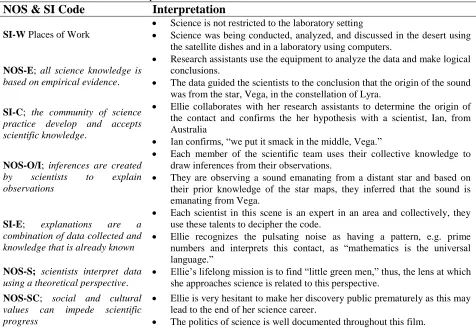
Many of the scenes chosen in this study contain multiple tenets of NOS and SI, which makes them rich descriptors of these constructs. Table 3 is an example of some of the codes found in this scene and the rationale as to why we used them.
Table 3
NOS & SI Codes Used to Interpret this Scene
NOS & SI Code Interpretation
SI-W Places of Work
Science is not restricted to the laboratory setting
Science was being conducted, analyzed, and discussed in the desert using the satellite dishes and in a laboratory using computers.
NOS-E; all science knowledge is based on empirical evidence.
Research assistants use the equipment to analyze the data and make logical conclusions.
The data guided the scientists to the conclusion that the origin of the sound was from the star, Vega, in the constellation of Lyra.
SI-C; the community of science practice develop and accepts scientific knowledge.
Ellie collaborates with her research assistants to determine the origin of the contact and confirms the her hypothesis with a scientist, Ian, from Australia
Ian confirms, “we put it smack in the middle, Vega.”
NOS-O/I; inferences are created by scientists to explain observations
Each member of the scientific team uses their collective knowledge to draw inferences from their observations.
They are observing a sound emanating from a distant star and based on their prior knowledge of the star maps, they inferred that the sound is emanating from Vega.
SI-E; explanations are a combination of data collected and knowledge that is already known
Each scientist in this scene is an expert in an area and collectively, they use these talents to decipher the code.
Ellie recognizes the pulsating noise as having a pattern, e.g. prime numbers and interprets this contact, as “mathematics is the universal language.”
NOS-S; scientists interpret data using a theoretical perspective.
Ellie‟s lifelong mission is to find “little green men,” thus, the lens at which she approaches science is related to this perspective.
NOS-SC; social and cultural values can impede scientific progress
Ellie is very hesitant to make her discovery public prematurely as this may lead to the end of her science career.
Electronic Journal of Science Education ejse.southwestern.edu
Graphical Representations in the Films, Contact and Twister
After the films Contact and Twister were viewed by each researcher, coded using the template, further analyzed and translated into the fingerprint, each film was graphically represented using a bar graph. It is important to note that the graphical representations depict the frequency of incidences we identified in each film and do not imply a quantitative hierarchy of importance. Again, to reduce inherent bias by any one researcher, lengthy discussions among the research team led to the final graphs for Contact and Twister. Figure 3 (NOS) and Figure 4 (SI) are two graphical representations that depict the frequency of incidents of NOS and SI as demonstrated in Contact and Twister.
Graphical Representation of NOS in Contact and Twister
Figure 3 presents a graphical representation of the tenets of NOS found in the films
Contact and Twister. Note that the seven tenets of NOS were used in this chart as all subcategories were collapsed into each respective tenet for purposes of clarity in the data.
Figure 3. Comparing the tenets of NOS in the films Contact and Twister.
The evidence presented in Figure 3 indicates that Contact included more incidences of NOS tenets when compared to Twister. As noted in the graph, the tenets most frequently seen in
Electronic Journal of Science Education ejse.southwestern.edu
Twister, the most prominent tenets are tentative (n=9), observation and inference (n=16), and social and cultural (n=11).
It is important to note that some films will highlight certain tenets of NOS and SI more so than other films. In particular, Contact portrays many incidences of the NOS tenet social and cultural. For example, a major theme in the film Contact is the conflict between science and religious belief. As indicated above, the intersection between science and religion is one of the subcategories of the social and cultural aspect of NOS. Because of this, we would expect SC to be the most prominent tenet, and thus we noted 53 incidents. For example, this conflict is demonstrated between the lead characters Ellie (representing the scientific perspective), and Palmer Joss (representing the religious perspective). When asked by Palmer if she believed in God, Ellie responds, “as a scientist I rely on empirical evidence and in this matter, I don‟t believe that there‟s data either way” (01:24:00). Palmer often questions the use of science and technology, “are we happier as a human race because of science and technology” (00:35:20). They continually questioned each other‟s beliefs and in the end, each questioned their own, as indicated by Palmer at the conclusion of the film: “as a person of faith, I‟m bound by a different covenant than Dr. Arroway. But our goal is one and the same: the pursuit of truth. I, for one, believe her” (02:17:20).
In addition to the science/religion conflict in the film, the political aspect of NOS (also within the NOS tenet social and cultural) plays a key role and is described by the following example. Ellie was plagued with diminishing funding for her research into the existence of extra-terrestrial intelligence. Several times, the director of the National Science Foundation (NSF) pulled her federal funding (00:14:00 & 00:26:15) and she was left to seek funding from private sources. When she acquired external funding (00:29:50) from a private source, the director of NSF retaliated and did not permit her to use the government-owned radio telescopes, because he believed she was ruining her career by pursuing what he believed was nonsense (00:32:30).
Graphical Representation of SI in Contact and Twister
Figure 4 is a graphical representation of the descriptors of SI described earlier in this manuscript. In comparing the films using the perspective of SI, Twister demonstrates how science is conducted (process; n=6) more than Contact does. However, when explaining how to analyze data (explanations; n=7), Contact would be the film of choice. Note that the scene from
Electronic Journal of Science Education ejse.southwestern.edu
Figure 4. Comparing aspects of SI in the films Contact and Twister. Discussion and Implications
In this article, we present a method for determining how to code and present incidences of NOS and SI in mainstream films. Some argue that films: (1) promote an understanding of abstract principles, (2) improve students‟ attitudes toward science, (3) compare and contrast pseudoscience from authentic science, (4) depict social and cultural issues as they apply to fantasy environments, and (5) promote the scientific endeavor as it incorporates multi-discipline approaches to real world situations (Dubeck et al., 1993). Others argue that the use of films in the science classroom can promote students‟ motivation to learn science and their overall attitudes toward science (Cavanaugh & Cavanaugh, 2004). Although the use of films has positive applications for learning science, there needs to be some caution as to the misconceptions that students can develop from the presentation of inaccurate science (Dhingra, 2003). It is ultimately the teacher‟s responsibility to make the distinction between accurate science content, pseudoscience, and misconceptions (Cavanaugh & Cavanaugh, 2004).
Reform documents (AAAS, 1993; NRC, 1996; 2013) have advocated that one role of science education is to produce scientifically literate citizens. One means to achieve this goal is through teaching NOS and SI. Teachers often conflate NOS with SI, and although closely related, these two notions are distinct. Scientific inquiry, used in this context, aligns with the
Electronic Journal of Science Education ejse.southwestern.edu supports the notion that students‟ combine “processes of science and scientific knowledge, critical thinking, and scientific reasoning to develop an understanding of science” (p. 105).
Research suggests that teachers‟ conceptions of NOS do not translate into classroom practice (Abd-El-Khalick et al., 1998; Brickhouse, 1990; Lederman, 2007; Moss & Koehler, 2004). Perhaps teachers have not been able to conceive how tenets of NOS can be pragmatically applied to real world settings, and as such, the use of films can model these concepts to help them better understand the epistemology underlying science. It is through these, often powerful, visual depictions that teachers can begin to understand these constructs more thoroughly.
It is our intent to provide science teachers with visual representations of teachable examples of NOS and SI in films. This is achieved through the development of a film fingerprint (Figures 1 and 2), and the graphical representation of that fingerprint (Figures 3 and 4) to demonstrate which tenets of NOS and aspects of SI are most prominent in the films such as
Contact and Twister.
This study fills a current gap in the literature as no research currently addresses the representation of NOS in films. For example, compared to the two studies on how NOS is represented in television (Collins, 1987; Dhingra, 2003), our results illustrate that films do include several instances that address NOS, particularly the tentative aspects of science. Our results align with Dhingra (2003) in that both films we chose included several instances indicating where science is tentative. Dhingra suggests that drama programs also presented science as tentative. However, unlike the findings in Collins‟ (1987) study, the films in the present study did not imply that science is absolute, but rather tentative. As for SI, results from the present study show that scientists work in a variety of locations and collaborate with other scientists, which contradict Weingart et al.‟s (2003) findings. Additionally, the films used in the present study do focus on the process of science and not just on the product of science as Hornig (1990) found.
The use of mainstream films such as Contact and Twister can potentially correct for this misconception by demonstrating that science can be: (1) conducted by either gender (Ellie Arroway [Contact] and Jo Harding [Twister] are both female scientists), (2) conducted in locations other than the laboratory (Ellie works in the desert, Jo chases tornadoes in corn fields), (3) be exciting (Ellie and her team are excited about the finding of the signal, Jo and her team live for the sighting of a tornado), and (4) collaborative (Ellie‟s team works together to decipher the message, Jo‟s team tracks tornadoes and eventually launches the data collection equipment,
Electronic Journal of Science Education ejse.southwestern.edu
Using Films to Teach NOS and SI in the Science Classroom
Even though research in NOS has indicated that while teachers can, at times, demonstrate an understanding of the complexities of science, they often find it difficult to infuse this understanding into their classroom teaching (Abd-El-Khalick et al., 1998; Brickhouse, 1990; Moss & Koehler, 2004). We argue that the use of films can provide a vehicle to foster this understanding. The use of films in a science classroom can engage students in topics of science that foster understandings of these domains. Given the current paradigm of testing in the United States, using full-length feature films can use valuable instructional time. As such, we have identified and prepared film clips, e.g. 3-10 minute snippets of the films, Contact and Twister. These film clips elucidate multiple tenets/aspects of NOS and/or SI and maximize the use of films in the classroom.
If a teacher decides to use a film in the science classroom to demonstrate incidents of NOS and/or SI, they might preview a graph (for example Figure 1) and determine if the film would be appropriate for teaching any particular aspect or tenet. They would then preview the specified film clip associated with the tenets/aspects they want to address and assess if that particular film clip is appropriate for their instructional purposes. While showing the film clip in the classroom, the teacher could then use the NOS/SI template with their students to target each tenet/aspect from the film clip for later class discussion.
Future Research
Additional films are also being considered for this ongoing research. We restricted our first fingerprint to the film Contact because it was commonly used in our own science classrooms and is recognized as one of the best films to portray how scientific research is conducted (Fraknoi, 2003). We then added Twister to apply and test this methodology to another film. Other films under investigation are: Gorillas in the Mist (biology), Jurassic Park
(biotechnology), and contemporary films such as Contagion (bioengineering) and I Am Legend
(life science). Several of these films were shown in at least one of the researchers‟ K-12 classrooms or in at least two researchers‟ preservice teacher preparation classrooms. We reviewed each additional film and determined that examples of NOS and SI exist.
We are further extending this work to use this methodology in investigating how films portray the characteristics of scientists (COS). We are exploring the possibility that the use of films can change the well documented misconceptions of who the scientist is as stated in the Draw-A-Scientist-Test (DAST) research. Of particular interest, we are also exploring the notion of the affective characteristics of a scientist, which is not well represented in the literature.
Limitations
Electronic Journal of Science Education ejse.southwestern.edu viewings by the three researchers are necessary to determine if this code is viable, and if so, where it should be included.
Our choice of the films, Contact and Twister, highlight women scientists. This gender bias has been noted. It was also noted that the characters we depict as the scientists are Caucasian. We want to advocate that the persons who conduct the scientific endeavor transcends gender, race and ethnicity. We have chosen other films, e.g. I Am Legend, to highlight scientists from underrepresented groups.
As previously stated, several misrepresentations of the scientific endeavor in these films need to be considered. This research is only investigating how NOS and SI are presented in the films. We are not investigating misconceptions and or the accuracy of the science contained therein. This is particularly true with misconceptions of science content. Whenever a film is shown for instructional purposes, the teacher needs to consider that the film may be science fiction, and can demonstrate misconceptions of science. For example, in Contact, the students must consider that sending a human through a wormhole to the distant star, Vega, is not physically possible at this time. The beauty of the film is that it demonstrates creativity in both the writing as well as the visual representation. Again, we advocate the use of film clips, instead of showing the entire full-length film, as a clip can be chosen specifically to eliminate some of the misconceptions and misrepresentations associated with inaccurate science and to maximize instructional time in the classroom. It remains the teachers‟ responsibility to note these misconceptions and use these films wisely in their science classrooms.
Electronic Journal of Science Education ejse.southwestern.edu References
Abd-El-Khalick, F. (2001). Embedding nature of science instruction in preservice elementary science courses: Abandoning scientism, but… Journal of Science Teacher Education, 12, 215-233.
Abd-El-Khalick, F., Bell, R.L., & Lederman, N.G. (1998). The nature of science and instructional practice: Making the unnatural natural. Science Education, 82, 417-437.
American Association for the Advancement of Science. (1993). Benchmarks for science literacy. New York: Oxford University Press.
Barnett, M., & Kafka, A. (2007). Using science fiction movie scenes to support critical analysis of science. Journal of College Science Teaching, 36(4), 31-35.
Bell, R.L., Lederman, N.G., & Abd-El-Khalick, F. (2000). Developing and acting upon one‟s conception of the nature of science: A follow-up study. Journal of Research in Science Teaching, 37, 563-581.
Bloom, M. A. (2008). The effect of a professional development intervention on inservice science teachers’ conceptions of nature of science (Unpublished doctoral dissertation). Texas Christian University, Fort Worth, TX.
Bloom, M.A., Binns, I.C., & Koehler, C.M. (In Revision). Multifaceted NOS instruction: An examination of science teachers‟ NOS conceptions before and after an intensive professional development experience.
Brickhouse, N.W. (1990). Teachers‟ beliefs about the nature of science and their relationship to classroom practice. Journal of Teacher Education, 41(3), 53-62.
Brown, J.S., Collins, A., & Duguid, P. (1989). Situated cognition and the culture of learning.
Educational Researcher, 18, 32-42.
Cavanaugh, T.W., & Cavanaugh, C. (2004). Teach science with science fiction films: A guide for teachers and library media specialists. Worthington, OH: Linworth Publishing, Inc.
Collins, H.M. (1987). Certainty and the public understanding of science: Science on television.
Social Studies of Science, 17, 689-713.
Creswell, J.W. (2013). Qualitative inquiry & research design: Choosing among five approaches (3rd ed.). Thousand Oaks, CA: Sage.
DeBoer, G. E. (2000). Scientific literacy: Another look at its historical and contemporary meanings and its relationship to science education reform. Journal of Research in Science Teaching, 37, 582–601.
Dhingra, K. (2003). Thinking about television science: How students understand the nature of science from different program genres. Journal of Research in Science Teaching, 40, 234-256.
Driver, R., Leach, J., Millar, R., & Scott, P. (1996). Young people's images of science.
Philadelphia: Open University Press.
Dubeck, L.W., Moshier, S.E., & Boss, J.E. (1988). Science in cinema: Teaching science fact through science fiction films. New York, NY: Teachers College Press.
Dubeck, L.W., Moshier, S.E., Bruce, M.H., & Boss, J.E. (1993). Finding the facts in science fiction films. The Science Teacher, 46-48.
Electronic Journal of Science Education ejse.southwestern.edu Elena, A. (1997). Skirts in the lab: Madame Curie and the image of the woman scientist in the
feature film. Public Understanding of Science, 6, 269-278.
Fraknoi, A. (2003) Teaching astronomy with science fiction: A resource guide. Astronomy Education Review, 2(1), 112-119.
Frank, S. (2003). Reel reality: Science consultants in Hollywood. Science as Culture, 12, 427-469.
Hornig, S. (1990). Television's Nova and the construction of scientific truth. Critical Studies in Mass Communication, 7, 11-23.
Kirby, D.A. (2011). Lab coats in Hollywood: Science, scientists, and cinema. Cambridge, MA: The MIT Press.
Koehler, C.M. (2006). Challenges and strategies for effectively teaching the nature of science: A qualitative case study (Unpublished doctoral dissertation). University of Connecticut, Storrs, CT.
Lederman, N.G. (1992). Students‟ and teachers‟ conceptions of the nature of science: A review of the research. Journal of Research in Science Teaching, 29, 331-359.
Lederman, N.G. (1999). Teachers‟ understanding of the nature of science and classroom practice: Factors that facilitate or impede the relationship. Journal of Research in Science Teaching, 36, 916-29.
Lederman, N.G. (2004). Syntax of the nature of science within inquiry and science instruction. In L.B. Flick & N.G. Lederman (Eds.), Scientific inquiry and the nature of science: Implications for teaching, learning, and teacher education (p. 301-317). Dordrecht, the Netherlands: Kluwer Academic.
Lederman, N.G. (2007). Nature of science: Past, present and future. In S.K. Abell & N.G. Lederman (Eds.), Handbook of research on science education (pp. 831-879). Mahwah, NJ: Lawrence Erlbaum Associates.
Lederman, N.G., Abd-El-Khalick, F., Bell, R.L. & Schwartz, R.S. (2002). Views of nature of science questionnaire: Toward a valid and meaningful assessment of learners‟ conceptions of nature of science. Journal of Research in Science Teaching, 39, 497-521.
Moss, D.M., Abrams, E.D. & Robb, J. (2001). Examining students‟ conceptions of the nature of science. International Journal of Science Education, 8, 771-790.
Moss, D.M., & Koehler, C.M. (2004, April). Teaching the nature of science in preservice program: Who, what, when. Paper presented at the annual meeting of the National Association for Research in Science Teaching, Vancouver, British Columbia, Canada. National Research Council. (1996). National science education standards. Washington, DC:
National Academy Press.
National Research Council. (2000). Inquiry and the national science education standards.
Washington, DC: National Academy Press.
National Research Council. (2013). Next generation science standards: For states, by states. Washington, D.C.: National Academy Press.
National Science Board. (2000). Science and engineering indicators – 2000 (NSB-00-1). Washington, DC: National Science Foundation.
Nowotny, H. (2005). High- and low-cost realities for science and society. Science, 308(5725), 1117–1118.
Electronic Journal of Science Education ejse.southwestern.edu Ribalow, M.Z. (1997). Take two: Have movies about cloning prepared us for the real thing? The
Sciences, 37(5), 38-41.
Ryder, J. (2001). Identifying science understanding for functional scientific literacy. Studies in Science Education, 36, 1-44.
Schubert, W.H. (2009). Outside curricula and public pedagogy. In Sandlin, J.A., Schultz, B.D., & Burdick, J. (Eds.), Handbook of public pedagogy: Education and learning beyond schooling (pp. 10-19). New York, NY: Routledge.
Schwab, J. J. (1962). The teaching of science as enquiry. In J. J. Schwab, & P. F. Brandwein (Eds.), The teaching of science (pp. 1–103). Cambridge, MA: Harvard University Press. Schwartz, R.S., & Lederman, N.G. (2002). “It‟s the nature of the beast”: The influence of
knowledge and intentions on learning and teaching nature of science. Journal of Research in Science Teaching, 39, 205-236.
Schwartz, R.S., Lederman, N.G., & Lederman, J.S. (2008, March). An instrument to assess views of scientific inquiry: The VOSI instrument. Paper presented at the annual meeting of the National Association for Research in Science Teaching, Baltimore, MD.
van Rens, L., Pilot, A., & van der Schee, J. (2010). A framework for teaching scientific inquiry in upper secondary school chemistry. Journal of Research in Science Teaching, 47, 788-805.
Weingart, P., Muhl, C., & Pansegrau, P. (2003). Of power maniacs and unethical geniuses: Science and scientists in fiction film. Public Understanding of Science, 12, 279-287.
Zemeckis, R. (Director/Producer), & Starkey, S. (Producer). (1997). Contact [Motion picture]. United States: Warner Bros.