Future Network and MobileSummit 2012 Conference Proceedings Paul Cunningham and Miriam Cunningham (Eds)
IIMC International Information Management Corporation, 2012 ISBN: 978-1-905824-29-8
A Modular, Flexible and Virtualizable
Framework for IEEE 802.11
Pablo SALVADOR1,2, Stefano PARIS3, Claudio PISA4, Paul PATRAS5, Yan
GRUNENBERGER6, Xavier PEREZ-COSTA7, Janusz GOZDECKI8 1Institute IMDEA Networks, Leganes, 28918, Spain, Email: [email protected]
2University Carlos III of Madrid, Leganes, 28918, Spain 3MobiMESH, Milan, Italy, Email: [email protected]
4University of Rome ”Tor Vergata”, Rome, Italy, Email: [email protected] 5Hamilton Institute, National University of Ireland Maynooth, Maynooth, Co. Kildare, Ireland,
Email: [email protected]
6Telefonica Research, Barcelona, Spain, Email:[email protected]
7NEC Laboratories Europe, Network Research Division, 69115 Heidelberg, Germany,
Email:[email protected]
8AGH University of Science and Technology, Krakow, 30-059, Poland,
Email:[email protected]
Abstract: Wireless networks are extensively deployed due to their low cost and configuration easiness. However, they are not adapted to the new services and appli-cations that are increasingly demanded by users. Current implementation of the IEEE 802.11 specification is supported in hardware devices and software developments, but they do not provide the adaptability that would enhance user experience in next gen-eration networks. In this paper, we present a new wireless framework, based on the one currently supported by the Linux stack:mac80211. This new framework, named
mac80211++, has been tailored to improve MAC features in terms of: (i) modular-ity, by defining different 802.11 MAC services;(ii)flexibility, by enabling dynamic configurability of the 802.11 MAC;(iii)virtualization, by managing parallel inde-pendent 802.11 MACs accessing the same system resources.
Keywords: IEEE 802.11, WLAN, architecture, framework, mac80211, driver
1.
Introduction
Wireless networks are a popular technology for Internet access. The evolution of new services and applications require WLANs to rapidly adapt to these modifications. How-ever, such evolution require new amendments in IEEE 802.11 standard [1] with the consequently increase of time to approve them. In addition, these new changes must be adopted by manufacturers by exploiting a new set of devices. Consequently, this pro-cess is slow and time-consuming, making standardization much slower than real user demands.
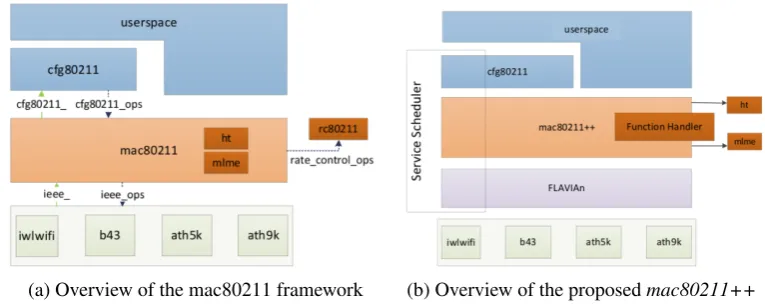
Most of WLAN card manufacturers follow theSoftMACapproach, much more flexible compared to the old FullMAC solution. FullMAC leaves all the control of the MAC layer functions to the card hardware/firmware, whereas SoftMAC implements a new set of control MAC primitives at the software level. The framework mac80211 [2], which is part of the Linux 802.11 stack and depicted in Fig. 1a, provides SoftMAC capabilities. Nevertheless, the mac80211 lacks of modularity and flexibility since it is a monolithic block composed of many sub-modules highly interconnected. Following the FLAVIA [3] paradigm, we propose and develop a preliminary implementation of a new framework, namelymac80211++, aimed to specify a solution whose advantages are three-fold: modularity, flexibility and virtualization.
Then, the goals of mac80211++ are to leverage on the current implementation mac80211, widely adopted in 802.11 networks, and to reduce the complexity and shorten the time when introducing changes to the standard. This will boost the implementa-tion of new improved services and reduce the amount of time for these modificaimplementa-tions to be commercialized. To this aim, we design a service scheduler and split the mac80211 framework components. The service scheduler adds and loads new services, flexibilizing the implementation of new modules compared to the standard procedure. Untangling the highly interdependent relations of the mac80211 components, we pursue to reduce the complexity of the current framework and to foster its modularization, by allowing sub-components being loaded independently.
2.
Existing framework
Fig.1a depicts an overview of the existing Linux 802.11 stack. This stack specifies the framework mac80211 that enables SoftMAC-capable device drivers used for operating with 802.11 hardware. While some of the MAC functionalities are implemented at the hardware level, mac80211 implements features such as handling several higher-layer components of the MAC, including support for HW/SW crypto, power saving, .11n style aggregation or LED management. Themac80211module plays two key roles: (i) Wrap the packet incoming from the upper layers and translate them into the 802.11 frame format; (ii) Control management operations related to the IEEE 802.11 standard. A standard wireless driver with Linux wireless capabilities includes some kernel modules and provides interfaces used by user level tools to configure the device behavior, as depicted in Fig. 1a. The main modules defined in the framework are the mac80211 and thecfg80211; these modules are loaded and used by the drivers (e.g., ath5k, ath9k, b43) that are implemented in separate Linux kernel modules.
(a) Overview of the mac80211 framework (b) Overview of the proposedmac80211++
Figure 1: Overview of the existing (left-sided) and proposed (right-sided) frameworks.
Bidirectional interfaces are defined among modules as represented in Fig.1aby the arrows. The exported functions provide a direct interface shown with the solid arrows. The usage of an exported function introduces a dependency in the direction of the arrow (e.g., the driver depends on mac80211). The interface in the other direction is implemented through the registration of callbacks (i.e., function pointers). In Fig. 1a
this dependency is represented by dashed arrows and the labels represent the structure containing the function pointers.
MAC layer management entity (mlme), the high throughput (ht) or the MPDU aggre-gation (agg), as specified in the IEEE 802.11n standard [4]. These parts are defined in dedicated files but not implemented as separated modules, thus preventing any kind of modularization.
3.
A new framework:
mac80211++
Motivated by the rigidness of the mac80211 framework, we develop a new solution, named mac80211++, which aims to overcome it. Fig. 1b depicts the new framework, mac80211++, showing the new blocks introduced with respect to the existing frame-work depicted in Fig. 1a. First, we provide a proof of concept of the modularity of mac80211++. Second, we develop and implement a Function Handler and a Service Scheduler that manage the loading and creation of new functions and services respec-tively, proving flexibility. Third, we describe as well the virtualization support, by adding an overlay layer, FLAVIAn, between the device drivers and the mac80211++ framework.
3.1 Modularity
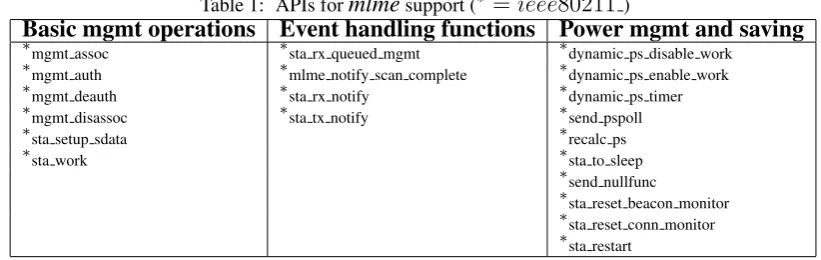
The development ofmac80211++can be considered as a first and relevant step towards the modularization of the wireless component inside the Linux kernel. Somemac80211 functionalities might be conveniently separated in order to provide the developers with a novel degree of flexibility. Thus, we propose to “break” the monolithic mac80211 framework and evolve to a new extended and more modular framework. The basic idea is to rely on the definition of well-defined interfaces for those functionalities. To this aim, we follow the rate control module approach replicating its interaction modality. This module depends onmac80211, but can be built as an independent module, within the framework or at the driver level, being able to load it at run-time.
Table 1: APIs formlmesupport (∗ =ieee80211 )
Basic mgmt operations Event handling functions Power mgmt and saving
∗
mgmt assoc ∗sta rx queued mgmt ∗dynamic ps disable work
∗
mgmt auth ∗mlme notify scan complete ∗dynamic ps enable work
∗
mgmt deauth ∗sta rx notify ∗dynamic ps timer
∗
mgmt disassoc ∗sta tx notify ∗send pspoll
∗
sta setup sdata ∗recalc ps
∗
sta work ∗sta to sleep
∗
send nullfunc ∗
sta reset beacon monitor ∗
sta reset conn monitor ∗
sta restart
3.2 Flexibility
The flexibility provided bymac80211++fosters the extension of the basic functionalities defined by the IEEE 802.11 protocol. In particular, our framework permits to implement innovative services and enhanced functions, providing a general yet flexible mechanism to extend the mac80211 framework. To this end, we design and develop two auxiliary kernel modules, namely theService Schedulerand theFunction Handler, which are liable, respectively, for managing the scheduling of a new service and the registration of the enhanced functions, which are executed at the occurrence of specific events handled by mac80211++(e.g., packet reception, packet transmission or channel switching).
Service Scheduler. The Service Scheduler has been designed to provide a simple and
standardized mechanism to schedule new services. Through this system, developers can focus only on the implementation of the main service functions, using the Service Scheduler as a mean to schedule periodically its execution. The Service Scheduler will run the functions registered by the service during its initialization phase. In addition, to simplify the implementation of a new service, the Service Scheduler architecture improves its maintenance, since the implementation of its internal functions can be improved to support enhanced services, as long as its APIs are not modified. Indeed, it can be easily updated with more sophisticated functionalities to meet the requirements of real-time systems.
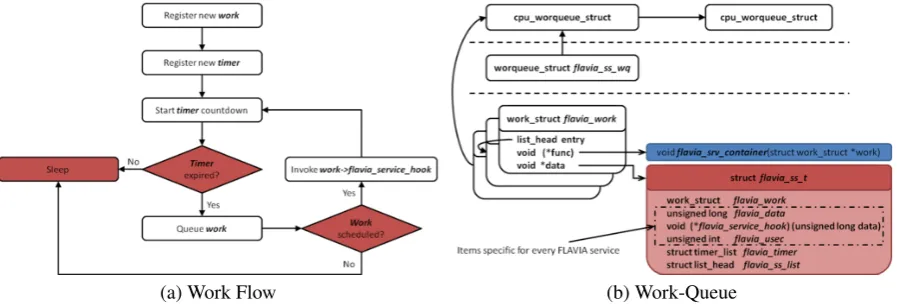
Fig.2(a)illustrates the main steps to register and execute a new service. When a new service is registered, the Service Scheduler creates a new Linux kernelworkrepresenting the task implementing the deferred service function, and adds it to a dedicated work-queue specifically designed to handle all services. When the timer expires, the Linux kernel work implementing the service is queued on the work-queue, which contains all the tasks that must be executed immediately. The Service Scheduler defines only one Linux kernel thread to extract and activate the works implementing the services on the work-queue, in order to serialize the management of all the events occurring in a distributed scenario like the channel access.
Once the work can be scheduled, the Linux kernel thread, which handles the work-queue, invokes an outer function, namely flavia srv container, which, in turn, executes the function implementing the service (pointed byflavia service hook), and reschedules the timer to execute the service later.
(a) Work Flow (b) Work-Queue Figure 2: Service Scheduler: Flow chart and work-queue.
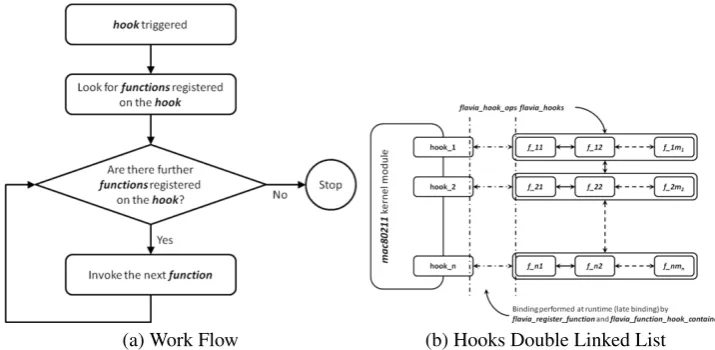
Function Handler. The Function Handler (FH) is designed to provide a standardized
to register a function to any hook added to the mac80211++ code; thus improving its functionalities with new functions. As depicted in Fig. 3, at the occurrence of a specific event, the Function Handler will call the functions previously registered on that hook. For example, when a new frame is received, the control flow of the mac80211 code reaches a hook that transfers the control to the FH, which, in turn, invokes the execution of all functions registered on that hook. Note that the function invoked by the Function Handler can register a service or create a new task executed by an independent kernel thread. Therefore, the FH mechanism provides a high level of flexibility to the developers of new functionalities and services.
(a) Work Flow (b) Hooks Double Linked List
Figure 3: Function Handler: Flow-chart describing the main operations performed by the Function Handler and structure used to fulfill the management task.
3.3 Virtualization
Whilemac80211++extends the capabilities of the original mac80211, the design of the mac80211 framework is intrinsically bound to the physical capabilities of the HW ad-vertised by the different device drivers. Past research work [5,6,7,8] has demonstrated that single radio hardware could be virtualized in a way very similar to the virtualization of computational resource in the hardware resources of computer. mac80211, and by extensionmac80211++, brings a logical view to the different wireless interfaces present in the system, but does not offer the proper abstraction necessary for implementing proper virtualization without breaking the existing code base. To overcome this lim-itation, we design FLAVIAn, an overlay layer that offers virtualization capabilities to mac80211and mac80211++, while preserving the existing hooks and API.
Therefore, FLAVIAn abstraction is twofold: first, FLAVIAn presents the usual drivers hooks that the traditional mac80211 is expecting. As well, FLAVIAn proposes the counterpart drop-in replacements to be used in each hardware driver
To ensure appropriate interaction of the mac80211 stack and the device drivers through the FLAVIAn overlay, a small modification in the driver code is also required in order to reroute themac80211callbacks to the equivalentieee80211 flavian ops struc-ture specified by the FLAVIAn overlay.
4.
Use Cases
This section specifies a representative set of use cases to illustrate the functionality introduced by themac80211++ framework.
4.1 Advanced Monitoring
The Advanced Monitoring Service(AMS) module provides a passive monitoring service able to measure several parameters related to radio channel conditions, capabilities of neighboring nodes and MAC 802.11 parameters estimation. Each node performs PHY/MAC layer measurements within the time-scale of microseconds. The wireless cards are set to promiscuous mode to ensure a comprehensive view of the current wire-less channel conditions. Then, all the measurements are performed within the normal activity of the wireless card and reported periodically. The AMS module supports mul-tiple network interfaces per node. It works on a frame level, meaning that all the frames sent and received by each network interface must be examined by the AMS functions. This imposes high requirements on the AMS module on the effectiveness of the frame analysis (i.e., limited computational power available at the nodes).
The AMS module hooks in the mac80211 module of the Linux kernel are placed in the ieee80211 rx() function for the downlink frame path and in the ieee80211 tx() function for the uplink frame path. The measurement functions called by the hooks require access to each frame header and frame timing information to discover and calculate a set of parameters per each neighboring station interface, such as: supported rates, SNR, F/BER, RTS Threshold or number of retransmissions.
For communication with user space the netlink mechanism is used. The application that requires monitoring data from the AMS module sends the command to the receiv-ing function of the AMS module. This command defines the parameters the application requests and the time interval at which results are to be sent to the application.
4.2 SuperSense (SPS)
The virtualization and flexibility features of our proposed framework foster the develop-ment of SuperSense(SPS), an innovative monitoring service that dynamically analyses the available wireless spectrum using both passive and active techniques to estimate the best network configuration. SPS analyses continuously the available wireless channels to select the set of parameters that provides the best network performance.
CSMA/CA or TDMA) to transmit their data traffic. During an active monitoring frame, only one node is allowed to send probes on the wireless channel in order to estimate actively the quality of the wireless links established with nearby nodes and the interference which might be generated by external sources.
4.3 Power Saving (PS)
The goal of the Power Saving (PS) service module is to enable various power saving algorithms, such as NoA/ASPP [9], to be easily implemented by specifying helpful functional blocks and their interactions with other services or functions.
Thanks to the modularity and flexibility exposed by mac80211++, this PS service is easily implemented as a loadable module. For that, we define the following two functions: (i)ps policy(), which is registered into the Function Handler. It incorporates the logic of the developed algorithms and stores information of the mechanism(s) in operation and its(their) state; (ii) ps management(), which provides management logic to support the PS mechanisms being implemented.
A generic PS scheme might require the ability of triggering sleep/awake events. This action is ultimately performed in HW by setting the proper HW registers accordingly. We then specify a primitive to communicate to the immediately lower layer the notifi-cation to execute the chosen event: drv ps notify(): This is a notification primitive and requires drivers to provide its proper handling. Thus, we push all the “intelligence” to the upper layer, designing this way a hardware-agnostic PS framework. In order to support sleep/awake transitions typically required by power saving algorithms, it is still needed that drivers and firmware support sleep/awake events (issued by the previously mentioned primitives of the PS service).
4.4 Rate Adaptation
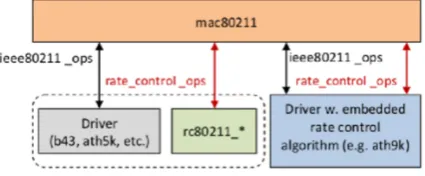
Most of the currentmac80211 drivers rely on rate control algorithms provided by the framework. These algorithms are encapsulated in independent kernel modules that are linked to the specific driver once a new device is being loaded. The naming convention of these modules is based on anrc80211 prefix, followed by the name of the algorithm. mac80211 implements two rate adaptation schemes, Minstrel and PID, but also per-mits the drivers to implement specific rate adaptation mechanisms and register them upon device initialization to notify the mac80211framework that rate selection will be handled by the driver itself. One example of such drivers is ath9k for Atheros cards.
Despite the differences of these two approaches, they both use a common mechanism to interface with the mac80211 framework. Specifically, the rate control ops callbacks are registered by the rate adaptation module to the framework. These design principles are illustrated in Fig.4.
Figure 4: Interfacing Rate Control with mac80211.
H-RCA [10], could be implemented. This is motivated by the fact that current state-of-the-art algorithms do not distinguish losses due to packet collisions from losses that occur due to noise. The driver incorporating H-RCA takes an approach similar to the rate control algorithms of ath9k. To register the H-RCA algorithm to the mac80211 framework, the driver is required to invokeieee80211 rate control registerfunction pass-ing a reference to arate control opsstructure, which contains the handlers implemented by the algorithm.
5.
Summary & Conclusions
This paper provides the specifications of a high level software architecture that proves the modularity, flexibility and virtualization accomplished by our framework to enhance user experience in wireless networks. Working at that level allows to extend every modification to almost any existing HW.
Our specification has started from an existing framework in Linux,mac80211, which has been substantially extended in order to support the aforementioned features. This new framework, namelymac80211++, becomes our development platform. Specifically, the extension of the mac80211++ is twofold: (i) We intend to create a modular frame-work by untangling the existing mac80211, at the present at early stage of development. (ii) We have developed and implemented a Service Handling module that allows loading new services in real-time, based on the mac80211++ framework.
We have identified as candidate modules to be implemented key representative blocks such as SPS and Power Saving. In order to implement the virtualization, a new layer, called FLAVIAn, has been specified between the framework and the wire-less drivers, exceeding the bounded capabilities of the driver on which the mac80211 framework relies.
References
[1] “IEEE Standard for Information Technology-Telecommunications and Information Exchange Between Systems-Local and Metropolitan Area Networks-Specific Requirements - Part 11: Wireless LAN MAC and Physical Layer (PHY) Specifications,”IEEE Std 802.11-2007 (Revision of IEEE Std 802.11-1999). [2] Linux kernel mac80211 framework for wireless device driver.
http://linuxwireless.org/en/developers/Documentation/mac80211.
[3] FLAVIA Project (Flexible Architecture for Internet Access). http://www.ict-flavia.eu/.
[4] “IEEE Standard for Information technology–Telecommunications and information exchange between systems–Local and metropolitan area networks–Specific requirements Part 11: Wireless LAN MAC and PHY Specifications Amendment 5: Enhancements for Higher Throughput,”IEEE Std 802.11n-2009. [5] G. Bhanage, D. Vete, I. Seskar, and D. Raychaudhuri, “SplitAP: Leveraging Wireless Network
Virtualiza-tion for Flexible Sharing of WLANs,” inIEEE GLOBECOM, pp. 1 –6, dec. 2010.
[6] T. Hamaguchi, T. Komata, T. Nagai, and H. Shigeno, “A Framework of Better Deployment for WLAN Access Point Using Virtualization Technique,” inIEEE WAINA, pp. 968 –973, Apr. 2010.
[7] L. Xia, S. Kumar, X. Yang, P. Gopalakrishnan, Y. Liu, S. Schoenberg, and X. Guo, “Virtual WiFi: bring virtualization from wired to wireless,” inProc. of the 7th ACM SIGPLAN/SIGOPS, VEE ’11, (Newport Beach, California, USA), pp. 181–192, 2011.
[8] G. Aljabari and E. Eren, “Virtualization of wireless LAN infrastructures,” inIEEE IDAACS, vol. 2, pp. 837 –841, Sept. 2011.
[9] D. Camps-Mur, X. P´erez-Costa, and S. Sallent-Ribes, “Designing energy efficient access points with wi-fi direct,”Elsevier Comput. Netw., vol. 55, pp. 2838–2855, Sept. 2011.