State Science Standards and Students’ Knowledge of What States Value: Lunar Phases
Mr. Ibrahim H. Yetter Texas Tech University, USA Dr. Kimberly K. Livengood Angelo State University, USA Dr. Walter S. Smith
Texas Tech University, USA
Abstract
This study of science standards of all 50 states and 1958 American early adolescents asked whether there is agreement among states about a science topic, lunar phases, that appears in all recent national standards documents, is of cultural significance, and has been widely studied for misconceptions held by children and adults. Secondly, we asked whether there is a significant correlation between what students know about lunar phase ideas which appear in state standards and the degree to which states value those ideas. Data about student knowledge was collected from a volunteer sample of early adolescents by a forced-choice, online test, the questions of which corresponded to 24 lunar phase ideas found among published state science standards. States were found not to be in agreement about what early adolescent students should learn about lunar phases, although all but one state expected students to learn something about lunar phases. Also, there was not a significant correlation between the number of students who could successfully answer questions about the states' various lunar phase standards and the number of states that had standards addressing those ideas. If the issue of lunar phases is representative of American science standards, states are not in agreement about what students should learn about science and students do not necessarily know the ideas, which more states value.
Keywords: state standards, national standards, science standards, lunar phases
Please address all correspondence to: Walter S. Smith, College of Education, Texas Tech University, [email protected]
Introduction
(NGSS Lead States, 2013) provide guidelines that multiple states may choose to follow or bypass.
In that context, the purposes for the investigation reported here are twofold. First, since concern about educational standards being set by the separate states has been expressed by multiple authors (e.g., Corcoran, Mosher, & Rogat, 2009; Lerner, Goodenough, Lynch, Schwartz, Schwartz, & Fordham, 2012; Rogat, 2011; Committee on Understanding the Influence of Standards in K-12 Science, Mathematics, and Technology Education, 2002), we were interested in what agreement might exist among the 50 states about what early adolescents should know about a topic which appears in national and state standards. Because of its universality among standards, its pervasive occurrence in contemporary culture and the broad research base about students’ conceptions (e.g., Trumper, 2001; Trundle, Atwood, & Christopher, 2007; Trundle, Atwood, Christopher, & Sackes, 2010), we chose to study lunar phases as that universal topic. Second, we were interested in early adolescents’ performance on questions derived from the various states’ science standards about lunar phases. In short, we asked whether states agreed about what early adolescents should know about an important science topic and whether early adolescents know what states would like them to know.
In consideration of the ubiquitous occurrence of lunar phases across all of humanity, we note that the study of lunar phases has deep roots in arts and culture. In Greek mythology the Moon was the daughter of Zeus and the Romans believed the moon was a goddess, Luna. In various places folklore such as "plant corn after the full moon in May" guides behavior (Boswell, 1975). The moon has found its way into literature. For example, in Act 2, Scene 2 of Romeo and Juliet Shakespeare had Juliet ask Romeo not to swear his love for her by the moon, “the inconstant moon that monthly changes in her circled orb; lest that thy love prove likewise variable.” The moon has shown both a sinister and romantic face in music. For example, “I see the bad moon arisin’ / I see trouble on the way” was sung by Creedence Clearwater Revival in Bad Moon Rising (Fogerty, 1969). In contrast, “shine on, shine on, harvest moon up in the sky / I ain’t had no lovin’ since April, January, June or July” debuted in 1908 and has been sung by many artists since then (Norworth & Bayes, 1908). The public’s attention to the Moon was especially whetted by President John F. Kennedy’s 1961 challenge to the nation to “commit itself to achieving the goal, before this decade is out, of landing a man on the moon and returning him safely to the earth” and the first human lunar landing eight years later by Neil Armstrong and Buzz Aldrin.
Students recognize that the moon’s appearance changes over time (Kruse & Wilcox, 2009; Leager, 2007). Developmentally, early adolescents are able to begin the shift from concrete thinking to understand abstract concepts (Sanders, 2013). However, even after receiving instruction about the cause of lunar phases, many students struggle with the more abstract concept and explain these lunar phases by the moon moving through the earth’s shadow (e.g., Binns, Bell, & Smetana, 2010; Brunsell & Marcks, 2007; Hermann & Lewis, 2003; Stein, 2007; Suzuki, 2003; Taylor et al., 2003; Trumper, 2001). When asked about a solar eclipse, more students can correctly explain a solar eclipse by an object, the moon, passing between the sun and earth than can correctly explain a lunar eclipse by an object, the earth, passing between the sun and moon (Barab, Hay, Barnett, & Keating, 2000a; Barab et al., 2000b; Gazit, Yair, & Chen, 2005; Keating, Barnett, Barab, & Hay, 2002; Mohapatra, 1991; Taylor et al., 2003).
Not only young students but also teachers express misconceptions about lunar phases (Ameyaw & Sarpong, 2011; Aydeniz & Brown, 2010; Bayraktar, 2009; Frède, 2008; Kücüküozer, 2007; Ogan-Bekiroglu, 2007; Sakyi-Hagan, 2011; Trundle, Atwood, & Christopher, 2002). However, teachers are not alone among adults lacking understanding of the causes of lunar phases. Sadler (1998) found that 21 of 23 graduating seniors, alumni, and faculty of a well-known university failed to correctly explain the cause of lunar phases.
Since most students can relatively easily view the moon, the size of the moon they see seems to influence their ideas of the relative size of the earth, moon and sun (Bryce & Blown, 2013; Fanetti, 2001; Sharp, 1999; Wallace, Dickerson, & Hopkins, 2007). Additionally, the physical models and illustrations used to teach about the solar system usually either depict relative size or relative distance but not both in the same model (Schneider & Davis, 2007). A misconception of the differences in size of the moon, earth and sun as well as the differences in the distances between the earth and moon versus the earth and the sun influences students’ understanding of other lunar concepts. When sixth, eighth, and tenth graders were surveyed about the moon’s size as compared to the earth, only 12% of the sixth graders correctly compared the sizes. Even at the tenth grade level only 33% of these students correctly compared the sizes. When questions about relative distances were asked, only 15% of the sixth graders, 9% of the eighth graders, and 25% of the tenth graders correctly identified the relative distances (Brunsell & Marcks, 2007).
Methodology and Results
The study reported here focused on two overarching questions. First, what do the 50 states expect early adolescents to learn about lunar phases; and second, what do early adolescents know about the lunar phase ideas, which at least some states expect them to know? Subsumed under these two questions are other issues such as the amount of agreement among the states about each of these ideas.
standards state by state for whether each statement was specifically found in a state’s standards, implied in the state’s standards, or not present. For example, Florida’s fourth grade standard, “describe the changes in the observable shape of the moon over the course of about a month,” was rated as specifically stating that students should learn “the lunar cycle is about one month long.” However, Texas’s eighth grade standard that “the student is expected to analyze and predict the sequence of events in the lunar and rock cycles” only implied that students should analyze and make predictions about the lunar cycle’s length. The two raters agreed on 99.7% of their categorizations; in the 0.3% of cases where they did not agree, the lower rating was used.
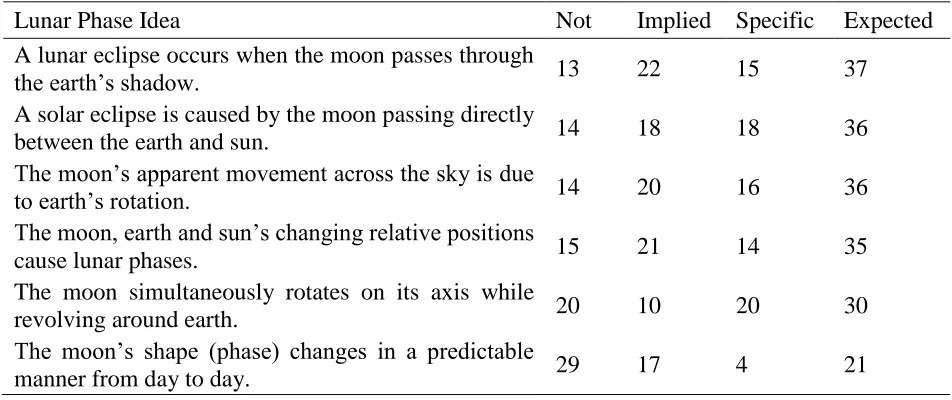
The results for this analysis are shown in Table 1 with ideas listed by order of the number of states that either specifically expected students to learn that idea or their learning of the idea was only implied in the state’s standards. The lunar phase idea most frequently found in state standards, i.e., “a lunar eclipse occurs when the moon passes through the earth’s shadow,” was part of about three-quarters (74%) of the states’ standards, but was not found in all states’ standards. Only five of the 24 lunar phase ideas were specifically found or implied in more than half of the states’ standards. Ideas such as “the moon’s shape (phase) changes in a predictable manner from day to day” that young students could learn for themselves from direct observation of nature were found in fewer than half of the states’ standards. A fundamental assumption about the nature of science, i.e., that nature behaves in a predictable manner, was found in fewer than half of the states’ standards in the instance of lunar phases. That is, only 21 of the states (42%) specifically or by implication expect their early adolescents to learn that the moon’s appearance is predictable. Further, frequently documented lunar misconceptions such as the causes of lunar phases are not addressed by 15 (30%) states in early adolescence, a time by which national documents suggest students can clear up this misconception. For example, the Next Generation Science Standards state in MS-ESS1-1 that adolescents should “develop and use a model of the Earth-sun-moon system to describe the cyclic patterns of lunar phases, eclipses of the sun and moon, and seasons" (NGSS Lead States, 2013).
Table 1.
Lunar Phase Ideas Found in State Science Standards for Early Adolescent Students
Lunar Phase Idea Not Implied Specific Expected
A lunar eclipse occurs when the moon passes through
the earth’s shadow. 13 22 15 37
A solar eclipse is caused by the moon passing directly
between the earth and sun. 14 18 18 36
The moon’s apparent movement across the sky is due
to earth’s rotation. 14 20 16 36
The moon, earth and sun’s changing relative positions
cause lunar phases. 15 21 14 35
The moon simultaneously rotates on its axis while
Lunar Phase Idea Not Implied Specific Expected The moon appears in different locations in the sky
from day to day because the moon is revolving around the earth.
31 9 10 19
The lunar cycle is about one month long. 36 4 10 14
The distance from earth to sun is nearly 400 times
greater than the distance from earth to moon. 37 13 0 13 We can see a full moon when the sun, earth and moon
are lined up in approximately a straight line with the earth between the sun and moon.
38 11 1 12
The earth’s diameter is about four times greater than
the moon’s diameter. 40 8 2 10
A full moon is followed a few days later by a waning
gibbous moon. 44 6 0 6
The distance between the moon and earth is approximately 30 times greater than the earth’s diameter.
44 6 0 6
The moon’s illuminated portion is caused by reflected
sunlight. 45 1 4 5
When the moon’s illuminated part increases, it is
called waxing. 45 4 1 5
The moon rises closer to East than any other cardinal
direction. 46 3 1 4
The moon is not visible when it is approximately between the sun and earth and all of the sunlight reflected off the moon is reflected away from earth.
47 1 2 3
An observer on earth will see the moon moving from east to west from hour to hour between when the moon rises and sets.
47 3 0 3
The moon is sometimes visible in daylight as well as
at night. 48 1 1 2
Seen from a spot above the North Pole, the moon revolves counterclockwise around earth over a one month period.
48 1 1 2
We can see a crescent moon when the moon is located about 45° to the left or right of a line drawn between the earth and sun.
49 0 1 1
A waxing crescent moon can be seen toward the West
around sunset. 49 1 0 1
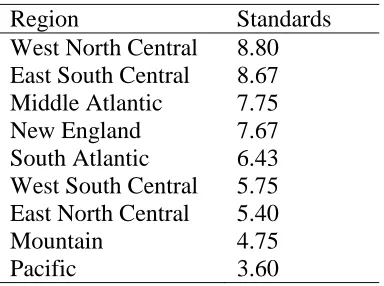
States varied in the number of lunar phase ideas included in their standards. Missouri’s standards were the most inclusive with 16 of the 24 lunar phase ideas expected by states being included in Missouri’s standards; and at the other end of the list, Idaho’s standards included none of the 24 lunar phase ideas as shown in Table 2. When states were grouped according to their U.S. Census regions (U.S. Census, n.d.), there was no significant difference in the nine region’s average number of standards per state (X2 = 0.86) as shown in Table 3.
Table 2.
Number of Lunar Phase Ideas Included in States’ Standards
State Total
Missouri 16
Alabama, Delaware 13
Mississippi, Vermont 12
Michigan, Virginia 11
Connecticut, New Hampshire, New York, South Dakota 10
Iowa, Kentucky, Tennessee 9
Arizona, Georgia, Kansas, Maryland, North Dakota 8 Florida, Massachusetts, Nebraska, Texas, Utah, Washington 7 Colorado, Nevada, New Jersey, New Mexico, Ohio, South Carolina 6
Louisiana, Maine, Minnesota, Oregon 5
Arkansas, Montana 4
Hawaii, Illinois, West Virginia 3
Alaska, North Carolina, Oklahoma, Pennsylvania, Rhode Island 2
California, Indiana, Wisconsin, Wyoming 1
Idaho 0
Table 3.
Average Number of Lunar Phase Standards by Census Regions
Region Standards
West North Central 8.80 East South Central 8.67 Middle Atlantic 7.75
New England 7.67
South Atlantic 6.43 West South Central 5.75 East North Central 5.40
Mountain 4.75
Starting with an instrument produced by Sherrod (2009), we developed a 31 item, online, multiple choice test, the Comprehensive Moon Phases Assessment – Revised (CMPA-R), of which 24 items were based on the 24 lunar phase ideas found in at least one state’s standards for early adolescent science and shown in Table 1. (The other seven items addressed students’ knowledge of global patterns in the appearance of lunar phases; and since those items addressed ideas that are not part of state standards, those results are not reported here.) The test required students to choose one of the four options for each item before their results were recorded. The CMPA-R has a Flesch Reading Ease of 78.4, indicating the reading was rather easy, and a Flesch-Kincaid Grade Level of 5.8, indicating that its reading level was at the lower end of our target age range of 10-14. Figure 1 shows a sample CMPA-R item.
1. About how long will you have to wait to see the Moon again just as it appears today? a. About a week
b. About two weeks c. About a month
d. It is not possible to know
Figure 1. Sample Item from the Comprehensive Moon Phases Assessment – Revised
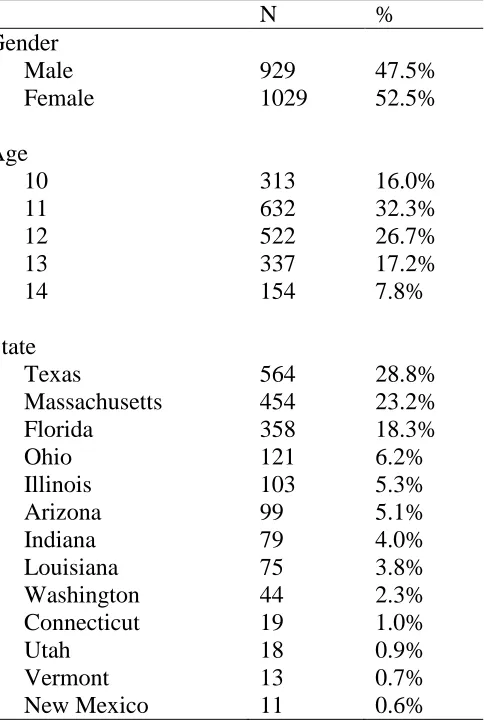
Table 4
Characteristics of Students
N %
Gender
Male 929 47.5%
Female 1029 52.5%
Age
10 313 16.0%
11 632 32.3%
12 522 26.7%
13 337 17.2%
14 154 7.8%
State
Texas 564 28.8%
Massachusetts 454 23.2%
Florida 358 18.3%
Ohio 121 6.2%
Illinois 103 5.3%
Arizona 99 5.1%
Indiana 79 4.0%
Louisiana 75 3.8%
Washington 44 2.3%
Connecticut 19 1.0%
Utah 18 0.9%
Vermont 13 0.7%
New Mexico 11 0.6%
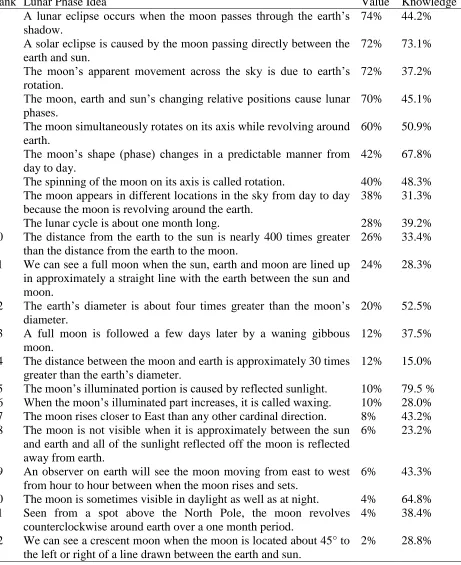
Table 5.
Comparison of State’s Valuation of Various Lunar Phase Ideas and Students’ Knowledge about Those Ideas
Rank Lunar Phase Idea Value Knowledge
1 A lunar eclipse occurs when the moon passes through the earth’s shadow.
74% 44.2% 2 A solar eclipse is caused by the moon passing directly between the
earth and sun.
72% 73.1% 3 The moon’s apparent movement across the sky is due to earth’s
rotation.
72% 37.2% 4 The moon, earth and sun’s changing relative positions cause lunar
phases.
70% 45.1% 5 The moon simultaneously rotates on its axis while revolving around
earth.
60% 50.9% 6 The moon’s shape (phase) changes in a predictable manner from
day to day.
42% 67.8% 7 The spinning of the moon on its axis is called rotation. 40% 48.3% 8 The moon appears in different locations in the sky from day to day
because the moon is revolving around the earth.
38% 31.3%
9 The lunar cycle is about one month long. 28% 39.2%
10 The distance from the earth to the sun is nearly 400 times greater than the distance from the earth to the moon.
26% 33.4% 11 We can see a full moon when the sun, earth and moon are lined up
in approximately a straight line with the earth between the sun and moon.
24% 28.3%
12 The earth’s diameter is about four times greater than the moon’s diameter.
20% 52.5% 13 A full moon is followed a few days later by a waning gibbous
moon.
12% 37.5% 14 The distance between the moon and earth is approximately 30 times
greater than the earth’s diameter.
12% 15.0% 15 The moon’s illuminated portion is caused by reflected sunlight. 10% 79.5 % 16 When the moon’s illuminated part increases, it is called waxing. 10% 28.0% 17 The moon rises closer to East than any other cardinal direction. 8% 43.2% 18 The moon is not visible when it is approximately between the sun
and earth and all of the sunlight reflected off the moon is reflected away from earth.
6% 23.2%
19 An observer on earth will see the moon moving from east to west from hour to hour between when the moon rises and sets.
6% 43.3% 20 The moon is sometimes visible in daylight as well as at night. 4% 64.8% 21 Seen from a spot above the North Pole, the moon revolves
counterclockwise around earth over a one month period.
4% 38.4% 22 We can see a crescent moon when the moon is located about 45° to
the left or right of a line drawn between the earth and sun.
Rank Lunar Phase Idea Value Knowledge 23 A waxing crescent moon can be seen toward the West around
sunset.
2% 29.2% 24 The moon rises and sets about an hour later each day. 2% 25.2% r = 0.289, n.s. at p<.05.
Table 6.
Early adolescents’ understanding of ideas about lunar phases
Idea
Mean and
99.9% Conf. Inter.
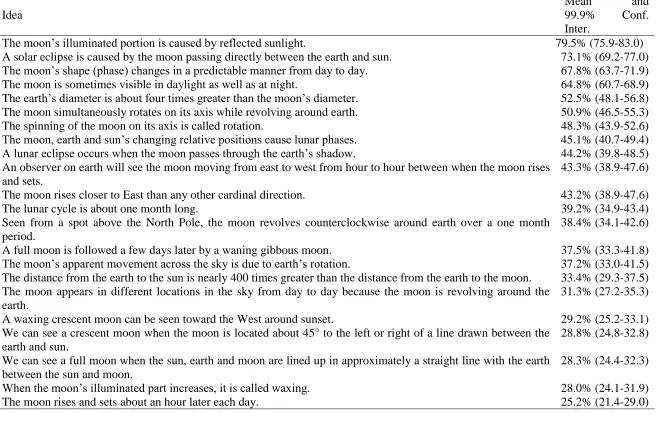
The moon’s illuminated portion is caused by reflected sunlight. 79.5% (75.9-83.0)
A solar eclipse is caused by the moon passing directly between the earth and sun. 73.1% (69.2-77.0) The moon’s shape (phase) changes in a predictable manner from day to day. 67.8% (63.7-71.9)
The moon is sometimes visible in daylight as well as at night. 64.8% (60.7-68.9)
The earth’s diameter is about four times greater than the moon’s diameter. 52.5% (48.1-56.8) The moon simultaneously rotates on its axis while revolving around earth. 50.9% (46.5-55.3)
The spinning of the moon on its axis is called rotation. 48.3% (43.9-52.6)
The moon, earth and sun’s changing relative positions cause lunar phases. 45.1% (40.7-49.4) A lunar eclipse occurs when the moon passes through the earth’s shadow. 44.2% (39.8-48.5) An observer on earth will see the moon moving from east to west from hour to hour between when the moon rises
and sets.
43.3% (38.9-47.6)
The moon rises closer to East than any other cardinal direction. 43.2% (38.9-47.6)
The lunar cycle is about one month long. 39.2% (34.9-43.4)
Seen from a spot above the North Pole, the moon revolves counterclockwise around earth over a one month period.
38.4% (34.1-42.6)
A full moon is followed a few days later by a waning gibbous moon. 37.5% (33.3-41.8)
The moon’s apparent movement across the sky is due to earth’s rotation. 37.2% (33.0-41.5) The distance from the earth to the sun is nearly 400 times greater than the distance from the earth to the moon. 33.4% (29.3-37.5) The moon appears in different locations in the sky from day to day because the moon is revolving around the
earth.
31.3% (27.2-35.3)
A waxing crescent moon can be seen toward the West around sunset. 29.2% (25.2-33.1)
We can see a crescent moon when the moon is located about 45° to the left or right of a line drawn between the earth and sun.
28.8% (24.8-32.8) We can see a full moon when the sun, earth and moon are lined up in approximately a straight line with the earth
between the sun and moon.
28.3% (24.4-32.3)
When the moon’s illuminated part increases, it is called waxing. 28.0% (24.1-31.9)
Idea
Mean and
99.9% Conf. Inter.
The moon is not visible when it is approximately between the sun and earth and all of the sunlight reflected off the moon is reflected away from earth.
Discussion and Conclusion
In A Nation at Risk the National Commission on Excellence in Education chastised America for the low academic performance of its students (Goldberg & Harvey, 1983); and in the report's aftermath the individual states developed education standards and produced achievements tests for evaluation of those standards (Liebtag, 2013). More recently the No Child Left Behind Act (No Child Left Behind [NCLB], 2003) focused on assessing states' standards to ensure accountability (Dahlin, Xiang, Durant, & Cronin, 2010). Schmidt and Prawat (2006) made a case for the desirability of coherent standards across the nation as they pointed out the TIMSS (Third International Mathematics and Science Study) results that showed a direct relationship between nations’ consistency in standards and their students’ success on the test. In an effort to bring coherence to the various states' standards, in 2010 the Council of Chief State School Officers and the National Governors Association released the Common Core State Standards for mathematics and English Language Arts (NGA & CCSSO, 2010). Subsequently expectations for science learning were addressed by the same two national bodies plus the National Science Teachers Association via the Framework for K-12 Science Education: Practices, Crosscutting Concepts, and Core Ideas (NRC, 2012) and in 2013 by the Next Generation Science Standards (NGSS Lead States, 2013).
Research focused on achievement of academic standards has approached the topic from a variety of different perspectives. One study compared the science achievement of standards of different size school districts in Texas (Mann, Maxwell, & Holland, 2013). Another study examined the gender gap in achievement of math standards from a national perspective (Cheema & Galluzzo, 2013). In addition, studies have explored the impact of specific strategies, such as the use of technology, on student achievement (Gulek & Demirtas, 2005).
Although schools in the United States are not required to follow one national science curriculum, many state and local curriculum documents have been based on ideas proposed in either the National Science Education Standards from the National Research Council or the earlier Benchmarks for Scientific Literacy from the American Association for the Advancement of Science (Schmidt, Wang, & McKnight, 2005). As of September 2016, three years after their publication, the Next Generation Science Standards had been adopted in some form by the District of Columbia and 17 states: Arkansas, California, Connecticut, Delaware, Hawaii, Illinois, Iowa, Kansas, Kentucky, Maryland, Michigan, Nevada, New Jersey, Oregon, Vermont, Washington, and West Virginia (Academic Benchmarks, 2017).
In the context of a movement toward the acceptance by the various states of nationally-agreed upon science standards, we make two primary conclusions that are based on this study.
In 2009 the states were not consistent in what they desired their early adolescent students to learn about science, if this investigation about lunar phase standards is representative of the states’ standards about other science topics. Although all but one of the states had produced standards indicating early adolescents should learn some ideas about lunar phases, little consistency existed about exactly what it is that students should learn.
On the basis of this study, we do not make recommendations about whether America should have greater consistency among its states about what students should learn in science. However, we do conclude that the states have been inconsistent in what they want early adolescent students to learn and that early adolescent students’ knowledge does not match states’ expectations.
We acknowledge the limits of this study and thus offer it as exploratory. We only investigated lunar phase standards. Additional studies to examine other science topics would be valuable. Further, to develop a reasonable length test, only one question about each of 24 lunar phase ideas identified among state standards was asked. Definitive conclusions about students’ knowledge of any one of the 24 lunar phase ideas should be based on follow-up interviews of students to more thoroughly understand their responses and tests with multiple questions rather than the one question about the topic. Moreover, this study compared the treatment of lunar phases in state standards; but did not investigate the correlation of state and national standards such as those contained in the Next Generation Science Standards. A different analysis that focuses on a state-national standard comparison is warranted. Finally, we looked at the content of state standards but did not probe the nature of the standards to ascertain whether different states took different approaches to writing standards. For example, it is possible that a state could have limited their standards to topics into which students could inquire by direct observation. Yet another state could have taken a different approach that emphasized definitions. A further investigation of state standards could look at standards from this point of view.
Although not the focus of this study of state standards and student knowledge, we do note some parallels in our findings with the findings of others. For example, as others have found (e.g., Gazit et al., 2005; Keating et al., 2002; Taylor et al., 2003; Trumper, 2001), fewer than half of the students could correctly answer a question about the cause of lunar phases (see Table 7), but significantly more students chose the correct answer than any of the other options, including the frequently expressed misconception that the earth’s shadow causes lunar phases.
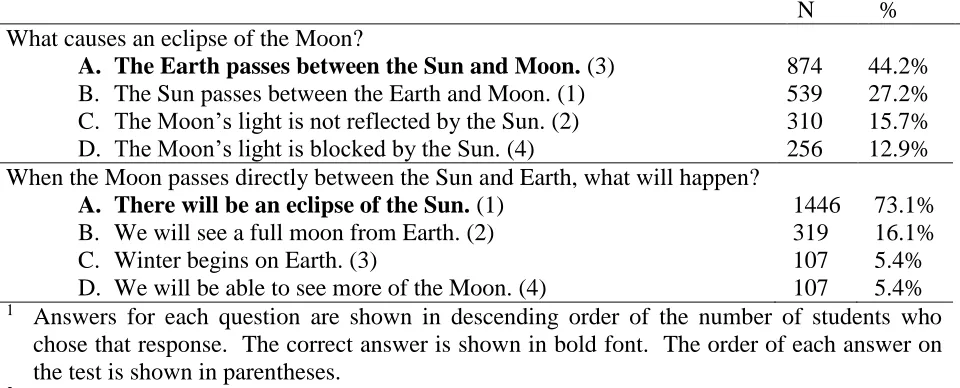
However, significantly more students correctly answered the question about the cause of a solar eclipse than the question about the lunar eclipse as seen in Tables 6 and 8. Perhaps some of the students could not reconcile the notion of the earth passing between the sun and moon causing both lunar phases and lunar eclipses; but they could accept the idea of a solar eclipse resulting from the moon passing between the earth and sun.
Table 7
Students’ Understanding of the Cause of Lunar Phases
N %
Which one of the following statements best explains why the shape of the Moon we see changes from day to day?
A. The position of the Moon compared to the Earth and Sun changes each day. (4)
D. The amount of the Moon covered by clouds changes each day. (1) 163 8.2% 1 Answers for each question are shown in descending order of the number of students who
chose that response. The actual order of the answer choices was different on the test itself; the position of each option is shown in parentheses. The correct answer is shown in bold font. 2 The results of a post-hoc chi-square analysis showed that all pairs of responses were
Table 8
Students’ Understanding of the Cause of Lunar and Solar Phases
N %
What causes an eclipse of the Moon?
A. The Earth passes between the Sun and Moon. (3) 874 44.2% B. The Sun passes between the Earth and Moon. (1) 539 27.2% C. The Moon’s light is not reflected by the Sun. (2) 310 15.7% D. The Moon’s light is blocked by the Sun. (4) 256 12.9% When the Moon passes directly between the Sun and Earth, what will happen?
A. There will be an eclipse of the Sun. (1) 1446 73.1%
B. We will see a full moon from Earth. (2) 319 16.1%
C. Winter begins on Earth. (3) 107 5.4%
D. We will be able to see more of the Moon. (4) 107 5.4% 1 Answers for each question are shown in descending order of the number of students who
chose that response. The correct answer is shown in bold font. The order of each answer on the test is shown in parentheses.
2 The results of a post-hoc chi-square analysis for the question about a lunar eclipse showed that all pairs of responses were significantly different at the p < .001 level.
References
Academic Benchmarks. (2017) Next Generation Science Standards Adoption Map Retrieved from http://academicbenchmarks.com/next-generation-science-standards-adoption-map/ American Association for the Advancement of Science (AAAS). (1993). Benchmarks for science
literacy. New York: Oxford University Press.
Ameyaw, Y., & Sarpong, L. (2011). The application of some conceptual approaches in rectifying teachers’ misconceptions on some science topics in the GA south district in the greater-accra region of Ghana. Journal of Education, 1(1), 16-24.
Aydeniz, M., & Brown, C. (2010). Enhancing pre-service elementary school teachers’ understanding of essential science concepts through a reflective conceptual change model. International Electronic Journal of Elementary Education, 2(2), 305-326.
Barab, S. A., Hay, K. E., Barnett, M., & Keating, T. (2000a). Virtual solar system project: Building understanding through model building. Journal of Research in Science Teaching, 37(7), 719-756.
Barab, S. A., Hay, K. E., Squire, K., Barnett, M., Schmidt, R., Karrigan, K., & Johnson, C. (2000b). Virtual solar system project: Learning through a technology-rich, inquiry-based, participatory learning environment. Journal of Science Education and Technology, 9(1), 7-25.
Bayraktar, Ş. (2009). Pre-service primary teachers’ ideas about lunar phases. Journal of Turkish Science Education, 6(2), 12-23.
Boswell, B. (1975). Moon beliefs. Western Folklore, 34(1), 48-53. Retrieved December 19, 2013, from http://www.jstor.org/stable/1498754.
Binns, I. C., Bell, R. L., & Smetana, L. (2010). Using technology to promote conceptual change in secondary earth science pupils’ understandings of moon phases. Journal of the Research Center for Educational Technology, 6(2), 112-129.
Brandou, B. (1997). Backyard astronomy: Observing moon phases. Science and Children, 34(8), 18.
Brunsell, E., & Marcks, J. (2007). Teaching for conceptual change in space science. Science Scope, 30(9), 20-23.
Bryce, T. G. K., & Blown, E. J. (2013). Children's concepts of the shape and size of the earth, sun and moon. International Journal of Science Education, 35(3), 388-446.
Cheema, J.R., & Galluzzo, G. (2013). Analyzing the gender gap in Math achievement: Evidence from a large-scale US sample. Research in Education, (90), 98-112.
Corcoran, T., Mosher, F. A., & Rogat, A. (2009). Learning progressions in science. Consortium for Policy Research in Education (CPRE), 13.
Dahlin, M., Xiang, Y., Durant, S., & Cronin, J. (2010). State standards and student growth: Why state standards don’t matter as much as we thought. Kingsbury Center, Northwest Evaluation Association.
Edwards, S. (2015). Active learning in the middle grades. Middle School Journal, 46(5), 26-32. Fanetti, T.M. (2001). The relationships of scale concepts on college age students' misconceptions
about the cause of lunar phases. (Unpublished master's thesis). Iowa State University, Ames, Iowa. Retrieved from http://www.physicseducation.net/members/Fanetti.pdf Fogerty, J. (1969). Bad Moon Risin [Recorded by Credence Clearwater Revival]. On Green
Frède, V. (2008). Teaching astronomy for pre-service elementary teachers: A comparison of methods. Advances In Space Research, 42(11), 1819-1830. doi:10.1016/j.asr.2007.12.001.
Gazit, E., Yair, Y., & Chen, D. (2005).Emerging conceptual understanding of complex astronomical phenomena by using a virtual solar system. Journal of Science Education and Technology, 14(5-6), 459-470.
Goldberg, M., & Harvey, J. (1983). A nation at risk: The report of the National Commission on Excellence in Education. Phi Delta Kappan, 65, 14-18
Gulek, J.C., & Demirtas, H. (2005). Learning with technology: The impact of laptop use on student achievement. The Journal of Technology, Learning, and Assessment, 3(2), 4-38. Hermann, R., & Lewis, B. F. (2003). Moon misconceptions. Science Teacher, 70(8), 51-55. Keating, T., Barnett, M., Barab, S. A., & Hay, K. E. (2002). The virtual solar system project:
Developing conceptual understanding of astronomical concepts through building three-dimensional computational models. Journal of Science Education and Technology, 11(3), 261-275.
Kennedy, J. (1961, May). Special Message to Congress on Urgent National Needs. Speech presented to the United States Congress, Washington, DC. Retrieved December 16, 2013, from http://www.jfklibrary.org/Asset-Viewer/Archives/JFKWHA-032.aspx.
Kücüküozer, H. (2007). Prospective science teachers' conceptions about astronomical subjects. Science Education International, 18(2), 113-130.
Kruse, J., & Wilcox, J. (2009). Conceptualizing moon phases: Helping students learn how to learn. Science Scope, 32(5), 55-59.
Leager, C. R. (2007). Science shorts: Taking a look at the moon. Science and Children, 45(3), 50-52.
Lerner, L. S., Goodenough, U., Lynch, J., Schwartz, M., Schwartz, R., & Thomas B., & Fordham, I. (2012). The State of State Science Standards, 2012. Thomas B. Fordham Institute.
Liebtag, E. (2013). Moving forward with common core state standards implementation: Possibilities and potential problems. Journal of Curriculum and Instruction, 7(2), 56-70. Mann, M.J., Maxwell, G.M., & Holland, G. (2013). Differences in middle school science
achievement by school district size. Journal of Instruction Pedagogies, 12, 1-8.
Mohapatra, J. K. (1991). The interaction of cultural rituals and the concepts of science in student learning: A case study on solar eclipse. International Journal of Science Education, 13(4), 431-437.
National Governors Association Center for Best Practices & Council of Chief State School Officers (NGA). (2010). Common Core State Standards. Washington, DC: Authors. NGSS Lead States. (2013). Next generation science standards: For states, by states.
Washington, DC: National Academies Press.
National Research Council (NRC). (1996). National science education standards. Washington, DC: National Academies Press.
Rogat, A. (2011). Developing learning progressions in support of the new science standards: A RAPID workshop series. Consortium for Policy Research in Education.
Ogan-Bekiroglu, F. (2007). Effects of model-based teaching on pre-service physics teachers' conceptions of the moon, moon phases, and other lunar phenomena. International Journal of Science Education, 29(5), 555-593.
Sadler, P. M. (1998). Psychometric models of student conceptions in science: Reconciling qualitative studies and distractor-driven assessment instruments. Journal of Research in Science Teaching, 35(3), 26.
Sakyi-Hagan, N. (2011). Elementary school science teachers’ understanding about the concept of the earth’s rotation. Journal of Educational and Social Research, 2(9), 91-99.
Sanders, R. A. (2013). Adolescent psychosocial, social, and cognitive development. Pediatrics in Review, 34(8), 354-358.
Schmidt, W. H., & Prawat, R. S. (2006). Curriculum coherence and national control of education: Issue or non-issue. Journal of Curriculum Studies, 38(6), 641-658.
Schmidt, W. H., Wang, H. C., & McKnight, C. C. (2005). Curriculum coherence: An examination of U.S. science and mathematics contents standards from an international perspective. Journal of Curriculum Studies, 37(5), 525 – 559.
Schneider, S. E., & Davis, K. S. (2007). The dimensions of the solar system. Science Scope, 30(9), 16-19.
Sharp, J. G. (1999). Young children's ideas about the earth in space. International Journal of Early Years Education, 7(2), 159-72.
Sherrod, S. (2009). The development and validation of an assessment that measures middle school students’ lunar phase understanding. (Unpublished doctoral dissertation). Texas Tech University, Lubbock, Texas.
Stein, M. (2007). The science belief quiz. Science Scope, 30(9), 50-51.
Suzuki, M. (2003). Conversations about the moon with prospective teachers in Japan. Science Education, 87(6), 892-910.
Taylor, I., Barker, M., & Jones, A. (2003). Promoting mental model building in astronomy education. International Journal of Science Education, 25(10), 1205-1225.
Trumper, R. (2001). A cross-age study of junior high school students' conceptions of basic astronomy concepts. International Journal of Science Education, 23(11), 1111-1123. doi: 10.1080/09500690010025085
Trundle, K. C., Atwood, R. K., & Christopher, J. E. (2007). Fourth‐grade elementary students’ conceptions of standards‐based lunar concepts. International Journal of Science Education, 29(5), 595-616.
Trundle, K. C., Atwood, R. K., & Christopher, J. E. (2002). Pre-service elementary teachers’ conceptions of moon phases before and after instruction. Journal of Research in Science Teaching, 39(7), 633-658.
Trundle, K. C., Atwood, R. K., Christopher, J. E., & Sackes, M. (2010). The effect of guided inquiry-based instruction on middle school students’ understanding of lunar concepts. Research in Science Education, 40(3), 451-478.
United States Census (U.S. Census). (n.d.)Census Regions and Divisions of the United States. Census.gov. Retrieved on December 19, 2013, from http://www.census.gov/geo/maps-data/maps/pdfs/reference/us_regdiv.pdf.
Wallace, A., Dickerson, D., & Hopkins, S. (2007). Moon phase as a context for teaching scale factor. Science Scope, 31(4), 16-22.
Weiss, I. R., Knapp, M. S., Hollweg, K. S., & Burrill, G., & National Academy of Sciences - National Research Council, W. C. (2002). Investigating the Influence of Standards: A Framework for Research in Mathematics, Science, and Technology Education.
Committee on Understanding the Influence of Standards in K-12 Science, Mathematics, and Technology Education (2002). Investigating the Influence of Standards: A Framework for Research in Mathematics, Science, and Technology Education. Weiss, I. R., Knapp, M. S., Hollweg, K. S., & Burrill, G. (eds.). Washington, DC: National Academy Press.