Available online on 15.11.2018 at http://jddtonline.info
Journal of Drug Delivery and Therapeutics
Open Access to Pharmaceutical and Medical Research© 2011-18, publisher and licensee JDDT, This is an Open Access article which permits unrestricted non-commercial use, provided the original work is properly cited
Open Access
Research Article
Development and optimization of virus neutralization test in chicken
embryonated eggs for indirect identification of avian influenza and
Newcastle disease virus
Huma Anwar, Muhammad Danish Mehmood*, Sana Noreen, MuhammadIsmail, Sajjad Hussain
Ottoman Pharma (Immuno Division), Raiwind Road Lahore-Pakistan, 2Veterinary Research Institute, Lahore, Pakistan
ABSTRACT
Avian viral problems have been consistently reported in commercial poultry of Pakistan causing heavy economic losses to the poultry farmers. Authentic idenfication and confirmation of the causative agent is always been question mark for the selection of vaccinal strain in this regard. Current study was therefore undertaken to optimize the virus neutralization test for the serological survey of vaccinated poultry particularly for avian influenza virus’s subtypes and Newcastle disease virus. Various physiochemical factors such as concentration of antigen and antibody, Incubation temperature and incubation period for in vitro and in-vivo reaction of antigen and antibody were optimized in chicken embryonated eggs. Serum samples were obtained from vaccinated breeder birds of five commercial poultry breeder companies and subjected for VNT using different concentration of three antigen and their respective homologous antibodies under optimized conditions. AIV H9 (EID50-1×109.0/ml) and NDV (EID50-1×108.2/ml)
having biological titer of 10-7 /50ul HA units were neutralize with 10-2/50ulHIU of antibody and incubated at 37C for 30 minutes
was injected subsequently into 10 day old chicken embryo followed by incubation at 37C for 38 hours showed ≥90% neutralizing specificity. Furthermore, sera obtained from five AIV-H9, AIV-H5 and NDV exposed commercial poultry farms revealed that Big bird broiler, Big bird breeders and A&S chicks are 100% sensitive and specific whereas, Gateway chicks and Waqas poultry breeders showed 100% homology for AIV-H5 virus but do not confers similarity with prevailing AIV-H9 and NDV field strains. Therefore, high sensitivity, reproducibility and specificity VNT, it could be a tool for indirect detection of homology between vaccinal strain and wild virus antigen using known antisera. Particularly, for those organisms possess natural ability to mutate in the adverse climatic conditions.
Keywords: Virus neutralization test, Avian Influenza Virus, Newcastle Disease Virus, Sensitivity, Specificity
Article Info: Cite this article as:
Mehmood MD, Anwar H, Noreen S, Ismail M, Hussain S, Development and optimization of virus neutralization test in chicken embryonated eggs for indirect identification of avian influenza and Newcastle disease virus, Journal of Drug Delivery and Therapeutics. 2018; 8(6):142-148 DOI: http://dx.doi.org/10.22270/jddt.v8i6.2084
*Address for Correspondence:
Muhammad Danish Mehmood, Ottoman Pharma (Immuno Division), Raiwind Road Lahore-Pakistan
INTRODUCTION
Pakistan is an agriculture country and the major sub division of the agriculture has become the poultry production1 (Mushtaq, 1994). In Pakistan poultry sector is
the feasible source of animal protein in term of egg and meat production. The enormous growth of the division is distinctively influenced by numerous viral, bacterial, protozoan and metabolic afflictions2 (Amare et al., 2012).
Avian influenza (AI) is most infectious disease which is caused by several serotypes of influenza virus among all viral diseases. The first epidemic of avian influenza virus was in 1994. The subtype H5N1 of Avian influenza virus causes huge economical losses in Pakistan3, 4 (Muneer et al.,
1995, Nauta et al., 2005). The low pathogenic subtype of
avian influenza is H9N2 which is still present in avian species. In Pakistan first outbreak of avian influenza virus subtype H9N2 was reported in 1999 which was also found in young and lying birds5, 6 (Naeem et al., 1999; Bano et al.,
2003). Newcastle disease (ND) is a lethal viral disorder first originated in England in 1926(Barbezange and Jestin, 2005)7.
Virus neutralization test (VNT) is one of the biological tests used for the semi quantitative detection of antigen and antibody. It has been also used in variety of epidemiological studies to carry out the seroprevalence. The development of VNT is described, evaluating the diagnostic specificity and sensitivity, repeatability and reproducibility8 (Loeffen et al., 2012). VNT is also known
concentration of antibodies present in the serum to block the receptors of the virus to penetrate into the cell during into vitro trans infection. Although, neutralization is intuitively more appealing because it is more closely mirrors the disease process in vivo, it considered harder to standardize across laboratories9, 10 (Stephenson et al.,
2007; Wood et al., 2012).
In influenza virus for the detection of specific neutralizing antibodies microneutralization test is used which is highly specific and sensitive assay in human and animal sera. Furthermore, it is also used for the detection of human
antibodies to avian subtypes (WHO, 2013). Neutralizing
antibodies play an important role in defense against
influenza virus11, 12 (Burton et al., 2012, Gerhard, 2001).
Neutralizing antibodies chiefly affect the heamagglutinin protein and glycoprotein. Glycoprotein is the main envelop
of the influenza virus13 (Bertram et al., 2010). So, micro
neutralization test is used as Gold standard for sub typing of influenza virus now days (Kwang et al., 2013).
Research has shown that virus neutralization test is used with monoclonal antibodies to determine the antigenic difference between the strains of Newcastle disease virus. It is also used to evaluate the sequences of neutralizing
epitopes14 (Panshin et al., 2002). Two serotypes of the
virus have been identified which are serotype 1 and serotype 2. Serotype 1 virus is very dangerous to chicken and also it is further classified into two types which are classic and variant. Serotype 2 virus is nonpathogenic to the chicken. To differentiate between the elicited antibodies by the two serotypes of serotype 1 virus the
virus neutralization test is used (Ashraf et al., 2005).
The application of virus neutralization assay is very simple and easy when a significant concentration of antibody is present; the antibody is identified by adding undiluted fluid such as blood serum in which suspected antibody is also present for the suspension and it also contains a known concentration of antigen. It is used to observe the geographic diffusion of its antigen and the titer of antibody in an anti-serum. The immunological factors of any disease
are underlying to these principles15 (peter et al., 1947).
MATERIALS AND METHOD
Source of virus:
Five ml of each characterized Avian influenza H5N1, H9N2 (Tahir et al., 2016)17 and ND live viruses (Vaccinal strains)
were officially obtained from Ottoman Pharma (Immuno division) licensed veterinary vaccine manufacturing company located at 10-km Raiwind road, Lahore Pakistan on the written request of director IMBB, The University of Lahore.
Source of antibody:
Two milliliter of monoclonal antisera against each strain of AIV-H5N1, AIV-H9N2 and ND virus was purchased from GD- diagnostic Holland. Furthermore, total of 25 blood samples were collected from 5 commercial breeders farms located in the periphery of Lahore, Pakistan and were also stored at -80C till further use.
Source of embryos:
Ten day old chicken embryonated eggs were purchased from big bird poultry breeders located at Raiwind road, Lahore. External surface of the eggs were disinfected with 2% pyodine, ethanol solution and transferred to the incubator at 37C till inoculation of virus.
Optimization of VNT:
Many variables were optimized during the study for the best neutralization of homologous antigen and antibody under controlled condition. However each of the following parameters were tested for five times in every experiment:
1. Concentration of antigen
2. Concentration of antibody
3. In vitro Incubation temperature
4. In vitro incubation period
5. In vivo Incubation Temperature
6. In vivo incubation Period
Final Protocol:
Inoculation:
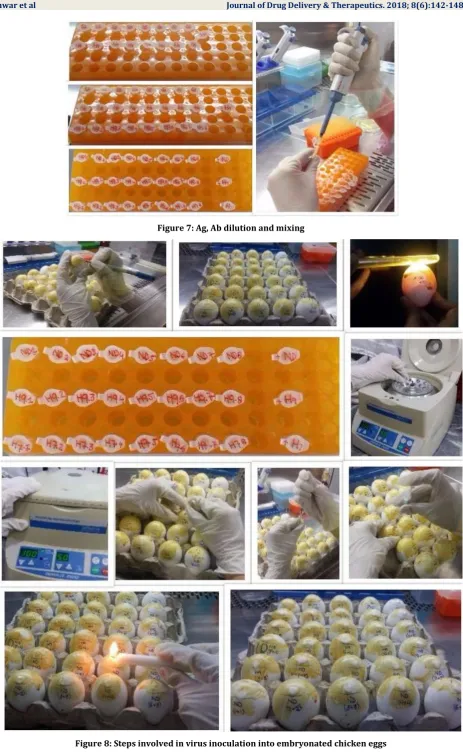
Antigen and antisera suspension was centrifuged at 3600g for five minutes. 0.1ml of supernatant was inoculated through the air sac opening with one ml disposable syringe by inserting the needle (25G) into the allantoic sac of the egg. The opening of the each egg was sealed with sterilized molten wax and the eggs were incubated along with non-inoculated control eggs at 37C for 48 hours till the cultivation of the virus.
Harvesting of antigen:
The eggs were chilled at -10°C for 30 minutes. The shell was cut above the air sac and carefully removed. The chorioallantoic membrane (CAM) and the amniotic membrane were turned with the help of sterile forceps, and the allantoic fluid was collected.
Control groups:
Five serum samples were obtained from non-exposed AIV and ND vaccinates. The samples were evaluated for relevant virus exposure through PCR and HI test using homologous antigens.
Spot Haemagglutination:
Sterile glass slide was labeled with respect to the marked eggs and test tubes containing allantoic harvest. Equal quantity (200ul) of each 25% washed chicken RBCs and harvested allantoic fluid were mixed on a clean glass slide allowed to react with each other for 2 minutes and results were recorded.
Haemagglutination of allantoic fluid17:
The HA test was performed using chicken erythrocytes and harvested allantoic fluid according to the method described by Allan et al., 1978.
Specificity, sensitivity and repeatability:
Each of the factor optimized in the study was run five times and data was evaluated through mean standard deviation (M±SD) to get p-value on the basis of Bonferroni analysis. Moreover, 25 virus free serum samples were tested in the final version of the assay. They were used in the test according to the cut off value in the assay to estimate the specificity, sensitivity and reproducibility.
RESULTS
Several parameters were optimized for virus
neutralization test using different concentrations of antigen and antibody for AIV-H5, AIV-H9 and NDV in the study. It was recorded that AIV-H5 antigen best neutralize
at concentration of 1×10⁻⁷ with antibody concentration of
1×10⁻². In Vitro optimum incubation temperature was 37°C
eggs temperature 37°C for 38 hours. Similarly, AIV-H9 antigen finest neutralization occurred at concentration of 1×10⁻⁷ with antibody concentration of 1×10⁻². In Vitro
optimum incubation temperature was 37°C for 30 minutes as compare to in-vivo chicken embryonated eggs temperature that was 37°C for 38 hours. Whereas, NDV antigen and antibody greatest neutralization observed at antigen concentration of 1×10⁻⁷ with antibody titer of
1×10⁻². In Vitro optimum incubation temperature was 37°C
for 30 minutes as compare to in-vivo chicken embryonated eggs temperature was 37°C for 38 hours (Fig, 1,2,3,4,5). Antigen and antibody concentration was considered as one of the critical variable in neutralization process and it was observed that increase in antigen or antibody count may adversely affect the sensitivity of the assay. At highest antigen 1×10⁻⁸ with lowest antibody level 1×10-0 did not
show significant neutralization indicated by HA titer after incubation at optimized incubation temperature (37°C) and time period (38 hours).
Serum samples collected from AIV and NDV confirmed infected birds showed higher anti-HI titers (64 HIU) from non-infected flocks. On the basis of these results the cut off value was set to 64 HAU. Serum samples from five poultry breeder companies were test through VNT using five mentioned optimized conditions for three different viruses. It was found that Big Bird Poultry breeder and big bird foods showed 12±4.38, 41±21.46 and 32±19.59 mean standard deviation (M+SD) status of allantoic fluid harvested post in vivo neutralization HA for H5, H9 and NDV respectively. Serum samples from A&S chicks showed 32±19.59, 14±3.57 and 17±4.38 (M+SD) status of allantoic fluid harvested post in vivo neutralization HA for H5, H9 and NDV respectively. Whereas, Gateway chicks showed 17±4.38, 102±35.05, 256±156.76 (M+SD) status of allantoic fluid harvested post in-vivo neutralization HA for H5, H9 and NDV respectively. Similarly, Waqas poultry revelead 41±21.46, 819±280 and 716±280.43 (M+SD) status of allantoic fluid harvested post invivo neutralization HA for H5, H9 and NDV respectively as shown in Fig. 6.
DISCUSSION
Wide ranges of biochemical and serological tests have been used for the detection of animal and human disease causing pathogen. It is imperative to have authentic method to evaluate and confirm the organism. Various serological tests are being used for the confirmation of isolates and antibodies actively raised against vaccines. In current studies virus neutralization test was developed showing high specificity and sensitivity for avian influenza viruses subtype AIV-H5, AIV-H9 and Newcastle disease virus. The assay was reproduced and repeated for antisera collected from different vicinities of Lahore and displayed high level of homology to immunoglublins actively raised against vaccination in commercial poultry flocks. However,
sera obtained from the flocks were hitby ND and AIV-H9 at
different age did not show any significant resemblance to the antigen. VNT for embryonated egg adapted viruses is easy to perform and can be evaluated by spot heamagglutination using 25% washed chicken RBCs. Despite of excessive vaccination in commercial poultry viral problems has been reported with massive economical
losses. In most of the cases researcher believed that the inefficiency of vaccines against their specific wild antigen is due to change in genotype often posed by pre disposing factors. Furthermore, influenza viruses are remained focused in research due its unique nature of nucleic acid which is prone to rapid mutation facilitated by the process of reassortment. Fusion protein (F) controlled by F gene of Newcastle disease virus is another unique phenomenon supporting the virus in attachment and penetration in to the cell. Mutation in F gene results in alteration of expressed proteins which cannot neutralize native antigen. Therefore, in order to rule out the cause of vaccine failure, VNT is the most effective technique could be used to investigate the homology between vicinal strain and wild type antigen. It is imperative to have authentic technique for evaluation of immunogenicity. Neutralizing antibody response to the viruses is serotype specific and VNT is considered as gold standard to detect avian influenza and Newcastle disease virus neutralizing antibodies.
In current study it was observed factors such as amount of antigen and antibody, temperature and incubation time affected the neutralization reaction in-vitro and in-vivo in chicken embryonated eggs. Each of the factors has critical significance in antigen antibody neutralization reaction. The optimum neutralization reaction set for H7,
AIV-H9 and NDV were antigen (512 HAU) 1×10⁻⁷ versus 1×10⁻²
of antibody (512 HIU), 37°C for 38 hours of incubation.
However, AIV-H9 was significantly has better
neutralization results when incubated at 37C for 38 hours. Olitsky and Harford 1938, Morgan, 1945 are in partial agreement with data obtained in current studies that the degree of neutralization in extra neural test is maximal and was not influenced by incubation23.
It is evident that temperature has significant role in the neutralization of specific antigen and antibody under specified physiochemical conditions. Whereas, In vitro antigen antibody neutralization results revealed that AIV-H9 and NDV are more susceptible for neutralization reaction at 37C if incubated for 30 minutes in contrast to
AIV-H5 which showed better neutralization at 37C for 60
minutes. So, Li et al., 1994 collaborates that immuno precipitation and neutralization reaction are thermal dependent and require co incubation of virus and antisera particularly at 37C which can act as catalyst for antisera against peptides corresponding to normal internal potions of VP1 that have the ability to precipitate virus.
Andrewes and Elford, 1933 described that antigen and antibody neutralization reaction, antibody neutralize the relative proportion of specific antigen on the basis of percentage law. Dilution factor of antigen such as AIV-H5,
AIV-H9 and NDV showed significant neutralization at 10-6,
10-4 and 10-1 respectively21. Diluted Antiserum reacts at
its best at the level of 10-2 against 10-7 dilution of AIV-H5,
AIV-H9 and NDV antigen titer. However, Klein et al., 1999
partial agreed that if concentration of human cytomegalovirus was increased up to 100 fold does not affect the titer of neutralizing sera. Further explanation was made on the basis of observation that assay performed under ordinary conditions relative occupancy of viral epitopes is masked by antibody titer and its functional affinity for antigenic determent20 (Klasse, 1996).
Figure 1:Effect of antigen and antibody dilution factor on virus neutralization test
Figure 2: In vitro effect of temperature on the antigen and antibody neutralization reaction
Figure 3: In vitro effect of incubation period on the antigen and antibody neutralization reaction
Figure 4: In vivo effect of temperature on the inoculated eggs for virus neutralization test
Figure 5:In vivo effect of incubation period on the inoculated eggs for virus neutralization test
Figure 6: Serum neutralization of samples collected from birds naturally exposed with AI and NDV
0 100 200 300 400 500 600 700 800 900 1000
H
A
Ti
te
r
Ag-Ab Dilution Factor
AIV H5 AIV H9 NDV
0 200 400 600 800 1000
35°C 36°C 37°C 38°C Control
HA
Ti
te
r
Temperature
AIV H5 AIV H9 NDV
0 200 400 600 800
30M 45M 60M 75M Control
H
A
Ti
te
r
Incubation Period
AIV H5 AIV H9 NDV
0 100 200 300 400 500 600
35°C 36°C 37°C 38°C Control
H
A
Ti
te
r
Temperature
AIV H5 AIV H9 NDV
0 200 400 600 800 1000
24H 38H 48H 58H Control
H
A
Ti
te
r
Incubation Period
AIV H5 AIV H9 NDV
0 200 400 600 800 1000
BB Broiler BB Breeder A&S Chicks Gateway Chicks
Waqas Poultry
Control +ve Control -Ve
H
A
Ti
te
r
Blood Samples
Figure 7: Ag, Ab dilution and mixing
Figure 9: Harvesting of antigen Figure 10: Spot agglutination of allantoic harvest
Figure 11: Haemagglutination of allantoic harvest
CONCLUSION
In antigen antibody reactions, both of the participants shall be highly specific and require certain optimal physiochemical factors for their neutralization. It is evident based on the results of current study that for in vitro neutralization reaction two phases must be considered to get reliable results. Firstly in vitro antigen and antibody reaction is predominantly influenced by biological titer of virus and antibody concentration, temperature and incubation period followed by in vivo elusion of antigen and antibody association is greatly affected by temperature
ACKNOWLEDGEMENT
The authors of the paper are highly grateful to Mr. Usman Farooq Khalid the director of Ottoman Pharma (Immuno
Division) for providing financial support, isolate of Avian influenza virus, Newcastle disease virus and laboratory facility to execute the research in the best interest of the poultry industry.
REFERENCES
1. Mushtaq AM. Poultry production. In: Animal husbandry. National Book Foundation, Islamabad. 1994; pp: 292-334. 2. Amare A, Worku N, Negussie H. Coccidiosis Prevailing in
Parent Stocks: A Comparative Study between Growers and Adult Layers in Kombolcha Poultry Breeding and Multiplication Center, Ethiopia. Global Veterinaria. 2012; 8(3):285-291.
3. Muneer MA, Muhammad K, Tahir Y. Pathways to control Avian Influenza in Pakistan. In: Agro Veterinary News. 1995; pp: 2-3. 4. Nauta JJ, Eliminating bias in the estimation of the geometric
mean of HA titers. Biology. 2005; 35:149-151.
5. Naeem K, Ullah A, Manvell RJ, Alexander DJ, Avian influenza A subtype H9N2 in poultry in Pakistan. Veterinary Record. 1999; 145(19):560.
6. Bano S, Naeem K, Malik SA. Evaluation of pathogenic potential of avian influenza virus serotype H9N2 in chickens. Avian Distribution. 2003; 47(3):817-822.
7. Barbezange C, Jestin V. Quasi-species nature of an unusual Avian Paramyxovirus type-1 isolated from pigeons. Virus Genes. 2005; 53:224-40.
8. Laoeffen W, Qwak S, Boer-luijtez ED, Hulst M, Poel WVD, Bouwstra R, Mass R. Development of a virus neutralization test to detect antibodies against Schmallenberg virus and serological results in suspect and infected herds. Acta Veterinaria Scandinavica. 2012; 2012:44-54.
9. Stephenson I, Das RG, Wood JM, Katz JM. Comparison of neutralizing antibody assays for detection of antibody to influenza A/H3N2 viruses: an international collaborative study. Vaccine. 2007; 25:4056-4063.
10. Wood JM, Major D, Health A, Newman RW, Stepheson I, Clark T, Katz JM, Zambon MC. Reproducibility of serology assays for pandemic influenza H1N1: collaborative study to evaluate a candidate WHO international standard. Vaccine. 2012; 30:210-217.
11. Burton DR, Poignard P, Stainfield RL, Wilson IA. Broadly neutralizing antibodies present new prospects to counter highly antigenically diverse virses. Science. 2012; 337:183-186.
12. Gerhard W. The role of antibody response in influenza virus infection. Cur tor microbial Immunology. 2001; 260:171-190. 13. Bertram S, Glowacka I, Kuhl A, Pholmann S. Novel insights into
proteolytic cleavage of influenza virus heamagglutinin. Rev. Medical Virology. 2010; 20:298-310.
14. Panshin A, Shihmanter E, Weisman Y, Orvell C, Lipkind M. Antigenic heterogeneity among the field isolates of Newcastle disease virus (NDV) in relation to the vaccine strain 1. Studies on viruses isolated from wild birds in Israel Comparative Immunology Microbiology. 2002; 25:95-108.
15. Peter K, Olitsky MD, Casals MD. Neutralization tests for diagnosis of Human virus encephalitides. Journal of the American Medical Association. 1947; 134(15):1224-1228. 16. Tahir MS, Mehmood D, Sultan U, Saeed MH, Khan AR, Ansari F,
Salman MM, Majeed KA. A modified strategy of multiplex RT-PCR for simultaneous detection of H5, H7 and H9 subtype of avian influenza virus based on common forward oligo. Journal of Applied Poultry Research. 2016; 25:322-327.
17. Allan WH, Lancaster JE, Toth B. Newcastle disease vaccines, their production and use. FAO animal production and health series. 1978; 57-62.
18. Qihan LI, Alicia GY, Young ML, James H, Marie C. Poliovirus neutralization by antibodies to internal epitopes of VP4 and VP1 results from reversible exposure of these sequences at physiological temperature. Journal of Virology. 1994; 64:3965-3970.
19. Klein M, Schoppel K, Amvrossiadis N, Mach M. Strain specific neutralization of human cytomegalovirus isolates by human sera. Journal of Virology. 1999; 73:878-886.
20. Klasse PJ, Moore JP. Quantitative model of antibody and soluble CD4-mediated neutralization of primary isolates and T-cell line adapted strain of human immunodeficiency virus type 1. Journal of Virology. 1996; 70:3668-3677.
21. Andrewes CH, Elford WJ. Observation on anti-phage sera. I. The percentage law. British Journal of Experimental Pathology. 1993; 14:367-376.
22. Hitchner SB. A virus neutralization screening test: Its limitations in classifying field isolates of infectious bronchitis virus. Avian Pathology. 1973; 2(2):103-109.
23. Olitsky PK, Harford CG. Intraperitoneal and intracerebral routes in serum protection tests with virus of equine encephalomyelitis: Comparison of two routes in protection tests. The Journal of Experimental Medicine. 1938; 68:173-189.