© 2015 IJSRSET | Volume 1 | Issue 3 | Print ISSN : 2395-1990 | Online ISSN : 2394-4099 Themed Section: Engineering and Technology
Performance Enhancement of Mobile Ad-Hoc Network
Using Delay Aware Routing Protocol
Aqueel Ahmad1, Aleem Ali2
1
Department of Computer Science & Engineering, Al-Falah School of Engineering & Technology, Dhauj, Faridabad, Haryana, India 2
Department of Computer Engineering, Gautam Buddha University, Greater Noida,Uttar Pradesh, India
ABSTRACT
A Mobile Ad Hoc Network (MANET) is a network comprising of a set of mobile hosts proficient of
communicating with each other without the help of base stations. In view of the fact that MANET is an
independent system of functionality equivalent mobile nodes, which have to be able to communicate while
moving without any kind of wired infrastructure to this end, mobile nodes must work together to provide
the routing services. A large number of MANET routing protocols have been projected in the last era.
These protocols can be categorized according to the routing approach that they follow to determine route
to the destination. These protocols execute variously depending on type of traffic, number of nodes, rate of
mobility, etc. Routing protocols categorized into 3 categories. These are Proactive protocols, Reactive
protocols and Hybrid protocols. There are Metrics which are accountable to the Performance of MANET
& to achieve the Quality of Services for a mobile Adhoc network these metrics play a major role. Delay is
one of the major metrics of Quality of Services. Which describes the delay of data packets at the
destination node. This Paper presents the concept and approach that how we can improve the performance
of MANET by decreasing the delay using any particular delay aware routing protocol. This paper also
presents the comparison of different routing protocol on the basis of Delay Metrics.
Keywords:
MANET, Delay, QoS, AODV, DSR, OLSR
I.
INTRODUCTION
In early 1990’s the use of database in web based
application was the choice of MySQL due to its fast
and flexible capabilities. “Monty” Widenius
developed this database and named after his
daughter name My and SQL that stands for
structured query language. The alternate database
won’t be a choice for people if they want to have an
ease of use, reliable and open source database. Over
the years this database is more stable and reliable
and it is used by small scale to large based
organizations. The number of year’s effort placed
by MySQL Ab Company to produce such a
capabilities based product into open source market.
protocol [2]. Proactive also known as Table Driven
Protocol [2]. And the last one is Hybrid which is the
combination of above two routing protocols. The
general overview of the MANET routing protocols
is described from the diagram give below.
Figure 1. Major Category of Routing Protocols in MANET [2]
The Mobile Ad-hoc Network that implement on
reactive routing protocol for the transmission of
packets from source to destination does not
maintains a routing information for all the nodes at
all time. Instead of this the routing information is
obtained on demand if a node wants to send a
packet to the destination and it does not have
enough information for sending the packet to the
destination it obtained an information on demand.
[3][5][6]. In the Proactive Protocol each node
maintains a Routing table at its end and these
routing table contains the information for the
delivery of data packets coming from the source
node. [4] Therefore there is an overhead problem
associated with a proactive protocol [5]. Hybrid
protocols is a combination of the pros of the
reactive protocol and proactive protocol. [6] But
hybrid protocol are also not able to meet the all
those requirement which are essential for achieving
the QoS in MANET [7].
II.
METHODS AND MATERIAL
A.Historical Background
We can classify MANET life cycle into first, second and third generation. The Mobile Ad-hoc network currently in is use belongs to the third generation [3]. The first generation of ad hoc network started during the 1970s and was given a term as Packet Radio Network (PRNET) [4]. The Defence Advanced Research Project Agency
(DARPA) initiated research of using packet switched radio communication to provide reliable communication between computers and urbanized PRNET. As the time passes development was at its pace and during the period of 1980 the PRNET has developed into the Survivable Adaptive Radio Network. (SU RAN)[5]. SURAN was smarter than PRNET and it provides some features by improving the radio performance (making them smaller, cheaper and power thrifty). SURAN also provides resilience to electronic attacks. At the same time United State Department of Defence (DOD) for continuing to an Ad hoc Network which can be used in practical or Real time and for developing this it continued funding for programs such Globe Mobile Information System (GloMo) and Near Term Digital Radio (NTDR). GloMo make use of CSMA/CA and TDMA molds, and provide organizing and self-healing network (i.e. ATM over wireless, Satellite Communication Network). The NTDR make use of clustering and link state routing and organized an ad hoc network. NTDR is worn by US Army [6]. By the enhancement of Ad- hoc Network number of research took place during the period of 1990’s.The functioning group of MANET is born in Internet Engineering Task Force (IETF) who worked to standardized routing protocols for MANET and gives rise to the development of various mobile devices like PDA‟s palmtops, notebooks, etc.
B. Delay Aware Routing Protocols Classification
i. Delay aware protocols based on AODV
AODV is one of the most important reactive protocol which based on demand used in table based approach. AODV protocol uses the terminology of the shortest path from source to destination as the main metric in determining the optimum path. The proposed protocol QoS-AODV [9]. It is an advance AODV Protocol which decides the minimum path from source to destination based on three major factors i.e. Hop count, delay and bandwidth. The combination of both the protocol i.e. QoS-AODV and AODV multipath yields a new protocol called as DAAM [10]. Which uses a delay aware routing protocol technique. In DAAM there is a computation of multiple node-disjoint path without incurring the overhead generated by link state routing method. QoS-AODV routing protocol helps in choosing optimal path by the usage of hop in addition with delay and bandwidth. This protocol does not take care of the other factors which are positively or negatively responsible for the optimal path such as dynamic behavior of the MANET node mobility due to which there is a fear of link failure. EDAODV is also one of the modified version of AODV with additional delay and energy extensions, in this routing protocol the two parameters of minimum energy and maximum delay are added to the AODV routing table per entry.
ii. Delay aware protocols based on DSR
DSR i.e. Dynamic Source Routing protocol is the on demand routing protocol based on the source routing theory. This protocol determines the shortest path from source to destination based on the minimum number of hops. The additional mechanism proposed for AODV is now applied to DSR and route discovery in DSR uses these energy and delay extensions to ensure to give a new protocol called as EDDSR [11]. In this protocol node who receives route request will search within its route cache to this destination with the specified energy and delay. If both metrics values satisfied with the values in node’s route cache the packet will be forwarded else it will be discarded.
iii. Delay aware protocols based on OLSR
In OLSR the basic mechanism is the selection of
minimum hop path between source and destination
node without concern about the quality of link.
Different types of routing schemes are proposed by
the authors over the OLSR such as QOLSR in
which delay and bandwidth measurements are
applied in order to improve the quality requirements
in routing information [12]. Another approach is
Link Quality aware Optimized Link State
Routing (LQOLSR), which makes a selection
between
source
and
destination
based
on
transmission delay [13].
The overall Representation of protocols using Delay as the Major Metric
Table-1 Main Features of Delay Aware Protocols [14], [15]
Protocol Added metric s Routi ng Proto col Class Simulatio n Modif y messa ges Kind of Delay LQOLS R
Delay Proact ive
Real Implement
ation
Yes Packet Transm
ission Delay OLSR Delay Proact
ive
N/A Yes Media Access Delay EDDSR Delay
and Energy
Reacti ve
Ns2 Yes End-to-End
QOLSR Delay and Bandwi
dth
Proact ive
OPNET Ye Averag e Delay
OLSR_ NN
Delay Proact ive
Ns2 Yes Mean Queuin g Delay SMR Delay
and Multip
ath
Reacti ve
GloMoSim Yes End-to-End
DAAM Delay and Multip
ath
Reacti ve
OPNET Yes End-to-End EDAOD V Delay and Energy Reacti ve
Ns2 Yes End-to-End QoS-AODV Delay and Bandwi dth Reacti ve
N/A Yes End-to-End EDC-AODV Delay and energy Reacti ve
Ns2 Yes Current size of queues
III.
RESULTS AND DISCUSSIONa free simulation tool that depends on a discrete event mechanism [18]. OPNET (Optimized Network Engineering Tools) is a commercial simulator with a Graphical user interface. It is well-organized in that many components such as mobility patterns, propagation models, MAC layer protocols and many routing protocols (e.g., AODV, DSDV) are already included [19]. NS-2 (Network Simulator version 2) is the most popular free simulation tool used in the field of mobile ad hoc networks [20]. It is equipped with lots of protocols and models. In addition, there is substantial technical support available in the open source community. NS-2 is split into the OTCL language and the C++ language.
1 Simulation Results of Delay Metric for DSDV and DSR
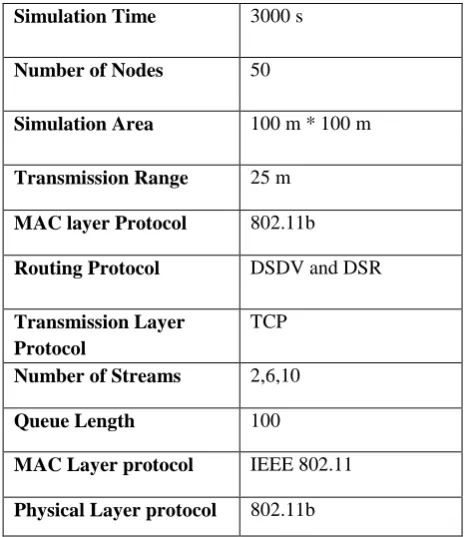
Table :-1 Simulation Parameters
Simulation Time 3000 s
Number of Nodes 50
Simulation Area 100 m * 100 m
Transmission Range 25 m
MAC layer Protocol 802.11b
Routing Protocol DSDV and DSR
Transmission Layer Protocol
TCP
Number of Streams 2,6,10
Queue Length 100
MAC Layer protocol IEEE 802.11
Physical Layer protocol 802.11b
Graphical Representation
Figure 2. Delay versus number of flows
2 Simulation Result of Delay Metric for AODV against DSDV Protocol
Table :-2 Simulation Parameters
Parameter Value
Simulator NS-2
Simulation time 500 seconds Area of the
network
500 m x 500 m
Number of nodes
25, 50, 100, 200
Pause time 10 seconds
Maximum speed of nodes
20 meters per second
Mobility Model Random waypoint
Graphical Representations.
Figure 4. Average End to End Delay for 50 Nodes
Figure 5. Average End to End Delay for 75 Nodes
Figure 6. Average End to End Delay for 100 Nodes
The simulation result as indicated in Fig-5 and Fig-6 shows that in case of low node density, the average end-to-end delay of AODV is higher than DSDV whereas Fig2.3 and Fig 2.4 indicates that with an increase in node density, AODV outperforms DSDV. It also has been observed that with an increase in pause time there is a decline in the average end-to-end for both the protocols under low node density environment (Fig-5 and Fig-6). However, this is not true when there is a rise in the network density. The possible reason for such
behavior is the presence of more number of nodes between source and destination which effects in increase of hop count thus resulting in increased average end-to-end delay.
3 Simulation Result of Delay Metric for AODV and OLSR
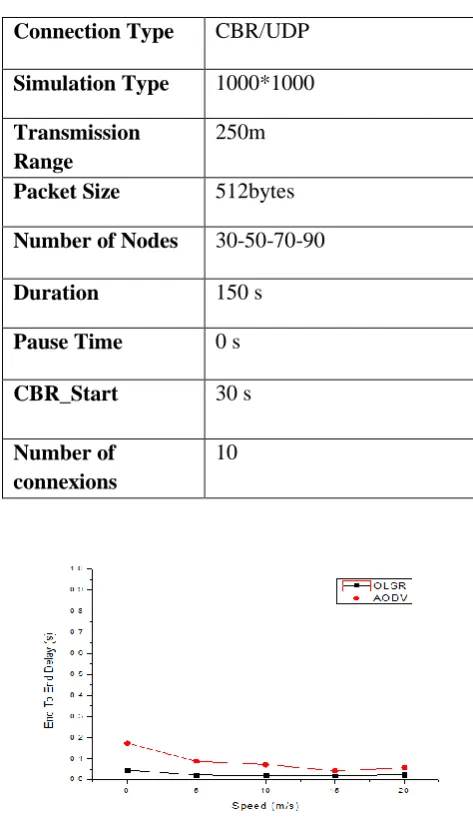
Table :-3 Simulation Parameters
Connection Type CBR/UDP
Simulation Type 1000*1000
Transmission Range
250m
Packet Size 512bytes
Number of Nodes 30-50-70-90
Duration 150 s
Pause Time 0 s
CBR_Start 30 s
Number of connexions
10
Figure 7. Delay versus Speed Graph
IV.
CONCLUSION
delivering a data packet to the destination node. Ad
–hoc networking is a rather hot concept in computer
communications. This means that there is much
research going on and many issues that remains to
be solved. In this paper, we have focused on
performance evaluation of three routing protocols,
AODV, DSDV and OLSR. However there are
many issues that could be subject to further studies.
First of all, it is important the practical
implementation of those routing protocols, in real
applications based on the scenarios that were
studied. Also, the simulator environment could be
improved. The objective of this thesis will be to
Search, Enhance and implement the Most Efficient
Delay Aware Routing Protocol so that all the
requirement metrics for the QoS can be achieved.
V.
REFERENCES
[1] Jeroen Hoebeke et.al, "An Overview of Mobile Ad hoc Network:
Applications and Challenges", Dept. of I.T (INTEC), Ghent. University, p.p-60-66, session 4, 2005.
[2] Salim M Zaki et.al, "A Review of Delay Aware Routing Protocol in MANET", Computer Science Letter, ISSR, vol. 1, p.p-1-12, June 2009.
[3] S. Basagni.I et.al,”A distance effect algorithm for mobility (DREAM)”,
Proceedings of the Fourth Annual ACM/IEEE International Conference on Mobile Computing and Networking (Mobicom98), Dallas, TX, 1998.
[4] B. Bellur et.al, “Topology broadcast based on reverse-path forwarding
routing protocol”, Internet Draft, draft-ietf-manet-tbrpf-06.txt, work in progress, 2003.
[5] Seema Dev et.al,” A Comprehensive Overview on Manet”, International
Journal of Engineering and Advanced Technology (IJEAT), volume-3, issue-6, pp. - August 2014.
[6] Mohit Kumar et al,” An Overview of MANET: History, Challenges and
Applications” Indian Journal of Computer Science and Engineering (IJCSE), ISSN: 0976-5166 Vol. 3 No. 1 Feb-Mar 2012
[7] http:// en.wikipedia.org/wiki/Mobile_ad_hoc_network.
[8] The Mobile Ad Hoc Networks Study Group
(GEDOC)/http://www.siam.dcc.ufmg.br/gedoc.
[9] Eichler, et.al, “Challenges of Secure Routing in MANETs: A Simulative
Approach using AODV-SEC”, Oct. 2006, IEEE International Conference on Mobile Adhoc and Sensor Systems(MASS).
[10]Andrea Goldsmith “Wireless Communications” Cambridge University
Press.
[11]Pravin.et.at,”Mobile Ad Hoc Networking: Imperatives and Challenges”
[12]Dr. Torsten et.al, “Performance Comparison of MANET Routing
Protocols in Different Network Sizes”, 2003.
[13]R.Asokan et.al, "Performance Evaluation of Energy and Delay Aware Quality of Services (QoS) routing Protocols in Mobile Ad hoc Networks", International Journal of Business Data Communications and Networking, vol. 4, p.p-52-63, 2008.
[14]Saad M.Adam et.al,” Delay aware Reactive Routing Protocols for QoS
in MANETs: a Review", vol.11, p.p-844-850, Dec 2013.
[15]Abolhasan et.al, "A review of routing protocol for mobile ad networks", Elsevier, ad Hoc Networks, vol.2, Issue, p.p-1-22, 2004
[16]Elizabeth et.al, “A Review of Current Routing Protocols for Ad Hoc Mobile Wireless Network”, IEEE Personal Communication, p.p-1-10, 1999
[17]Kapang Lego et.al, “Comparative Study of Adhoc Routing Protocol
AODV, DSR and DSDV in Mobile Adhoc NETWORK”, Indian Journal of Computer Science and Engineering, vol.1 No 4364-371, ISSN 0976-5166.
[18]OPNET Modeler, http://www.opnet.com/solutions/network_rd/
modeler.html.
[19]The Network Simulator: ns-2, http://www.isi.edu/nsnam/ns
![Figure 1. Major Category of Routing Protocols in MANET [2]](https://thumb-us.123doks.com/thumbv2/123dok_us/1164793.1618847/2.595.59.270.144.303/figure-major-category-routing-protocols-manet.webp)