A Conceptual Model for Developing a Valid and Reliable
Questionnaire on Nutritional Knowledge and Supplement
Habits Among Disabled Athletes in Malaysia
NoRAzMiR MD NoR
1*, HAiDziR MANAf
2and NuRul AtHiRAH MoHD AzHARi
11Centre of Nutrition and Dietetics, Faculty of Health Sciences, Universiti Teknologi MARA, Puncak Alam, 42300 Malaysia.
2Centre of Physiotherapy, Faculty of Health Sciences, Universiti Teknologi MARA, Puncak Alam, 42300 Malaysia.
Abstract
Disability sports has become more popular since the last the five decades. The increase in participation will cause pressure among athletes to achieve optimum sports performances. Through proper nutrition, the athletes’ sports performance can be enhanced. The benefits of nutrition in sports performance among athletes can be attained if their level of nutritional knowledge and habits are identified. This paper intends to present the design of the questionnaires from previous literature and predicted questionnaire model for this study. This study aims to develop a questionnaire that combines both nutritional knowledge and supplement habits among disabled athletes in Malaysia, to validate and determine the reliability of the developed questionnaire. Expert validation, test-retest reliability, and internal consistency reliability will be used in this study. In expert validation, six experts in nutrition, dietetics and sports nutrition field will be involved, and the data will be measured using the content validity ratio (CVR). Pearson Correlation Coefficient and Cronbach Alpha will be applied to determine the internal consistency reliability and test-retest reliability in determining the reliability of the developed questionnaire. As a result, a valid and reliable questionnaire that combines both nutritional knowledge and supplement habits specifically for Malaysian disabled athletes will be established, thus optimizing the growth of Malaysia disability sports. However, this research has not completed yet.
Current Research in Nutrition and food Science
Journal Website:www.foodandnutritionjournal.org
CoNtACt Norazmir Md Nor [email protected] Centre of Nutrition and Dietetics, Universiti Teknologi MARA, Puncak Alam, 42300, Malaysia.
© 2017 The Author(s). Published by Enviro Research Publishers
This is an Open Access article licensed under a Creative Commons Attribution-NonCommercial-ShareAlike 4.0 International License (https://creativecommons.org/licenses/by-nc-sa/4.0/ ), which permits unrestricted NonCommercial use, distribution, and reproduction in any medium, provided the original work is properly cited.
To link to this article: http://dx.doi.org/10.12944/CRNFSJ.5.3.06
Article History
Received: 04 October 2017
Accepted: 20 December 2017
Keywords
Developing a questionnaire, Disabled athletes, Malaysia,
Nutritional knowledge, Supplement habits.
introduction
The participation of disabled athletes in sports is increasing over the year. The increasing participants can be seen with the growing percentage of countries in the Paralympic Games. In the year 2012,
injuries, amputee athletes and Les Autres sports classification (physical disability athletes that do not meet other categories)2.The increase participants in sports may cause internal and external pressure to the disabled athletes in achieving optimum sports performance. Nutrition is one of an important factor in obtaining optimum sports performance. Proper diet is a crucial factor in achieving optimum development of physical and results3. Adequate nutrition guarantees that fuels necessary for the production of energy needs linked to recovery and activity can be build up in an individual4. Besides that, insufficient intake of energy relating to energy used contributes to the negative balance of energy notably5. For instance, female athletes participating in volleyball with chronic energy insufficient shows reduced in athletic performance, and this displays actual threat for health problems5.In athletes with disabilities, appropriate diet may act as an essential factor in avoiding health problems, as they are more prone towards fatigue, stress and poor performance compared to non-disabled athletes2. The benefits of nutrition in sports for disabled athletes can be attained by identifying their nutritional knowledge and supplement habits.
The nutritional knowledge among disabled athletes still lack as well as the existing studies in this population. In spinal-cords injury athletes, a potential gap in nutrition knowledge is identified6. Iranian athletes with physical disabilities have an average score of nutrition knowledge level, but they have shown to have lack knowledge in several areas of nutrition such as calcium7. In supplement habits, the intake of supplements among disabled athletes are slightly higher or similar than non-disabled athletes with at least one supplement taken for the last six-month6.
Although the role of nutrition in sports performance is widely known, the existing studies on both nutritional knowledge and supplement habits among disabled athletes are still scarce, especially in Malaysia. There is no available validated and reliable questionnaire in either nutritional knowledge or supplement habits for disabled athletes in Malaysia. Thus, this study aims to develop a questionnaire that combines both nutritional knowledge and supplement habits among disabled athletes in Malaysia. If the level of nutritional knowledge and supplement habits
among disabled athletes are identified, effective intervention can be implemented to enhance their sports performance, thus aids them to obtain high achievement in disability sports through nutrition. In this paper, the previous structures of questionnaires from existing literature and the predicted model for this study will be shown.
Materials and Methods
situations, better precision of single measurements is essential in identifying the changes in measurement as better reproducibility propose better precision9. Internal consistency reliability is described as the magnitude to which every item of a test measures the similar construct, that is, the common aspect saturation by Revelle (1979)10.Internal consistency reliability will be used as to identify whether all the items in the questionnaire measure the same theory or construct and correlates with each other. Statistical Package for Social Sciences (SPSS) will be used to check the reliability using Cronbach Alpha for internal consistency reliability and Pearson Correlation Coefficient for test-retest reliability. The nutritional status of the participants will be identified through diet recall and use Nutritionist Pro software in analyzing their nutritional status. The sampling method used is purposive sampling.
Results
Existing Model of Questionnaires in Nutritional Knowledge Among Disabled Athletes
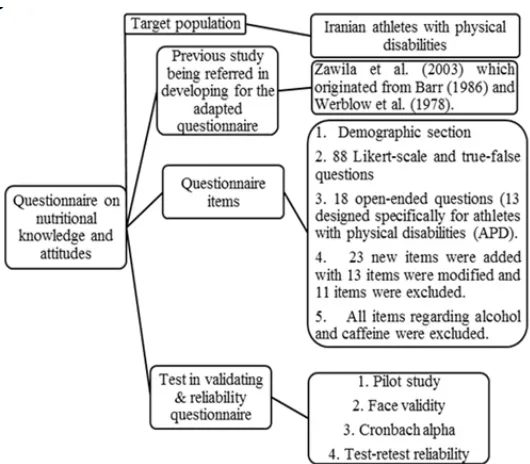
In disabled athlete’s population, two questionnaires used in identifying the nutritional knowledge among athletes with disabilities have been ascertaining in the literature search. Rastmanesh et al.,6 has adopted a questionnaire (Figure 1) to identify the nutritional knowledge of Iranian athletes with physical disabilities. They aimed to distinguish the difference of Iranian athletes with disabilities (APDs) on nutritional knowledge and attitudes after education in nutrition4. The self-administered questionnaire was back-translated into English and Persian. Their model of the questionnaire was adapted from Zawila et al.,11, a questionnaire that targeted female collegiate cross-country runners as their subject11. As the questionnaire was not suitable for APDs and food habits of Islamic-Iranian, Rastmanesh et al.,6 modified it to make it more appropriate for their target population; Iranian APDs. The overall score for the test-retest reliability was 0.85, and the score for individual items using Pearson (r) was 0.61 to 0.93, which deemed as satisfactory.
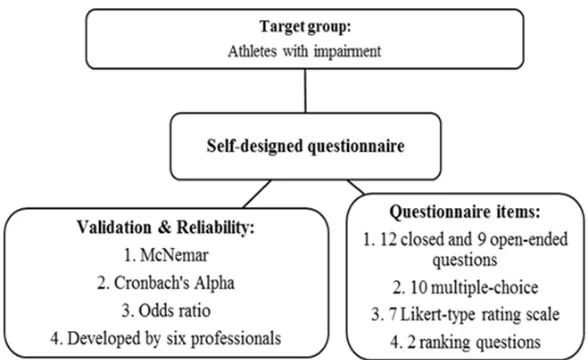
Meanwhile, Moulds2 used a questionnaire for athletes with spinal cord injuries (SCI) in her study. She aimed to identify the nutritional knowledge of SCI athletes to compare with non-disabled athletes using the self-designed and a self-developed questionnaire on nutrition knowledge and, to determine the sources of
dietary habits, nutrition education and effects on food choice for both SCI and non-disabled athletes2. The questionnaire items were either developed or revised from previous literature on nutrition knowledge or practices of athletes as shown in Figure 2. The earlier study used as references in preparing the questionnaire focused on either coaches, adults or varsity athletes, not on disabled athletes. Although this study had developed a questionnaire for spinal cord injury athletes, due to the restriction of time, validity and reliability of this questionnaire were not able to perform.
Existing Models on Supplement Habits Among Disabled Athletes
In nutritional supplement habits among disabled athletes, two questionnaires used for determining the nutritional supplement habits among athletes with disabilities from previous studies had been identifying. Terri et al.,7 created a questionnaire to answer their objectives which were to identify; 1) prevalence and type of nutritional supplement (NS) taken, 2) frequency, quantity of use and causes for NS use, 3) sources of information on supplements, 4) the factors (age, gender, nationality, performance level, training hours, category of sport and disability) that affect the use of NS in athletes, 5) perception of athletes in using NS and 6) level of knowledge of doping/anti-doping in sport. The developed questionnaire underwent three stages as depicted in Figure 3. Frequencies (%) or mean ± SD was used to present the descriptive data. Chi-square statistical (χ2) analysis was implemented in this study in which any groups that had less than five, as expected frequencies will be removed.
six professionals including a dietitian, a qualitative scientist and sports nutritionists/scientist with several methods in validating the questionnaire as shown in Figure 4. The range of value for the McNemar and
Cronbach’s Alpha tests using to check the reliability was p = .582 to 1.000 except for one question (p = .125) in a representative sample (n=10)12.
fig. 1: Questionnaire design on nutritional knowledge among iranian physical disabilities athletes
fig. 4: Questionnaire design on nutritional supplement habits and sources of information
Proposed integrated Model in Developing a Questionnaire on Nutrition Knowledge and Supplement Habits Among Disabled Athletes
At the end of this study, a validated and reliable questionnaire will be established specifically for Malaysian disabled athletes. Based on the existing model, questionnaire on both nutritional knowledge and supplement habit among disabled athletes is absent, thus leading to this study to close the gap of the research. Through this questionnaire, both information on nutritional knowledge and supplement habits among disabled athletes can be obtained. Identifying the level of knowledge and nutritional supplement habits can help determining the area of deficit in knowledge, making the athletes
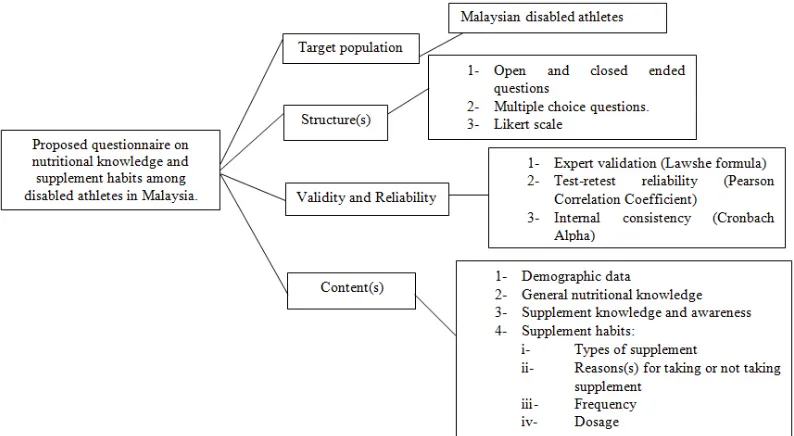
more receptive towards nutrition education. The component of the developed questionnaire is described in Figure 5. The questionnaire will be adapted and develop using the questionnaires from the previous studies in nutritional knowledge and supplement habits among disabled athletes including from Moulds2 and Graham-Paulson et al.,12. Besides adapting questionnaire items from some studies, some of the questionnaire items in this expected questionnaire model has been edited, created new and removed accordingly to the culture of the Malaysian population.The questionnaire will also undergo translation process from English to Malay as to prevent any language barrier and obtain data more efficiently.
The proposed questionnaire is expected to has four domains; demographic data, general nutritional knowledge, supplement knowledge and awareness, and supplement habits. The demographic data domain is needed to identify the characteristics of the population such as age, race groups, educational level, sports classification and much more. The second domain which is general nutritional knowledge would contain questions focused on both macronutrients and micronutrients. This domain is very crucial as it is the section that will identify the nutritional knowledge of the Malaysian disabled athletes. The third domain would be supplement knowledge and awareness. This domain is made to identify the understanding of athletes towards supplement. The data in this domain may show relation to the supplement habits of the Malaysian disabled athletes. The last domain in this proposed questionnaire is supplement habits. This domain is an essential domain as to answer the objective of this research; to develop a valid and reliable questionnaire on nutritional knowledge and supplement habits among Malaysian disabled athletes. Besides, this domain is important in identifying the types of supplement used, frequency, dosage and reasons in taking or not taking supplement among the disabled athletes in Malaysia.
By understanding, the nutritional knowledge and supplement habits among disabled athletes, practical nutrition education can be applied. Nutrition education is crucial for supplement habits, especially among disabled athletes. Inappropriate dosage, overconsumption of supplement due to low nutritional knowledge on regular dietary consumption and emerging of a nutritional supplement on the market with most of them unverified by scientific evidence would pose potential harmful and toxic effects7. Thus, assessment of nutritional knowledge and supplement habits without a doubt bring benefits to the disabled athletes’ population.
implication and Direction for future Research
This research will contribute a validated and reliable questionnaire on nutritional knowledge and supplement habits for Malaysian disabled athletes. Hence, in future, more research can be conducted to identify the best nutritional education and intervention for Malaysian disabled athletes, thus assisting them to obtain significant achievement in disability sports. Moreover, it helps to promote the growth of disability sports in Malaysia through nutrition. This research indirectly able to act as a reference in developing a specific recommendation for a nutritional supplement for disabled athletes in future studies.
Conclusion
This conceptual model is necessary to present the existing model related to the study and closing the gap of the research. A new paradigm of the questionnaire on both nutritional knowledge and supplement habits among Malaysian disabled athletes will be expected at the end of this study. The questionnaire would be able to assess the level of nutritional knowledge, supplement habits such as frequency, dosage, sources of information when
taking a supplement, and reasons for consuming supplement among disabled athletes in Malaysia, thus providing new insight into the growth of disability sport in Malaysia.
Acknowledgements
This research was funded by Ministry of Higher Education via Universiti Teknologi MARA, Malaysia. Grant no. 600-IRMI/FRGS 5/3 (052/2017).
References
1. Mauerberg-DeCastro E, Campbell DF, Tavares CP. The global reality of the Paralympic Movement: Challenges and opportunities in disability sports.Motriz Rev Educ Fis. 2016;22(3):111-123. doi:10.1590/S1980-6574201600030001.
2. Moulds JJ. The Nutritional Knowledge and Dietary Practices of Athletes with Spinal Cord Injuries. [master's thesis]. Dunedin, NZ: The University of Otago; 2012.
3. Baranauskas M, Stukas R, Tubelis L, et al. Nutritional habits among high-performance endurance athletes. Medicina. 2015;51 (6):351-362. doi:10.1016/j.medici.2015.11.004. 4. Smith JW, Holmes ME, McAllister MJ.
Nutritional Considerations for Performance in Young Athletes. J Sports Med. 2015;2015:1-13. doi:10.1155/2015/734649.
5. Papadopoulou SD. Impact of energy intake and balance on the athletic performance and health of top female volleyball athletes. Sport Med J / Med Sport. 2015;11 (1):2477-2481. http://search.ebscohost.com/login. aspx?direct=true & db=s3h & AN=108366748 & site=ehost-live & scope=site.
6. Rastmanesh R, Taleban FA, Kimiagar M, Mehrabi Y, Salehi M. Nutritional knowledge and attitudes in athletes with physical disabilities. J Athl Train. 2007;42(1):99-105. 7. Terri G, Perret C, Crosland J, Smith B, Vicky
G-T. Nutritional Supplement Habits and Perceptions of Disabled Athletes. Montreal (Quebec):World Anti-Doping Agency (WADA); 2014: https://www.wada-ama.org/sites/ default/files/.../files/TOLFREY-Final-2012-EN. pdf.
8. Berchtold A. Test-retest: Agreement or T\Reliability? Methodol Innov. 2016; 9: 205979911667287. doi:10.1177/2059799 116672875.
9. Vaz S, Falkmer T, Passmore AE, Parsons R, Andreou P. The Case for Using the Repeatability Coefficient When Calculating Test-Retest Reliability. PLoS One. 2013; 8(9):1-7. doi:10.1371/ journal.pone.0073990.
10. Tang W, Cui Y, Babenko O. Internal Consistency: Do We Really Know What It Is and How to Assess it? J Psychol Behav Sci. 2014;2(2):205-220.
11. Zawila LG, Steib CM, Hoogenboom B. The Female Collegiate Cross-Country Runner: Nutritional Knowledge and Attitudes. Athl Train. 2003;38(1):67-74.