©2019 New Delhi Publishers. All rights reserved
Severity Analysis of Problems Faced by Maize Growers in
Punjab
Yugraj Singh and Baljinder Kaur Sidana*
Department of Economics and Sociology, Punjab Agricultural University, Ludhiana-141004, Punjab, India *Corresponding author: [email protected]
ABSTRACT
The area under maize crop has been consistently decreasing in the Punjab state over the last few decades, despite its multiple uses. Ineffective implementation of price policy along with certain problems, the maize growers could not earn remunerative returns form maize cultivation in the state. The present study was designed to highlight the various problems in the context of production and marketing front of maize crop in the Punjab state. The data with respect to various problems being faced by the maize growers were collected through well structured pre-tested schedule. The data recorded on scales and severity analysis was carried out by using mean rank score. Garret ranking technique was applied to extract the important problems that influence the maize cultivation in the Punjab state. The severity analysis indicated that among biotic constraints, the emergence of diseases (mean score=1.82) was reported as the most severe problem faced by the maize growers. Plant protection measures being adopted by the maize growers for effective control of insect, pest and management of diseases could increase the production cost of maize. Based on the value of mean score, shortage of labor supply during peak season (mean score=2.82) was the most important problems amongst abiotic problems, while the intensity of the problems like price variability, shortage of farm machinery was moderately high in the study area. Low price of the produce was exposed as the most influential problem by applying Likert scale. Shortage of labour supply during peak season, emergence of diseases, insect-pest attack and weeds infestation were exposed as moderately severe problems. Hence, the effective and suitable measures to address the highlighted problems of maize could provide impetus to increase maize acreage in the Punjab state.
Highlights
mAmong different varieties of maize, the productivity of hybrid maize is at par with its competing crop, paddy, but still farmers are reluctant in growing maize, the second most important cereal crop of kharif season, due to a number of production and marketing constraints being faced by them. The study highlights the main obstacles faced by maize growers in Punjab state which comes in the way, though the crop is relatively less costly and moreover requires nearly one-fourth of water than its competing crop.
Keywords: Maize, Mean Score, Severity Analysis, Problems, Garret ranking technique
Maize (Zea mays) is one of the most important cereal crop worldwide; not only for human consumption but also for animal consumption. The crop is an important staple food for more than 1.2 billion
people in Sub-Saharan Africa and Latin America
and a key food crop in Asia. Globally what makes maize a popular crop from cultivation point of view, is its versatility in terms of its suitability to diverse
agro-climatic zones offering highest genetic yield
potential amongst other cereal crops. Maize is used
21.81 million tonnes of maize, making this crop as
third most important food grain after wheat and
rice. It contributes nearly 9 per cent to the national food basket and more than ` 400 billion to the agricultural GDP besides generating employment to 1000 million man-days in the farm and downstream agricultural and industrial sectors. The maize is cultivated throughout the year in all states of the country for various purposes including grain, fodder, green cobs, sweet corn, baby corn and pop corn. The predominant maize growing states that contributes more than 80 per cent of the total maize production are Karnataka (14.99 %), Madhya Pradesh (11.83 %), Bihar (10.99%), Tamil Nadu (10.93%), Telangana (7.96%), Maharashtra (6.93 %),
Andhra Pradesh (6.48 %), Uttar Pradesh (5.76%) and
Rajasthan (5.55 %). Apart from these states maize is also grown in Jammu and Kashmir and North-Eastern states (GOI, 2016).
Punjab unlike the rest of India had traditionally been a maize growing state until rice became popular. Area under maize cultivation declined
since 2006-07 with little improvement in the yield.
The maize production in Punjab in 2014-15 was 0.42 million tonnes, and the total area under the crop was 0.12 million hectares. With an average productivity of 3,687 kg/ha, farmers cultivating maize made
substantial profits that year. With in Punjab the
primary maize producing areas are Hoshiarpur,
Roopnagar, Nawan Shahar, Kapurthala, Ropar and
Amritsar (Anonymous 2016). In Punjab, the maize is sown normally during the end of May to end of
June and is harvested in the months of September-October. A number of efforts were made to bring
about technological breakthrough in this crop. In spite of this, the area under maize depicted a continuous decline during the Post-green revolution period. The decline in maize-acreage was mainly caused by the advent of HYVs of its competing
crop (Singh et al 2012). The predominance of rice-wheat rotation in the Punjab state has been leading to many environmental related problems such as the problem of depleting water table, deteriorating soil fertility etc. In wheat-paddy rotation, paddy crop is more resource depleting than wheat crop
and inefficiencies in its production are larger in
the case of the small farmers (Kataria and Melkani 2014). Paddy crop is highly water intensive crop, as it consumes 3000 litres of water to produce one kilo
of rice (Saran et al. 2013). Thus, the sustainability of agriculture in state is under threat. In order to revitalize Punjab agriculture through exploring alternatives to the rice-wheat system, various
expert committees and other have recommended
the diversification of agriculture towards high-value commodities and a broader mix of traditional commodities and agro-processed products that augment farm income, promote exports and conserve soil and water resources. Underlying the
importance of diversified agriculture, it has been
observed that the Punjab state has large potential for cultivation of a variety of high value crops as
well as related enterprises (Johl Committee, 2002).
Recently, Punjab government has submitted a
diversification plan to the Union government for shifting 12 lakh hectares of paddy area to other crops like maize, cotton, sugarcane, agro-forestry,
pulses, fruits and vegetables in the kharif season groups. For this purpose, the funds demanded by
the State Government from Union Government are
worth about ` 5000 crores.Maize is one of the best
alternate crop, as the profits in Maize-Potato-Wheat rotation comes after Paddy-Potato-Wheat rotation
(Kaur and Kaur 2012).
In 1970-71, the area under maize cultivation was approximately 5.55 lakh hectares, but ever since, this area has been continuously declining. The
agricultural policy reflects the potential of maize
crop as the future crop of Punjab, becoming the most suitable replacement for paddy. The maize cultivation in the state is facing certain constraints which have proved detrimental to the growth of maize crop in Punjab. It has been found that cost of cultivation of maize is lower than the rice in the state but productivity of maize could not keep pace with the productivity of rice. In the back drop of this, the present study is initiated to examine the various problems faced by the maize growers during its cultivation. The Punjab state has targeted towards other crops to maintain ecological balance and to save the depleting water table as well as soil condition of the state. Market malpractices, high cost of storage facilities, few processing industries are the main constraints of maize growing farmers in the state. An attempt has also been made to identify
MATERIALS AND METHODS
The present study was conducted in Punjab state during the year 2014-15.. Multi-stage sampling technique was followed for the selection of the
study sample. At the first stage, two districts with
highest concentration of area under maize crop for the year 2014 was selected namely Hoshiarpur and Roopnagar. At the second stage two blocks from each district were selected following the same criterion. Garhshanker and Banga blocks were selected from
Hoshiarpur district and Shri Anandpur Sahib and
Noorpur Bedi blocks were selected from Roopnagar district respectively. At third and last stage, a sample of 100 maize growers (25 from each selected block) was randomly selected. A comprehensive schedule was developed for the collection of data with respect to various problems being faced by the maize growers while production and marketing of maize. More comprehensive techniques like one sample t-test and garret ranking techniques were used in
order to draw significance inferences of the data.
Methodological framework of these techniques is given as under:
Likert Scale
Three point Likert scale was used to assess the severity of problems being faced by the sample growers for producing and marketing of maize. It was developed by Rensis Likert, an American social psychologist. It is a most widely used approach to scaling responses in survey research and following scale were used:
Severity of problem Scale
Normal 1
Moderate 2
Severe 3
Mean score
Mean score representing the mean level of severity of problems being faced by the maize growers. It is calculated by using following formula,
Mean score =
∑
(
1*fnormal+2*100fmoderate+3*fsevere)
Where,
fnormal = frequency of farmers reported as ‘normal’
response in favour of severity of problem
fmoderate = frequency of farmers reported as ‘moderate’
response in favour of severity of problem
fsevere = frequency of farmers reported as ‘severe’
response in favour of severity of problem
The results are interpreted on the basis of the value of mean score. More is the value of mean score more sever is the problem and vice-versa.
One sample t-test
The level of severity of problems being faced by each individual maize grower supposed to be
varied significantly in the sample. In this regard, one sample t-test was used to test significance of
severity of problems to be reported by the sampled farmers. The null and alternative hypothesis was given as under:
Null Hypotheses (H0): Mean score of severity of
problems faced by the sampled maize growers with respect to various production and marketing
problems do not vary significantly in the sample
(Test score are equal)
Alternative Hypotheses (H1): Mean score of severity of problems faced by the sampled maize growers with respect to various production and marketing
problems do vary significantly in the sample (Test
score are unequal).
The form of the model is given below:
X T Test
n µ σ
−
− =
Where,
X
= Sample meanµ
= Population meanσ
= Standard deviationn = no of respondents
Garret Ranking Method
i.e. 1 for most important problem and 8 for least important problem. The orders of merit given by the respondents were converted into ranks by using the following formula:
Percentage Position = 100
(
Rij 0.5)
N−
Where,
Rij= Rank given for ith item jth individual Nj = Number of items ranked by jth individual.
The percentage position of each rank thus obtained was converted into scores by referring to the table given by Henry Garret. Then for each factor the scores of individual respondents were added together and divided by the total number of respondents for whom the scores were added. The mean scores for all the factors were arranged in the order of their ranks and inferences were drawn.
RESULTS AND DISCUSSION
Among cereals, maize is the third most important
crop after wheat and paddy in the Punjab state.
Maize crop has strongly been recommended by many expert committees to be the part of
diversification plan due to its nature of low intake of natural resources. In spite of cost-effective, the
area under this crop has been declining consistently due to certain problems being faced by maize
growers. The findings of the present study and their
relevant discussion have been summarized under the following heads:
Severity analysis of problems faced by maize growers
Sample maize growers have reported many
production and marketing constraints which
hamper the production and affects the marketing pattern of maize in the study area. Depending upon
the nature of problems, all the constraints faced by the maize growers are further classified into biotic and abiotic constraints. As discussed in the methodology, a three-point Likert scale was used
to find out the severity of the constraints, all the
sample farmers were asked to give number to each constraint i.e. 1 for normal, 2 for moderate and 3 for severe problem. Results were interpreted on the
basis of mean score and the constraint with highest mean recognized as the severe problem.
Among the different biotic constraints (Table 1), emergence of diseases emerged as the most important problem as the mean score (1.82) was the highest in this case. Rust (Puccinia sorghi), stalk rot (Physoderma maydis) and storage rots (Aspergillus spp.) were the common diseases reported in the sample districts. As reported by the maize growers,
attack of insect-pest and weeds infestation was some
of the other important constraints which discourage the cultivation of maize crop in the study area. The value of mean score came out to be 1.70 and 1.52 in favour of these problems. The calculated value of t-statistics is very high than that of table value which further revealed that mean score of severity of problems faced by the sampled maize growers
with respect to biotic constraints vary significantly
in the sample. The maize growers were used to follow many plant protection measures to control
the attack of insect pests, emergence of diseases and
weeds in the study area. As reported by the growers, high price of plant protection measures increases the production cost of maize which ultimately led to lower net returns from maize and thus was one of the major hurdle in maize production.
Table 1: Constraints in the production and marketing of maize in Punjab, 2014-15
Constraints Mean score Deviation t-valueStandard Biotic Constraints
Diseases 1.82 0.39 4.66*
Insect-Pest 1.70 0.46 6.51*
Weeds 1.52 0.50 9.56*
Abiotic Constraints
Shortage of labour 2.83 0.37 21.98* Price variability 2.82 0.39 21.24* Non-availability of good
quality Inputs 2.76 0.43 17.71*
Non-availability of
machines 2.66 0.47 13.86*
Low market demand 2.46 0.50 9.18*
Storage of grains 2.42 0.50 8.47* Marketing problem 2.41 0.49 8.29* Environmental constraints 2.41 0.49 8.29*
Difficult to access
information on price 1.18 0.39 21.24* Lack of grading facility 1.12 0.32 26.94*
Not aware of grading
structure 1.06 0.24 39.38*
As revealed from Table 1, the mean score was the highest in case of shortage of labour (2.83) and hence, the shortage of labour supply during peak season has emerged as the major problem as perceived by the sample growers. Intensive labour is being used for maize cultivation as most of the operations are manually operated. Harvesting and threshing covers near 80 per cent of the total human labour used in maize cultivation and these operations are being performed by migrant labourers.
As reported by the sample farmers, due to shortage of migrant labourers at the time of harvesting and threshing, the wage rate shoot up and thus cost goes up. The farmer has to bear burden of high harvesting costs due to demand-supply gap in which less supply of labour and more demand leads to increase in wage rate. The migrant labourers charge near about ` 10000 to ` 11000 per hectare for harvesting maize crop depending upon the labour availability during peak period. The second major problem faced by the farmers was price variability
in maize crop with mean score of 2.82 (S.D=0.39).
The price of the maize grain mainly depends upon the moisture content present in it. Price is negatively related with the moisture, means more moisture fetches less price and less moisture fetches more prices. Price is directly related with the moisture content, the grain having the optimum moisture i.e.
≤13.50 per cent, is considered best for marketing,
but the farmers in the sample study was not much aware of this thing.. The third major constraint was non-availability of quality inputs as mean
score in this regard came out to be 2.76 (S.D=0.43). In lieu of getting more profit margin, most of the
pesticides dealers have been promoting and selling sub-standard inputs in study area. Additionally,
operational efficiency of farm is greatly influenced
by the availability of farm machinery as well.
Shortage of machinery and equipment is another
important problem reported by maize growers. Other important problems faced by the maize growers were low market demand, low storage capacity of grains, low output price, environmental constraints, lack of grading facilities and unaware of the grading structure. The calculated value of t-statistics is very high than that of table value which further revealed that mean score of severity of problems faced by the sampled maize growers with
respect to all abiotic constraints vary significantly
in the sample. Hence, there is an urgent need to address these problems to promote area under maize cultivation. The constraint analysis the marketing of maize reflects the urgent need for overhauling of the entire maize marketing system in the state. This in turn would help in the allocation of more resources to maize crop. This will go a long way to squeeze out some areas from rice that would provide impetus to much publicized
diversification programme of government and also attain the increase in maize production (Chahal and
Kataria, 2010).
Problems faced by sample maize growers in Punjab
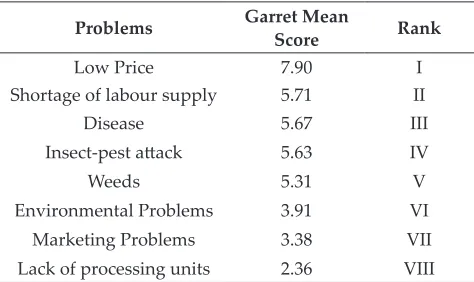
Garret-ranking technique is another analytical
technique to extract the most significant problem which influences the maize cultivation. As per this
method, respondents have been asked to assign the rank for all the problems and the outcome of such ranking has been converted into score value. First rank given to the problem with the highest mean score and lowest rank given to the minimum mean score (Table 2).
Table 2: Ranking of problems faced by sample maize growers in Punjab, 2014-15
Problems Garret Mean Score Rank
Low Price 7.90 I
Shortage of labour supply 5.71 II
Disease 5.67 III
Insect-pest attack 5.63 IV
Weeds 5.31 V
Environmental Problems 3.91 VI
Marketing Problems 3.38 VII
Lack of processing units 2.36 VIII
Among the different problems faced by maize growers, highest mean score was assigned to low
price of maize crop (7.90) and placed at first rank.
An average price received by the farmer was only ` 1070 per quintal which was very low than that
of MSP of maize (` 1310 per quintal) during the
2014-15. Shortage of labour supply during peak
season is the second important problem as reported
by the sampled growers. Stalk rot and rust were
emergence of diseases, insect-pest attack and weeds
infestation came out to be 5.67, 5.63 and 5.31 and placed at III, IV and V rank. Though the other problems like environmental issues, marketing problems and lack of processing units were the least
important problems, but these also play influential
role on maize production in the Punjab state.
CONCLUSION
An exhaustive severity analysis of constraints faced by the maize growers revealed that emergence of diseases (in case of biotic constraints) and shortage of labour (in case of abiotic constraints) were most severe problems in the study area. Based on the value of mean score, the intensity of the problems like price variability, shortage of farm machinery was moderately high, while the prevalence of problems like non-availability of quality inputs, low market demand, storage of grains, marketing problems and environmental constraints was fairly
moderate, however, the problems such as difficult to
access information on price, lack of grading facilities and not aware of the grading structure were the least important problems. Low price of the produce
was exposed as the most influential problem by applying Garrett ranking technique. Shortage of
labour supply during peak season, emergence of
diseases, insect-pest attack and weeds infestation
were exposed as moderately important problems. Based on the outcomes of the study, there is an
urgent need of effective implementation of MSP
so far sale of maize is concerned. Development of disease resistance varieties, check on sub-standard pesticides, availability of good quality inputs, availability of modern machinery to improve
farm efficiency, and development of post harvest
technologies (storage facilities, opening up of processing units etc.) were some of the suggestive measure to encourage the maize cultivation in the Punjab state.
REFERENCES
Anonymous. 2016. Statistical Abstract of Punjab. Economic and Statistical Organization, Government of Punjab. Chahal, S.S. and Kataria, P. 2010. Constraints in the production
and marketing of maize in Punjab. Agric. Update,5: 228-236.
Directorate of Maize Research. 2013. Annual Report 2012-13, Indian Council of Agricultural Research, Pusa Campus, New Delhi.
Government of India. 2016. Agricultural Statistics at a Glance. Ministry of Agriculture & Farmers Welfare, Department of Agriculture, Cooperation and Farmers Welfare, Directorate of Economic and Statistics, New Delhi. Johl, S.S. 2002. Agricultural production pattern adjustment
programme in Punjab for productivity and growth A Report by Chief Minister Advisory Committee in Agricultural Policy & Restructuring, Government of Punjab
Kaur, A. and Kaur, P. 2012. Shift in cropping pattern vis-à-vis stress on water resources in Punjab. Ind. J. Econ. Dev.
8: 91-98.
Kataria, P. and Melkani, A. 2014. Sustainability of paddy-wheat rotation in Punjab. Ind. J. Econ. Dev.,10: 313-18. Saran, S.K., Kataria, P. and Kaur, A. 2013. An electricity energy
usage and energy subsidy in Punjab agriculture. Ind. J. Econ. Dev.,9: 199-206.