Indigenous research: Culturally relevant methodologies
Hineraumoa TeApatu1, Ngaire Liddell1 & Said Shahtahmasebi123 PhD
1
Centre for Health & Social Practice, Wintec, NZ.
2
The Good Life Research Centre Trust, Christchurch, New Zealand
3
Division of Adolescent Medicine, University of Kentucky, Lexington, KY, USA
Keywords: cultural sensitivity, research methodology, kaiawhina
Received: 15/2/2014; Revised: 29/3/2014; Accepted:3/4/2014
INTRODUCTION
Although ‘research’ and ‘researchers’ feature prominently socially and politically a lot of people do not realise that the research community has a major issue with what constitutes good research (Said Shahtahmasebi, 2014). The problem is exacerbated when attention is turned to a particular group in society with different health, social and historical parameters such as minorities and indigenous populations.
In New Zealand, this issue is highly politicised and political boundaries have been placed around conducting Maori research, in effect isolating Maori which is in conflict with the ethos of doing research. This in part is due to government organisations, public institutions, and other entities attempting to comply with the Treaty of Waitangi, and, also due to Maoris’ mistrust of Pakeha (white non-Maori) conducting research about them rather than treating them as researchers in their own right. Ironically, the purpose of research is to
remove boundaries through gained additional insight into Maori.
Politicisation of research is not strictly confined to Maori or indigenous populations, invisible boundaries have been placed to keep others out e.g. in suicide research (S. Shahtahmasebi, 2013). Similarly, Maori identify research with Maori cultural values and belief system (Kaupapa Maori Principles and Practices) and claim that current research methodologies are inappropriate for researching Maori (Ahuriri-Driscoll, Hudson, Bishara, & Milne, 2012; Baskin, 2005; Bishop, 1999; Edwards, McManus, & McCreanor, 2005; Mane, 2009; Tipene-Matua, Phillips, Cram, Parsons, & Taupo). A discussion of Kaupapa is beyond the scope of this paper and the interested reader is referred to Tuhiwai Smith (Tuhiwai Smith, 2000).
A point of contention with Maori is the claim that only Maori can do Maori research because Pakeha do not understand Maori, and Maori research methodology.
In this paper, we discuss what is meant by scientific research methodology: the theories underpinning and defining each research study, the framework, research designs, tools, and so on, in order to discuss the implications for Maori research. These applications are illustrated using ‘kaiawhina’ as the research question/topic.
BACKGROUND
qualitative research (Said. Shahtahmasebi & McNamara, 2011), or women’s research and feminism and qualitative research (S Shahtahmasebi, Shahtahmasebi, & Cassidy, 2008), and indigenous research and cultural values and a belief system (Baskin, 2005; Bishop, 1999; Edwards et al., 2005). In certain quarters, this belief is so strongly held that it has impacted on behaviour, e.g. Maori believe that Maori research can only be done by Maori, for fear of and concern about being led by Pakeha as demonstrated in (Ahuriri-Driscoll et al., 2012). In such a research Maori culture, protocols, and research ‘methodology’ are often used
interchangeably (e.g. (Ahuriri-Driscoll et al., 2012; Bishop, 1999; Edwards et al., 2005; Waititi, 2007)). But, culture, protocols, theoretical and philosophical principles of a belief system, and fear of issues arising from colonisation DO NOT constitute research
methodology on their own; they must inform methodology.
When methodology is not informed by cultural theories then research becomes bounded by them, e.g. Maori researchers’ concern of being led by ‘Pakeha whakaaro’ (Ahuriri-Driscoll et al., 2012) which can cause a diversion from following the course of the methodology.
It appears that there is confusion here between what constitutes scientific research methodology in order to conduct a scientific piece of research and the substantive theory necessary to inform research: study design, tools for data collection, analysis and
interpretation, and to inform the development of appropriate policies. A lack of capacity to carry out Maori research does not mean research methodologies are inappropriate to Maori.
Perhaps, before Maori condemn scientific research methodology it would be useful to
understand its deployment first. The first rule in conducting research be it indigenous, or non-indigenous, experimental etc, is to understand as much about the context and environment in which the research question exists. Without such information it is difficult to develop a study design. It is therefore understandable and legitimate that indigenous scholars may object to having been guinea pigs for non- indigenous researchers who then make inference about them based on incomplete data. So, research will forever conclude that adverse health and social outcomes are the result of being Maori e.g. the indigenous custom of maintaining one’s extended family being blamed for infectious diseases (McCorkindale, 2013).
There is nothing wrong with scientific methodology, and its appropriateness to researching any given population may well depend on the researcher conducting research.
SCIENTIFIC RESEARCH METHODOLOGY
In its elementary form scientific methodology refers to a logical structure that can be followed and can be duplicated to reproduce research results. Specifically:
a- Define the problem or question to be addressed b- ‘solve’ the problem
c- Assess and evaluate the results; return to (a) if results are unsatisfactory; else proceed with interpretation of results and conclusions.
through belief systems, ‘growing up’ environment, social, political and other parameters objectivity and measurability is frequently tainted with subjectivity and measurement error. Nevertheless, within a structured framework of research these issues can be highlighted, discussed and debated, which in turn will enable reproducing the research albeit with modification and improvement (S. Shahtahmasebi & Berridge, 2010). With a change of discipline the application of the scientific research, too, must change and adopt a different set of values, but, without changing its infra-structure.
However, the problem is neither ‘scientific research methodology’ nor ‘Maori research’. There are similar issues with Pakeha research which taken at face value would indicate that research methodologies are inappropriate to Pakeha research too! However, Pakeha have a fail/safe mechanism which provides the notion of more research if theoretical/predicted realities do not match observed realities. In other words, when a theory does not predict or stops predicting as hypothesised – this will often lead to more research. The danger is, of course, that researchers will attempt to force-fit observable realities into models based on observable reality, even if and when observable reality suggests otherwise.
Therefore, the only conclusion that can be made is that any research is as good as the researchers conducting it, see also (Said Shahtahmasebi, 2014).
MOARI RESEARCH: Kaiawhina Background/literature search
The online Maori dictionary (http://www.maoridictionary.co.nz/)defines the word
‘kaiawhina’ as assistant (meaning anyone who provides help or assistance). The definition is quite broad and vague, yet, in a formal organisational setting kaiawhina is often used to describe such a position. Job descriptions for Kaiawhina varies between organisations – but in general is related to its meaning as described in the Maori dictionary. It would be
interesting to gain insight into the roots of this word in order to help inform policy making to increase the effectiveness of kaiawhina by delivering appropriate help and assistance where and when needed.
Contemporary and modern research methods and tools are often inappropriate to
investigating issues that inherently have their roots in a cultural system. Although, research methodologies allow accounting for cultural effects, such an approach merely provides some clues or guidance about variations in results due to cultural differences. The main problem is that conventional research methodologies capture data from individuals, and, by directly linking data to individuals make inferences about a group or a sample or a population. Such methods can be helpful in most cultures for example, in epidemiological research.
Within indigenous groups where culture, traditions and beliefs are an integral part of daily life and governance then methodologies must be ‘modernised’ in order to investigate issues of interest to the group as a whole as well as those within such a group.
This paper is primarily concerned with methodology employed to investigate the roots of Kaiawhina and understand historical social issues that led to it being utilised as a job title. The results will be discussed in a forthcoming paper.
The subject of this paper arose from a simple question: what does Kaiawhina mean? However, without an appropriate context leading to sub-questions such as ‘Where did it originate from (which iwi)?’, and ‘why?’kaiawhina would remain a simple question.
It can be seen that the Maori research questions are no different to other research questions, in which case research methodologies are applicable in addressing them. But, what
researchers MUST be aware of is that the population under study has different characteristics than the conventional application of methodologies.
Researching this word opened up a whole lot of substantive issues of major relevance to theory, methodology, and social history and culture.
From the first moment the research question was formed, it was acknowledged that
background information was essential for designing a suitable research strategy. Clearly the first step in any research is a critical literature search and review. This step is an important one, for the main reason that during this stage of the research, researchers are able to critique previous knowledge and offer an alternative. Skipping this stage will result in theloss of theoretical and philosophical grounds to articulate the researcher’s alternative point of view. Some authors report that Maori researchers’ concern of being led by ‘Pakeha whakaaro’ has led themto skip methodology step(s) (Ahuriri-Driscoll et al., 2012).
The question is how to source and collect relevant data/information?
Certainly, a conventional search of databases was not productive, e.g. a search of Google Scholar using the search term ‘roots of kaiawhina’ generated only 59 hits, and using
‘kaiawhina’ on its own resulted in only 259 hits, none of which came close to explaining the word or its roots.
STUDY DESIGN
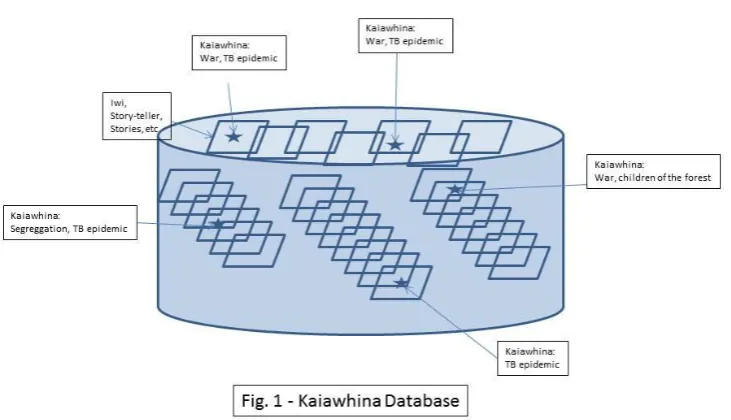
A retrospective longitudinal study design was adopted for data collection using a data mining approach. This study design is intended to lead to the development of a database of case-histories by the individual provider and by iwi. The database, once populated with
appropriate and relevant data/information will provide cross-referencing facilities in order to identify further leads to follow in search of information. This aspect of the design is quite useful because it facilitates cross-checking and validating information on kaiawhina in the database. Furthermore, it will be useful to hold in one database an archive of any information related to kaiawhina, see Fig. 1.
Fig. 1 - an example of records (stories) in a database.
Once the database is populatedwith relevant and appropriate information (stories), an
‘archaeological’/data-mining approach will be employed to identify ‘artefacts’ that may guide the research towards the source of kaiawhina that gave rise to its widespread usage as a title.
In recent decades a concerted attempt has been made to collect and archive stories with cross-referencing facilities. Although such archives exist, they are not unified and are not centrally held in the name of Maori research. Oral history archives can be found in museums, some university libraries and some public libraries, e.g. Alexander Turnbull Library.
From the outset it was acknowledged that we may not find the answers to our questions directly from koreros, stories or archives but as with any data-mining or archaeological dig we expected to find a series of artefacts hidden within stories that would lead us to the answers.
Thus formed the basis for our research strategy within a longitudinal study design to adopt a multi- method staggered approach for this investigation, as follows:
Literature search/pilot study
1- Identify sources of information (i.e. defining a population to sample from) 2- Develop and adopt the tools for field work (i.e. design protocols such as a survey
questionnaire to collect data)
3- Understand Maori protocol to identify a key individual to guide us 4- Obtain ethical approval and Maori consent
5- Organise korero sessions 6- Record stories about kaiawhina 7- Analyse results
9- Analyse results 10-Triangulate results
11-Based on results from previous step then design the next stage e.g. identification of key people to hold korero about kaiawhina
12-Return to step 1 for guidance in identifying key people 13-Set up korero sessions
14-Record oral history about kaiawhina
15-Identify key elders and scholars to elaborate on stories further and substantiate them 16-Search archives for additional supporting stories and materials
17-Populate the kaiawhina archive (database, see Fig. 1) 18-Modify data-mining techniques with Maori values 19-Apply data-mining techniques
20- Evaluate results.
DISCUSSION
Ahuriri-Driscoll (Ahuriri-Driscoll et al., 2012) reports that they had to skip steps in their literature search and review in response to Maori researchers’ concern about being led by
‘Pakeha whakaaro’. In order for research to be of some benefit the distinction between methodology and theoretical framework that informs it must be explicit. And in order to separate methodology from cultural values, research must be depoliticised and driven by substantive theory rather than based on politics. This means that:
(a) researchers must be able to justify their methodology in relation to their aims and objectives
(b) the methodology must fit with the questions being asked
(c) the development of a research methodology must be within the scientific framework for research
(d) the development of a research methodology must also be informed by information from the context and environment in which the research question exist.
Persisting with a difference of opinion which is essentially a political matter as a major reason to dismiss established research methodologies will reinforce borders between different groups in society rather than remove them. All that needs to happen is to remove colonial attitudes from research processes and replace them with cultural ideals for appropriateness and relevance of the theoretical framework.
Pakeha’s approach to researching an issue often dictates that insight may be gained through an understanding of the basic elements of the issue under study. In observational studies, this is done at two levels: first, association of the issue under study to a
sub-discipline, and second, the definition of the unit(s) to be observed, e.g. collecting information from individuals (the smallest units in social settings).
Holistic concepts allow an understanding of a problem or an issue in the environment that it has arisen. To address it ‘researchers’ must understand it not by breaking it down but by going up a level and seek guidance from cultural values that led to the issue being studied, e.g. system of beliefs, national government’s policies. In other words, rather than
deconstructing to its smallest component in order to solve a problem or an issue, a holistic approach will expand and include other processes (e.g. see (S Shahtahmasebi, 2006)).
The indigenous/Maori concept of research is based on a holistic concept of seeking guidance from the whole (i.e. cultural principles and values that bind a nation together) in order to understand each component and how to address them. However, storytelling and collecting stories and other cultural principles, on their own, are neither holistic nor research
methodologies; butthey can form part of a tool for data collection which will need analysing and interpreting. Certainly a good understanding of the culture as well as understanding the parameters that led to the stories being created and re-told is absolutely essential.
REFERENCES
Ahuriri-Driscoll, A., Hudson, M., Bishara, I., & Milne, M. (2012). TRADITIONAL MĀORI HEALING AND WELLNESS OUTCOMES. Institute of Environmental Science and Research (ESR) Ltd, ISBN 978-971-877166-877117-877164.
Baskin, C. (2005). Storytelling circles: Reflections of aboriginal protocols in research. Canadian Social Work Review/Revue canadienne de service social, 171-187. Bishop, R. (1999). Collaborative Storytelling: Meeting Indigenous Peoples' Desires for
Self-Determination in Research.
Edwards, S., McManus, V., & McCreanor, T. (2005). Collaborative research with Maori on sensitive issues: the application of tikanga and kaupapa in research on Maori sudden infant death syndrome. Social Policy Journal of New Zealand, 25, 88.
Mane, J. (2009). Kaupapa Māori: A community approach. MAI Review, 3, Accessed April 2, 2014, URL: http://ojs.review.mai.ac.nz/index.php/MR/article/viewFile/2243/2282. McCorkindale, W. (2013). House overcrowding disease fears. National Homepage URL:,
http://www.stuff.co.nz/national/health/8768249/House-overcrowding-disease-fears. Mulder, R. (2013). Problems with suicide risk assessment. Australian and New Zealand
Journal of Psychiatry, 45, 605 -607. doi: DOI:10.3109/00048674.2011.594786
Shahtahmasebi, S. (2006). The Good life: A holistic approach to the health of the population. TheScientificWorldJournal, 6, 2117-2132. doi: 10.1100/tsw.2006.341
Shahtahmasebi, S. (2013). De-politicizing youth suicide prevention. Front. Pediatr, 1(8), 10.3389/fped.2013.00008. doi: 10.3389/fped.2013.00008
Shahtahmasebi, S. (2014). Any ‘research’ is as good as the researchers conducting it.
Dynamics of Human Behaviour, 1(1), http://journalofhealth.wordpress.com/.
Shahtahmasebi, S., & Berridge, D. (2010). Conceptualising behaviour in health and social research: a practical guide to data analysis. New York: Nova Sci.
Shahtahmasebi, S., & McNamara, N. (2011). Towards understanding the nurse/research interaction. Int J Adolesc Med Health, 23(3), 187-192.
Tipene-Matua, B., Phillips, H., Cram, F., Parsons, M., & Taupo, K. Old ways of having new conversations: Basing qualitative research within Tikanga Māori (Māori protocol). Māori Research Protocols, accessed April 2, 2014, URL:
http://www.katoa.net.nz/kaupapa-maori/maori-protocols
Tuhiwai Smith, L. (2000). KAUPAPA MÄORI PRINCIPLES AND PRACTICES: A
LITERATURE REVIEW. INTERNATIONAL RESEARCH INSTITUTE FOR MÄORI AND INDIGENOUS EDUCATION, Accessed April 2, 2014: URL:
http://www.kaupapamaori.com/assets/Maori_research.pdf.