World Maritime University World Maritime University
The Maritime Commons: Digital Repository of the World Maritime
The Maritime Commons: Digital Repository of the World Maritime
University
University
World Maritime University Dissertations Dissertations
11-5-2017
Understanding the motives for digital transformation in the
Understanding the motives for digital transformation in the
container shipping sector
container shipping sector
Ntsako Nkuna
Follow this and additional works at: https://commons.wmu.se/all_dissertations Part of the Transportation Commons
Recommended Citation Recommended Citation
Nkuna, Ntsako, "Understanding the motives for digital transformation in the container shipping sector" (2017). World Maritime University Dissertations. 598.
WORLD MARITIME UNIVERSITY
Malmö, Sweden
UNDERSTANDING THE MOTIVES FOR
DIGITAL TRANSFORMATION IN THE
CONTAINER SHIPPING SECTOR.
By
NTSAKO NKUNA
South Africa
A dissertation submitted to the World Maritime University in partial
Fulfilment of the requirements for the award of the degree of
MASTER OF SCIENCE
In
MARITIME AFFAIRS
(SHIPPING MANAGEMENT AND LOGISTICS)
2017
DECLARATION
I certify that all the material in this dissertation that is not my own work has been identified, and that o material is included for which a degree has previously been conferred on me.
The contents of this dissertation reflect my own personal views, and are not necessarily endorsed by the University.
(Signature): ______ ____
(Date): 19 September 2017
Supervised by: (Prof. Ilias Visvikis) World Maritime University
Assessor: Prof. Fabio Ballini
Institution/organization: World Maritime University
Co-assessor: Dr. Photis M Panayides
ACKNOWLEDGEMENTS
Appreciation goes to my supervisor, Professor Ilias Visvikis, for his assistance in developing the research topic.
Thank you to my fellow classmates for the continuous support and discussions that has assisted me in understanding the topic. Thank you to the friendly WMU library staff for their assistance on a topic with limited resources.
ABSTRACT
(NOTE: MAX 300 WORDS)
Title of Dissertation:
Degree:
This thesis aims to understand the motives behind digital transformation strategies for the container shipping sector. Due to limited resources, the thesis has been built around key concepts identified applicable to the topic of research. Followed by reviewing the current maritime transport sector through an industry analysis through the use of Porters 5 forces. The research then aims to understand the trends, developments along with the structure of a specified market to understand the motives behind digital transformation.
KEY WORDS: Digital transformation, Information management, Intelligent processes, innovation, Integration, industry 4.0, sharing economy
Understanding the motives for digital transformation in the container shipping sector.
TABLE OF CONTENTS
DECLARATION ... I
ACKNOWLEDGEMENTS ... II
ABSTRACT (NOTE: MAX 300 WORDS)... III
TABLE OF CONTENTS ... IV
LIST OF FIGURES ... VI
LIST OF ABBREVIATIONS ... VII
INTRODUCTION ... 1
IMPORTANCE OF DIGITAL TRANSFORMATION ... 4
RESEARCH CONTRIBUTIONS ... 5
STRUCTURE OF THESIS ... 7
RESEARCH QUESTION ... 8
METHODOLOGY ... 9
THEORETICAL FRAMEWORK ... 10
4.1 HISTORY ... 10
THE SHIPPING INDUSTRY NOW ... 12
THE FUTURE OF THE SHIPPING INDUSTRY ... 13
BUSINESS STRATEGY AND IT STRATEGY ... 14
INTEGRATION ... 16
DIGITALISATION, DIGITIZATION AND DIGITAL TRANSFORMATION ... 18
4.6.1.TRANSFORMING CUSTOMER EXPERIENCE ... 24
4.6.2.TRANSFORMING OPERATIONAL PROCESS ... 25
4.6.3.TRANSFORMING THE BUSINESS MODEL ... 25
INNOVATION ... 27
DISTINCTIVE CHARACTERISTICS OF THE MARITIME TRANSPORT SECTOR ... 29
5.1COMPETITIVESCENARIO-PORTERS5FORCES ... 31
5.1.1BARRIERS TO ENTRY ... 32
5.1.2SUPPLIER POWER ... 33
5.1.3THREATS OF SUBSTITUTES ... 33
5.1.4BUYER POWER ... 33
5.1.5DEGREE OF RIVALRY ... 34
5.2THE SECTORS ... 35
DRY BULK ... 36
TANKER ... 37
CONTAINER SECTOR ... 38
5.3COMPETITION:ALLIANCE STRUCTURE ... 42
DEVELOPMENTS IN THE MARKET AND INDUSTRY STRUCTURE ... 45
OVERVIEW OF THE INDUSTRIAL REVOLUTIONS ... 46
INDUSTRY 4.0. ... 48
LINEAR VS PLATFORM ... 51
DIGITAL CULTURE SHIFT ... 53
LIMITATIONS AND RECOMMENDATIONS ... 55
CONCLUSION ... 56
WHAT IS DIGITALIZATION AND HOW THIS WOULD AFFECT THE EXISTING BUSINESS STRATEGY OF THE CONTAINER SHIPPING SECTOR? ... 56
WHAT ARE THE DRIVING FORCES BEHIND THE DIGITALIZATION OF THE INDUSTRY? .... 58
WHAT CHALLENGES FACE OF DIGITAL TRANSFORMATION IN THE MARITIME INDUSTRY? ... 59
CAN THE EXISTING SHIPPING INDUSTRY MARKET SURVIVE THE EFFECTS OF DIGITALIZATION? ... 60
SHOULD THE CONCEPT OF DIGITALISATION BE CONSIDERED A DISRUPTOR OR A POTENTIAL ENABLER FOR THE MARITIME INDUSTRY? ... 60
LIST OF FIGURES
Name Page
Figure 4.1 Sea trade over 2000 years showing impact of fossil
fuels
12
Figure 4.2 Development of Marine transport 5000 BC to the
present
13
Figure 4.3 Data Management Solutions 23
Figure 5.1 The average newbuilding prices and the global
order cover.
38
Figure 5.2 World fleet by Principle vessel 42
Figure 5.3 Growth Percentage share: World fleet by Principle vessel
42
Figure 5.4 Container ship Fleet Demand vs Supply 43
Figure 5.5 Alliance structure 45
Figure 6.1 Industrial revolution evolution 49
Figure 6.2 Industry Digitalisation Index 52
Figure 6.3 Traditional shipping model 54
LIST OF ABBREVIATIONS
The following abbreviations are used in this dissertation:
3D Three Dimensional
AIS Automatic Identification system
BIMCO Baltic and International Maritime Council
CO2 Carbon Dioxide
DWT Dead Weight Tonnage
HMM Hyundai Merchant Marine
IMO International Maritime Organisation
M&A Mergers and Acquisitions
MSC Mediterranean Shipping Company
RFID Radio-frequency identification
UASC United Arab Shipping Company
UNCTAD
United Nations Conference on Trade and Development
INTRODUCTION
After the recent economic crisis in 2008, the maritime industry, specifically the
container shipping industry has been hit hard, making it unprofitable and an extremely
volatile market due to the decreasing amount of freight available versus the surplus of
container vessels available in the maritime transport sector. Other factors such as the
global economic crisis and according to Mckinsey “the efforts by corporate customers
to control costs”. The reality is that companies within the shipping industry need to
take initiative to turn the current situation around as the industry, find ways to embrace
the changes to better adjust because in many ways has hardly gone through change
since 1956.
According to Ernst & Young (2011) publication on digitalisation and how
organisations need to adapt to change consumer behaviour is summarised in the quote
below.
“Digitalisation is a step change even greater than the internet. Exponential
technology advances, greater consumer power and increased competition
mean all industries face the threat of commoditisation. The winners will act
now, and build a strategic advantage that leaves their counterparts wondering
what happened.”
The business environment has always expected organisations to be dynamic and adapt
or die. Today’s business environment and its customers have moved towards an
increased desire for fast services which in turn have led to faster changes in the
business environment. The drive for faster services, improved processes and all round
better efficiency whilst also desiring the cutting down of operational cost has also
Digitalisation in its simplest form is the conversion of analogue, physical data, into
digital information and through the continuous extension and growth of digitalisation,
the end result is to move towards creating more interconnected networks. Therefore,
the focus of this research would be on the connectivity of the maritime transport
industry. As technology further develop, the maritime industry cannot be left behind.
Over the years’ vessels will become more accessible through the connection of
systems and components to the internet and through this changing the way the industry
manages information. At the moment, the most digitalised section of maritime
transport would be the navigation systems, for example the concept of e-navigation
and the ongoing developments within navigation in general. The bigger picture is to
grow digitalisation throughout the maritime transport to increase efficiency.
It is commonly known that the shipping industry has been a reactive rather than a
proactive change type of industry due to the volatility of the industry. From the
development of conventions to managing with economic challenges. But the way in
which the general business environment has change, does not allow for this type of
reactionary stand point anymore. Businesses in today’s environment will do anything
and everything to remain relevant, even if it means taking bigger risk such as branching
out into different industries in order to stay relevant. Relevance has not only become
the only factor, but consistent economic concept behind businesses, profit
maximisation through the decreasing of operational costs. Through the concept of
digitalisation, organisations such Google have entered into car manufacturing, Tesla
into space exploration, Uber into self-driving-trucking and Amazon recently acquiring
an ocean freight license in China. What all these organisations have in common is their
exceptional ability to manage big data. Big data refers to the analysis of large digital
data collections in order to uncover patterns, trends and changes especially in terms of
human behaviours and interactions. Through this, these organisations and digital based
industries have had a significant advantage over other organisations and industries in
this in turn has resulted in companies and industries with this ability to retain control
in terms of consumer behaviour and power.
Shipping transport moves around 90% of the world’s trade but in terms of managing
information, its processes are considered decades behind other transport and logistics
industries. Again, this could be drawn back to the instability of the industry throughout
its history. The article “Big data boom in the shipping industry” states that the industry
produces about 100-200 million data point daily between ports, couriers, social feeds,
vessel movements and the rest of its operating network. Therefore, one can establish
that there is an already existing network. The introduction of digitalisation and big data
management would contribute to better and improved efficiencies in terms of route
identification, port allocations and creating better links with couriers. Assisting
everyone within the industry to improve without the entrance of new competitors.
Today’s shipping environment faces challenges such as the fall of freight rates post
financial crisis, oversupply in the market and the threat of external industries
penetrating the market, which stem from external industry having growing interest in
the current market. In addition, situations such as the 2008 financial crisis have led to
major changes in the way shipping businesses conduct their business. The concept of
digitalisation has unsettled the shipping and maritime industry for the past 5 years with
the discussion around the topic continually growing and becoming more prevalent in
operations. In the dynamic environment, today it is an unavoidable topic, heavily
linked to the development` of the new industrial revolution, the 4th industrial
revolution dubbed Industry 4.0. Compared to the earlier times in the maritime industry,
it’s almost impossible to think about maritime transport as just shipping as the
movement of cargoes from port to port and vessels only as business activities are not
as simple as they used to be. Today’s business environment requires faster and more
efficient services with increased competition demanding existing organisations to
continually find means to differentiate themselves to remain in business. The current
organisations do business through the drive of integrating more digital processes and
the adoption of new technologies to enhance the and expose the industry to more
opportunities.
Importance of digital transformation
The increase connectivity accessibility has changed the business model today,
distorting the lines between industries and organisations as well as the capabilities
of these industries and organisations which has fundamentally changed the value
chain of global supply chains. With certain segments of the supply chain having
already been affected by the change from linear to platform model value chains,
the structures have changed either eliminating existing participants or introducing
new players into the chains such as aggregators, each taking their own margin, to
fulfil the demands of their customers Lin et al (2009).
Digital transformation requires changes for both the central business processes of
the organization as well as support processes (Lin et al 2009 ;Westerman et al.
2011). For example, whenever a customer uses a digital service instead of, or in
addition to using the traditional offline services of the organization, it is possible
to gather much more information about their behaviour and more easily customize
the service the suit their specific needs. As an example of the requirements for
support processes, the increasing and rapidly fragmenting customer interaction
requirements make it very difficult for the organization to answer the demand with
the limited resources available.
With this information, experts have concluded that digitalisation is more than a
disruptive trend, but here to stay and become a permanent part of the way
businesses conduct themselves in future. When not only considering the disruptive
importance of embracing this change to the industry, the bigger picture in the
integration of the global service and supply chains and finding ways to continually
create value throughout their operations. Poor understanding and analysis of the
opportunities in digitalization have led to the industry only focusing on certain
aspects of the concept which has led to the industry labelling the concept as a
disruptor and a trend that wouldn’t inevitably affect the industry in the long term.
Some industry analysis has decided otherwise; that is, they have labelled
themselves as futurists, considering digitalization as a big part of the future of
maritime transport sector not only regarding the operational and technological side
but the holistic standpoint of digitalization and digital transformation on different
aspects of the industry.
Research Contributions
To clarify and understand the concept of digitalisation specifically in application
to shipping and logistics in the maritime industry. In addition, to identify business
strategy opportunities in relation to digitalisation and embracing the role of
maritime transport in the 4th Industrial revolution.
The shipping industry has gone through minimal change since its inception back
in 1956 which has recently attracted the attention of tech dominating companies
such as Uber and Amazon. The growing interest of the technology sector has
potentially created a growing threat to the industry. The shipping industry is not
immune to the changes currently affecting today’s business environment,
digitalization has been noted as one of the most dynamic developments in our
time, closely linking opportunities and risks. Current tech giants aim to destabilize
the current shipping industry and reduce the current reliance on existing shipping
companies through their aims at reducing their own operating costs and
developing more flexible shipping services. Organisations such as Amazon aim to
but expanding its operations to decrease these costs by finding ways to reduce
transaction costs and increasing automation and flow of information and services
to their benefit, which has lead them to seek opportunities in the shipping industry.
In an article by Condliffe (2016) organisations such as Amazon spend about 10.8
percent of its sales revenue on shipping, it would be a logical reason to want to
expand operations through vertically integrating into shipping, and through this
this Citigroup estimates potential savings of $1.1 billion per year for Amazon.
Therefore, how could this potential threat of loss of income to the shipping
industry be returned to the industry? Through the proactive reaction and adoption
of digitalisation to current operations.
Currently, only larger organisations within the shipping industry have made
investments into implementing big data management and digitalisation based
business models, but for the industry as a whole to survive, the efforts need to be
made by the smaller organisations that support the industry. It has become a
talking point within the industry that a proactive stance needs to be taken and
discussion is being had. From an article adapted by Lloyds list “what will save the
shipping industry?” the discussion facilitated by 9 industry experts and leaders
individually acknowledged that the industry needs to make specific necessary
changes in order to survive, from the use of digital investments to assist with
overcapacity on the supply end, to assisting with controlling emissions from the
industry. It has been acknowledge that the trend towards big data management and
digitalisation is very relevant for the industry to survive and that the problem with
the current industry is its lack of connectivity and ability to keep up with the
continually changing business environment. Yet the industry leaders need to
ensure that the discussion does not just end at realising what the problem or
potential solution to their problems/threats and begin to implement the solution
Structure of Thesis
The chapter following the introduction addresses the research questions that intend to
manage the structure of the thesis. Followed by the methodology the thesis intends to
follow.
The following chapter addresses the theoretical framework of the research, which
begins with a brief overview of the history of maritime transport. Within the
framework, the research will address both business strategy in maritime transport as
well as the proposed digital transformation strategy. Each strategy aligned with a
distinct characteristic which will be addressed with the strategy.
The next chapter will review the distinctive characteristics of the maritime transport
sector, which includes understanding the sectors that make up maritime transport as
well as the industry analysis. This would then be followed by the reviewing of
developments in the markets and understanding the structure of the container sector in
relation to digital transformation. Finally, the thesis will conclude by answering the
RESEARCH QUESTION
The fundamental objective of the research is to identify the reasons for digital
transformation in the container shipping sector. This will be done through the
understanding of literature and key concepts used to build up the sector to what it is
today and performing industry analysis to estimate the position of the market in
comparison to global industry dynamics.
In addition to better understand the reason for digital transformation, a review of the
chosen industries characteristics along with recent trends in industry dynamics have
been taken into account. In order to do so, it is required to ask research driven questions
to continually align the research. Due to the limited resources available in addressing
the topic, the main research question will be answered through the addressing five sub
questions.
Main question: what are the fundamental reasons for digital transformation in the
container shipping sector?
1. What is digitalization and how this would affect the existing business strategy
of the container shipping sector?
2. What are the driving forces behind the digitalization of the industry?
3. can the existing shipping industry market hold survive the effects of
digitalization?
4. Should the concept of digitalisation be considered a disruptor or a potential
enabler for the maritime industry?
METHODOLOGY
With limited resources directly dissecting the topic in relation to maritime transport,
the literature has been limited to articles and journals published in the last 10 years
with the cut off year as 2007. General academic literature has not been limited to a
specific period for reasons that will be justified later. Priority has been placed with
practitioners and authors focused on the topics centred around digital transformation
topics.
Secondly, as previously highlighted, with limited literature directed at maritime
transport in relation to digital transformation, the technique used to find relevant
literature was to search using a wide assortment of applicable keywords. Searches for
research would be guided by a combination of key terms taken from the questions,
such as integration, innovation, digitalisation, digitisation digital transformation,
maritime transport, and strategy. The main search engines would be the WMU library
and google scholar.
Thirdly, the literature review will be structured beginning with a glance of the history
of maritime transport and the changes experienced followed by answering a series of
questions, What, Who, When, How and Why? With each section being made up by
the specific combination of the key terms in an attempt to fully address the interests of
THEORETICAL FRAMEWORK
4.1History
Shipping has an extensive history with over 5000 years of documented history but only
in the last two centuries has sea transport cemented its role in the globalisation of the
world economy (Stopford, 2010). In the early 1800s, ships where constructed by wood
and powered by wind, relatively smaller than trade vessels today at 100-600 tons.
Through the years as will be further highlighted, sea transportation has not only been
affected by socioeconomic factors but also developments and discoveries of fossil
fuels and technological innovations that changed the ways of shipping, as seen in
Figure 4.1 below.
Figure 4.1.: Sea trade over 2000 years showing impact of fossil fuels
Source: (Stopford, 2010)
As ships grew bigger distances travelled became longer and with time, and technical
improvements such as navigational tools required more accuracy with the transition
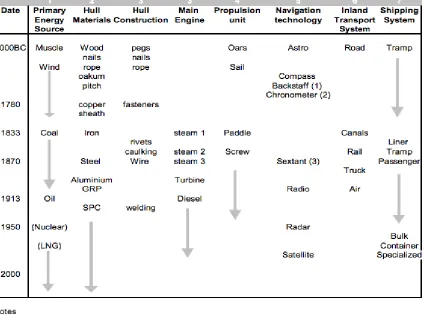
and speed of the vessels at the time of the first industrial revolution. Figure 4.1 shows
how the discovery of fossil fuels has also changed the propulsion of vessels and
contributed to the development of marine transport, which can be summarised in the
Figure 4.2 below.
Figure 4.2: Development of Marine transport 5000 BC to the present
Source: (Stopford, 2010)
The use of different fuelling methods and sources not only contributed to the efficiency
but the cost of marine transportation. While providing a cheap, reliable and efficient
transport source the shipping industry assisted in converting the world into a single
economy back then. With continual external factors affecting the maritime sector, the
business cycles are getting longer and challenges faced by the industry are growing.
In 2010, Stopford suggested that “if shipping stopped for 3 months, so would modern life as we know it” and this would be as a result of the evolutions in shipping and its
vessels from size to efficiencies which have brought down the cost of shipping but this
didn’t take into account macro-environmental factors that influence the industry today.
The shipping industry now
Whilst Micro-environmental factors such as improvements in efficiencies, cost
management and establishing economies of both scale and scope have contributed to
the low cost of shipping which has contributed to the industry’s concept of shipping is
indispensable, the industry had not taken into account the macro-environmental
factors. This is because in that time industries had clear definition and little to no
overlapping happening between them. With the development of concepts such as the
internet of things, increasing connectivity and changing the way organisations conduct
themselves. The rapid developments in technologies have and will continually also
interrupt the current business models employed today. From the literature reviewed, it
may be concluded that the previous business strategies employed by shipping lines
would be strategies that focused on either the lean or agile approach mainly through
integrations, and mergers and acquisitions. Integration has assisted shipping lines in
growth strategies with the aim of expanding the range of services to their customers,
with the aim of keeping external costs low by integrating them into internal operations
as well as adding to the organisation agility through the expansions of services. Their
main purpose of integration projects would be redesign and optimise an organisations
supply chain to support the businesses core business. These activities have been
distinguished through the terms 2pl, 3pl and 4pl providers, which the more integration
But while integration may appeal to both strategies at the same time without limitation
may be detrimental to cost management by not limiting the organisations offerings to
customers. Leaving space for increasing costs for maintaining services that customers
don’t use. Mergers and acquisitions have also played a significant role in maintaining
the structures of the existing alliances but may be considered more of a power strategy
between the lines. The industry has been known to use bigger is better strategy seen
through economies of scale, which this trend can be seen through the significant
growth in vessel sizes over the years. While maritime transport is a services business,
literature suggests that the strategies employed by the industry focuses on strategies
employed in manufacturing based sectors. With concepts and jargons such as the focus
on supply chain management rather than a focus on service chain management could
lead to significant changes in the industry. This significant shift in thinking is referred
to as cognitive diversity. Using the correct way of thinking to solve problems faster
could be a solution for the industry to assist in the turmoil that has followed it. The
previous and current strategies employed have provided for strategies to treat
symptoms rather than the actual problems that organisations in the industry which this
paper aims to address.
The future of the shipping industry
In assessing the future, looking at the theme from the 2016 world maritime day,
“Shipping: indispensable to the world” but with the continued acceleration in
connectivity and expansions of global supply chains and with it supply technologies
truly indispensable to the world. With this, questioning what is truly disruptive to the
maritime transport industry.
Business strategy and it strategy
In revisiting one of the purposes of this research, would to review a digital
transformation strategy for the maritime transport sector aligned with the objectives of
industry 4.0. in the previous chapters, we have discussed both the digital side and the
industry 4.0. in order to efficiently and effectively implement digital transformation in
relation to business activities this relationship would have to be facilitated or managed
through a plan or what is referred to as a strategy. Specifically, for the purpose of the
research we refer to a business strategy. Strategy along comes in the form such as
corporate, business and functional strategy. Corporate strategy focuses on establishing
what business to be in, business strategy focuses on how to compete while functional
strategy focuses on supporting business strategy. Since the purpose of the research
does not single out a specific organisation as well as the research focusing on
improvement on how to compete with the changes in the existing industry while
seeking strategic cooperation throughout the industry and will therefore focus on
business strategy. The business of maritime transport is to provide a service to its
customers, Minztberg therefore relates the term by defining it by “how shall we compete in each business?” in trying to understand and align this definition to the
research, it is to establish a general operating strategy and to facilitate health
competition how would organisations customise themselves to compete as individual
businesses in one industry.
Linking back to the original statement, writers such as Watkins (2007) define business
strategy as;
“a set of guiding principles that, when communicated and adopted in the
therefore about how people throughout the organisation should make
decisions and allocate resources in order to accomplish key objectives”.
While Mintzbergs definition highlights the importance of competition, Watkins
definition brings it back to basics, and focuses on core issues that need to be dealt with
specifically aligning resources with objectives, which from the industry analysis of the
industry is a persistent issue. In order to fully compliment the focus of strategy with
natural competition, (Henderson, 1980) quote “all competitors who persist over time
must maintain a unique advantage by differentiation over all others. Managing that
differentiation is the essence of long-term business strategy” and in todays business
environment it can be assumed that the differentiation factor may be an organisation
or industries ability to adapt to the changing times, linking business to Darwinisms
adapt or die theory. This is imperative in understanding the future role of maritime
transport within Industry 4.0.
In the context of digital transformation and the overlapping of industries of today, an
interesting perspective to business strategy would be the concept of emerging
strategies (Mintzberg et al, 1999). Concurrent with the challenge faced by shipping
today, the penetration by external forces, has contributed to the formulation of these
new innovation based strategies. With shipping’s concern revolving around the
delivery of goods and services required by customers, business strategy is crucial in
facilitating the identification of opportunities, provides for an objective view to solving
business problems while giving a framework to improve internal and external
collaboration in addition to numerous supporting attributes from business strategy.
(Lun, Lai, & Cheng, 2010) Walker et al 2003 identifies that a well structured strategy
for shipping incorporates five key components:
1. Scope referring to the strategic domain or industry including market segments
3. Resource deployment denotes the management of resources aligned with achieving
the underlined goals and objectives.
4. Competitive advantage considers the importance of competition awareness,
indicating how an organisation intends to compete, either through maintaining
sufficient employment of vessels or through the additional services i.e. integrated
services.
5. Synergy referring to the compatibility of resources, an existing example may be
noted through the collaboration of entities in alliances.
Integration
In taking into consideration the changes in both the maritime transport sector and the
evolutions of the industrial revolutions, the concept of integration along with
macro-environmental such as globalisations, deregulation and technology factors have played
a crucial role in the changes in which have restructured the shipping industry. While
maritime transportation is considered a global business, with the factors mentioned
previously, customers are looking to a bigger picture beyond straightforward shipping.
Previously logistics organisations operated as separate entities but with globalisation,
the concept of global logistics grew, changing the business structures with the purpose
of adding value through freight integration within the supply chain. As a result, the
changes of the maritime industry, maritime logistics stem as resulting trends of
integration.
To further understand the role of integration regarding the research topic, with
maritime transport activities involved in the global supply chain, supply chain
integration, a key component of supply chain management which provides both an
internal-external perspective to understand it is used (Chen, Daugherty, & Landry ,
2009). The main drivers of integration are note by: the information revolution; the
supplier and customer driven markets; the emergence of new types of
inter-organisational relationships (Handfield & Nichols, 1999). Together with (Vickery,
Jayaram, Droge, & Calantone , 2003) highlight two aspects in their conceptualisation
of an integrative supply chain strategy, firstly the existence of intgrative information
technologies and secondly the existence of practives that strengthen linkages between
organisations occupying different positions in the supply chain. Even in the periods
before connectivity has become a crucial aspect, the topics highlighed in relation to
integration play a important role in the effective implementation of digital
transformation strategies within maritime transport. To be discussed later specifically
the container shipping sector in chapter 6.
In discussing integration in the business context, we refer to vertical and horizontal
integration, strategic alliances of different forms (Panayides & Wiedmer, 2011) and
mergers and acquisitions, which in itself has been used as business strategies in the
maritime sector as an expansion strategy. Within the maritime transport industry,
horizontal integration takes place in the form of alliances, mergers and acquisitions,
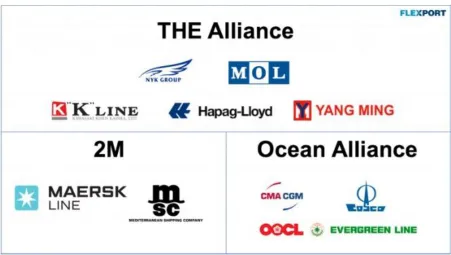
this has contributed to the established 3 major alliance groups known today namely
2M, The Ocean Alliance and The Alliance. Each alliance controls a significant amount
of market share, this type of strategy has allowed organisations to maintain a power
based model used to grow therefore resulting in a bigger is better type situation as well
as a “too big to fail”.
The way maritime has used the horizontal type strategy has raised questions on the
cartel aspect of maritime business as this type of strategy has limited the barriers to
entry in the industry. The alternative, to vertically integrate is to merge two businesses
involved in different parts of the supply or service chain. Whilst horizontal integration
has been the popular option within maritime, vertical integration has gained traction
due to the change in the competition structure and provision of new service options.
(Altuntaş, C., Göçer, A. 2014) writes about integration in the maritime context is the
activities to design optimal shipping networks and support the maritime transport
chains while taking into consideration cost implications and environmental impacts.
He attributes this to the high interdependent nature of the activities between maritime
transport and the pre-and post logistical activities that establish the network.
Competitiveness in the maritime transport industry structure has changed, shipping
lines no longer compete on the basis of competing against each other as shipping lines
but with the overlapping of industries breaking down barriers to entry into the sector
organizations would have to find alternative ways to compete and remain relative. The
reason behind understanding integration is within the maritime context, it has mostly
been studied in the field of container shipping. This is because the goals, operations
and activities have been more relavant to those of logistics, hence the importance of
understanding digital transformation within the container sector.
Digitalisation, digitization and digital transformation
In the era of information, it is imperative to ensure the right information is allocated
correctly and understood correctly. While organisations operate in the era of
information and in a digital world. There are many misconceptions around concepts
linked to the digital world. This may be attributed to different levels of or patterns of
thinking and understanding and therefore it is important to constantly establish mutual
understanding of terms and concepts in order to achieve a mutual goal. From the
analysis there is an existing misconception that technology is digitalisation, whilst
technology is merely a component of digitalisation. The other important consideration
in applying these terms it to remember that all three terms may have different meanings
depending on the context they are being used in. this paper would also establish the
context of use for the terms applicable to the maritime transport industry. (Lorange,
companies, with the idea that they intend to disrupt or take over the maritime industry
whilst futurists such as (Adamson, 2017) believe that there won’t be a maritime
industry to turn to if the industry does not embrace digitalisation as a whole. This clash
of understanding may be attributed to what each author understands about the terms
or their own personal perspective of what is happening in the business environment.
While reports that have significant impact in the maritime world such as the Global
Maritime trends report label digitalisation as disruptive and solely focus on the technological aspect and not a holistic viewpoint, it is understandable why people in
the industry would the same.
Driver of digitalisation is performance, lack of performance has led to disruptive
technologies with the potential of impacting the industry negatively. According to
(Brennen & Kreiss, 2014) digitalisation can be defined as the “adoption in use of
digital or computing technology by an organisation, industry or country”. In saying
this, the world around us today has become more accessible regarding connectivity.
At the same time (Brennen & Kreiss, 2014) as state that the terms are closely
associated and used interchangeably while also believing that analytical value can
provide distinction at the same time between the two terms. Literature describes
digitisation as a process of creating a digital version of things, not necessarily replacing
the one with the new but creating a backup version which would be easily accessible.
Therefore, from this definition digitisation can be the digital copy of something or
defined as the process of converting something to digital format in which it can also
be described as a synonym for automation. With a more broader meaning, the business
dictionary definition of digitalisation states it as the integration of digital technologies
into everyday life by the digitization of everything that can be digitized. Because the
two words digitisation and digitalisation are only differentiated by 2 letters, people
tend to think you can use the terms interchangeably, yet the definition from the
business dictionary reveals otherwise. (Amarnath , 2015) describes digitalisation as
the management and correct application of big data or of a collection of digital
above, his view may be more business orientated while other literature views
digitalisation on a more general base. (Amarnath , 2015) agrees that digitisation is a
process of conversion and creating a collection of big data. the main aspects from the
terms is processing and management, and technology only plays the role of facilitator.
Therefore, where does the misconception of the two terms being technology come
from? This will be further discussed in the next chapter.
Within digitalisation, there are a number of key focus points such as Big data which is
the result of the process of digitisation as indicated previously. Whilst it is still a
relatively new term this concept has gained traction since the early 2000’s following
the Dotcom crisis. It is described as the gathering and storage or large volumes of
information to eventually be analysed and articulated. The concept itself is not new,
as organisations including and beyond the maritime sector have been storing this type
of information, maybe not on a digital platform but maybe in a document warehouse
for a different purpose such as auditing. The term big data came with the processing
of digitising this already existing information to be stored in a centralised platform or
what can be referred to as a data warehouse which has heavily been supported by
additional concepts such as the internet of things and technological developments.
Industry analysist such as (Laney, 2001) summarises the definition of the term big data
using the three V’s, Volume, Velocity and Variety. While (Laney, 2001) based his
definition of big data based on e-commerce business models as seen in the figure
below, with the overlapping of industries and retail and e-commerce industries such
as Amazon and Alibaba having potential to penetrate the maritime industry, this model
established by (Laney, 2001) is relative to the maritime industry today.
Source: META Group (Laney, 2001)
The volume aspect of the (Laney, 2001) definition of big data refers to the collection
of data from various sources, any data that goes through the organisation and that is
relevant. As previously highlighted, this has historically been done but because of the
limitations to storing physical data, the collected data was selective but with
technological developments platforms such as Hadoop and cloud computing allow for
organisations to continually stock large amounts of data digitally to be called back
when necessary. The velocity aspect relates to the speed in which data streams in
which may also relate to the frequency in which data is loaded. The speed and
frequency would be determined by the means of data transmission, from the use of
sensor, smart tagging and RFID of manual digitisation of documentation would have
different effects of the speed in which the data is processed. Lastly variety is about the
different formats in which the data may be presented in ranging from structured,
numerical, unstructured documentation, videos, emails financial etc. analysts such as
side of it whilst organisations such as Gartner look at big data from both perspective,
storage as well as processing. Taking into consideration (Laney, 2001) idea of the
three V’s, (Sicular, 2013) believes the definition of big data is misunderstood and defines big data as “high volume, -velocity and –variety information assets that
demand cost-efficient, innovative forms of information processing for enhanced
insight and decision making” Gartners (Sicular, 2013) employs this definition of big
data not only to establish a common ground between themselves and their clients but
also use it to identify both the challenges and opportunities available with managing
big data. through their process, they have found ways to solve problems by making
use of all data to establish patterns and provide new insights from data that previously
wouldn’t get a second look at. The most crucial aspect that Gartner takes into
consideration unlike (Laney, 2001) is the cost-effective, innovative forms of
information processing which they have added in their definition. Ultimately big
problems require equally big solutions and Gartner strives in providing these solutions
but extensively taking advantage of all data available, the larger the resource pool the
greater the potential for multiple solutions but it is empirical to ensure quality and
standard as well as cost while operating in this manner. Last, Gartner considers the last
addition to their definition as the most crucial element to big data, which they believe
differentiates themselves from other definitions. The insight and decision-making
aspect, in which their goal may be considered as means to find value in the efforts put
to not only to gather, but store, analyse and transform the data to viable information to
add value.
Previously, its noted that big data today wouldn’t be as manageable without the
concept of the internet of things (IoT), (Rouse, 2016) defines the IoT phenomenon as
the development of interrelated computing devices, mechanical and digital machines
that are provided with unique identifiers and the ability to transfer data over a network
without requiring human-to-human computer interaction. In essence, without IoT, the
velocity aspect of Laney’s big data concept would not be viable. IoT has allowed for
business facet but in everyday life. With its complexity, some literature suggests it has
simplified life whilst other literature argues it has disrupted environments resulting on
an over reliance and dependence. While some literature may argue that humans have
become dependent on IoT, authors such as (Adamson, 2017) and (Ashton, 1999) both
from different periods have said that the internet is dependent wholly on human beings
for information.
Linking everything together is technology development, it has allowed for the creation
of computers and everything that followed with it. With technological development
came changes and the evolution of innovation too as highlighted previously.
Technological development has followed with all the evolutions highlighted and has
developed along with the change in mind-set of human beings and what is considered
cognitive diversity.
In relation to the business environment, without information, there is no market but
this vital information must come from somewhere (Blum, 2017). This information is
initially data that would be gathered from customers, processed and converted into
“useable” information and from this information, strategic business decision may be
made. One could resolve from the previous statement that two crucial elements of
digitalisation and digital transformation is considering two basic factors, namely the
customer and data and using this along with the technological advances available to
enable organisations and industries to optimise performance and enhance efficiencies
across their value chains. Unfortunately, the apprehensive culture within the industry
has not allowed the industry to fully understand the concept of digitalisation, only
understanding the concept through the technological aspect and overlooking the
knowledge management characteristic to digitalisation, remaining with a one-sided
view point which would only provide for minimal gains. In this sense, the concept of
digitalisation for the majority in the maritime sector has remained a buzz word rather
than a concept of consideration and this assumption may be supported but the limited
Gartner (Sicular, 2013) uses digital transformation as a synonym to digitalisation,
going back to the definition of digitalisation provided earlier, in addition to it, the
concept is used to create revenue, improve business, transform business processes and
not simply automating them and create an environment for digital business, where
digital information is at the core and the process of achieving this may be referred to
as digital transformation.
Literature from (Westerman, Bonnet, & McAfee, 2014) categorises the strategy of
digitalisation/ digital transformation into three categories with a total of nine aspects
focused on a holistic approach in apply the strategy. In analysing their approach to
digitalisation as a business strategy, in implementation, it aims at moving a business
or industry from a less lean approach to a more agile approach suitable for today’s
dynamic business environment.
4.6.1. Transforming customer experience
Customer experience makes or breaks an organisation or industry, this category
focuses on firstly, understanding the customer revolves around finding out what the
customer wants and needs through data collection. This building block will be further
addressed in this research as it has played a major role regarding disruption In general
in the maritime transport sector. The relevance of understanding the customer relates
to its analytical capability to understand the customer, which is the data/big data aspect
of digitalisation and digital transformation, for example, the use of behavioural
analytics to understand supply and demand to fully optimise resources. Secondly
growing the top-line centred around the use of technology to facilitate the relationship
between the customer and the business/industry and lastly customer touchpoints which
revolves around the transparency and connection between the business/industry and
its customers. The theme of transparency will be further elaborated on in later
4.6.2. Transforming operational process
The second category focuses on identifying the strengths and weaknesses of internal
processes and transforming them through the process of digitisation, enablement and
performance management. The 3 aspects that are of importance to this category are
process digitisation, worker enablement and performance management. The successful
employment of all three requires detailed assessment of micro-environmental factors.
Whilst machinery may be automated the holistic process it may be involved in may
not, continuous commitment from supporting staff as stated by (Adamson, 2017) and
(Ashton, 1999) that humans play a crucial role in the entire process. Lastly continuous
assessment plays an important role in ensuring that goals are aligned.
4.6.3. Transforming the business model
The last category aims at looking at the holistic effect of the previous categories on an
organisation. Each aspect and category has a cascading effect on the other and in
assessing the business model it is ideal to look at the bigger picture. As continuously
highlighted, the business model has changed and will continue to change with the
advances of all the concepts discussed previously. Within this framework,
(Westerman, Bonnet, & McAfee, 2014) had established that companies are not only
changing how their functions work, but redefining how their functions network and
expand the margins of the organisation. The three aspects of this category focus mostly
on the opportunities available both internally and externally as well as benchmarking
against similar organisations to assess implementation of the transformation strategy.
This category holistically looks at the macro-environmental aspects of digital
transformation regarding digitally modified businesses, looking at what is happening
in the business environment and the effects on organisations that have modified.
Secondly, new digital businesses, looking at what is available to the market in terms
of digital products and what opportunities would be available in relation to gaps in the
digital market. Potentially looking at customisation opportunities to differentiate
scale, industry scale rather than sectorial. From this perspective, one can see who has
benefitted from what and what concepts are more viable than others. For the purpose
of the study, the discussed digital transformation strategy would be revisited as a
component in the theoretical framework for the research to be elaborated on in the
fourth chapter.
Currently based on the aspects noted, the maritime transport industry has focused its
digitalisation or digital transformation strategy mostly on operational processes mostly
on a safety orientated activities. This assumption can be supported by the trend
analysis report, the global maritime trends 2030 which highlights application of digital
transformation within the naval sector. In analysing the industry, it can be noted that
coast guard sectors, for example the Hellenic Coast Guard has embraced digital
transformation through the use of integrated platforms through the use of AIS data to
strategically plan their operations.
Regarding the remaining two remaining categories, transforming the customer
experience and transforming the business model. These two categories are the basis of
this research. From a joint seminar held at the World Maritime University along with
the Korean Maritime Institute, a question was raised to speaker Peter Lorange whose
discussion was centred around Innovations in Shipping with emphasis of a Model for
value creation. In the panel discussion, a guest raised the question “who is the customer?”. Literature by (Adamson, 2017) touches on a similar discussion, stating that shipping has lost track of its “real” customers and has “established” the IMO as
its customer, focusing solely on building vessels that satisfy the specs of IMO and
forgetting to consider the customers’ needs. In losing focus in who the customer it
serves is, has resulted in the disruptions that the industry faces today. The leader in the
industry has identified this discrepancy,
There is also a misconception that digitalisation means less people and that the idea is
and those who understand know that people play a crucial part in the digital
transformation process. People not only provide the data/information that is needed
but for digitalisation to be efficient the most crucial element is ensuring the correct
data needs to be used.
Innovation
The definition of the concept “Innovation” has changed over the years and also
dependent on the industrial use of the term. Historically the term has been used more
as an accusation rather than an accolade. Dating back to the 13th century the term
innovation was used in the law context for the renewal of contracts but not seen as a
term for creation. Later in the 16th and 17th centuries, the term innovation was used in
relation to Puritanism, relating it to purity in the religious context and not in the most
positive light. Used to identify church officials as innovators in Henry Burtons
campaign against the churches, which later resulted in his ears being chopped off and
life imprisonment. (Ma, 2012) attribute the evolution of innovation to the similar
evolution of humanity. That innovation has changed with the complexity of thinking
of humanity, that innovation is directly correlated to ideation. With humanities
evolution based on three stages, namely hunter gathering, the industrial era and lastly
the information era, literature suggests that innovation has followed a similar pattern
namely the “before computers” similar to the hunter gathering, the use of artefacts and simplicity was used to solve problems and make decisions. The next era, “after digital”
like the industrial revolution, the invention of computers changed the ways of doing
things. Along with computers came along innovation tools such as mind mapping.
There was a shift from the basic way of doing things to building brain tools. Like the
industrial revolutions discussed in the previous sections, with the increase of
industrialised tools such as factories and the conveyor belt type systems, the second
wave of the innovation evolution came with idea factories. Lastly, the current stage of
fundamentally create better or alternative solutions. One could state that the previous
two stages of innovation can be linked more to science and the current state attempting
to find a balance between art and science. Previous ways could be labelled as treating
symptoms rather than the actual illness whilst the current means of innovation,
partnered with cognitive diversity reaches beyond treating symptoms and targets the
underlying problems faced.
The maritime industry is no different to any other industry that contributes to global
trade under the aspect that it is businesses facilitating trade. With this, digital
transformation is affecting a number of different industries involved in global trade it
is then up to the industries to determine what to do with the road ahead and with the
current and potential capabilities of the industry determine whether the trend or
possible future way of doing business would be an actual disruptor or enabler to the
DISTINCTIVE CHARACTERISTICS OF THE MARITIME
TRANSPORT SECTOR
The purpose of this section is to detail what was discussed in the history of shipping
and elaborate on what we mean by the term shipping in addition addressing the focal
point of the study.
Shipping is concerned with the transport of cargo between ports by ships. (Lun, Lai,
& Cheng, 2010). Shipping as a derived demand has been considered one of the world’s
most international industries, overtime becoming increasingly dynamic and complex
in nature through concepts such as economies of scale, network based management
and the adoption of technology for efficiency and effectiveness. While shipping is
generally a broad term and can be used to describe this activity in any mode of
transportation, the research will be focused on shipping in the perspective of maritime
transport.
In looking at maritime transport markets, “it must be possible for buyers and sellers to communicate with each other and to make meaningful deals over the whole market”
(Lipsey, 1993) Initially the market was undivided and not specialised, but with the
increase in trade, the expansion of the market and increased economic motivation for
higher levels of productivity is when the need for specialisation grew with the
customisation of vessels. Bringing us to todays in which markets have been distinctly
segmented and one cannot refer to shipping particularly in maritime transport as one
activity. The segmentation has been developed through the differentiation of vessel
types, trade requirements and geographical location.
The maritime transport sector is segmented by type of cargo carried by different types
of vessels as well as the shipbuilding and demolitions markets. Majority of the industry
based on the different markets within the maritime transport sector. For the research,
analysis would be performed on a holistic sense as digital transformation would affect
all markets within the maritime transport industry in regard to business strategy
implementation, further modifications to “personalise” the business strategy approach
to the market may be for further research.
The purpose of an industry analysis is to analyse a specific industry, see its past trends,
demand-supply mechanics and future outlook (Nigudkar , 2016). There are six steps
to performing an industry analysis which involve the reviewing of available reports,
ensuring that the approach is driven by the correct industry, assessing the demand and
supply scenario of the selected industry, analysis of the competitive scenario,
reviewing of recent developments and lastly focusing on industry dynamics. This
process will allow us to further understand what is happening in the industry and
establish the role of digital is the current state of the industry through the analysis of
the macro and micro-environment of the industry.
This process involves the reviewing of information on current economic market
conditions, there are two types of ways in which an industry analysis can be performed,
quantitative and qualitative. Quantitative following a more mathematical process used
to analyse a specific part of an industry whilst qualitative method looks at reviewing
industry information to make judgements based on the information reviewed. The
benefit to performing industry analysis is to gain specific knowledge regarding an
economic marketplace, establish value propositions and gaps in a market place
beneficial to both existing and potential players in the industry.
The shipping or maritime transport industry, industry reports have been written by
various entities in the general industry. Mostly by associations affiliated to the industry
such as ship owners’ associations, registries, auditors and individual industry
analysists with different perspectives. Mostly based qualitative information gathered
focusing on specific segments or modes of transportation, giving a perspective of their
general overview and outlook of the industry and the outlook of the Norwegian
associates aren’t the same as those of the Danish and the same goes from auditing
houses to financial institutions.
Most current industry reports begin with highlighting the struggles the maritime
transport industry has been through. For the analysis, the research will focus on a
handful of carefully selected reports which focus on various aspects of the maritime
transport sector and that will also provide for different perspectives, written by
different organisations in and involved internally or externally to the industry. The
most notable report would be the UNCTAD review of maritime transport report
published annually since 1968. The report claims to provide an analysis of structural
and cyclical changes affecting seaborne trade, ports and shipping as well as statistical
information to support. It’s said to provide data in every issue about seaborne trade,
emerging trends affecting maritime transport, fleet ownership and registration,
shipbuilding and demolitions, freight rate conditions, shipping connectivity, port
traffic, regulatory developments and bonus topical issued covered in a special chapter.
The other reports stated in the figure below, were also used to perform the industry
analysis but are written from perspectives of the entities that wrote them allowing the
research to be more objective.
5.1 COMPETITIVE SCENARIO - PORTERS 5 FORCES
To accurately assess an industry, it’s imperative to understand the industries
framework used to assess the competitiveness of entire markets used to provide a
global overview, rather than detailed business analysis techniques (Hanlon, 2016). In
addressing each force to determine the level of limitation or power, certain questions
need to be addressed. Essentially the model assumes that profitability or return should
be constant across organisations and industry, however in reality different levels of
profitability or return would be varied due to different structure. As a result, industries
or organisations have used this model to identify gaps and edge over competitors and
to further establish untapped potential aligned with the interested within the industry
or organisation.
5.1.1 Barriers to entry
i. Threat of new businesses starting in the sector?
ii. Ease of start up?
iii. Rules and regulation?
iv. Finance?
v. Barriers to entry that give greater power?
The business cycle history has previously lowered the barriers of new entrants in the
time when freight rates are low, subsequently lowering the price of vessels in the
market allowing opportunities to purchase. With the current cycle which has been
prolonged, the biggest threat regarding the starting of new businesses has come from
outside of existing owner base in the industry. The threat has come from external
industries attempting to penetrate the shipping industry with the wave of digitalisation.
To quote Michael Hansen, the global sales head at A.PMM, “bad services results in
disruption in markets”. Shipping is a capital-intensive industry, therefore ease of doing
business is relatively high, this has increased since the 2008 financial crisis which has
limited accessibility of funding. Previously funding was based on trust and reputation
which was sufficient to grant loans but with the crisis, banks have become increasingly
wary, resulting in a shift from traditional financing structures and zones with a gradual