CSUSB ScholarWorks
CSUSB ScholarWorks
Electronic Theses, Projects, and Dissertations Office of Graduate Studies
6-2016
THINKING POKER THROUGH GAME THEORY
THINKING POKER THROUGH GAME THEORY
Damian Palafox
Follow this and additional works at: https://scholarworks.lib.csusb.edu/etd
Part of the Other Applied Mathematics Commons, and the Probability Commons
Recommended Citation Recommended Citation
Palafox, Damian, "THINKING POKER THROUGH GAME THEORY" (2016). Electronic Theses, Projects, and Dissertations. 314.
https://scholarworks.lib.csusb.edu/etd/314
A Thesis
Presented to the
Faculty of
California State University,
San Bernardino
In Partial Fulfillment
of the Requirements for the Degree
Master of Arts
in
Mathematics
by
Damian Palafox
A Thesis
Presented to the
Faculty of
California State University,
San Bernardino
by
Damian Palafox
June 2016
Approved by:
Joseph Chavez, Committee Chair Date
Corey Dunn, Committee Member
Roland Trapp, Committee Member
Charles Stanton, Chair, Corey Dunn
Department of Mathematics Graduate Coordinator,
Abstract
Poker is a complex game to analyze. In this project we will use the mathematics
of game theory to solve some simplified variations of the game. Probability is the building
block behind game theory. We must understand a few concepts from probability such as
distributions, expected value, variance, and enumeration methods to aid us in studying
game theory. We will solve and analyze games through game theory by using different
decision methods, decision trees, and the process of domination and simplification. Poker
models, with and without cards, will be provided to illustrate optimal strategies.
Ex-tensions to those models will be presented, and we will show that optimal strategies still
exist. Finally, we will close this paper with an original work to an extension that can be
Acknowledgements
Dedicated to:
Joseph, professor, adviser, mentor, friend. Thank you for believing in this project.
Joyce, mentor and friend. Thank you for believing in me.
Table of Contents
Abstract iii
Acknowledgements iv
List of Tables vii
List of Figures viii
1 Introduction 1
2 Probability 3
2.1 Probability . . . 3
2.2 Distributions and Expected Value . . . 7
2.3 Enumeration . . . 9
2.4 Variance . . . 13
2.5 Bayes’ Theorem . . . 13
3 Decision Analysis 17 3.1 Decision Making . . . 17
3.2 Decision Trees . . . 23
4 Theory of Games 27 4.1 Types of Games . . . 27
4.2 Domination . . . 30
5 Poker Models 36 5.1 Uniform Poker Models . . . 36
5.2 Borel’s Poker . . . 37
5.3 von Neumann’s Poker . . . 41
5.4 von Neumann’s Poker Extension 1 . . . 45
6 Game Theory of Poker 52
6.1 Half-Street Games . . . 52
6.2 The Clairvoyance Game . . . 53
6.3 The AKQ Game . . . 56
6.4 The AKQJ Game . . . 62
7 Conclusion 75
List of Tables
3.1 Products and Profits . . . 19
3.2 Opportunity Loss Table . . . 20
3.3 Current vs. Expansion . . . 21
3.4 Conditional Profits . . . 22
3.5 Expected Profit with Perfect Information . . . 23
4.1 Standard Matrix . . . 28
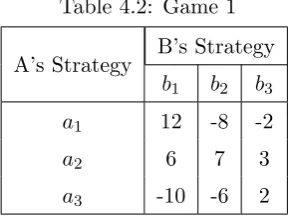
4.2 Game 1 . . . 29
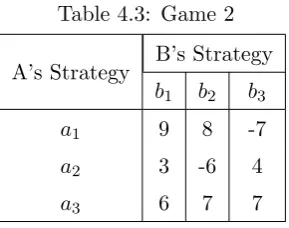
4.3 Game 2 . . . 31
4.4 Game 2, Row Reduced . . . 32
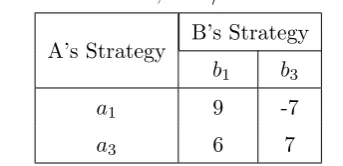
4.5 Game 2, Row/Column Reduced . . . 32
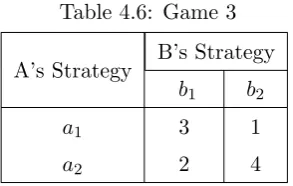
4.6 Game 3 . . . 33
4.7 Algebraic 2 by 2 Matrix . . . 33
6.1 The Clairvoyance Game . . . 53
6.2 AKQ Game . . . 56
6.3 AKQ Game, Row Reduced . . . 57
6.4 AKQ Game, Row/Column Reduced . . . 58
6.5 AKQ Game, Simplified . . . 58
6.6 AKQ Game, Matrix Solution . . . 59
6.7 AKQ Game, Expected Values . . . 60
6.8 AKQ Game, Expected Values, Simplified . . . 60
6.9 AKQJ Game . . . 63
6.10 AKQJ Game, Reduced . . . 64
6.11 AKQJ Game, Simplified . . . 64
6.12 AKQJ Game, Expected Values . . . 70
6.13 AKQJ Game, Expected Values, Simplified . . . 71
6.14 AKQJ Game, Expected Values, Re-Simplified . . . 71
List of Figures
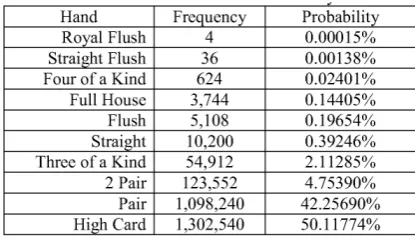
2.1 5-Card Poker Hands with Respective Probabilities. . . 12
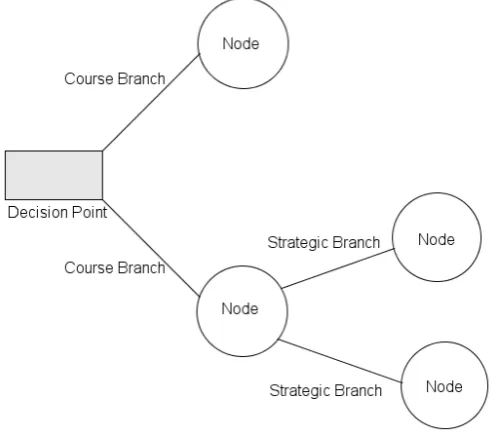
3.1 Decision Tree Diagram. . . 23
3.2 Investment Opportunities. . . 25
5.1 La Relance. . . 38
5.2 von Neumann’s Poker Model. . . 42
5.3 von Neumann’s Poker Intervals. . . 42
5.4 Example 5.3.1 Intervals. . . 43
5.5 von Neumann’s Poker Extension 1. . . 46
5.6 von Neumann’s Poker Extension 1 Intervals. . . 46
5.7 Example 5.4.1 Solutions. . . 49
5.8 von Neumann’s Poker Extension 2. . . 50
Chapter 1
Introduction
There are many categories of poker games, and within each game category, there
are many variations, and even regional variants of the same game. Casinos could have
their own set of rules, while a home game could run the same game completely differently.
In general, poker games share some characteristics, there will be betting involved, and for
the most part a deck of 52 cards is used in play. In this sense, we can examine the game,
which may seem that involves randomness and luck, through a mathematical eye. This
will demonstrate that indeed, the game is solvable if we analyze it using game theory.
What are the tools needed for us to tackle this project?
In this expository paper we will present known solutions to simplified poker
models. Additionally, we will present original work extending some of these models.
Be-fore we can understand how the poker models work, some background work in probability
is required. Poker caters to some specific probability problems, those that fall into the
combinatorial spectrum. Our work in probability will lead us to understand one of the
most powerful concepts available to statisticians, Bayes’ Theorem. We will also need, as
the title of this project suggest, a grasp on game theory. Game theory has many
applica-tions in a wide array of fields such as economics, politics, psychology, science, computer
science, and biology to name a few. Although, we could spend an entire project studying
game theory alone, we will concentrate on decision making and solving 2-person games.
We can then think of Chapters 2 through 4 as an introductory stepping stone into the
world of poker. We will revise some old concepts while learning new ideas in the process.
Fer-guson & FerFer-guson, father and son, will provide an extensive look into the work of game
theorists ´Emile Borel and John von Neumann, about solving poker models. The poker
models provided will be reduced instances of an actual game with a well defined set of
rules. These poker models will also serve as a reminder that if a game is played optimally,
then a game can be profitable.
In the final chapter, we will attempt to apply game theory to a poker game.
Chen and Ankenman provide exhaustive work in their book, about how poker can be
solved step by step via mathematics. From their work we will take the game theoretical
approach to solving poker. We will start by extending the poker models of Chapter 5 to
an actual game of poker. Then, we will demonstrate how to reduce the whole game of
poker to a simple 3-card game that we can solve, and thus, we can play optimally. The
work done in Chapter 6 can then be applied to any other game, or specific circumstance
that we may encounter in real life.
In short, this project will not teach anyone how to play poker, but instead, we
Chapter 2
Probability
2.1
Probability
Game theory is the mathematical study of games. Game theory can be
di-vided into many branches, but it is usually defined as combinatorial or classical. The
combinatorial game theory is the branch that studies enumerations, combinations, and
permutations of sets of elements, and the mathematical relations that characterize their
properties. Understanding combinatorics is key in solving probability problems as they
arise in a game of poker. Probability is then defined as a real-valued set functionP that
assigns, to each event Ain the sample space S, a numberP(A), called the probability of
the event A, such that the following properties are satisfied:
(a) P(A)≥0.
(b) P(S) = 1.
(c) If A1, A2, A3, ... are events and Ai ∩Aj = ∅, i 6= j, then P(A1∪A2 ∪ · · · ∪Ak) =
P(A1) +P(A2) +· · ·+P(Ak) for each positive integerk, andP(A1∪A2∪A3∪ · · ·) =
P(A1) +P(A2) +P(A3) +· · · for an infinite, but countable, number of events [HT10].
Theorem 2.1. For each eventA, P(A) = 1−P(A0).
Proof. We have
S=A∪A0 and A∩A0 =∅.
Thus, from properties (b) and (c), it follows that
Hence,
P(A) = 1−P(A0).
[HT10].
We may also define probability as a number. If some number of n trials of an
experiment producesn0 successes, how many occurrences of an event xwill we have? As
nbecomes larger and grows without bound, this number will converge to a specific ratio,
thus the probability p of xoccurring p(x) times is the ratio
p(x) = lim n→∞
n0
n.
For example, what is the probability that we can draw a specific card from a
standard deck of cards? We first define a standard deck of cards as follows:
1. There are 52 cards.
2. There are 4 suits,♠ spades,♣clubs, ♥hearts, and ♦diamonds.
3. There are 13 ranks in each suit, A, 2, 3, 4, 5, 6, 7, 8, 9, 10, J, Q, K (The A, “Ace”
is both a high and low card in poker games).
4. Each card is unique, ie. there is only one 6 of clubs (6♣), and only one 8 of diamonds (8♦), etc.
It should be evident that the probability of drawing a specific card is then
1/52≈1.92% since each card is unique. If we wanted to draw any one card of any suit, say any club, we know that there are 13 clubs out of 52 possible cards, so 13/52 = 1/4 = 25%.
It should be clear that since the deck is divided into 4 equal suits, the probability of
drawing one card, of any one particular suit, is 25%. Another question we could ask is,
what is the probability of drawing any ace or any heart? We know that there are 4 aces
in the deck, and that there are 13 hearts in the deck, however, we must be careful and
not double count the A♥, this is the only card that can both be an ace and a heart at the same time. We can add the probabilities of a card being an ace, or a card being a heart,
there are 13 hearts and 4 aces and only one ace of hearts, so the probability of drawing
any ace or any heart is (5213) + (524)−(521) = 1652 ≈30.77%.
As demonstrated above, there could be many factors affecting probability and its
calculations. For some events, the occurrence of one event may not change the probability
of the occurrence of the other. Events of this type are said to be independent events.
The probability that both A and B occur is called the joint probability of A and B.
However, when one event has a clear impact on the other, that is, if event A happening
affects the probability of eventBoccurring, then it is said that the events aredependent.
We may also need to consider the conditional probability of A given B. This is the
probability that if event B happens, event A will also occur. In summary, we have the
following:
• EventsAandBareindependentif and only ifP(A∩B) =P(A)P(B). Otherwise,
A and B are calleddependent events.
• The conditional probability of an event A, given that event B has occurred is defined byP(A|B) =P(A∩B)/P(B) provided thatP(B)>0.
Throughout, we will use the following notation:
P(A∪B) = Probability of AorB occurring.
P(A∩B) = Probability of Aand B occurring.
P(A|B) = Conditional probability ofA occurring givenB has already occurred. For mutually exclusive events we have P(A∪B) =P(A) +P(B).
For all events P(A∪B) =P(A) +P(B)−P(A∩B). For independent events we have P(A∩B) =P(A)P(B). And for all events P(A∩B) =P(A)P(B|A).
Example 2.1.1 What is the probability that in rolling two fair dice, we can obtain a sum of 12?
We should note that we have two independent events, as the roll of one die will
not have any influence on the other. There is also only one way of obtaining a sum
of 12 from two dice, when both dice land on 6, which carries a 1/6 probability on
each die. Let P(A) be the probability that the first die is a 6, and letP(B) be the
probability that the second die is a 6. Then
Example 2.1.2 Three football players will attempt a field goal. LetAidenote the event that the field goal is made by player i, where, i = 1,2,3 and let P(A1) = 0.5,
P(A2) = 0.7,and P(A3) = 0.6. What is the probability that exactly one player is
successful? [HT10].
In this case we have three independent events, since one player, succeeding has no
affect on the others’ success or failure rate. We want to compute the probability of
one success and two failures, but we do not know which player will score and which
two will not. Therefore we must calculate the probability that if player 1 scores,
both player 2 and player 3 will miss. Also, since any player can score, we will do the
same for the other two cases, when player 2 scores the other two miss, and when
player 3 scores, both player 1 and player 2 miss. Now, we have
P(A1) +P(A10)→0.5 + 0.5 = 1,
P(A2) +P(A20)→0.7 + 0.3 = 1,
P(A3) +P(A30)→0.6 + 0.4 = 1.
We proceed to calculate,
P(A1∩A02∩A
0
3) +P(A
0
1∩A2∩A03) +P(A
0
1∩A
0
2∩A3)
=P(A1)P(A02)P(A03) +P(A01)P(A2)P(A03) +P(A10)P(A02)P(A3)
= (0.5)(0.3)(0.4) + (0.5)(0.7)(0.4) + (0.5)(0.3)(0.6)
= 0.06 + 0.14 + 0.09
= 0.29.
Example 2.1.3 Given a standard deck of cards, draw two cards without replacement, what is the probability that both cards will be aces?
We now have a pair of events that are dependent, since removing a card from the
deck will affect the probability of drawing the second card. Denote event A as the
first card is an ace, and eventBas the second card is also an ace. We know that the
probability of drawing one ace is 4/52 because there are 4 aces in a 52 card deck.
However, the probability of drawing a second ace is now 3/51, we have removed one
card from the deck, namely, an ace. Thus, for these dependent events
We will draw a pair of aces 1/221 ≈ 0.45% of the time. Now drawing two aces, or any other pair carries the same percentage. If this is the case, then what is the
probability that we can draw any pair? Since there are 13 ranks, we can have 13 types
of pairs. Then
13(2211 ) = 171 ≈5.88%.
With these tools at our disposal, we can calculate any combination of cards
imaginable.
Example 2.1.4 Given a standard deck of cards, draw three cards without replacement, what is the probability that all cards will be of the same rank, that is three of a
kind?
As in the previous example, we have a set of dependent events. Let A denote the
event that the first card drawn is any card of any rank. Now B is the event where
second card is of the same rank asA, andC the event where the third card is of the
same rank as the previous two cards from Aand B. The probability of the events
are 52/52, 3/51, and 2/50 respectively. Then, for dependent events
P(A ∩ B ∩ C)
=P(A)P(B|A)P(C|B∩A)
= (5252)(513)(502) = 4251 ≈0.2%.
2.2
Distributions and Expected Value
More often than not, it is necessary to take into account many different
proba-bilities simultaneously. Possible outcomes and their respective probaproba-bilities can be
char-acterized by probability distributions. Probability distributions are created by taking
each outcome and pairing it with its probability.
• The probability distributionDof eventAwith probabilityP(A), and eventB with probability P(B), ... , and event Z with probability P(Z) is
D={(A, P(A)),(B, P(B)), ...,(Z, P(Z))},
For example, rolling a standard die yields the outcomes 1, 2, 3, 4, 5, or 6.
Each result happens 1/6 of the time. Thus the probability distribution of the roll is
D = {(1,16),(2,16),(3,16),(4,16),(5,61),(6,16)}. When a probability distribution is repre-sented by numerical values per every single outcome, we can find the expected value,
< EV >, of that distribution. EV is defined as the value of each outcome multiplied by
its probability, all summed together. In order to do well at any game, we must play in a
way that maximizes expected value.
Example 2.2.1 Roll a fair 6-sided die. We place a bet of one-unit on any particular number. A winning bet pays five-units when the dies lands on our chosen number,
otherwise, it is considered a losing bet, and we lose our bet of one-unit. What is
the expected value of this game? Is this a profitable game that we should play?
It does not matter which number we pick. We could pick always the number “2”
or we could change our number after every roll. Every single number has the same
probability of appearing. It is erroneous to think that a “4” is coming just because
it has not been observed in many rolls, or that “1” is the lucky number because that
number seems to repeat often. Therefore, let’s assume that we pick any number x
that has a 1/6 probability of showing. When we roll an x we will be paid 5 units,
however, we will lose 1 unit when any other of the five numbers show, which will
happen 5/6 of the time. The probability distribution is D={(5,16),(−1,56)}. The expected value of the game is < EV >= (16)(5) + (56)(−1) = 0.
Since the expected value of the game is 0, this is not a profitable game to play. If
we played this game long enough, we will never show a profit. Suppose we start by losing
some games, but winning just once will get us back to where we started. Or perhaps, we
could start by winning a few games, but eventually we will lose all of our profits and will
be back at zero. Note that if the payouts were changed to six-units per win, we will show
a profit of exactly 1/6 units or ≈0.16 units per unit played. If that were the case, we should be happy to play this game.
Example 2.2.2 Given a standard deck of cards, randomly draw a card. We place a bet of one-unit on any face card (any K, Q, J). If a face card is drawn we will win three-units, otherwise, we lose our initial bet. What is the probability distribution
The probability distribution is D ={(3,1252),(−1,4052)}. The expected value of the game is < EV >= (1252)(3) + (4052)(−1) = −0.07. This is a game that we should avoid since the expected value is negative.
The example above shows a characteristic of all casino games which are designed
to have negative expected values for the consumers. It should be noted that there are 12
face cards, any of which will win for us, and 40 non-face cards, which we lose to. There
is more than triple of the bad cards (3.33) than the good cards. We are only given 3 to 1
to our money, but we will lose more than that per game. We could in fact create our own
games, just like above, to give the consumer the illusion of being able to win big, when
in fact, they will lose overall. We may now formally define expected value of a random
variable X with probability distributionP as
< X >= n
X
i=1
pixi.
2.3
Enumeration
When working with probabilities, there may be a multitude of outcomes. So far
we have limited our experiments to six-sided dice, or a standard deck of 52 cards. Before
we can take on more complex or varied problems, we need to define some enumeration
techniques. The first and easiest is the multiplication principle. Suppose that a
procedure can be broken intomsuccessive (ordered) stages, withr1 different outcomes in
the first stage, r2 different outcomes in the second stage, ... , and rm different outcomes in the mth stage. If the number of outcomes at each stage is independent of the choices
in previous stages and if the composite outcomes are all distinct, then the total procedure
has (r1)(r2)· · ·(rm) different composite outcomes [Tuc02].
Example 2.3.1 In California, standard license plates for passenger vehicles are made up of one digit, followed by three letters, and ending with a three digit number.
Assuming that leading zeros are permissible, and that repetition is allowed, how
many different combinations of standard license plates are there?
Since there are 10 digits, 0-9, and 26 letters, a-z, available, the multiplication
prin-ciple gives
Example 2.3.2 In California, standard license plates for passenger vehicles are made up of one digit, followed by three letters, and ending with a three digit number.
Suppose leading zeros are not permissible, and repetition is not allowed on either
letters or numbers, now, how many different combinations of license plates are there
giving these restrictions?
There are 10 digits, 0-9, and 26 letters, a-z, available, the multiplication principle
gives
(9)(26)(25)(24)(9)(8)(7) = 70,761,600.
By having those restrictions, the total possible number of combinations was
reduced by 105 million possibilities. Let’s take a moment to discuss how the restrictions
affected the total number. The first factor is one of nine digits, 1-9, since 0 is not an
option. The second factor can be any of the 26 letters, whereas the third factor can
be any of the remaining 25 letters, because there is no repetition allowed. Similarly, the
fourth factor can consist of any of the remaining 24 letters. Now for the remaining factors,
the fifth factor can be any of the remaining nine digits, including zero but excluding the
leading digit of the license plate. Thus, the sixth and seventh factors have eight and seven
possible choices.
Another counting method is apermutation. Suppose that there arenpositions
which can be filled with n different objects. We can choose the first object in any of n
different ways,n−1 ways of choosing the second object,n−2 for the third, ... , and only one remaining way for the last object to be chosen. Thus by the multiplication principle
there are n(n−1)(n−2)· · ·(2)(1) = n! possible arrangements. Here n! is read as “n
factorial” where 0! = 1 [HT10].
Example 2.3.3 A soccer coach can field 11 players. Assuming that every player can play in any position, how many different line-ups are there available to the coach?
The coach can position the first player in any of the open 11 positions. The second
player in any of the remaining 10 positions, ... , the last player will fill the last open
position. Then there are
11! = (11)(10)· · ·(2)(1) = 39,916,800
Now, what if we had nobjects available and only need to fillr positions where
r < n? Then the number of possible arrangements is
nPr=n(n−1)(n−2)· · ·(n−r+ 1).
Here there are nways to fill the first position,n−1 ways to fill the second position, until only [n−(r−1)] = (n−r+ 1) ways of filling the rth position. Or
nPr=
n(n−1)· · ·(n−r+ 1)(n−r)· · ·(3)(2)(1) (n−r)· · ·(3)(2)(1) =
n! (n−r)!.
where each of the nPr arrangements is called a permutation of n objects taken r at
a time [HT10].
Example 2.3.4 How many ordered samples of five cards can be drawn without replace-ment from a standard deck of cards?
(52)(51)(50)(49)(48) = 52! (52−5)! =
52!
47! = 311,875,200.
In poker however, the order of selection is not important. If we have a pair of
aces, it does not matter in which manner we receive each card. We could get an ace as
the first card, and the last, fifth card could be the second ace. That hand will be equal
in value as if we had received both aces as our first two cards.
When we can disregard the order of selection of objects, since subsets are of
equal worth, we say that each of the nCr unordered subsets is called acombination of
n objects taken r at a time, where
nCr =
n r
= n!
r!(n−r)!.
Here nCr is read as “nchoose r” [HT10].
Example 2.3.5 What is the number of five-card hands of poker that can be made from a standard deck if we disregard order?
52C5 =
52 5
= 52!
5!47! = 2,598,960.
We can also calculate 52C5 as 525
Example 2.3.6 A poker hand is defined as drawing 5 cards at random without replace-ment from a standard deck of cards. What is the probability that the hand will
consist of one pair, that is two cards of the same rank and three different cards of
different ranks?
We first must choose one rank to make a pair. Since there are four cards of the
same rank, we can choose any two cards from that set. We then must be careful
and choose three cards, one from each of the remaining 12 ranks, where each can be
chosen from any of the four available cards. Otherwise we run the risk of making
either a second pair, or perhaps a three of a kind.
13 1 4 2 12 3 4 1 4 1 4 1 = 13 1 ·
4·3 2·1 ·
12·11·10 3·2·1 ·
4 1· 4 1 · 4 1
= 1,098,240.
Now, since there are 2,598,960 total five-card hands and 1,098,240 are one-pair
hands we have
1098240
2598960 ≈.4227.
Thus, there are about 42% of hands that will contain at least one pair.
The figure below displays all possible five-card poker hand combinations.
2.4
Variance
Probability distributions have two characteristics which if taken together
de-scribe most of the behavior of the distribution for repeated experiments. As previously
discussed, the first one is the expected value, which is also called the mean of the
dis-tribution. The second characteristic is variance, a measure of the dispersion of the
outcomes from the expectation.
• For a probability distribution P, where each of the noutcomes has a value xi and a probability pi, the variance of P,Vp is
Vp= n
X
i=1
pi(xi−< P >)2.
We say that variance is the weighted mean of the squares of the outcomes. The
positive square root of the variance is called the standard deviation. Thus, we
denote variance as σ2 and standard deviation simply asσ [HT10].
Example 2.4.1 Consider the following probability distributionD={(1,36),(2,26),(3,16)}. Calculate the expected value, the variance and the standard deviation.
< EV >= (1)(36) + (2)(26) + (3)(16) = 10
6 =
5 3.
σ2= 3 6(1−
5 3)
2+2
6(2−
5 3)
2+1
6(3−
5 3)
2= 15
27 = 5 9. σ= r 5 9 = √ 5 3 .
Thus, the expected value is 5/3≈1.66, the variance is 5/9≈0.56, and the standard deviation is
√
5
3 ≈0.75.
2.5
Bayes’ Theorem
The last item needed for our background work in probability isBayes’
Theo-rem. Before we are ready to proceed, recall the definition of conditional probability from
Section 2.1 which was the probability of two eventsA andB happening. Here,P(A∩B) is the probability of A, P(A), times the probability of B given that A has occurred,
P(B|A). In other words, we have
On the other hand, the probability ofA and B is also equal to the probability
of B times the probability ofA givenB,
P(A∩B) =P(B)P(A|B).
Equating the two equations yields:
P(A)P(B|A) =P(B)P(A|B),
and thus
P(A|B) =P(A)P(B|A)
P(B) .
The equation above is the basic idea behind Bayes’ Theorem [CA06].
From above, we know that one of the basic probability equations given for
all dependent events is P(A∩B) = P(A)P(B|A). Sometimes, it may be preferable to calculate the conditional probability ofBgiven thatAhas already occurred. For example,
in poker, I know the cards in my hand, and now I can use that information to calculate
the probability that my opponent has a certain type of hand.
We now define apartition ofS as a collection of sets{B1, B2, . . . , Bk}, for some positive integer k, whereB1, B2, . . . , Bk are sets such that:
1. S =B1∪B2∪ · · · ∪Bk.
2. Bi∩Bj =∅, fori6=j.
IfAis any subset ofSand{B1, B2, . . . , Bk}is a partition ofS, thenAcan be decomposed as:
A= (A∩B1)∪(A∩B2)∪ · · · ∪(A∩Bk).
Theorem 2.2 (Bayes’ Theorem). Assume that P(A)>0 and that {B1, B2, . . . , Bk} is a
partition of the sample space S such thatP(Bi)>0 for i= 1,2, . . . , k. Then
P(Bj|A) =
P(Bj)P(A|Bj)
Pk
i=1P(Bi)P(A|Bi)
.
Proof. We have,A= (A∩B1)∪(A∩B2)∪ · · · ∪(A∩Bk). Then,
P(A) = k
X
i=1
P(Bi∩A)
= k
X
i=1
Since
P(Bj|A) =
P(A∩Bj)
P(A)
= PkP(Bj)P(A|Bj) i=1P(Bi)P(A|Bi)
.
[WMS08].
Example 2.5.1 Suppose a new player sits at our poker table. We know from previous observations that he is 10% likely to be an aggressive player who will raise any hand
80% of the time. Also, from experience, we can deduce that he is 90% likely to be a
passive player who will only raise the top 10% of his hands. On the first hand that
he plays, he raises, what is the probability that this player is aggressive? [CA06].
DenoteAas the probability that the player plays his first dealt hand. DenoteB as
the probability that the player is aggressive. Then,
a) P(A|B) = 0.8 is the probability that given that the player is aggressive, he will raise 80% of the time.
b) P(A|B¯) = 0.1 is the probability that given that the player is not aggressive, therefore passive, he will only raise 10% of the time.
c) P(B) = 0.1 is the probability that the player is aggressive, 10%.
d) P( ¯B) = 0.9 is the probability that the player is passive, 90%
By Bayes’ Theorem we have,
P(B|A) = P(A|B)P(B)
P(A|B)P(B) +P(A|B¯)P( ¯B)
P(B|A) = (0.8)(0.1) (0.8)(0.1) + (0.1)(0.9)
P(B|A) = 0.4705≈47.1%
Just by observing this player raise his first hand, we can adjust the probability that
this player is aggressive from 10% to 47%. Now, what will happen if this player
a) P(A|B) = 0.8 is the probability that given that the player is aggressive, he will raise 80% of the time.
b) P(A|B¯) = 0.1 is the probability that given that the player is not aggressive, therefore passive, he will only raise 10% of the time.
c) P(B) = 0.47 is the probability that the player is aggressive, 47%.
d) P( ¯B) = 0.53 is the probability that the player is passive, 53%
By Bayes’ Theorem again we have,
P(B|A) = P(A|B)P(B)
P(A|B)P(B) +P(A|B¯)P( ¯B)
P(B|A) = (0.8)(0.47) (0.8)(0.47) + (0.1)(0.53)
P(B|A) = 0.8764≈87.6%
Thus, by observing this player raise his first two hands in a row, we can deduce
Chapter 3
Decision Analysis
3.1
Decision Making
Decision making is an everyday process, and decisions we make, big or small,
can have a great impact on life. There are many factors that can influence the decision
making process, and normally a combination of these factors will play a role. Some of
these factors may include conflict, time, competition, attitude, risk, policies, etc. Thus,
a great decision-maker is a person who rises above these factors and is able to bring out
its best through the process of rationality of decisions, making and improving upon
decisions made. Hence, deep analysis of previous decisions and that of complexities of the
given environment help the process of rational and effective decision making. Decision
theory comes into play when, more often than not, parameters, inputs, or consequences
are not fully known and thus uncertainty exists which complicates the decision making
process. Uncertain situations are dealt with by assuming parameters following various
probability distribution functions. However, uncertainty must be approached with a
determined amount of calculated risk, since the variables involved could change due to
the environment and even by our own decisions. Similarly, conditions may change based
upon equivalent circumstances. In order to calculate risk we turn to a decision table,
orpay-off table [Sha09].
The decision making process can be broken down into four steps:
1. Identify all possible states of nature, events available, or factors affecting the decisions.
3. Identify the pay-offs for various strategic solutions under all known events or states of
nature.
4. Decide to choose from amongst these alternatives under given conditions with identified
pay-offs.
Tactical decisions are day-to-day decisions having impact on the immediate
business environment and the resultant outcome. These types of decisions are but only
one of many other types of decision categories. Tactical decisions are affected by decision
making environments. One such environment is uncertainty. Decision making under
uncertainty is the absence of past data, where it may not be possible to estimate the
probabilities of occurrence of different states of nature. There exist some useful criteria
when there is no prior data that the decision maker can rely upon, and there is no method
of computing the expected pay-off for any strategy. Sharma, in his book Operations Research, provides the following methods to compute expected pay-offs:
1. Maximin criterion: The decision maker adopts a pessimistic approach and tries to
maximize his security, for a worst case scenario we must make the best of the situation
and choose the highest pay-off.
2. Minimax criterion: Of the best possible scenario, we will try to secure the minimum
of the maximums available.
3. Maximax: We start getting greedy and will go for maximum pay-off, totally optimistic,
we choose the highest reward of the best case scenario.
4. Laplace criterion: There is no definite information about the probability of occurrences,
so we assume that each one is just as likely. This is the sum of all probabilities for a
specific strategy.
5. Hurwicz Alpha criterion: A combination of maximin and maximax. The decision
maker utilizesαas a degree of optimism where 0< α <1 , where 0 is total pessimism
and 1 is total optimism. The decision Di is defined by
Di=αMi+mi(1−α),
whereMi is the maximum pay-off from any of the outcomes from theith strategy and
6. Regret criterion: We consider the dissatisfaction associated with not having obtained
the best return in investment. Regret is computed as the difference in pay-off of the
outcome and the largest pay-off which could have been obtained under the
correspond-ing state of nature. Also called the opportunity loss table.
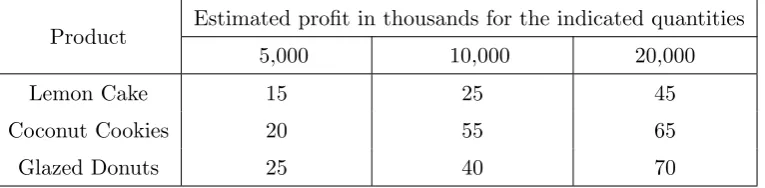
Example 3.1.1 A bakery usually sells the following three products, lemon cake, coconut cookies, or glazed donuts. Next year, the expected sales are highly uncertain, and
the owner decides to scale back to selling just one product. It is estimated that
profits will reflect the table below [Sha09].
Table 3.1: Products and Profits
Product Estimated profit in thousands for the indicated quantities
5,000 10,000 20,000
Lemon Cake 15 25 45
Coconut Cookies 20 55 65
Glazed Donuts 25 40 70
Which product should the bakery sell under the different criterion?
(a) Under the maximin criterion, we want to pick the best outcome from all of
the minimums. That is, if we only make five thousand of any product, the
best result will be the donuts. Thus, the bakery should make the donuts and
expect a $25,000 profit.
(b) The maximax is the best of the best, thus donuts will yield $70,000 profit if
the bakery makes 20,000 of them.
(c) If we use the Laplace method, where we assume that each outcome is just as
likely, we have for lemon cakes,
1 3(15) +
1 3(25) +
1
3(45) = 28.33.
For coconut cookies,
1 3(20) +
1 3(55) +
1
3(65) = 46.67.
And for glazed donuts,
1 3(25) +
1 3(40) +
1
Thus, under this criteria, the bakery should sell the cookies.
(d) Under the Hurwicz alpha criteria, assume α = 0.6, then for lemon cakes we
have,
0.6(45) + 15(1−0.6) = 33.
For coconut cookies,
0.6(65) + 20(1−0.6) = 47.
And for glazed donuts,
0.6(70) + 25(1−0.6) = 52.
Thus, the bakery should sell the donuts.
(e) For the regret criteria, we must subtract the highest possible pay-off under
each state of nature from the outcomes associated with each of the possible
events. From the opportunity loss table, we want to minimize future regret,
and as such, the bakery should choose to sell the coconut cookies.
Table 3.2: Opportunity Loss Table
Product 5,000 10,000 20,000 Max Regret
Lemon Cake (25-15)=10 (55-25)=30 (70-45)=25 30
Coconut Cookies (25-20)=5 (55-55)=0 (70-65)=5 5
Glazed Donuts (25-25)=0 (55-40)=15 (70-70)=0 15
It is important to note that a person cannot predict the outcome of any event,
by selecting an action we can expect some conclusions to occur which may be beneficial,
insignificant or even harmful. Thus, there is risk involved and in order to reach the
optimal decision we can use probability distributions out of the probable outcomes based
upon previously collected data. This is another type of decision making category which
we will call decision making underrisk. We can make our decisions according to a model
that will yield the largest expected profit value which is called expected money value
or EMV for short. EMV is used in order to calculate risk and facilitate the decision
making process. EMV is calculated with the following equation.
EM V(Ci) = n
X
i=1
Here,
Ci = Course of action i,
Pi = Probability of occurrence of outcomeO,
n= Number of possible outcomes,
Oi = The pay-off expected or outcome of actioni.
The equation above for EMV is another way of illustrating the expected value
of a probability distribution.
Example 3.1.2 A trading company is considering expansion. We need to determine whether to operate from an existing office and cover the area by traveling, or to
open a new locale closer to the new market. We come up with the following data:
[Sha09].
Table 3.3: Current vs. Expansion
Alternatives States of Nature Probability Pay-off
A. Operate from current office i) Increase in demand by 30% 60% 50
ii) No change 40% 5
B. Open new office i) Increase in demand by 30% 70% 40
ii) No change 30% -10
The expected pay-off forAis 0.6(50) + 0.4(5) = 32, and the expected pay-off forB
is 0.7(40) + 0.3(−10) = 25. As a result, we decide to stay at the current location and operate by trading locally and by traveling to the new market.
Decision making underconflict arises when there is more than one option open
for optimal gain, mainly due to the action of others in the field. This is where game
theory comes in handy. Some concepts that can be analyzed by game theory isexpected
value of perfect information or EVPI. This is the average outcome of the states of
nature of the level of information. That is to say, the information is available and the
probabilities are known and hence we can calculate the best option that results on the
highest profit possible. So EVPI = (best outcome of first state of nature)(probability of
first state of nature) + (best outcome of second state of nature)(probability of second
of nature). There is also the concept of expected profit with perfect information or
EPPI. EPPI is the maximum obtainable monetary gain given that all possible parameters
are known and accounted for. We can then define this relationship as
EV P I =EP P I−EM V,
where, EPPI is the expected profit with perfect information, and EMV is the expected
monetary value.
Example 3.1.3 As a manufacturer we want to increase our business. There are two choices available to choose from, first, expansion of the existing capacity at a cost
of 8 units, or second, modernization of current capacity at a cost of 5 units. We
estimate a 35% probability of having a high demand versus a 65% probability of
having no change on demand. Additionally, when demand is high, we will be
earning 12 units if we decide to expand, against 6 units if we decide to modernize.
If there is no change in demand, we will earn 7 units on expansion versus 5 units
for modernization. Let S1 be the state of nature pertaining to high demand with
probability P1 at 35%. Let S2 be the state of nature corresponding to no change
in demand with probability P2 at 65%. Also, list the courses of action as A1 for
expansion, and A2 for modernization. The conditional profits will be given by the
difference of the new revenue and the cost of expansion or modernization [Sha09].
Table 3.4: Conditional Profits
States of Nature A1 A2
S1 12−8 = 4 6−5 = 1
S2 7−8 =−1 5−5 = 0
Then, the expected monetary values are:
EM V(A1) = 4(0.35) + (−1)(0.65) = 0.75,
and
EM V(A2) = 1(0.35) + 0(0.65) = 0.35.
Thus we choose to expand since this course of action will maximize EMV. Now, we
need to calculate the EPPI by choosing the optimal course of action for each state
Table 3.5: Expected Profit with Perfect Information
States of Nature Probability Optimal Course of Action Expected Profit
S1 0.35 A1 4(0.35) = 1.4
S2 0.65 A2 0(0.65) = 0
Therefore EPPI is 1.4 + 0 = 1.4.
Hence,
EP P I−EM V =EV P I
1.4−0.75 = 0.65.
3.2
Decision Trees
Decision making may involve multiple stages and at each stage, each decision will
open up different outcomes with their respective pay-offs. Adecision tree facilitates this
process. A decision tree is made up of nodes, branches, probabilities, and the resultant
pay-offs of each outcome. Decision trees are graphical tools that allows us to see how
decisions affect the outcomes.
Possibly the most important tool available to a decision maker is posterior
probabilities and analysis. By evaluating old decisions, new and improved models
can be derived. With new information, new alternatives can be considered . This may
drastically change future expected pay-offs. Bayes’ Theorem, is used to calculate the
effects and relationships of prior probability, the initial probability statement with
pay-offs, posterior probability, and allows us to revise probability statements due to post data
analysis.
Example 3.2.1 Suppose we are offered two investment opportunities, call them A and
B. The probability of success on A is 70% and on investment B is 40%. Both
investments require a capital of $2,000 to get started. InvestmentA returns $3,000
while investment B returns $5,000. If either investment fails, we lose our initial
capital of $2,000. We can only partake in one investment at a time. Thus, our
options are, to take investment A and stop, or if successful we may continue onto
investmentB. Or we may start with investmentBand stop, or if successful continue
with investmentA. Which is the best course of action? [Sha09].
We have the following courses of action:
i. Take A and stop.
ii. Take B and stop.
iii. Take A and if successful, takeB.
iv. Take B and if successful, takeA.
We begin by filling in the decision tree, shown on the next page, with the actual
investments values, and from there we can calculate the expected values of each
decision. For example, taking on investment A and succeeding gives a payout of
$3000, but if we fail, we will lose the capital investment of $2000. If we are successful
at A, we reach decision point 2. From here we can choose to stop, at which point
we will collect $3000, or we may continue with investment B. IfB is successful, we
collect the new pay-out of $5000 plus we still have the amount fromAfor a total of
$8000. However, if investment B fails, we lose $2000, but we still have $1000 from
the initial gain from A. The same logic follows if we decide to take investment B
Figure 3.2: Investment Opportunities.
on which investment we take first, the pay-out for failing on the second investment
will be different. Also, failing at any investment first carries the same negative
expectancy of −$2000. Thus, if we want maximum pay-out, we must follow the path that carries the greatest expected value for our choices.
The expected value ofAsucceeding and thenB succeeding is given by (8000)(0.6)+
(1000)(0.4) = 3800 Thus, $3800 is the expected value at decision point 2. The
expected value of taking only A is (3800)(0.7) + (−2000)(0.3) = 2060. Thus $2060 is the expected value of investment A succeeding alone.
If the investments are reversed, the expected value of B succeeding and then A
succeeding is given by (8000)(0.7) + (3000)(0.3) = 6500, which is the expected value
(−2000)(0.6) = 1400.
Although, success in both investments yields the same pay-out, which path should
we take? At decision point 1, we can compare the expected values of 2060 and 1400,
at which point we follow the largest which is to invest in A first. At this juncture,
the expected value of continuing versus stopping is 3800 versus 3000, so we decide
to continue with investmentB. This is the strategy offered in iii. Hence, takingA
and if successful taking B is the best course of action since it returns the greatest
Chapter 4
Theory of Games
4.1
Types of Games
Game theory comes into practice when there is a well understood problem and
the action of all persons of interest are known beforehand. For example, actions taken by
companyAwould have a direct impact on companyB, and thus companyBmust react to
the new situation, and must react optimally. Once companyB has adjusted, companyA
could readjust to the new environment and alter its own actions once again. Thus, game
theory is mainly used in figuring out the decisions and options given a set of conflicting
outputs and the motives of competing parties. Game theory applies when a game is finite,
that is, there exists a limited number of choices, and a finite number of moves at each
choice, and most importantly, each choice follows a rational set of rules and behaviors.
This will ensure that an acceptable outcome can be predefined for each game. Since game
theory deals with human thoughts, a player must take into account its environment. Each
player is an independent decision maker, but the outcome of the game would depend on
the action and strategies taken by all players. Since each player may have a different goal
in mind, this would be categorized as decision making under conflict. Players may
not all be motivated by maximum profit, but rather by optimal dominating decisions
over other players which may help in that particular player dominating the game in the
long run. Thus each player must be prepared with strategies and counter-strategies for
any given outcome. Game theory is then an interactive process that must be analyzed
decipher our opponents goals.
There are many types of games, but can be reduced to the following:
1. 2-Person Zero-Sum Game, a game where the gain of one player is the loss of the other.
2. 2-Person Non-Zero-Sum Game, a game where gain and loss are not equal, and thus
the outcome is not obvious.
3. N-Persons Game, a game where there exists a large number of players all trying to
maximize profits. There could be multiple winners, each with a different amount of
profit.
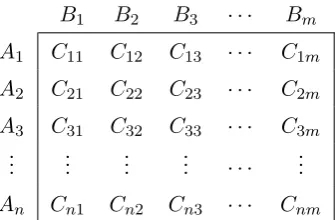
In order to represent a game with fixed strategies for two players, we can draw
a simple matrix like the next table below.
Table 4.1: Standard Matrix
B1 B2 B3 · · · Bm
A1 C11 C12 C13 · · · C1m
A2 C21 C22 C23 · · · C2m
A3 C31 C32 C33 · · · C3m ..
. ... ... ... · · · ...
An Cn1 Cn2 Cn3 · · · Cnm
The matrix indicates the expected pay-offs as values obtained from using
strat-egyAand strategyB. For example, if playerAadopts strategyA2and playerB counters
with strategy B3, then the resulting pay-off will beC23. It is standard practice to show
the pay-offs from the columns player, that is in this case, from player A’s perspective,
where positive numbers indicate gains and negative numbers indicate losses. For the
other player, these values would be reversed.
For the remainder of this chapter we focus on 2-person games in which Sharma
assumes the following rules:
1. Players act rationally and intelligently.
2. Each player has all relevant information.
3. Each player can use the information in a finite number of moves with finite choices for
4. Players make independent decisions of courses of actions without consultation.
5. Players play the game for optimization.
6. The pay-off is fixed and known in advanced.
Example 4.1.1 Solve the game [Sha09].
Table 4.2: Game 1
A’s Strategy B’s Strategy
b1 b2 b3
a1 12 -8 -2
a2 6 7 3
a3 -10 -6 2
We want to find the optimal strategy pair for both playersAandB. PlayerAwants
to maximize his profits, while player B wants to minimize his losses. We can solve
the game by finding the maximin, the maximum of the minimums for playerA, and
the minimax, the minimum of the maximums for playerB. From the matrix we can
derive that the minimum for each of player A strategies is {-8, 3, -10}. From this set, player A will attempt to secure the maximum pay-off of 3. Similarly, player
B maximums from each of his strategies is the set {12, 7, 3} from which we must give up the minimum of 3. Thus, the solution to the game is given by the strategies
a2b3. In this game, by following the same strategy, playerA can gain 3 units from
player B. The solutiona2b3 is said to be optimal, since it is the only strategy that
will yield the safest return for player A, and at the same time, player B gives up
the least amount of equity. When a unique solution to a game exists, it is said to be
a saddle point. A saddle point is the point of equilibrium for both strategies. At
this point there exists a maximum gain for player A and minimum loss for player
B.
Let’s look at what the previous example solution means. Player A has three
strategies open to him. If he chooses either a1 or a3 he risks losing as indicated by the
negative numbers. Only a2 offers a profit every time, and at worst, player A can only
seem like the maximum pay-off, and thus the one that we should be striving to obtain,
we run the risk of losing -8 and -2 when player B chooses b2 and b3 respectively. Even
if we assume that each strategy is as likely to be chosen, by Laplace criterion we have
1 3(12) +
1
3(−8) + 1
3(−2) = 0.66, which makes choosing this strategy not ideal. Another
point to consider is, when playerBrealizes that playerAis constantly choosinga1, player
B can switch to playingb2 exclusively, and thus he will win 8 units from player Aevery
time.
By following the assumptions above, we can define astrategy as an alternative
course of action available to all players in advance. There are two types of strategies. A
pure strategy is where a player selects the same strategy each time without variation.
In this manner, each player knows exactly what the other player would do against his
own selected strategy. The other type of strategy is a mixed strategy. Here each of the
players use a combination of strategies, and each player leaves the other one guessing as
to what he would do next. Thus, opposing players must bring their own counter-strategy
with the aim of optimization. Regardless of which type of strategy is used, an optimal
strategy is the preferred course of action. Such a strategy will put the player in a superior
position regardless of his competitor’s actions. This will lead to the player obtaining a
maximum pay-off, a measurement of achievement, or a gain in profit. The pay-off as
previously discussed is the expected outcome, or the expected value, which we will call
the value of the game, which is obtained when players follow their optimal strategies.
2-Person zero-sum games can then be either purely strategic, where a players
follows one particular action to victory, or a mixed strategy game, where a players adapts
different strategies depending on the present situation. When both players use the best
strategy and said strategy is optimal, a saddle point exists. In Example 4.1.1, the saddle
point is a2b3 which has a value of 3.
4.2
Domination
A game with multiple strategies will lead to a large matrix. However, some
of those strategies could be dominated by another strategy, and thus the matrix can
be simplified until we obtain a more manageable, smaller matrix. This is what we will
term as the concept of dominance. Dominance occurs when one strategy is clearly
another strategy regardless of which counter-strategy is used against it, such a strategy
will dominate, and that strategy will be the preferred course of action to use. Domination
is applied as follows: [Sha09].
1. The rule of rows applies when all elements in a row are less than or equal to the
corresponding elements in another row. Such row is then said to be dominated and
can be removed from future play.
2. The rule of columns, applies when all elements in a column are greater than or equal to
the corresponding elements in another column. That column is said to be dominated
and can be removed from future play.
3. The rule of averages is when a pure strategy may well be dominated by the average of
two or more pure strategies. This will reduce the matrix faster since we can remove
several rows and, or columns simultaneously, if these are found to be dominated by
one of the previously mentioned rules.
Example 4.2.1 Solve the game [Sha09].
Table 4.3: Game 2
A’s Strategy B’s Strategy
b1 b2 b3
a1 9 8 -7
a2 3 -6 4
a3 6 7 7
Before we attempt to solve this game we should look for saddle points. If a saddle
point exists, then there exists a pure strategy available to both players. The
min-imums from each of A’s strategies is {-7, -6, 6} which has a maximum of 6. Now, the maximums from B are {9, 8, 7} whose minimum is 7. Since 66= 7, there is no saddle point, and a pure strategy does not exist. However, we may now turn our
attention to removing dominated strategies from the matrix. By the rule of rows
we can see that all values from a2 are less than those from a3. Thus we say that
a3 dominates a2. Player A will always achieve a better result by choosing a3 over
a2 regardless of what option playerB chooses. By removing a2 from the matrix we
Table 4.4: Game 2, Row Reduced
A’s Strategy B’s Strategy
b1 b2 b3
a1 9 8 -7
a3 6 7 7
Now, by rule of columns, playerBcan removeb2since it is dominated byb3, because
values in b2 are greater than or equal to those inb3. Thus, the new reduced game
is given by the matrix as:
Table 4.5: Game 2, Row/Column Reduced
A’s Strategy B’s Strategy
b1 b3
a1 9 -7
a3 6 7
PlayerAminimums from each strategy are{-7, 6}whose maximum is 6, and player
B maximums are {9, 7}whose minimum is 7. Since 66= 7, no pure strategy exists. Hence, player A must play a mixed strategy froma1 anda3, while player B reacts
by playing a mixed strategy fromb1andb3. It is important to note, that it could be
possible for a saddle point to appear once dominated strategies have been removed.
In the example above, both players must choose mixed strategies, but how often
should they play each strategy? Furthermore, why does player A not simply choose a3
as his sole strategy since he can at worst get 6 units from player B?
Perhaps it is not obvious from the preceding example, but playerA should still
play a1 from time to time, even at the risk of losing 7 units to player B. In order to
illustrate this point, we can look at a simplified game with all positive values.
Example 4.2.2 In Game 3, playerA can choosea2 every time since this will secure him
at a minimum a pay-off of 2 units. Player B also loses the minimum by choosing
b1. However, playerAnotices that playerB always choosesb1, so playerAswitches
toa1 in order to get a better profit of 3. PlayerB follows the same argument and
Table 4.6: Game 3
A’s Strategy B’s Strategy
b1 b2
a1 3 1
a2 2 4
they switch their strategies in order to maximize and minimize their respective
winnings and losses. Assuming playerAalternates between his two options equally,
his expected value from b1 is 12(3) + 12(2) = 2.5 which is preferable over strictly
choosing a2 which will only give him 2. Similarly, the expected value from b2 is 1
2(1) + 1
2(4) = 2.5. Thus player A must play a mixed strategy since his expected
value for both strategies is greater when using mixed strategies than by using a
pure strategy alone.
Is it possible that playerA can actually increase his expected value by playing
one strategy more than half the time, and if so, how often should he play each strategy?
Sharma provides three methods for solving games, algebraic, graphical, and linear
pro-gramming. For the purpose of this project we will focus on the algebraic method. The
algebraic method for solving a 2 by 2 game is derived by the following general formula:
Table 4.7: Algebraic 2 by 2 Matrix
B1 B2
A1 C11 C12
A2 C21 C22
Suppose playerAselects strategyA1 with probabilitypandA2 with probability
1−p. Suppose player B selects strategy B1 with probability q and B2 with probability
1−q. Then, the expected value of A versusB1 is
C11(p) +C21(1−p).
Now, using the values from Example 4.2.2 and the general formula, we can algebraically
plays against b1:
3(p) + 2(1−p) = 3p+ 2−2p
=p+ 2.
When playerA plays againstb2 we have:
1(p) + 4(1−p) =p+ 4−4p
=−3p+ 4.
The solution is given when these equations equal each other,
p+ 2 =−3p+ 4
4p= 2
p= 1 2.
How often should player A select each strategy? Since p = 12, player A must play a1
50% of the time, and he must balance his play by selecting a2 the other 50% of the time.
In this example it turns out that A can maximize his expected value by exactly playing
each strategy one half of the time! But this is not the case for B. When playerB plays
against a1 we have:
3(q) + 1(1−q) = 3q+ 1−q
= 2q+ 1.
And when B plays againsta2 we have:
2(q) + 4(1−q) = 2q+ 4−4q
=−2q+ 4.
The solution is given when these equations equal each other,
2q+ 1 =−2q+ 4
4q = 3
In order for playerB to minimize his losses, he must playb1 75% of the time, andb2 the
remaining 25% of the time.
We can now revisit Example 4.2.1, Game 2, to find out how often each player
must play each strategy. We have, A’s strategy versus b1 as 9(p) + 6(1−p) and versus
b3 as −7(p) + 7(1−p). Solving these equations and setting them equal to each other
gives p= 171 . Similarly, forB we have, againsta1, 9(q) + (−7)(1−q) and againsta3 we
have 6(q) + 7(1−q). Solving these equations and setting them equal to each other obtain
q = 1417. Thus, in Game 2, player A must play a mixed strategy that contains a1 1/17
of the time, a2 zero percent of the time (since it is dominated), and a3 the remaining
16/17 of the time. Player B must play b1 14/17 of the time, b2 zero percent of the time
(since it is also dominated), and b3 the remaining 3/17 of the time. The expected value
for the game from playerA’s perspective is 9(171 ) + 6(1− 1 17) =
105
17. And from playerB’s
perspective 9(1417)−7(1−14 17) =
105
17. Hence, by using the mixed strategies above, playerA
stands to win approximately 6.18 units while player B stands to lose the same amount.
Thus, this is the optimal strategy for each player to follow.
As stated earlier, when dealing with game theory, we are assuming that the gain
of one player is the loss of another player. However, it is highly unlikely that a player
will have access to all of the required information ahead of time. The lack of information
will leave us guessing as to whether a specific strategy is optimal or not. Therefore,
we must restrict our assumptions to a basic standard set of rules that are well defined
and understood by all players. In real life, competitors will not divulge their strategies,
and as such, pay-offs will not be known, which implies that courses of actions cannot
be predicted. Thus, a decision maker is left with the option of taking risk since the
outcomes are uncertain. Furthermore in real life, there could be more than two players,
Chapter 5
Poker Models
5.1
Uniform Poker Models
We now turn our attention to solving poker models. These are simplified poker
games that can be solved algebraically. We will now assume that we are playing
two-person zero-sum games. The participants will be called player 1 and player 2. In this type
of game, a player will gain some amount from the other player, and this sum will always
be zero. We will also assume that hands are randomly and independently distributed.
For the models, player 1 is dealt a random hand X ∈ [0,1] where X has a uniform distribution over the interval [0,1]. To be precise, of all minimum and maximum values
for each member of the family, all intervals of the same length on the distribution have
equal probabilities. In this case, in a standard deck of 52 cards, the probability of getting
dealt one specific card is exactly 1/52, the probability of getting dealt a second specific
card is exactly 1/51, and so on. Getting dealt a specific card does not influence the
outcome of the second card. Similarly, player 2 is also dealt an independently random
hand Y ∈ [0,1] with equal uniform distribution on [0,1] as X. Both players are well aware of the value of their own hands, but have no information on their opponent’s hand
strength. We can think of it as each player has a number between 0 and 1, but they
have no idea if their opponent’s number is higher or lower. On each model there exists a
betting structure. Both players must pay a “unit” worth, (decided amongst the players
in advance) that is paid before the hands are dealt, this is called anante. The antes and
and bets. Each player will have a predefined set of actions available to them. Player
1 may decide to bet or not to bet his hand, and player 2 reacts with his own actions,
whether to call or fold. For all models we are ignoring other options found in poker,
which could be for player 1 to check-raise, check-call, or for player 2 to bet his own hand
or to raise when faced with a bet by player 1, amongst some common poker strategies.
At the end of the game, the hands are compared at what is know asshowdown, and the
highest valued hand wins the pot.
If we disregard the randomly distributed hands, given that players’ options
are known and announced, will make this game a game of perfect information. This
type of game can be solved using one or more techniques as described in the previous
chapters about decision analysis and game theory. However, since we are ignorant of our
opponent’s holdings, this is then called a game of almost perfect information, where
we may deduce the strength of our opponent’s cards by what we have. For instance, if I
have an ace it is less likely that my opponent has an ace of his own, or, since I hold two
spades, it is less likely that my opponent has any spades at all. Thus, we may study and
derive the correct strategy to play using decision trees which we will be calling betting
trees.
5.2
Borel’s Poker
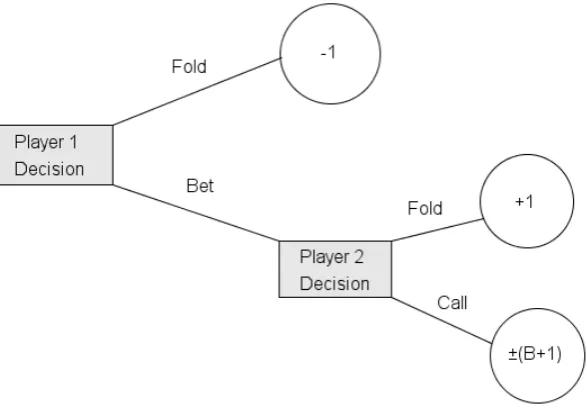
Borel’s poker model is referred to as La Relance (Figure 5.1). In this model
each player pays one unit in ante and then they are dealt their respective randomly
independent uniformly distributed hands. Player 1 acting first, will have two options,
one tofold his hand, that is, to discard one’s hand and forfeit interest in the current pot.
In this case, player 1 surrenders the hand to player 2, giving up his claim to the pot, and
conceding the pot to player 2. When player 1 folds, he loses his ante, and player 2 wins
one unit. The second option is for player 1 to make a wager, to bet some valueB where
B > 0 and B may not necessarily be equal to an ante’s worth but could be higher. In
the case that player 1 bets, if player 2 folds, then player 1 wins the two antes, and gains
one unit worth. If player 2 calls the bet, then hands are compared at showdown, and the
best hand will take the pot and in this case will gain both antes, plus whatever the betB
was, for a net worth of B+ 1 ante. The model disregards the case where both hands are
Figure 5.1: La Relance.
when dealing with real cards, as opposed to random number distributions, such cases do
occur in real life. In such a scenario, both bets are returned and there is no exchange
of money between the players. Borel’s poker game favors player 2, given that player 1
must decide to either bet or fold, puts him at a starting disadvantage, he will bet with
his strong hands and will only lose to a better hand with a small probability, but at the
same time he will not get called often by a worse holding. As a result, player 1 will only
gain just the ante [FF03].
The following result is attributed to Borel.
Borel’s Theorem: The value of La Relance is:
V(B) =− B
2
(B+ 2)2.
The unique optimal strategy for player 2 is to call if Y > c and to fold otherwise,
where
c= B
B+ 2
An optimal strategy for player 1 is to bet if X > c2 and to fold otherwise.
Showing that these strategies are optimal can be done using the principle of
Players can choose either course of action without affecting the overall value of the game.
Suppose then, that player 2 chooses the point c in such a way as to make player 1
indifferent between folding and betting. If player 1 bets with a hand whereX < che will
win 2 units when Y < c (since player 2 is playing optimally and he will fold), and will
lose B when player 2 has a handY > c. Player 1 will have a handX > csome percent of
the time, the remaining time his hand will be in the interval 1−c. Now, if player 1 folds, he will win nothing. Player 1 is then indifferent at the point c when 2c−B(1−c) = 0. Then,
2c−B(1−c) = 0
2c−B+BC= 0
2c+BC=B
c(2 +B) =B
c= B
B+ 2.
Example 5.2.1 Suppose two players play with $1 antes and $5 bets, who does this game favor by Borel’s Theorem?
The value of the game is
V(5) =− 5
2
(5 + 2)2 =−
25
49 =−0.51.
Since the game is shown from player 1’s perspective, and the value of the game is
negative, this game favors player 2. With these specific antes and bets, player 1
will lose 51 cents on average, that is, the expected value for player 1 is−$0.51.
In the game above, as stated before, player 1 starts at a disadvantage. By the
rules of the game, player 1 must choose whether to bet or to fold his hand. The pot
consists of $2 worth of antes, and player 1 must risk $5 in order to win $1, since he
will only gain his opponent’s ante. If player 2 calls, player 1 stands to win $6 from his
opponent, but if he loses, player 1 will lose his $1 ante plus his $5 bet. Player 1 has the
option to fold at the beginning of the game, giving up his ante to player 2, which means
he still loses $1. Regardless of how much the antes and the bets are worth, the value of
the game for player 1 is always negative, thus, this is a game that we should not play as
bet if X > c2, or to fold otherwise. So whenB = 5
c= B
B+ 2 = 5
7 = 0.71.
Then
c2 = (57)2 = 25
49 = 0.51.
The optimal strategy for player 2 is to call ifY > c= 0.71 and to fold otherwise.
Let’s take a closer look at the implications that these numbers have on our game. Player
1 will receive a hand from the interval [0,1], if his number is lower than 0.51 he will fold
automatically, losing his ante to player 2. Now, there will be many instances when player
2’s number is less than 0.51, if we assume equal distribution, 51% of the time it will be
lower and 49% of the time it will be higher.
For an extreme example, suppose player 1 draws a 0.50, he has to fold to player
2, even knowing that player 2 will have half of the time a number even lower than 0.50.
Now, if player 1 draws a number higher than 0.51 he will bet, and now player 2 must call if
and only if his own number is greater than 0.71. Thus player 1 will still lose, say when he
draws anything between 0.52 and 0.71, but also when both players have numbers greater
than 0.72 but player 2’s number is gr