M c G r e g or, Ric h a r d ( 2 0 0 7 ) I n t e r p r e ti n g c o m p o si tio n al p r o c e s s in Wolf g a n g Ri h m ' s C hiff r e cy cl e. F r a n kf u r t e r Z ei t s c h rif t f ü r M u si k wi s s e n s c h a f t, 1 0 . p p . 2 6-7 0 .
Do w n l o a d e d fr o m : h t t p ://i n si g h t . c u m b r i a . a c . u k /i d/ e p ri n t/ 1 9 5 /
U s a g e o f a n y i t e m s f r o m t h e U n i v e r s i t y o f C u m b r i a’ s i n s t i t u t i o n a l r e p o s i t o r y ‘I n s i g h t ’ m u s t c o n f o r m t o t h e f o l l o w i n g f a i r u s a g e g u i d e l i n e s .
Any it e m a n d it s a s s o ci a t e d m e t a d a t a h el d i n t h e U niv e r si ty of C u m b r i a ’s in s ti t u ti o n al r e p o si t o r y I n si g h t ( u nl e s s s t a t e d o t h e r wi s e o n t h e m e t a d a t a r e c o r d ) m a y b e c o pi e d , di s pl ay e d o r p e rf o r m e d , a n d s t o r e d i n li n e wi t h t h e JIS C f ai r d e a li n g g ui d eli n e s ( av ail a bl e
h e r e) fo r e d u c a t i o n al a n d n o t-fo r-p r ofi t a c tiviti e s p r o v i d e d t h a t
• t h e a u t h o r s , ti tl e a n d full bi blio g r a p h i c d e t ail s of t h e it e m a r e ci t e d cl e a rly w h e n a n y p a r t
of t h e w o r k is r ef e r r e d t o v e r b a lly o r i n t h e w ri t t e n fo r m
• a h y p e rli n k/ U RL t o t h e o ri gi n al I n si g h t r e c o r d of t h a t it e m is i n cl u d e d i n a n y ci t a ti o n s of t h e w o r k
• t h e c o n t e n t is n o t c h a n g e d i n a n y w a y
• all fil e s r e q ui r e d fo r u s a g e of t h e it e m a r e k e p t t o g e t h e r wi t h t h e m a i n it e m fil e. Yo u m a y n o t
• s ell a n y p a r t of a n it e m
• r e f e r t o a n y p a r t of a n it e m wi t h o u t ci t a ti o n
• a m e n d a n y it e m o r c o n t e x t u ali s e it i n a w a y t h a t will i m p u g n t h e c r e a t o r ’s r e p u t a t i o n
• r e m ov e o r a l t e r t h e c o py ri g h t s t a t e m e n t o n a n it e m . T h e full p oli cy c a n b e fo u n d h e r e.
Alt e r n a t iv ely c o n t a c t t h e U niv e r si t y of C u m b ri a R e p o si t o ry E di t o r b y e m a ili n g
Part 2
Before discussing Chiffre VI it is important to give some consideration to Bild, written in 1984 but related to the Chiffre series, since this work carries a significant extra-musical association which has some bearing on the later composition. As mentioned earlier, Bild is, according to Rihm's hand-written note on the score, 'a self-standing composition in the orbit of the Chiffre-cycle'44. Rihm conceived the work such that it might
be played live with Luis Buñuel's film The Andalusian Hound (Un chien andalou, 1929), although it is not
to be synchronized with the film. The idea of writing a work which had a relationship with the film may have been in Rihm's mind for some time, but composition only began in January 1984. The work now
called Bild was first named Tonspur, for which two fragments survive. An important difference between
these and the works of the Chiffre series is that neither Bild nor Tonspur included piano. Rihm's original idea, noted on the sketches for Schattenstück, seems to have been to write eine Chiffre für Andal[usischen] Hund which was translated at first into Tonspur [Eine Chiffre] before developing new life as Bild.
Since Bild was written as music which can be played with a film with which it has no specific
connections, which film does not tell a story, and neither does the music, this is association by
disassociation – the double meaning in the quotation below (in the German translation) from Pascal found
on Rihm's sketches for Chiffre VI and which he subsequently used in the programme note for all the works
of the Chiffre series finished by 1985:
A type conveys absence and presence, pleasure and dis-pleasure.
A 'chiffre' has a double meaning, one clear, and one in which it is said that the meaning is hidden.45
44 Rihm, Ausgesprochen, vol. II, 335
45 Blaise Pascal, Gedanken über Gott und den Menschen, trans. Wolfgang Rüttenauer, (Wiesbaden: Dietrichsche Verlagsbuchhandlung, 1947), 208, quoted in Rihm, Ausgesprochen, Vol. II, 345.
Ein Bild enthält Abwesenheit und Gegenwart, Gefallen und Mißfallen.
Eine Chiffre hat einen doppelten Sinn: einen klaren, und einen von dem gesagt ist, daß ein anderer Sinn darin verborgen sei
<www.gutenberg.org/files/18269/18369-h/18269-h.htm> (accessed 17 July 2007).
One could interpret 'Bild' here to represent the source of Rihm's title for the work of that name, which, allied to the use of the word 'Chiffre' suggests that this quotation can be used as a key to understanding the role of Chiffre VI in relation to the rest of the cycle, as will be discussed subsequently.
Chiffre VI
Overview
Chiffre VI and Chiffre III, following Rihm's markings, are the shortest works in the cycle with notional durations of six minutes each; the available non-commercial recordings held at the Paul Sacher Stiftung in
Basle, show that Chiffre VI is the shortest. It was written for a concert given by Ensemble 13 in Karlsruhe
(12 Apr. 1985).
Chiffre VI can be divided into four sections with short codetta: 1–30 (general pause); 31–44/5 (long
held chord); 45–67 (climax approach ~12-pitch chord, pause); 68 (climax)-79 (G.P.); 80–83 (codetta).As in
Chiffre II (Table 2), the musical elements are repoled from section to section. Throughout the work up to
the climax point the dyad F,E has an important unifying function, analogous to, but not the same as, the
dyad B,A# in Chiffre [I] (Ex. 1b).
Soundspace
Motifs and Chords
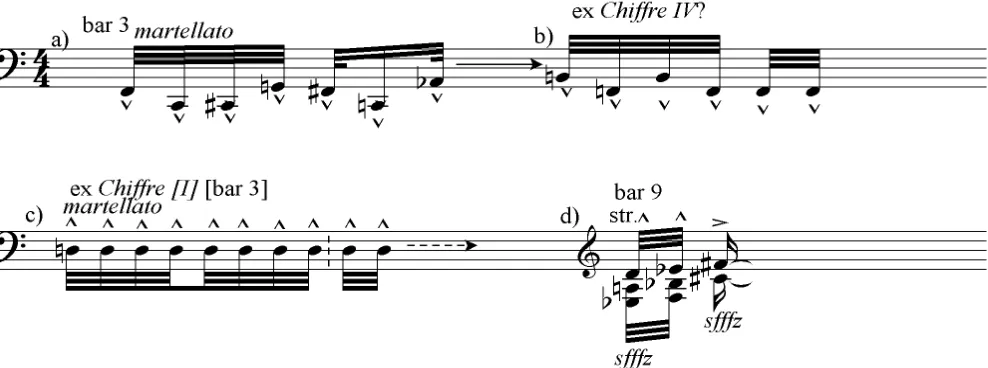
Although the work seems to divide naturally into the four sections detailed above, these divisions do not correspond to a formal structure any more than did the sections delineated in Chiffre [I] and II. Rather, they serve as a framework for the articulation of a collection of short motifs whose relationship with each other is constantly reconfigured throughout the piece, and which are recognisable in many cases not so much by pitch content as by rhythmic outline, as is demonstrated by the following simple example:
The motifs used in Chiffre VI are identified by the letters a) to d) (see Ex. 8b) with connections and variants
indicated. In this work the motifs are not invariant but change shape, length, and configuration on each
repetition. Knowledge of the exact nature of these alterations is not necessary for the purposes of this
discussion.
Ex. 8b: Chiffre VI – principal motivic elements a), b), c) and d)
Table 3 presents a motivic, chordal and focus pitch summary of the whole work. Chords are indicated in
Table 3 by the shorthand 'Ch', and although the Lenz chord (Ch1) is prominent at the outset, most of the
work is based on derivations of the third discrete chord heard: F#, G, G#, A/D, C#, E,F. Ex. 9a summarizes its progress through the work and gives an indication of how variant versions link to each other. From this it will be evident that the focus pitches F and E have an essential role to play in the chord generation process and therefore are the pitches around which the subsequent chords are repoled. These pitches are taken from the closing horn motif of Chiffre V, bb, f1 ,e2 a linear version of the Lenz chord. With
respect to the detail of the chordal components, these are presented in Ex. 9a for the principal chord complex of the work, chord 3 (Ch3) only, and, in Ex. 9b, for the progression of chords across the work.
The first chord (Ch1) is simply the pervasive Lenz chord, while Chord 2 (Ch2) is a chromatic trichord
Ex
. 9a: '
cho
rd
prog
ress
ion' in
Chif
fre VI
–
voice
le
adi
Ex.9b: chord progression in Chiffre VI for chords other than (Ch3)
Table 3: Motif, chordal and focus pitch analysis of Chiffre VI
BAR 1 2 3 4 5 6 7 8 9 10 11 12 13 14 15
Section 1 FocusPitch Chordal Ch1 LENZ Detached Ch1
inv. T8 Ch2 Ch1 inv.T11 T5- T9
---Ch2(+) --- Ch2(+)
Ch31
Motif (motif
derived) abac - ---- b, a d, b,a c c c c, b c c
Section
1 16 17 18 19 20 21 22 23 24 25 26 27
Focus
Pitch B
b--- --- --- F# E
Chorda
l Ch3
2 Ch2(+)
on Bb +
F#
- Ch33 Ch34 Ch35/Ch1
Ch35
Motif a c, b b c c
Pedal PEDAL C - - PEDAL C -
--Section 1
28 29 30
Focus Pitch
Bb
Chordal Ch35
Motif a,c c
Section 2
31 32 33 34 35 36 37
Focus
Pitch A--b
(D)
--- D
Chordal Ch36 Ch2(+)
Motif d --- a,
b c, b
Section
2 Focus Pitch 38 39 40(Strings 41 42 43
new?)
F# ---(c.f. b. 25)
---Chordal Ch1 ¦ Ch2
LENZT5+T9
Ch37 Ch2(+) --Ch1
T9
Ch4 ---(10 note)
---Motif b
Pedal C PEDAL---- --- C#, G -- PEDAL ---
---Section
3 Focus 44 45 46 47 48 49 50 51 52 53 54 55
Pitch F
#--- --- --- F#--- F/E
Chordal Ch4
-Ch1
(c.f. b.1)
----Ch35 (c.f. b. 24)
(c.f. b. 25)
Ch35 Ch38 Ch4 Ch
2
(c.f. bb. 13/39)
Motif c- c- a, b
Pedal -- PEDAL
C --- --- ---- -- ----
-Sect ion 3
56 57 58 59 60 61 62 63 64 65 66 67
Focus
Pitch (c.f. b.18) --- (c.f. bb.28/9) --EXT- ENDE
D (c.f. b. 30 inv.) (c.f. b. 28) F/E 12-note ¦
Chordal Ch6 Ch1/Ch1 Ch7 --- Ch39,Ch310
Motif c,b a, (b) a,b,c --- (b), c c
Pedal PEDA
L
C--- PEDAL C -- PEDAL C PEDAL C
---Section
4 Focus Pitch Eb----68 ---69 70 71Eb/A 72E/A 73(Bb) 74 75
Chordal Ch8 Ch2 Ch35
Ch2 --- Ch3
9
Tritones C,F#, D,Ab
Motif c b b, a (b)
Section
4 Focus Pitch 76 77 78G#--- 79 80 81 82 83
Chordal Ch2(+) Ch2(+)
[GP] E---
---Ch2(+) Ch9
Motivic content
There are the five principal elements which serve to bind the work together. The first and most obvious element is the recurrent demisemiquaver motivic figure with its three forms (a, b and c of Section 1). An
alteration of motivic element c) to include the dyad F, E at bar 13 is the catalyst for the change to the
semitonally-derived chord (chord 3) at b. 15 which then becomes the basis for almost all the chords heard thereafter (Ex. 9a). In particular, it connects bb. 24, 47, 49, 67 and 73 together. However, neither the
demisemiquaver passages nor the chords are completely new material. The pitch sequences Db, G, A (bb.
20–1) and B, Eb, C (bb. 58–9), for example, are components of arabesque sequences found at bb. 35–6 in
Chiffre V, which has clearly acted as the generative pole (Ex. 10):
Ex; 10: Comparison of pitch sequences between Chiffre V bars 35-6 and Chiffre VI bars 20-1, 58-9
Likewise the repeated pitch element of c) and the oscillating tritone dyad of b) are found in various places
through the cycle, including, for example, b. 43 in Chiffre IV (see Ex. 5). The chord at b. 68 in Chiffre VI
which underpins the first bar of the climax (chord 8 in Table 3) is not specifically related to the other
chords in the work, but it too has a precursor – the components are recognisable by their dyadic
Ex. 11: Chiffre V chord precursor of climax chord in Chiffre VI bar 68)
The two marked dyads in the lowest hexachord are the basis of significant chords throughout the earlier works and have their origin in Chiffre [I] [see Ex.1b, chord (e)].
Generating trichord
The second principal element of this work derives from manipulation of the generating trichord from the end of Chiffre V, itself a transposition of bb. 30–1 in Chiffre [I].
Ex 12: final linear trichord of Chiffre V compared to bb. 30-1 of Chiffre [I]
The trichord not only contains the F, E dyad which has such an important role in providing a unifying
factor for the pitch structures in Chiffre VI, but it also essentially provides the focal pitches for the horn
part. The most significant horn phrase occurs at 59-62 and is associated with the only rit. (and therefore
change of tempo)in the work:
This phrase has significance for the musical discourse on a number of levels: it is an extension of the trichord motif bb, f1, e2 which ended Chiffre V; it is an elaboration and repoling of the main motivic focus
of Chiffre VI and in particular of bb. 27–30; and it points forward to the final bar of the work where the strings have a rising chromatic scale46 in tetrachord clusters.
As suggested earlier, aural links between works in the cycle are made through the use of instrumental timbre. Thus the Eb clarinet in its highest register connects Chiffre VI with Chiffre II and
Chiffre V, the two other works in the cycle which use the instrument. Such aural links between the works
which transcend the actual pitches may constitute one of the chiffre Rihm had in mind, and they can
certainly be interpreted as signs (Zeichen). It is likely that the penultimate bar of Chiffre VI, which combines the contrabassoon's Bb3 for the last time with the Eb clarinet's 'slow painful [upward] glissando'
('langsames qualvolles Glissando'), is probably referential and may have some sort of (unknown) programmatic reference.
Instrumentation
The third principal unifying element is the connection between the deep instruments and the low dense
chordal writing typical of the piano parts in the earlier Chiffre works. Some brief sketches show Rihm's
original plan for this work was to have clarinet, bassoon and horn with five strings, but Rudolf Frisius47
implies that Rihm chose to retain the instrumentation of the Schubert octet, with two important changes: from bassoon to contra-bassoon and from clarinet to the extreme registers of bass clarinet and Eb clarinet. The two instrumental quartets, for most of the work, are therefore string quartet on the one hand and a bass quartet of bass clarinet, contra bassoon, horn and double bass on the other. This latter group is not only expressive of Rihm's love of deep low sounds but in this work functions as a substitute, in its absence, for the bottom register of the piano.
The climax of the work is reached when the bass clarinet switches to Eb and is immediately
directed to play 'only highest and ugliest tones' ('nur höchste und hasslichste Töne') in bar 68. The strings
tremolando which supports the build up to this climax is to be played 'strongest stress notwithstanding frenetic tremolo, when possible; always over three strings' ('stärkster Druck, trotzdem frenetisches Tremolo, wenn möglich; immer über drei Saiten').
Specific pitch connections with previous works in the cycle are articulated through instrumental disposition. The E2, B3 dyad in double bass at b. 16, was first heard in b. 43 of Chiffre [I] and it underpins
the repeat of that part of Chiffre [I] which follows letter B in Chiffre II. When it is heard in double bass at b. 69 at the climax of Chiffre VI it is overlaid with the chromatic trichord c1, c#1, d1tremolando just as it
46 The associated triplet semiquaver rhythm therefore also becomes an important unifying feature for the work (with the quaver triplets in the final bar as an augmentation).
was at letter B in Chiffre II. The deep chromatic trichord Bb3, B3, C2, with the Bb on contra-bassoon, heard
in Chiffre VI at bb. 6 and 12, is again from Chiffre II at letter M+5 (see Table 2). This latter is a good
example of hidden unity that can be gained from repoling since it is probably not particularly audible as a new version of the Chiffre II material, although there can be no question that it is as a study of the score reveals.
Focus pitches
The fourth principal element which underpins the whole work, and again is a typical feature of Rihm's writing, is the use of focus pitches. Often these pitches are isolated in unison or in octaves as discrete entities, and while they represent a point of harmonic and thematic stasis in the music they will normally have a dynamic envelope which ensures that the sound itself is not static.48 Although E and F are important
as generating pitches, the most significant of the focus pitches in Chiffre VI is the F# which at b. 25 functions as a point of stasis (and is marked 'like a breath' / 'wie ein Hauch') on bass clarinet doubled by double bass harmonic. Subsequently this pitch (at the same level) reappears at bb. 42–9 where it links
sections 2 and 3. The pitch Eb performs a similar function between sections 3 and 4 on the horn but this is
tied into the repoling of the horn's pitches eb2, e2, f2 from bar 61. Finally, the low cello C1 functions in the
manner of a pedal note, most obviously perhaps in section 1 (at bb. 10 to 13 and 19 to 21) but it is significantly present across bb. 60–2 and at the climax from 65–9.
Chord Density
The fifth element is the gradual increase in density of the chords towards the 10-note chord at bb. 41–4, structurally the mid-point of the work, and a point of harmonic stasis. I have delineated this as a sectional change since the third section of the work contains quite frequent repoled moments from Section 1 while at the same time building the chordal texture towards the 12-note climactic point at bb. 67–8. As Ex. 4 demonstrated this is the culmination of a gradual build-up of density from Chiffre III.
Tempo and Metre
As in Chiffre II tempo and metre have a largely static function. The default metre is, as usual, four
chromatic phrase on horn. As discussed in part 1 of this article, the tempo and metre almost always function in Chiffre VI as relatively fixed and stable elements round which the other elements change.
Soundsign
Articulation, rhythm, and dynamics
As is typical for Rihm, virtually every pitch in Chiffre VI has one or more performance direction, and every chord and arabesque has a dynamic marking. However the dynamics demonstrate a strongly circumscribed usage. With very few exceptions the markings are either ff or fff against pp or ppp with rapid crescendi (or
vice versa) between these two states. Articulation is dominated by sffz and sfffz markings. It is not, however, unusual in Rihm's work to have such dynamic extremes occurring in rapid succession, as
comparison with near contemporary works such as thefourth string quartet (1981) or Monodram (1983)
will show. What is unusual is the virtual absence of middle ground dynamics in the Chiffre cycle, but
particularly in Chiffre VI. This may have something to do with the missing piano in that, whereas registral
extremes were a key textural feature of Chiffre [I] and II, so dynamics in Chiffre VI are performing an analogous function in the absence of the piano: in Chiffre VI the dynamic polarities are substitutes for the registral polarities of the piano.
'
A sound transforms …'
One of the difficulties in presenting Rihm's work analytically is the fact that many of his musical ideas can be related together either thematically or harmonically, or both, but Rihm's writings suggest that there is an absence of intention in the compositional process. This implies that analysis concerned with process will only find 'accidental' relationships. And yet, visually (on the score) and aurally (in performance) we are conscious of repetition, of the repoling of material, even though the actual detail may be quite different
from previous occurrences. In Chiffre VI demisemiquaver arabesques clearly relate b. 3 with, among
others, b. 58 despite there being only a few direct pitch connections (e.g.C, F#, B). Likewise the chord at b. 15 links with b. 24 not just through dyadic overlap, but in the disposition of those dyads within the chord.
The problem then is whether this process can be effectively articulated in words. Since there is an element of chance in the writing, in the sense that an exact development is not intended, is it really
predecessor',49 there will be some kind of a relationship between the original sound and its transformer.
There exists therefore an essential contradiction between that position and the concept of 'spontaneous composition' with its inherent lack of intent.
In Chiffre VI, while the pitch content of chord 3 changes as the piece progresses, its essential outline does not. It dominates the second half of the first section, and at b. 24, the version of the chord attained at that point (Ch35 on Table 3), is placed in opposition to Chord 1 (the Lenz chord) whose role it
takes over both in terms of repoling/generating new versions of itself towards the climax, but also as a static entity punctuating the texture as at bb. 27, 28, 47, 49, and finally 70, where it is re-juxtaposed with
Chord 1, the Lenz chord, for the second time in the work, so creating a repoled moment which recalls bar
24. Chord 3 therefore functions throughout this work as a means of changing our perception of the musical content and consequently as it recurs throughout the piece it effectively transforms its predecessors even if we as listeners are not particularly conscious of this process taking place.
SoundScript
As discussed earlier, Rihm's programme notes for this cycle are symbolic and always say something about
the compositional imperatives of the particular work. There are two programme notes for Chiffre VI, both
printed in the volumes of Rihm's collected writings. The first speaks only of the process of writing ideas
onto paper, while the second is very short and terse: 'Dark sign. Grid. Blackened (repainted) Octet. Density
Hunger. In its way, burst.'50 The image of a blackened, repainted octet and the dark sign suggest that
Chiffre VI should be viewed not as a climax to the cycle but as its antithetical opposite (and possibly also of the Schubert octet, the other work performed in the concert). The climax reached in this work must be
heard as dark and unresolved: a hollow victory over the missing piano? 'Density hunger' seems to be
Rihm's way of describing the progress towards thicker, denser and deeper chords culminating in the climax
of b. 67 et seq. This is borne out by the programme note for the next work in the cycle – Chiffre VII –
which speaks of '(dis)integrated [or (dis)solved] and bright(er) signs, more open, in the direction of (lit:
'perspectively')melody',51 that is, a counterbalance to Chiffre VI.
49 'Ein Klang, der einem anderen Klang zeitlich folgt, formt seinen Vorgänger wirklich um' ('A sound, which temporally
follows another sound, really transforms its predecessor') from Mutation (Exkurse), in, Rihm Ausgesprochen, Vol. I, p. 159.
And what of the double sign/double meaning (doppelten Sinn)?52 Is this just an affectation, a
literary conceit useful because relating the work to an established tradition or an intellectual background gives the cycle a sense of depth and authority? It is certainly possible to view the use of the Pascal reference in this way, but Rihm says that these works were an attempt to find a new language. Indeed in the first of the Chiffre VI programme notes53 he articulates his search for 'the step aside' from the 'binding
Tradition in which one finds oneself' ('aus einer durchaus bündigen Tradition in der man sich befindet, den Schritt daneben zu tun'). It seems unlikely that he should wish to ally himself with part of that intellectual tradition whilst simultaneously trying to break out of it.
Envoi
The results of Rihm's search for 'a new means of expression' in the Chiffre works can perhaps best be
summarised by considering the ways in which these works exemplify sound being etched onto the
Klangraum and how this relates to the concepts of generative pole and repoling.
Although the Chiffre works are aphoristic in character, the elements of his musical vocabulary are
not substantially changed from earlier work. The piano figurations of Chiffre [I] and Chiffre II, for
example, are closely linked to those of Klavierstück 6 (1977–8) but recontextualised as moments of sound
which can be juxtaposed with, and opposed to, other musical ideas. The gestures of earlier works – even one as close in date to Chiffre [I] as the fifth quartet Ohne Titel (1981–3) – tend to be more continuous in nature. The discontinuity of sounds in the Chiffre works is counterbalanced by the increasing use of earlier material as generative poles round which new material is shaped. Continuity is achieved by the very act of
using repoled material such as demonstrated in the development of chordal density from Chiffre III to
Chiffre VI (Ex. 4).
The idea of a generative pole, rather than a thematic idea for example, allows Rihm to revisit material in different ways, and explains the role of Chiffre [I] inside Chiffre II. It could be said that the earlier work writes itself into the Klangraum of the later work and it is a realisation of the 'potential' of the
Klangraum that then opens up a new series of possibilities for the composer to explore. In Rihm's
Klangraum every sound has meaning and although this might certainly be part of his 12-note heritage returning in retranslated form, his increasing attention to the characteristics of every tone – duration, juxtaposition and above all dynamics and articulation – are integral to his view of the relationship of sounds in the 'space' they occupy.
The Chiffre cycle was not just a related series of works, it became an evolution, a path traced
through a Klangraum – a series of signs and symbols constantly recontextualised. A Chiffre is essentially a
52 See footnote 45.
sign and if there is a hidden meaning within the Chiffre cycle perhaps it is nothing more, nor less, than the search for that personal and unique musical identity. This may explain why the final work in the cycle, though started in 1985, was not completed until 1988. Chiffre VIII is a long slow coda to the rest of the cycle, a signing off at the end of a process of discovery. It is difficult, however, to hear/see all but the most general connections between Chiffre VIII and the rest of the cycle. The reason for this may be quite simple.
When Rihm began the Chiffre cycle he was certainly in search of a 'new means of expression' and while
there were many works written at the same time, it is the Chiffre works which are acknowledged as the
place where that search took place.54 One can interpret the unfolding of the cycle as a gradual progress
towards abstraction and detachment, which is never actually achieved, since a cycle by its very nature implies some semblance of continuity. There is an essential unity underlying the works in this cycle but it
is a unity borne of recontextualisation rather than repetition. Chiffre VIII may be nothing more than a
musical 'full stop' to the process in this particular cycle.
Rihm's interpretation of the nature of the cycle may be somewhat idiosyncratic but that was the purpose of the exercise after all: a reinterpretation of the concept as a means to an end. The works are all
Chiffre because they have meanings which transcend the music, and those meanings can be interpreted by
translation of the composer's use of Klang- words, as I have suggested. These can therefore be used as a
APPENDIX
Comparative data for the works of the Chiffre cycle
Title Instrumentation Duration Completed
Chiffre [I] 0,0,1(+ B.Cl.),1, 0,1,1,0, Pno, 0,0,0,1+1,1 [total = 8]
c8 min.
[CD 0012072KAI = 8 min. 51 sec.]
8.I.83
Chiffre II
Silence to be
Beaten
1(+Picc.),1(+C.A.),1(+Eb + B.Cl.),1(+
C.Bas), 1,1(+D Trp.),1,0, 2 Perc., Pno,
1,1,1,1,1 [15]
c14 min
[CD 0012072KAI = 12 min. 50 sec.]
10.IX.83
Chiffre III 0,C.A.,B.Cl.,1(+C.Bas), 1,B.Trp,1,0, 2
Perc, Pno, 0,0,0,2,1 [12]
c6 min
[6min. 56 sec.]
3.XI.83
Chiffre IV B.Cl., Vc, Pno [3] c9min
[CD 0012092KAI = 10 min. 20 sec.]
30.XII.83
Bild 0,0,0,0, 0,1 (+high Trp.),1,1, 2 Perc, Pno,
0,0,1,1,1 [9]
c9 min
[7 min. 20 sec.]
4.III.84
Chiffre V 1 (+ Picc.),1,1 (+Eb.Cl.),1, 1,1, Bass Trp,
1,0, 2 Perc, Pno, 1,1,1,1+1,1 [17]
c11 min
[?13 min]
15.X.84
Chiffre VI B.Cl.(+Eb Cl.), C.Bas., Hn, 1,1,1+1,1,1 [9] c6 min.
[5 min 48 sec or 4 min 53sec]
30.I.85
Chiffre VII 1 (+Picc.),1 (+C.A.),1,1 (+C.Bas),
1,1,B.Trp.,1,0, 2 Perc.,Pno, 1,1,1,1+1,1 [17]
c11 min.
[10 min 30 sec]
30.VII.85
Chiffre VIII B.Cl.,C.Bas.,Hrn,Trp., Pno, 0,0,0, 1+1,1 [8] C9 min. 1985/26.III.88
In the duration column the first duration is that which is indicated on the score and the second an actual duration for a performance. Where no CD is indicated the duration is taken from a recording of a broadcast held at the Sacher Foundation.
Note added pre-publication: a recent (2006) CD [cpo 777 169-2], Wolfgang Rihm, Chiffre-Zyklus, performed by musikFabrik, conducted by Stefan Asbury, has some rather different timings as follows:
[I] 9 min 31 sec
[II] 13 min 10 sec
[III] 9 min 10 sec
[IV] 8 min 46 sec
Bild (eine Chiffre) 7 min 56 sec
[VI] 4 min 43 sec
[VII] 9 min 38 sec
[VIII] 4 min 17 sec
Current location of sketch material:
The box numbers refer to the location, as at October 2006, of the sketches at Sacher Institute at Basle, while the page numbers refer to the draft index prepared by the author for each box. The sketch material is currently in process of being re-assigned to the individual folders for each work.
Chiffre [I] p5 BOX
Chiffre (II) p34, p41, p42 BOX
Chiffre III p41 BOX
Chiffre IV p42 BOX
Bild None yet found
Chiffre V p56, sketchbook 1982–89 BOX
Chiffre VI p55, (p56) sketchbook 1984–86 BOX
Chiffre VII p82, sketchbook 1982–89 BOX
Chiffre VIII p43 BOX
Tonspur p13, p77 SMALL BOX 1, p56 BOX
Bibliography
Adorno, Theodor W. Alban Berg: Master of the Smallest Link, trans. Juliane Brand and Christopher Hailey,
New York and Cambridge: Cambridge University Press, 1991.
Andraschke, Peter. Dichterischer Text und musikalischer Kontext, in Zum Verhältnis von Zeitgenössischer
Musik und Zeitgenössischer Dichtung, ed. Otto Kolleritsch. Vienna: Universal Edition 1988, pp. 84– 101.
Brodsky, Seth. 'Write the moment': two ways of dealing with Wolfgang Rihm 1. Musical Times vol.145 no.
1888 (Autumn 2004), pp. 57–71.
Brügge, Joachim. Zur Form und Ästhetik in Wolfgang Rihms drittem Streichquartett. Die Musikforshung
LII (1999), pp. 178–89.
Frisius, Rudolf. 'Werk and Werkzyklus', in Musiktexte 11 (1985), 17–20.
Frisius, Rudolf, Zum Chiffre Zyklus in Wolfgang Rihm: Komponistenportrait. Berlin: Berliner Festwochen
1988, pp. 13–18. (Programme booklet of the 38th Berliner Festwochen 29 and 30 October 1988).
Frisius, Rudolf. Wandlungen des musikalischen Denkens über Form und Struktur im Spiegel der Musik von
Wolfgang Rihm: Überlegungen am Beispiel von Chiffre I, in Wolfgang Rihm: Musik–Konzepte Sonderband X11/2004, ed. Ulrich Tadday. München: Richard Boorbeg Verlag, 2004, pp. 75–92, p. 154.
Hofer, Wolfgang, Triobeschreibung: Rihm, booklet notes to Wolfgang Rihm Trios 1969–94, CD, Kairos
0012092KAI 1999/2000, an interview with Wolfgang Rihm 10.3.2000, pp. 4–29 (English translation pp. 16–22).
Isser, Edward. 'The Semiotics of Acting: from Hieroglyphs to Ideograms'.
Kogler, Susanne. Momente der Sprachlosigkeit, in O Wort, du Wort Das Mir Fehlt, ed. Otto Kolleritsch. Vienna: Universal Edition 1999, pp. 230–252.
Nattiez, Jean-Jacques. Music and Discourse, trans. Carolyn Abbate. Princeton: Princeton University, 1990.
Nielinger-Vakil, Carola. Quiet Revolutions: Hölderlin Fragments by Luigi Nono and Wolfgang Rihm.
Music and Letters vol. 81 no. 2, (May 2000), pp. 245–74.
Pascal, Blaise. Gedanken über Gott und den Menschen, trans. Wolfgang Rüttenauer, Wiesbaden: Dietrichsche Verlagsbuchhandlung, 1947.
Phipps, Graham H., 'The Tritone as an Equivalency: A Contextual Perspective for Approaching
Schoenberg's Music', The Journal of Musicology, Vol. 4, No. 1 (Winter, 1985-86), pp. 51-69
Rihm, Wolfgang, uncatalogued sketches in various boxes, Paul Sacher Stiftung, Basle
Rihm, Wolfgang, catalogue of sketches, draft scores, and final scores, Paul Sacher Stiftung, Basle
Rihm, Wolfgang, non-commercial CD recordings from radio broadcasts of Chiffre [I] – VIII and Bild, Paul
Sacher Stiftung, Basle
Rihm, Wolfgang, Chiffre [I]. Vienna: Universal Edition, [no score number given], 1983 .
Rihm, Wolfgang, Chiffre II, Silence To Be Beaten. Vienna: Universal Edition, UE 17862, 1983.
Rihm, Wolfgang, Chiffre III. Vienna: Universal Edition, 17865, 1983.
Rihm, Wolfgang, Chiffre IV. Vienna: Universal Edition 17877, 1984.
Rihm, Wolfgang, Chiffre V. Vienna: Universal Edition, 18115, 1984.
Rihm, Wolfgang, Chiffre VI. Vienna: Universal Edition, 9/97, 1985.
Rihm, Wolfgang, Chiffre VIII. Vienna: Universal Edition, 19035, 1988.
Rihm, Wolfgang, Bild. Vienna: Universal Edition, [no score number given], 1984.
Rihm, Wolfgang. Ausgesprochen: Schriften und Gespräche, ed. Ulrich Mosch. Winterthur: Paul Sacher
Stiftung vols 6/1 and 6/2, 1997.
Rihm, Wolfgang, booklet notes to Chiffre I and Silence to be Beaten (Chiffre II), CD, Kairos 0012072KAI
1999/2000, pp. 10–11 (English translation pp. 16–17).
Rihm, Wolfgang. Interview by the author: 18 Nov 2000 Huddersfield Contemporary Music Festival. Private tape recording (on aspects of his compositional processes). (in press McGregor Richard,
Hunting and Forms: An Interview with Wolfgang Rihm, in Contemporary Music: Theoretical and Philosophical Perspectives, ed. Max Paddison and Iréne Deliège, Aldershot, Ashgate, expected 2007.
Rihm, Wolfgang. Offene Enden, ed. Ulrich Mosch. Munich and Vienna: Carl Hanser Verlag 2002.
Rihm, Wolfgang, Vor Bildern with an introduction by Ulrich Mosch, in Intermedialität: Studien zur Wechselwirkung zwischen den Künsten, ed. Günter Schnitzler and Edelgard Spaude. Freiburg im Breisgau: Rombach Verlag, 2004.
Schoenberg, Arnold, Structural Functions of Harmony, rev. ed.,tr. Leonard Stein, New York: W.W. Norton
and Co. 1969
Sloterdijk, Peter. Der generative Pol: Wolfgang Rihm in Gespräch mit Peter Sloterdijk (7.11.1988).
Österreichische Musikzeitschrift XLIV 6 (June 1989), pp. 281–6.
Urmetzer, Reinhold. Wolfgang Rihm. Stuttgart: Edition Patricia Schwarz, 1988.
Warnaby, John. Wolfgang Rihm's Recent Music. Tempo 213 (July 2000), pp. 12–19.
Williams, Alistair. 'Voices of the Other: Wolfgang Rihm's Music Drama Die Eroberung von Mexico'. in
Journal of the Royal Musical Association, vol. 129 part 2, 2004, pp. 240–271
[Compiler not credited] Drucksache N.F. 3 Wolfgang Rihm (Sketches for Elf späte Gedichte von Heiner