Geschke Center
Doctoral Dissertations Theses, Dissertations, Capstones and Projects
2012
De La Salle Christian Brothers' Experiences of
Catholic Identity in Higher Education in the
United States
Scott Anthony Kier [email protected]
Follow this and additional works at:https://repository.usfca.edu/diss Part of theEducation Commons
This Dissertation is brought to you for free and open access by the Theses, Dissertations, Capstones and Projects at USF Scholarship: a digital repository @ Gleeson Library | Geschke Center. It has been accepted for inclusion in Doctoral Dissertations by an authorized administrator of USF Recommended Citation
Kier, Scott Anthony, "De La Salle Christian Brothers' Experiences of Catholic Identity in Higher Education in the United States" (2012).Doctoral Dissertations. 44.
The University of San Francisco
DE LA SALLE CHRISTIAN BROTHERS’ EXPERIENCES OF CATHOLIC IDENTITY IN HIGHER EDUCATION
IN THE UNITED STATES
A Dissertation Presented to
The Faculty of the School of Education Department of Leadership Studies Catholic Educational Leadership Program
In Partial Fulfillment
of the Requirements for the Degree Doctor of Education
THE UNIVERSITY OF SAN FRANCISCO Dissertation Abstract
De La Salle Christian Brothers’ Experiences
Of Catholic Identity in Higher Education in the United States
Catholic identity is considered to be the single most important issue facing
Catholic higher education in the United States. Scholars (Burtchaell, 1998; Gallin, 1999;
Gleason, 1995; Heft, 2003; Marsden, 1994; O’Brien, 1994) have suggested that
sustaining Catholic identity and preventing secularization depends on the integration of
the Catholic intellectual tradition with the sponsoring religious congregation. The
Catholic identity often has been discussed in terms of the decreasing presence of various
signs and symbols of Catholicity. Additionally, the number of Catholics among the
student body, the number of required theology courses, and the role of the curriculum and
faculty, have been employed as measures of Catholic identity.
This qualitative study utilized virtual research methodology to explore the De La
Salle Christian Brothers’ personal experiences of Catholic identity in higher education in
the United States as the sponsoring congregation on their campuses. The researcher
interviewed 20 Brothers from four institutions of higher education regarding their
definitions of Catholic identity, their experiences of Catholic identity from an historical
and current-day perspective, as well as their visions of Catholic identity in higher
education in the future.
The study’s findings revealed that the Brothers experienced themselves as the
animators of Catholic identity at the institutions of higher education where they were
Catholic and Lasallian traditions; that, where Catholic identity is strong, the rituals and
practices of the Catholic faith are also a vital part of the religious life of the campus; that
presidential leadership is critical to the Catholic identity of the institution; and, that
aspects of the operations of the institution reflect a connection to Catholicism, including
the Catholic composition of the student body and faculty in terms of religious affiliation,
the integration of the curriculum within the Catholic intellectual tradition, and programs
that support the Catholic faith tradition.
This study provided research on Catholic identity from the personal voices of the
sponsoring religious congregation of institutions of higher education in the United States.
With decreasing vocations in religious life and, therefore, less religious present in
colleges and universities, an important segment of higher education, the voices of the
This dissertation, written under the direction of the candidate’s dissertation committee
and approved by the members of the committee, has been presented to and accepted by
the Faculty of the School of Education in partial fulfillment of the requirements for the
degree of Doctor of Education. The content and research methodologies in this work
represent the work of the candidate alone.
Scott A. Kier December 6, 2012 Candidate
Dissertation Committee
Gini Shimabukuro, Ed.D. December 6, 2012
Chairperson
Stephen Katsouros, SJ, Ed.D. December 6, 2012
DEDICATION
This doctoral dissertation is dedicated to
Kay and Dennis Urbaniak
and
ACKNOWLEDGEMENTS
A dissertation can be considered as the culmination of their doctoral journey, but I
consider this work to be my thank you to all the De La Salle Christian Brothers who have
made an impact on my life. With the exception of my parents and my brothers, the
Christian Brothers have been a part of my life the longest. I can honestly say their impact
on me has been profound.
I would first like to acknowledge and thank the Jesuit Community at the
University of San Francisco (USF) for providing the Ignatian Tuition Grant. The
financial support of this grant provided me the opportunity to achieve my dream of
earning my doctorate at a Jesuit institution of higher education.
The Institute of Catholic Educational Leadership (ICEL) at USF was my home
away from home for the last four years and the faculty and staff of ICEL are second to
none. Specifically, I am appreciative of all the support and friendship afforded to me
from Sarah Wannemuehler and Doreen Jones for making the Summer West experience
truly special. I am extremely fortunate to consider them as my friends as well as my
teachers.
The support I received from my colleagues at Saint Mary’s College of California
afforded me the opportunity to pursue this doctorate. I want to acknowledge the support
and counsel provided by Jane Camarillo. I am grateful to Jane for having the confidence
in my juggling the demands of my work and for providing me with a flexible schedule
during the last year so I could travel weekly to meet with my advisor. Also, a grant from
and universities and introduce my myself and the study. Without these visits, I am sure I
would not have received the participation of the Brothers that I did.
I am a “Brother’s Boy” and I am forever indebted to the Christian Brothers. My
journey with the Brothers began in 1979 when I was a freshman at St. Joseph’s Collegiate
Institute in Buffalo, NY, then professionally in Warren, MI, and now Moraga, CA. The
Brothers Communities at each of these schools opened their doors to me and I am
grateful for their hospitality and friendship over the years. The Brothers who I have met
and have become friends with throughout my life have shaped the person who I am
today. While they are too many to list, I would like to acknowledge Brothers Chris, Fred,
Gerard, Michael, Peter, William, Joe, Joseph, Tom, Brice, Stan, Louis, Charles, Ronald,
Richard, Dominic, and Mark.
I am sure every doctorate student considers their dissertation committee the best,
but I will put mine up against anyone’s and I am confident I am correct with my
assertion. Dan McPherson and Father Steve Katsouros provided wisdom, counsel, and
invaluable feedback throughout the proposal and writing process. I appreciated their
accessibility to answer questions as well as their flexibility when my proposal defense
date changed a couple of times. I am especially grateful that I had the opportunity to have
Gini Shimabukuro as my advisor. I was extremely fortunate to have someone as
thoughtful, caring, and understanding as Gini with me throughout this journey. I am
going to miss our technology conversations but look forward to coffee in Alameda.
Shortly after my pre-proposal meeting with my dissertation committee, I lost a
member of my committee, Brother Donald Mansir. More than just a committee member,
left too soon, but I know he was at my side throughout the writing and still accompanies
me on my life’s journey.
My final acknowledgment goes to my parents and my family. Mom and Dad, a
thank you does not even begin to convey how grateful I am to you for helping me and
being there throughout the journey. You nudged me along, encouraging me to remain
focused and to complete this degree, while life continued on. A special thanks also goes
to my family for accepting that “I have class” or that “I have to write” as an excuse for
not being present at events or not traveling as much as I would have liked. Time to make
TABLE OF CONTENTS
LIST OF TABLES ... xiv
LIST OF FIGURES ...xv
CHAPTER I: THE RESEARCH PROBLEM ...1
Statement of the Problem ...1
Background and Need ...3
De La Salle Christian Brothers ...5
Catholic Identity ...7
Purpose of the Study ...8
Theoretical Rationale ...8
Research Questions ...10
Significance ...10
Definition of Terms ...11
CHAPTER II: REVIEW OF THE LITERATURE ...13
Restatement of the Problem ...13
Overview ...13
Research on Catholic Identity ...14
Catholic Identity and Higher Education in the United States ...14
Historical Context of Catholic Higher Education in the United States ...14
Catholic Identity Contested ...18
The Roman Catholic Church Definition of a Catholic University ...19
The Status of American Catholics ...20
The Quest for Academic Excellence ...20
Upheaval within American Society ...21
Second Vatican Council ...22
Decline in Presence of Clergy and Religious ...23
Laicization of Boards ...23
Catholic Identity and the Catholic Church ...24
Land O’Lakes ...24
Ex Corde Ecclesaie ...26
Pope Benedict XVI and Catholic Identity ...28
Congregation for Catholic Education ...29
Research Studies on Catholic Identity in Higher Education ...31
Role of the Sponsoring Religious Congregation ...45
Summary ...50
CHAPTER III: RESEARCH METHODOLOGY ...52
Restatement of the Problem ...52
Research Design ...52
Qualitative Research ...52
Population ...56
Role of the Researcher ...59
Interviews ...60
Data Collection ...63
Data Analysis ...65
Validity and Reliability ...67
Background of the Researcher ...68
Limitations to the Study ...69
CHAPTER IV: FINDINGS ...71
Overview ...71
Demographics ...72
Summary of Demographic Variables ...75
Approach to Reporting the Findings ...76
Research Question 1 ...76
Catholic Ethos ...77
Roman Catholic Church ...78
School Mission ...79
Gospel Values ...79
Sacraments ...79
Religious Presence ...80
Academics ...80
Theology/Religious Studies Department ...81
Curriculum/Courses ...81
Faculty and Staff Hire/Composition ...82
Campus Life ...83
Student Admissions ...83
Campus Ministry ...83
Extra-Curricular Activities ...84
Religious Symbols ...84
Research Question 2 ...85
Presence of the Christian Brothers ...86
Animators of Catholic Identity ...86
Relationship with Students ...87
Catholic Institutional Ethos ...89
Roman Catholic Church ...89
Institutional Mission ...90
Faculty and Administrators ...91
Catholic Integration Within the Institution ...93
Curriculum ...93
Campus Ministry and Sacraments ...94
Visible Signs ...94
Research Question 3 ...95
Roman Catholic Church ...95
Lasallian Character ...98
Catholicity of the Institution ...99
Administration/Faculty/Staff Hiring ...99
Mission and Institution Identity ...100
Campus Programs ...102
Faculty/Staff Formation ...102
Campus Ministry ...103
Extracurricular Activities ...104
Research Question 4 ...104
Institutional Mission ...105
Lay Leadership ...106
Alignment with Roman Catholic Church ...106
Secularization of Institution ...107
Institutional Demographics ...108
Formation Programs ...109
Hiring for Mission ...109
Student Body ...110
Summary ...111
CHAPTER V: CONCLUSIONS, IMPLICATIONS, AND RECOMMENDATIONS ...115
Summary of the Study ...115
Conclusions ...118
Implications ...122
Recommendations ...123
Recommendations for Future Research ...123
Recommendations for Future Practice ...124
National Level ...124
Local Level ...125
Closing Remarks ...125
REFERENCES ...128
APPENDICES ...140
Appendix A: Letter to Brother Visitor Seeking Permission to Conduct Research with Christian Brothers in their District ...141
Appendix B: Signed Letters from Brother Visitor Granting Permission to Conduct Research with Christian Brothers in their District ...144
Appendix C: Email to the Brother Director Introducing Researcher Seeking Meeting with Brother’s Community ...151
Appendix D: Consent Form to Participate in Research ...153
Appendix E: Contact Form for Participant Information ...156
Appendix F: Email to the Christian Brother Inviting Participation in the Research Study ...158
Appendix I: Email to the Christian Brother Announcing Posting of
Initial Interview Questions ...165 Appendix J: Email to the Christian Brother Indicating Discontinued Use of
Online Blog and Providing Initial Set of Interview
Questions for Response ...167 Appendix K: Email to the Christian Brother Reminding of Initial
Interview Questions ...169 Appendix L: Email to the Christian Brother Containing Second Set of
Interview Questions ...171 Appendix M: Email to the Christian Brother Reminding of Second Set of
Interview Questions ...173 Appendix N: Email to the Christian Brother Containing Final Set of
Interview Questions ...175 Appendix O: Email to the Christian Brother Reminding of Final Set of
Interview Questions ...177 Appendix P: Email to the Christian Brother Announcing Closure of
Research Study ...179 Appendix Q: Email Thanking the Christian Brother for Participation in the
Research Study ...181
LIST OF TABLES
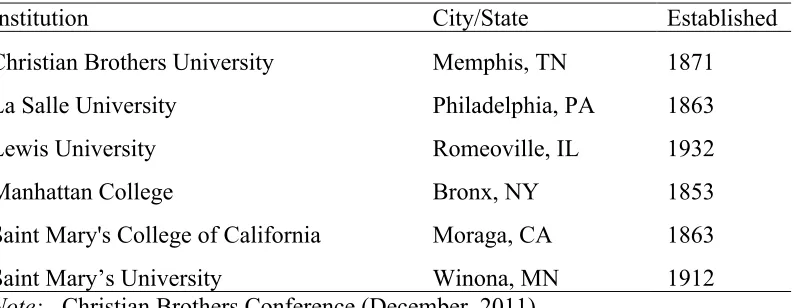
1 Lasallian Colleges and Universities in the United States ...56
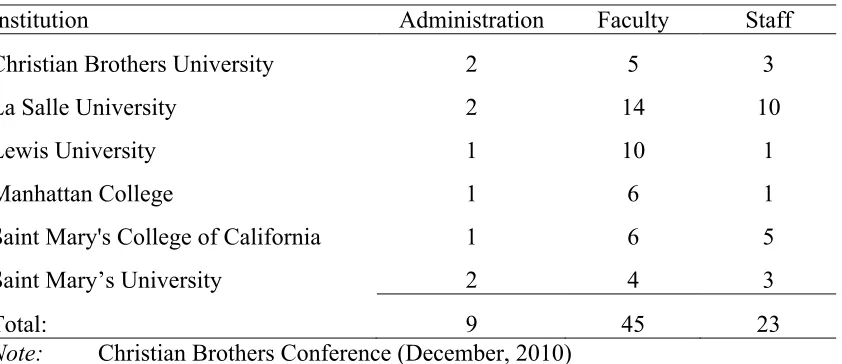
2 Christian Brothers at Lasallian Colleges and Universities in the
United States ...57
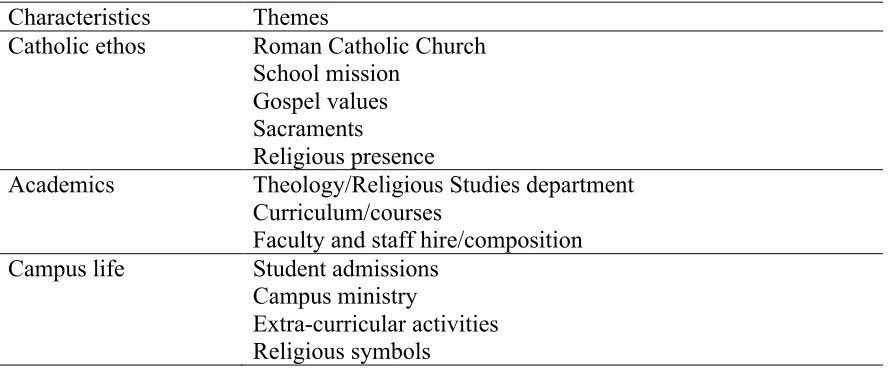
3 Characteristics and Themes Emerging From Findings Related to
Research Question 1 ...77
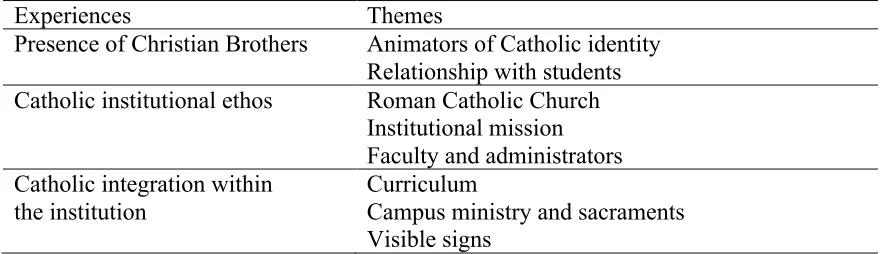
4 Experiences and Themes Emerging From Findings Related to
Research Question 2 ...85
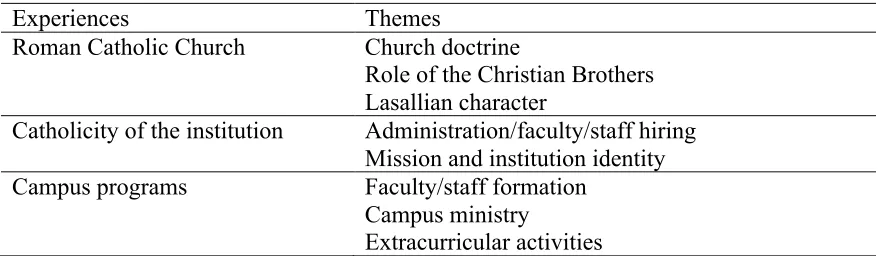
5 Experiences and Themes Emerging From Findings Related to
Research Question 3 ...96
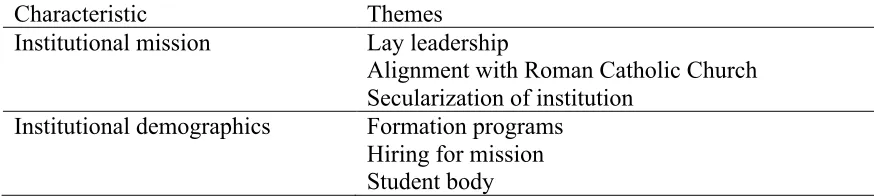
6 Characteristics and Themes Emerging From Findings Related to
LIST OF FIGURES
1 District Map of United States/Toronto Region of Christian Brothers ...55
2 Number of Years as a Christian Brother ...73
3 Number of Years as a Christian Brother in Higher Education ...73
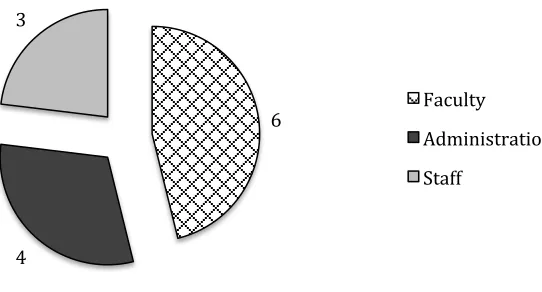
4 Last Assigned Position of Retired Brother Participants ...74
5 Current Assigned Position of Non-Retired Brother Participants ...74
CHAPTER I
THE RESEARCH PROBLEM
Statement of the Problem
Scholars (Burtchaell, 1998; Gallin, 1999; Gleason, 1995; Heft, 2003; Marsden,
1994; O’Brien, 1994) raised the question: Will Catholic institutions eventually lose their
distinctive identity and become secular? Many scholars have suggested that sustaining
Catholic identity and preventing secularization depends upon the integration of the
Catholic intellectual tradition and the tradition of the sponsoring religious congregation
(Buckley, 1998; Cernaro & Morgan, 2000, 2002; Curran, 1997; Gallin, 1999, 2000, 2002;
Hayes, 2000b; Heft, 2003; Hellwig, 1997, 2000a, 2002a; Hesburgh, 1994; John Paul II,
1990; Langan, 2000; O’Brien, 1994, 1997; Steinfels, 2003).
Additionally, the pursuit of academic excellence and other values of American
higher education, as well as the changes in the Catholic Church as the result of the
Second Vatican Council, have made the promotion of Catholic identity more complex
and challenging. The extent of this challenge was typified by Gleason (1995) who
claimed that American Catholic higher education faces a crisis: “The crisis is not that
Catholic educators do not want their institutions to remain Catholic, but that they are no
longer sure what remaining Catholic means” (p. 320). Daley (1993) asserted that the
issue of Catholic identity is the “most gnawing, and elusive question facing Catholic
universities today” (p. 7). In fact, Catholic identity is considered to be the single most
important issue facing Catholic higher education in the United States (Allen, 1999;
Daley, 1993; Gleason, 1992, 1995; Introcaso, 1996; Janosik, 1996; Morey & Piderit,
Philip Gleason (1992), a professor at the University of Notre Dame and a noted
historian of 20th century American Catholic higher education, commented on the identity crisis issue:
In one sense the amount of explicit attention devoted to the subject is in itself a significant response, for what it indicates is the recognition that something formerly taken for granted now has to be addressed as a problem requiring self-conscious and systematic attention. (p. 249)
Some historians in the Catholic Church and in Catholic higher education have questioned
whether Catholic colleges and universities have become too secular (Burtchaell, 1998;
Mardsen, 1994; Morey & Piderit, 2006). In case studies of Boston College, the College
of New Rochelle, and Saint Mary’s College of California, Burtchaell (1998) asserted that
these schools have abandoned their calling to ministries of the Catholic Church by
moving toward a less Catholic and more secular curriculum and identity. Gleason (1997)
maintained that “the debate over Catholic higher education illustrates a larger cultural
discourse about the changing meaning of being Catholic in the United States” (p. 26).
There is concern among some conservative Catholic groups that Catholic institutions of
higher education will follow the secularization path of the Protestant institutions, e.g.
Harvard (Greeley, 1990; Morey & Piderit, 2006). They fear for the loss of a distinctive
Catholic identity and traditions, similar to the experiences of many religious institutions
that have become secularized.
In a 2003 survey of 124 administrators at 33 Catholic colleges and universities in
the United States, Morey and Piderit (2006) found that 41% of religious and 26% of lay
presidents acknowledged a lack of clarity about Catholic intellectual traditions and
Catholicity. Trend analysis on the number of the founding religious groups present on
governing boards or among the faculty (Galvin, 1971; Maloney, 1973, Sullins, 2004), the
number of Catholics among the student body (Maloney, 1973), the number of required
theology courses (Maloney, 1973), or the number of liturgical opportunities available for
Catholic formation (Lucey, 1978) have been employed as measures of Catholic identity.
Others have discussed the role of the curriculum and the faculty in the Catholic identity
of the institution (Hehir, 1993; Holtschneider & Morey, 2000; Kennedy, 1992; Lyon,
Beaty and Mixon, 2002) and Janosik (1996) presented a synthesis of the wide variety of
views on what Catholic identity means.
Morey and Piderit (2006) noted that the disappearance of nuns, brothers, and
priests, would “drive Catholic institutions to make changes to assure the vitality of their
Catholic identity” (p. 7). Additionally, Morey and Piderit went so far as to claim that the
loss of nuns, brothers, and priests as a vital and visible presence on campuses may prove
fatal for the institutional Catholic character (p. 3).
Today, the Christian Brothers account for only 3.3% of all full-time faculty
members and 1.8% of full- and part-time professional staff in the institutions they
sponsor (Christian Brothers Conference, 2012). With an aging and diminishing
population of Christian Brothers present in the colleges and universities that they
sponsor, the rich diversity of the experiences of the Christian Brothers regarding Catholic
identity were those voices that this research intended to capture.
Background and Need
Unlike their Protestant counterparts, Catholics had neither the social nor the
critical mass through immigration did Catholics give serious thought to higher education
(Power, 1958). According to Gleason (1967), the early development of Catholic
education lagged behind others chronologically but, once begun with the founding of
Georgetown in 1789, embraced the same general purposes as other colleges. While there
may have been a remote connection to the intellectual life, the basic aims of the first
Catholic colleges were to prepare boys for the priesthood, to create centers for missionary
activity, and to cultivate in boys and young men the moral virtues (Power, 1958).
Catholic bishops, the leaders of the local churches, encouraged the growth of
colleges, but religious congregations of priests, brothers, and sisters founded and staffed
most of the institutions (Power, 1958). Georgetown and St. Louis became the first of
many colleges that bore the influence of Jesuits. Historians suggested that the Jesuit
influence may have been the strongest and most lasting on Catholic higher education
(Gleason, 1995; Power, 1958). Currently, in the United States, the Jesuits sponsor 28
colleges and universities, the largest number of institutions connected with any
sponsoring religious congregation. In contrast, the Christian Brothers sponsor six
colleges and universities in the United States. Although they represented a minority and
were generally not included in early studies (Haynes, 2002; Rudolph, 1968), Catholic
colleges and universities currently enroll half of the students attending church-related
institutions. The 2011 membership report of the Association of Catholic Colleges and
Universities (ACCU) included 244 Catholic degree-awarding institutions with more than
De La Salle Christian Brothers
The Institute of the Brothers of the Christian Schools, known in the United States
as the Christian Brothers or, more recently, the De La Salle Christian Brothers, was
founded in France in 1680 by Saint John Baptist de La Salle. Declared by Pope Pius XII
to be the patron saint of those who teach young people, de La Salle wished the members
of his Institute to be devoted entirely to the work of Christian education in the schools
(Salm, 1996). For that reason, he made it a rule that his Brothers would never aspire to
Holy Orders, and he would not even allow them to teach or study Latin (Poutet &
Watson, 1997). The Brothers’ mission has been “to provide a human and Christian
education to the young, especially the poor, according to the ministry entrusted to them
by the church” (Brothers of the Christian Schools, 2011, p. 12). The Congregation has
engaged in the apostolate of educating the poor throughout its 300 year history. It is a
ministry that “has the school as its setting, the teacher and the student as its focus, and the
salvific potential of education as its inspiration” (Brothers of the Christian Schools, 2011,
p. 4).
Prior to founding the Institute, John Baptist de La Salle was a canon of the
metropolitan church of Rheims, France. In order to carry out the last will of his spiritual
director, Canon Roland, he first busied himself with consolidating a religious
congregation devoted to the education of poor girls (Salm, 1996). He, then, seconded the
efforts of a zealous layman, Adrien Nyel, to multiply schools for poor children. Thus, he
was led to create an Institute that would have no other mission than that of Christian
The spirit of the Institute, infused by the example and teachings of its founder and
fostered by the exercises of the religious life, is a spirit of faith and of zeal. The spirit of
faith induces a Brother to see God in all things, to suffer everything for God, and above
all to sanctify himself. The spirit of zeal attracts him towards children to instruct them in
the truths of religion and penetrate their hearts with the maxims of the Gospel, so that
they may make it the rule of their conduct. St. John Baptist de La Salle had himself given
his Brothers admirable proofs of the purity of his faith and the vivacity of his zeal (Salm,
1996).
Salm (1996) noted that La Salle pointed out that the zeal of a religious educator
should be exercised by three principal means: vigilance, good example, and instruction.
Vigilance removes from children a great many occasions of offending God; good
example places before them models for imitation; and, instruction makes them familiar
with what they should know, especially with the truths of religion. Hence, the Brothers
have always considered catechism as the most important subject taught in their schools.
They are, therefore, in accordance with the spirit of their Institute, religious educators: as
religious, they take the three usual vows of poverty, chastity, and obedience; as
educators, they add the vow of teaching the poor gratuitously according to the
prescriptions of their rule, and the vow of remaining in their Institute, which they may not
leave of themselves even for the purpose of joining a more perfect order.
Since the founder’s time, the ministry of the Brothers has extended from an
almost exclusive commitment to primary schools to educational institutions and
enterprises of various kinds. The original purpose of the Institute itself was the schooling
establishment, the Institute of the Brothers of the Christian Schools sponsors Lasallian
educational institutions worldwide that range from primary education to teacher training
programs to advanced institutions of higher education. The De La Salle Christian
Brothers are members of a worldwide educational movement of more than 1,000 teaching
establishments within which 6,000 Brothers and 100,000 Lasallian Partners teach
approximately a million children, young people, and adults in 82 countries (Casa
Generalizia FSC, 2012).
Catholic Identity
Whereas some institutions of higher education had been accused of being “too
Catholic” in the 1950s, the charge in the 1960s was that the institutions were not Catholic
enough (Hassenger, 1967). Gleason (1967) suggested that a new question based in the
institution’s basic reason for existence challenged the Catholic college and university and
startled the academic community. Despite concerns about quality, there had never before
been doubts about why American Catholic higher education existed (Gleason, 1967;
O’Brien, 1994). Gleason (1995) characterized the identity issue as an enduring problem
rather than a crisis, stemming from a
…lack of consensus as to the substantive content of the ensemble of religious beliefs, moral commitments and academic assumptions that supposedly constitute Catholic identity and a consequent inability to specify what that identity entails for the practical functioning of Catholic colleges and universities. (p. 330)
In the early years of the 21st century, questions about Catholic identity persisted (Gallin, 2000; Hellwig, 2002b). According to Hellwig (2002a), a few scholars
proclaimed that the era of Catholic higher education was over; some advocated for tighter
more forthright statement of Catholic character, identity, and purpose of the institution
both in words and in operational values” (Hellwig, 2002a, p. 109).
Purpose of the Study
The purpose of this qualitative study was to explore the De La Salle Christian
Brothers’ personal experiences of Catholic identity in higher education in the United
States as the sponsoring congregation of these campuses. With an aging and diminishing
population of Christian Brothers present in the colleges and universities that they
sponsor, the rich diversity of the experiences of the Christian Brothers regarding Catholic
identity were those voices that this research intended to capture. Initially, the researcher
explored the Brothers’ personal characterizations of Catholic identity. Then, this study
examined the Brothers’ personal experiences of Catholic identity in higher education
from an historical, as well as a current day, perspective. Finally, the researcher invited
the Brothers to envision the future of Catholic identity in higher education. For this
qualitative study, the researcher utilized virtual research. The virtual research allowed
the researcher to include the experiences of the Christian Brothers assigned to various
institutions of higher education in the United States sponsored by the Brothers.
Theoretical Rationale
Considered one of the leading approaches to qualitative research, grounded theory
(Denzin & Lincoln, 1994; Padgett, 2004; Shank, 2002) was first articulated by Barney
Glaser and Anselm Strauss in 1967. Glaser and Strauss (1967) described their method
succinctly as “…the discovery of theory from data systemically obtained from social
research” (p. 2). Originally, the authors advocated the discovery, rather than the
Gradually, Glaser and Strauss moved in different directions and other researchers
further nuanced their original work; however, Glaser, Strauss and Corbin remained the
predominant voices in the grounded theory approach (Charmaz, 2000, 2002; Denzin &
Lincoln, 2000; Ryan & Bernard, 2000; Shank, 2002). Strauss became primarily
associated with Julien Corbin whose background was nursing science. Their
methodology moved to a behaviorist rather than an interpretist position. According to
Charmaz (2000), Glaser criticized Strauss and Corbin for forcing data and for stressing
the verification rather than the generation of theory.
A brief summary of the constructivist approach articulated by Charmaz (2000)
will explain the way in which grounded theory was used in this study. Charmaz,
described by Strauss and Corbin (1997) as an “extremely skilled researcher who has
always used grounded theory in her highly regarded work” (p. 35), maintained that the
work of both Glaser and Strauss and Corbin rested on a foundation of positivistic
objectivism. She contended that these originators of grounded theory assumed that there
is an objective, external reality and that researchers maintain distance from the reality,
accessing it and writing about it as “distant experts” (p. 153). The researcher’s
perspective is not part of the meaning-making process; the researcher does not
necessarily probe for “views and values” and the multiple meanings and perspectives
underneath what is viewed and heard (Charmaz, 2000, p. 525). In contrast,
Charmaz (2000) contended that the grounded theory approach is sufficiently
flexible and broad to include “both objectivist and constructivist visions” (p. 528). In
fact, both Glaser and Strauss (1967) and Strauss and Corbin (1994) recommended
adaptability and flexibility in the application of the grounded theory methodology.
Accordingly, this study adopted the constructivist approach to grounded theory.
Research Questions
To document the voices of the Christian Brothers’ regarding their experiences of
Catholic identity in higher education in the United States, this study examined the
following research questions:
1. How do De La Salle Christian Brothers characterize Catholic identity in higher
education?
2. Historically, what have been the De La Salle Christian Brothers’ personal experiences
of Catholic identity in higher education?
3. Currently, what are the De La Salle Christian Brothers’ personal experiences of
Catholic identity in higher education?
4. With regard to the future, how do De La Salle Christian Brothers envision Catholic
identity in higher education?
Significance
This study provided research on Catholic identity from the personal voices of the
sponsoring religious congregation of institutions of higher education in the United States.
This grounded theory study added to the research related to the issues of Catholic higher
members of their congregations. Researchers may replicate this study at other colleges
and universities, giving voice to the sponsoring religious congregation’s members
regarding their experiences of Catholic identity.
In addition, an important segment of American higher education, Catholic
colleges and universities, may benefit from understanding the experiences of the
sponsoring religious congregation in regard to Catholic identity. Generally, many in
Catholic higher education believe that their institutions are quickly becoming secularized,
losing their sense of a Catholic or religious order identity (Morey & Pideritt, 2006). With
decreasing vocations in religious life and, therefore, less religious present in colleges and
universities, an important segment of higher education, the voices of the sponsoring
religious congregation, may be lost forever.
Definition of Terms
Blog: “A popular abbreviation for weblog, it is a type of web-page that is, in the ideal, frequently updated, and which consists of dated entries arranged in reverse chronological order” (Kozinets, 2010, p. 189).
Christian Brothers: For the purpose of this study, Christian Brothers will refer to the Institute of the Brothers of the Christian Schools (also known as Lasallian Christian Brothers, French Christian Brothers, or the De La Salle Brothers) as opposed to the Congregation of Christian Brothers.
Holy Orders: In the Catholic Church, a bishop, priest, or deacon, who has received the Sacrament of Ordination.
Lasallian: “An adjective used to describe whatever is in the Brothers’ heritage or
traditions as initiated by [St. John Baptist] De La Salle; more recently also used as a noun to name those who share in the mission and heritage of the Institute” (Van Grieken, 1999, p. 197).
Priest: In the Catholic Church, an ordained minister who has the authority to perform rites and administer sacraments.
Second Vatican Council: Also known as Vatican II, the 21st Ecumenical Council of the Catholic Church addressed relations between the Roman Catholic Church and the modern world. It opened under Pope John XXIII on October 11, 1962 and closed under Pope Paul VI on December 8, 1965.
CHAPTER II
REVIEW OF THE LITERATURE
Restatement of the Problem
Catholic identity is considered to be the single most important issue facing
Catholic higher education in the United States (Allen, 1999; Daley, 1993; Gleason, 1992;
Gleason 1995; Introcaso, 1996; Janosik, 1996; Morey & Piderit, 2006; O’Brien, 1994).
Many scholars have suggested that sustaining Catholic identity and preventing
secularization depends upon the integration of the Catholic intellectual tradition and the
tradition of the sponsoring religious congregation (Buckley, 1998; Cernaro & Morgan,
2000, 2002; Curran, 1997; Gallin, 1999, 2000, 2002; Hayes, 2000b; Heft, 2003; Hellwig,
1997b, 2000, 2002a; Hesburgh, 1994; John Paul II, 1990; Langan, 2000; O’Brien, 1994,
1997; Steinfels, 2003). Morey and Piderit (2006) went so far as to claim that the loss of
nuns, brothers, and priests as a vital and visible presence on campuses may prove fatal for
the institutional Catholic identity (p. 3). With an aging and diminishing population of
Christian Brothers present in the colleges and universities that they sponsor, the rich
diversity of the experiences of the Christian Brothers regarding Catholic identity were
those voices that this research intended to capture.
Overview
The researcher will first provide an overview of the history of American Catholic
higher education and an exploration of Catholic identity. Then, the topics of Catholic
identity and Catholic Church documents are reviewed. The third section explores the role
of the sponsoring religious congregation in preserving Catholic identity in higher
Research on Catholic Identity
Catholic identity is one of the most critical and frequently explored issues in
American Catholic higher education (Curran, 1997; Gallin, 1992, 1999, 2000; Gleason,
1995; Heft, 2003; Hellwig, 1997, 2000, 2002a, 2002b; O’Brien, 1994; Stenfels, 2003).
Between 1965 and 1995, there were at least 255 doctoral dissertations related to Catholic
identity in Catholic colleges and universities (Janosik, 1996). Over the past 20 years,
approximately half of the articles in Current Issues in Catholic Higher Education, the journal of the Association of Catholic Colleges and Universities, considered some aspect
of Catholic identity. Since 1990, the Lily Endowment and other foundations have
allocated more than 15 million dollars to colleges and universities investigating
church-related identity and how to maintain it (Gallin, 2002; Mahoney, Schmalzbauer, &
Youniss, 2000).
The volume of writings on Catholic identity makes it impossible to review all the
literature. Therefore, the review of articles on Catholic identity concentrates on
publications since 1990, the year that Pope John Paul II delivered the Apostolic
Constitution Ex Corde Ecclesiae, the document defining Catholic identity in higher education.
Catholic Identity and Higher Education in the United States
Historical Context of Catholic Higher Education in the United States
In order to understand Catholic higher education in the United States, an historical
context of Roman Catholics in the United States is necessary (Greeley, 1967; O’Brien,
1994). Roman Catholicism was illegal in most of the American colonies, and the
1955; Power, 1958). Considered outsiders by the dominant Protestant population,
Catholics lived and socialized together (Mahoney, 2003; Schier & Russett, 2002). To
safeguard the faith and develop and preserve a Catholic sub-culture, Catholic elementary
schools and eventually Catholic high schools were established (Power, 1958). In 1884,
American Catholic bishops mandated the establishment of an elementary school in every
Catholic parish and instructed Catholic parents to send their children to these schools
(Heft, 2003). Although not part of the diocesan system of Catholic education, Catholic
colleges aimed to support the growing Catholic immigrant population and to protect the
faith of Catholic young men and eventually young women (Curran, 1997; Fogarty, et.al.,
1996; Gleason, 1995; O’Brien, 1994; Power, 1958; Stenfels, 2003). The Catholic Church
set unambiguous boundaries; Catholic education offered a cohesive vision of life and
protected Catholics from the modern world (O’Brien, 1994).
The distinctiveness of the Catholic college, that is its difference from other
American colleges, contributed to the preservation of the Catholic sub-culture (Gallin,
2000; Gleason, 1995). Unlike other American colleges that followed the English model
separating secondary and collegiate work, Catholic colleges adhered to the French and
German models that combined secondary and college (Power, 1958). This model
incorporated a modified version of the Jesuit Ratio Studiorium (plan of studies) developed in 1599, with a structured and coherent curriculum emphasizing Latin and
Greek classics, rhetoric and grammar, mathematics, natural science, literature, modern
languages, English, history, geography, and philosophy (Gleason, 1995; Power, 1958).
1967), the elective system had no place in Catholic colleges for more than 100 years
(Power, 1958; Rudolph, 1968).
For the first century, Catholic colleges also rejected the need for research,
believing it was more appropriate to pass on an accepted tradition rather than to engage in
the creation of new knowledge (Fogarty et al., 1996; Heft, 2003). However, in the last
decades of the 19th century, it became apparent that Catholic colleges needed to examine emerging ideas in science, philosophy, and biblical studies in light of their own faith
tradition (Gleason, 1995). After extended debate, the Catholic University of America
was founded in 1889. The Catholic University struggled to establish itself as a scholarly
forum integrating faith and the intellectual and cultural dimensions of the world.
However, politics, divergent ideologies, and competition for students created problems
for the new institution (Gleason, 1995).
Debates surrounding the university were eclipsed by controversies related to
Americanism and Modernism. Gleason (1995) analyzed the meaning and impact of both
“isms.” Expressed simply, Americanism suggested that the Catholic Church should
accept the best of modern thinking, integrate it with traditional belief, and use the newly
constructed belief system for the Church’s evangelizing mission. Modernism attempted
to examine philosophy, theology, and biblical exegesis in light of modern thought and
research. In 1899, Pope Leo XIII condemned Americanism, and in 1907 Pope Pius X
condemned modernism. These papal announcements also silenced faculty members who
attempted to integrate modern thought with traditional Catholic Church teaching
(Gleason, 1995). Such actions eventually led scholars to question whether it was possible
committed to “intellectual freedom and methodological skepticism” (O’Brien, 2002, p.
1).
In addition to internal ideological struggles connected with The Catholic
University of America and Americanism and Modernism, Catholic colleges also
struggled with external challenges to the quality of their academic offerings (Gleason,
1995; Mahoney, 2003). In 1892, Harvard refused to admit Boston College students
without examinations to its law school. In 1913, the North Central Association listed
Notre Dame as the only Catholic accredited institution, and the American Medical
Association accorded a satisfactory ranking only to St. Louis Medical School. Such
challenges led Catholic colleges to concentrate on curricular revision and issues of
standardization and accreditation (Gleason, 1995; Mahoney, 2003; Power, 1958). Much
later, Burtchaell (1998) identified the increasing focus on academic excellence,
disciplinary specialization, and accreditation as factors in the secularization of
church-related colleges.
During the first 160 years of Catholic higher education in the United States, even
as Catholic colleges and universities addressed challenges to their academic quality, there
was no doubt about the Catholic identity of the Catholic college (Gleason, 1995; O’Brien,
1994). The philosophy of St. Thomas Aquinas, also designated as Scholasticism,
Neoscholasticism, and Thomism (Gleason, 1995), was the basis for Catholic intellectual
formation and the principle for the integration of the Catholic intellectual tradition into
the Catholic college undergraduate curriculum (Gleason, 1995, 1997; Mahoney, 2003;
colleges and universities. The 1917 Code of Canon Law of the Roman Catholic Church
confirmed Thomas Aquinas as the pre-eminent voice for the Catholic tradition. By 1927,
speakers at the college division of the National Catholic Educational Association had
endorsed the philosophy of Aquinas as the rational grounding for the Catholic faith and
life (Gleason, 1995).
During this time in the early 20th Century, religious formation consisted of catechetical instruction, required participation in prayer and liturgical experiences, and
pastoral support services (Gallin, 2000; Gleason, 1995; O’Brien, 1994; Power, 1958).
The study of theology as an academic discipline was reserved for seminaries. The
Catholic Action movement provided the model through which students in Catholic
colleges engaged the Catholic faith with contemporary social, economic, and cultural
issues (Carey, 1999; Gleason, 1995, 1997; Mahoney, 2003). For many Catholics, the
presence of religious and priests on the campus also ensured the Catholic identity (Heft,
2003; Hellwig, 2000b). Because the externals of Catholic life, worship, and observance
were highly visible on Catholic college campuses, Catholic identity was not questioned
(Curran, 1997; Gallin, 2000; Gleason, 1995; Hellwig, 2002b; O’Brien, 1994; O’Meara,
1994).
Catholic Identity Contested
The portrait that most authors painted of Catholic higher education prior to World
War II revealed little cause for concern about the Catholic character of the institutions.
However, after 1949, questions of the institution’s Catholic character began to emerge
(Hellwig, 2002b). Some of the questions stemmed from within the Catholic Church and
The “near mania for excellence” that emulated standards set by secular universities
caused some institutions to lose their Catholic character (Gleason, 1995, p. 295). Still
other concerns emerged from changes in society and culture in the years following World
War II. Many associated the dilemma about Catholic identity with the changes that
swept through the Church in the wake of the Second Vatican Council.
The Roman Catholic Church Definition of a Catholic University
Several authors (Gallin, 2000; Gleason, 1995; Hellwig, 2002b; O’Brien, 1994)
described a concern about Catholic identity stemming from the official Vatican
understanding of Catholic higher education in the middle of the 20th Century. In 1949, the International Federation of Catholic Universities (IFCU) was created to promote
collaboration with the Vatican, the United Nations Educational, Scientific, and Cultural
Organization (UNESCO), and the International Association of Universities. The IFCU
gave Catholic universities a voice in international affairs. The statutes of the IFCU
defined the Catholic university as an institution erected or governed by the Roman
Catholic Church, that is, the Vatican. Within the American Catholic higher education
system, only The Catholic University of America met this description. In contrast to the
Vatican definition, the American experience of Catholic higher education embraced the
concept of institutional autonomy ensuring the institution freedom from outside control,
including control by ecclesiastical leaders, in such matters as hiring, policy formation,
and curriculum development (Gleason, 1995). To respect the reality of American
Catholic colleges and universities, the IFCU revised its statutes and membership
However, the original definition remained a source of difficulty between the IFCU and
the Vatican.
The Status of American Catholics
The historical situation of American Catholics also impacted Catholic identity.
By the end of World War II, American Catholics were no longer struggling immigrants
on the fringes of American society (Gleason, 1967). O’Brien (1994) described the
decline of the American Catholic subculture: The Catholic blue collar, low income
immigrants of the 1930s were replaced in the years following World War II by
economically secure professionals. The advancement and acculturation of American
Catholics were reflected in the growth of American Catholic colleges (Fogarty et al.,
1996; Greeley, 1967). Between 1940 and 1960, U.S. Catholic colleges and universities
increased from 193 to 231, the number of faculty members grew from 13,142 to 24,255,
and, enrollments surged from 162,000 to more than 426,000 (Gleason, 1995).
Increasingly, lay women and men educated in secular universities joined the faculties of
Catholic colleges (Carey, 1997, 1999; Curran, 1997; Greeley, 1967). As Catholics
entered mainstream American society and culture, Catholic colleges and universities no
longer needed to serve as a protective counter-culture (Curran, 1997; Gallin, 2000;
Gleason, 1995; O’Brien, 1994).
The Quest for Academic Excellence
Between 1940 and 1960, a time of growth in college enrollments and the
increased desire for higher education among an upwardly mobile Catholic population,
historian John Tracy Ellis (1955) criticized American Catholic colleges and universities
contended that Catholic colleges and universities stressed moral development but failed
to cultivate intellectual excellence. Although this was not the first criticism of the
intellectual vitality of American Catholic higher education, Ellis’s indictment provoked
unprecedented efforts to raise academic standards (Fogarty et al., 1996; Gallin, 2000;
Gleason, 1995; O’Brien, 1994; Rehner, 1989; Shelley, 1995). Catholic colleges and
universities joined other American institutions of higher education in a renewed quest for
excellence precipitated by scientific exploration, the National Defense Education Act,
and the Rockefeller Fund report, The Pursuit of Excellence (O’Brien, 1994). However, the focus on academic excellence ignored one of Ellis’s main points: Catholic educators
had neglected to develop and share the distinctive Catholic intellectual heritage (Gallin,
2000; Gleason, 1995; O’Brien, 1994). In the pursuit of excellence according to the
standards of secular American universities, Catholic institutions may have “shut out, at
least temporarily, some of the wisdom resident in their own rich tradition” (Gallin, 2000,
p. 110).
Upheaval Within American Society
The decade of the 1960s was an era of questioning and challenge that impacted
individuals, society, and institutions. The list of issues and causes was endless, such as
civil rights, the Vietnam War, women’s rights, and the rights of students. Underlying the
issues were fundamental questions about human, political, and academic freedoms
(O’Brien, 1994). The Catholic campus was not immune to the resulting upheaval on
college campuses across the nation (Curran, 1997; Gallin, 2000; Gleason, 1995; O’Brien,
1994). In addition to the problems faced by society in general, the Catholic college faced
the religious presence within faculties, administrations, and boards of colleges and
universities; and the challenges to academic freedom.
Second Vatican Council
The Second Vatican Council (October 1962 to December 1965) was a noteworthy
event in the relationship of the Catholic Church and Catholic higher education,
specifically the Council’s deliberations and decrees related to religious freedom, the role
of the laity, and ecumenism (Gallin, 2000). The Council decentered the Church,
proclaiming that the Church’s life was meant to be within, and not apart from, the life of
the entire human family (Mahoney, 2003; O’Brien, 1994). Such an understanding of
church and what it meant to be Catholic replaced the vision of a Catholic counter-culture
with the vision of a Catholic community within and in dialogue with all cultures.
Gaudium et Spes or The Pastoral Constitution on the Church in the Modern World (Paul VI, 1965) became the “magna carta” for Catholic higher education, encouraging a study
of human sciences, inter-religious dialogue, service to society, and respect for all cultures
(O’Brien, 1994, p. 49). The relationship between the Church and Catholic colleges and
universities shifted from a juridical context to a collegial community characterized by
trust, mutual exchange, and genuine dialogue (Gannon, 1987). In response to the
Council’s affirmation of ecumenism and inter-religious dialogue, Catholic colleges
diversified their curricular offerings and recruited faculty members with other-than
Catholic viewpoints (Carey, 1999; Gallin, 2000; O’Brien, 1994; Steinfels, 2003). Gallin
(2000) observed that ecumenical outreach “added to the richness of faculty competencies
and insights, but it also diminished the number of now-tenured faculty with a deep
Decline in Presence of Clergy and Religious
In the wake of the Second Vatican Council, religious congregations experienced a
decline in their membership. Many of those who remained questioned the purpose of
institutional ministries and opted for more direct forms of service, choosing involvement
in works related to civil rights, peace, and poverty (Hellwig, 2000a). The movement
away from service in Catholic colleges and universities by many priests and religious
affected morale within the institutions and increased confusion about identity and
purpose (Heft, 2003). The decreasing presence of religious in Catholic colleges and
universities also contributed to ambiguity because the canonical status of Catholic
institutions flowed through their connection with religious congregations (Gallin, 2000).
The departure of priests and religious from college campuses created an imbalance that
impacted Catholic identity. Holtschneider and Morey (2000) observed that in the late
1960s and 1970s, “with a core group of congregation members highly visible and
involved in campus life,” other faculty members of other denominations were hired to
bring “diverse intellectual and faith perspectives” (p. 35). Faculty hired primarily for
their diverse intellectual and faith perspectives were not likely to be prepared to sustain
and develop the Catholic and congregational cultures and identity (Holtschneider &
Morey, 2000).
Laicization of Boards
During the early 1970s, a number of factors converged and resulted in the
formation of lay boards of trustees in most Catholic colleges and universities (Gallin,
1999, 2000; Gleason, 1995; O’Brien, 1994). From a theological point of view, the
congregations to share the governance and administration of their institutions. At the
same time, the decreasing number of priests and religious made a change in governance a
practical necessity. Furthermore, as federal aid became available to institutions that were
not pervasively sectarian, colleges recognized the need to ensure that there was neither
the reality nor a perception of inappropriate control by the Church or by religious
congregations. The governance change created a new partnership between lay and priests
and religious, with religious sponsors remaining as significant participants in
administration and policy formation (Gallin, 1992, 2000; Gleason, 1995). While some
authors equated the transition to lay boards with secularization, most suggested that the
move to lay governance encouraged Catholic colleges and universities to become more
intentional about an identity and purpose that many had taken for granted (Curran, 1997;
Hellwig, 2000c).
Catholic Identity and the Catholic Church
Land O’Lakes
Beginning in 1967, the Roman Catholic Church produced a number of documents
related to the identity and purpose of Catholic higher education (Gallin, 1992, 2000;
Gleason, 1995; O’Brien, 1994; Steinfels, 1995, 2003). According to Gallin (1992), the
documents attempted to respond to two questions: “What does it mean to be a university
or college, and what does it mean for that institution to be Catholic?” (p. 1). From 1967
to 1972, the International Federation of Catholic Universities (IFCU) held a series of
meetings in Colombia, Manila, Paris, and Land O’Lakes, Wisconsin, to prepare for the
culminated in the publication, The Catholic University in the Modern World (National Catholic Education Association, 1973).
The most important of these meetings for American Catholic universities was the
Land O’Lakes, Wisconsin, gathering in 1967 (Steinfels, 1995, 2003). Gleason (1995)
described the Land O’Lakes statement as a “symbolic manifesto” which marked a new
era in Catholic higher education (p. 317). The Land O’Lakes document proclaimed the
American Catholic college and university’s identity as an academic and scholarly
institution committed to the pursuit of truth. The Land O’Lakes document introduced
two concepts that became foundational for all future conversations about the nature of
Catholic higher education: academic freedom and institutional autonomy (Gallin, 1992).
In addition to the Land O’Lakes document, Gallin (1992) described the content
and impact of several documents related to Catholic higher education. In 1976, the
College and University Department of the National Catholic Education Association
(NCEA) issued a position paper concerning relations between American Catholic
colleges and universities and the Church. The position paper enumerated several
dimensions of Catholic identity, including service to the Church and society, strong
theological studies programs, leadership in ecumenical efforts, effective pastoral ministry
on campus, provision for theological and ethical reflection on secular disciplines, vibrant
liturgical life, and establishment of forums for dialogue with the Church. Pope John Paul
II also issued various statements and personally addressed the presidents of Catholic
colleges and universities in 1979. At this address, John Paul II stated,
never be a mere label either added or dropped according to the pressures of varying factors. (p. 919)
In 1980, the National Conference of Catholic Bishops issued a statement attesting to the
important contributions of Catholic higher education. The bishops’ opening sentences
were:
As we enter the twentieth decade of Catholic higher education in the United States, we wish to express in a formal fashion our profound gratitude and esteem for those in this ministry. They serve the entire American people in every field of learning. They also serve the Church in three indispensable ways. Catholic colleges and universities strive to bring faith and reason into an intellectually disciplined and constructive encounter. In addition, they are called to be
communities of faith and worship…. Finally, our schools are serving increasingly the educational needs of adults as they seek to advance their learning at various stages of their lives. (p. 1)
While each of these documents had a specific focus, several common elements
were evident: the role of the university in facilitating an encounter between faith and
reason; the importance of providing students with a foundation in their Catholic
theological heritage; the encouragement of teaching and research that would support
human development and address issues related to peace and justice; and, a desire to
maintain a healthy balance between the academy and the Catholic Church, free from
inappropriate restraint and control.
Ex Corde Ecclesiae
Of all the documents issued, Ex Corde Ecclesiae, the pontifical document on Catholic higher education, received the most attention in the literature. In Ex Corde Ecclesiae, Pope John Paul II (1990) articulated the basic feature of a Catholic institution of higher education: Christian inspiration, reflection upon human knowledge in light of
II, “must be both a community of scholars representing various branches of human
knowledge, and an academic institution in which Catholicism is vitally present and
operative” (¶ 14). In addition to the general features of a Catholic institution, John Paul
II described in concrete terms the responsibilities of the faculty. The Pope highlighted
the need for a “fruitful dialogue between the Gospel and culture” in both faculty research
and teaching (¶ 43).
Gallin (1992) traced the development of Ex Corde Ecclesiae, beginning in 1980 when the Congregation for Catholic Education initiated a worldwide consultative process
of reflection and discussion on the nature of a Catholic university. After several drafts
were circulated for comment, the official document was published in 1990. Finally
accepted by American bishops in 1999, Ex Corde continues to be the subject of much debate. Several scholars (Buckley, 1998; Hellwig, 1997, 2000, 2004; Hesburg, 1994;
Langan, 1993, 2001) have written and edited extensive explications and critiques of Ex Corde Ecclesiae, expanding upon, clarifying, and challenging John Paul II’s vision for a Catholic university.
In 2000, the National Conference of Catholic Bishops published The Application of Ex Corde Ecclesiae for the United States. This document affirmed the institutional autonomy and academic freedom essential for an educational institution. In addition, the
document identified particular norms to enable Catholic colleges and universities to
remain faithful to their Catholic identity. The norms included guidance on incorporating
into institutional documents, statements about Catholic identity and ensuring that
Catholic principles appropriately influence the teaching of theology, morality, and ethics.
in other academic disciplines. The document specified that institutions should provide
pastoral ministry programs and worship opportunities in the Catholic tradition. In
addition, the norms stated the importance of hiring practices with attention to Catholic
identity. The document also recommended that the president of the institution should be
a Catholic and that efforts should be made to attract a majority of qualified Catholic
trustees and faculty members. Finally, the norms recommended collaboration between
Catholic institutions and the Church and stated that Catholics who teach theology should
seek a mandatum from the local Bishop acknowledging their commitment to teach
authentic Catholic doctrine.
Pope Benedict XVI and Catholic Identity
In his April 17, 2008, address to Catholic educators at the various levels of their
respective institutions in the United States, Pope Benedict XVI commented on his
interpretation of the role that Catholic identity should play in Catholic education.
A university or school's Catholic identity is not simply a question of the number of Catholic students. It is a question of conviction – do we really believe that only in the mystery of the Word made flesh does the mystery of man truly become clear (cf. Gaudium et Spes, 22)? Are we ready to commit our entire self-intellect and will, mind and heart – to God? Do we accept the truth Christ reveals? Is the faith tangible in our universities and schools? Is it given fervent expression liturgically, sacramentally, through prayer, acts of charity, a concern for justice and respect for God's creation? Only in this way do we really bear witness to the meaning of who we are and what we uphold. (p. 742)
Pope Benedict continued:
Clearly, then, Catholic identity is not dependent upon statistics. Neither can it be equated simply with orthodoxy of course content. It demands and inspires much more: namely that each and every aspect of your learning communities
God's active presence in human affairs is recognized and in which every young person discovers the joy of entering into Christ's "being for others." (p. 743)
Pope Benedict's remarks to Catholic educators were intended to motivate them to
rededicate themselves and their institutions to the promotion of Catholic identity in all
aspects of the lives of their institutions. Nevertheless, he did not give specific or concrete
steps for Catholic educators to undertake to promote Catholic identity in higher
education. It is apparent that Pope Benedict, himself, a former university professor,
remained very concerned that Catholic identity should pervade all aspects of the life of a
university that promotes itself as a Catholic university.
Congregation for Catholic Education
As Secretary for the Congregation for Catholic Education, Archbishop Michael
Miller was very concerned with helping Catholic universities to better understand what
their Catholic identity entailed. In 2005, Archbishop Miller expressed the Congregation's
concern that all Catholic universities should preserve and foster their Catholic identity,
which he indicated could present the greatest challenge that these institutions might
embrace. Archbishop Miller stated,
To date the Holy See's primary concern at every level is encouraging the fostering and, if necessary, the reclaiming of the Catholic identity of institutions of higher learning. It does this . . . by insisting first on the university's institutional
commitment to the church and second on its fidelity to the Catholic faith in all its activities. (p. 453)
Archbishop Miller (2005) suggested that the measure of an institution's Catholic
identity be judged by the integrity of its Gospel witness to the Church and the world. If
this is so, then it could mean that where secularization in a university proves to be
commentators would conclude from this that if a nominally Catholic university is no
longer motivated by a strong sense of its institutional Catholic identity, it is better to let it
go, to end its claim of being Catholic” (p. 454).
Rather than focus the issue of Catholic identity on the minimum standards that a
university must attain to be considered Catholic, what Archbishop Miller (2005) referred
to as "sterile arguments over how 'Catholic-lite' a university can be and still be Catholic”
(p. 454), he characterized the issue with a different emphasis: "How does a Catholic
university honestly and effectively provide a Christian presence in the world of higher
education? The burden of proof now falls on the university itself” (p. 455). This question
requires a university that wishes to continue to retain its identity as a Catholic university
to plan for the future with its Catholicity in mind. Archbishop Miller cautioned that the
answer to this question cannot be simply to preserve the status quo,
…instead it involves positive institutional changes which will result in clear witness where this has not been the case in teaching and scholarship to
Catholicism's rich intellectual, artistic, moral, literary, historical, spiritual, socio-political and even scientific traditions. (p. 455)
Thus, one way in which a Catholic college or university demonstrates its Catholic
identity is through its relationship with the Church and its incorporation of Church
teachings into its curriculum. An institution that claims to be Catholic, but picks and
chooses its own ways of demonstrating its Catholicity rather than looking to the Church
for guidance, is more akin to what Archbishop Miller (2005) refers to as a “Catholic-lite”
college or university rather than a Catholic college or university that truly embraces its
Research Studies on Catholic Identity in Higher Education
A result of the concern and speculation on the causes of a perceived loss of
Catholic identity among American Catholic colleges and universities has been an
increase in reflection and research focused on the concept of Catholic identity and the
means by which the Catholic identity of American Catholic higher education is nurtured
and enhanced (Dwyer & Zech, 1996; Galvin, 1971; Houston, 1995; Introcaso, 1996;
Janosik, 1996; Lucey, 1978; Mahoney, 1973).
As the studies cited in chronological order in this section of the literature review
indicate, the issue of Catholic identity has been a research topic for more than 30 years.
However, while a number of variables have been identified with the issue of Catholic
identity, the experiences of Catholic identity from members of sponsoring religious
communities has not yet been examined. Nonetheless, previous research on the issue of
Catholic identity and American Catholic colleges and universities provides a relevant
consideration for this study.
Ford and Roy (1968), in their study on American Catholic higher education,
found that unique organizational and governance structures, as well as distinct
institutional operating philosophies, impacted by what they considered to be independent
direction from the founding religious orders of American Catholic colleges and
universities, resulted in autonomy, lack of coordination, and diverse philosophical
differences among the leadership of American Catholic higher education. They
concluded that these results had much the same effect on American Catholic higher
education as denominational differences had earlier impacted Protestant institutions of