BELOWGROUND ZONE OF INFLUENCE OF BIG SAGEBRUSH (Artemisia tridentata)
by Andrii Zaiats
A thesis
submitted in partial fulfillment of the requirements for the degree of
Master of Science in Biology Boise State University
© 2019 Andrii Zaiats
DEFENSE COMMITTEE AND FINAL READING APPROVALS
of the thesis submitted by
Andrii Zaiats
Thesis Title: Intraspecific Variation in Plant-Plant Interactions and Belowground Zone of Influence of Big Sagebrush (Artemisia tridentata)
Date of Final Oral Examination: 25 February 2019
The following individuals read and discussed the thesis submitted by student Andrii Zaiats, and they evaluated his presentation and response to questions during the final oral examination. They found that the student passed the final oral examination.
Trevor T. Caughlin, Ph.D. Chair, Supervisory Committee Matthew Germino, Ph.D. Member, Supervisory Committee Marcelo Serpe, Ph.D. Member, Supervisory Committee
iv
Post-fire restoration of degraded sagebrush ecosystems over large areas of the Great Basin is challenging, in part due to unpredictable outcomes. Low rates of restoration success are attributed to increasing frequencies of wildfires, biological invasions, and climate variability. Quantifying restoration outcomes by accounting for sources of biotic and abiotic variability will improve restoration as a predictive science. One source of biotic variability is neighbor interactions, which can regulate demographic parameters of coexisting species and are an important determinant of community
structure, ecosystem functions, and population dynamics. Our objective was to quantify how intraspecific variability in big sagebrush, Artemisia tridentata, including three subspecies and two ploidy levels, is related to subspecies’ reaction to conspecific neighbor presence. Neighbor interactions can alter population growth rate via
competition or facilitation depending on specific environmental conditions. Using a long-term common garden experiment, we developed spatially-explicit hierarchical models to quantify the effects of size-structured crowding on plant growth and survival. We found that neighbor interactions can vary significantly over time and space, and tend to be more pronounced under wetter and cooler climate conditions. We further tested if water
v
vi
ABSTRACT ... iv
LIST OF TABLES ... viii
LIST OF FIGURES ... ix
CHAPTER ONE: INTRASPECIFIC VARIATION IN PLANT-PLANT INTERACTIONS OF BIG SAGEBRUSH ...1
Abstract ...1
Introduction ...1
Methods...6
Study Site ...6
Data Analysis ...8
Results ...11
Discussion ...14
REFERENCES ...19
Figures...27
Tables ...32
CHAPTER TWO: QUANTIFYING INTRASPECIFIC VARIABILITY IN BIG SAGEBRUSH LATERAL ROOT EXTENT AND FUNCTIONING USING A DEUTERIUM TRACER EXPERIMENT ...33
Abstract ...33
Introduction ...34
vii
Plant Water Balance ...39
Deuterium Labeling ...40
Data Analysis ...42
Results ...44
Discussion ...45
REFERENCES ...51
Figures...58
Tables ...64
APPENDIX A ...65
Supplementary Figures: Chapter One ...65
APPENDIX B ...71
viii
ix
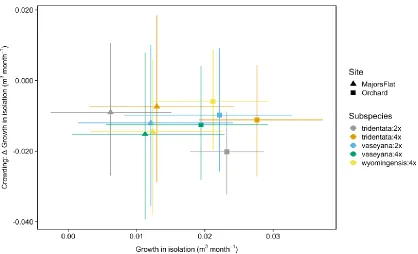
Figure 1: Posterior samples representing the relationship between the growth in isolation and crowding effect in three A. tridentata common gardens during the 2011 census interval. The y axis represents the change to growth in isolation when the crowding effect is increased by 2 SD. The symbols show the medians of estimated parameters and the error bars indicate 68%CI... 27 Figure 2: Posterior samples representing the relationship between the growth in
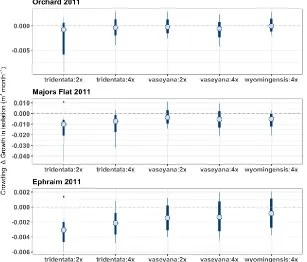
isolation and crowding effect in two A. tridentata common gardens during the 2018 census interval. The y axis represents the change to growth in isolation when the crowding effect is increased by 2 SD. The symbols show the medians of estimated parameters and the error bars indicate 68%CI. ... 28 Figure 3: Posterior samples that represent the crowding effect on the relative growth rates (RGR) of A. tridentata in three common gardens using 2011 census interval. Thick lines represent 80%CI, while thinner lines indicate 95%CI. The x axis shows five subspecies:cytotype groups of A. tridentata. The effect size corresponds to the change in RGR in isolation when crowding is increased by 2SD. Values of zero indicate no crowding effect on RGR. ... 29 Figure 4: Posterior samples that represent the effect of crowding on survival
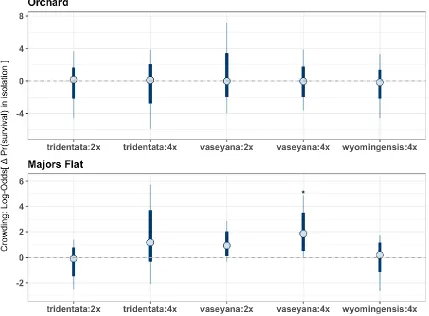
probability in A. tridentata in two common gardens. The effect sizes are based on census interval between 2012 and 2018. Thick lines show 80%CI, while thinner lines indicate 95%CI. Coefficients indicate the change to survival in isolation when crowding is increased by 2 SD, and values of zero indicate no crowding effect. ... 30 Figure 5: The rate of decline of crowding effect with distance in Majors Flat
common garden during 2011 growth season for A.t. tridentata:2x. The black line corresponds to the median crowding effect, and the shaded area to the 1 SD. The y axis represents growth in isolation decline of the target plant under the presence of an average neighbor. ... 31 Figure 6: A diagram of an experimental unit in Orchard common garden. The
x
day leaf water potential measurements for five different
subspecies:cytotype groups of big sagebrush. Lower values represent higher water stress... 59 Figure 8: A. tridentata uptake of deuterium (2H
2O) enriched water as a function of
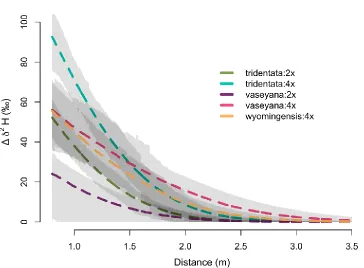
distance from the source location and plant size. The label was introduced into plant interspaces in Orchard common garden in Spring 2018. The vertical axis indicates the change in deuterium ratio between the pre- and post-treatment. Different colors indicate subspecies:cytotype identity of big sagebrush, and the gray areas represent one SD around the posterior mean. ... 60 Figure 9: Posterior distribution of the average deuterium uptake by a target plant
(upper plate). The lower plate shows the crowding effect on the label uptake in isolation under 2 SD increase in crowding ratio. The categories correspond to three subspecies of A. tridentata (tridentata, vaseyana, and wyomingensis). ... 61 Figure 10: A line plot representing soil volumetric moisture readings at three soil
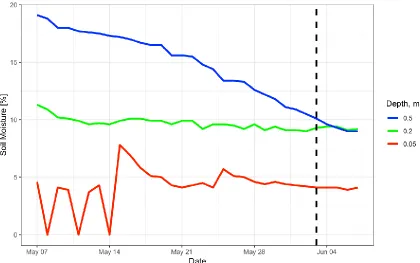
depths over the period of one month preceding the labeling experiment. The vertical dashed line indicates the day of deuterium addition. ... 62 Figure 11: Predicted belowground zone of influence of A. tridentata
subspecies:cytotype groups in Orchard common garden. The figures correspond to deuterium content where higher colour intensity indicates higher water uptake from shallow 5-25 cm soil horizon. Projections <0.9 m were excluded (empty centers) due to out of range model predictions. 63 Figure S1: An empirical cumulative density function (ECDF) plot showing the
distribution of relative growth rate (RGR) of A. tridentata in three
common gardens. The RGR is calculated using 2011 census interval for all three sites (Orchard, Majors Flat, and Ephraim), and 2018 census interval for Orchard Majors Flat sites. The RGR is scaled to a monthly time step, and each point represents an individual plant. ... 66 Figure S2: Posterior samples representing the intrinsic relative growth rates of A.
tridentata in three common gardens. Thick lines represent 80%CI, thinner lines indicate 95%CI, and the dots are the medians of the posterior
distributions. The categories on the x axis represent five analyzed
subspecies:cytotype groups of A. tridentata. ... 67 Figure S3: Posterior samples that represent the intrinsic probability of survival of A.
xi
samples. ... 68 Figure S4: Posterior samples that represent the crowding effect on the relative growth rates of A. tridentata in two common gardens using 2018 census interval. Thick lines represent 80%CI, while thinner lines indicate 95%CI, and the dots are the medians of the posterior samples. The x axis represents five subspecies:cytotype groups of A. tridentata. The effect size corresponds to the change in RGR when the calculated competitive pressure increases by 2 SD. Values of zero correspond to the change in RGR of a target plant under the average competitive pressure. ... 69 Figure S5: Mapped competition effect on A.t. tridentata:2x in Majors Flat common
garden based on 2011 census interval. Dark colors indicate higher
predicted competition effect, and the dots represent sagebrush plants with the relative crown size corresponding to the size of a point. The axes show x and y coordinates in meters... 70 Figure S6: Big sagebrush (Artemisia tridentata) in Orchard common garden, ID. The photograph shows the spatial arrangement and individual variation in size and survival of A. tridentata. ... 72 Figure S7: A box plot showing crown size distribution of A. tridentata in Orchard
common garden. Measurements represent the data collected in summer 2018. The original crown dimensions were transformed to crown volume. The actual data points (pink dots) are jittered over the standard boxplots. ... 73 Figure S8: A box plot indicating deuterium uptake by big sagebrush individuals in
Orchard common garden. The label uptake is calculated as the difference between the pre- and post-treatment deuterium measurements, and is shown for five subspecies:cytotype categories. The actual data points (pink dots) are jittered over the standard boxplots. ... 74 Figure S9: A box plot indicating deuterium uptake by three subspecies of big
CHAPTER ONE: INTRASPECIFIC VARIATION IN PLANT-PLANT INTERACTIONS OF BIG SAGEBRUSH
Abstract
Species coexistence and neighbor interactions are critical factors in structuring plant communities, maintaining species diversity and ecosystem functions. Intraspecific variability, including genome duplication and local adaptations can contribute to
variation in demographic rates, stress tolerance, and neighbor interactions. Using a long-term common garden experiment, we applied spatially-explicit neighborhood models to quantify differential effects of crowding on growth and survival of Artemisia tridentata, including three subspecies and two ploidy levels. Our results suggest that intraspecific patterns in competition effect on growth are more pronounced during the early stage of stand development, and dissipate as the plants mature. We also found evidence of
facilitation as neighbor presence differentially increased the probability of plant survival. In general, neighbor effects were more pronounced in sites with higher precipitation and cooler temperature regimes. Our findings generally agree with the stress-gradient
hypothesis, and provide experimental evidence for intraspecific variation in plant-plant interactions.
Introduction
heterospecific plant neighbors plays a critical role in theories for species coexistence (Barabás et al., 2018; Chesson, 2018, 2000). Within single-species populations, negative density dependence is an important determinant of spatial and temporal dynamics (Law et al., 2003). Interactions between conspecific neighbors also underlie conservation and restoration outcomes, including tree species extinction after seed disperser loss (Caughlin et al., 2015), forest plantation biomass after thinning (Simard and Sachs, 2004), and plant reintroduction success in degraded sites where nurse plants facilitate establishment (Zhao et al., 2007). Most studies of interactions between plant neighbors have considered differences at the species-level (but see Bennett et al., 2016; Hart et al., 2016; Shao et al., 2018; Uriarte and Menge, 2018). However, many plant species have considerable
intraspecific variation, including life strategy, local adaptation, and ploidy variation (Bonham et al., 1991; Shryock et al., 2014; Wood et al., 2009). How intraspecific variation alters the outcomes of interaction between neighboring plants remains an unanswered question with consequences for ecology, evolution, and conservation.
stress-gradient hypothesis (Maestre et al., 2009). Humphrey and Pyke (1998) investigated the effects of intraspecific variation in growth strategies of a rhizomatous grass species revealing a competitive advantage of one species over another when resource availability increased. A few studies have asked how individual-level trait values impact plant competition (Shao et al., 2018; Umaña et al., 2018), but we lack empirical evidence of how conspecific biotic interactions operate in natural communities, change in space and time, and allow for genetically distinct populations to coexist.
Another key component of intraspecific variability in plant populations is variation in ploidy level, the number of sets of homologous chromosomes per cell. This variation is common among vascular plants including intraspecific ploidy variation (Wood et al., 2009). Polyploidy can impact plant vital rates (Groot et al., 2012) and competitive interactions (Petrone Mendoza et al., 2018). Neighbor interactions along polyploid hybrid zones are believed to be one of the key factors in polyploid
establishment (Petit et al., 1999). Despite the spatial nature of neighbor interactions, few studies have adopted an explicitly spatial approach to quantify plant-plant interactions in polyploidy hybrid zones (Li et al., 2004; Rodriguez, 1996). Intraspecific variation in competitive abilities is a common outcome of intraspecific ploidy variation (Čertner et al., 2019; Maceira et al., 1993), however, understanding this variation becomes critical in context of landscape population dynamics and population persistence.
genotypes for eco-evolutionary dynamics, understanding demographic outcomes when non-local genetic material is introduced to novel environments is of paramount
importance. However, predicting the demographic success of plant genotypes under novel competitive regimes (e.g., Leger, 2008) is complicated because plant-plant interactions are likely to change over the course of stand development. Because smaller individuals are more susceptible to asymmetric competition than larger individuals, the effects of slight size differences during initial establishment tend to be compounded over time (DeMalach et al., 2016; Werner et al., 2016). Alternatively, plant-plant interactions may switch from facilitation to competition as nurse plants initially facilitate seedling establishment and then eventually compete with new recruits (Maestre et al., 2009; Miriti, 2006). At the same time as individual size changes during plant establishment, stand-level characteristics change as well. These changes could have consequences for plant-plant interactions as self-thinning during the initial stages of stand development leaves individuals relatively insensitive to competition in lower densities, thereby decreasing competition processes (Yastrebov, 1996). Altogether, we expect that in the environments with mixed conspecific genotypes, interactions between neighbors will have important consequences for ecology and evolution of plant populations (Havens et al., 2015). Because plant-plant interactions are likely to change over time during
individual and stand development (Schwinning and Weiner, 1998), quantifying these interactions at multiple time points will be necessary. However, studies that have examined plant-plant interactions over time as the stand develops are rare.
is locally adapted to a wide range of soil and climatic conditions across western North America and exhibits high levels of genetic diversity within species (McArthur et al., 1981; Richardson and Chaney, 2018). A combination of morphological and ecological differences has led to the recognition of three wide-spread subspecies (Shultz, 2009). Additionally, A. tridentata is characterized by high frequencies of polyploidy (from hereon cytotypes) with multiple evolutionary origins (Richardson et al., 2012). Accounting for local adaptation in genetically-diverse A. tridentata populations is an increasingly important component of regional restoration projects (Miglia et al., 2005). Ecological restoration in the Great Basin is often aimed at recovering A. tridentata populations following wild fires. These attempts are conducted with seeds or seedlings that originate from natural, but not necessarily local, populations or plant nurseries (Germino et al., 2018; Mahalovich and McArthur, 2005). Altogether, understanding how novel combinations of genetically different populations of A. tridentata plants interact has direct application to restoring the imperiled sagebrush steppe ecosystem.
We quantified how plant-plant interactions impact demographic rates, growth, and survival between individuals that represent a range-wide intraspecific diversity of A. tridentata. Our study represents data from plots in a common garden experiment,
Subspecies with higher growth rates will be more sensitive to competition compared to slow growing subspecies, and polyploids will be less affected compared to diploid cytotypes; (ii) Neighbor competition will increase as environmental conditions become more favorable; (iii) Local intraspecific competition will be weaker early in stand development and will intensify as the stand develops.
Methods
Study Site
Our study includes three experimental common gardens established in 2010. The three locations represent an environmental gradient of precipitation and temperature (Chaney et al., 2017). The gardens were established between April and June 2010, when 468-470 seedlings were outplanted in each garden. Growth and survival were monitored for the first two years after establishment and were resumed five years later in the
Orchard and Majors Flat gardens, while the Ephraim common garden was terminated due to logistical difficulties in maintenance. Plant size was measured during early
development in 2011 in Orchard (n=419), Majors Flat (n=448), and Ephraim (n=434); late development growth during 2018 in Orchard (n=255) and Majors Flat (n=368). The survival data set includes the time period between 2012 and 2018 in Orchard (n=421), and Majors Flat (n=448).
we did not include these individuals in our analyses. We grouped individuals of A. tridentata into five groups, representing different combinations of subspecies and
cytotypes. Plants within each garden were organized in a grid with 1 m and 1.5 m spacing on two axes respectively. To analyze spatial interactions between the individuals, we calculated a distance matrix, including pairwise distances between all plants in each common garden. Based on previous work, we expected no direct effect from neighbors beyond a four-meter distance, and, therefore, considered plant neighbors in a radius of <4 m from target plants (Sturges, 1977).
long-term interval for Orchard (five) and Majors Flat (six years) to capture a high number of mortalities while excluding the initial two years of growth when mortality due to density independent factors is more likely.
Data Analysis
The goal of our statistical model was to quantify the effect of neighbors (i.e., crowding effect) on growth and survival of plants in three common gardens across census intervals. The crowding effect represents a quantitative measure and impact of local neighborhoods on each target plant and allows for positive and negative modes of neighbor effect (Canham and Uriarte, 2006). We fit hierarchical Bayesian models for each site, census interval, and vital rate, resulting in a total of seven models. We decided to fit separate models, rather than pooling all data together in a single model, based on our expectation that growth and survival are likely to vary widely between sites and census intervals. For all models, we included random effects of intraspecific groups, enabling shared variance between subspecies:cytotype levels (Gelman and Hill, 2006).
We modeled plant growth as a function of subspecies:cytotype levels, target plant size, and crowding effects. Crowding was modeled as a non-linear function that depends on the size of a neighbor, as well as its distance from the target plant. We described the non-linear effect of crowding with a modified negative exponential function:
𝑊𝑖,𝑠= ∑ 𝑐[𝑠]𝑆𝑖𝑧𝑒𝑗,𝑠𝑒−𝑏𝐷𝑗2
𝑛
𝑗=1,𝑗≠𝑖
target plant i. Parameter c[s] estimates the contribution of each subspecies:cytotype group to the crowding term as a normally-distributed random effect. Similar spatial models have been successfully applied to model competition between neighbors of a closely related sagebrush species (Adler et al., 2010; Chu and Adler, 2015).
To estimate the strength and spatial scale of crowding effect, we used inverse modeling to capture neighbor interactions (Adler et al., 2010; Canham and Uriarte, 2006; Ribbens et al., 1994), with the relative growth rate at time t as a response, and plant size and crowding index at time t-1 as predictors. We modeled growth as a
normally-distributed random variable using the following structure:
𝑔t,s ~ Normal(µ𝑖,𝑠,𝑡, 𝜎2)
µ𝑖,𝑠,𝑡 = 𝛼[𝑠] + 𝛽[𝑠]𝑆𝑖𝑧𝑒𝑖,t−1+ 𝛾[𝑠]W𝑡−1
where gt is growth at time t, 𝛼[s] is the average relative growth rate of subspecies:cytotype group s, Sizei is the crown volume of the target plant at t-1, [s]
determines the strength and the mode of competitive effect on plant i by neighbors j, at time t-1. All three unknown parameters were modeled as random effects by
subspecies:cytotype group identity [s].
The survival models had a similar structure and predictors, and were modeled using a Bernoulli distribution:
𝑠t ~ Bernoulli(θ𝑖,𝑠,𝑡)
𝑙𝑜𝑔𝑖𝑡(θ𝑖,𝑠,𝑡) = 𝛼[𝑠] + 𝛽[𝑠]𝑆𝑖𝑧𝑒𝑖,t−1+ 𝛾[𝑠]𝑊𝑡−1
subspecies and ploidy level, we quantified how the crowding parameter () varied between subspecies:cytotype groups across all models. Positive values of indicate facilitation, while negative values of indicate competition. To test the second
hypothesis, we quantified differences in neighborhood interaction parameters between our three sites which reflect the change in crowding along an environmental gradient. We expected neutral or positive interactions under harsher conditions, and a shift in a
negative direction as conditions improve. To test the third hypothesis, we quantified differences in neighborhood interactions between the early and late census intervals. We expected that crowding effect in early stage of stand development will be weaker and intensify over time.
We fit hierarchical Bayesian models using the Hamiltonian Monte Carlo
algorithm from ‘rstan’ package in R (Stan Development Team 2018, R Core Team 2018). We obtained samples from the posterior distribution for each census interval by running 4 chains, 10000 iterations each, with a warm-up period of 9500 iterations. To evaluate model convergence, we visually assessed the behavior and mixing of chains and checked that ‘Rhat’ values were below the threshold of 1.1 (Gelman and Rubin, 1992), and checked each model for divergent transitions. For posterior sampling, we chose weakly informed, normally distributed priors centered at zero, with the variance that captured biologically meaningful effect sizes. All predictors were standardized by centering them around the mean and dividing by two standard deviations (Gelman and Hill, 2006). We evaluated the fit of our spatial models by calculating WAIC scores (Hooten and Hobbs, 2015) and comparing the fit models, that only included an individual’s size and
term (𝛾[𝑠]𝑊) intrinsic demographic parameters only reflecting performance in isolation, with those that had an additional non-linear crowding term.
Results
After the first growing season and the first winter, the sample size in Orchard was reduced to 419 for the first census interval, and over the course of the experiment down to 255 individuals. In Majors Flat, 448 individuals were present during the second growing season and the sample size was reduced to 368 by 2018. Our data set from the Ephraim garden includes only the second growing season when 434 plants were alive after the first winter.
On the monthly scale, the community level growth in isolation of sagebrush plants in Orchard common garden in 2011 and 2018 was at 0.0038 m3month-1 (95%CI: 0.0019, 0.0057) and 0.0224 (95%CI: -0.0038, 0.0421) respectively (Fig. S1). Growth rates were initially higher in Majors Flat common garden, with the median values of 0.0214 m3month-1 (95%CI: 0.0104, 0.0383) in 2011 and 0.0114 m3month-1 (95%CI:
average growth rate among subspecies:cytotype groups were minimal with overlapping posterior distributions (Fig. S2).
The estimates for survival in isolation also differed considerably. In Orchard, the median community-level survival was 56% (95%CI: 28.4, 79.4), versus 79.8% in Majors Flat (95%CI: 52.3, 90.8). The median probability of survival in Orchard was lowest for A.t. vaseyana:2x at 22.4 %, and highest for A.t. tridentata:4x at 88.5% (Fig. S3). In Majors Flat, the survival in isolation was generally higher and followed the same pattern by subspecies:cytotype group.
The estimated interaction coefficients varied between the subspecies:cytotype groups, the three common garden locations, as well as development stage (Fig. 1). The parameter values indicate the change to target plant growth or probability of survival in isolation when the crowding index is increased by two SD. With respect to our first hypothesis, subspecies:cytotype differences in response to crowding, the median crowding effects for A.t. tridentata:2x and, to a lesser degree A.t. tridentata:4x, were stronger (more negative) when compared to the common garden average effects (Fig. 3). This general pattern persisted across common gardens and census intervals. In terms of survival, crowding had a positive effect on A.t. vaseyana:4x, which was only observed in Majors Flat (Fig. 4).
Ephraim gardens this probability was higher with respect to the overall averages as well as by subspecies, but the effect size varied. The probability of negative neighbor effects on A.t. tridentata:2x in both of the Utah gardens was >95% (Fig. 3). The median effect on growth in isolation for A.t. tridentata:2x was -0.01 and -0.003 m3month-1 in Majors Flat 2011 and Ephraim respectively. A.t. wyomingensis showed intermediate response with a posterior mean of -0.005 and -0.0008 m3months-1 and a probability of negative interactions 90.7% and 71.3% for Majors Flat 2011 and Ephraim gardens respectively. We also found evidence for positive crowding effect on survival in one of the gardens (Fig. 4). In Majors Flat, the two cytotypes of A.t. vaseyana and A.t. tridentata:4x were more likely to benefit from their neighbors, suggesting facilitative interactions. The probability of positive crowding effect for A.t. vaseyana:2x and A.t. vaseyana:4x was 92.6% and 97.3% respectively, and 86.7% for A.t. tridentata:4x. The effect on survival for other subspecies:cytotype groups was indiscernible from zero.
We predicted that plant-plant interactions will intensify with time as the plants grew, but the observed change in effect size was variable. Over time, during 2018 growth season in Orchard the overall probability of negative crowding effect increased to 81.3% with the median effect size on growth -0.0119 m3month-1 (95%CI: -0.0449, 0.0267). On
The scaling parameter associated with the rate of decline in neighbor effect indicates the spatial extent at which neighbors can affect the target plant. We modeled this parameter as a fixed effect and the coefficients were fairly consistent across time and space. The estimated values for this parameter suggest that the effect of neighbors
becomes negligible beyond a distance of two meters from the target plant (Fig. 5). We also did not find any difference between the estimates of parameter c, which indicates the contribution of each subspecies:cytotype group to the cumulative crowding term,
suggesting that the response was independent from the identity of the neighbor. Discussion
Using a long-term experimental dataset, we applied spatially-explicit neighborhood models to evaluate how intraspecific variation alters plant-plant
interactions. This approach allowed us to account for plant intraspecific identity, size, and the distance between neighbors to quantify plant-plant interactions. Our results suggest that distinct subspecies and cytotypes may have different capacity for neighbor tolerance reflected in growth and survival vital rates. These differences appear to be subject to environmental conditions and change over time which is generally consistent with the framework of the stress-gradient hypothesis (SGH) and individual ontogenic stages of plant development (He et al., 2013; Maestre et al., 2009; Miriti, 2006). Specifically, the differences by location appear to be more pronounced compared to the effects of time in nine years of stand development. Our study complements currently scarce experimental evidence on the spatial and temporal variability of plant-plant interactions on
Species coexistence and plant-plant interactions have been intensively investigated (Adler et al., 2018), it is unclear if divergent ecological traits within A. tridentata can result in differential patterns of interaction between subspecies and
cytotypes. The overarching trend in our results on the subspecies:cytotype level suggests that growth rates of A.t. tridentata:2x, and to a lesser degree A.t. tridentata:4x are more prone to be affected by negative crowding effect. Previous findings are indirectly comparable with our results where A.t. tridentata, among the three subspecies, was associated with a colonial type of life strategy (Bonham et al., 1991). This strategy is characterized by a relatively high growth rate while limited competitive capacity, which to some degree matches our results. In agreement with the general ecological theory (Chapin et al., 1993; Tilman, 1990), both cytotypes of A.t. tridentata which showed higher growth in isolation compared to the common garden average were also more sensitive to competition in growth. This type of competition effect could underlie a stabilizing effect on size distribution within population indicating that individuals with conservative growth strategies may not be in disadvantage to fast growing neighbors (Schwinning, 1996; Schwinning and Weiner, 1998).
neighbor interactions in space explicitly will provide insights into evolutionary origins and mechanisms of polyploidy in plant species.
Environmental conditions, distinct in all three locations (Chaney et al., 2017), proved to be important for intraspecific biotic interactions in growth and survival. Our results support the idea of stronger competitive interactions under more favorable
The crowding effect on survival in the driest site was indiscernible from zero and the median shifted in a positive direction with higher precipitation and lower minimum temperatures. Again, intraspecific identity mattered in this response as well, where generally more conservative in growth A.t. vaseyana was associated with positive crowding effect from nearby individuals. This mechanism could potentially include protection from cool temperatures documented to be detrimental for survival of A. tridentata (Brabec et al., 2017; Loik and Redar, 2003), or associational resistance to herbivory where subspecies with lower palatability might protect those that are more palatable or smaller in stature (Barbosa et al., 2009; Rosentreter, 2004; Shiojiri and Karban, 2008). Although the observed patterns in growth and survival models may involve different mechanisms of interactions, the results generally corroborate SGH in the common garden system. This variation, however, was not uniform across
subspecies:cytotype groups and vital rates benefiting smaller stature A.t. vaseyana in wetter and cooler sites in terms of survival, while A.t. tridentata appear to be most neighbor intolerant in terms of growth. Comparing the crowding effects across census intervals and sites, the differences were more apparent between different locations and less so in time corresponding different stages of stand development. Overall, our study suggests that plant-plant interactions on the level of subspecies and cytotype are subject to environmental and temporal effect expected under SGH, however, the specific response could also depend on the intraspecific identity of the target plant.
diversity of 55 source populations in the common garden represent experimental conditions that are unlikely to occur in natural ecosystems. However, a mixing of plant material from genetically distant populations in restoration treatments is common (Germino et al., 2018). For large-scale restoration projects, the scope of an intervention and limitations in local plant material requires sourcing seeds from various locations, and distinct subspecies, and cytotypes. Therefore, instances where such interventions have been implemented represent existing study cases where diverse population coexist, while future restoration treatments could serve as potential natural experiments for studying how population dynamics depend on intraspecific diversity (Gellie et al., 2018).
REFERENCES
Adams, T.P., Holland, E.P., Law, R., Plank, M.J., Raghib, M., 2013. On the growth of locally interacting plants: differential equations for the dynamics of spatial moments. Ecology 94, 2732–2743.
Adler, P.B., Ellner, S.P., Levine, J.M., 2010. Coexistence of perennial plants: an embarrassment of niches. Ecology Letters 13, 1019–1029.
Adler, P.B., Smull, D., Beard, K.H., Choi, R.T., Furniss, T., Kulmatiski, A., Meiners, J.M., Tredennick, A.T., Veblen, K.E., 2018. Competition and coexistence in plant communities: intraspecific competition is stronger than interspecific competition. Ecology Letters 21, 1319–1329.
Barabás, G., D’Andrea, R., Stump, S.M., 2018. Chesson’s coexistence theory. Ecological Monographs 88, 277–303.
Barbosa, P., Hines, J., Kaplan, I., Martinson, H., Szczepaniec, A., Szendrei, Z., 2009. Associational Resistance and Associational Susceptibility: Having Right or Wrong Neighbors. Annual Review of Ecology, Evolution, and Systematics 40, 1– 20.
Bennett, J.A., Riibak, K., Tamme, R., Lewis, R.J., Pärtel, M., 2016. The reciprocal relationship between competition and intraspecific trait variation. J Ecol 104, 1410–1420.
Bertness, M.D., Callaway, R., 1994. Positive interactions in communities. Trends in Ecology & Evolution 9, 191–193.
Brabec, M.M., Germino, M.J., Richardson, B.A., 2017. Climate adaption and post-fire restoration of a foundational perennial in cold desert: insights from intraspecific variation in response to weather. J Appl Ecol 54, 293–302.
Brooker, R.W., Callaghan, T.V., 1998. The Balance between Positive and Negative Plant Interactions and Its Relationship to Environmental Gradients: A Model. Oikos 81, 196–207.
Calama, R., Conde, M., de-Dios-García, J., Madrigal, G., Vázquez-Piqué, J., Gordo, F.J., Pardos, M., 2019. Linking climate, annual growth and competition in a
Mediterranean forest: Pinus pinea in the Spanish Northern Plateau. Agricultural and Forest Meteorology 264, 309–321.
Callaway, R.M., Pennings, S.C., Richards, C.L., 2003. Phenotypic Plasticity and Interactions Among Plants. Ecology 84, 1115–1128.
Canham, C.D., Uriarte, M., 2006. Analysis Of Neighborhood Dynamics Of Forest Ecosystems Using Likelihood Methods And Modeling. Ecological Applications 16, 62–73.
Caughlin, T.T., Ferguson, J.M., Lichstein, J.W., Zuidema, P.A., Bunyavejchewin, S., Levey, D.J., 2015. Loss of animal seed dispersal increases extinction risk in a tropical tree species due to pervasive negative density dependence across life stages. Proc Biol Sci 282.
Caughlin, T.T., Peña‐Domene, M. de la, Martínez‐Garza, C., 2019. Demographic costs and benefits of natural regeneration during tropical forest restoration. Ecology Letters 22, 34–44.
Čertner, M., Sudová, R., Weiser, M., Suda, J., Kolář, F., 2019. Ploidy-altered phenotype interacts with local environment and may enhance polyploid establishment in Knautia serpentinicola (Caprifoliaceae). New Phytologist 221, 1117–1127. Chaney, L., Richardson, B.A., Germino, M.J., 2017. Climate drives adaptive genetic
Chapin, F.S., Autumn, K., Pugnaire, F., 1993. Evolution of Suites of Traits in Response to Environmental Stress. The American Naturalist 142, S78–S92.
Chesson, P., 2000. Mechanisms of Maintenance of Species Diversity. Annu. Rev. Ecol. Syst. 31, 343–366.
Chesson, P., 2018. Updates on mechanisms of maintenance of species diversity. Journal of Ecology 106, 1773–1794.
Chu, C., Adler, P.B., 2015. Large niche differences emerge at the recruitment stage to stabilize grassland coexistence. Ecological Monographs 85, 373–392.
Currie, D.J., Mittelbach, G.G., Cornell, H.V., Field, R., Guégan, J.-F., Hawkins, B.A., Kaufman, D.M., Kerr, J.T., Oberdorff, T., O’Brien, E., Turner, J.R.G., 2004. Predictions and tests of climate-based hypotheses of broad-scale variation in taxonomic richness. Ecology Letters 7, 1121–1134.
Davis, M.B., Shaw, R.G., 2001. Range Shifts and Adaptive Responses to Quaternary Climate Change. Science 292, 673–679.
DeMalach, N., Zaady, E., Weiner, J., Kadmon, R., 2016. Size asymmetry of resource competition and the structure of plant communities. Journal of Ecology 104, 899– 910.
Evans, R.D., Black, R.A., 1993. Growth, Photosynthesis, and Resource Investment for Vegetative and Reproductive Modules of Artemisia Tridentata. Ecology 74, 1516–1528.
Evans, R.D., Black, R.A., Link, S.O., 1991. Reproductive Growth During Drought in Artemisia tridentata Nutt. Functional Ecology 5, 676–683.
Gellie, N.J., Breed, M.F., Mortimer, P.E., Harrison, R.D., Xu, J., Lowe, A.J., 2018. Networked and embedded scientific experiments will improve restoration outcomes. Frontiers in Ecology and the Environment 16, 288–294.
Gelman, A., Rubin, D.B., 1992. Inference from Iterative Simulation Using Multiple Sequences. Statistical Science 7, 457–472.
Germino, M.J., Moser, A.M., Sands, A.R., 2018. Adaptive variation, including local adaptation, requires decades to become evident in common gardens. Ecological Applications.
Groot, G.A. de, Zuidema, P.A., Groot, H. de, During, H.J., 2012. Variation in ploidy level and phenology can result in large and unexpected differences in demography and climatic sensitivity between closely related ferns. American Journal of
Botany 99, 1375–1387.
Hahn, M.A., Buckley, Y.M., Müller‐Schärer, H., 2012. Increased population growth rate in invasive polyploid Centaurea stoebe in a common garden. Ecology Letters 15, 947–954.
Hart, S.P., Schreiber, S.J., Levine, J.M., 2016. How variation between individuals affects species coexistence. Ecology Letters 19, 825–838.
Havens, K., Vitt, P., Still, S., Kramer, A.T., Fant, J.B., Schatz, K., 2015. Seed Sourcing for Restoration in an Era of Climate Change. Natural Areas Journal 35, 122–133. He, Q., Bertness, M.D., Altieri, A.H., 2013. Global shifts towards positive species
interactions with increasing environmental stress. Ecology Letters 16, 695–706. Hooten, M.B., Hobbs, N.T., 2015. A guide to Bayesian model selection for ecologists.
Ecological Monographs 85, 3–28.
Humphrey, L.D., Pyke, D.A., 1998. Demographic and growth responses of a guerrilla and a phalanx perennial grass in competitive mixtures. Journal of Ecology 86, 854–865.
Kramer, A.T., Wood, T.E., Frischie, S., Havens, K., 2018. Considering ploidy when producing and using mixed-source native plant materials for restoration: Ploidy in mixed-source native plant materials. Restoration Ecology 26, 13–19.
Leger, E.A., 2008. THE ADAPTIVE VALUE OF REMNANT NATIVE PLANTS IN INVADED COMMUNITIES: AN EXAMPLE FROM THE GREAT BASIN. Ecological Applications 18, 1226–1235.
Li, B.-H., Xu, X.-M., Ridout, M.S., 2004. Modelling the establishment and spread of autotetraploid plants in a spatially heterogeneous environment. Journal of Evolutionary Biology 17, 562–573.
Lind, B.M., Friedline, C.J., Wegrzyn, J.L., Maloney, P.E., Vogler, D.R., Neale, D.B., Eckert, A.J., 2017. Water availability drives signatures of local adaptation in whitebark pine (Pinus albicaulis Engelm.) across fine spatial scales of the Lake Tahoe Basin, USA. Molecular Ecology 26, 3168–3185.
Loik, M.E., Redar, S.P., 2003. Microclimate, freezing tolerance, and cold acclimation along an elevation gradient for seedlings of the Great Basin Desert shrub, Artemisia tridentata. Journal of Arid Environments 54, 769–782.
Maceira, N.O., Jacquard, P., Lumaret, R., 1993. Competition between diploid and derivative autotetraploid Dactylis glomerata L. from Galicia. Implications for the establishment of novel polyploid populations. New Phytologist 124, 321–328. Maestre, F.T., Callaway, R.M., Valladares, F., Lortie, C.J., 2009. Refining the
stress-gradient hypothesis for competition and facilitation in plant communities. Journal of Ecology 97, 199–205.
Mahalovich, M.F., McArthur, E.D., 2005. Sagebrush (Artemisia spp.) Seed and Plant Transfer Guidelines. Native Plants Journal 5, 141–148.
McArthur, E.D., Pope, C.L., Freeman, D.C., 1981. Chromosomal Studies of Subgenus Tridentatae of Artemisia: Evidence for Autopolyploidy. American Journal of Botany 68, 589–605.
McCallum, K.P., Lowe, A.J., Breed, M.F., Paton, D.C., 2018. Spatially designed revegetation—why the spatial arrangement of plants should be as important to revegetation as they are to natural systems. Restoration Ecology 26, 446–455. Miglia, K.J., Mcarthur, E.D., Moore, W.S., Wang, H., Graham, J.H., Freeman, D.C.,
mountain big sagebrush (Artemisia tridentata: Asteraceae) hybrid zone of Salt Creek Canyon: the importance of multiple-year tracking of fitness. Biological Journal of the Linnean Society 86, 213–225.
Miriti, M.N., 2006. Ontogenetic shift from facilitation to competition in a desert shrub. Journal of Ecology 94, 973–979.
Moya-Larano, J., 2010. Can Temperature and Water Availability Contribute to the Maintenance of Latitudinal Diversity by Increasing the Rate of Biotic Interactions? The Open Ecology Journal 3, 1–13.
Münzbergová, Z., Haisel, D., 2018. Effects of polyploidization on the contents of
photosynthetic pigments are largely population-specific. Photosynthesis Research. Petit, C., Bretagnolle, F., Felber, F., 1999. Evolutionary consequences of diploid–
polyploid hybrid zones in wild species. Trends in Ecology & Evolution 14, 306– 311.
Petrone Mendoza, S., Lascoux, M., Glémin, S., 2018. Competitive ability of Capsella species with different mating systems and ploidy levels. Ann Bot 121, 1257– 1264.
R Core Team, 2018. R: A language and environment for statistical computing. R Foundation for Statistical Computing, Vienna, Austria. https://www.R-project.org/.
Ribbens, E., Silander, J.A., Pacala, S.W., 1994. Seedling Recruitment in Forests:
Calibrating Models to Predict Patterns of Tree Seedling Dispersion. Ecology 75, 1794–1806.
Richardson, B.A., Chaney, L., 2018. Climate-based seed transfer of a widespread shrub: population shifts, restoration strategies, and the trailing edge. Ecological
Applications 28, 2165–2174.
Rieseberg, L.H., Willis, J.H., 2007. Plant Speciation. Science 317, 910–914. Rodriguez, D.J., 1996. A Model for the Establishment of Polyploidy in Plants. The
American Naturalist 147, 33–46.
Rosentreter, R., 2004. Sagebrush Identification, Ecology, and Palatability Relative to Sage-Grouse 14.
Schlaepfer, D.R., Edwards, P.J., Billeter, R., 2010. Why only tetraploid Solidago gigantea (Asteraceae) became invasive: a common garden comparison of ploidy levels. Oecologia 163, 661–673.
Schwinning, S., 1996. Decomposition Analysis of Competitive Symmetry and Size Structure Dynamics. Annals of Botany 77, 47–58.
Schwinning, S., Weiner, J., 1998. Mechanisms determining the degree of size asymmetry in competition among plants. Oecologia 113, 447–455.
Shao, X., Brown, C., Worthy, S.J., Liu, L., Cao, M., Li, Q., Lin, L., Swenson, N.G., 2018. Intra-specific relatedness, spatial clustering and reduced demographic performance in tropical rainforest trees. Ecology Letters 21, 1174–1181. Shiojiri, K., Karban, R., 2008. Seasonality of herbivory and communication between
individuals of sagebrush. Arthropod-Plant Interactions 2, 87–92.
Shryock, D.F., DeFalco, L.A., Esque, T.C., 2014. Life-history traits predict perennial species response to fire in a desert ecosystem. Ecol Evol 4, 3046–3059. Shryock, D.F., Havrilla, C.A., DeFalco, L.A., Esque, T.C., Custer, N.A., Wood, T.E.,
2015. Landscape genomics of Sphaeralcea ambigua in the Mojave Desert: a multivariate, spatially-explicit approach to guide ecological restoration. Conserv Genet 16, 1303–1317.
Shultz, L.M., 2009. Monograph of Artemisia Subgenus Tridentatae (Asteraceae-Anthemideae). Systematic Botany Monographs 89, 1–131.
Stan Development Team, 2018. RStan: the R interface to Stan. R package version 2.18.2. http://mc-stan.org/.
Sturges, D.L., 1977. Soil Water Withdrawal and Root Characteristics of Big Sagebrush. American Midland Naturalist 98, 257.
Tilman, D., 1990. Constraints and Tradeoffs: Toward a Predictive Theory of Competition and Succession. Oikos 58, 3–15.
Umaña, M.N., Zipkin, E.F., Zhang, C., Cao, M., Lin, L., Swenson, N.G., 2018.
Individual-level trait variation and negative density dependence affect growth in tropical tree seedlings. Journal of Ecology 106, 2446–2455.
Uriarte, M., Menge, D., 2018. Variation between individuals fosters regional species coexistence. Ecology Letters 21, 1496–1504.
Werner, C.M., Vaughn, K.J., Stuble, K.L., Wolf, K., Young, T.P., 2016. Persistent asymmetrical priority effects in a California grassland restoration experiment. Ecol Appl 26, 1624–1632.
Wood, T.E., Takebayashi, N., Barker, M.S., Mayrose, I., Greenspoon, P.B., Rieseberg, L.H., 2009. The frequency of polyploid speciation in vascular plants. Proceedings of the National Academy of Sciences 106, 13875–13879.
Wright, A., Schnitzer, S.A., Reich, P.B., 2014. Living close to your neighbors: the
importance of both competition and facilitation in plant communities. Ecology 95, 2213–2223.
Yastrebov, A.B., 1996. Different Types of Heterogeneity and Plant Competition in Monospecific Stands. Oikos 75, 89–97.
Figures
Figure 1: Posterior samples representing the relationship between the growth in isolation and crowding effect in three A. tridentata common gardens during the 2011 census interval. The y axis represents the change to growth in isolation when the crowding effect is increased by 2 SD. The symbols show the medians of
Figure 2: Posterior samples representing the relationship between the growth in isolation and crowding effect in two A. tridentata common gardens during the 2018 census interval. The y axis represents the change to growth in isolation when the crowding effect is increased by 2 SD. The symbols show the medians of estimated parameters and the error bars indicate 68%CI.
Figure 3: Posterior samples that represent the crowding effect on the relative growth rates (RGR) of A. tridentata in three common gardens using 2011 census interval. Thick lines represent 80%CI, while thinner lines indicate 95%CI. The x axis shows five subspecies:cytotype groups of A. tridentata. The effect size
Figure 4: Posterior samples that represent the effect of crowding on survival probability in A. tridentata in two common gardens. The effect sizes are based on census interval between 2012 and 2018. Thick lines show 80%CI, while thinner lines indicate 95%CI. Coefficients indicate the change to survival in isolation when
Tables
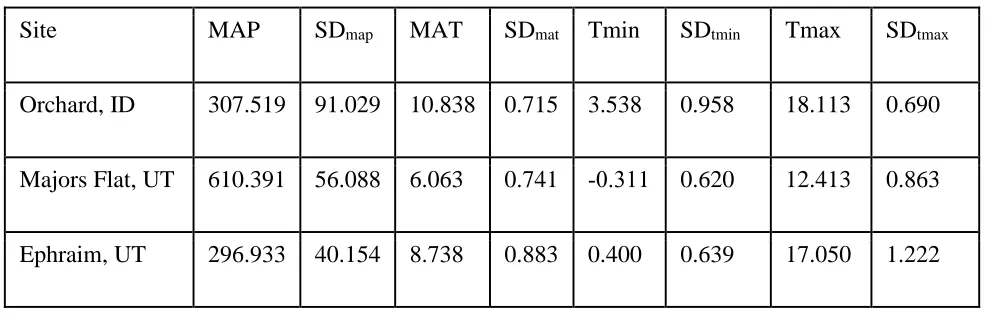
Table 1: Annual climate data for three common gardens during the experiment (2010-2017).
Site MAP SDmap MAT SDmat Tmin SDtmin Tmax SDtmax
Orchard, ID 307.519 91.029 10.838 0.715 3.538 0.958 18.113 0.690
Majors Flat, UT 610.391 56.088 6.063 0.741 -0.311 0.620 12.413 0.863
CHAPTER TWO: QUANTIFYING INTRASPECIFIC VARIABILITY IN BIG SAGEBRUSH LATERAL ROOT EXTENT AND FUNCTIONING USING A
DEUTERIUM TRACER EXPERIMENT Abstract
predictor of water uptake in general, and that the effect of neighborhood crowding was indiscernible from zero, which likely suggests a symmetric partitioning of belowground water resources. Intraspecific variation in patterns of resource acquisition is particularly important in arid ecosystems in context of species coexistence, changing climate, and seasonal patterns of precipitation. Our study complements our understanding of big sagebrush lateral root structure and function, intraspecific variation in life strategies, and mechanisms of stress response.
Introduction
The spatial organization of belowground plant parts in plant communities impact multiple processes, from individual fitness to ecosystem function. Belowground
interactions between neighboring plants could be one mechanism leading to biodiversity-maintaining niche differences (Chesson et al., 2004; Schenk, 2006). By affecting plant community species composition, spatial distribution and root interactions could impact critical ecosystem functions including nutrient cycling and primary production (Tilman et al., 1997). Furthermore, belowground processes are subject to global changes in
Belowground competition and root interactions are likely to play a major role in species and community dynamics in sagebrush steppe ecosystems (Rau et al., 2011). There is evidence for strong plant-plant interactions between congeneric sagebrush plants and heterospecific neighbors, with implications for long-term species coexistence (Adler et al., 2010). Despite a common understanding that water availability is an important covariate in plant performance, explicitly linking water limitation to neighbor
competition is difficult (Casper and Jackson, 1997; Loik et al., 2004). For big sagebrush, some experimental evidence favors the Walter’s two-layered hypothesis (Flanagan and Ehleringer, 1991; Germino and Reinhardt, 2014), which should minimize water-based competition. Other studies have documented negative density dependence in arid ecosystems (Adler et al., 2010; Miriti et al., 2001), which likely results from
belowground processes, as competition for light is rare due to generally sparse canopy cover. Nevertheless, we lack experimental studies that examine size-structured
competitive interactions, and there is conflicting evidence for water competition in general (DiCristina and Germino, 2006; Goldberg and Novoplansky, 1997; Schenk and Mahall, 2002).
Big sagebrush, Artemisia tridentata, is one of the dominant shrub species of the arid western United States. Significant intraspecific variation related to a wide
geographical distribution and high genetic diversity is another key feature of big
sagebrush populations (Richardson and Chaney, 2018). Ecological theory proposes that, for stable coexistence, competitive interactions within species must be stronger compared to those between different species (Adler et al., 2010; Chesson, 2018), however,
2016; Uriarte and Menge, 2018). This variation in ecophysiological characteristics between genetically different populations has consequences for long-term
eco-evolutionary dynamics of sagebrush populations (Miglia et al., 2007; Richardson et al., 2012), and practical importance for post-fire restoration, where choosing locally-adapted sagebrush seeds promotes establishment success in heterogeneous landscapes (Germino et al., 2018). However, how intraspecific variation in local adaptation impacts
belowground processes in big sagebrush subpopulations remains largely unknown. In addition to ecophysiological plasticity, A. tridentata is a species with frequent polyploidy and complex phylogeny. Polyploidy in big sagebrush is a widespread process driven by local, landscape, and regional factors (Richardson et al., 2012). Intraspecific variability in cytotype level, the number of homologous chromosomes in a plant cell, can alter population vital rates (Groot et al., 2012) as well as plant competitive ability
genetically-diverse populations.Over its range, A. tridentata occupies habitats with distinct characteristics, including differences in soil profile depth. These differences underlie intraspecific patterns of big sagebrush distribution, and are associated with morphological and physiological traits related to plant water and nutrient use (Kolb and Sperry, 1999; Shultz, 2009). Local adaptations, including adaptations to soil profile depth, are likely to have a profound impact on root formation and functioning. For example, the ability of A. tridentata to utilize water resources from deep and shallow soils combined with variation in intraspecific stress tolerance may lead to different water acquisition patterns among the subspecies (Donovan and Ehleringer, 1994; Kolb and Sperry, 1999). Differences in water use from shallow soils and the ability of A. tridentata to maintain functional lateral roots through the dry season may be important for plant water status, photosynthesis, and seed production (Evans et al., 1991; Leffler et al., 2004; Loik, 2007). Therefore, the spatial scale of functionally-active lateral roots in shallow soils may be indicative of the differences in local adaptations and life-history strategies among the subspecies of A. tridentata. In addition, while multiple studies have addressed plant-water relationships and plant-plant interactions, fewer have assessed if water could underlie the mechanism of competitive interactions in arid ecosystems (but see Belcher et al., 1995; DiCristina and Germino, 2006; Kadmon, 1995; Schenk and Mahall, 2002). Consumptive
competition, competition for the same resource, is a mechanism that can explain negative interactions between neighboring individuals (Goldberg, 1990). Investigating
test if neighboring plants share common consumptive resources, such as water, and whether competition for these resources can underlie competitive interactions between neighboring big sagebrush individuals.
We conducted a deuterium oxide tracer experiment in an eight-year old A. tridentata common garden experimental plot to test if water in shallow soil horizons can be shared between neighboring individuals. We applied spatially-explicit models to characterize the neighborhood effect via belowground zone of influence (Casper et al., 2003), and to quantify the effect of neighboring individuals on tracer uptake by a target plant (i.e., crowding effect). We further ask if intraspecific variability on the level of subspecies:cytotype can underlie root architecture differences and competitive capacity realized through tracer uptake. Specific questions that we ask in this study include: (i) Does intraspecific identity have an effect on deuterium uptake? (ii) How does
belowground zone of influence in A. tridentata subspecies:cytotype groups decline with distance? (iii) Does the size of the neighbors have an effect on the water uptake by a target plant?
Methods
Site Description
Measurements were made on an eight-year-old plantation of big sagebrush individuals that represented range-wide intraspecific variability, including three
covariates, is outlined in Chaney et al. (2017). Due to mortality, a total of 244 individuals of three subspecies were present at the time of our experiment. The crown size of the plants was measured one month prior to the experiment and further converted to a crown volume using a standard ellipsoid volume equation V=4(r1r2r3)/3.
Plant Water Balance
Considering the variability of big sagebrush root activity in shallow soil horizons in response to sparse summer precipitation, we chose to conduct the tracer addition experiment in the beginning of June (1-3) 2018. This consideration was based on the possibility that shallow roots may fall into physiological dormancy during the dry period of the year (Germino and Reinhardt, 2014). We selected a rainless time window for the experiment to avoid a precipitation event interfering with the deuterium label
concentration. To analyze soil moisture, a monthly record of soil moisture measurements preceding the experiment was obtained from a nearby weather station (Soil Climate Analysis Network: Orchard Range Site, https://www.wcc.nrcs.usda.gov/scan/). The moisture probes (Hydraprobe Analog (2.5 Volt) at 2,8, and 20 inches depths) are located in close proximity to the common garden and are representative of the long-term soil moisture content preceding the deuterium addition. To evaluate the overall water status of the plants during the experiment, we randomly selected 4 individuals for each
Deuterium Labeling
We split the common garden into 14 spatially-separated sub-plots. Each subplot corresponded to one deuterium oxide injection and a buffer distance that included the subject plants. Considering that lateral roots of A. tridentata rarely exceed 1.5 m from the base of plants (Reynolds and Fraley, 1989; Sturges, 1977), we used a 3 m radius around the injection point as a buffer zone. We introduced deuterium oxide solution in the center of each sub-plot, so the injection location was equidistant to the four nearest plants (Fig. 6). Each sub-plot would have had 24 plants in the original planting, but due to mortality there were between 8 and 17 plants per sub-plot. The proximity of individual plants to the source location in the centroid was at six distance increments (0.9, 1.7, 2.3, 2.6, 2.7, 3.4 m) with this experimental design.
We prepared the labeling solution by mixing 2H
2 concentrate (99.8%, Cambridge
Isotope Laboratories, Inc.) and tap water (𝛿2H
2 ~-123‰), which resulted in a solution of
𝛿2H
2 ~15950‰, a concentration assumed to be adequate for label detection based on a
few pre-trials. Background 𝛿2H
2 concentrations in soils were -106.8‰ 9.8 (mean 1
SD). We introduced one liter of the solution to the soil starting at a depth of 5 cm below the surface (beneath litter and annual weed roots that were excavated away). We poured the solution into through 0.11 m diameter plastic cylinders placed at the soil surface to prevent run-off and thereby force downward infiltration. Following label application, the volume of soil that became saturated under each injection location was estimated to be ~0.006 m3, assuming a cylindrical plume to a depth of 0.2 m. These estimates were
injections would disperse in the soil. Injections were made in the morning, and measurements of plant water status and 𝛿2H
2 were made ~30 hours later in the afternoon
of the following day. This sampling time was estimated based on previous 2H
2 tracer
experiments (e.g., Kulmatiski and Beard, 2013), and was also tested in pre-trial additions near the experimental site.
Data Analysis
We calculated the difference between the pre-treatment and post-treatment 𝛿2H
ratios in xylem water, which was our response in the statistical models. This variable indicated the amount of labeled water taken up by each plant. We discarded one outlier reading that was 13 standard deviations above the average difference between pre- and post-treatments.
The objective of our statistical models was to determine the effects of
intraspecific variation and size-based crowding on the deuterium uptake rates. To answer questions (i) and (ii), we used the identity, size, and distance of plants from the label injection locations as predictors of deuterium uptake to quantify belowground zone of influence. We modeled the response using a modified negative exponential function with two parameters, the average uptake by subspecies:cytotype group and the rate of change in deuterium content with distance (Eq. 1):
𝐷𝑒𝑢𝑡𝑒𝑟𝑖𝑢𝑚 𝑢𝑝𝑡𝑎𝑘𝑒 = 𝛼𝑒−𝐷2𝛽; (1)
where D is its distance from the centroid of the sub-plot, is the intercept, and is the rate of decline in deuterium content with distance.
Both 𝛼 and 𝛽 parameters were modeled as random effects with five categories corresponding to the five subspecies:cytotypes combinations. Random effects
To answer question (iii), the effect of neighbors on uptake of the label, we subset the observations to include only the nearest neighbors of the deuterium source location. We excluded more distant plants for two reasons: (1) only the nearest neighbors were in an equal position to absorb the labeled water; (2) from the biological standpoint, the effect on resource competition imposed by distant individuals for the resource located at a centroid of the subplot is likely to be negligible, compared to the advantage of being spatially close to the source. Our competition model included the base (average)
deuterium uptake by a target plant, and a ratio of cumulative neighbor crown volume to the crown volume of the target plant as an additive term, reflecting the relative
aboveground physical space occupied by the neighbors compared to that of the target plant. We modeled the parameters as random effects corresponding to the three subspecies of A. tridentata (Eq. 2):
𝑑𝑒𝑢𝑡𝑒𝑟𝑖𝑢𝑚 𝑢𝑝𝑡𝑎𝑘𝑒 = 𝛼0,𝑖,[𝑠]+ 𝛼1,𝑖[ 1 𝑆𝑖
∑ 𝑆𝑗 4
𝑗=1,𝑗≠𝑖
] ; (2)
where 0 is the average deuterium uptake with subspecies as a random effect, and
1 is a neighbor effect on the target plant uptake rate modeled as fixed effect with no
pooling of variance.
widely applicable information criterion (WAIC) scores and calculated mean absolute error (MAE) as a measure of model fit (Vehtari et al., 2017).
Results
Measurements of ambient soil moisture revealed that moisture content was relatively high and stable during the month preceding the experiment (Fig. 10). The leaf water potentials indicated that plant water status was variable but within the range tolerated by A. tridentata (Kolb and Sperry, 1999). There was a significant difference between the pre-dawn and mid-day water potentials (r2 = 88%, F1,38=281.3, p = <0.001),
but no differences among groups during the mid-day measurements (r2 = 35%, F4,15, p =
0.139) (Fig. 7). These results suggest that the observed subspecies:cytotype differences in label uptake would be attributed to differences in belowground zone of influence and not to differences in plant water status.
compared to other groups. Additionally, tetraploids within a subspecies, namely A.t. tridentata:4x and A.t. vaseyana:4x, tended to have a higher average uptake and wider lateral reach compared to their diploid variants (Fig. 8). Although there was a large amount of uncertainty around the estimates, these results suggest that intraspecific
variability in lateral root extent of A. tridentata may be related to cytotype and subspecies identity.
Contrary to our expectations, we did not find a discernable effect of the crowding ratio on deuterium uptake. Moreover, we excluded the size of the target plant as a
separate predictor from the model because its effect was not detectable, and it did not improve the overall model fit. The estimated median of deuterium uptake under the average crowding pressure (i.e., intercept) was highest for A.t. tridentata, but the credibility intervals for all groups highly overlapped. We did not find a strong evidence that neighbors had an effect on deuterium uptake by a target plant. The median response to crowding of A.t. vaseyana and A.t. wyomingesis was very close to zero, and the effect on A.t. tridentata was negative at -52‰ but with credibility intervals overlapping zero (95%CI: -244, 138) (Fig. 9).
Discussion
groups of A. tridentata have different rates of water uptake from shallow soil horizons, suggesting intraspecific variability in structural and functional root architecture. Contrary to our expectations, we did not find that aboveground crown volume was a strong
predictor of belowground zone of influence. Similarly, we found that cumulative crown volume of plant neighbors was not a strong predictor of water uptake. Instead, our results demonstrated that the differences in lateral extent of water uptake from shallow soils in A. tridentata were more related to the subspecies identity and ploidy level of target plants. These differences may have implications for subspecies’ ecological responses to global changes including changing precipitation patterns and biological invasions (Germino et al., 2016; Knapp et al., 2008; Schwinning and Kelly, 2013).
suggesting higher surface water use capacity (Fig. 11). The development and activity of lateral roots is highly relevant to A. tridentata performance under seasonal precipitation patterns in the Great Basin. The reproductive effort in this species occurs during the season with sporadic and unpredictable rain events during the summer and depends on the capacity of lateral roots to utilize limiting water resources from shallow soils (DePuit and Caldwell, 1973; Goldberg and Novoplansky, 1997). Based on our results, this trait was related to the ploidy effect that persisted across subspecies, as both A.t. vaseyana and A.t. tridentata tetraploids, juxtaposed with their diploid variants, had higher average uptake and slower rate of decline with distance. The presence and activity of lateral roots, located close to the soil surface, may also be important in context of long-term species coexistence and intraspecifc interactions (Ryel et al. 2010; Wilcox et al. 2012).
of a strong relationship between crown and root presence in shallow soil horizon based on deuterium uptake rates. Current evidence by allometric models relating above- and belowground parts in A. tridentata suggests crown measurements could be used to coarsely estimate total root biomass (Cleary et al., 2008). However, patterns of soil resource uptake are likely more complex and related to the spatial arrangement and functioning of roots (Kulmatiski et al., 2017).
The overall lateral root extent in different subspecies:cytotype groups of big sagebrush has implications for energy allocation and stress tolerance. In terms of drought response and eco-hydrological strategy, Araya et al. (2011) outlines a clear trade-off between tolerance of aeration stress and drought stress. The underlying mechanisms behind drought response in terms of root plasticity suggests a trade-off between drought tolerance and, e.g., nutrient uptake by prioritizing vertical root growth and thereby limiting access to mineral nutrients in more aerated shallow soil horizons (Xiong et al., 2006). This mechanism involves abscisic acid (ABA), a plant stress hormone that can inhibit lateral root elongation by allocating available resources to the growth of the main root to increase water supply from deeper soils. In the context of our study, this pattern may suggest that polyploids of A. tridentata, which generally have higher capacity for drought tolerance, would be able to minimize this trade-off between nutrient and water access compared to more drought-sensitive diploid plants. We found that
A.t. wyomingesis:4x and A.t. tridentata:4x were associated with wider lateral root extent, while A.t. tridentata:2x seemed more likely to be allocating resources to root growth along the vertical axis (Knick and Connelly, 2011). Moreover, the results for
horizontal direction while at the same time might have limited ability to reach deeper soil based on the average performance and survival in this group (Chaney et al., 2017). These intraspecific traits also support previous evidence of subspecies differences in response to the gradient of drought stress by Kolb and Sperry (1999).
Deuterium tracer experiments provide an opportunity to experimentally test spatial and temporal patterns of belowground processes, including neighbor interactions. In our study, we aimed to understand how individuals of A. tridentata respond to a local water resource pulse in an arid environment, and how the resource was spatially
distributed among neighboring individuals. In congruence with the finding from an excavating study of Larrea tridentata (Brisson and Reynolds, 1994), we did not find a strong evidence that the size of a target plant and neighbors influenced patterns in
resource acquisition. This finding, however, could be an artifact of: (i) inadequate sample size for the neighborhood model, and especially for the subspecies with high mortality and a relatively small representation (e.g., A.t. vaseyana), or (ii) common garden experimental design. For example, if plants are outplanted at the same time, we would expect that their root system develops unobstructed until their roots interface with those of the neighbors. This pattern could potentially result in a relatively proportional
following the treatment could disentangle this uncertainty. On the other hand, our results clearly indicate that multiple plants can benefit from a relatively small local water pulse, and the observed variability in deuterium uptake may be dependent upon the root density in the resource island. This also suggests a that the roots of neighboring A. tridentata individuals in the common garden setting may have a high degree of overlap, which was previously documented for A.t. vaseyana (Krannitzi and Caldwell, 1995).
Our experiment illustrates how deuterium experiments can be used to evaluate a species’ belowground zone of influence and local interactions such as consumptive competition. The results complement the existing knowledge of belowground root