© 2016 IJSRSET | Volume 2 | Issue 4 | Print ISSN : 2395-1990 | Online ISSN : 2394-4099 Themed Section: Engineering and Technology
Parametric Optimization of SPIF Process Using Taguchi Method
Ganesh Dasharath Khatal*, B. R. Borkar, Ghadmode M. M.
Department of Production Engineering, AVCOE, Sangamner, Maharashtra, India
ABSTRACT
The conventional sheet metal forming process need part dependent tooling, which costs in terms of time and money. Due to these factors along with increasing variants, variety in the sheet metal fabrication, highly flexible forming processes are being developed. The incremental sheet forming is one of the emerging flexible forming technologies in the sheet metal engineering, which rather uses universal tooling that is mostly part dependent .Hence the process offer higher flexibility reducing the product development greatly and making it suitable for low volume production. The present work focused on the optimization of the process parameters of the single point incremental forming (SPIF) process on vertical milling machine using Taguchi approach. The main aim of the optimization is to obtain the appropriate surface roughness values in the forming process. Subsequently the mathematical model developed using regression analysis to predict the values of the surface roughness for different products and different values of the predictors.
Keywords: SPIF, Taguchi, Milling Machine, Surface Roughness
I.
INTRODUCTION
ISF and spinning are closely related. Both are Incremental Sheet Forming processes with aspects in common, but there are some fundamental differences. As a general rule, in spinning a work piece is clamped onto a rotating mandrel while the spinning tools approach the work piece and deform it into the required shape. In conventional spinning the blank edge is moving inwards, and the material thickness is kept more or less constant. In shear spinning the blank edge is not moving inwards and the sheet thickness are reduced considerably .As in flow forming, the final wall thickness is determined by the distance between the tool and the mandrel. Basically, the mould determines the final shape. Unlike the standard metal forming process, fast production changes are possible to the very simple IF machine configuration. Even if the time required for making one product is much longer than in the traditional press forming, the IF advantages are gained on tool design and production in prototyping phase. IF could be also successfully applied in completion flexible work cells, for example after hydro forming operations for slots or small parts finishing. Furthermore, instead of using general purpose CNC machines, the modern
between die and sheet metal, difficulty in lubrication, high severity of forming. This is due to complicate shapes of the component produced. Moreover, the cost of the die and punch is also high. The press forming processes for sheet metal forming is limited due to the formation of necking, fracture, wrinkling or earing. The strain values are measured at the onset of these failures under tension-tension region, tension compression region and plane strain regions.
Literature Review
Nimbalkar D.H. et al [1] demonstrated Incremental sheet forming its great potential to form complex three Dimensional parts without using a component specific tooling. The die-less nature in incremental forming provides competitive alternative for economically and effectively fabricating low volume functional sheet products. The process locally deforms sheet metal using a moving tool head achieving higher forming limit than that conventional sheet metal stamping process. Incremental sheet metal forming has the potential to revolutionize sheet metal forming, making it accessible to all level of manufacturing. This paper describes the current state of the art of Incremental sheet metal forming.
J. Leona, et al. [2] classified within the field of sheet metal forming processes, more specifically in the asymmetric incremental deformation process. Some studies have been carried out on the influence of different parameters in the process. However, there are few publications that evaluate the influence of these parameters using design of experiments by finite element modelling. This work provided a better understanding of the process, which will enable an optimization of the ISF process and its comparison with other metal forming processes. Furthermore, this study will be the basis for determining the development of the equipment necessary to carry it out. Bagudancha, et al. [3] estimated that incremental sheet forming force is required in order to design dedicated equipment, utilize adapted machinery or develop online process control strategies. In the present work, forces on Single Point Incremental Forming (SPIF) of variable wall angle geometry were studied under different bending conditions. The effect of several process parameters was analyzed. The results demonstrated that the maximum forming force increases with the tool diameter and the
step down while for higher spindle speeds the forming force decreases. The last effect is due to the higher friction between the tool and the blank when using a fixed spindle speed, which causes an increase of the forming temperature. The forming force evolution, which varies with the bending conditions, could be used as an indicator to prevent the sheet failure.
II.
METHODS AND MATERIAL
A Scientific approach to plan the experiments is a necessary for efficient conduct of experiments. By the statistical design of experiments the process of planning the experiment is carried out, so that appropriate data will be collected and analyses by statistical methods resulting in valid and objective conclusion. Using Minitab Design of experiments was designed and S/N ratio’s for the concerned experiments was calculated.
TABLEI
ANALYSIS OF S/N RATIO
Sr. No.
Wall Angle
Step size
Spindle Speed
Tool Diameter
1 35 0.2 1500 10
2 35 0.3 2000 12
3 35 0.4 2500 14
4 45 0.2 2000 14
5 45 0.3 2500 10
6 45 0.4 1500 12
7 55 0.2 2500 12
8 55 0.3 1500 14
9 55 0.4 2000 10
Analysis of Variance is a statistically based objective decision making tool for detecting any difference in average performance of groups of items tested. The decision rather than pure judgments, take variation in to account. The experimental design and subsequent analysis like ANOVA are intrinsically tied to each other. Analysis of Variance breaks total variation down into accountable source and total variations is decomposed into its appropriate components.
TABLEIII
ANALYSIS OF S/N RATIO
Sr. No.
Wall Angle
Ste p size
Spi ndle
Spe ed
Tool Diam eter
Surfa ce Roug hness
S/N Ratio
1 35 0.2 150
0 10 0.501 6.00325
2 35 0.3 200
0 12 0.515 5.76386
3 35 0.4 250
0 14 0.512 5.81460
4 45 0.2 200
0 14 0.701 3.08564
5 45 0.3 250
0 10 0.556 5.09850
6 45 0.4 150 0 12
0.60 2
4.4080 7
7 55 0.2 250 0 12
0.82 7
1.6498 9
8 55 0.3 150 0 14
0.77 5
2.2139 7
9 55 0.4 200 0 10
0.83 5
1.5662 7
Graph 1. Main Effects Plot for S/N Ratio
Graph 2. Main effects plot for Means
TABLEIIIII
RESPONSE TABLE FOR MEANS
Level Wall Angle
Step Depth
Spindle Speed
Delta 0.303000 0.06100 0.05766 0.03200
Rank 1 2 3 4
Table III Shows Wall angle proves to be most significant for surface roughness followed by step depth, spindle speed, tool diameter.
TABLEIVV
ANALYSIS OF VARIANCE
Sourc e
D F
SS MS F P % Contribut ion
Wall Angle
2 0.141 10 0.07 05 32.0 4 0.00 1 68.93 Step Depth
2 0.005 6
0.00 28
0.11 0.00 3
27.35
Spindl e Speed
2 0.006 1
0.00 30
0.12 0.00 8
2.97
Tool Diame ter
2 0.001 5
0.00 08
0.03 0.09 7
0.7327
Error 8 0.463 0
0.07 72 Total 16 0.209
2
0.07 71
III.
RESULT AND DISCUSSION
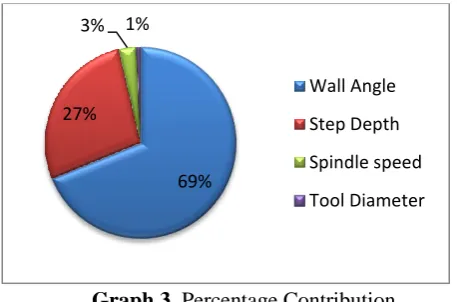
In order to statistically analyze the result, ANOVA was performed. Process variables having p-value<0.05 are considered significant terms for the requisite response characteristics. The insignificant parameters were having p value larger than 0.05. The percentage contribution is calculated as below.
Graph 3. Percentage Contribution
Wall angle contributes 69%, step depth 27% which are the most significant and contributing parameters in the process. The Spindle speed and tool diameter are
relatively insignificant parameters in the forming process with their contribution of 3% and 1% respectively.
IV.
CONCLUSION
Percentage contribution to the total sum of square can be used to evaluate the importance of a change in the process parameter on these quality characteristics. From graph 3 it is clear that among three process parameters wall angle has the highest contribution followed by step depth, spindle speed, tool diameter. So, wall angle is most influencing factor on surface roughness.
V.
REFERENCES
[1]. Nimbalkar D.H., "Review of Incremental Forming of Sheet Metal Components", International Journal of Engineering Research and Applications Vol. 3, Issue 5, pp.39-51 Sep-Oct 2013,
[2]. J. Leona, et al., "Analysis of the influence of geometrical parameters on the mechanical properties of incremental sheet forming parts", The Manufacturing Engineering Society International Conference MESIC 2014
[3]. Bagudancha, "Forming force in Single Point Incremental Forming under different bending conditions", The Manufacturing Engineering Society International Conference, MESIC 2013 [4]. J. Lupianez, "The effect of process parameters on
the energy consumption in Single Point Incremental Forming", The Manufacturing Engineering Society International Conference
[5]. Massimo Callegari "Sheet Incremental Forming: Advantages of Robotised Cells vs. CNC Machines", Industrial Robotics: Programming, Simulation and Application, ISBN 3-86611-286-6, pp. 702,
[6]. C. Pandivelan, A.K. Jeevanantham, "Formability Evaluation of AA 6061 Alloy Sheets on Single Point Incremental Forming using CNC Vertical Milling Machine". ISSN: 2028-2508
[7]. M.B. Silva, M. Skjoedt, "single point incremental forming of metal sheets", Instituto Superior Tecnico, Technical University of Denmark.
[8]. Premika Suriyaprakan, "Single Point Incremental Forming and Multi-Stage Incremental Forming on Aluminium Alloy 1050", Thammasat University February 2013,
69% 27%
3% 1%
Wall Angle
Step Depth
Spindle speed