Firdouse et el Journal of Drug Delivery & Therapeutics. 2019; 9(5-s):73-104 Available online on 15.10.2019 at http://jddtonline.info
Journal of Drug Delivery and Therapeutics
Open Access to Pharmaceutical and Medical Research© 2011-18, publisher and licensee JDDT, This is an Open Access article which permits unrestricted non-commercial use, provided the original work is properly cited
Open
Access
Research Article
GC MS Analysis of Bioactive Compounds Present in Marketed Herbal
Formulation Pykure Capsule
Dr. Seema Firdouse
1*,Humaira Fatima Begum
2, Dr. Parwez Alam
31Associate Professor, Department of Pharmaceutical Analysis and Quality Assurance, Anwarul Uloom College of Pharmacy, Hyderabad- 500001, Telangana, India.
2Department of Pharmaceutical Analysis, Anwarul Uloom College of pharmacy, Hyderabad- 500001, Telangana, India
3Associate Professor, Department of Pharmacognosy, Shadan College of Pharmacy, Peerancheeru, Hyderabad-500091, Telangana, India
ABSTRACT
It is more acceptable to believe that natural remedies are safer than synthetic subjects that with fewer side effects. The global market demand was increasing due to fusion of herbs. Standardization parameters and evaluation of herbal formulation is essent ial in order to assess the quality of drug of therapeutic value. This study was carried out in order to determine the bioactive compounds present in the marketed herbal formulation pykure capsule by using the GC MS instrument. The extract was prepared by using 20 capsules by removing the capsule shell with ethanol solvent by simple maceration method. Capsule extract was analyzed by using Agilent 6890 GC with 59739N MSD and GC -MS equipped with Elite I fused with silica capillary column (Cpsil 8cb:30mm×25mm×0.25mm). The result of GC-MS analysis confirmed the presence of 74 compounds.
Keywords: Pykure capsule, Ethanolic extract, GC-MS analysis.
Article Info:Received 13 July 2019; Review Completed 17 Aug 2019; Accepted 24 Aug 2019; Available online 15 Oct 2019
Cite this article as:
Firdouse S, Begum HF, Alam P, GC MS Analysis of Bioactive Compounds Present in Marketed Herbal Formulation Pykure Capsule, Journal of Drug Delivery and Therapeutics. 2019; 9(5-s):73-104http://dx.doi.org/10.22270/jddt.v9i5-s.3601
*Address for Correspondence:
Dr. Seema Firdouse, Associate Professor, Department of Pharmaceutical Analysis and Quality Assurance, Anwarul Uloom College of Pharmacy, Hyderabad- 500001, Telangana, India.
1. INTRODUCTION
Herbal medicines can be defined as any medicinal product which contains active ingredients as one or more herbal preparation or herbal substances [1]. Herbal medicine is an ancient form of ailment. The use herbal medicine is increased tremendously over past 2 decades. In this field, there is a significant lack of research data. Since 1990 three volumes of
entire patients satisfaction. Each 750mg of Pykure capsule contains the following ingredients: Terminalia chubularets 0.10 grams, Abutilon indicum 0.10 grams, Mesua ferrea 0.08 grams, Azadirachta indica 0.19 grams, Saraca indica -0.12 grams, Cuminum cyminum - 0.05 grams. It is used to treat different types of Ano-rectal disorders [4, 5].
Firdouse et el Journal of Drug Delivery & Therapeutics. 2019; 9(5-s):73-104
2.2. Methods of Analysis of sample by Gas
chromatography Mass spectrometry (GC-MS):
GC-MS analysis of sample was performed by using Agilent 6890 GC with 59739N MSD and GC -MS equipped with Elite I, fused with silica capillary column (cpsil 8cb :30 mm x
25mm x 0.25 mm) composed of 100% Dimethyl
polysiloxane. For GC-MS detection an electron ionization system with ionizing energy of 70 ev was used. Hydrogen (99.99%) was used as the carrier gas at a flow rate of 1.5 ml and an injection volume of 2 micro liters. It was employed with split ratio of 10:1, Initial injection temp of 400c to final
280 0 c. Ion source temp 230 0 c. The oven temp was
programmed from 110 0c (isothermal for 2 minute) with a
rate of 10 0c per min to 3000c. And a scan interval 0.5 sec
and fragments from 20-200 Dalton. Total GC running time was 36 minutes. The relative average peak area and retention time, molecular formula with that of molecular weight were obtained. The interpretation on mass spectrum GC-MS was conducted by using the data base of national institute standard and technology (NIST), having 62,000 patterns. The spectrum of unknown component was compared with spectrum of known component stored in NIST library. The name, molecular weight and structure of the components of the sample material were identified [6].
3. RESULTS AND DISCUSSION:
Firdouse et el Journal of Drug Delivery & Therapeutics. 2019; 9(5-s):73-104
Firdouse et el Journal of Drug Delivery & Therapeutics. 2019; 9(5-s):73-104
Firdouse et el Journal of Drug Delivery & Therapeutics. 2019; 9(5-s):73-104
Firdouse et el Journal of Drug Delivery & Therapeutics. 2019; 9(5-s):73-104
Firdouse et el Journal of Drug Delivery & Therapeutics. 2019; 9(5-s):73-104
Firdouse et el Journal of Drug Delivery & Therapeutics. 2019; 9(5-s):73-104
Firdouse et el Journal of Drug Delivery & Therapeutics. 2019; 9(5-s):73-104
Firdouse et el Journal of Drug Delivery & Therapeutics. 2019; 9(5-s):73-104
Firdouse et el Journal of Drug Delivery & Therapeutics. 2019; 9(5-s):73-104
Firdouse et el Journal of Drug Delivery & Therapeutics. 2019; 9(5-s):73-104
2-hydroxyoctanoic acid 2-heptanal, 2
Firdouse et el Journal of Drug Delivery & Therapeutics. 2019; 9(5-s):73-104
Firdouse et el Journal of Drug Delivery & Therapeutics. 2019; 9(5-s):73-104
Firdouse et el Journal of Drug Delivery & Therapeutics. 2019; 9(5-s):73-104
Firdouse et el Journal of Drug Delivery & Therapeutics. 2019; 9(5-s):73-104
Tricosane 2-methyl docosane
methyl-Firdouse et el Journal of Drug Delivery & Therapeutics. 2019; 9(5-s):73-104
Firdouse et el Journal of Drug Delivery & Therapeutics. 2019; 9(5-s):73-104
methyl-Firdouse et el Journal of Drug Delivery & Therapeutics. 2019; 9(5-s):73-104
Firdouse et el Journal of Drug Delivery & Therapeutics. 2019; 9(5-s):73-104
Firdouse et el Journal of Drug Delivery & Therapeutics. 2019; 9(5-s):73-104
Firdouse et el Journal of Drug Delivery & Therapeutics. 2019; 9(5-s):73-104
Undecane, 2-methyl - dosocane,
Firdouse et el Journal of Drug Delivery & Therapeutics. 2019; 9(5-s):73-104
,2-methyl-Firdouse et el Journal of Drug Delivery & Therapeutics. 2019; 9(5-s):73-104
Firdouse et el Journal of Drug Delivery & Therapeutics. 2019; 9(5-s):73-104
Firdouse et el Journal of Drug Delivery & Therapeutics. 2019; 9(5-s):73-104
Firdouse et el Journal of Drug Delivery & Therapeutics. 2019; 9(5-s):73-104
Firdouse et el Journal of Drug Delivery & Therapeutics. 2019; 9(5-s):73-104
Firdouse et el Journal of Drug Delivery & Therapeutics. 2019; 9(5-s):73-104
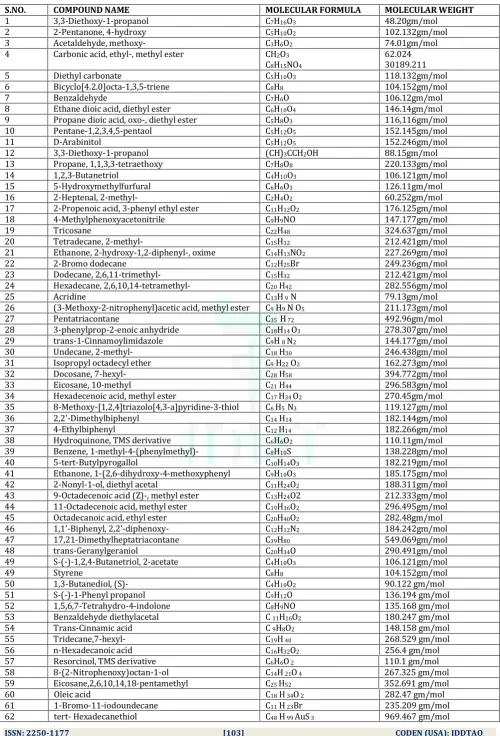
Table 1. Phytocomponents found in pykure capsule by gc-ms analysis.
S.NO. COMPOUND NAME MOLECULAR FORMULA MOLECULAR WEIGHT
1 3,3-Diethoxy-1-propanol C7H16O3 48.20gm/mol
2 2-Pentanone, 4-hydroxy C5H10O2 102.132gm/mol
3 Acetaldehyde, methoxy- C3H6O2 74.01gm/mol
4 Carbonic acid, ethyl-, methyl ester CH2O3
C8H15NO4
62.024 30189.211
5 Diethyl carbonate C5H10O3 118.132gm/mol
6 Bicyclo[4.2.0]octa-1,3,5-triene C8H8 104.152gm/mol
7 Benzaldehyde C7H6O 106.12gm/mol
8 Ethane dioic acid, diethyl ester C6H10O4 146.14gm/mol
9 Propane dioic acid, oxo-, diethyl ester C5H8O3 116,116gm/mol
10 Pentane-1,2,3,4,5-pentaol C5H12O5 152.145gm/mol
11 D-Arabinitol C5H12O5 152.246gm/mol
12 3,3-Diethoxy-1-propanol (CH)3CCH2OH 88.15gm/mol
13 Propane, 1,1,3,3-tetraethoxy C7H8O8 220.133gm/mol
14 1,2,3-Butanetriol C4H1OO3 106.121gm/mol
15 5-Hydroxymethylfurfural C6H6O3 126.11gm/mol
16 2-Heptenal, 2-methyl- C2H4O2 60.252gm/mol
17 2-Propenoic acid, 3-phenyl ethyl ester C11H12O2 176.125gm/mol
18 4-Methylphenoxyacetonitrile C9H9NO 147.177gm/mol
19 Tricosane C22H48 324.637gm/mol
20 Tetradecane, 2-methyl- C15H32 212.421gm/mol
21 Ethanone, 2-hydroxy-1,2-diphenyl-, oxime C14H13NO2 227.269gm/mol
22 2-Bromo dodecane C12H25Br 249.236gm/mol
23 Dodecane, 2,6,11-trimethyl- C15H32 212.421gm/mol
24 Hexadecane, 2,6,10,14-tetramethyl- C20H42 282.556gm/mol
25 Acridine C13H9N 79.13gm/mol
26 (3-Methoxy-2-nitrophenyl)acetic acid, methyl ester C9H9N O5 211.173gm/mol
27 Pentatriacontane C35H72 492.96gm/mol
28 3-phenylprop-2-enoic anhydride C18H14 O3 278.307gm/mol
29 trans-1-Cinnamoylimidazole C9H 8 N2 144.177gm/mol
30 Undecane, 2-methyl- C18H30 246.438gm/mol
31 Isopropyl octadecyl ether C9H22O2 162.273gm/mol
32 Docosane, 7-hexyl- C28H58 394.772gm/mol
33 Eicosane, 10-methyl C21H44 296.583gm/mol
34 Hexadecenoic acid, methyl ester C17 H34O2 270.45gm/mol
35 8-Methoxy-[1,2,4]triazolo[4,3-a]pyridine-3-thiol C6 H5N3 119.127gm/mol
36 2,2'-Dimethylbiphenyl C14H14 182.144gm/mol
37 4-Ethylbiphenyl C12 H14 182.266gm/mol
38 Hydroquinone, TMS derivative C6H6O2 110.11gm/mol
39 Benzene, 1-methyl-4-(phenylmethyl)- C8H10S 138.228gm/mol
40 5-tert-Butylpyrogallol C10H14O3 182.219gm/mol
41 Ethanone, 1-(2,6-dihydroxy-4-methoxyphenyl C9H10O3 185.175gm/mol
42 2-Nonyl-1-ol, diethyl acetal C11H24O2 188.311gm/mol
43 9-Octadecenoic acid (Z)-, methyl ester C13H24O2 212.333gm/mol
44 11-Octadecenoic acid, methyl ester C19H36O2 296.495gm/mol
45 Octadecanoic acid, ethyl ester C20H40O2 282.48gm/mol
46 1,1'-Biphenyl, 2,2'-diphenoxy- C12H12N2 184.242gm/mol
47 17,21-Dimethylheptatriacontane C39H80 549.069gm/mol
48 trans-Geranylgeraniol C20H34O 290.491gm/mol
Firdouse et el Journal of Drug Delivery & Therapeutics. 2019; 9(5-s):73-104
63 Supraene C19H10Br4O5S 331.35 gm/mol
64 Isopropyl octacosyl ether C4H10O 74.123 gm/mol
65 2-Methyltriacontane C3164H 436.853 gm/mol
66 2-Methylpentacosane C16H34 226.448 gm/mol
67 Squalene C30H50 410.73 gm/mol
68 Hexadecane, 7,9-dimethyl- C18H38 254.502 gm/mol
69 Triacontane, 11,20-didecyl C50H102 703.366 gm/mol
70 Nonadecane C19H40 308.773 gm/mol
71 Disulfide, di-tert-dodecyl C24H30S2 402.787 gm/mol
72 Tricosane C23H48 324.637 gm/mol
73 Eicosane C20H42O 282.529 gm/mol
74 Hentricontane C31H64 436.85 gm/mol
4. CONCLUSION
Ayurvedic herbal formulations are widely used in allopathic era for their effectiveness and reduced risk of side effects. Pykure is a poly herbal capsule containing Mesua ferrea, Terminalia chebularates, Cuminium cyminium, Azadiracta indica, Saraca indica, Abutilon indicum, Picrorhiza kurroa and Red ochre. Label claims different dosages for varied pharmacological activity in Bleeding hemorrhoids, fissures and rectal swelling, prolapsed of rectum, fistula. For quest of
compounds present in poly herbal formulation.
Spectroscopic studies mainly Gas chromatography and Mass spectroscopy was carried out and 74 known compounds were reported and matched with NIST library of IICT.
5. ACKNOWLEDGEMENT:
I would like to thank Mr.Vijaya Sarathi, Sr.Scientist IICT, Tarnaka, Hyderabad, Telangana for providing the facility and support used to carry out the work.