Fast Multicast Scheme with Secure Network Coding in
Cloud Data Centers
Kaixiang Huang1, Yue Chen1,2, Hongyong Jia1, Julong Lan2, Xincheng Yan1, and Zhiwei Wang3
1 Sciences State Key Laboratory of Mathematical Engineering and Advanced Computing, 450001 Zhengzhou, China
2 China National Digital Switching System Engineering and Technological Research Centre 450001 Zhengzhou, China
3 Department of Computer Sciences of the University of Hongkong Hongkong, China
Abstract. Multicast is widely applied in cloud data centers. Because intermediate nodes can encode the packets, network coding improves the capacity and robust-ness of multicast applications. However, this system is vulnerable to pollution at-tacks. Existing schemes mainly focus on homomorphic cryptographic technologies against such attacks. However, the homomorphic cryptographic technology intro-duces complicated key management and calculation and storage overhead. This pa-per proposes a novel, fast, and secure network-coding multicast on software-defined networks. This scheme separates the complicated secure multicast management from fast data transmission. In the control layer, when users and switches try to join the secure multicast, they are authenticated and authorized by the controller. Only trusted nodes can join the forwarding paths. In the data layer, the trusted nodes only forward the data. The proposed scheme can use traditional cryptography without homomorphy; thus, it greatly reduces computation complexity, improves transmis-sion efficiency, and thwarts pollution and eavesdropping attacks.
Keywords:cloud data center, multicast, secure network coding, software-defined networks.
1.
Introduction
Many applications have been implemented in the cloud data center, an important cloud-computing infrastructure [1]. Cloud services such as pushing information, distributing files [2], and deploying replicated data [3], among others, often need to transfer data from one point to one or more points. Therefore, multicast technology is widely adopted to conserve the bandwidth of the data center networks [4][5]. Network coding [6] is a novel transmission mechanism that allows intermediate nodes to encode the received packets, improve the capacity of multicast applications, and enhance network robustness and throughput relative to the traditional ”store-and-forward” mechanism [7].
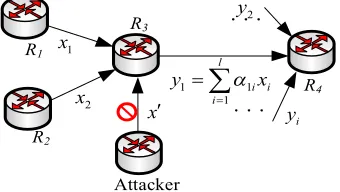
to their downstream nodes. When the recipients receive a sufficient number of packets, they can obtain the original data by decoding these vectors. However, if some malicious nodes are present in the network and they forward fake vectors or invalid combinations of received vectors, the polluted vectors will be quickly spread to the other nodes even in the whole network. Only some of the multiple packets obtained by the recipients are un-corrupt vectors. In this case, the recipients have no way of decoding the vectors [9], and network resources are wasted. Therefore, preventing pollution attack is very important to make network coding more practical. Fig. 1 shows that preventing pollution attack is difficult using the standard signatures or message authentication codes (MACs). Because intermediate nodes may encode the data vectors, the signatures or MACs may be dam-aged. The signatures or MACs of the original vectors cannot be verified by the recipients.
2
x
1
x
x′
1 1
1
l
i i i
y α x
=
=
∑
R2
R1
R3
R4
Attacker
2
y
i y
Fig. 1.Pollution attacks
In this paper, we propose a scheme called secure switch network coding (SSNC) to prevent against pollution attack. SSNC can use the traditional cryptographic technology without homomorphy to prevent pollution attacks, which reduces the complexity of the calculation and transmission delay.
In section 2 we discuss prior work defending the pollution attacks in the network coding, and describe the advantages of our scheme. In section 3, we introduce our scheme how to design and implement in the SDN. In the section 4, we describe the details of the SSNC protocol. In the section 5, we analysis the performance and security of the SSNC scheme. Finally, a conclusion is made in Section 6.
2.
Related Work
To defend against pollution attack in network coding, an increasing number of researchers have proposed several novel hashing or signature schemes. Zhao et al. [10] introduced a signature scheme based on the linear subspace. At the sender side, the file is broken into a set of vectors v1, ...,vm, and these vectors can span subspaceV. In the intermediate
Thus, the signature is very long, and the public key is only used for a single file. The pro-cess will become complex when multiple multicast groups are present. Therefore, Boneh et al. [11] proposed a homomorphic signature scheme in which they can sign the linear subspace using a constant public-key size. This scheme signs an individual vector instead of the entire subspace; however, it suffers from highly expensive computational overhead due to bilinear pairing operations.
Yu et al. [12] proposed a probabilistic key pre-distribution scheme to prevent pollu-tion attacks. The sources need to add multiple MACs to the data before forwarding them, and multiple nodes can verify the different parts of the message via shared secret keys. Agrawal et al. [13][14] designed a homomorphic MAC scheme, which allows each node to check the integrity of a data vector. However, this system is vulnerable to collusion and tag pollution attacks. To defend against the tag pollution attack, Li et al. [15] proposed the RIPPLE based on the idea of Ref. [16]. This scheme provides a symmetric key so-lution using the homomorphic MAC algorithms and TESLA [17]. However, to calculate the MAC labels in RIPPLE, the sources must take the longest path from each node to the source as the input. Wu et al. [18] proposed KEPTE, which is a key pre-distribution-based tag encoding scheme. The source generates multiple tags for each packet. The intermedi-ate nodes generintermedi-ate a new tag according to the received tags and then verify the correctness of the packet. However, this scheme requires a key distribution center.
Recently, most schemes have used the homomorphic cryptographic technology to sign or hash the original data to provide a secure random linear network coding. The devel-opment of the software-defined network (SDN) [19][20] and the reconfigurable networks [21] presents a new idea of providing secure services. In the SDN architecture, the com-plicated secure multicast management can be separated from the fast data transmission [22][23]. In the current paper, we propose a scheme called SSNC to prevent against pol-lution attack. SSNC possesses advantages in the following aspects: (a) the controller is responsible for managing the multicast group; thus, it can prevent attackers from sending data and illegal users from receiving data; (b) the controller authenticates and authorizes the switch by only allowing a trusted switch to join the path of the multicast tree; (c) the switches only encode/decode and forward the data according to the flow entry; and (d) SSNC can use the traditional cryptographic technology without homomorphy to prevent pollution attacks, which reduces the complexity of the calculation and transmission delay.
3.
Design and Implementation of SSNC
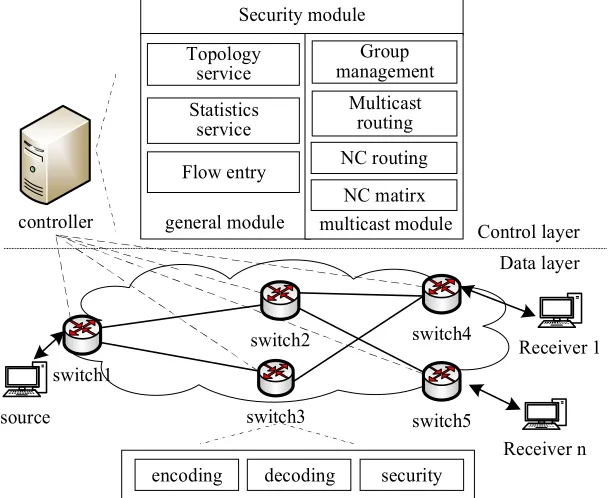
We mainly use network coding to implement the multicast application [24][25]. In the SDN, a legal sender can generate and send out original packets without being aware of the encoding/decoding affairs, whereas a legal recipient can receive these packets from the network. For multicast transmission, the controller is responsible in deciding whether to use the network coding. When multiple multicast trees are aggregated to use the network coding for transmission, the controller is then responsible in routing the paths, updating the flow table of the switches, and calculating the local encoding matrix for each switch involved in the transmission. Finally, the controller generates the flow-table entries of the network coding and sends these to each switch via the interface.
knowing the global network topology, generating and updating the flow entry, and moni-toring the state awareness. To create a strategy, the general module also exchanges basic parameters with the other modules. The state-aware module monitors and analyzes the network state to promptly discover the abnormal switch nodes and current traffic dis-tribution. The network-topology module obtains the whole network structure to provide a global view. The flow-entry module generates and updates the flow-table entries of the switches. The multicast module manages the group members, the routing of multi-cast trees, the decision of whether to use network coding for multimulti-cast, the selection of network-coding path, and the generation of a coding matrix based on the parameter in-formation provided by the general module. The security module mainly generates and manages the certificates and completes the authorization and authentication of the mem-ber switches by cooperating with the other modules.
source controller
Receiver 1
Receiver n Security module
encoding decoding security switch1
switch2 switch4
switch5 switch3
Topology service
Flow entry Statistics
service
Group management
Multicast routing
NC routing
NC matirx
multicast module
general module Control layer
Data layer
Fig. 2.SSNC scheme
The data layer is composed of switches and users, which are only involved in data transmission. In the switch, the encoding module is responsible for encoding the data according to the local encoding matrix assigned by the controller. The decoding module only runs when the switch is connected to the receiver. It decodes according to the decod-ing matrix and then sends the data to the receiver. The security module stores private keys and certificates and simultaneously verifies the credibility of the data as well as its own credibility by connecting with the controller.
Step 1: In the setup stage, the controller authenticates the true identity of all users and switches and builds the trusted switch and user lists.
Step 2: The source and the receivers send request packets to join with or quit from the group. The controller verifies each source and receiver and then computes the forwarding tree and the security policies according to the network status, the known trusted switch list, and the group members. Finally, the controller sends the strategy to the switches, which are in the path of the forwarding tree.
Step 3: The switches update the flow entries of the group.
Step 4: While the source sends the data, the switch forwards the data according to the flow entry. The receivers obtain the data when the session is finished.
Step 5: During the transmission, the controller dynamically adjusts the tree and the policies.
4.
Secure Switch Multicast Scheme
Network coding needs to establish the forwarding paths for the multicast group. In addi-tion, knowing all the nodes in the path is difficult for traditional networks [26]. Therefore, most research works sign the source data or the spanning vector space and ensure security through source authentication in each node. If the switches in the path are all real and trusted during the whole data transmission, they can effectively prevent other switches from replaying and tampering attacks. Authentication, authorization, and integrity checks must be provided in the network-coding transmission. Only authenticated and authorized switches must be used.
4.1. Initialization
The control node in the whole SDN is a trusted controller (denoted asCN). It maintains the list of group members by deciding which members can be added to the secure multicast group and what their permissions (such as create, join, and delete) are.CN has a pair of keys for the public key cryptosystem, which is used to issue a certificate for group members. When an entity wants to join a secure multicast, it needs to provide its public key toCNto verify its true identity. The authenticated and approved entity will receive a certificate consisting of the IP address, multicast group address, public key, permission, time stamp, and lifetime. As an example, the following is a certificate issued to userU.
CERTU= [IPU,MC,K+U,Perm,T S,Li f e]K−CN
whereCERTUis the certificate,IPUis the IP address ofU,MCis the multicast address, K+U is the public key ofU,Permis the permission ofU,T Sis the time stamp, andLi f e
is the lifetime of this certification.K−CNis the private key corresponding to the public key
of the controller, and[message]K−CNdenotes the signature of the message usingK−CN.
the trusted and authenticated devices and builds the multicast paths from this list. The list is dynamically changed based on anomaly or failure detection algorithms [30]. If the trustworthiness of the devices are questioned or shows abnormal behavior, it will be re-ported by other switches or controller. Once the trustworthiness of a switch drops below the threshold, the switch will automatically be quarantined by other switches and con-troller. Then, this switch is removed from the list. TrustedCNdistributes a certificate for each secure and trusted switch as follows:
CERTR= [IPR,MC,K+R,T S,Li f e]K−CN
4.2. Group Creation
When sourceSwants to create a secure multicast network, first, it needs to send an ap-ply message toCN for a certificate. The message consists of the IP address, public key, multicast address, and permissions desired.
S→CN:[IPS,K+S,MC,Perm]K−S
WhenCN receives the application from the source, it will check the truth of source
Saccording to the public key and IP ofS. Then, it checks whetherShas the permission to create a secure multicast. If the above checks are successful, it issues a certificate toS
with the private key ofCNand sends it toS.
CN→S:CERTS= [IPS,MC,K+S,T S,Li f e]K−CN
When theCN multicast management module has issued a certificate for the source distribution and has created a group, it can accept the application of the group members to join the multicast tree. In SSNC, some control messages are in place to join or quit the multicast, which are calledJoin Request(JR),Join Acknowledgement(JA),Controller Request(CR),Controller Acknowledge(CA), andQuit Notice(QN). To ensure that no authorized users and switches can be added to the multicast tree, JRandJAmessages need to be signed. However, theQN message cannot allow new branches to be added to the multicast tree; thus, no signature is needed. TheCRandCAmessages are used to prevent attacker replay of theJRandJAmessages, and they must be signed.
The establishment process of the multicast tree is introduced as follows. When a re-ceiver wants to join the multicast tree, it sends aCRmessage signed by the sender con-taining random numberNU and the sender certificate. Then, the message is directly
trans-mitted toCNvia the nearest switch.
U→CN:[CR,CERTU,NU]K−U
WhenCN receives theCRmessage, it verifies the message and the certificate. Once the verification is successful, it directly sends the identification informationCA to the receiver signed byCN, which contains the certificateCERTCNofCN, random numberNU
of the receiver, and random numberNCNgenerated byCN.
When the receiver receives the identification message fromCN, it sends the joining messageJRtoCN, which contains certificateCERTUof the receiver and random number NCNprovided byCN.
U→CN:[JR,CERTU,NCN]K−U
OnceCNreceives joining messageJR,CNverifies it. Further,CNwill calculate the multicast forwarding tree based on the trusted switch and update all the flow entry and security policy of the trusted switch. The set of selected trusted switches is denoted as R. The update information includes the public key ofCN, multicastID, initial sequenceSEQ, and sharing keyKBof the forward tree. Finally,CNneeds to sign the message and sends
an identification message to userU. Meanwhile, the sharing key of the tree can choose to use the classical symmetric encryption scheme such as the Advanced Encryption Standard (AES), which has a faster speed compared with the public-key cryptography.
CN→R:[JAR1,CERTCN,{KB,ID,SEQ,}K+R1]K−CN,
[JAR2,CERTCN,{KB,ID,SEQ,}K+R2]K−CN,···
CN→U:[JA,CERTCN,NU{KB,ID,SEQ}K+U]K−CN.
4.3. Multicast Data Forwarding
In the SSNC protocol, the multicast data mainly consist of two parts. One part is the data actually needed to be sent, denoted asvi. The other part is the control information,
which is encrypted by the sharing multicast session keyKB. After the secure multicast
forwarding tree is established, each switch, sender, and receiver in the multicast paths can obtain session keyKB, initial sequenceSEQ, and the checksum of the data.
For the sender, the original data are represented by vectorV = (v1,v2, ...,vl), and the
different data vectorviis sent to the different next switchRNEX T.
R→RNEX T1:{v1},{ID,SEQ,CS({v1})}KB,
RNEX T2:{v2},{ID,SEQ,CS({v2})}KB,···
For switchR, which is located in the same path as the source, once packets are being received, it decrypts the control part of the packet using session keyKB, checks theID
and theSEQof the multicast, and checks the checksum of the data part of the packet. If all checks are successful, all the received data vectors are linearly combined to new data vectorybased on encoding matrixM. Then, the new data vector and the control infor-mation are sent to the next switcher, whereIDindicates which multicast does the packet belong to, SEQ indicates which generation of the network coding the packet belongs to, and the checksum is verified against the modified data.
y=
l
∑
i=1
R→RNEX T1:{y},{ID,SEQ,CS({y})}KB,
RNEX T2:{y},{ID,SEQ,CS({y})}KB,···
For receiverU, which is located in the same path as the source, once it receives a packet, it decrypts the control part of the data using session keyKB and checks theID, SEQ, and checksum of the data. If all checks are successful,U will encode the packet using network coding to obtain the original data.
4.4. Key Update
When members change or some nodes are no longer trusted, session keyKB should be
updated in time; otherwise, malicious nodes will forge the data using the old key and then launch a pollution attack. Meanwhile, the life cycle of the key also requires regular updating. Therefore,CNmust generate new keys and resetSEQ. After a new key is gen-erated, the old key and new SEQ are encrypted by the public keys of each member and switch, which are then encrypted by the private key ofCN. Finally, they are sent to all the switches and members of the paths.
CN→R:[IPR1,{KBNew,KBOld,SEQ}K+R1]K−CN,
[IPR2,{KBNew,KBOld,SEQ}K+R2]K−CN,···
CN→U:[IPU1,{KBNew,KBOld,SEQ}K+U1]K−CN,
[IPU2,{KBNew,KBOld,SEQ}K+U2]K−CN,···
4.5. Maintenance of Multicast Path
5.
Performance and Security Analysis
5.1. Security Analysis
The set of the whole network is denoted asN. The set of nodes in the secure multicast path is denoted asC (C ⊂N ). The number of multicasts in the network is denoted asl, and the attacker is denoted asA.
Confidentiality means that information must not be leaked to unauthorized users. In network coding, the original data are divided into many data vectors before being sent. The data vectors will be combined into new data vectors. The original data can be decoded only ifA obtains sufficient data vectors and the corresponding coding matrix. To prevent an eavesdropper from obtaining the correct data, the traditional network coding encrypts the coefficient or partial data. However, the encryption scheme usually is homomorphic. In the SSNC, the coding coefficients are not transmitted with the data but distributed to the trusted node by the RSA. To obtain the coefficient, must obtain the private key of the trusted node or successfully fake the trusted node certification; thus, this mechanism can provide confidentiality.
Each of the trusted nodes is authenticated by the public key infrastructure. However, A may fake the source or the trusted node to send and forward data. To solve this problem, we provide the source authentication in SSNC by combining the hash with symmetric encryption. When the multicast service requires source authentication, the data part is added by theIPof the source. The control part of the packet can be faked only if A obtains the session key. However,A can tamper the data part with the correct control part; thus, we use the hash function to protect against this attack. Non-repudiation is provided by adding the sourceIPencrypted by its private key to the data part, for example,
R→RNEX T1:{y,[IPS]K−S},{ID,SEQ,CS({y,[IPS]K−S})}KB,
RNEX T2:{y,[IPS]K−S},{ID,SEQ,CS({y,[IPS]K−S})}KB,···
Integrity refers to that information in the process of transmission cannot be changed without authorization. For example, the pollution attack tampers the data by faking or adding some invalid data. An attackerA fakes a message{v∗},{ID,SEQ,CS({v∗})}K∗. Once the node ofC receives this data and decodes the control part, the messagev∗will be accepted. However, A has to crack secret keys of the AES. Without cracking the AES, A has to fake the trusted nodes to join the secure multicast group. It sends the messageU∗→CN:[JR,CERTU∗,NCN∗]K−U∗ toCN. The private key should be known,
as well as the certificate of which the security depends on the RSA. In another case, when the attackers eavesdrop on the link betweenCN and the trusted node, they will get the message:CN→R:[JAR,CERTCN,{KB,ID,SEQ,}K+R]K−CN. Obtaining theCNpublic
key is easy, but obtaining the node private key is difficult.
To obtain the data of the multicast, attackerA eavesdrops on the joint messages sent by the trusted node, which then returns the false key to the node. For example, a source wants to send a joint message toCN, The attacker eavesdrops on the message and returns the message:CN∗→S:CERTS∗= [IPS,K+S,MC,Perm,T S,Li f e]K−CN∗ to the source.
Sometimes, although the messages:[JAR,CERTCN,{KB,ID,SEQ,}K+R]K−CN and
[JA,CERTCN,NU{KB,ID,SEQ}K+U]K−CN are eavesdropped, obtaining KB or forging
the messages remains difficult.
The security of the whole system depends on the encryption algorithms used in our scheme. From the above analyses, we can conclude that our system is capable of resisting pollution and eavesdrop attacks.
5.2. Performance analysis
The communication overhead of network coding refers to the bandwidth cost to distribute the authentication information to each node. The overhead mainly considers two aspects: keys and signatures. The computational overhead mainly refers to encoding/decoding the vector and verifying the signatures. The storage overhead refers to the storing of the keys, certificates, and other safety parameters.
SSNC is composed of two stages. The first stage is the setting up of the system.CN
selects the trusted nodes for the set of C from the set of N . Using RSA,CN autho-rizes and authenticates the nodes. We denotetRas a running time for finishing a RSA
algorithm. In the setup stage, interactions betweenCN and the nodes occur two times; thus, the total time is 2tR. During the building of a secure multicast group, interactions
betweenCNand the nodes also occur two times, but running the RSA algorithm requires five times. This type of overhead does not affect the time of transmission. For the sec-ond SNNC stage, each intermediate node must decrypt and verify the control part of the packet. If the decrypting and verification algorithms are very complex, the efficiency of the data transmission will significantly be reduced. Therefore, we use the AES algorithm to encrypt and decrypt the control part of the packet by denoting the time of completing the AES algorithm astAES. Before combing the data vectors, we verify the vectors without
tampering them using the hash algorithm and denote the time of completing the hash al-gorithm asthash. Before the new vector is forwarded to the next node, the node also needs
to generate a new hash value using hash and encrypts the new control part of the packet using AES. If a node receivesniuput packets, the total computation overhead of this node
is(niuput+1)(tAES+thash).
For each intermediate node,two types of keys are needed for storage. One is the public key, whose size is denoted as|KR|. The intermediate node should store its private key and
theCNpublic key. Whereas the system needs to provide the source authentication service, the node needs to store the source public key. The other is the session key, where one key is shared by one group. We denote the size of the session key as|KA|. FFor the intermediate node, the total storage overhead is 3|KR|+|KA|·l.CNstores the public nodes of the whole C and all the session keys; therefore, the total overhead is|KR| ·c+|KA| ·l.
In the SSNC scheme, the encoding matrix and the session keys are distributed to each node before transferring the data. Thus, the packets do not have to carry too much information. We denote the size of the data vector as|v|, and the size of the checksum as
|v|hash(which is a constant, e.g., 16 bytes). The sizes of multicarIDandSEQ, denoted as
p, are also constant as well as the total of the control part||v|hash+P|AES.
algorithm is much longer than that of the combination and verification process. The inter-mediate nodes need to use the random generator and pseudo-random function algorithms to combine the received data. The time overhead of the two algorithms are denoted as
tPRGandtPRF, respectively. In SSNC, the node first verifies the vectors and then combines
them. However, in the scheme in Ref. [13], the node first combines the vectors and then verifies them. Therefore, determining which vector is forged is very hard. Further, the scheme needs to generate n keys for one multicast. For each node, it distributes a differ-ent key. Thus, it requires a complex key managemdiffer-ent mechanism. The size of the key is denoted as|KHMAC|. Each node needs to store two sets of keys to ensure that it can act as both data source and receiver node. In contrast to the scheme in Ref. [13], the SSNC key management is more simple and effective. In the data transmission phase, in addition to the original vector, it also needs to attach tagst, extension of the vector data, and data sourceID. The sizes of the tags and the extended vector are respectively denoted as|tag|, which is set in advance, and|y|. TheIDof the data source is a constant and denoted as P. Further, this scheme needs to distribute the keys before transmission.
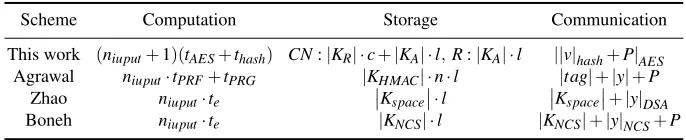
Table 1.Comparison of the computation, storage, and communication overhead
Scheme Computation Storage Communication
This work (niuput+1)(tAES+thash) CN:|KR| ·c+|KA| ·l,R:|KA| ·l ||v|hash+P|AES Agrawal niuput·tPRF+tPRG |KHMAC| ·n·l |tag|+|y|+P
Zhao niuput·te Kspace·l Kspace+|y|DSA
Boneh niuput·te |KNCS| ·l |KNCS|+|y|NCS+P
In the scheme in Ref. [10], the source finds an orthogonal vector and the signatures. The intermediate node verifies the signatures whose security is based on the DiffieCHell-man problem. This computation overhead is denoted as|te|. The complexity of this
al-gorithm is much higher. This scheme uses the public key encryption scheme. The source preserves the private key and distributes the public key. Although the number of needed keys is not very large, the size of the key is related to the size of files. We denote the size of the public and secret keys as|Kspace|, and the size of public key is 6(g+h)/ghtimes
that of the file, where the file with size M is divided into g blocks and h is the size of each block. During the transmission, the main communication overhead is the public key and signature vector. This scheme signs the vector using standard algorithm, and the size is denoted as|y|DSA.
The scheme in Ref. [11] combines the linear subspace with a homomorphic signa-ture. It uses a constant size of the public key and signasigna-ture. The internal nodes verify the signature according to the public key id and the dimensionality of the signed vector. The complexity of the calculation is similar to that of the scheme in Ref. [10], but the storage overhead is much smaller. The size of the keys is constant and is denoted as|KNCS|. In
ad-dition, the size of the signature in this scheme is constant, which usually takes upglog2p
bits or more, denoted as|y|NCS.
for the packet is reduced. Although the intermediate nodes need to encrypt/decrypt the packets, the AES is very quick, and the length of control information is constant.
5.3. Simulation Experiment
We verify the performance of SNNC by simulation experiments. We mainly use Mininet [31] to carry out the SDN, where each switch is connected to a receiver. Each switch is also connected to the controller, and the system contains one sender and five receivers. We generate different network topologies using Mininet and generate the encoding matrix and encoding nodes using the network-coding algorithm [32]. The controller needs to run the RSA authentication algorithm, generate the AES keys, and distribute the keys to each node in the forwarding path. Each node encodes the packets with a simple XOR operation.
10 15 20 25 30
0 5 10 15 20 25
the number of the nodes
ru
nt
im
e
HMAC network coding SNNC setup stage SNNC transmission stage network coding
Fig. 3.Runtime of the SSNC
0 10 20 30 40 50 60 70 80 90 100 2.5
3 3.5 4 4.5 5 5.5 6 6.5
the number of the packet
de
la
y
tim
e
NC SSNC HMAC
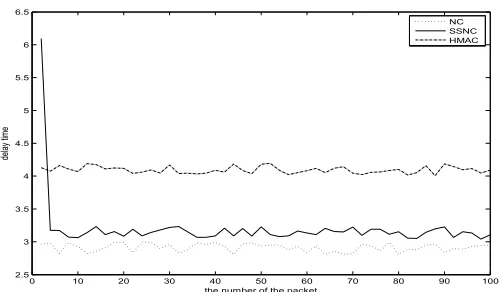
In the experiment, we use a Dell desktop computer, which has a 2.93 GHz Intel core i3 530 CPU with 4 GB main memory and runs on Ubuntu Linux. First, the sender sends the packets at the calculated maximum flow, and each packet is 1 k bytes in size. We record two time types: (a) the setup stage (the time for the controller to authenticate the switches and the time for the switches to update the entries) and (b) the transmission stage (the data-forwarding time). Fig. 3 shows that when the nodes in the network increase, the maximum flow of the network and the setup time also increase. However, the total time of the multicast is shorter, and the total multicast time is less than that of the Homomorphic MAC (HMAC) scheme proposed by Agrawal et al. [13]. Second, the data source continu-ously sends the data. We record the delay time of each packet. Fig. 4 shows our recorded delay curves of the 100 packets. SNNC requires more time to set up. Therefore, the first packet requires more time to arrive at the receivers. However, the total delay time is less than that of the HMAC scheme.
6.
Conclusions
In this paper, we have proposed a novel and fast SSNC multicast on the SDNs. We sep-arate the secure management from the transmission. During the management stage, only authorized users can join the multicast tree and obtain multicast session keys. Moreover, only a trusted switch can join in the multicast forwarding tree. Our scheme ensures that the node can verify the data from the other trusted nodes, which greatly improves its abil-ity against pollution and eavesdropping attacks. During data transmission, the node only focuses on how to forward the data to maintain high performance of the network cod-ing. To provide more flexible and efficient multicast services, we will further improve the system dynamics in the future, especially on how to deal with the frequent changes of members.
Acknowledgements.This work is supported by the National Basic Research Program of China (2012CB315901), and also supported by National Natural Science Foundation of China (61373006).
References
1. Winter, M.: Data center consolidation: A step towards infrastructure clouds. In Proceedings of the 1st International Conference on Cloud Computing. 190-199. (2009)
2. Chen, H. C., Yang, C. Y., Su, H. K., Wei, C. C., Lee, C. C.: A Secure E-Mail Proto-col Using ID-based FNS Multicast Mechanism. Computer Science and Information Systems 11(3):1091C1112. (2011)
3. Li, D., Yu, J., Yu, J., Wu, J.: Exploring efficient and scalable multicast routing in future data center networks. Proceedings - IEEE INFOCOM, 34(17), 1368 - 1376. (2011)
4. Li, H., Li, P., Guo, S.: Efficient privacy-preserving multicast in cloud data centers. Communi-cations (ICC), 2014 IEEE International Conference on. 810 C 815. (2014)
5. Zhang, X. C., Yang, M. H., Geng, G. G., Luo, W. M. Li, X. F.: A Two-Tiered Reliable Appli-cation Layer Multicast. ComSIS Vol. 8, No. 3. (2011)
7. Li, S. Y. R., Cai, N., Yeung, R. W.: On theory of linear network coding. In Proceedings. Inter-national Symposium on Information Theory. pp. 273C277.(2005)
8. Li, S. Y. R., Yeung, R. W., Cai, N.: Linear network coding. IEEE Trans. Inform. Theory, 49(2):371-381. (2003)
9. Han, K., Ho T., Koetter, R., Medard, M., Zhao, F.: On network coding for security. In IEEE MILCOM (2007).
10. Zhao, F.Kalker, T.Medard, M.Han, K. J.: Signatures for content distribution with network cod-ing. IEEE International Symposium on Information Theory, NiceFrance 556-560. (2007) 11. Boneh, D., Freeman, D., Katz, J., Waters, B.: Signing a Linear Subspace: Signature Schemes
for Network Coding. Lecture Notes in Computer Science, 68-87. (2008)
12. Yu, Z., Wei, Y., Ramkumar, B. Guan, Y.: An efficient scheme for securing XOR network coding against pollution attacks. in Proc. of the 28th IEEE International Conference on Computer Communications (INFOCOM). (2009)
13. Agrawal, S., Boneh, D.: Homomorphic MACs: MAC-based integrity for network coding. In Proceedings of ACNS 09, volume 5536 of LNCS: 292-305. (2009)
14. Agrawal, S., Dan, B., Boyen, X., Freeman, D. M.: Preventing Pollution Attacks in Multi-source Network Coding. Lecture Notes in Computer Science, 161-176. (2010)
15. Dong, J., Curtmola, R., Nita, R. C.: Practical Defenses Against Pollution Attacks in Intra-Flow Network Coding for Wireless Mesh Networks. in ACM WiSec09. 111-122. (2009)
16. Li, Y., Yao, H,, Chen, M., Jaggi, S., Rosen, A.: RIPPLE Authentication for Network Coding. Proceedings - IEEE INFOCOM, 29(16):2258-2266. (2010)
17. Perrig, A., Canetti, R., Tygar, J. D., Song, D.: The TESLA Broadcast Authentication Protocol. RSA CryptoBytes, vol. 5. (2002)
18. Wu, X., Xu, Y., Yuen, C., Xiang, L.: A Tag Encoding Scheme against Pollution Attack to Linear Network Coding. IEEE Transactions on Parallel and Distributed Systems, 25(1):33-42. (2014) 19. Ho, T., Medard, M., Koetter, R., Shi, J., Effros, M. Karger, D. R.: On randomized network cod-ing. In: Proc. of the 41st Annual Allerton Conf. on Communication, Control, and Computcod-ing. (2003)
20. Kozat, U.C., Liang, G., K?kten, K.: On diagnosis of forwarding plane via static forwarding rules in software defined networks . In: Proc. of the IEEE INFOCOM. (2014)
21. Cohen, R., Eytan, L.L., Naor, J.S., Raz, D.: On the effect of forwarding table size on SDN network utilization. In: Proc. of the IEEE INFOCOM. (2014)
22. Lan, J. L.: Research on the architecture of the reconfigurable fundamental Information com-munication network. Report of the National Basic Research Program of China. (2012) 23. Liu, S., Hua, B.: NCoS: A framework for realizing network coding over software-defined
net-work. 2014 IEEE 39th Conference on Local Computer Networks (LCN)IEEE Computer Soci-ety. 474-477. (2014)
24. Tan, X., Li, H., Zhu, Z., Yu, C., Qin, L.: LMTM: Multi-tree multicast with inter-layer network coding for layered multimedia streaming. Communications and Networking in China (CHINA-COM), 2013 8th International ICST Conference on (Vol.12, pp.871-876). IEEE (2013) 25. Jadhav, J., Gadage, S.: Secure and fast data transfer with network cofing. International Journal
of Computer Science Engineering and Information Technology Research (IJCSEITR) ISSN(P): 2249-6831; ISSN(E): 2249-7943. Vol. 3, Issue 5, 153-164. (2013)
26. Nagata, A., Tsukiji, Y., Tsuru, M.: Delivering a File by Multipath-Multicast on OpenFlow Networks. Intelligent Networking and Collaborative Systems (INCoS), 2013 5th International Conference on (pp.835-840). IEEE. (2013)
27. Shields, C., Garcia-Luna-Aceves, J. J.: Khip – a scalable protocol for secure multicast routing. Acm Sigcomm, routing. Acm Sigcomm, 29, 53-64. (1999)
29. Kreutz, D., Ramos, F. M. V., Verissimo, P.: Towards secure and dependable software-defined networks. Proceedings of the second ACM SIGCOMM workshop on Hot topics in software defined networkingACM.55-60. (2013)
30. Yan, Z., Prehofer, C.: Autonomic Trust Management for a Component-Based Software System Dependable and Secure Computing IEEE Transactions on. 8(6):810-823. (2011)
31. Lantz, B., Heller, B., Mckeown, N.: A network in a laptop: rapid prototyping for software-defined networks. Acm Sigcomm Hotnets Workshop. (2010).
32. Jaggi, S., Sanders, P., Chou, P. A., Effros, M., Egner, S., Jain, K., Tolhuizen, L. M. G. M.: Polynomial time algorithms for multicast network code construction. Information Theory IEEE Transactions on, 51(6), 1973-1982. (2005)
Kaixiang Huang received his M.S. degree in Computer Application from Institute of Zhengzhou Information Technology, China, and is now a PhD candidate in computer application. He has worked in the area of broad band multicast. He is skilled in network security technology.
Yue Chenreceived his M.S. degree in Computer Software from Institute of Zhengzhou Information Technology, China and his Ph.D. degree in Communication and Information System from China National Digital Switching System Engineering and Technological Research Centre, china. His research area broad band multicast. He is currently with net-work security technology.
Hongyong Jiareceived his M.S. degree in Computer Application from Institute of Zheng-zhou Information Technology, China, and his Ph.D. degree in Cryptography from Beijing University of Post and Telecommunication, China. He has worked in the area of applied cryptography and network security. He is proficient in developing data packet authentica-tion methods for the cloud and complex network environment.
Julong Lanreceived his M.S. degree in Communication and Electronic System from Xi-dian University and his Ph.D. degree in Communication and Information System from China National Digital Switching System Engineering and Technological Research Cen-tre. He has worked in the areas of network router, parallel switch structure and IPv6 technology. He is currently the Chief Scientist in Chinese national basic research project-Flexible Architecture of Reconfigurable Infrastructure.
Xincheng Yanreceived his B.A. degree in Software Engineering from Institute of Zheng-zhou Information Technology, China, and is now a M.A. candidate in computer applica-tion. He has worked in the area of network security and he is skilled in access control of cloud data.
Zhiwei Wangreceived his Ph.D. degree in cryptography from the Beijing University of Posts and Telecommunications, Beijing in 2009. He is an associate professor in the de-partment of information security at Nanjing University of Posts and Telecommunications. Currently, He serves as a research associate in the department of computer sciences at the University of Hongkong. His research interests include digital signatures, provable security, cryptographic protocols and cloud security.