Available online on 15.07.2019 at http://jddtonline.info
Journal of Drug Delivery and Therapeutics
Open Access to Pharmaceutical and Medical Research© 2011-18, publisher and licensee JDDT, This is an Open Access article which permits unrestricted non-commercial use, provided the original work is properly cited
Open Access
Research Article
Formulation and Evaluation of Prulifloxacin Sustained Release Matrix
Tablets
V. Phani Deepthi*
1, A. Rajesh Pavan
1, G. Naresh babu
2, K. Sreenivasulu
31. Department of Pharmaceutics, JNTUA -Oil Technological and Pharmaceutical Research Institute, Anantapuramu, A.P, India 2. Department of Pharmaceutics, Balaji College of pharmacy, Ananthapuramu, AP, India.
3. Department of Pharmaceutics, Creative Educational Society’s College of Pharmacy, Kurnool, AP, India.
ABSTRACT
Prulifloxacin is a chemotherapeutic antibiotic of Fluor quinolone drug used to treat a various urinary tract infections. It has short half-life, makes the sustained release (SR) forms extremely advantageous. Sustained release tablets results in increased bioavailability. The purpose of the present study was to develop a sustain release matrix drug delivery system (SR) containing Prulifloxacin as a model drug by using various proportions of polymers such as HPMC E15, HPMC K15. The sustained release formulations of Prulifloxacin were prepared by direct compression method. Optimization of formulation was done by studying effect of drug to polymer ratio on drug release. FT-IR studies indicated absence of any interaction between Prulifloxacin, polymers (HPMC E15 and HPMC K15) and excipients. Ten formulations were prepared and Formulation F8 possesses good drug release property. The tablets were also evaluated for its hardness, friability and other In-vitro evaluation tests. All parameters complied with IP limits. Drug release was diffusion controlled and followed Zero order kinetics. Non-Fickian diffusion was the drug release mechanism for all the tablets formulated.
Keywords: Sustained drug delivery system, Prulifloxacin, HPMCE15, HPMCK15
Article Info: Received 09 May 2019; Review Completed 13 June 2019; Accepted 21 June 2019; Available online 15 July 2019
Cite this article as:
Deepthi VP, Pavan AR, Babu GN, Sreenivasulu K, Formulation and Evaluation of Prulifloxacin Sustained Release Matrix
Tablets, Journal of Drug Delivery and Therapeutics. 2019; 9(4):72-81 http://dx.doi.org/10.22270/jddt.v9i4.2974
*Address for Correspondence:
V. Phani Deepthi, Department of Pharmaceutics, JNTUA -Oil Technological and Pharmaceutical Research Institute, Anantapuramu, A.P, India
INTRODUCTION
Sustained release dosage forms are designed to release a drug at a predetermined rate by maintaining a constant drug level for a specific period of time with minimum side effects. The basic rationale of sustained release drug delivery system optimizes the biopharmaceutical, pharmacokinetic and pharmacodynamics properties of a drug in such a way that its utility is maximized, side-effects are reduced and
cure/treatment of the disease is achieved. Oral sustained
release (SR) products provide an advantage over conventional dosage forms by optimizing bio-pharmaceutics, pharmacokinetics and pharmacodynamics properties of drugs in such a way that it reduce dosing frequency to an extent that once daily dose is sufficient for penetration, polymer swelling, drug dissolution, drug diffusion and Matrix erosion . The materials most widely used in preparing matrix systems include both hydrophilic and hydrophobic
polymers1.
Sustain release system includes any drug delivery systems that achieves slow release of drug over prolong period of time. Matrix tablets are considered to be the commercially feasible sustained action dosage forms that involve the least processing variables, utilize the conventional facilities and accommodate large doses of drug. There remains an interest in developing novel formulations that allow for sustained the drug release using readily available, inexpensive excipient by matrix based formulation. During the last two decades there has been remarkable increase in interest in sustained release drug delivery system. This has been due to various factors like the prohibitive cost of developing new drug entities, expiration of existing international patients, discovery of new polymeric materials suitable for prolonging the drug release, and the improvement in therapeutic efficiency and
safety achieved by these delivery systems2.
MATERIALS:
Prulifloxacin was obtained as gift sample from DR.Reddys
Microcrystalline cellulose from SD Fine Chemicals Ltd., Mumbai, Magnesium Stearate and Talc were procured from Nice Chemicals Pvt. Ltd., Cochin, Polymers like HPMC E15, HPMC K15 were procured from S.Kant.Health Care Ltd., Gujarat and all other chemicals used for this study was analytical grade.
METHODS:
Compatibility studies
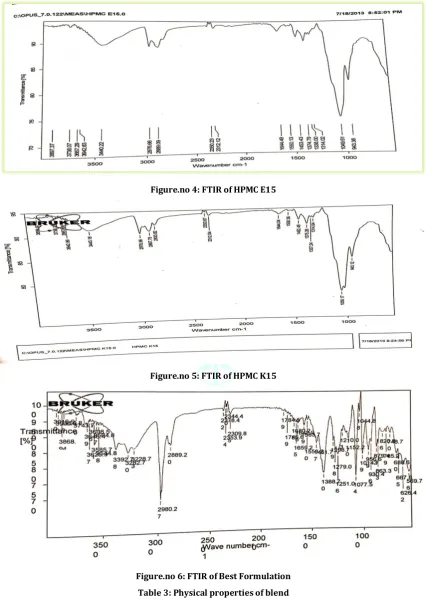
The compatibility of drugs and excipients used under experimental condition were studied. The study was performed by taking 2 mg sample in 200 mg KBr (Bruker
spectrum-100). The scanning range was 600 to 4000 cm-1
and the resolution was 1cm-1. This spectral analysis was
employed to check the compatibility of drugs with the excipients used5.
Pre-Compression Characteristics
The pre-compression characteristics like angle of repose, bulk density, tapped density Hauser’s ratio, Carr’s index, Scale of Flow ability were determined and tabulated in the table no 3.
Angle of Repose:
The angle of repose of powder mix was determined by the funnel-method. The accurately weighed granules were taken in a funnel. The height of the funnel was adjusted to a height of 2 cm in such a manner that the tip of the funnel just touched the apex of the heap of the granules. The granules were allowed to flow through the funnel freely onto the surface. The diameter of the powder cone measured and angle of repose was calculated using the following equation. Tan θ = h/r
Where h and r are the height and radius of the powder cone, θ is the angle of repose.
Angle of repose values less than 25, 25-30, 30-40, and more than 40 indicates excellent, good, passable, and poor flow
properties respectively3, 7.
Bulk density:
Both loose bulk density (LBD) and tapped bulk density (TBD) were determined. A quantity of 2 g of powder from each formula, previously lightly shaken to break any agglomerates formed, was introduced into a 10ml measuring cylinder. After the initial volume was observed, the cylinder was allowed to fall under its own weight onto a hard surface from the height of 2.5 cm at 2 second intervals. The tapping was continued until no further change in volume was noted. LBD
and TBD were calculated using the following formula4, 5.
LBD = weight of the powder/volume of the packing TBD = weight of the powder/tapped volume of the packing. Compressibility index:
The compressibility index of the granules was determined by Carr’s Compressibility index.
Carr’s index (%) = [(TBD-LBD) * 100] / TBD
Where, LBD: Weight of the powder/volume of the packing. TBD: Weight of the powder/Tapped volume of the packing.
Hausner’s ratio:
Hausner’s ratio can be determined by the following
equation5,
Hausner’s ratio = TBD / LBD
Where, TBD -Tapped bulk densities & LBD- Loose bulk densities
Formulation Prulifloxacin Matrix Tablets
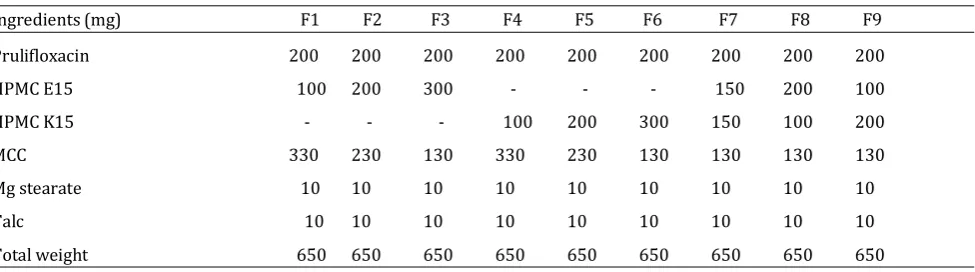
All the formulations were prepared by direct compression method using HPMC E15, HPMC K15 polymers in various ratios and other excipients microcrystalline cellulose, Magnesium Stearate and talc are used. Prulifloxacin and all
other ingredients were individually passed through sieve
60. All the ingredients were mixed thoroughly by triturating up to 15 min. The powder mixture was lubricated with magnesium stearate and talc.
Table 1: Formulation of Prulifloxacin Matrix Tablets
Ingredients (mg) F1 F2 F3 F4 F5 F6 F7 F8 F9
Prulifloxacin 200 200 200 200 200 200 200 200 200
HPMC E15 100 200 300 - - - 150 200 100
HPMC K15 - - - 100 200 300 150 100 200
MCC 330 230 130 330 230 130 130 130 130
Mg stearate 10 10 10 10 10 10 10 10 10
Talc 10 10 10 10 10 10 10 10 10
Total weight 650 650 650 650 650 650 650 650 650
Post-Compression Characteristics
The post-compression characteristics like Weight Variation, Thickness, Hardness, and Friability were determined and tabulated in the table no 4.
Thickness and Diameter:
Control of physical dimension of the tablet such as thickness and diameter is essential for consumer acceptance and tablet uniformity. The thickness and diameter of the tablet
Tablet hardness:
Tablet hardness of the tablets for shipping or breakage under conditions of storage, transportation and handling depends on hardness which was determined using Monsanto hardness tester. For each formulation, the hardness of 10 tablets was determined. The tablet was held along its oblong axis in between the two jaws of the tester.
At this point, reading should be zero kg/ cm2. Then constant
force was applied by rotating the knob until the tablet
fractured. The value at this point was noted in kg/cm27, 8.
Weight variation:
This is an important In-process quality control test to be checked frequently (every half an hour). Corrections were made during the compression of tablets. Any variation in the weight of tablet (for any reason) leads to either under medication or overdose. So, every tablet in each batch should have a uniform weight. 20 tablets were weighed individually. Average weight was calculated from the total weight of all tablets. The individual weights were compared with the average weight. The percentage difference in the weight variation should be within the permissible limits (7.5%). The percent deviation was calculated using the following formula. The limits are mentioned in the below
table as per Indian pharmacopoeia (I.P) 9, 10.
Friability Test:
For each formulation, 6 tablets were weighed. The tablets were placed in a Friabilator (Roche Friabilator) and subjected to 100 rotations in 4 minutes at 25 rpm. The tablets were then reweighed. The friability was calculated as
the percentage weight loss.11, 12
%Friability = (Loss in weight/Initial weight) x 100 In vitro drug release studies13, 14:
Drug release studies were conducted using USP-22 dissolution apparatus-2, paddle type (Lab India) at a
rotational speed of 50 rpm at 37±0.5º. The dissolution media
used were 900 ml of 0.1 mol / l HCl for first 2 h followed by pH 6.8 phosphate buffer solutions for 22h. Sink condition was maintained for the whole experiment. Samples (10 ml) were withdrawn at regular intervals and the same volume of
pre-warmed (37±0.5º) fresh dissolution medium was
replaced to maintain the volume constant. The samples withdrawn were filtered through a 0.45 μ membrane filter and the drug content in each sample was analyzed after
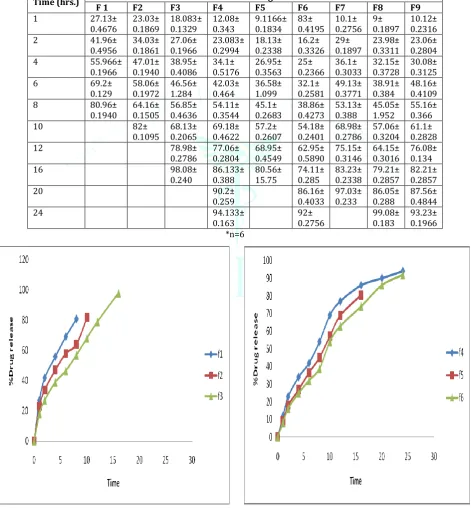
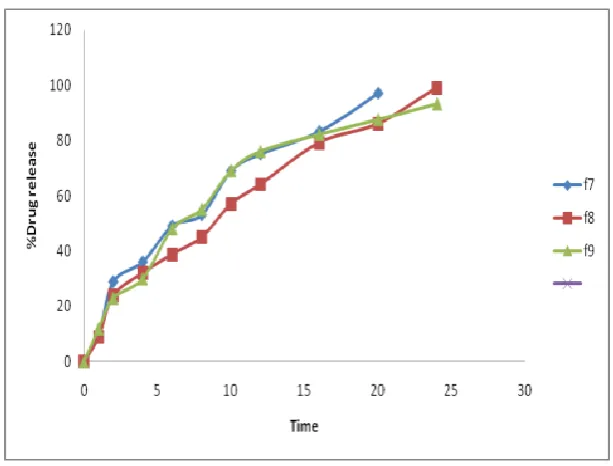
suitable dilution with a UV spectrophotometer (Shimadzu UV-1700) at 276nm. The dissolution test was performed in triplicate. Drug dissolved at specified time periods was plotted as cumulative percent release versus time (h) curve and results obtained were tabulated in table no 5 .
RESULTS AND DISCUSSION
Table 2: Calibration curve for Estimation of Prulifloxacin S.NO Concentration(µg/ml) Absorbance
0.1 N HCl 6.8pH
1 0 0 0
2 5 0.134 0.127
3 10 0.261 0.245
4 15 0.382 0.388
5 20 0.512 0.523
6 25 0.628 0.641
Fig no 1: Calibration curve of Prulifloxacin in 0.1 N HCl
Figure.no:2 Calibration curve of Prulifloxacin in 6.8pH
Figure.no 4: FTIR of HPMC E15
Figure.no 5: FTIR of HPMC K15
Figure.no 6: FTIR of Best Formulation Table 3: Physical properties of blend
F.CODE Angle Repose± SD* of Bulk Density (g/ml) ±SD* Tapped (g/ml) ±SD* Density Carr’s (%)±SD* Index Hausner’s ±SD* Ratio
F1 26.25±0.23 0.488±0.0202 0.5091±0.0252 8.61±1.9083 1.0416±0.0088
F2 27.96±0.15 0.5055±0.0055 0.5170±0.012 8.222±0.2266 1.02227±0.0052
F3 26.65±0.34 0.4859±0.0069 0.5329±0.0051 8.8235±0.3054 1.0967±0.0321
F4 28.93±0.12 0.3463±0.068 0.3810±0.0093 9.0909±0.1994 1.1000±0.004
F5 27.36±0.15 0.3127±0.056 0.3528±0.0009 9.3636±0.6143 1.1082±0.0481
F6 29.45±0.64 0.4650±0.0019 0.5093±0.001 8.6956±0.1499 1.0952±0.1191
F7 27.54±0.15 0.5161±0.0050 0.5704±0.0014 9.6774±0.4180 1.1071±0.021
F8 28.62±0.17 0.5000±0.0007 0.5577±0.0008 9.5750±0.3041 1.1034±0.0071
F9 28.74±0.25 0.4706±0.0031 0.5333±0.0017 8.7647±0.9171 1.0933±0.0025
Table 4: Evaluation of post compression parameters
Trial Weight variation ±SD*** Thickness (mm) ±SD** Hardness (Kg/cm²) ±SD* Friability (%w/w) ±SD**
F1 649±1.422 5.81±0.049 8±0.331 0.32±0.02
F2 659±2.772 5.84±0.036 8.5±0.338 0.44±0.01
F3 650±1.631 6.68±0.033 9±0.378 0.37±0.05
F4 658±1.744 6.04±0.029 9±0.318 0.49±0.03
F5 657±1.713 5.9±0.027 11±0.347 0.51±0.01
F6 654±1.313 6.01±0.025 8.5±0.314 0.53±0.05
F7 659±1.080 5.9±0.027 9.5±0.313 0.54±0.03
F8 651±1.005 6.1±0.032 10.5±0.383 0.52±0.02
F9 649±1.426 5.8±0.028 9.5±0.357 0.47±0.05
*n=6 **n=10 ***n=20
Table 5: In vitro Drug Release Studies for different Trials Formulations
Time (hrs.) F 1 F2 F3 % Cumulative Drug Released ±SD* F4 F5 F6 F7 F8 F9
1 27.13±
0.4676 23.03± 0.1869 18.083± 0.1329 12.08± 0.343 0.1834 9.1166± 83± 0.4195 10.1± 0.2756 9± 0.1897 10.12± 0.2316
2 41.96±
0.4956 34.03± 0.1861 27.06± 0.1966 23.083± 0.2994 0.2338 18.13± 16.2± 0.3326 29± 0.1897 23.98± 0.3311 23.06± 0.2804
4 55.966±
0.1966 47.01± 0.1940 38.95± 0.4086 34.1± 0.5176 0.3563 26.95± 25± 0.2366 36.1± 0.3033 32.15± 0.3728 30.08± 0.3125
6 69.2±
0.129 58.06± 0.1972 46.56± 1.284 42.03± 0.464 1.099 36.58± 32.1± 0.2581 49.13± 0.3771 38.91± 0.384 48.16± 0.4109
8 80.96±
0.1940 64.16± 0.1505 56.85± 0.4636 54.11± 0.3544 0.2683 45.1± 38.86± 0.4273 53.13± 0.388 45.05± 1.952 55.16± 0.366
10 82±
0.1095 68.13± 0.2065 69.18± 0.4622 57.2± 0.2607 54.18± 0.2401 68.98± 0.2786 57.06± 0.3204 61.1± 0.2828
12 78.98±
0.2786 77.06± 0.2804 68.95± 0.4549 62.95± 0.5890 75.15± 0.3146 64.15± 0.3016 76.08± 0.134
16 98.08±
0.240 86.133± 0.388 80.56± 15.75 74.11± 0.285 83.23± 0.2338 79.21± 0.2857 82.21± 0.2857
20 90.2±
0.259 86.16± 0.4033 97.03± 0.233 86.05± 0.288 87.56± 0.4844
24 94.133±
0.163 92± 0.2756 99.08± 0.183 93.23± 0.1966
*n=6
Fig No.7: In vitro Drug Release Studies for F1, F2, F3 Fig 8: In vitro Drug Release Studies for F4, F5 and F6
Fig 9: In vitro Drug Release Studies for F7, F8 andF9 Formulations
Zero Order Plots
Fig 10: Zero order plots of F1-F3 Fig 11: Zero order plots of F4-F6
First Order Plots
Fig 13: First order plots of F1-F3 Fig 14: First order plots of F4-F6
Fig 15: First order plots of formulations F7-F9 Hixso- Crowell Plots
Fig 18: Hixson Crowell plots of formulations F7-F9 Higuchi Plots
Fig19: Higuchi plots of F1-F4 Fig 20: Higuchi plots of F4-F6
Korsmeyer Peppas Plots
Fig22: Korsmeyer Peppas plots of F1-F3 Fig 23: Korsmeyer Peppas plots of F4-F6
Fig 24: Korsmeyer Peppas plots of formulations F7-F9
Table 6: Release Kinetics Studies for different strengths of final optimized formulation Formulation
Code Zero order First order Hixson Crowell Higuchi Peppas R² Values n values
F1 0.914 0.079 0.995 0.997 0.509
F2 0.934 0.146 0.961 0.979 0.517
F3 0.975 0.053 0.916 0.978 0.595
F4 0.899 0.088 0.98 0.972 0.582
F5 0.986 0.002 0.989 0.98 0.794
F6 0.969 0.04 0.993 0.984 0.758
F7 0.934 0.073 0.966 0.985 0.691
F8 0.961 0.155 0.942 0.989 0.573
F9 0.888 0.061 0.978 0.97 0.655
DISCUSSION OF RESULTS:
In the present study first characterization of API was done followed by its compatibility studies with various excipients and API was found to be compatible with all the excipients. Then various Pre-compression parameters like bulk density, tapped density, Hausner’s ratio, Carr’s consolidation index and angle of repose were determined and found to be within the limits and post compression parameters like weight
variation, hardness, friability were determined and found to
be within limits and In-vitro dissolution of all the
formulations were analyzed and Among all the nine formulations F8 shown maximum drug release of 99.08% after 24 hours and all the data were fitted into various
kinetic models like Zero order, First order, Hixson Crowell,
from these studies the release was found diffusion controlled and followed Zero order kinetics.
CONCLUSION
So in this present work an attempt is made to formulate sustained release matrix tablet which shown prolonged drug release for 24 hours. Prior to the development of dosage form, all the fundamental Pre-formulation and Post-formulation Parameters of drug molecule are evaluated and the results were found satisfactory. The formulation was characterized for various properties of the dosage forms like assay, dissolution and other physical properties. Drug release was extended up to 24 hours with diffusion controlled and followed Zero order kinetics. Further the scope of the work need to be extended to carry out stability studies.
REFERANCES
1. Karvekar M, Khan AB, A Brief Review on Sustained Release Matrix Type Drug Delivery System, Journal of Pharmaceutical Research Volume, 2017;16(30):282-289.
2. H.D.Zalte, R.B.Saudagar, Review on Sustained Release Matrix Tablet, International Journal of Pharmacy and Biological Sciences, 2013; 3(4):17-29.
3. Ramu S, Rambabu S, Srinivasa Rao D, Rama Krishna G, Formulation and evaluation of sustained-release matrix tablets of Timolol maleate, International Journal of Pharmaceutical Chemical and Biological Sciences, 2015; 5(4): 834-851.
4. Mehta P, Deshmukh GJ, Seth AK, Patel B, Formulation and Evaluation of Sustained Release Matrix Tablets of Captopril, Indo American Journal of Pharmaceutical Research. 2011; 2(1): 69-83.
5. Hadi MA, Lokeswara Babu V, Pal N, Formulation & Evaluation of Sustained Release Matrix Tablets of Glimepiride Based on Combination of Hydrophilic & Hydrophobic Polymers, Journal of Applied Pharmaceutical Science, 2012;2(6):101-107.
6. Basavaraja, Navade K, Someswara Rao B, Suresh V. Kulkarni, Formulation and Evaluation of Sustained Release Matrix Tablets of Flurbiprofen by Using Natural & Synthetic Polymers, Journal of pharmaceutical sciences & research, 2015;7(6):274-28.
7. Padmaja Bookya, Ramakrishna Raparla, Harikishan Prasad Sriramula, Sunitha Tarrigopula, Sridhar Vanga, Formulation and Evaluation of Metformin Hydrochloride Sustained-Release Oral Matrix Tablets, Asian Journal Pharmaceutical and Clinical Research, 2018;11(3):342-345.
8. Shanmugam S, Maniyarasi M and Vetrichelvan T, Formulation and evaluation of sustained release matrix tablets of Aceclofenac using different polymers, Journal of Pharmacy Research, 2012;5(3):1537-1540.
9. Soma Vinisha, Sajida Akhtari Begum, Nikhat Tabassum, Soma Anusha, Preparation and Evaluation of Matrix Tablets Containing Ambroxol Hydrochloride, Pharma Tutor Magazine, 2014;2(6):139-153
10. Nagaich U, Bharti C, Pal AK, Gulati N, Diclofenac Sodium Loaded Sustained Release Matrix Tablet Possessing Natural and Synthetic Polymers, Formulation and In-vitro
characterization, Indian Journal of Pharmaceutical Education and Research, 2014; 48(Supplement): 49-55.
11. Madhavi N, Sudhakar B, PRavikanth PV, Kodisana Mohan and Kolapalli Ramana Murthy, Formulation and Evaluation of Phenytoin Sodium Sustained Release Matrix Tablet, Journal of bioequivalence and bioavailability, 2012; 4(7): 128-133. 12. Joshi N C, Ahmad Z, Mishra S.K and Singh R, Formulation and
Evaluation of Matrix Tablet of Tramadol Hydrochloride, Indian Journal of Pharmaceutical Education and Research, 2011;45(4):360-363.
13. Wadher KJ, Kakde RB, Umekar MJ, Formulation and Evaluation of a Sustained-Release Tablets of Metformin Hydrochloride Using Hydrophilic Synthetic and Hydrophobic Natural Polymers, Indian journal of Pharmaceutical sciences, 2011; 73(2):208-215.