Open Access
Study protocol
A perturbation-based balance training program for older adults:
study protocol for a randomised controlled trial
Avril Mansfield
1,2, Amy L Peters
2, Barbara A Liu
3,4and Brian E Maki*
1,2,5Address: 1Institute of Medical Science, University of Toronto, Toronto, Ontario, Canada, 2Centre for Studies in Aging, Sunnybrook Health Sciences
Centre, 2075 Bayview Ave, Toronto, Ontario, M4N 3M5, Canada , 3Department of Medicine, Sunnybrook Health Sciences Centre, Toronto,
Ontario, Canada, 4Department of Medicine, University of Toronto, Toronto, Ontario, Canada and 5Department of Surgery, University of Toronto,
Toronto, Ontario, Canada
Email: Avril Mansfield - [email protected]; Amy L Peters - [email protected]; Barbara A Liu - [email protected]; Brian E Maki* - [email protected]
* Corresponding author
Abstract
Background: Previous research investigating exercise as a means of falls prevention in older adults has shown mixed results. Lack of specificity of the intervention may be an important factor contributing to negative results. Change-in-support (CIS) balance reactions, which involve very rapid stepping or grasping movements of the limbs, play a critical role in preventing falls; hence, a training program that improves ability to execute effective CIS reactions could potentially have a profound effect in reducing risk of falling. This paper describes: 1) the development of a perturbation-based balance training program that targets specific previously-reported age-related impairments in CIS reactions, and 2) a study protocol to evaluate the efficacy of this new training program.
Methods/Design: The training program involves use of unpredictable, multi-directional moving-platform perturbations to evoke stepping and grasping reactions. Perturbation magnitude is gradually increased over the course of the 6-week program, and concurrent cognitive and movement tasks are included during later sessions. The program was developed in accordance with well-established principles of motor learning, such as individualisation, specificity, overload, adaptation-progression and variability. Specific goals are to reduce the frequency of multiple-step responses, reduce the frequency of collisions between the stepping foot and stance leg, and increase the speed of grasping reactions. A randomised control trial will be performed to evaluate the efficacy of the training program. A total of 30 community-dwelling older adults (age 64–80) with a recent history of instability or falling will be assigned to either the perturbation-based training or a control group (flexibility/relaxation training), using a stratified randomisation that controls for gender, age and baseline stepping/grasping performance. CIS reactions will be tested immediately before and after the six weeks of training, using platform perturbations as well as a distinctly different method of perturbation (waist pulls) in order to evaluate the generalisability of the training effects.
Discussion: This study will determine whether perturbation-based balance training can help to reverse specific age-related impairments in balance-recovery reactions. These results will help to guide the development of more effective falls prevention programs, which may ultimately lead to reduced health-care costs and enhanced mobility, independence and quality of life.
Published: 31 May 2007
BMC Geriatrics 2007, 7:12 doi:10.1186/1471-2318-7-12
Received: 20 December 2006 Accepted: 31 May 2007
This article is available from: http://www.biomedcentral.com/1471-2318/7/12
© 2007 Mansfield et al; licensee BioMed Central Ltd.
Background
Falling is a leading cause of serious injury, loss of inde-pendence and nursing-home admission in older adults [1]. Previous research investigating exercise as a means of falls prevention in older adults has shown mixed results. A number of studies have shown that exercise can help to prevent falls [2-11]; however, other exercise studies have shown little or no benefit [12-15]. Although exercise pro-grams that include a balance-training component have tended to be most effective [2], no previous studies have targeted specific aspects of balance-recovery reactions. This lack of specificity may explain, in part, the failure to demonstrate a more pronounced reduction in fall rates.
It is important for fall-prevention interventions to include a focus on balance-recovery reactions, because it is the ability, or inability, to respond effectively to a balance per-turbation ('loss of balance') that ultimately determines whether or not a fall occurs. Balance perturbations can arise from events such as slips, trips and collisions, but also occur as a consequence of volitional movement (e.g. turning, bending, reaching). Change-in-support balance reactions, which involve very rapid limb movements (stepping, or reaching to grasp an object for support), play a critical role in responding to balance perturbations (for recent reviews, see [16-19]). These compensatory stepping and grasping reactions are the only line of defence against large perturbations, but are also frequently recruited at lower magnitudes of perturbation (provided that subjects are permitted to react naturally, i.e. with no instructional or physical constraints on limb movement) [20,21].
A number of studies have reported age-related impair-ments in compensatory stepping reactions. Compared to young adults, older adults show increased frequency of collisions between the swing foot and stance leg [22], reduced step length [23], increased frequency of multiple-step responses [22-25], and an increased tendency to fol-low an initial forward or backward step with one or more lateral steps [24]. Few studies have examined age-related differences in compensatory grasping reactions; however, it has been reported that older adults tend to rely more than younger persons on arm reactions to recover balance [22], yet the speed at which they are able to initiate and execute grasping reactions is reduced [25]. Importantly, it appears that many of the age-related impairments in change-in-support reactions listed above are associated with increased risk of falling, as determined retrospec-tively [26-28] and prospecretrospec-tively [25]. Such findings sup-port the view that training to promote more effective change-in-support reactions may help to reduce the risk of falls, and hence should be included as part of a falls pre-vention program [29].
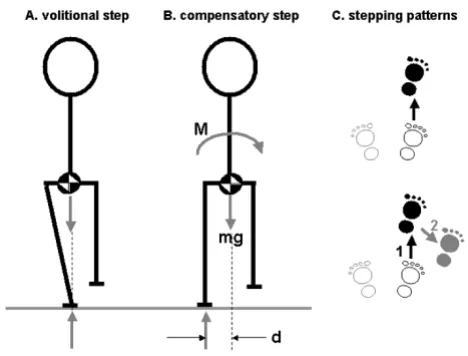
The neural control of volitional limb movements differs in some fundamental ways in comparison to reactions
that are evoked by postural perturbation [18,30]. It can therefore be argued that the most effective approaches to training compensatory stepping and grasping will involve the use of perturbations. A clear example to support this view pertains to the control of lateral stability during for-ward and backfor-ward stepping (Figure 1). During volitional stepping, anticipatory postural adjustments (APAs) act to preserve lateral stability by shifting the centre-of-mass toward the stance leg before lifting the swing foot. In con-trast, during compensatory stepping, these APAs are typi-cally absent or severely truncated [31,32]. As a result, the body falls laterally toward the unsupported side during the step and this lateral falling motion must be arrested during the landing phase. Training volitional stepping might lead to improved control of the APA but would probably not improve control of lateral stability during compensatory stepping. Another example pertains to training of reaction speed. It has been shown that older adults are slower than younger subjects to lift the foot when stepping voluntarily but are equally as fast as the young when the stepping reaction is evoked by postural
Control of lateral stability during forward and backward steps
Figure 1
perturbation [33]; hence, training to improve the speed of volitional stepping movements may provide little or no benefit in terms of the ability to execute effective compen-satory stepping reactions.
Recently, a small number of studies have begun to assess the efficacy and feasibility of perturbation-based balance training in older adults [34-39]. These training programs have shown potential to improve reaction time for voli-tional stepping and grasping movements [34,37]; how-ever, improvements in volitional stepping and grasping may not translate to balance-recovery situations, for the reasons noted earlier. To date, only one study has exam-ined effects of perturbation-based training on the control of compensatory stepping reactions. This study demon-strated increased step length and faster step initiation fol-lowing training [35]; however, the study was limited to persons with Parkinson's Disease. To our knowledge, no studies have directly addressed the potential to use pertur-bation-based training to counter specific impairments in compensatory stepping related to normal ageing, rather than neurological disease. Furthermore, no studies have investigated the potential to use perturbations to train compensatory grasping reactions.
The objective of the present study is to develop and test a perturbation-based balance-training program to counter specific, previously-reported age-related impairments in change-in-support stepping and grasping reactions. We hypothesize that subjects who undergo the perturbation-based training program will show greater improvements in the ability to step and grasp to recover balance in com-parison to control subjects who undergo flexibility and relaxation training. In this paper, we describe the develop-ment of the perturbation-based training program and lay out the protocol for a randomised controlled trial to eval-uate the efficacy of this program.
Methods – Part A
Development of the perturbation-based training program
Method of perturbation
In the simplest terms, maintaining stable upright stance involves keeping the centre of mass (COM) of the body over the base of support (BOS) defined by the feet (and, in some situations, the arms). Hence, the essential defin-ing feature of any balance perturbation is that it induces relative motion between the COM and the BOS. For stance perturbations, this relative motion can be induced by causing displacement of either the COM (e.g. via cable waist-pull systems) or the BOS (e.g. via motion platform systems). During gait, this relative motion can also be induced when the cyclic progression of the COM and BOS is disrupted due to perturbation of the BOS (e.g. due to a slip on a low-friction surface, a trip on an obstacle, or sud-den acceleration or deceleration of a treadmill).
The various available perturbation methods may differ in a number of respects, such as the pattern of motion induced at specific joints, the evoked sensory inputs and the pattern of the early evoked muscle activation [40]. Nonetheless, these various methods all fulfil the funda-mental biomechanical requirement (disruption of the COM-BOS relationship) and can often elicit postural reac-tions that are similar in many respects [40]. Hence, it is possible that the training benefits derived using one type of perturbation may generalise (at least to some extent) to the reactions evoked by other types of perturbations. This, however, remains to be established. If there is limited gen-eralisability of training benefits, then it would be best to choose a perturbation method that closely emulates the perturbations that lead to loss of balance and falls in daily life; however, it is unlikely that this can be accomplished using any one single method of perturbation. The training perturbations would need to simulate both slips and trips, (report to occur in approximately 40–60% of falls in older adults [41-43]) as well as the sizeable proportion of falls that do not involve ambulation, (e.g. self-induced pertur-bation during leaning, turning, reaching or sit-stand trans-fer movements; support-surface motion that occurs when standing in a moving vehicle [41,43]).
For this study, we elected to develop a custom-designed pneumatic motion platform for the purpose of delivering the postural perturbations needed to evoke stepping and grasping reactions during training (Figure 2). One impor-tant feature of the moving-platform approach is the ease with which the direction of perturbation can be varied in an unpredictable manner [18]. Unpredictability is a criti-cal requirement, as the CNS can learn to recognise any fea-tures of the perturbation that are predictable (direction, magnitude, waveform or timing), and can use this infor-mation to improve the efficacy of the balance reactions in a predictive manner [44-48]. This type of predictive con-trol is unlikely to be helpful in responding to the unpre-dictable perturbations that commonly lead to falls in daily life; hence, the adaptations that result from training with predictable perturbations may have limited general-isability [18]. A second practical advantage of the motion-platform approach is that large numbers of perturbations can be delivered in a short span of time, hence maximis-ing opportunity for trainmaximis-ing while minimismaximis-ing the risk of fatigue, which would be more likely to occur during gait-perturbation methods [36,39].
platform motion naturally. For the initial stepping train-ing session, handrails will be mounted on the platform to help subjects feel at ease, but will be removed for subse-quent sessions. Subjects are instructed to respond to the platform movement by stepping, if required (Figure 2A). For grasping training, a handrail is mounted on one or both sides of the subject and foam blocks are placed around the feet to prevent stepping (Figure 2B). Subjects will be instructed to recover balance by grasping the rail or rails "as quickly as possible" in response to the platform movement. Subjects will wear a safety harness secured to the ceiling at all times during the training.
Design of the program to optimise motor learning
The training program adheres to the principles of exercise prescription, that is, specificity, progressive overload, individualisation and random variation. In addition, we applied principles that dictate how feedback and instruc-tions should be provided in order to optimise motor learning.
Specificity
The need to target specific goals is considered to be one of the most important motor training principles [49]. The perturbation-based program targets specific age-related impairments in compensatory stepping and grasping, as follows:
1. Multiple steps: Older adults take more steps to recover balance [22] and tend to respond to perturbations with a multiple-step response more frequently than younger adults [22-25]. Although use of multiple steps can be a pre-planned strategy in some situations [23], it appears that the 'extra' steps often emerge as a consequence of instability arising after the initiation of the first step [24]. Impaired ability to control the tendency of the centre-of-mass to fall laterally toward the unsupported side during step execution appears to be a particular problem, neces-sitating additional steps to recover lateral stability [24] (Figure 1C) as well as other step modifications [28]. The tendency to take multiple steps to recover balance predicts increased falling risk, and the tendency to follow an initial forward or backward step with a lateral step predicts an increased risk of falling laterally [25]. To reduce the fre-quency of multiple-step responses, subjects will be instructed to respond to the platform movement by taking as few steps as possible.
2. Foot collisions: Collisions between the swing foot and stance leg can jeopardise stability by impeding efforts to rapidly extend the base of support in the lateral direction [22]. Foot collisions are rare in young adults, but occur more frequently in older adults and are associated with increased risk of falling [22,25]. These collisions are most likely to have a serious effect on stability during pro-longed crossover steps (Figure 3A). To train subjects to avoid such collisions, crossover responses will be discour-aged and subjects will instead be guided toward using a sequence of side-steps (Figure 3B). During the first two training sessions, crossover responses to lateral perturba-tions will be discouraged by placing foam-rubber barriers in front of and behind the feet and instructing subjects "not to let your feet touch the blocks". During subsequent training sessions, the foam blocks will be removed and subjects will be instructed as follows: "if you need to move your feet, imagine the foam blocks were still there and try not to let your feet hit them".
3. Delay in onset of arm reactions and slowing of arm movement: Older adults show delays in the time taken to initiate and complete a compensatory grasping reaction, and this tendency is predictive of falling [25]. In order to train faster reaction and movement times for grasping reactions, subjects will be instructed to grasp the rails as quickly as possible. To further promote fast reactions, sub-jects will be provided with feedback about their response
Perturbation platform used during balance training Figure 2
time using data from force-sensing resistors located on the handrails. There already exists some evidence that the latency of triggered reactions can be reduced with training [38,50]. Potentially, movement time could also be reduced. It is also anticipated that the training may lead to more effective grasping of the handrail, i.e. reduced inci-dence of errors, (e.g. overshoot, undershoot, collision of the hand with the rail) and more effective balance recov-ery (as evidenced by fewer "falls" against the safety har-ness).
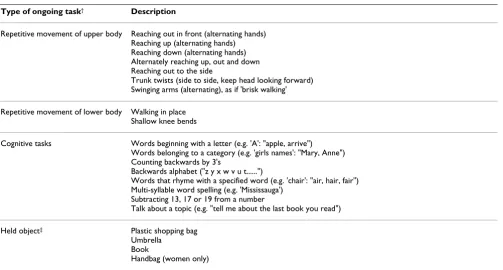
4. Delayed attention switching: Balance-recovery reac-tions require attentional resources and cognitive process-ing [51,52]; however, older adults show delays in switching attention from ongoing cognitive or motor tasks to the task of balance recovery [53] and balance recovery is more attentionally demanding for older adults [51]. To improve ability to rapidly switch attention, cog-nitive and movement tasks will be included during
train-ing (Table 1). The type of task will be changed with each set of eight perturbations.
5. Ability to drop object to grab rail: The ability to effec-tively grasp a handrail may be impaired if an object is held prior to balance loss [54]. During some grasp-training tri-als, subjects will be given an object to hold (e.g. shopping bag, umbrella, book, handbag) and will be instructed to drop this object in response to the platform movement, in order to grab the rail.
Progressive overload
The perturbation-based training can be considered to rep-resent an 'overload', which results in adaptation in the stimulated physiological systems. To elicit further improvement, there must be a progression in overload to further increase the challenge to the system [49]. Progres-sions will be made by increasing the magnitude of the applied perturbations whenever the subject is consistently able to recover balance by stepping or grasping without difficulty.
Individualisation
Training programs should be tailored to the individual needs and abilities of the participant [55]. Progressions should match the individual's rate of adaptation; there-fore, progression in magnitude of perturbation will be based on the subject's ability to recover balance at the cur-rent magnitude.
Random, variable practice
Variability of practice conditions ensures that the learned motor skill will generalise to a wide variety of situations [56]. In order to optimise motor learning, the conditions should be varied in a random manner [57,58]. To facili-tate skill acquisition during the initial stages of training (i.e. the first four sessions), antero-posterior and lateral perturbations will be presented in separate blocks of trials; however, in subsequent sessions, the direction of pertur-bation will be varied, trial-to-trial, in a pseudo-random sequence. To promote generalisability, the perturbations will be delivered while subjects perform a variety of cog-nitive and movement tasks, including a walking-in-place task that is intended to simulate some of the demands of executing the stepping and grasping reactions in response to perturbation of locomotion (Table 1).
Augmented feedback
Provision of external augmented feedback has been shown to improve performance of motor skills, but can hinder learning if the individual becomes too dependent on it [56]. To decrease dependence and facilitate learning, the feedback should be 'faded', or gradually reduced, as training progresses [59]. In this study, faded augmented feedback will be provided to improve the speed of the
Method to deter crossover steps during training Figure 3
Method to deter crossover steps during training. Large foam blocks (indicated by the shaded areas) are placed in front of and behind the feet during the lateral-perturbation trials in the first two training sessions. Subjects cannot exe-cute a crossover step because the foam prevents the swing foot from travelling or landing in front of or behind the stance foot (panel A). The training is intended to promote instead the use of a side-step sequence (panel B). Note that both of these step patterns involve an initial step with the foot that is unloaded as a result of the perturbation-induced body motion. The foam blocks also permit a lateral step with the loaded leg (panel C); however, this pattern of stepping tends to occur infrequently [22]. Note that panels A-C
grasping reactions. Subjects will be told their handrail-contact timing score after every trial during the first week, after every second trial during the second week, etc. Aug-mented feedback will not be required for the step training, as pilot testing has shown that subjects are typically well aware of the occurrence of multiple steps and foot colli-sions during training.
Instructions
Instructions should direct the learner's attention toward important aspects of the skill being learned. However, to promote optimal learning, complex skills should not be broken down into smaller sub-components, and instruc-tions should refer instead to the 'whole response' [59]. Furthermore, instructions that provide the learner with an external focus promote learning better than instructions with an internal focus [60,61]. Therefore, in this study, subjects will be provided with generalised instructions regarding the task goals. Thus, for example, subjects will be given no specific instructions about weight shifting or control of the limb trajectory during stepping reactions, but will instead simply be told to take as few steps as pos-sible or to avoid contacting the foam-rubber barriers. Where possible, subjects will be provided with an external focus, such as the handrail to be grasped or the foam blocks that they must avoid.
Subject tolerance and acceptance
A pilot study was performed to evaluate the degree to which older adults with instability problems are willing and able to tolerate the training procedures. As described in more detail elsewhere (Maki et al., paper in review), the study involved eight older adults who were referred to a clinical falls prevention program, due to problems with instability, falling and/or fear of falling. Subjects were assigned, at random, to either the perturbation-based pro-gram or a propro-gram that focussed on training of rapid voli-tional stepping and grasping movements. The pilot results support the feasibility and safety of the perturbation-based program, and provide no evidence that balance-impaired older adults would be less able or willing to tol-erate this approach in comparison to training of volitional movement. Compliance was very similar in the two groups. Moreover, no subjects indicated that they felt unsafe during the training, and there were no injuries or other adverse outcomes in either training program.
Methods – Part B
Experimental protocol to assess the training program
A randomised controlled trial will be performed to assess the efficacy of the perturbation-based training program. Ethical approval for this study was obtained from the Table 1: Secondary tasks prescribed during perturbation-based training
Type of ongoing task† Description
Repetitive movement of upper body Reaching out in front (alternating hands) Reaching up (alternating hands) Reaching down (alternating hands) Alternately reaching up, out and down Reaching out to the side
Trunk twists (side to side, keep head looking forward) Swinging arms (alternating), as if 'brisk walking' Repetitive movement of lower body Walking in place
Shallow knee bends
Cognitive tasks Words beginning with a letter (e.g. 'A': "apple, arrive") Words belonging to a category (e.g. 'girls names': "Mary, Anne") Counting backwards by 3's
Backwards alphabet ("z y x w v u t...")
Words that rhyme with a specified word (e.g. 'chair': "air, hair, fair") Multi-syllable word spelling (e.g. 'Mississauga')
Subtracting 13, 17 or 19 from a number
Talk about a topic (e.g. "tell me about the last book you read") Held object‡ Plastic shopping bag
Umbrella Book
Handbag (women only)
†Type of task varies every eight perturbation trials.
‡For grasping training, subjects are asked to hold one of these items in their right hand and drop it in order to effectively grab the rail following the
Research Ethics Board of Sunnybrook Health Sciences Centre.
Recruitment of subjects
Community-dwelling older adults, aged 64–80 years, will be recruited via advertisements in local newspapers and seniors' residences and by word of mouth. All subjects will be mobile (not dependent on mobility aids) and will be able to stand (≥ 1 minute) and walk (≥ 10 m) without any assistance. To simplify training and assessment, the study will be restricted to persons who are right upper- and lower- limb dominant (as defined by the preferred limb for writing and kicking). In order to target an 'at risk' pop-ulation, volunteers who respond affirmatively to any of the following questions will be included in the study:
• Have you fallen in the past 5 years?
• Have you lost your balance or almost fallen in recent memory?
• Have you reduced your activities or changed your life-style because you were concerned that you might fall?
• Do you ever feel unsteady when: getting in or out of a chair, changing direction when you are standing or walk-ing, reaching for something above your head, or walking and talking to someone at the same time?
• Has anyone, such as a friend or family member, expressed concern that you may have problems with your balance or are at risk of falling?
Additionally, volunteers who report a decline in their bal-ance greater than a 'moderate amount' in recent years, or have low balance confidence (Activity-specific Balance Confidence score less than 85% [62]), will be included in the study.
To avoid potential confounding effects on balance and to ensure a relatively homogeneous cohort, the following exclusion criteria will be applied: 1) current diagnosis of neurological or sensory disorders, diabetes, depression or osteoporosis; 2) uncorrected vision problems that impair ability to read, watch television, or drive a car; 3) recurrent dizziness; 4) cognitive impairment (standardized Mini-Mental State Examination [63] score < 24); and 5) joint replacement or joint fusion. To ensure that the subjects are sufficiently fit and healthy to tolerate the training pro-gram without adverse effects, volunteers who answer 'yes' to any items on the Physical Activity Readiness Question-naire [64] will be asked to obtain approval from their doc-tor prior to participating in the study. To prevent potential confounding effects of other exercise programs, volun-teers who regularly (≥ once per week) participate in a
supervised exercise program will be excluded. Subjects who are unable to provide written informed consent (e.g. due to poor English language comprehension) will also be excluded.
Randomisation and blinding
Subjects will be randomly assigned to either the perturba-tion-based training group or a control group. Randomiza-tion will be stratified in blocks of two according to sex, age (64–72 or 73–80 years old), baseline compensatory step-ping performance (average number of 'extra' steps required to recover balance: <1 or ≥ 1), and baseline com-pensatory grasping performance (reaction time: <120 ms or ≥ 120 ms). Random sequence generation will be per-formed by an individual who will not interact with sub-jects during the balance-testing sessions (AM).
Subjects will be informed that they will be randomly assigned to one of the two training programs, and will not be led to expect that either program will be more effective in improving their balance. The individual who adminis-ters the training programs (AM) will be the only member of the research team aware of the subjects' group alloca-tion. A blinded research assistant will administer the bal-ance tests and will perform any data processing that involves subjective judgements. Scripts will be used dur-ing testdur-ing to ensure that all subjects receive the same instructions.
Cohort descriptors
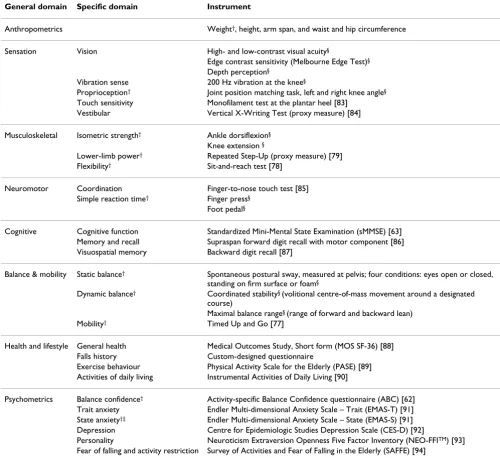
A number of measures will be collected for purposes of characterising the cohort, in terms of sensory, muscu-loskeletal, neuromotor and cognitive function, balance and mobility, anthropometrics, psychometrics, health sta-tus and lifestyle. As indicated in Table 2, a subset of these measures will also be used to compute an overall falls-risk score (FallScreen© [65]), based on a database compiled
from numerous prospective falls-prediction studies [66-69].
Intervention
The control subjects will undergo a flexibility and relaxa-tion program, and will receive the same degree of interac-tion with experimenters as those in the perturbainterac-tion- perturbation-training group. The first session of each week will involve 30 minutes of passive muscular relaxation exercises [70]. The second and third sessions will focus on lower- and upper-body flexibility exercises, respectively. In the flexi-bility sessions, a ten-minute warm-up (heart rate kept below 60% of maximum) will precede 15 minutes of stretching exercises, (two sets of 7–9 stretches for each
muscle group, with each stretch held for 15 seconds). The control program is designed to involve a limited intensity of physical activity, so as to avoid bringing about any sig-nificant physiological changes. A similar, but more intense, flexibility and relaxation program failed to reduce falling [9], or brought about only moderate improve-ments in falls risk [71]. Subjects will be asked not to prac-tice the relaxation or flexibility exercises outside of the scheduled sessions during the study.
Table 2: Cohort descriptors
General domain Specific domain Instrument
Anthropometrics Weight†, height, arm span, and waist and hip circumference
Sensation Vision High- and low-contrast visual acuity§
Edge contrast sensitivity (Melbourne Edge Test)§
Depth perception§
Vibration sense 200 Hz vibration at the knee§
Proprioception† Joint position matching task, left and right knee angle§
Touch sensitivity Monofilament test at the plantar heel [83] Vestibular Vertical X-Writing Test (proxy measure) [84] Musculoskeletal Isometric strength† Ankle dorsiflexion§
Knee extension §
Lower-limb power† Repeated Step-Up (proxy measure) [79]
Flexibility† Sit-and-reach test [78]
Neuromotor Coordination Finger-to-nose touch test [85] Simple reaction time† Finger press§
Foot pedal§
Cognitive Cognitive function Standardized Mini-Mental State Examination (sMMSE) [63] Memory and recall Supraspan forward digit recall with motor component [86] Visuospatial memory Backward digit recall [87]
Balance & mobility Static balance† Spontaneous postural sway, measured at pelvis; four conditions: eyes open or closed,
standing on firm surface or foam§
Dynamic balance† Coordinated stability§ (volitional centre-of-mass movement around a designated
course)
Maximal balance range§ (range of forward and backward lean)
Mobility† Timed Up and Go [77]
Health and lifestyle General health Medical Outcomes Study, Short form (MOS SF-36) [88] Falls history Custom-designed questionnaire
Exercise behaviour Physical Activity Scale for the Elderly (PASE) [89] Activities of daily living Instrumental Activities of Daily Living [90]
Psychometrics Balance confidence† Activity-specific Balance Confidence questionnaire (ABC) [62]
Trait anxiety Endler Multi-dimensional Anxiety Scale – Trait (EMAS-T) [91] State anxiety†‡ Endler Multi-dimensional Anxiety Scale – State (EMAS-S) [91]
Depression Centre for Epidemiologic Studies Depression Scale (CES-D) [92]
Personality Neuroticism Extraversion Openness Five Factor Inventory (NEO-FFITM) [93]
Fear of falling and activity restriction Survey of Activities and Fear of Falling in the Elderly (SAFFE) [94]
†These tests will be completed pre- and post-intervention
Testing of compensatory stepping and grasping reactions
Two balance-laboratory assessments will be performed to evaluate the effects of the training on compensatory step-ping and grasstep-ping. The first session will occur not more than one week before the start of training and the second no more than one week after the end of training. Two dif-ferent types of balance perturbation will be used: waist-pulls and surface translations. Because support-surface translations are also used during the perturbation-based training, testing with surface translations will allow us to identify whether the targeted aspects of the change-in-support reactions were improved by the training. The waist pulls involve perturbation of the centre of mass (rather than the base of support), elicit different patterns of body motion and sensory drive, and evoke stepping and grasping reactions that differ in some key respects in comparison to reactions evoked by platform perturbation [72,73]; hence, the waist-pull tests will allow us to begin to examine whether any of the benefits of the training are generalisable to other balance-loss situations.
All laboratory tests will be performed with the subject standing at the centre of a large (2 × 2 m) computer-con-trolled motor-driven motion platform [17,74]. The waist-pull system is mounted on the motion platform, thereby allowing the type of perturbation to be varied unpredicta-bly during testing (Figure 4). Waist-pull perturbations will be applied by dropping a weight (20% of body weight), attached to a belt worn around the pelvis via a custom-built cable and pulley system. Four cables are attached to the belt to allow perturbations to be delivered unpredict-ably forward, backward, left or right. The weight is dropped 40 cm for stepping trials and 30 cm for grasping trials. For the support-surface translations, we will use a displacement, velocity and acceleration of 0.18 m, 0.6 m/ s and 2.0 m/s2, respectively, for forward translations
(which evoke backward falling motion), and 0.27 m, 1.0 m/s and 3.0 m/s2 for the other translation directions
(backward, left, right). We know, from pilot tests and pre-vious studies [22-24], that the selected waist-pull and sur-face-translation parameters are tolerated by older adults and will consistently evoke stepping or grasping reactions.
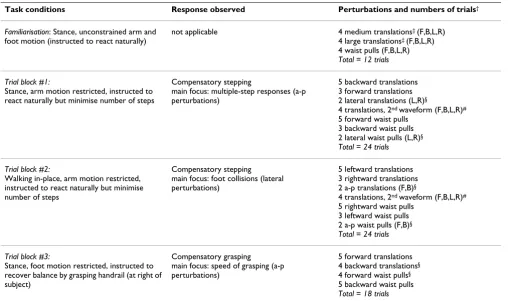
Perturbation direction and type (i.e. waist pull or surface translation) will be varied in an unpredictable pseudo-random sequence so as to prevent subjects from pre-plan-ning their response. An initial set of 12 familiarisation tri-als will be completed at the start of each laboratory session in order to dampen within-session habituation effects [47]. Following this, three blocks of perturbation trials will be completed: 1) compensatory stepping during stance, 2) compensatory stepping while walking in-place, and 3) compensatory grasping during stance. Table 3 details the task conditions and numbers of trials com-pleted in each trial block.
During compensatory stepping tests, subjects will be asked to respond to the balance perturbations naturally, but to minimise the number of steps taken if they do step. To restrict arm movement, they will hold a lightweight rod behind their back [74]. To deter conscious efforts to pre-plan or modulate the reactions, subjects will be required to perform a concurrent distraction task (count-ing backward by 3's from a 3-digit number randomly assigned at the start of the trial) while waiting for the per-turbation, during the stance trials (blocks 1 and 3). In the
Experimental set-up for testing of stepping and grasping reac-tions
Figure 4
second block of trials, they will perform a walk-in-place task, (lifting the feet in time with a metronome, 100 beats per minute) to increase the probability that a foot colli-sion will occur [22]. For compensatory grasping trials, a handrail will be mounted to the right of the subject. Sub-jects will be instructed to grab the rail with the right hand as quickly as possible to recover balance, in response to the perturbation. They will be told not to step, and foam blocks will be placed around their feet to further deter stepping. A safety harness will be worn throughout all of the testing.
Outcome measures
The four primary outcome measures correspond to the specific aspects of change-in-support reactions that were targeted in the perturbation-based training program: 1)
average number of 'extra' steps taken to recover balance, 2) frequency of foot collisions when responding to lateral perturbations, 3) frequency of additional lateral steps when responding to antero-posterior perturbations, and 4) handrail-contact time for grasping reactions. Secondary outcome measures relating to other features of the bal-ance reactions will also be analysed. For compensatory stepping, these include the frequency and magnitude of anticipatory postural adjustments (APA), foot-off time, foot-contact time, step length and frequency of arm reac-tions. For compensatory grasping, we will analyse onset timing and magnitude of arm-muscle activation (biceps, medial deltoid), arm trajectory, and frequency of grasping errors (e.g, undershoot, overshoot, collision of hand with rail). The early 'automatic postural response' (which occurs in both stepping and grasping trials) will be ana-Table 3: Balance tests performed before and after training
Task conditions Response observed Perturbations and numbers of trials†
Familiarisation: Stance, unconstrained arm and foot motion (instructed to react naturally)
not applicable 4 medium translations‡ (F,B,L,R)
4 large translations‡ (F,B,L,R)
4 waist pulls (F,B,L,R)
Total = 12 trials Trial block #1:
Stance, arm motion restricted, instructed to react naturally but minimise number of steps
Compensatory stepping
main focus: multiple-step responses (a-p perturbations)
5 backward translations 3 forward translations 2 lateral translations (L,R)§
4 translations, 2nd waveform (F,B,L,R)#
5 forward waist pulls 3 backward waist pulls 2 lateral waist pulls (L,R)§
Total = 24 trials Trial block #2:
Walking in-place, arm motion restricted, instructed to react naturally but minimise number of steps
Compensatory stepping
main focus: foot collisions (lateral perturbations)
5 leftward translations 3 rightward translations 2 a-p translations (F,B)§
4 translations, 2nd waveform (F,B,L,R)#
5 rightward waist pulls 3 leftward waist pulls 2 a-p waist pulls (F,B)§
Total = 24 trials Trial block #3:
Stance, foot motion restricted, instructed to recover balance by grasping handrail (at right of subject)
Compensatory grasping
main focus: speed of grasping (a-p perturbations)
5 forward translations 4 backward translations§
4 forward waist pulls§
5 backward waist pulls
Total = 18 trials
†During trial blocks #1–3, the listed platform-translation and waist-pull perturbations are delivered in an unpredictable randomised sequence, in the
directions indicated (F = forward, B = backward, L = left, R = right; a-p = antero-posterior)
‡ The familiarisation block includes initial medium-magnitude platform perturbations, followed by the same large-magnitude perturbations that are
used in the main trial blocks. The platform acceleration of the large perturbations (2.0 m/s2 forward, 3.0 m/s2 other directions) is 50% greater than
the medium perturbations (1.3 m/s2 forward, 2.0 m/s2 other directions).
§ These tests are included primarily for the purpose of increasing the unpredictability of the perturbation direction and will not be part of the main
analysis
# The 2nd waveform tests will not be part of the main analysis, but are included to deter subjects from learning to use the deceleration of the
platform to aid in recovering balance [46]. The usual waveform comprises a 300 ms acceleration pulse followed immediately by a 300 ms deceleration pulse. The 2nd waveform comprises a 200 ms acceleration pulse and a 400 ms constant-velocity interval, prior to a 200 ms deceleration
lysed using centre-of-pressure measures and the latency and magnitude of the initial ankle-muscle activation (tibi-alis anterior, medial gastrocnemius).
The kinematic measures (step length, arm trajectory) will be determined by using a six-camera infrared motion-analysis system to record displacement of reflective mark-ers placed bilaterally on the feet and arms. The behav-ioural measures (foot collisions, additional steps) will be determined using a computer-based algorithm to process the foot-marker kinematics; results will be verified by manual inspection of these data and associated video recordings by a blinded investigator. In addition, effec-tiveness of the stepping and grasping reactions in prevent-ing "falls" will be analysed by usprevent-ing a load cell to monitor the force applied to the safety harness. Step timing, APAs and centre-of-pressure will be characterized using three force plates built into the surface of the motion platform. Handrail-contact timing will be determined from force-sensing resistors mounted on the rail. Muscle activation will be recorded bilaterally using surface electromyogra-phy (EMG). All timing measures will be defined in rela-tion to onset of platform morela-tion (measured with accelerometers) or onset of weight-drop (measured with a load cell). See previous articles for more details about the measurement and analysis methods [74-76].
Other secondary outcome measures will be analysed to evaluate whether the training had any benefits extending beyond effects on balance reactions. We will explore indi-rectly the effect on overall falls risk using the FallScreen©
battery noted earlier. In addition, we will explore effects on: 1) balance confidence (Activity-specific Balance Con-fidence questionnaire [62]); 2) mobility ('Timed Up & Go' test [77]); 3) flexibility (modified 'sit and reach' test [78]); and 4) lower-limb power (using the repeated step-up test [79] as a proxy measure [80]).
Statistical analysis
The effect of the two training interventions on the out-come measures will be determined using repeated-meas-ures analysis of variance (ANOVA) with two factors: 1) group (perturbation-based training versus control group), and 2) session (pre- versus post-training). Any of the cohort descriptors (measured at baseline, as detailed ear-lier) that show significant inter-group differences in pre-liminary univariate analyses will be included as covariates in the main analysis. As noted earlier, the control training program was specifically designed not to improve balance control; therefore, changes in the control group (pre- ver-sus post-training) are expected to represent typical learn-ing effects resultlearn-ing from repeated exposure to the balance-assessment procedure, as well as possible 'pla-cebo' effects associated with the interventions. Analysis of the group-by-session interaction will therefore reveal any
real benefits resulting from the perturbation-based train-ing intervention.
Sample size estimate
To date, five subjects have completed the perturbation-based training and five have completed the control inter-vention. Sample size calculations for repeated measures ANOVA [81] were performed using the variance from these initial ten subjects. Separate calculations were per-formed using two of the primary outcome measures, so as to determine the sample-size requirements based on step-ping reactions (average number of 'extra' steps taken to recover balance) and grasping reactions (handrail-contact time). For both calculations, probability of Type I error was 0.05, and probability of a Type II error was 0.2.
A previous study of older adults showed that the average number of 'extra' steps taken to recover balance was 1.21 in 'fallers' and 0.825 in 'non-fallers' [25]. This suggests that a reduction equal to 0.5 steps, due to the perturba-tion-based training, will have functional significance. Using this value, in combination with the initial variance estimate (SD = 0.44 steps), it was determined that 15 sub-jects per group will be required. For grasping responses, the previous study [25] indicated that handrail-contact time was delayed by 50 ms, on average, in the 'fallers'. Detection of a training effect of this size, given the initial variance estimate (SD = 39 ms), requires a sample of only 12 subjects per group. Thus, to ensure sufficient statistical power for both stepping and grasping measures, it appears that 15 subjects per group will be required. However, sam-ple-size requirements will be re-evaluated at two interme-diate stages, i.e. after completing 10 and 15 subjects in each group. If any subjects are still enrolled in either train-ing program when the new estimate for the required number of subjects is reached, these remaining subjects will complete the study and the tested sample will exceed the estimated requirement.
Discussion
The perturbation-based training program outlined in this protocol is believed to improve on previously proposed programs because: 1) it targets specific aspects of balance-recovery reactions that are known to be impaired in older adults and associated with increased falling risk; 2) the perturbations challenge balance control in multiple direc-tions; 3) the perturbations are unpredictable and hence prevent adaptations that rely on predictive control; 4) the perturbations are applied in a manner that allows for well-controlled progressions in perturbation magnitude; 5) ongoing cognitive and movement tasks are included to increase the generalisability of training; and 6) the train-ing methodology (use of instructions, feedback, etc) adheres to principles that are known to promote optimal motor learning.
We believe that these features will increase the probability that the program will bring about functionally significant improvements in the control of compensatory stepping and grasping. Ultimately, such improvements should help to reduce the incidence of falls. We plan to collect preliminary falls data by monitoring falling in our sub-jects for a one-year period following the completion of training (using monthly report cards and telephone fol-low-up [41]); however, investigation of effects on falling is beyond the intended scope of this initial study, and the current sample will likely be too small to determine signif-icant changes in fall rate.
An important factor that may strongly influence the longer-term benefits of the training is the inclusion of some form of maintenance program, which will likely be needed to prevent reversal of the training benefits [82]. Such a maintenance program could potentially involve exercises that can be performed at home, without supervi-sion; however, the development and testing of such a pro-gram is beyond the scope of this initial study.
The results of this study, and the initial results from the falls follow-up, will provide new evidence regarding the effectiveness of perturbation-based balance training pro-grams, which may in turn justify additional studies to examine the generalisability of the training benefits to a wider range of balance perturbations and balance-loss sit-uations, as well as larger-scale studies to examine the effects of the training on risk of falling and fall-related injury. If the results are promising, then future efforts will be directed at developing and testing simpler and less expensive methods for administering the perturbations during training, as well as cost-effective exercise programs for long-term maintenance of the training benefits. We anticipate that these efforts will help to guide the develop-ment of more effective falls prevention programs, which may ultimately lead to reduced health-care costs and enhanced mobility, independence and quality of life.
Competing interests
The author(s) declare that they have no competing inter-ests.
Authors' contributions
All authors contributed to design of the study and the development of the balance training program. AM wrote the paper, and will administer the training program, col-lect the data, process the data that do not require blinding, and perform the statistical analyses. ALP will assist with data collection, processing and analysis. BL and BEM are the study co-principal investigators who devised the study and will provide guidance and supervision during the data collection, processing and analysis. All authors con-tributed significantly to the preparation of the paper, and read and approved the final version.
Acknowledgements
This study is supported by the Canadian Institutes of Health Research. The authors wish to acknowledge the technical expertise of Andrea Holbeche, Emily King, Tracy Lee, Gilad Shoham, Adam Sobchak, James Tung, and Phil Wilcox, who contributed to the design and construction of instrumenta-tion used in this study. The contribuinstrumenta-tions of Geoff Fernie, Bill McIlroy, Brandi Row, and J. Charles Victor to the study design are also gratefully acknowledged.
References
1. Masud T, Morris RO: Epidemiology of falls. Age Ageing 2001,
30:3-7.
2. Province MA, Hadley EC, Hornbrook MC, Lipsitz LA, Miller JP, Mul-row CD, Ory MG, Sattin RW, Tinetti ME, Wolf SL: The effects of exercise on falls in elderly patients: a preplanned meta-anal-ysis of the FICSIT trials. J Am Med Assoc 1995,
273(17):1341-1347.
3. Gillespie LD, Gillespie WJ, Robertson MC, Lamb SE, Cumming RG, Rowe BH: Interventions for preventing falls in elderly people.
Cochrane Database Syst Rev 2001, 3:CD000340.
4. Wolf SL, Barnhart HX, Kutner NG, McNeely E, Coogler C, Xu T:
Reducing frailty and falls in older persons: an investigation of Tai Chi and computerized balance training. J Am Geriatr Soc 1996, 44:489-497.
5. Campbell AJ, Robertson MC, Gardner MM, Norton RN, Tilyard MW, Buchner DM: Randomised controlled trial of a general prac-tice programme of home based exercise to prevent falls in elderly women. BMJ 1997, 315(7115):1065-1069.
6. Campbell AJ, Robertson MC, Gardner MM, Norton RN, Buchner DM: Falls prevention over 2 years: a randomized controlled trial in women 80 years and older. Age Ageing 1999, 28:513-518. 7. Day L, Fildes B, Gordon I, Fitzharris M, Flamer H, Lord S: Ran-domised factorial trial of falls prevention among older peo-ple living in their own homes. Br Med J 2002,
325(7356):128-131.
8. Barnett A, Smith B, Lord SR, Williams M, Baumand A: Community-based group exercise improves balance and reduces falls in at-risk older people: a randomised controlled trial. Age Ageing 2003, 32:407-414.
9. Lord SR, Castell S, Corcoran J, Dayhew J, Matters B, Shan A, Williams P: The effect of group exercise on physical functioning and falls in frail older people living in retirement villages: a rand-omized, controlled trial. J Am Geriatr Soc 2003, 51:1685-1692. 10. Li FZ, Harmer P, Fisher KJ, McAuley E, Chaumeton N, Eckstrom E,
Wilson NL: Tai Chi and fall reductions in older adults: A ran-domized controlled trial. J Gerontol A Biol Sci Med Sci 2005,
60(2):187-194.
rehabilitation exercise program. Am J Phys Med Rehabil 2005,
84:238-250.
12. Reinsch S, MacRae P, Lachenbruch PA, Tobis J: Attempts to pre-vent falls and injury: a prospective community study. Geron-tologist 1992, 32:450-456.
13. Lord SR, Ward JA, Williams P, Strudwick M: The effect of a 12-month exercise trial on balance, strength and falls in older women: a randomized controlled trial. J Am Geriatr Soc 1995,
43:1198-1206.
14. McMurdo MET, Miller AM, Daly F: A randomized controlled trial of fall prevention strategies in old people's homes. Gerontology 2000, 46:83-87.
15. Wolf SL, Sattin RW, Kutner M, O'Grady M, Greenspan AI, Gregor RJ:
Intense Tai Chi exercise training and fall occurrences in older, transitionally frail adults: a randomized, controlled trial. J Am Geriatr Soc 2003, 51:1693-1701.
16. Maki BE, McIlroy WE: Effects of aging on control of stability. In A Textbook of Audiological Medicine: Clinical Aspects of Hearing and Bal-ance Edited by: Luxon L, Martini A, Furman J and Stephens D. London, Martin Dunitz Publishers; 2003:671-690.
17. Maki BE, McIlroy WE, Fernie GR: Change-in-support reactions for balance recovery: control mechanisms, age-related changes and implications for fall prevention. IEEE Eng Med Biol Mag 2003, 22:20-26.
18. Maki BE, McIlroy WE: Change-in-support balance reactions in older persons: an emerging research area of clinical impor-tance. Neurol Clin 2005, 23:751-783.
19. Maki BE, McIlroy WE: Control of rapid limb movements for bal-ance recovery: age-related changes and implications for fall prevention. Age Ageing 2006, 35(Suppl 2):ii12-ii18.
20. McIlroy WE, Maki BE: Task constraints on foot movement and the incidence of compensatory stepping following perturba-tion of upright stance. Brain Res 1993, 616:30-38.
21. Jensen JJ, Brown LA, Woollacott MH: Compensatory stepping: the biomechanics of a preferred response among older adults. Exp Aging Res 2001, 27:361-376.
22. Maki BE, Edmondstone MA, McIlroy WE: Age-related differences in laterally directed compensatory stepping behavior. J Ger-ontol A Biol Sci Med Sci 2000, 55(5):M270-7.
23. Luchies CW, Alexander NB, Schultz AB, Ashton-Miller J: Stepping responses of young and old adults to postural disturbances: kinematics. J Am Geriatr Soc 1994, 42:506-512.
24. McIlroy WE, Maki BE: Age-related changes in compensatory stepping in response to unpredictable perturbations. J Geron-tol A Biol Sci Med Sci 1996, 51(6):M289-96.
25. Maki BE, Edmondstone MA, Perry SD, Heung E, Quant S, McIlroy WE:
Control of rapid limb movements for balance recovery: do age-related changes predict falling risk? In Control of Posture and Gait Edited by: Duysens J, Smits-Engelsman BCM and Kingma H. Maas-tricht, Netherlands, International Society for Postural and Gait Research; 2001:126-129.
26. Wolfson LI, Whipple R, Amerman RN, Kleinberg A: Stressing the postural response: a quantitative method for testing bal-ance. J Am Geriatr Soc 1986, 34:845-850.
27. Chandler JM, Duncan PW, Studenski SA: Balance performance on the postural stress test: comparison of young adults, healthy elderly, and fallers. Phys Ther 1990, 70:410-415.
28. Rogers MW, Hedman LD, Johnson ME, Cain TD, Hanke TA: Lateral stability during forward-induced stepping for dynamic bal-ance recovery in young and older adults. J Gerontol A Biol Sci Med Sci 2001, 56(9):M589-94.
29. Maki BE, McIlroy WE: Control of compensatory stepping reac-tions: age-related impairment and the potential for remedial intervention. Physiother Theory Pract 1999, 15:69-90.
30. Maki BE, McIlroy WE: The role of limb movements in maintain-ing upright stance: the "change-in-support" strategy. Phys Ther 1997, 77:488-507.
31. McIlroy WE, Maki BE: Do anticipatory postural adjustments precede compensatory stepping reactions evoked by pertur-bation? Neurosci Lett 1993, 164:199-202.
32. McIlroy WE, Maki BE: The control of lateral stability during rapid stepping reactions evoked by antero-posterior pertur-bation: does anticipatory control play a role? Gait Posture 1999,
9:190-198.
33. Luchies CW, Wallace D, Pazdur R, Young S, DeYoung AJ: Effects of age on balance assessment using voluntary and involuntary step tasks. J Gerontol A Biol Sci Med Sci 1999, 54(3):M140-4. 34. Rogers MW, Johnson ME, Martinez KM, Mille ML, Hedman LD: Step
training improves the speed of voluntary step initation in aging. J Gerontol A Biol Sci Med Sci 2003, 58(1):46-51.
35. Jöbges M, Heuschkel G, Pretzel C, Illhardt C, Renner C, Hum-melsheim H: Repetitive training of compensatory steps: a therapeutic approach for postural instability in Parkinson's disease. J Neurol Neursurg Psychiatry 2004, 75(12):1682-1687. 36. Shimada H, Obuchi S, Furuna T, Suzuki T: New intervention
pro-gram for preventing falls among frail elderly people: the effects of perturbed walking exercise using a bilateral sepa-rated treadmill. Am J Phys Med Rehabil 2004, 83:493-499. 37. Mansfield A, Peters AL, Liu BA, Maki BE: Training stepping and
grasping reaction time as part of a falls prevention program.
Med Sci Sports Exerc 2005, 37:S74.
38. Marigold DS, Eng JJ, Dawson AS, Inglis JT, Harris JE, Gylfadóttir S:
Exercise leads to faster postural reflexes, improved balance and mobility, and fewer falls in older persons with chronic stroke. J Am Geriatr Soc 2005, 53:416-423.
39. Protas EJ, Mitchell K, Williams A, Qureshy H, Caroline K, Lai EC:
Gait and step training to reduce falls in Parkinson's disease.
Neurorehabilitation 2005, 20:183-190.
40. Maki BE: Postural strategies. In Encyclopedia of Neuroscience Edited by: Binder MD, Hirokawa N and Windhorst U. New York, Springer in press.
41. Berg WP, Alessio HM, Mills EM, Tong C: Circumstances and con-sequences of falls in independent community-dwelling older adults. Age Ageing 1997, 26:261-268.
42. Maki BE: Gait changes in older adults: predictors of falls or indicators of fear? J Am Geriatr Soc 1997, 45:313-320.
43. Wild D, Nayak USL, Isaacs B: Description, classification and pre-vention of falls in old people at home. Rheumatol Rehabil 1981,
20:153-159.
44. Horak FB, Diener HC, Nashner LM: Influence of central set on human postural responses. J Neurophysiol 1989, 62:841-853. 45. Maki BE, Whitelaw RS: Influence of expectation and arousal on
center-of-pressure responses to transient postural perturba-tions. J Vestib Res 1993, 3:25-39.
46. McIlroy WE, Maki BE: The 'deceleration response' to transient perturbation of upright stance. Neurosci Lett 1994, 175:13-16. 47. McIlroy WE, Maki BE: Adaptive changes to compensatory
step-ping responses. Gait Posture 1995, 3:43-50.
48. Pavol MJ, Runtz EF, Edwards BJ, Pai YC: Age influences the out-come of a slipping perturbation during initial but not repeated exposures. J Gerontol A Biol Sci Med Sci 2002,
57(8):M496-M503.
49. Drowatzky KL, Drowatzky JN: Physical training programs for the elderly. Clinical Kinesiology 1999, 53:52-62.
50. Xu DQ, Li JX, Hong Y: Effect of regular Tai Chi and jogging exercise on neuromuscular reaction in older people. Age Age-ing 2005, 34:439-444.
51. Brown LA, Shumway-Cook A, Woollacott MH: Attentional demands and postural recovery: the effects of aging. J Gerontol A Biol Sci Med Sci 1999, 54(4):M165-M171.
52. Woollacott M, Shumway-Cook A: Attention and the control of posture and gait: a review of an emerging area of research.
Gait Posture 2002, 16:1-14.
53. Maki BE, Zecevic A, Bateni H, Kirshenbaum N, McIlroy WE: Cogni-tive demands of executing postural reactions: does aging impede attentional switching? NeuroReport 2001, 12:3583-3587. 54. Bateni H, Zecevic A, McIlroy WE, Maki BE: Resolving conflicts in task demands during balance recovery: does holding an object inhibit compensatory grasping? Exp Brain Res 2004,
157:49-58.
55. Briggs J: Sports therapy: theoretical and practical thoughts and considerations. Chichester, Corpus Publishing; 2001. 56. Magill RA: Motor learning: concepts and applications. 5th
edi-tion. Boston, McGraw-Hill; 1998.
57. Dick MB, Hsieh S, Dick-Muehlke C, Davis DS, Cotman CW: The variability of practice hypothesis in motor learning: does it apply to Alzheimer's disease? Brain Cogn 2000, 44:470-489. 58. Lee TD, Simon DA: Contextual interference. In Skill acquisition in
Publish with BioMed Central and every scientist can read your work free of charge "BioMed Central will be the most significant development for disseminating the results of biomedical researc h in our lifetime."
Sir Paul Nurse, Cancer Research UK
Your research papers will be:
available free of charge to the entire biomedical community
peer reviewed and published immediately upon acceptance
cited in PubMed and archived on PubMed Central
yours — you keep the copyright
Submit your manuscript here:
http://www.biomedcentral.com/info/publishing_adv.asp
BioMedcentral 59. Vickers JN, Livingston LF, Umeris-Bohnert S, Holden D: Decision
training: the effects of complex instruction, variable practice and reduced delayed feedback on the acquisition and trans-fer of a motor skill. J Sports Sci 1999, 17:357-367.
60. McNevin NH, Wulf G, Carlson C: Effects of attentional focus, self-control, and dyad training on motor learning: implica-tions for physical rehabilitation. Phys Ther 2000, 80:373-385. 61. Hodges NJ, Franks IM: Instructions, demonstrations and the
learning process: Creating and constraining movement options. In Skill acquisition in sport: Research, theory and practice Edited by: Williams AM and Hodges NJ. London, Routledge, Taylor and Fran-cis Group; 2004:145-174.
62. Powell LE, Myers AM: The Activities-specific Balance Confi-dence (ABC) Scale. J Gerontol A Biol Sci Med Sci 1995,
50A(1):M28-34.
63. Molloy DW, Clarnette R: Standardized Mini Mental State Examination: a user's guide. Troy, Newgrange Press (Canada); 1999.
64. Thomas S, Reading J, Shephard RI: Revision of the Physical Activ-ity Readiness Questionnaire (PAR-Q). Can J Sport Sci 1992,
17(4):338-345.
65. Lord SR, Menz HB, Tiedemann A: A physiological profile approach to falls risk assessment and prevention. Phys Ther 2003, 83:237-252.
66. Lord SR, Clark RD, Webster IW: Physiological factors associated with falls in an elderly population. J Am Geriatr Soc 1991,
39:1194-1200.
67. Lord SR, Ward JS, Williams P, Anstey KJ: Physiological factors associated with falls in older community-dwelling women. J Am Geriatr Soc 1994, 42:1110-1117.
68. Lord SR, Sambrook PN, Gilbert C, Kelly PJ, Nguyen T, Webster IW, Eisman JA: Postural stability, falls and fractures in the elderly: results from the Dubbo Osteoporosis Epidemiology Study.
Med J Aust 1994, 160:684-691.
69. Lord SR, Clark RD: Simple physiological and clinical tests for the accurate prediction of falling in older people. Gerontology 1996, 42:199-203.
70. Payne RA: Relaxation Techniques: A Practical Handbook for the Health Care Professional. 2nd edition. Edinburgh, Churchill Livingstone; 2000.
71. Lord SR, Tiedemann A, Chapman K, Munro B, Murray SM, Sher-rington C: The effect of an individualized fall prevention pro-gram on fall risk and falls in older people: a randomized, controlled trial. J Am Geriatr Soc 2005, 53:1296-1304.
72. Liu W, Kim SH, Long JT, Pohl PS, Duncan PA: Anticipatory pos-tural adjustments and the latency of compensatory stepping reactions in humans. Neurosci Lett 2003, 336:1-4.
73. Mansfield A, Scovil C, Maki BE: Are age-related impairments in change-in-support balance reactions consistent for different types of perturbation? Gait Posture 2007, Suppl; in press:. 74. Maki BE, McIlroy WE, Perry SD: Influence of lateral
destabiliza-tion on compensatory stepping responses. J Biomech 1996,
29:343-353.
75. Zettel JL, McIlroy WE, Maki BE: Environmental constraints on foot trajectory reveal the capacity for modulation of antici-patory postural adjustments during rapid triggered stepping reactions. Exp Brain Res 2002, 146:38-47.
76. Ghafouri M, McIlroy WE, Maki BE: Initiation of rapid reach-and-grasp balance reactions: is a pre-formed visuospatial map used in controlling the initial arm trajectory? Exp Brain Res 2004, 155:532-536.
77. Podsiadio D, Richardson S: The Timed "Up & Go": A test of basic functional mobility for frail elderly persons. J Am Geriatr Soc 1991, 39:142-148.
78. Hoeger WWK, Hopkins DR: A comparison of the sit and reach and the modified sit and reach in the measurement of flexi-bility in women. Res Q Exerc Sport 1992, 63:191-195.
79. Brauer SG, Burns TR, Galley P: A prospective study of laboratory and clinical measures of postural stability to predict commu-nity-dwelling fallers. J Gerontol A Biol Sci Med Sci 2000,
55(8):M469-476.
80. Row BS: Weight-bearing speed of movement in older adults: The effects of high-velocity resistance training. In PhD Penn-sylvania State University; 2003.
81. Chow S-C: Sample size calculations in clinical research. Taylor & Francis; 2003.
82. Wolfson L, Whipple R, Derby J, Judge J, King M, Amerman P, Schmidt J, Smyers D: Balance and strength training in older adults: intervention gains and Tai Chi maintenance. J Am Geriatr Soc 1996, 44:498-506.
83. Mayfield JA, Sugarman JR: The use of the Semmes-Weinstein monofilament and other threshold tests for preventing foot ulceration and amputation in persons with diabetes. J Fam Pract 2000, 49:S17-29.
84. Stoll W: Der vertikale zeichentest (Vertical "X" Sign Test).
Arch Otorhinolaryngology 1981, 233:201-217.
85. Swaine BR, Lortie , Gravel D: The reliability of the time to exe-cute various forms of the Finger-to-Nose test in healthy sub-jects. Physiother Theory Pract 2005, 21:271-279.
86. Crook T, Ferris S, McCarthy M, Rae D: Utility of digit recall tasks for assessing memory in the aged. J Consult Clin Psychol 1980,
48:228-233.
87. Ramsay MC, Reynolds CR: Separate digits tests: a brief history, literature review, and a reexamination of the factor struc-ture of the test of memory and learning (TOMAL). Neuropsy-chol Rev 1995, 5:151-171.
88. Ware JE: SF-36 Health Survey: manual and interpretation guide. 2nd edition. Boston, The Health Institute, New England Med-ical Center; 1997.
89. Washburn RA, Smith KW, Jette AM, Janney CA: The physical activ-ity scale for the elderly (PASE): development and evaluation.
J Clin Epidemiol 1993, 46:153-162.
90. Lawton MP, Brody EM: Assessment of older people: self-main-taining and instrumental activities of daily living. Gerontologist 1969, 9:179-186.
91. Endler NS, Edwards JM, Vitelli R, Parker JDA: Assessment of state and trait anxiety: Endler Multidimensional Anxiety Scales.
Anxiety Research 1989, 2:1-14.
92. Radloff LS: The CES-D Scale: A self-report depression scale for research in the general population. Applied Psychological Measurement 1977, 1:385-401.
93. Psychological Assessment Resources, Inc. [http://www3.par inc.com]
94. Lachman ME, Howland J, Tennstedt S, Jette A, Assmann S, Peterson EW: Fear of falling and activity restriction: the survey of activities and fear of falling in the elderly (SAFE). J Gerontol A Biol Sci Med Sci 1998, 53(1):P43-P50.
95. Falls and Balance Research Group, POWMRI [http:// www.powmri.edu.au/FBRG/]
Pre-publication history
The pre-publication history for this paper can be accessed here: