R E S E A R C H A R T I C L E
Open Access
Health-promoting factors in medical students and
students of science, technology, engineering, and
mathematics: design and baseline results of a
comparative longitudinal study
Thomas Kötter
1,2*, Yannick Tautphäus
1, Martin Scherer
2and Edgar Voltmer
3Abstract
Background:The negative impact of medical school on students' general and mental health has often been reported. Compared to students of other subjects, or employed peers, medical students face an increased risk of developing depression, anxiety and burnout. While pathogenetic factors have been studied extensively, less is known about health-promoting factors for medical students' health. This longitudinal study aims to identify
predictors for maintaining good general and mental health during medical education. We report here the design of the study and its baseline results.
Methods:We initiated a prospective longitudinal cohort study at the University of Lübeck, Germany. Two consecutive classes of students, entering the university in 2011 and 2012, were recruited. Participants will be assessed annually for the duration of their course. We use validated psychometric instruments covering health outcomes (general and mental health) and personality traits, as well as self-developed, pre-tested items covering leisure activities and sociodemographic data.
Results:At baseline, compared to students of STEM (science, technology, engineering, and mathematics) subjects (n = 531; 60.8% response rate), a larger proportion of medical students (n = 350; 93.0% response rate) showed good general health (90.9% vs. 79.7%) and a similar proportion was in good mental health (88.3% vs. 86.3%). Medical students scored significantly higher in the personality traits of extraversion, conscientiousness, openness to experience and agreeableness. Neuroticism proved to be a statistically significant negative predictor for mental health in the logistic regression analyses. Satisfaction with life as a dimension of study-related behaviour and experience predicted general health at baseline. Physical activity was a statistically significant predictor for general health in medical students.
Conclusions:Baseline data revealed that medical students reported better general and similar mental health compared to STEM students. The annual follow-up questionnaires, combined with qualitative approaches, should clarify wether these differences reflect a higher resilience, a tendency to neglect personal health problems - as has been described for physicians - before entering medical school, or both. The final results may aid decision-makers in developing health-promotion programmes for medical students.
Keywords:Medical students, Medical education, Mental health, Health promotion, Prevention, Personality assessment
* Correspondence:[email protected]
1Institute for Social Medicine and Epidemiology, University Medical Center Schleswig-Holstein, Campus Lübeck, Ratzeburger Allee 160, Lübeck 23562, Germany
2
Department of Primary Medical Care, University Medical Center Hamburg-Eppendorf, Martinistraße 52, Hamburg 20246, Germany Full list of author information is available at the end of the article
Background
A growing body of evidence shows that medical school can pose a threat to students’mental health. Longitudinal studies in different countries revealed that the mental health of medical students declines during their graduate education, while the prevalence of depression, anxiety or burnout increases [1-6]. Numerous studies have examined potential pathogenetic factors for students’mental health [5,7,8]. Workload, competition, sleep deprivation, lack of social support and the suffering and dying of patients con-tribute to medical students’stress and their deteriorating mental health [8]. Other predictors for graduating from medical school in poor mental health have been shown to include certain personality traits [5] and coping styles [9]. Students with high scores in neuroticism, overcommit-ment or emotional-oriented coping may be at a higher risk for psychosocial symptoms and illness. In their systematic review on the influence of personality characteristics on medical students’ performance, Doherty and Nugent found conscientiousness to be a significant predictor not only of academic success in medical school, but also of vulnerability to stress [10]. Certain pathogenetic factors specific to medical education seem to lead to a higher prevalence of stress-related illnesses, such as depression, anxiety and burnout among medical students when com-pared to students of other subjects or employed peers [8]. However, a recent systematic review conducted by Cohen et al. [11] questions wether the prevalence of these condi-tions is higher for medical students than for the general population. Nevertheless, being already burned out or de-pressed at the beginning of a medical career could have negative consequences not only for the impaired doctor him- or herself, but also for their patients. Doctors’distress may lead to decreased patient satisfaction [12] and de-creased patient compliance [13], as well as inde-creased absenteeism and cynicism among doctors. Even more importantly, recent studies have shown that physicians’ distress is related to medical errors [14,15].
One promising strategy in combating the decrease in mental health during medical school might be to promote good health. Focusing on resources which might be effect-ive in promoting resilience, rather than on risk factos for illness, is a widely accepted public health concept [16]. Healthpromoting factors can include amongst others -optimism, hardiness, self-efficacy, a sense of coherence and social support [1]. Since the medical knowledge that is required to be learned is not arbitrarily reducible, and since it lies in the nature of medicine to act with the high-est responsibility, to often deal with uncertainty, and to be confronted with the suffering and dying of patients, fos-tering resilience could thus be a promising approach to solving the particular problem of medical students’ deteri-orating mental health. However, this certainly does not exclude fostering health by setting-related interventions
targeted to focus on the curriculum, or fostering team orientation instead of competition, for example through mentoring programs and by critically reviewing the fre-quency and content of examinations.
Mental health is an integral part of health as defined by the World Health Organization (WHO) [17]. Good mental health is the foundation of good“general”health and both are interdependent. However, to date, little at-tention has been given to the general health of medical students and its changes during medical education. We are not aware of any longitudinal studies reporting on the general health of medical students as an outcome. Also, to date, little is known about protective factors for medical students’ health [3,7]. In addition to a few cross-sectional studies [18,19], we are aware of only one longitudinal study reporting predictors for resilience in medical students [3]. Since promoting health and preventing health de-terioration is the preferable action strategy compared to treating already-ill students or doctors, more research in this field is overdue.
Our study, therefore, has three major aims:
1) to identify individual predictors of graduating from medical school in good general health (defined as rating one’s health [in general] as good or very good) and good mental health (defined as the absence of psychological distress [anxiety and/or depression] [20]); 2) to reveal starting points for health-promoting
interventions in medical school;
3) to evaluate the feasibility and effectiveness of pilot interventions initiated during the study period.
Here we present the protocol and baseline data of our longitudinal study.
Methods
Study design and setting
Study design
We are conducting a single centre, prospective, observa-tional study. From their enrolment onwards, students will be surveyed annually for the duration of their undergradu-ate and graduundergradu-ate education.
Setting
The study center is the University of Lübeck, a public university with a focus on medicine and life sciences.
Participants
Study size
The study size is predefined by the number of Freshmen at the University of Lübeck. In order to achive a good compromise between homogeneity and study size, we recruited two complete, consecutive classes.
Bias
In order to reduce bias due to non-response, we offer a reward in terms of a book voucher for the amount of 5 Euro per survey for every participant. Information on the whereabouts of non-responders in the follow-up survey will be provided by the university administration in order to interpret losses to follow-up. Additionally, we offer a short non-responder survey for students unwilling to participate in the baseline survey.
Data collection/instruments
The questionnaires comprise sociodemographic questions, health outcomes (self-rated general health and mental health as defined above) as well as potential predictors of the outcomes (dimensions of study-related behaviour and experience, personality traits and self-developed, pre-tested items covering leisure activity). The pre-tested, paper-based baseline surveys consisted of 150 items and took about 30 minutes to complete. All follow-up surveys will be websurveys and are planned to be shorter.
Sociodemographic data
Sociodemographic data comprises age, gender, marital status, number of children, and distance to the parental home (calculated using the postal code).
General health
In order to measure self-rated general health by a single item, as suggested by the World Health Organisation (WHO; [21]) and previous research [22], we use the question: “How would you describe your health in general?”, with the five answering options:“very good”(1), “good”, “fair”,“poor”, and“very poor” (5) [21]. In the ana-lyses reported here, being healthy in general was defined as rating one’s general health as“good”or“very good”.
Mental health
We used the Hospital Anxiety and Depression Scale (HADS) in order to measure mental health, which we de-fined as the absence of psychological distress, i.e. the ab-sence of both clinical anxiety and depression [20]. The HADS was initially developed for clinical populations but has been widely used among students in general and med-ical students in particular [23-27]. The HADS comprises fourteen items for two scales. Each of the two sub-scales relates to anxiety and depression and consists of seven items which obtain responses on a four-point Likert scale, ranging from 0 = mostly to 3 = not at all. Possible
sub-scale scores range from 0 to 21. We used the German version (HADS-D), published by Herrmann-Lingen et al. in 1995 and available in the 3rdedition [28]. For statistical pur-poses, HADS scores were, and will be, dichotomized (anx-iety or depression negative). Students with a depression score >8 were considered depressive, and students with an anxiety score of >10 were considered anxious [28]. In the analyses reported here, being mentally healthy was defined as being neither depressive nor anxious.
Study-related behaviour and experience patterns
The AVEM (“Arbeitsbezogene Verhaltens- und Erle-bensmuster”, [Work-related Behaviour and Experience Pat-terns] [29]) was originally developed to collect self-reported data about personal experiences with work-related stress and typical coping strategies. We used the 44-item version adapted for students (see Additional file 1) [1]. This instru-ment comprises 11 separate dimensions representing behaviour-related health risks or resources (see Table 1). These scales cover the following three major domains: (1) professional commitment; (2) resistance towards stress; and (3) emotional well-being (in the context of work). Each scale comprises 4 items with response options presented as 5-point Likert scales, ranging from 1: I strongly disagree to 5: I strongly agreee. The AVEM has been used with medical stu-dents in numerous studies conducted in Germany [1,30,31].
Personality traits
Personality traits predict health outcomes [32]. The NEO FFI is a short version (60 items) of the NEO PI-R (240 items) and measures the Big Five domains of person-ality (neuroticism, extraversion, openness to experience, conscientiousness and agreeableness) [33]. Each of the five sub-scales consists of 12 items that obtain responses on a five-point Likert scale, ranging from 0 = I strongly disagree to 5 = I strongly agree. The two questionnaires have been used with medical students in numerous studies [5,34-36].
Leisure activity
Furthermore, we assess certain leisure activities, which could serve as protective factors for the students’self-rated general and mental health [3]. In the baseline survey, we asked whether students were involved in sports, musical ac-tivities, voluntary services, activity in religious communities and about the practice of relaxation techniques, such as yoga or progressive muscle relaxation. Each of these ac-tivities has been proposed as a health-promoting factor among students and the general population [37-43]. Leisure activity will be assessed every other year in the follow-up surveys.
Data management
the original questionnaire. Following a random quality control by a second researcher, data was exported to IBM SPSS statistics, version 20. From the websurvey, data is exported directly into an SPSS format file.
Data from the follow-up surveys will be matched by the pseudonyms explained below.
Data analysis
After a plausibility check, data from the baseline question-naires was merged and summarised using descriptive sta-tistics to provide a comprehensive profile of this cohort. Where possible, we substitute missing values following the rules provided in the handbooks for the instruments (see above). We then exclude incomplete data-sets. Data analyses are conducted with IBM SPSS statistics, version 20. We use two-tailed t-tests to compare means of con-tinuous variables and report results as means ± standard deviation. For categorical variables, data are analysed using chi-square-tests and results reported as percentages. In order to express bivariate correlations, we use Spearman’s rho. We use binary logistic regression ana-lyses in order to assess correlations between potential predictors and outcomes. We conduct separate regres-sion analyses for both groups of students (medical and STEM students). In order to remove variables in the logistic regression analyses, we employ stepwise back-wards elimination with p > 0.05 as the level for removing effects, while keeping age and gender as important socio-demographic variables and the other outcome (general or mental health) in order to control for them. Additional statistical methods used for the longitudinal analyses will be detailed in the respective publications.
Ethical issues
This study is being conducted in accordance with the guidelines provided by the Declaration of Helsinki. The study has been approved by the University’s Deans and
President and the Student Council and we have obtained informed consent from each participant. All data are col-lected de-identified. The de-identification is stressed in both the advertisements for the baseline and follow-up surveys as well as for the informed consent sheet. A self-generated code and the student’s matriculation number serve as pseu-donyms, both of which cannot be linked to the real name by the investigators without further investigation. The study protocol was approved by the ethical committee of the University of Lübeck (file reference: 11-010).
Results
In the following sections, we present and discuss cross-sectional baseline results of our ongoing longitudinal study.
Participants
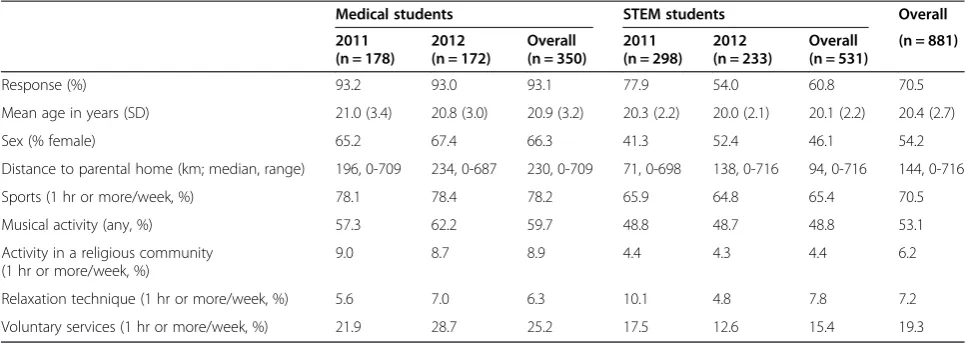
In 2011 and 2012, 351 medical students and 540 STEM students were recruited to participate in our study. Data from 350 medical students and 531 STEM students were in-cluded in the statistical analyses. After exclusion of incom-plete data-sets, the response rates were 93.0% for medical students and 60.8% for STEM students. The average age of the study participants at baseline was 20.43 ± 2.65 years with a range of 16 to 41. The majority of the medical stu-dents (66.3%; whole student population: 65.8%) and 46.1% of the STEM students (whole student population: 41,1%) were female. Compared to STEM students, a higher percentage of medical students exercised regularly (78.2% vs 65.4%) or engaged in musical acticity (59.7% vs 48.8%). Only a few were engaged in a religious community or practiced a relaxation technique regularly.
Further demographic data are shown in Table 1.
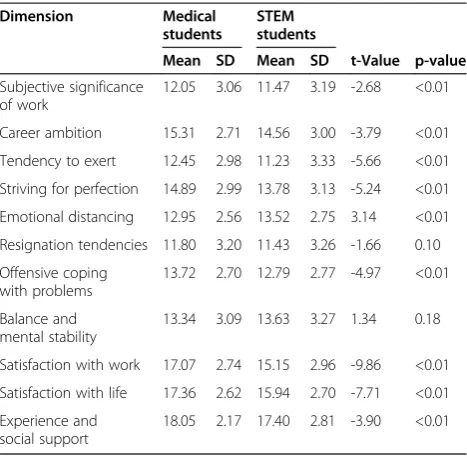
Dimensions of study-related behaviour and experience Table 2 shows the sum-scores in the dimensions of study-related behaviour and experience of the medical students compared to the STEM students at baseline.
Table 1 Characteristics of the study participants at baseline
Medical students STEM students Overall
2011 (n = 178)
2012 (n = 172)
Overall (n = 350)
2011 (n = 298)
2012 (n = 233)
Overall (n = 531)
(n = 881)
Response (%) 93.2 93.0 93.1 77.9 54.0 60.8 70.5
Mean age in years (SD) 21.0 (3.4) 20.8 (3.0) 20.9 (3.2) 20.3 (2.2) 20.0 (2.1) 20.1 (2.2) 20.4 (2.7)
Sex (% female) 65.2 67.4 66.3 41.3 52.4 46.1 54.2
Distance to parental home (km; median, range) 196, 0-709 234, 0-687 230, 0-709 71, 0-698 138, 0-716 94, 0-716 144, 0-716
Sports (1 hr or more/week, %) 78.1 78.4 78.2 65.9 64.8 65.4 70.5
Musical activity (any, %) 57.3 62.2 59.7 48.8 48.7 48.8 53.1
Activity in a religious community (1 hr or more/week, %)
9.0 8.7 8.9 4.4 4.3 4.4 6.2
Relaxation technique (1 hr or more/week, %) 5.6 7.0 6.3 10.1 4.8 7.8 7.2
Medical students showed statistically significant higher sum-scores in the dimensions of subjective significance of work, career ambition, tendency to exert, striving for perfection, offensive coping with problems, satisfaction with work, satisfaction with life and experience of social support. STEM students, in contrast, showed statistically significant higher sum-scores in the dimension of emo-tional distancing. We observed no statistically signifi-cant difference between the two groups regarding the dimensions of resignation tendency and balance and mental stability.
Personality traits
Mean values for the five personality traits are shown in Table 3. Medical students scored significantly higher than STEM students in all but one dimension of personality: extraversion, openness to experience, conscientiousness and agreeableness. The mean scores in the NEO-FFI
dimension of neuroticism did not differ significantly between the two groups.
General and mental health
Self-rated general health was slightly, but significantly, different between STEM and medical students. Medical students rated their general health better (1.73 ± 0.64) than STEM students (1.98 ± 0.76) (p < 0.01; Cohen’s d -0.36). 90.9% of the medical and 79.7% of the STEM students were in good general health (as defined above) before the beginning of the courses (p < 0.01).
When compared to STEM students, a significantly higher proportion of medical students was free of clinically-relevant depression (as defined above) (96.6% vs 92.2%; p = 0.02). The proportions for absence of clinically-relevant anxiety (as defined above) didn’t differ significantly between medical and STEM students (89.7% vs 90.0%; p = 0.91).
A higher proportion of the medical students (88.3% vs 86.3% of the STEM students) was in good mental health (as defined above) at baseline (p = 0.41).
The correlation between general and mental health was weak, but statistically significant (Spearman’s rho 0.19, p < 0.01).
Predictors of general and mental health
For the general health of medical students, logistic regres-sion revealed that a higher level of satisfaction with life, as well as a lower level of career ambition and physical activ-ity of 1 hour or more per week were statistically significant predictors. Age was also a significant predictor for general health, whereas gender and mental health had no statisti-cally significant effect (Table 4).
For the general health of STEM students, logistic re-gression revealed that a lower level of neuroticism and a higher level of satisfaction with life were statistically significant predictors. Age, gender and mental health had no statistically significant effect, with a similar odds Table 2 Dimensions of study-related behaviour and
experience patterns at baseline
Dimension Medical
students
STEM students
Mean SD Mean SD t-Value p-value
Subjective significance of work
12.05 3.06 11.47 3.19 -2.68 <0.01
Career ambition 15.31 2.71 14.56 3.00 -3.79 <0.01
Tendency to exert 12.45 2.98 11.23 3.33 -5.66 <0.01
Striving for perfection 14.89 2.99 13.78 3.13 -5.24 <0.01
Emotional distancing 12.95 2.56 13.52 2.75 3.14 <0.01
Resignation tendencies 11.80 3.20 11.43 3.26 -1.66 0.10
Offensive coping with problems
13.72 2.70 12.79 2.77 -4.97 <0.01
Balance and mental stability
13.34 3.09 13.63 3.27 1.34 0.18
Satisfaction with work 17.07 2.74 15.15 2.96 -9.86 <0.01
Satisfaction with life 17.36 2.62 15.94 2.70 -7.71 <0.01
Experience and social support
18.05 2.17 17.40 2.81 -3.90 <0.01
Table 3 Personality traits of medical and STEM students
Trait Medical
students
STEM students
Mean SD Mean SD t-value p-value
Neuroticism 18.71 7.65 19.76 7.42 2.01 0.04
Extraversion 30.63 6.14 28.10 6.69 -5.67 <0.01
Openness to experience 32.15 6.13 30.79 6.05 -3.25 <0.01
Agreeableness 34.37 5.47 32.31 5.78 -5.28 <0.01
Conscientiousness 33.85 5.63 30.97 6.73 -6.85 <0.01
Table 4 Predictors of general health–medical students
Predictor Range Odds ratio 95% CI p-value
Age 17-41 1.12 1.01-1.28 0.03
Gender 0 male 0.78 0.33-1.84 0.57
1 female
Mental health 0 no distress 1.13 0.36-3.56 0.83
1 distress
Satisfaction with life 0-16 0.75 0.64-0.87 <0.01
Career ambition 0-16 1.33 1.13-1.56 <0.01
Physical activity 0 less than one hour per week
0.34 0.14-0.79 0.012
1 one hour or more per week
ratio (OR; 1.10) for every one year increase in age com-pared to medical students (OR 1.12; Table 5).
For mental health of medical students, age was a statistically significant predictor. Here, lower levels of neuroticism and conscientiousness and higher levels of emotional distancing and, notably, striving for per-fection and the subjective significance of work, showed a statistically significant contribution to predict good mental health. Gender and mental health had no statis-tically significant effect (Table 6).
For the mental health of STEM students, neither age nor gender were statistically significant predictors. How-ever, the OR for every one year increse in age (1.10) was again similar compared to medical students (OR 1.15). Lower levels of neuroticism and resignation tendencies and being generally healthy were signicifantly related to good mental health in STEM students (Table 7).
Discussion
General and mental health
In the baseline survey of our longitudinal study on med-ical students’health and its predictors, we found that most medical students were in good general and mental health. Their fellow students from other, mainly science and tech-nology subjects, were in similar good mental health but less often in good general health. In both groups, students with higher levels of satisfaction with life were more likely to be in good general health. Those medical and STEM students with lower levels of neuroticism were more likely to be in good mental health.
The proportion of individuals rating their general health as good in our cohort of medical students is comparable to that in the similar age group (18-29) of a recent German general population sample [44]. In this sample, 89.1% of the female and 92.3% of the male respondents rated their health as good or very good. Medical students in our cohort matched these porportions quite well (90.7% of the male and 90.9% of the female students were in good health), whereas only 79.6% of the male and 79.9% of the female STEM students were in good general health.
The proportion of medical students free of clinically-relevant depression (96.6%) tends to be higher than
proportions derived in other studies on medical stu-dents in their first years of medical school using the same cut-off (70.7% and 94.3%) [24,45] and the propor-tion of a similar age group (18-29) of a German general population sample (90.1%) [46]. This might be due to the very early timepoint of the baseline survey before the beginning of courses and, thus, before exposure to medical-school-associated stress. Another explanation might be that young people with clinically-relevant de-pression are less likely to qualify for and to start med-ical school. The proportion of medmed-ical students free of clinically-relevant anxiety in our cohort (89.7%) lies in between scores reported in comparable studies on medical students (79.7% and 93.2%) [23,45]. The high proportions of students with clinically relevant depres-sion and anxiety scores in the study of Karaoglu et al. [45] might reflect cultural differences as it was con-ducted in Turkey.
Our results are also in accordance with the results Leahy et al. derived from a cross-sectional study com-paring medical students’ distress levels with those of students of non-medical subjects [47]. In this study, students from non-health disciplines were significantly
Table 5 Predictors of general health–STEM students
Predictor Range Odds ratio 95% CI p-value
Age 16-36 1.10 0.98-1.23 0.11
Gender 0 male 1.02 0.62-1.67 0.95
1 female
Mental health 0 no distress 1.72 0.88-3.35 0.11
1 distress
Satisfaction with life 0-16 0.88 0.79-0.97 0.01
Neuroticism 0-60 1.816 1.13-2.93 0.02
Nagelkerkes R20.14.
Table 6 Predictors of mental health–medical students
Predictor Range Odds ratio 95% CI p-value
Age 17-41 1.15 1.02-1.30 0.02
Gender 0 male 2.80 0.97-8.12 0.06
1 female
General health 0 1.33 0.32-5.59 0.70
1 good/ very good
Subjective significance of work
0.16 0.83 0.69-1.00 0.05
Striving for perfection 0-16 0.75 0.60-0.94 0.01
Emotional distancing 0-16 0.56 0.42-0.74 <0.01
Neuroticism 0-60 12.35 4.93-30.92 <0.01
Conscientiousness 0-60 3.32 1.05-10.52 0.04
Nagelkerkes R2
0.50.
Table 7 Predictors of mental health–STEM students
Predictor Range Odds ratio 95% CI p-value
Age 16-36 1.10 0.95-1.27 0.22
Gender 0 male 1.01 0.53-1.94 0.97
1 female
General health 0 0.40 0.20-0.80 0.01
1 good/ very good
Resignation tendencies
0-16 1.27 1.13-1.43 <0.01
Neuroticism 0-60 5.56 2.91-10.7 <0.01
more distressed than students from health disciplines and 11% had overall been treated for a mental health problem, compared to 12% (medical students) and 14% (STEM students) showing clinically-relevant anxiety and/or depression (as defined above) in our study.
Study-related behaviour and experience
When compared to the STEM students in our cohort and German early-year medical students surveyed in other studies [30,31], students in our cohort showed consistently higher sum-scores for the dimensions that form the domains of professional commitment and emotional well-being. With the exception of“offensive coping with problems”, they showed lower to equal sum-scores in the dimensions that form the domain of resistance towards stress. As neither the STEM stu-dents in our cohort nor the medical stustu-dents in the other studies were surveyed before the beginning of any relevant courses (see “Strengths and limitations”), this difference might again be related to the timepoint of the baseline survey, indicating that resistance towards stress is a trait which can be considered as “improving” while being exposed to stress.
Personality traits
Consistent with earlier results on personality traits in medical students [48,49], we found low scores for neur-oticism and high scores for agreeableness. Jerant et al. [48] described the medical students in their sample as having higher levels of conscientiousness and agreeableness, similar levels of openness to experience and extraversion and lower levels of neuroticism, when compared to a general population sample. This is consistent with our results in comparison to a general population sample from German-speaking countries [50]. As Jerant et al. conclude, high levels of conscientiousness and agreeableness might be expected in medical students. The observed low neur-oticism scores might also reflect some social desirability in the responses, as Jerant et al. propose.
Predictors of general and mental health
Consistent with earlier research [5,51], lower neuroticism scores predicted better mental health in both groups of students. In a study by Tyssen et al. [52] of Norwegian medical students (n = 421), neuroticism was an independ-ent predictor of perceived stress. Hochwälder [53] reports that low neuroticism scores were correlated with low scores of emotional exhaustion in nurses (n = 659).
With regard to the focus of our work on health pro-motion, it was important to see that regular physical activity was a significant predictor for general health, at least in medical students. The beneficial effects of physical activiy on health and well-being have been re-ported extensively [54,55]. Especially if follow-up results
reveal a health-promoting effect of regular physical activity, leaving space in the curriculum for regular physical activity for students from the beginning of their courses onwards could be a promising, albeit difficult to enforce, health-promoting intervention [38].
Despite a growing body of literature that has also shown the positive effects of regular exercise on men-tal health [56,57], we were not able to show such an ef-fect in our regression analyses. This is consistent with the findings of Buchmann et al. [58] who reported that depression and anxiety were not correlated to exercise in Freshmen medical students. Instead, we found that lower levels of resignation tendencies and higher levels of emotional distancing were correlated to being mentally healthy in medical students. The ability to distance oneself from work has been described as an important factor to avoid workaholism and burnout [59].
Surprisingly, a higher level of striving for perfection was also a predictor of being mentally healthy in med-ical students. This is in contrast to a number of studies that describe perfectionism as a major influence for medical students’ or physicians’stress and burnout [60], and which interpret a relative decrease in the course of study as a sign of a healthy adaptation [30]. On the other hand, Enns et al. [36] discern between an adaptive and a maladaptive form of perfectionism and report that only the latter was associated with higher levels of depression in a sample of first to third year medical students. Likewise, perfectionism as imposed by others and not by oneself was found to cause negative mental health effects [61]. Fry [62] even described perfectionism together with optimism and humour as positive moderators of the impact of daily hassles on self-esteem and burnout in female executives. However, none of these studies ex-amined the association between striving for perfection and mental health as early in the students’course as ours did. It will therefore be of interest as to how perfectionism will develop and how it will predict mental health during the course of our study.
Strengths and limitations
The major strength of this study is its longitudinal design and the high number of participants, this latter due to a high response rate, especially among medical students. We will be following a cohort of medical students (two consecutive classes) throughout their entire study period.
The annual presentation of results to the cohort may have an influence on the subsequent surveys, but we con-sider them an indispensable measure to keep participants motivated to respond to the yearly surveys.
One limitation of our study is the lower than expected initial response rate among the STEM students. Due to the fact that we conducted the baseline survey in the pre-course week, which mainly consists of Mathematics lectures, we may have missed those students feeling well enough prepared in Mathematics to skip this course. Despite the fact that we conducted two subsequent base-line data collection waves in the first week of courses, this may be a potential source of bias, as these students could have estimated themselves healthier than those feeling the need to take this course in order to pass the exams. Also, a higher share of female STEM students participated in our study, when compared to the whole student population. As gender did not predict any of the health outcomes in STEM students, the risk of bias result-ing from this is probably low.
The response rate of over 90% among the medical students makes any selection bias very unlikely. In con-trast to the STEM counterpart, the medical students’ pre-course week doesn’t contain any subject matter rele-vant for examinations, which may have led to a different answering behaviour.
Implications for research and practice
The high percentages of medical students in good self-rated general and/or mental health at the beginning of their undergraduate education and the knowledge from earlier research, indicate that the health of these stu-dents is likely to decline throughout medical school, highlighting the urgent need for health-promoting and preventive interventions at a very early point in time. The resilience of students should be fostered by, for example, teaching stress-reduction skills and promot-ing social and personal well-bepromot-ing activities. Compared to empirical studies describing medical school stress and related symptoms, there are only a few articles de-scribing health-promoting interventions, and only a small proportion of these have been evaluated using scientifically-rigorous methods [64]. Thus, further high quality evaluation studies are urgently needed. Since we found a particularly low prevalence of regular practice of a relaxation technique among the study participants at baseline, and because there is evidence that learning and practising a relaxation technique might have a positive influence on health outcomes [64,65], this might be a po-tential starting point for a health-promoting intervention.
Also, the finding of the relatively bad health of STEM subject Freshmen should be further investigated in lar-ger, multi-center trials. This group of students could require special interventions to promote their health
and well-being and keep the rate of premature drop-outs low.
Conclusions
Here we describe the rationale for our longitudinal study in medical and STEM students and report the baseline characteristics of a cohort of 881 students. At baseline, medical students rated their general health better, but there was no significant difference in mental health compared to STEM students. Medical students showed higher scores for the personality traits of extraversion, openness to ex-periences, agreeableness and conscientiousness. Regular physical activity, a good ability to distance themselves from work, low resignation tendencies and low levels of neuroticism were predictors for general and mental health. Follow-up surveys will reveal the development of general and mental health during medical school and factors predicting the maintainance of a good health status. The final results of our longitudinal study will help answer the question of what keeps future doctors healthy.
Additional file
Additional file 1:Domains and dimensions of study-related behaviour and experience and related sample questionnaire items.
Abbreviations
AVEM:Work-related behaviour and experience patterns (German: Arbeitsbezogene Verhaltens- und Erlebensmuster); CI: Confidence interval; HADS: Hospital anxiety and depression scale; STEM: Science, technology, engineering, and mathematics; NEO FFI: NEO Five-factor inventory; NEO PI-R: NEO personality inventory - revised; OR: Odds ratio; SF-36: Short Form - 36; WHO: World Health Organization.
Competing interests
The authors declare that they have no competing interests.
Authors’contributions
All authors were involved in the design of the study. TK conceived the study, participated in the collection of data, performed the statistical analysis and data interpretation and drafted the manuscript. YT participated in the collection of data, performed the statistical analysis and revised the manuscript for important intellectual content. MS critically revised the manuscript for important intellectual content and gave advice regarding statistical issues. EV participated in the collection of data, statistical analysis and data interpretation and critically revised the manuscript for important intellectual content. All authors read and approved the final manuscript.
Acknowledgements
This research was supported by a grant from the University of Lübeck (E18-2011). The authors thank Alexander Katalinic, Nora Eisemann, Sabine Stumpf, Jürgen Westermann and Sabine Voigt for their valuable help during data collection and analysis.
Author details
1Institute for Social Medicine and Epidemiology, University Medical Center Schleswig-Holstein, Campus Lübeck, Ratzeburger Allee 160, Lübeck 23562, Germany.2Department of Primary Medical Care, University Medical Center Hamburg-Eppendorf, Martinistraße 52, Hamburg 20246, Germany. 3Department of Health and Behavioural Sciences, Friedensau Adventist University, An der Ihle 19, Friedensau 39291, Germany.
References
1. Voltmer E, Rosta J, Aasland OG, Spahn C:Study-related health and behavior patterns of medical students: a longitudinal study.Med Teach 2010,32:e422–e428.
2. Guthrie E, Black D, Bagalkote H, Shaw C, Campbell M, Creed F:Psychological stress and burnout in medical students: a five-year prospective longitudinal study.J R Soc Med1998,91:237–243.
3. Kjeldstadli K, Tyssen R, Finset A, Hem E, Gude T, Gronvold NT, Ekeberg O, Vaglum P:Life satisfaction and resilience in medical school–a six-year longitudinal, nationwide and comparative study.BMC Med Educ2006,6:48.
4. Bachmann N, Berta D, Eggli P:Macht Studieren krank?.Bern: Huber; 1999. 5. McManus IC, Keeling A, Paice E:Stress, burnout and doctors’attitudes to
work are determined by personality and learning style: a twelve year longitudinal study of UK medical graduates.BMC Med2004,2:29. 6. Rosal M, Ockene I, Ockene J, Barrett S, Ma Y, Hebert J:A longitudinal study of
students’depression at one medical school.Acad Med1997,72:542–546. 7. Dyrbye LN, Thomas MR, Shanafelt TD:Medical student distress: causes,
consequences, and proposed solutions.Mayo Clin Proc2005,80:1613–1622. 8. Dyrbye LN, Thomas MR, Shanafelt TD:Systematic review of depression,
anxiety, and other indicators of psychological distress among U.S. and Canadian medical students.Acad Med2006,81:354–373.
9. Dunn LB, Iglewicz A, Moutier C:A conceptual model of medical student well-being: promoting resilience and preventing burnout.Acad Psychiatr 2008,32:44–53.
10. Doherty EM, Nugent E:Personality factors and medical training: a review of the literature.Med Educ2011,45:132–140.
11. Ahmed H, Rhydderch M, Cohen D:Prevalence of common mental health disorders in medical students: A systematic review and meta-analysis. InFrom Awareness to Action.Montreal: 2012. http://www.cma.ca/ multimedia/PhysicianHealth/ICPH/ICPH2012_PrelProg_EN.pdf. 12. Haas JS, Cook EF, Puopolo AL, Burstin HR, Cleary PD, Brennan TA:Is the
professional satisfaction of general internists associated with patient satisfaction?J Gen Intern Med2000,15:122–128.
13. DiMatteo MR, Sherbourne CD, Hays RD, Ordway L, Kravitz RL, McGlynn EA, Kaplan S, Rogers WH:Physicians’characteristics influence patients’ adherence to medical treatment: results from the Medical Outcomes Study.Health Psychol1993,12:93–102.
14. West CP, Huschka MM, Novotny PJ, Sloan JA, Kolars JC, Habermann TM, Shanafelt TD:Association of perceived medical errors with resident distress and empathy: a prospective longitudinal study.JAMA2006,296:1071–1078. 15. Williams ES, Skinner AC:Outcomes of physician job satisfaction: a
narrative review, implications, and directions for future research.Health Care Manage Rev2003,28:119–139.
16. World Health Organization:Ottawa charter for health promotion: an International Conference on Health Promotion, the move towards a new public health, 17-21 November.Geneva: World Health Organization; 1986. 17. World Health Organization:Promoting Mental Health: Concepts, Emerging evidence, Practice: A report of the World Health Organization, Department of Mental Health and Substance Abuse in collaboration with the Victorian Health Promotion Foundation and the University of Melbourne.Geneva: World Health Organization; 2005.
18. Park CL, Adler NE:Coping style as a predictor of health and well-being across the first year of medical school.Health Psychol2003,22:627–631. 19. Mosley TH Jr, Perrin SG, Neral SM, Dubbert PM, Grothues CA, Pinto BM:
Stress, coping, and well-being among third-year medical students. Acad Med1994,69:765–767.
20. Scherer M, Himmel W, Stanske B, Scherer F, Koschack J, Kochen MM, Herrmann-Lingen C:Psychological distress in primary care patients with heart failure: a longitudinal study.Br J Gen Pract2007,57:801–807. 21. World Health Organization:Health interview surveys. Towards international
harmonization.Geneva: World Health Organization; 1996.
22. DeSalvo KB, Bloser N, Reynolds K, He J, Muntner P:Mortality prediction with a single general self-rated health question. A meta-analysis.J Gen Intern Med2006,21:267–275.
23. Prinz P, Hertrich K, Hirschfelder U, de Zwaan M:Burnout, depression and depersonalisation - Psychological factors and coping strategies in dental and medical students.GMS Z Med Ausbild2012,29:Doc10.
24. Quince TA, Wood DF, Parker RA, Benson J:Prevalence and persistence of depression among undergraduate medical students: a longitudinal study at one UK medical school.BMJ Open2012,2:e001519.
25. Pickard M, Bates L, Dorian M, Greig H, Saint D:Alcohol and drug use in second-year medical students at the University of Leeds.Med Educ2000, 34:148–150.
26. Woolf K, Cave J, McManus IC, Dacre JE:“It gives you an understanding you can’t get from any book.“The relationship between medical students’ and doctors’personal illness experiences and their performance: a qualitative and quantitative study.BMC Med Educ2007,7:50. 27. Ashton CH, Kamali F:Personality, lifestyles, alcohol and drug consumption
in a sample of British medical students.Med Educ1995,29:187–192. 28. Herrmann-Lingen C, Buss U, Snaith RP:Hospital Anxiety and Depression
Scale–Deutsche Version.3rd edition. Bern: Huber; 2011.
29. Schaarschmidt U, Fischer AW:Arbeitsbezogenes Verhaltens- und Erlebensmuster AVEM.2nd edition. Frankfurt am Main: Swets Test Services; 2003.
30. Voltmer E, Kötter T, Spahn C:Perceived medical school stress and the development of behavior and experience patterns in german medical students.Med Teach2012,34:840–847.
31. Aster-Schenck I-U, Schuler M, Fischer MR, Neuderth S:Psychosocial resources and burnout risk factors in medical school: A cross-sectional study and analyses of need for preventive curricular interventions. GMS Z Med Ausbild2010,27:Doc61.
32. Turiano NA, Pitzer L, Armour C, Karlamangla A, Ryff CD, Mroczek DK: Personality trait level and change as predictors of health outcomes: findings from a national study of Americans (MIDUS).J Gerontol B Psychol Sci Soc Sci2012,67:4–12.
33. Costa PT, McCrae RR:NEO Inventories Professional Manual: NEO-PI-3, NEO-FFI-3, NEO PI-R.Odessa, FL: Psychological Assessment Resources; 2011. 34. Lievens F, Coetsier P, De Fruyt F, De Maeseneer J:Medical students’
personality characteristics and academic performance: a five-factor model perspective.Med Educ2002,36:1050–1056.
35. Lievens F, Ones DS, Dilchert S:Personality scale validities increase throughout medical school.J Appl Psychol2009,94:1514–1535. 36. Enns MW, Cox BJ, Sareen J, Freeman P:Adaptive and maladaptive
perfectionism in medical students: a longitudinal investigation. Med Educ2001,35:1034–1042.
37. Tyson P, Wilson K, Crone D, Brailsford R, Laws K:Physical activity and mental health in a student population.J Ment Health2010,19:492–499. 38. Elliot CA, Kennedy C, Morgan G, Anderson SK, Morris D:Undergraduate
physical activity and depressive symptoms: a national study.Am J Health Behav2012,36:230–241.
39. Morris A, Do D, Gottlieb-Smith R, Ng J, Jain A, Wright S, Shochet R:Impact of a fitness intervention on medical students.South Med J2012,105:630–634. 40. Frich JC, Fugelli P:Medicine and the arts in the undergraduate medical
curriculum at the University of Oslo Faculty of Medicine, Oslo, Norway. Acad Med2003,78:1036–1038.
41. Jenkinson CE, Dickens AP, Jones K, Thompson-Coon J, Taylor RS, Rogers M, Bambra CL, Lang I, Richards SH:Is volunteering a public health interven-tion? A systematic review and meta-analysis of the health and survival of volunteers.BMC Public Health2013,13:773.
42. Vasegh S, Mohammadi M-R:Religiosity, anxiety, and depression among a sample of Iranian medical students.Int J Psychiatry Med2007,37:213–227. 43. Shapiro SL, Schwartz GE, Bonner G:Effects of mindfulness-based stress
reduction on medical and premedical students.J Behav Med1998, 21:581–599.
44. Lampert T, Kroll LE, von der Lippe E, Müters S:Stolzenberg H [Socioeconomic status and health: results of the German health interview and examination survey for adults (DEGS1)].Bundesgesundheitsbla2013,56:814–821. 45. Karaoglu N, Seker M:Anxiety and depression in medical students related
to desire for and expectations from a medical career.West Indian Med J 2010,59:196–202.
46. Busch MA, Maske UE, Ryl L, Schlack R:Hapke U [Prevalence of depressive symptoms and diagnosed depression among adults in Germany: results of the German health interview and examination survey for adults (DEGS1)].Bundesgesundheitsbla2013,56:733–739.
47. Leahy CM, Peterson RF, Wilson IG, Newbury JW, Tonkin AL, Turnbull D: Distress levels and self-reported treatment rates for medicine, law, psychology and mechanical engineering tertiary students: cross-sectional study.Aust N Z J Psychiatr2010,44:608–615.
49. Plaisant O, Courtois R, Toussaint PJ, Mendelsohn GA, John OP, Delmas V, Moxham BJ:Medical students’attitudes toward the anatomy dissection room in relation to personality.Anat Sci Educ2011,4:305–310.
50. Borkenau P, Ostendorf F:NEO-Fünf-Faktoren-Inventar.2nd edition. Göttingen: Hogrefe; 2008.
51. Friedman HS, Kern ML, Reynolds CA:Personality and health, subjective well-being, and longevity.J Pers2010,78:179–216.
52. Tyssen R, Dolatowski FC, Røvik JO, Thorkildsen RF, Ekeberg O, Hem E, Gude T, Grønvold NT, Vaglum P:Personality traits and types predict medical school stress: a six-year longitudinal and nationwide study.Med Educ 2007,41:781–787.
53. Hochwälder J:Burnout among Torgersen’s eight personality types. Soc Behav Personal2009,37:467–479.
54. Samitz G, Egger M, Zwahlen M:Domains of physical activity and all-cause mortality: systematic review and dose-response meta-analysis of cohort studies.Int J Epidemiol2011,40:1382–1400.
55. Lotan M, Merrick J, Carmeli E:A review of physical activity and well-being. Int J Adolesc Med Health2005,17:23–31.
56. Ströhle A:Physical activity, exercise, depression and anxiety disorders. J Neural Transm2009,116:777–784.
57. Dunn AL, Jewell JS:The effect of exercise on mental health.Curr Sports Med Rep2010,9:202–207.
58. Buchman BP, Sallis JF, Criqui MH, Dimsdale JE, Kaplan RM:Physical activity, physical fitness, and psychological characteristics of medical students. J Psychosom Res1991,35:197–208.
59. Sonnentag S, Binnewies C, Mojza EJ:“Did you have a nice evening?“ A day-level study on recovery experiences, sleep, and affect.J Appl Psychol2008,93:674–684.
60. Grosch WN, Olsen DC:Clergy burnout: an integrative approach.J Clin Psychol2000,56:619–632.
61. Henning K, Ey S, Shaw D:Perfectionism, the imposter phenomenon and psychological adjustment in medical, dental, nursing and pharmacy students.Med Educ1998,32:456–464.
62. Fry PS:Perfectionism, humor, and optimism as moderators of health outcomes and determinants of coping styles of women executives. Genet Soc Gen Psychol Monogr1995,121:211–245.
63. German Federal Statistical Office:Destatis - Website of the German Federal Statistical Office.http://www.destatis.de/.
64. Shapiro SL, Shapiro DE, Schwartz GE:Stress management in medical education: a review of the literature.Acad Med2000,75:748–759. 65. Shiralkar MT, Harris TB, Eddins-Folensbee FF, Coverdale JH:A systematic
review of stress-management programs for medical students.Acad Psychiatr 2013,37:158–164.
doi:10.1186/1472-6920-14-134
Cite this article as:Kötteret al.:Health-promoting factors in medical students and students of science, technology, engineering, and mathematics: design and baseline results of a comparative longitudinal study.BMC Medical Education201414:134.
Submit your next manuscript to BioMed Central and take full advantage of:
• Convenient online submission
• Thorough peer review
• No space constraints or color figure charges
• Immediate publication on acceptance
• Inclusion in PubMed, CAS, Scopus and Google Scholar
• Research which is freely available for redistribution