Corresponding Author: Ramos P Pasaribu, Christian University of Indonesia, Mayjen Sutoyo Street No.2, Jakarta. [email protected].
6
Journal of Social Science and Humanities, 2 (2): 06-14, 2019 e-ISSN: 2600 - 9056
© RMP Publications, 2019 DOI: 10.26666/rmp.jssh.2019.2.2
Relationship Between the Activity and Function in Production
“Open Pedestrian-Friendly Façade” in the Kampung Around the Campus in Jakarta
Ramos P Pasaribu
1, Uras Siahaan
2, Rumiati R Tobing
31,2,3 Parahyangan Catholic University, Architecture Department, Bandung, Indonesia 1,2 Christian University of Indonesia, Jakarta, Indonesia
Abstract:One interesting phenomenon found in Indonesia to date is “living and growing alongside a town with the characteristic features of a village is but the face of other’s” [1], such as the kampung (an urban village) which coexists with college institutions.The activities of college students pouring in the villages, mostly consisting of fulfilling their daily needs (meals, lodging house, etc.), results in a reproduction of social interaction space (public area) of the village’s trading activities. Physical changes also occur on the groundfloor of buildings which are made into various business activities while the upper floors into lodgings, eventually shaping an open façade. Research was carried out in the kampung around the campus of Bina Nusantara University, Syahdan, Jakarta as a kampung of 9 villages in Jakarta that met the criteria as the location of the object of study cases [see [2]].The research method used in the research is qualitative research method. Results of the research find that, based on the condition of public visual view space on a public area reproduced in Haji Senin road was found three types of “Open Pedestrian-Friendly Façade”, among others 1.direct open facade, 2.transparent open facade, 3.partly open facade (a combination of direct open facade and transparent open facade) which produced from the relation between the activities and the building function along Haji Senin road.
Keywords:Activity, Function, “Open Pedestrian-Friendly Facades” INTRODUCTION
An interesting phenomenon found in Indonesia to date is “living and growing alongside a town with the characteristic features of a urban village is but the face of other’s” [1]. As an example of what occurs in Jakarta where there are higher education institutions coexisting with the kampung surrounding them with mutual needs [3], as shown in figure 1.
Figure 1. Kampung Kemanggisan around campus of Binus, Syahdan, Jakarta. Source : Goggle earth.
Activities of the college students pouring into the kampung result in a phenomenon where the said activities, mostly done to fulfill their daily needs such as their meals and their lodgings, take place. Result of a study shows that the percentage of college students living in the kampung reached 51% of the total population of the village itself [4].
As the activities keep going on over time, villagers took the initiative to turn their residences into business/rentable lodging for college students, and an understanding of environment can be categorized into four types : physical environment, culture social environment, psychological environment, and dimension of time and therefore a physical spatial change in the kampung is explored through economic aspect, social aspect and cultural aspect [5].
7 A change in social interaction between the locals and non-locals becomes a social interaction between customers and sellers. This is what dominates the social interaction in the kampung, making it mostly consists of visual communication between passersby (public) and the activities take place on the groundfloor/front yard of the surrounding buildings as a place for running a business (semi-public).
College students have their daily needs, and the locals/residence owners tend to indirectly fulfill their needs which creates material culture encouraging the start the culture of producing (trading), therefore house owners tend to perceive their house to be more profitable were they to rent it out as a lodging for college students. The reality of said physical change occuring may have good impact on passersby along Haji Senin Road which is the presence of a visual social interaction between passersby and the facade of buildings along the sides of Haji Senin Road in which there is a visual interaction between passersby and those who are on the balcony of flat houses (upper floors) and the place for running business on the groundfloor/front yard.
The researcher would like to to point out the relationship between the activities of the college students residing in the kampung and the spatial function on the buildings and front yard located along Haji Senin Road in forming an “Open Pedestrian-Friendly Facades” to passersby. The reality of the visually formed social interaction between passersby and the residents on the balcony of flat houses (upper floors) and at the place of business on groundfloor/front yard results in a phenomenon which is “the presence of change in social interaction space in the kampung surrounding the campus” and the issue of “the creation of an open facade formed by the relation between college students’ activities in the kampung with the function of bulding/front yard”.
The issue is important because facade as a visual element is the one observed firsthand [6]. The appearance of open facade is highly influential in a building’s openness on the environment as to creating a social interaction space and the balance of environment which is oriented toward the users of passersby-friendly scaled building with respect to [7] states that “The kampung can be said to represent the complexity of cities’ problems”.
The issue is also relevant because the social interaction space (public area) in the kampung around the campus always occured, is produced and reproduced.
Facade is a reflection of the inner layout [6], which means the appearance of function and activities influence the appearance (characteristic) of a building’s facade. We, of course, have found that the groundfloor is where communication between what’s inside and outside the building takes place [8], activities on the groundfloor is needed in a visual form of communication between the building and passersby.
From the relationship between college students activities and function of said buildings/front yard, it can be inferred that these affect the order of function of internal and external space of a building as well as influencing the appearance of a facade of a building, and forming an “Open Pedestrian-Friendly Facades” which shows balcony of flat houses and groundfloor/front yard which is visually within the reach of passersby.
The focus of the issue is on the buildings along Haji Senin Road which possess a building function on the upper floors as a rentable and groundfloor as small scale shop/store.
Several authors have written about kampung around the campus [see [2,3,9,10,11,12]]. Novelty in the research is by approach the theory of social space production (Lefebvre) was found a reproduction of a new social interaction, and wherein the three types of “Open Pedestrian-Friendly Facades” were produced in along Haji Senin road.
The research question in this research are :
1) How can the relationship between students’ activities and function of buildings form the appearance of “Open Pedestrian-Friendly Facades” along Haji Senin Road ?
2) How is the tendency of the relationship between students’ activities and function of buildings in producing public visual view space displayed in “Open Pedestrian-Friendly Facades” along Haji Senin Road ?
3) How are the kinds of “Open Pedestrian-Friendly Facades” formed by students’ activities and function of buildings along Haji Senin Road ?
METHODS
This research was conducted with a qualitative research method (a type of descriptive research and case study) especially in expressing production/reproduction of a new social interaction space in the kampung surrounding the campus supported by social space production theory by Lefebvre.
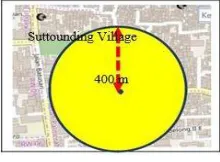
As shown in figure 6, research radius of 400 m range from the campus by considering college students’ fatigue range.
Figure 6. Range of research radius.
8 perspectives on these cases [13]. In this research, the maximum variation type with the goal of documenting diversity of the object of research (places) along Haji Senin Road based on specific criteria that is the buildings have the function to : provide lodgings (upper floor) and a place running a business (groundfloor/front yard).
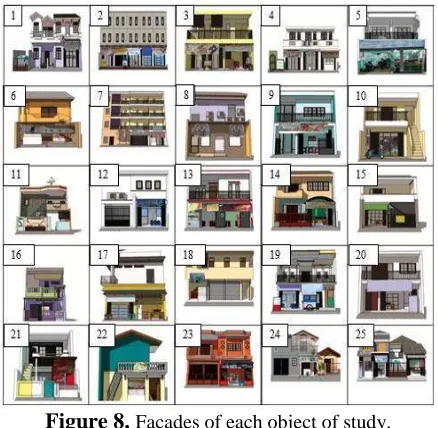
Based on said criteria, of 63 houses along Haji Senin Street, there are 25 houses where the upper floors serve as rentable lodgings and the groundfloor as a place for running business. These 25 houses as shown in figure 7, 8 is made as the sample of the research,
Figure 7. Location map of each object of the case study along Haji Senin street.
Figure 8. Facades of each object of study.
RESEARCH and DISCUSSION Reproduction of Social Interaction Space
As shown in figure 9, The relationship between the two variables is found derived on the process relationships between college student’s activities and function of building.
Firstly, From the relationship between the College campus and the kampung around it which results in the college students’ activities pouring into the kampung to for food, kosks, etc (college students’ need).
Secondly, College students’ activities in their daily needs and the function of building where the locals
change the landuse in the kampung, the function of building of their landuse from the simple house into the middle house, and their property to turn the upper floors into kosks and the ground floor as place of business (foods,laundry etc.)
Overall, The relationship can be described as follows :
Figure 9. The relationship between function and activities in reproduction of social interaction space.
The reproduction of social interaction space analysis based the production of social interaction space (Lefebvre). In the production of social space (Henri Lefebvre) offers a triadic concept in the production of social space. In whole or in whole, the way the triadic concept works can be seen like the figure 10.
Figure 10. Triadic concept of production of space. A triadic concept (Lefebvre) of "social space production" as stated by Knox [14] that “Material spatial practices refer to the interactions and physical flows that occurs in and across space as part of fundamental processes of economic production and social reproduction, Representation of Space include all of the signs, symbols, codifications, and knowledge that allow material spatial practices to be talked about and understood, Space of Representation are mental constructs such as utopian plans, imaginary landscapes, paintings and symbolic structures that represent new meanings or possibilities for spatial practices”.
9 Figure 11. Condition of the kampung surrounding Binus University in 1985 (dominated by unused land), b. Map zonation of kampung Kemanggisan around Binus University in 2015 (as function of R4/housing or medium), c. Condition of representation of space by houseowners in 2018 as mixed function.
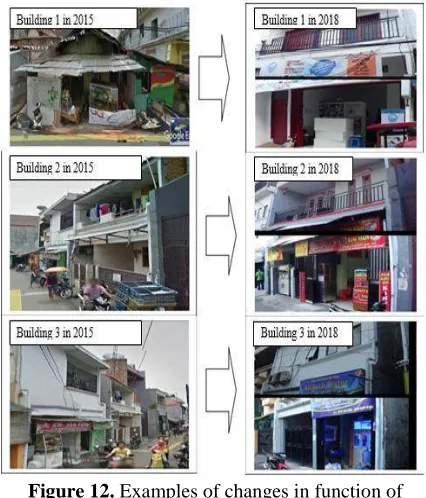
Figure 12. Examples of changes in function of buildings along Haji Senin Street.
Source : Google earth and field documentation. As a representation of space in the perception of house owners (social reality) which can be seen based on representation space of physical reality where there is a change in the building function/front yard, it can be inferred that house owners’ perception tend to be dominated by the thought of making it more profitable for them to turn their houses into a rentable lodging and a place for running business.
The dominant activities on Haji Senin road are renting out lodgings and restaurant/food stalls. Of the dominant function of buildings along Haji Senin road are found: 8 houses for lodging and laundry, 15 houses for lodging and restaurant, 7 houses for lodging and food stalls, 2 houses for lodging and copy center.
Other functions which do not dominate the activities on Haji Senin road amounting to 24.75 % are: 6 equipment stores, 1clock repair shop, 2 mobile credit retail shop.
Open Pedestrian-Friendly Facades
“Pedestrian-Friendly Facades” is an open/transparent facade. Visual permeability reffers to transparency [15]. being friendly to the environment [6]. a good human scale [8], the private interior is part of the visual field of the passing pedestrian [16]. "Open Pedestrian-Friendly Facades" is a facade where between pedestrians and inner space can meet directly without transparent media, that has indicators; permeable, active, social.
Permeable, gives an opportunity to apply social interaction activities. Active, provide opportunities for visual communication between business activities on the ground floor, balcony with pedestrians. Social, openness in displaying public visual view space and visually the business space can be enjoyed directly by pedestrians/public.
Due to the pattern of building function planning along Haji Senin road being dominated by upper floors used as flat house and groundfloor/front yard as business, a public visual view space (semi-public area of the groundfloor/frontyard as business and the balcony on the upper floors) is created in the facade which is visually reachable by passersby.
From the social reality of trading activity which forms physical reality of buildings used for flat house and business was discover to consist : 3 internet cafes (12 %), 1 educational reading (4 %), 1 gym (4%), 1 mineral water refill depot (4 %), 2 bookstores (8 %).
As shown in figure 10, It can be seen that function of buildings along Haji Senin road changed from settlement to a commercial or trading activity. This can be proven from field discovery that the plan of land function dominated by the village in 1985 (which was relatively dominated by unused land). From when Binus University was established in 1985 until today, the land changed to settlement function, and then based on representation of space by house owners to the houses and environment changed again to a mixed function or “settlement and business function”.
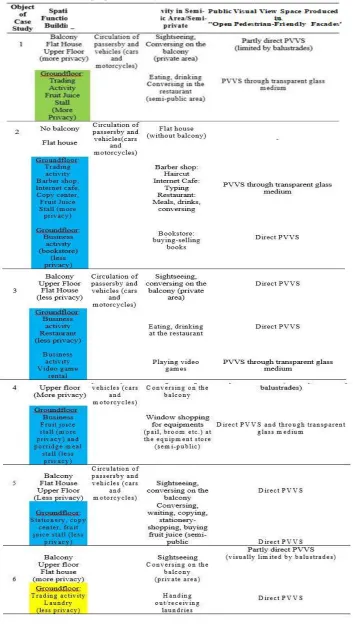
As shown in figure 8 and table 1, in each facade, it the relationship between college students’ daily activities in the Kampung and the function of buildings on 25 objects of research along Haji Senin Road to produce the “Open Pedestrian-Friendly Facades”.
10
Table 1. Relationship between function and activity in the production “open pedestrian-friendly facades” activity proper, activity by choice, mix activity.
13 CONCLUTION
By approach the theory of social space production (Lefebvre), was found a reproduction of a new social interaction, and wherein the three types of “Open Pedestrian-Friendly Facades” were produced in along Haji Senin road.
The appearance of “Open Pedestrian-Friendly Facade” shows the visual relationship between activities that take place on the groundfloor of buildings/front yard with passersby, as well as visual relationship between activities on the upper floors (balcony of the flat houses) with passersby.
The appearance of functions of buildings/front yard along Haji Senin road is influenced by social activity which include a broad spectrum of various activities (through a passive visual and audio means, watching people and what is happening) and an active social activity (people who are talking directly) which is needed by college students in flat houses, food store, laundry etc.
As shown in figure 13, 14 15, there are 3 types of facade was found along Haji Senin road :
1) 1st type : “Open Pedestrian-Friendly Façades” showing direct open façade with less privacy.
2) 2nd type : “Open Pedestrian-Friendly Facades” showing transparent open façade with more privacy.
3) 3nd type : “Open Pedestrian-Friendly Facades” showing partly open facade (a combination of direct open facade and transparent open facade) with mixed privacy.
Figure 13. 1st type : “Open Pedestrian-Friendly Façades” showing direct open façade with less privacy.
Figure 14. 2nd type : “Open Pedestrian-Friendly Facades” showing transparent open façade with more privacy.
Figure 15. 3nd type : “Open Pedestrian-Friendly Facades” showing partly open facade (a combination of direct open facade and transparent open facade) with mixed privacy.
References
[1]
Budihardjo, E. 1992. Sejumlah Masalah Pemukiman Kota. Bandung: Alumni.[2]
Pasaribu, R.P. 2017. Commodities space for social interaction space in the kampung around campuses at Jakarta. Journal of Architecture and ENVIRONMENT. 16. 113-132.[3]
Ala, I., Gunawan J., Ren ZD. 2012. Super Kampung. Jakarta : Jurusan Arsitektur Untar.[4]
Mulyana, E. 2016. “Karakteristik kampung-kota di sekitar perguruan tinggi”. Thesis. Bandung: Program Studi Perencanaan Wilayah dan Kota-SAPPK. Institut Teknologi Bandung.[5]
Sabaruddin, A. 2016. Permukiman Berkelanjutan. Telaah Psikologi Sosial. Jakarta: Erlangga.[6]
Sastra, M.S. 2013. Inspirasi Fasade Rumah Tinggal. Yogyakarta: Andi.[7]
Peraturan Menteri Pekerjaan Umum. 2006 Peraturan Menteri Pekerjaan Umum No.6/PRT/M/2007. Jakarta : Dinas Perumahan Provinsi DKI.[8]
Gehl, J. 2010. Cities for People. London: Island Press.[9]
Hapsari, M.D., Pradoto, W. 2013. Perkembangan permukiman di sekitar lingkungan kampus Undip Tembalang. Jurnal Pembangunan Wilayah & Kota. 9. 404-415.[10]
Pasaribu, R.P. 2018. Re/produksi ruang interaksi sosial berbasis kegiatan perdagangan dalam kampung kota di sekitar kampus. Jurnal AGORA.16 52-59.14 road in Bandung. Journa of Language and Literature. 4 (2). 101-105.